

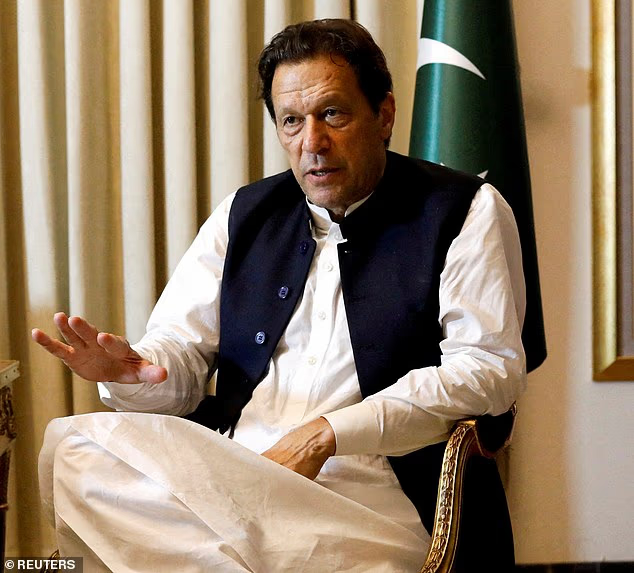
In a small, dank, insect-infested cell in a Pakistani jail, a 73-year-old man is waiting to die. He is kept in solitary confinement for days on end. He cannot exercise properly, since the room measures only 6ft by 8ft, including the latrine.
There is no window, and sometimes the lights are switched off so he sits in blackness for days on end, waiting to be able to see again. For long periods he is given no access to books or newspapers, let alone visitors, with the result that he feels increasingly divorced from the outside world, and in fear of his mental stability.
It is now more than three years since he has been incarcerated in these conditions, enduring extreme heat in the summer and bitter cold in the winter. After shoddy and delayed medical treatment, he has lost 85 per cent of the sight in his right eye.
The conditions in which he is being kept have now been condemned three times, in the past two years, by the UN special rapporteur on torture. Amnesty International has voiced its concern, and – perhaps most importantly – so has the Supreme Court in Pakistan, which has ruled that the prisoner is being denied access to proper medical care.
He is, of course, Imran Khan, the former prime minister from 2018 to 2022, and his suffering is now becoming a global scandal. Since leaving office he has been subjected to a barrage of politically motivated cases, designed to eradicate him permanently from public life.
These charges have been so blatantly without merit that they have mostly collapsed – all except one: an accusation that Imran Khan’s government steered some UK government cash towards a certain property developer, who then made a handsome donation to a university that had connections to Imran and his wife.
Even if these accusations were true in every particular – and Imran Khan is appealing his conviction – the Pakistani prosecutors have conceded that neither he nor his wife stood to benefit financially from the university donation.
Even if it is true that Imran has some sort of case to answer in the so-called Al-Qadir case (and it is far from clear to me that he does), he has done nothing to deserve the kind of mental and physical torture he is getting. Above all, he deserves to have his appeal heard speedily and by an independent court.
It has been more than three years since Imran Khan, the former prime minister of Pakistan, was incarcerated in a tiny jail cell

Supporters welcome politician Sohail Afridi in Hyderabad, Pakistan, this month ahead of a planned protest demanding the release of the Tehreek-e-Insaf party’s founder Imran Khan
Instead he is being left literally to rot to death in jail. That is because this case was never about corruption, since he has been in fact one of the most open and transparent Pakistani politicians of modern times.
This case – like all of the lawfare he has faced since leaving office – has been driven by the desire of the Pakistani military to get him off the scene. His mistake was to take democracy seriously, and to try to use his prerogatives as the elected representative of the people of Pakistan.
Under the constitution, he had the right to appoint the head of the military – but when he wished to exercise his discretion, in favour of his preferred candidate, it turned out that the generals had other ideas.
Imran Khan tried to change the way Pakistan works, and paid a price. That is essentially why he is in jail.
I should declare that I of course know Imran, and like him. He did some good things as prime minister of Pakistan – or tried to. He had great ideas on forestry and the environment. He understood the cardinal importance in that country of female literacy.
Ask yourself why Pakistan is one of the few countries in the world with continued vast and unsustainable population growth – and the answer is obvious in the literacy figures. Apart from Afghanistan, Pakistan has just about the worst record in the entire world, with about 50 per cent of women still unable to read and write.
Imran understood that this was a disaster for his country, and tried to turn it round, with bonus payments designed to encourage girls to stay in school. He perhaps didn’t make as much progress as he would have liked – but that was mainly the fault of Covid, which kept everyone out of school, boys and girls alike.
He certainly wasn’t right about everything. I remember calling Imran the day after Putin’s invasion of Ukraine, and finding that he was far from totally solid in his condemnation of Moscow; but then you could say the same, I am afraid, of some other notable friends and allies of the UK.
Nor was he 100 per cent sound on the Taliban; but then it is a longstanding policy of the Pakistani government to support anyone in Kabul, no matter how ghastly and fundamentalist, provided they are not aligned with India.
You can object to some of the attitudes he struck, and to his teenage anti-Americanism, but nothing he said or did can conceivably justify the brutality with which the Pakistani generals are treating the former PM: banged up in foul conditions, with deteriorating health, no date for a new trial and no apparent hope of release.
Why are they doing it? Simple: they are scared of him. Imran Khan is one of the greatest cricketing heroes Pakistan – or the world – has ever produced. He led his country to its first ever test victories over both India and England, and in 1992, at the age of 39, he steered Pakistan to its first World Cup victory.
What the Pakistani generals fear is that if they let him out, his millions of fans in Pakistan will simply bear him aloft to a tumultuous victory in the next available election. That is why they are treating him with such cruelty – refusing even to allow his two sons, Sulaiman and Kasim, to have visas to visit him in jail.
The continued jailing of Imran Khan is a pathetic and unnecessary act of cowardice by Pakistan; and the UK government has been correspondingly abject in its protests.

What the Pakistani generals fear is that if they let Khan out, his millions of fans in Pakistan will simply bear him aloft to a tumultuous victory in the next election, writes Boris Johnson
These two Khan boys have British passports. Imran Khan was himself educated at Royal Grammar School Worcester, read PPE at Keble and captained the Oxford Blues team before playing for Worcestershire and Surrey. He has millions of fans in this country, to say nothing of Pakistan, and yet the Foreign Office has barely raised a peep on his behalf.
Britain has longstanding, deep and in many cases familial ties with Pakistan. After three years of watching Imran in torment, it is time for us to stop pussy-footing around, use our leverage and call for his release.
The Pakistani generals, led by Asim Munir, are riding high. Field Marshal Munir has been the go-to man in the Iran negotiations. He is admired in the White House.
The Field Marshal has nothing to fear from a 73-year-old man in poor health, and it would be the obvious and humane thing to let Imran out, and if necessary keep him under house arrest pending his appeal.
That, above all, would be in line with Pakistan’s own Supreme Court ruling.
At the moment I am afraid that it looks as though the Pakistanis are actively hoping that he will die in jail. That would be a serious stain on the country’s reputation.
Unlock that cell – and free Imran Khan.















































You must be logged in to post a comment Login