It was 2am when the phone rang and Fiona saw her 18-year-old daughter Zoe’s name flash up on her phone screen. Any trace of sleepiness instantly leaving her, she picked up the call to see Zoe and her new boyfriend Leo FaceTiming her from a club.
A few short months ago Fiona had been like every other mum sending her child off to university for the first time – fretting about whether she’d find friends, eat properly and cope with the coursework. But when she saw Zoe’s face, she realised she’d been worrying about the wrong thing.
‘I couldn’t really hear what she was saying, but she sounded almost manic. She was in a club with this boy. I’m not sure even now why they were calling – just to say hello, I think. It was clear they were both very worse for wear.
‘At first, I thought she was just drunk, but I’d worked in the City in the 1980s and I knew all the signs. Her pupils were huge and black, her jaw was moving strangely and she was tripping over her words. After just a few seconds, it was clear to me she was high on cocaine.’
Over the next week, around a quarter of a million parents will help excited children shop for Ikea kitchenware and pack up clothes for their first term at university. They may well know about the easy availability of drugs like cannabis and have heard of ketamine, the party drug sometimes known as Special K. But what they probably don’t know is how prevalent cocaine has become on Britain’s university campuses, and how easily accessible it is to students barely out of school.
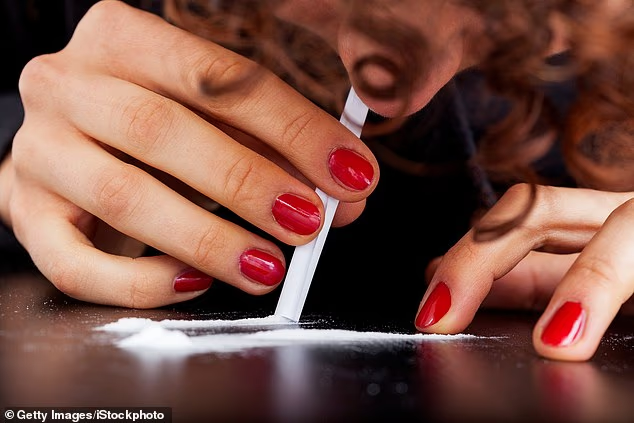
A recent study carried out by Loughborough University covering students at 54 different institutions found that almost one in four (24 per cent) had used cocaine. The drug that used to be associated with ‘loadsamoney’ City financiers, 1990s supermodels and middle-aged dinner parties has so infiltrated modern student life, its presence is almost a given on a freshers’ night out.
‘Her pupils were huge and black, her jaw was moving strangely and she was tripping over her words. After just a few seconds, it was clear to me she was high on cocaine,’ recounts Fiona
‘Cocaine has never been more readily available. It’s never been purer and it’s never been more affordable relative to everything else we purchase,’ explains Harry Sumnall, professor in substance use in the School of Psychology at Liverpool John Moores University.
Even though it’s a Class A drug that carries a prison sentence of up to seven years for possession, Sumnall says that many students no longer see cocaine as a dangerous substance.
‘For many young adults, it’s still seen as less of a drug. It affects brain and behaviour, of course, but compared to other products, ones more well known for dependence and addiction, there’s a distance from the stereotypes and stigma around drug taking,’ he explains.
It’s a perception backed by the attitude of Archie, a 20-year-old from London who’s about to start his final year at one of the country’s leading northern universities. ‘Cocaine is everywhere,’ he says. ‘We all take it when we’re out drinking. Alcohol makes you sleepy but coke wakes you up,’ says Archie. ‘It means we can stay out for longer.
‘For a lot of people in my generation who were locked away as teenagers because of Covid, meeting new people is really stressful. But cocaine makes you feel great. It gives you the confidence to chat to anyone and that helps you deal with your social anxiety.
‘It’s not that expensive really either, especially when you compare it to alcohol. A pint costs about £6 now and a cocktail can be more than £10. But for half a gram of coke you pay around £40 and that will give you around six lines – enough for a big night out between two or three friends,’ he continues.
While mum Fiona says her daughter had never been into drugs before university, Archie admits to trying cannabis and ketamine in his sixth form at school. Until he went to university, however, he barely ever saw cocaine. Now he takes it most weekends along with his college friends, and doesn’t view his level of use as a problem.
‘If I am planning a night out, I will usually try to buy some. At the time I love the way it makes me feel, although I will admit the come down is awful. I feel anxious and out of it for most of the next day, but it’s not that much worse than a hangover,’ he says.
This blasé attitude is in stark contrast to the reality.
According to private addiction and rehab specialists the Priory Group, mixing cocaine with alcohol is extremely risky. It can cause blackouts, impaired vision, vomiting and alcohol poisoning as well as feelings of aggression, anxiety and paranoia.
‘I’d noticed that Zoe seemed quite anxious. She was moodier and tired, but I’d put it down to a new environment and all the pressures of leaving home,’ explains Fiona.
Zoe had also lost weight – another common side effect of cocaine since it acts as an appetite suppressant. ‘I still feel guilty for not spotting the signs sooner,’ says Fiona.
Indeed experts warn that missing the warning signs of cocaine use can have serious consequences.
‘Even when used relatively infrequently, particularly if young people are susceptible, cocaine can have a significant impact on mental health and wellbeing,’ explains Professor Sumnall.
A 2023 study of UK students published in Brain Sciences supports this, reporting that anxiety, depression, perceived stress and insomnia were all linked to increased reports of substance use, including cocaine.
Professor Sumnall adds that every episode of drug use involves ‘risky’ choices, and often leads to impulsive behaviour that can put a young person in danger. A 2021 study of 3,520 UK university students found that cocaine was associated with not only riskier sexual practices but also more years as a student, lower grades, PTSD, ADHD and psychological or emotional problems.
But the outcome can be even worse for some people as deaths from cocaine use are on the increase, with a 14.4 per cent rise in cocaine related fatalities since 2023 across all ages, including students. In 2021, Oxford University student Daniel Mervis died from a cocaine overdose after developing an addiction during his first year, while Bristol University student Lucy White died in 2018 at the age of 24 after a line of cocaine triggered a heart attack.
Hospitalisations have also surged over the past decade, especially cocaine-related mental health admissions, which tripled over a ten-year period to 2018.
In part, it’s down to a market awash with cocaine. UN figures show that global illegal cocaine production rose by 34 per cent in a single year to a record 3,708 tonnes in 2023 – and continues to boom. It’s also 44 per cent purer in quality today than it was in 2014, according to EU data – all of which creates a lethal cocktail.
A recent study carried out by Loughborough University covering students at 54 different institutions found that almost one in four (24 per cent) had used cocaine
‘After that 2am phone call, I lay awake all night in state of blind panic,’ says Fiona. ‘I wanted to jump into the car and drive to see her, but the university is a five-hour drive away and I’m not a confident driver.’
Instead, the pair had a heart-to-heart on the phone the next day. ‘At first she was defensive and denied everything, but I kept pushing her until she broke down in tears and told me she had first tried cocaine during Freshers Week.
‘In hindsight it was obvious something wasn’t right. During her first term, she’d call home regularly. I had recently separated from her father, Mark, and she knew I was lonely in my empty nest, but as the weeks passed the calls became less frequent and typically she would only ring to ask me for money. I know how hard budgeting can be for students so I was happy to help. Now I realise I was funding her growing coke habit.’
Zoe’s drug use escalated when she started dating Leo, whose well-off middle class clique viewed cocaine as an essential part of a fun night out. Zoe didn’t ever buy the cocaine herself, but got it from Leo’s friends, they would either order it via social media like a Deliveroo for drugs, or buy it from friends of friends.
‘Not everybody who takes drugs has the confidence to get drugs,’ says Professor Sumnall. ‘They may be worried about the consequences of buying directly, but if they buy through somebody they know or a friend of a friend, that reduces the risk in their mind.’
Archie’s experience was similar. ‘At home I had smoked weed and tried ket (ketamine), but I’d never really seen cocaine until I went to university. In the student bars and clubs it’s easy to find someone to buy from.’
The SOS report found that almost half (44 per cent) of respondents believed students take drugs to fit in with their peers and 12 per cent agreed they had tried drugs because people around them were taking them and they wanted to fit in.
Zoe admitted to her mother that, as a state school girl, she had struggled to find her way at a university full of posh, private school kids.
‘That really broke my heart as I’d felt the same way among the rich City boys in the 80s and I hated the idea that Zoe had been put under the same pressure to fit in. I’d always been open about dabbling with cocaine when I was in my 20s and I’d hoped that would put Zoe off. But it seems like some things never change.
‘By the time she called me from the club she was taking cocaine multiple times every weekend. She felt low, anxious and exhausted all the time, but said the only thing that made her feel better was to take more of the drug. My heart ached for my beautiful girl – if only she could have told me sooner I could have helped her before it got so bad.
‘When Zoe came home I was tempted to make her stay at home and drop out of her course. I was terrified she would get even worse if she went back. But Zoe was determined to continue her studies. She agreed to see the student wellbeing team and ask for help. And amazingly she did. She saw them every week on campus and she could call them whenever she needed to. It was a lifeline for her get back on track.
‘But it wasn’t easy for her. I visited much more often to check on her. I think she got sick of me, but I wasn’t going to let any more danger signs pass me by. She broke up with Leo and built a much healthier friendship group who didn’t do drugs. The worst she gets up to now is a few drinks in the student bar.’
‘She’s about to start her second year now and I can finally sleep easy as I know she’s safe and is unlikely to touch drugs again, even if she had to learn her lesson the hard way,’ says Fiona.
‘It might not make me a “cool” mum to say this, but while students might not see the harm in cocaine, drugs are dangerous, particularly for young, vulnerable students away from home for the first time. Zoe was lucky nothing worse happened to her, but not everyone is.’
Fiona hopes that by sharing her story other parents will act faster when warning bells start to ring. But she recognises that it’s a hard balancing act for parents as their children move away from home. ‘I feel like such a bad mother for failing to quiz her about her behaviour changes, but I also knew I had to let go and allow her her independence. I suppose I didn’t want to be a burden to her as she was spreading her wings, but I took it too far and clearly neglected her.’
All names have been changed.































































You must be logged in to post a comment Login