

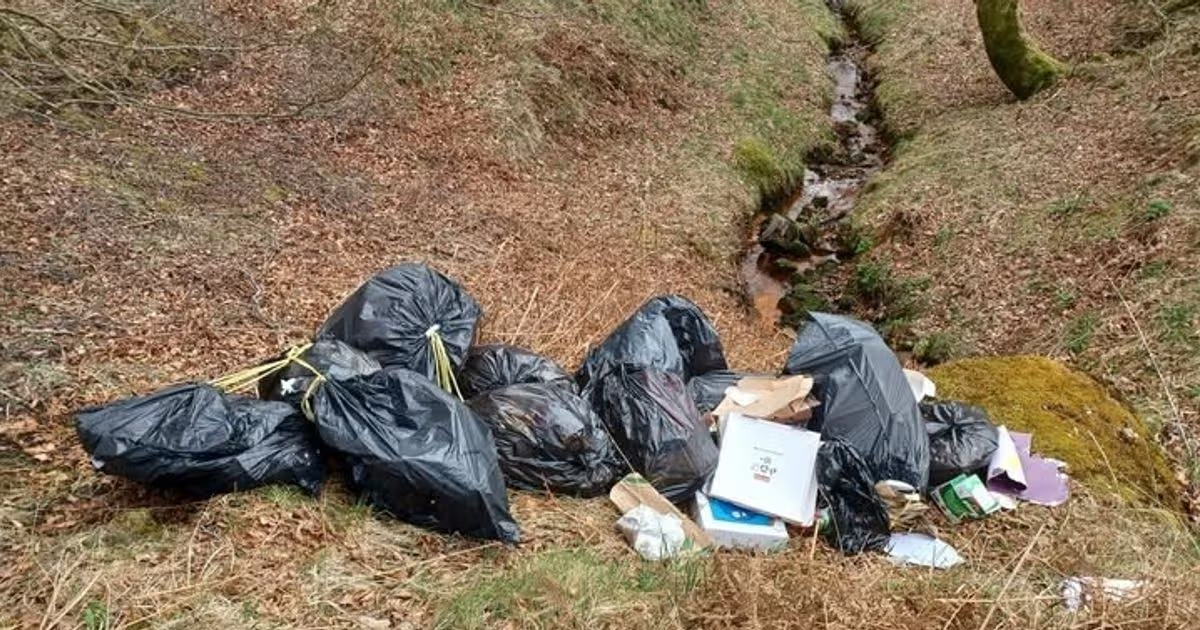
One area of Cambridgeshire saw fly-tips that cost the taxpayer £65,800 in clean-up costs
Cambridgeshire’s fly-tipping hotspots have been revealed by a new map showing the parts of England with the worst rubbish problems. In the year ending March 2025, local authorities in England dealt with 1.25 million flytipping incidents, a 9% rise on the previous year.
That included 777,000 collections of household waste ranging from bin bags to old furniture and carpets, 7,000 of animal carcasses, 70,000 dumps of commercial waste, and 3,000 involving asbestos.
There were 19,224 separate illegal dumps in Cambridgeshire alone. In our area, fly-tippers dumped more rubbish in Peterborough than anywhere else, with a total of 10,474 separate fly-tipping incidents.
That included 188 large-scale incidents in which at least a tipper lorry-sized load of waste was dumped, costing taxpayers £65,800 in clean-up costs. That’s the equivalent of 29p from the pockets of everyone who lives in Peterborough on large-scale clean-ups alone. Defra has not published the clean-up costs for overall fly-tipping incidents, only the large-scale dumps.
In Cambridgeshire, Huntingdonshire had the next-largest rubbish problem, with 3,560 illegal dumps, followed by Cambridge with 2,166 fly-tipping incidents. Last year, councils in Cambridgeshire made a total of 9,392 enforcement actions, including issuing 482 fixed penalties and collecting £11,669 in fines.
You can see how badly your area is affected by fly-tipping and how it compares to the rest of England, using our interactive map.
Nearly two thirds of fly-tipping (62%) involved household waste, which ranges from black bags of day-to-day rubbish to old furniture, carpets, and bric-a-brac from loft and shed clearances.
Fly-tipping most commonly occurs on pavements and roads, accounting for more than a third of cases (37%), according to the figures. Almost a third of incidents (31%) were the size of a small van load, while 27% were the equivalent to a car boot or less.
However, 52,000 cases involved an amount of rubbish that was equivalent to a tipper lorry load or more, an 11% increase, costing councils in England £19.26 million to clear up.
In addition to the figures from local authorities, the Environment Agency dealt with 98 incidents of large-scale illegal dumping last year, Defra said. In response, councils issued 572,000 enforcement actions, an 8% increase on the previous year, and 69,000 fixed penalty notices, a 9% rise.
However, the number of court fines fell by 9% to 1,250, and the combined value of those fines dropped from £730,000 to £673,000. Councils also seized 139 vehicles last year.
New guidance has been published by Defra to help councils seize and crush more vehicles used for fly-tipping, or repurpose them for clean-up operations, along with advice on how to take cases to court. Councils are also being urged to name and shame fly-tippers on social media.
Defra Minister Mary Creagh said: “We are empowering local authorities to clamp down on waste cowboys and restore pride in our local areas. I share the public’s fury at seeing our streets, parks and fields used as dumping grounds.
“Fly-tippers should know – if you use your van to trash our countryside, don’t be surprised when it ends up on the scrapheap.”













































You must be logged in to post a comment Login