But the ‘diggers’ of the Friends of Castleshaw Roman Fort would not have it any other way.
Led by lead archaeologist Norman Redhead, the team of volunteers spend their summer weekends excavating the expansive site, which continues to reveal secrets year after year.
We went to visit the team in their penultimate weekend of summer digs to find out the progress they’ve made this season and why it means so much to the volunteers dedicating their time and effort to preserve it.
‘Piecing together the jigsaw’
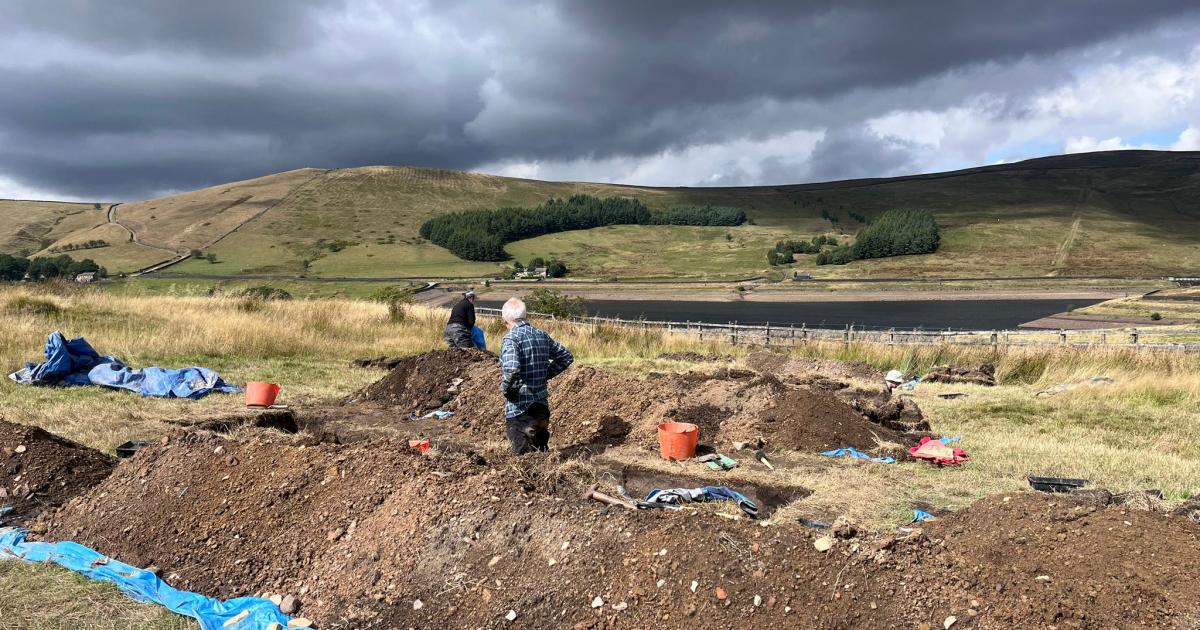
Like last year, the 2026 excavations have focused on the “annexe”, an area of the site Mr Redhead said they had no idea existed five years ago.
So far, they have found evidence of food production and what they think could be an ancient “motorway services”, as well as a “spaghetti junction” of post-holes, which are helping Mr Redhead and the team slowly understand the layout and uses of the ancient complex.
![]() This year, the dig focused on the annex of the site again. (Image: The Oldham Times)
This year, the dig focused on the annex of the site again. (Image: The Oldham Times)
Mr Redhead said: “Our whole purpose this year was to try to define these timber buildings, get some corners and create plans. Because it is so complex, I do not think we will achieve that this year, so we will have to come back.”
In one area, Mr Redhead said one volunteer had identified a possible drain for a Roman toilet, still identifiable by the “whiff” of it. In another, they’ve found postholes supporting a raised floor of a granary.
Outside of the dig season, Mr Redhead has also had the opportunity to excavate the garden of a neighbouring house, as well as dig a couple of trenches even further back on United Utilities land.
The archaeologist said: “The annex enclosure is much bigger than we originally thought. We are piecing together all these little bits of the jigsaw.”
An important part of the whole project is the community of volunteers.
Mr Redhead said they’ve had 18 people, both professionals and amateurs, helping to excavate the site and the group overall now has around 90 members, which he added is “pretty good for a society like this these days”.
![]() The 2026 dig season at Castleshaw Roman Fort (Image: The Oldham Times)
The 2026 dig season at Castleshaw Roman Fort (Image: The Oldham Times)
Visitors are always welcomed at the site. This year, around 300 people have come to see the excavations.
Some people make special trips to see the forts, while others just stumble across it while on an afternoon walk.
Regardless, they are all treated to a dedicated tour of the trenches by Norman’s wife Jayne Redhead, who has also been digging at Castleshaw for decades.
‘Amazing to be a part of’
This is how some of the group’s volunteers came to be members.
Stephen Reynolds, 58, travels from the other side of Greater Manchester, near Wigan and Salford, to help excavate at Castleshaw.
Mr Reynolds has been digging with the group for the past two years, after first coming across the site while out walking with his wife.
He said: “I just love it. Whatever the weather, coming up here and digging is great. There are lots of people, everyone is really nice, and it is like a little social thing. You learn a lot as well.”
![]() Stephen Reynolds has been volunteering for two years after stumbling across the dig on a walk two years ago. (Image: The Oldham Times)
Stephen Reynolds has been volunteering for two years after stumbling across the dig on a walk two years ago. (Image: The Oldham Times)
As someone without a background in archaeology, Mr Reynolds said it was “daunting” at first, but Mr Redhead and the more experienced volunteers were always on hand to help.
He added: “Sometimes it is muddy and horrible, but there is the excitement of knowing I am working in a layer where another person was working in AD 70.
“I am occupying the same space as that soldier. My body is in the same space that he was, and it is quite weird.
“I am digging out beam slots and moving fill, and that fill is material those soldiers would have shifted.
“While I am doing it, I think: who were they? Where did they come from? Most of them would have been auxiliaries, from somewhere in eastern Europe. What was the weather like when they were doing it? Was it a nice sunny day, or was it raining or snowing? It is quite bleak up here.
“Those are the sort of things I think about while I am working.”
In a neighbouring trench, Luke Entwistle and his son Benjamin, from Lees, had found some bits of charcoal and were busy trying to find an “elusive” wall and post-hole.
![]() Father an son Luke and Benjamin Entwistle (Image: The Oldham Times)
Father an son Luke and Benjamin Entwistle (Image: The Oldham Times)
He said that they “hadn’t had much luck” so far, but were still hopeful they’ll find something before the end of the season.
Mr Entwistle, who works for Action Together Oldham and runs a volunteer counselling service, last took part in the dig ten years ago, but decided to return now that his son is studying history in college.
He said: “Being part of this is a big thing because we are able to touch things that people have not touched for nearly 2,000 years. It is quite amazing for us to be part of that.
“History is something I am passionate about. Benjamin is passionate about it too, and my younger son is as well.
“Hopefully, in another five or six years, he will be old enough to join us and take part in a dig too.”
Tim Jeffrey, 65, travels from Sheffield to help with the excavations and when I commented on the distance, he replied: “But it is good archaeology. It is worth the extra trek.”
When we stopped to chat, he had just uncovered what he suspected was a piece of lead and was eager to show Mr Redhead his find.
![]() Volunteer Tim Jeffrey and what he believed could have been a piece of lead found in his trench. (Image: The Oldham Times)
Volunteer Tim Jeffrey and what he believed could have been a piece of lead found in his trench. (Image: The Oldham Times)
His first experience of Castleshaw was in 2014, when the group held a community dig, and “has been coming back ever since”.
He is so passionate about archaeology that he retrained after retiring and has been working on commercial digs for the past couple of years.
Mr Jeffrey said: “I had always been coming here as a hobby, though, and I am still here — and will be for the foreseeable future.”
Similarly, volunteer Andrew Church had also decided to complete a one-year diploma in archaeology, despite not previously having a formal background in the field.
He said: “I think I started in 2019. I have been here most years since then, apart from during Covid.
“It is a very interesting site, and every time we come here we discover a bit more about it. We are gradually piecing it together from all the trenches we have been digging over the seasons.”
Mr Church was working on an “enigmatic” trench together with volunteer Ian Rowley, who described himself as more of an “armchair archaeologist”.
![]() Andrew Church and Ian Rowley working on their ‘enigmatic’ trench. (Image: The Oldham Times)
Andrew Church and Ian Rowley working on their ‘enigmatic’ trench. (Image: The Oldham Times)
He explained that while there weren’t many “small finds”, like bits of pottery, their focus was on following the patterns of the holes.
Mr Rowley said: “This is more about structures. We found a slot over there, so we are trying to see how far it continues. That is why we dug here. This feature was unexpected, so finding out what it is will be on next year’s agenda.
“There is always something more to find out.”
The volunteer working on the deepest trench of the excavation was 21-year-old Harrison Duddle, from “down the valley”, who is studying a masters in Roman and Classical Archaeology at Durham University.
He had his first taste of archaeology at Castleshaw a decade ago when he was just 11 years old.
Mr Duddle said: “I always liked history. My mum saw they were digging up here and sent me up.
“I was always going to do something historical, but archaeology has an immense amount of practical work and tells us details about the past that you simply cannot get through history alone.”
Through his studies, he has had the opportunity to work on some “phenomenal” sites, such as a Commonwealth-era mansion from the 1650s.
![]() Archaeology student Harrison Duddle (Image: The Oldham Times)
Archaeology student Harrison Duddle (Image: The Oldham Times)
He also recently went on a “once in a lifetime” trip to Egypt and while he didn’t get to dig in the end, he did get to visit the museums and learn about conservation.
When I asked if that would be his dream location to work, Mr Duddle said: “No, I am not going anywhere. I am staying here — this is my home.
“There are too many questions in the North West that need to be answered. There has been research, but much more is needed, particularly on the rural landscape.
“People think Roman archaeology is stodgy, settled and finished, that people have been there and done that, but that’s not the case.”
‘We have a duty to let people know’
There is definitely more work to be done at Castleshaw and Mr Redhead already has plans for the next season and beyond.
Next year, there will be a dedicated project to investigate the preserved timbers they found during the 2025 season and they will continue trying to figure out what’s going on with all the postholes.
Mr Redhead said: “There is so much going on here.”
Elsewhere, they will also be starting to think about publishing their findings, both academically and for laymen like you and me. They also want to install a new information board at the annex, just like the ones near the fort.
![]() A walker stops to read about the Castleshaw Roman Forts. (Image: The Oldham Times)
A walker stops to read about the Castleshaw Roman Forts. (Image: The Oldham Times)
He added: “We have a duty to let people know what we have found.
“There are two sides to that: meeting academic requirements for a specialist audience, including lectures, and producing popular publications and visitor information boards.
“It is all going well and it really has been a great summer again.”
More information about the Friends of Castleshaw Roman Forts can be found on the group’s social media pages.
If you want to see some of the finds up close, they also have an exhibition at Saddleworth Museum.






















































You must be logged in to post a comment Login