Her guide and a paramedic performed CPR but sadly Karen could not be saved.
Skye Mountain Rescue Team announced two people died in the area last week and thanked the crew of Coastguard Rescue 853 from Oban, and staff at Sligachan Hotel for their support
Karen was a keen golfer and clinched her third Scottish Senior Women’s Open title in a row at Aboyne Golf Club in 2023.
Advertisement
Her wife, Susan, left a touching tribute online following the tragedy.
She said: “My family and friends are rallying round me, and I am feeling very supported and loved.
“In the meantime please hug your loved ones and tell them you love them. Karen and I did that every day, so although this was completely sudden and unexpected, I don’t feel we left anything unsaid.
Advertisement
“Words can’t describe how much I’m going to miss my beautiful kind cheeky chancer. I was so lucky to have had 20 years with her.”
Susan added: “I can’t put into words how grateful I am for all the efforts that everyone made to save my lovely wife Karen. You are wonderful people.
“I know it must have been difficult for all involved, and I hope everyone is doing ok. If there is a way I could contact the crew of Coastguard Rescue 853 directly,
Advertisement
“I would really love that. Karen loved the Cuillins, so if this had to happen, it gives me some comfort that it happened there.”
Get more Daily Record exclusives by signing up for free to Google’s preferred sources. Click HERE.
The Scottish parliamentary election in May saw Reform UK return the same number of MSPs to Holyrood – 17 – as Scottish Labour. This remarkable result – effectively from a standing start – showed that the party is now a force to be reckoned with in Scotland just as in other parts of the UK. But where did it attract votes north of the border?
My analysis examines constituency-level patterns in support for Reform UK, compared with the other main parties. It focuses on three constituency characteristics: deprivation levels, whether it is classified as urban or rural, and centre–periphery location. The aim is to identify broad territorial patterns in party performance, rather than to draw firm conclusions about individual voters.
The figures discussed here are average vote shares across constituencies within each category. In other words, they show the average party result in, for example, more deprived constituencies compared with less deprived constituencies. This approach is useful for mapping the territorial profile of party support, but it should be complemented with individual-level data before drawing firm conclusions about voter motivations or social characteristics.
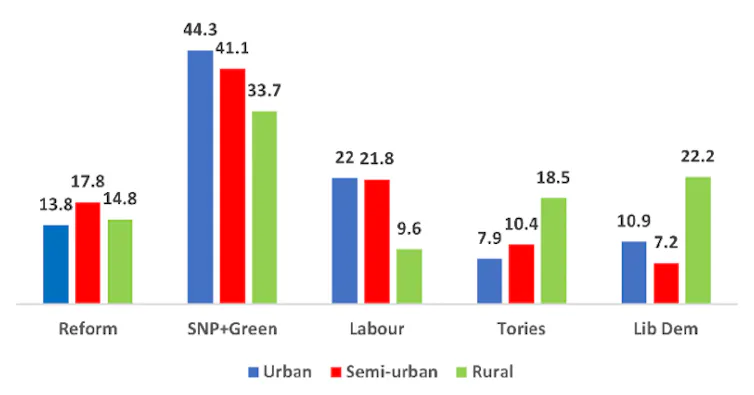
The first pattern concerns deprivation. Reform UK support appears to be higher in the most deprived third of constituencies than in the least deprived third. On this dimension, Reform looks closer to the SNP-Green and Labour pattern than to the Conservatives and Liberal Democrats, whose support is more concentrated in less deprived constituencies.
Advertisement
This does not mean that Reform voters are necessarily more deprived at the individual level, as constituency-level data cannot show this. But the aggregate pattern is still important. It suggests that Reform is performing relatively better in places where socio-economic pressures are more visible, and where dissatisfaction with existing political options may be more pronounced.
Party support and socio-economic territorial divideReform performed relatively better in areas with visible socio-economic pressures. Dr Davide Vampa, CC BY
The urban-rural pattern points to a distinctive Reform geography. Reform appears to perform best in semi-urban constituencies, rather than in the most urban or most rural areas. This separates Reform from the Conservatives and Liberal Democrats, who perform more strongly in rural constituencies. It is also different from the SNP-Green vote, which is strongest in urban constituencies.
Semi-urban constituencies may be politically important because they often combine proximity to major cities with a feeling of distance from them culturally or socio-economically. These areas may therefore provide fertile ground for parties appealing to voters in places that are close to urban centres, but do not necessarily share fully in their economic opportunities, public investment or cultural politics.
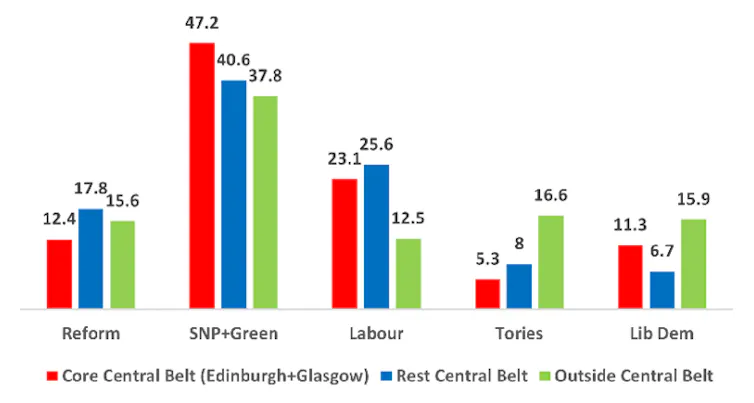
The centre-periphery divide adds another layer to this picture. Here, centre-periphery refers to three types of area: Edinburgh and Glasgow as the core of the central belt (Scotland’s main population corridor), other constituencies within the central belt but outside the two-city core, and areas beyond the central belt. Reform performs better immediately outside the Edinburgh-Glasgow political core than within it.
This pattern is again distinctive. The SNP-Green vote is more clearly concentrated in the core central belt, while the Conservatives are stronger in more peripheral constituencies. The Liberal Democrats display a U-shaped profile across the centre-periphery divide, performing relatively well both in core and more peripheral areas.
Reform’s profile is different: it is generally stronger in the periphery of the central belt than in the periphery of Scotland as a whole. In this sense, its geography is not simply one of rural or peripheral conservatism, but one of places within the central belt but outside its core. In other words, close to where political power is concentrated, but not fully part of it.
Party support and the centre-periphery divide
Advertisement
Reform’s vote was strong in constituences that lie close to – but outside – where power is concentrated. Dr Davide Vampa, CC BY
The contrast with the Conservatives is one of the most important findings. Reform UK’s pattern of support looks quite different from the Conservative map. While there may be overlap between the two electorates, Reform does not simply reproduce the traditional Conservative geography.
This matters because it challenges the idea that Reform’s support in Scotland can be understood simply as a Conservative splinter or replacement vote. Its territorial profile points to a potentially broader appeal, particularly in more deprived and semi-urban constituencies.
Overall, the results suggest that Scottish party competition is structured not only by ideology or national identity, but also by clear socio-economic and territorial divides. The SNP-Green and Labour vote is more urban and central, with some strength in deprived constituencies. The Conservative and Liberal Democrat vote is more rural, peripheral and less deprived.
Reform UK occupies a distinctive position: more deprived than the Conservative map, more semi-urban than rural, and stronger outside the core central belt without simply replicating the geography of established unionist parties.
These findings remain preliminary. Still, the constituency-level evidence suggests that any serious analysis of Reform UK’s performance in Scotland needs to take these territorial divides seriously.
Readers have been responding to The Independent’s ranking of the 50 greatest World Cup players by putting forward their own favourites, with the list prompting a wave of alternative selections and personal top 10s.
The ranking from our team of sports reporters focused strictly on World Cup performances – and many commenters responded by putting forward their own selections, nominating players they felt were overlooked or underrated.
At the very top, the consensus around the podium was mixed but passionate. Several readers backed Pele as undisputed No 1, with one insisting: “Pele without a doubt. Yes, Maradona at 2.”
Others were less convinced by the modern era’s place in the hierarchy, questioning whether Messi belongs in the same conversation. “Messi? Are you kidding?” one commenter wrote, while others simply rejected the framing altogether in favour of earlier generations of greats.
Advertisement
Away from the top three, much of the debate focused on players readers felt were left out or ranked too low, from Cruyff, Zidane and Beckenbauer to Baggio, Romario, Maldini and Moore. One commenter argued: “Platini, Xavi, Iniesta and Cruyff… are too far back,” while another lamented the omission of Kenny Dalglish.
Perhaps the loudest criticism was reserved for Cristiano Ronaldo’s absence from the top 50. One reader wrote that “CRO has to be there,” arguing that a player who has had such a profound impact on his country’s performances could not be overlooked, even in a World Cup-only ranking.
Here’s what you had to say:
German legends
Advertisement
From a German perspective, I expect Matthaus, Brehme, Klose, Gerd Muller and, of course, Beckenbauer, very far up, not to forget Seeler, Schnellinger, Podolski and Schweinsteiger. There are some more, but who knows where the author made the cut. Walter at 50 indicates some recency bias.
These lists are difficult anyway, so kudos for trying.
Greatest and most consistent performance in a single World Cup has to be Jairzinho in 1970. It is so overlooked, but he scored at least one goal in every single game in 1970, a feat never replicated, though Klose, as his name implies, came close. He scored more than one as well and had a hand in others that Pele became famous for, but really he is long overdue for celebration of his amazing feat.
Europeans were loath to recognise Brazilian achievement and gave in by recognising Pele and the beautiful game after 1970, but Jairzinho was not playing in Europe and got overshadowed because it was Pele’s third and the team was loaded. But really it was Jairzinho who was responsible for ensuring victory in every game in 1970 for Brazil.
Pele without a doubt. Yes, Maradona at 2, but Messi at 3? Come on. Five World Cups and one win, but more than that, an abject failure in 2016 with a hugely strong squad.
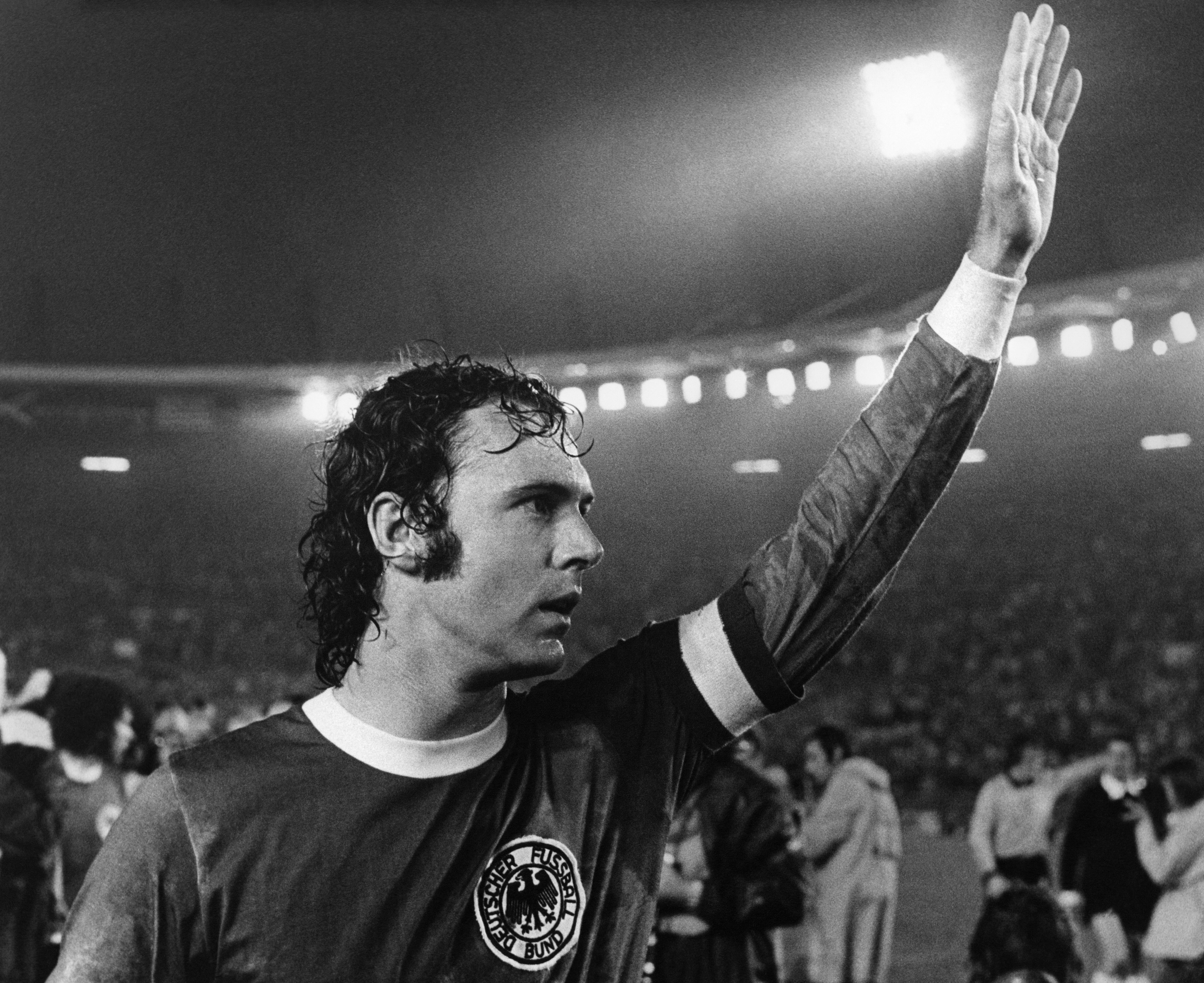
German football player Franz Beckenbauer waves to the spectators after winning the World Cup 1974 final football match against Sweden, in Dusseldorf, on June 30, 1974 (AFP/Getty)
Ronaldo missing
Ronaldo is missing from the list. He is one of the best Portuguese players and has not forgotten his background coming from a poor family.
Team player with individual talent, not greedy with the ball, can read the game, football brain, humble, doesn’t cheat, no dramatics, passionate about the game, the team, the fans.
Without the points, just thinking aloud and for now, in no particular order:
Advertisement
Ronaldo, the real one, Ronaldo Luis Nazario de Lima
I’d like to make a case for Kenny Dalglish, without doubt Scotland’s finest player.
His record as a player and player-manager is remarkable. I know it’s an impossible job to compare players from the 1930s against more recent ones, so it’s only a minor complaint.
Looking at the video of Maradona’s “goal of the century”, if this was played today then Peter Reid would have cynically fouled him at 10 seconds, got a yellow, and the resulting free kick would have seen players wrestling and diving in the six-yard box, and the ball would have been launched into the crowd. And we say football is better these days! I think not.
Messi? Are you kidding? He did well in some ways in 2022, that’s all. With five trophies, there are at least five Brazilians in the top 10: Pele, Zagallo, Garrincha, Zico, Ronaldo. Zagallo is the only human being with four canecos!
Cristiano Ronaldo has to be there. I can’t understand why a footballer who has had a profound impact on his country’s performances is missing from the list.
I was privileged to see Cruyff in his pomp twice. Like all great players, even when not involved in the game for a while, he suddenly created magic. The famous turn alone should have him in the top five.
There were also a lot of players who played for lesser teams and, as a result, never won anything, but they still did great things at the World Cup. Hristo Stoichkov comes to mind, as does Gheorghe Hagi.
Some of the comments have been edited for this article for brevity and clarity.
Advertisement
Want to share your views? Simply click ‘log in’ or ‘register’ in the top right corner to sign in or sign up. Once registered, you can comment on the day’s top stories for a chance to have your opinions showcased.
Want your voice to stand out? Independent Premium subscribers enjoy priority for featured comments. Subscribe here.
Make sure you adhere to our community guidelines, which can be found here. For a full guide on how to comment, click here.
The homes are to be made available to those aged over 55
Plans have been approved to build 42 affordable homes despite concerns over increased traffic on existing roads that are “already under significant pressure”. Bowsall Developments Limited and Housing 2I submitted plans to Fenland District Council to build the homes on land west of a playing field on Barton Road in Wisbech.
Advertisement
All of the homes are proposed to be made affordable to those aged over 55 for renting. Each of the homes will be bungalows, “making them attractive for the increasing older population in Fenland”, the applicants said.
These homes, as well as a unit functioning as a manager’s office, a communal space and kitchen facilities for residents and highways improvements have now been approved by the district council.
Despite the approval, the plans received a number of objections from residents who were concerned about the impact the development would have on traffic. One objector in Ashdale Park, Wisbech said that the existing roads are “in a state of disrepair” which they believe “will be made worse by additional traffic generated by the new development”.
They added: “The roads are narrow and there is frequent congestion, particularly on North Brink at the drop off and pick up times for Wisbech Grammar School. This will be exacerbated by the build process as well the additional traffic generated by the development.”
Advertisement
One person said the they moved into their home for some quiet in their retirement and have since had to put up with an “orchard being ripped up, a Care Home being built, and 46 houses being built soon”. They added: “The works associated with that site have caused damage to the base of my home, and constant noise, shaking, and dirt and dust is ridiculous!
“Now I see planning for 42 homes on the other side of our site has been put forward, so much for my quiet retirement! That now means the residents on the other side will have the same problem as we have had! The infrastructure around this area is at best inadequate now, so who knows what it will be like once work gets underway. The whole idea for both of these applications was ridiculous in the extreme.”
Another resident in Woodcote Park raised a concern that the existing road network is “already under significant pressure” and whenever traffic is redirected through the area, “congestion becomes severe, with long queues and safety concerns for both drivers and pedestrians”.
The objector added: “The current infrastructure cannot accommodate a further increase in traffic without causing considerable disruption.”
Advertisement
MP Stephen Barclay also raised similar concerns in a formal objection. He said that the proposed development would “significantly increase traffic on North Brink and Barton Road”, especially during school drop-off and pick-up times at Wisbech Grammar School.
MP Barclay also said that the development would “exacerbate existing hazards caused by poor road conditions” including potholes as well as introduce “heavy construction traffic” and “increase safety risks for pedestrians and cyclists”.
No-one has won the World Cup Golden Boot more than once – but two men have a good chance to become the first to do so this summer.
Mbappe scored four goals in World Cup qualifying and as one of the strongest squads in the tournament, it is likely that 2022 finalists France will reach the latter stages of the competition.
Another striker seeking a historic second boot is Kane. At 32, he is as we know significantly older than the average winner – but with 54 goals for his club this season, Kane is no average player. If Thomas Tuchel’s side go deep into the tournament, Kane is surely certain to score his fair share.
Messi has claimed plenty of personal accolades in his career, but there is a Golden Boot-shaped gap next to the eight Ballon d’Or trophies in his cabinet. Aged 38, the 2026 tournament is his final chance.
Advertisement
At the other end of the age scale, Yamal will turn 19 the week before the final. Spain have not progressed beyond the round of 16 since their 2010 tournament win, but Luis de la Fuente’s men showed they have the mettle to go the distance at Euro 2024 and were impressive in qualifying.
Premier League Golden Boot winner Erling Haaland has scored 26 league goals for Manchester City this season but his bid for the boot might depend on how long Norway stay in the tournament. Haaland scored 16 goals in eight qualifying games.
Feeling older than you actually are might be more harmful than you think. It’s linked to poor quality sleep, symptoms of insomnia and poorer bodily function throughout the day, a new study released Tuesday shows.
Adults who said they felt older than their age reported more sleep-related impairments, decreased overall sleep health and lower sleep regularity, an American Academy of Sleep Medicine study of nearly 3,200 adults showed.
“These associations remained significant even after accounting for chronological age, depression and anxiety,” Joseph Dzierzewski, senior vice president of research and scientific affairs at the National Sleep Foundation, explained in a statement.
The researchers don’t suggest why this is the case, but past research has tied feeling older than your age to premature death and feeling younger to slower brain aging. Your mindset has been proven to control your health, like with stress and blood pressure.
Advertisement
And, the findings add to the many reasons Americans aren’t getting enough sleep. Between 7-9 hours of shut-eye a night are recommended by federal health officials to ensure the heart, immune system, muscles and brain are firing at full cylinders.
Feeling older than you are? It may contribute to your insomnia, a new survey of nearly 3,200 adults shows (Getty Images/iStock)
Still, some 12 percent of American adults are living with insomnia, a chronic sleep disorder referring to difficulty falling or staying asleep, according to the American Academy of Sleep Medicine.
Insomnia is often a symptom of negatively affected mental health, or vice versa. They feed into each other, creating a vicious cycle.
People with insomnia are 10 times as likely to have depression and 17 times more likely to have anxiety than others, previous research shows.
Advertisement
“It’s becoming increasingly clear that sleep and mood have a bidirectional relationship,” Andrea Goldstein-Piekarski, an assistant professor of psychiatry and behavioral sciences at Stanford Medicine, said in a statement last August.
Women are disproportionately impacted by mental illness, although a fifth of Americans live with one (Getty Images/iStock)
The study asked respondents about their age, insomnia, sleep health, mental health and how old they felt in an online survey. The researchers also took their reported sex, race and history of depression and anxiety into account.
The older they felt, the worse the self-reported physical health associated with bad sleep was.
The results challenge how clinicians should talk about aging, the researchers say.
Advertisement
“These findings suggest how people perceive their own aging may have important implications for sleep and overall well-being,” Dzierzewski said. “Understanding subjective age could help inform future approaches to support healthier sleep and quality of life across the lifespan.”
Feeling older doesn’t have to be permanent, the Society for Biopsychosocial Science and Medicine says.
“Find something that makes you feel young again. Exercise more, take a class, do something artistic,” Angelina Sutin, an associate professor at the Florida State University College of Medicine, told the society. “We have this entrenched idea that feeling old is inevitable. But when you find the thing that makes you feel young again, you discover it’s not so.”
The research is being presented later this month at the annual meeting of the Associated Professional Sleep Societies in Baltimore, Maryland.
“Groups of men and women sit around openly injecting drugs in the middle of the street and going to the toilet wherever they want.”
06:00, 03 Jun 2026
Advertisement
A North Belfast mum has called for urgent action as she says the street she lives on has become a hotspot for constant drug abuse and anti-social behaviour as people inject openly in the middle of the street.
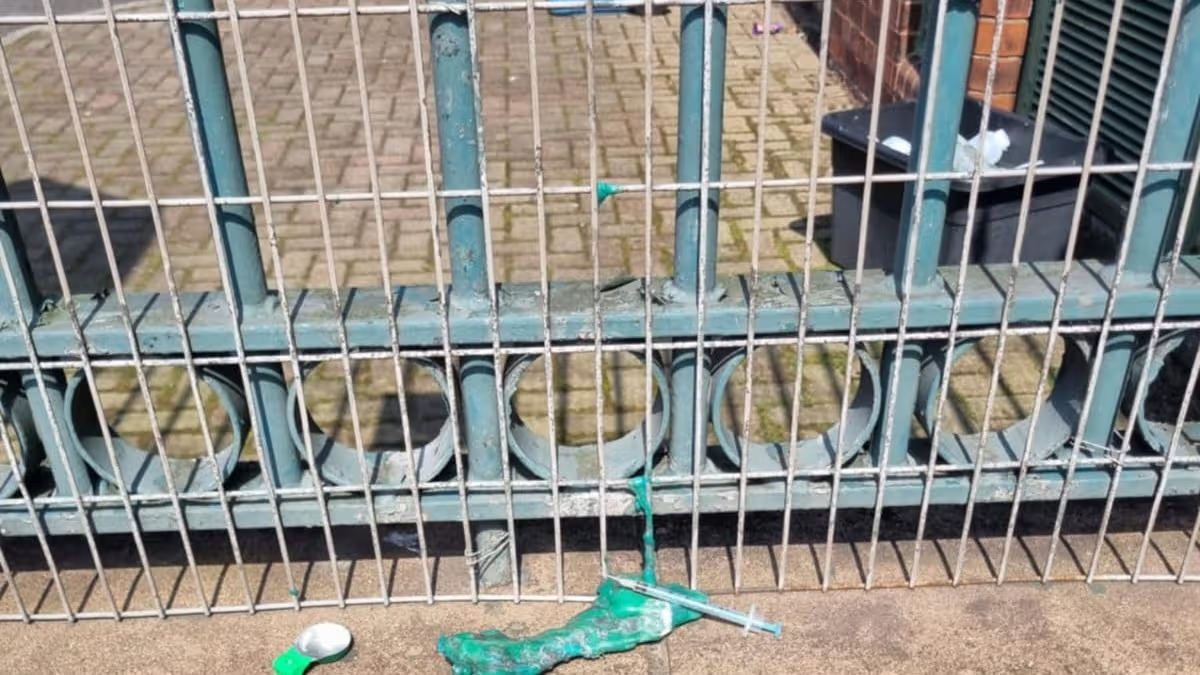
The mum, who does not wish to be named, says that for the past two years, on Annesley Street off Carlisle Circus has been constantly plagued by people using it as a location to drink and take drugs, saying she regularly sees people injecting drugs in the middle of the street just yards away from her front door.
She said groups arrive on the street every day and have become aggressive toward local residents when asked to leave. It has been alleged that when police arrive on the street, the groups involved in anti-social behaviour just move a few hundred yards to another location and wait for them to leave before returning.
Speaking to Belfast Live, the concerned parent said: “The things that we have to deal with on a daily basis is disgusting. Groups of men and women sit around openly injecting drugs in the middle of the street and going to the toilet wherever they want.
Advertisement
“The pavement is constantly covered in used needles and empty beer cans and have had them thrown into our gardens. It is not fair on local families who have to live beside this every day with their children.
“When we tell them people to leave they can get aggressive with us but when we ring the police that doesn’t do much either because they just walk a few hundred yards down the road until they leave and then come back again. We have had meetings with the police where we have been promised that this would be dealt with but nothing seems to have changed and the issues are as bad as they have ever been.”
North Belfast independent councillor Paul McCusker has been helping local residents regarding the ongoing issues on Annesley Street and said it is part of a wider issue Belfast that needs to be urgently address and can’t just be “pushed around” to different locations in the city.
Advertisement
He said: “People need to accept that there is a serious drug problem in Belfast. I am aware of the ongoing issues on Annesley Street and have been speaking with local residents and can understand how frightening it can be, especially when they have young children, to see people injecting in the street.
“I have called for a meeting with police, local residents and Choice Housing in the hopes that this issue can be addressed. But we cannot just push this to another location and this is part of a wider problem in Belfast where drug use is increasing. It needs to be dealt with at a policy level but is sadly lacking the political support from the larger parties.”
Inspector Hamilton said: “I fully understand the effect antisocial behaviour can have on communities. Police are here to listen to all community concerns and to work with local residents and partner agencies to find a solution to any issues and will act on any information we are given.
Advertisement
“Drug and substance abuse is a complex societal issue which is affecting many cities across the UK and Ireland. We have been working tirelessly with our partner agencies to clean up locations where drug use was suspected to have been taking place and to make these locations less welcoming environments for drug users.
“I appeal to anyone who finds what they suspect to be drug paraphernalia: do not touch these items. Contact police on the non-emergency number 101, or if they are in a public area, contact Belfast City Council on 028 9027 0469 and a specialist team will safely recover the items.
“I also remind those who use needles of the risks to others they cause by discarding them so wantonly. These items can be dangerous, especially to younger children who may not be aware of what they have found.”
Advertisement
“We know that street-level drug dealing and drug use is happening across Northern Ireland, but we need the help and support of local communities to remove this activity from our streets. Drugs bring misery to individuals, families and communities. I want to warn people to be mindful of the dangers of taking illegal drugs or misusing prescription medication or other chemical products.
“We are committed to addressing illegal drug use and supply. Anyone who is suspected of involvement in the supply of drugs can expect to be arrested by police and presented before the courts.
“Our message is clear and simple: if you see or know of anyone who is dealing drugs in your local area, then contact your local police on 101. Alternatively, information can also be provided to the independent charity Crimestoppers on 0800 555 111 which is 100% anonymous and gives people the power to speak up and stop crime.”
Slugs and snails might be “more outdoors than in”, but after a shower, they can be “everywhere” – something that can spell bad news for your plants, even if they are potted
Preventing slugs and snails from devouring your potted plants might simply require one unexpected bathroom product, it has been claimed. While they’re often regarded as pests, slugs and snails are actually part of your garden’s natural biodiversity, and are “superb at recycling waste vegetative matter”, according to BBC Gardener’s World’s Monty Don.
Advertisement
However, as he explains, they “do not discriminate between a fallen leaf and a delicious young seedling” – though there could be relief for exasperated gardeners.
A recent piece covering how rainfall can force common pests indoors highlighted creatures including rats, mice, ants, spiders and mosquitoes – alongside slugs, which Monty describes in his blog as having been considered gardeners’ “public enemy number one”.
Slugs and snails are “more outdoors than in”, according to Household Advice Editor Katie Mortram, though she cautioned that they’ll get “everywhere” after a shower, potentially meaning trouble for your plants.
She explained in Good Housekeeping: “The additional moisture on the ground and in the air makes the environment ideal for their survival and travel. And your damp plants are pre-watered for consumption.”
Katie subsequently offered some guidance: “As for slugs and snails, you can protect your plants with a few small adjustments. You can create a barrier of eggshells, coffee grounds, wool pellets or copper rings.
“For potted plants, applying petroleum jelly on the outside of the pot acts as another measure.”
In other news, Richard, who presents Sheffield Made Gardens and Sheffield Made Plants on YouTube, revealed a cost-free technique for deterring slugs and other pests using an everyday garden item.
Advertisement
As part of a series highlighting why you should retain your old plant pots instead of discarding them, Richard recommended using one for this purpose, noting that pests appeared to have gone on an “absolute rampage” in his garden.
He said: “This year, it seems like slugs and other pests have been on an absolute rampage. My marigolds over there have been eaten by something in the greenhouse. So, I need something to keep them at bay. And plastic pots are just the answer.
“So, grab a pot that’s going to fit over the plant, very susceptible to pests, like my marigolds are. And we’re just going to take our scissors and just go through the drainage hole and make a snip.”
Advertisement
Following this, he punctured the base of a plastic plant pot with the scissors and cut around it to create a protective “collar”. He added: “And then we can get in there and just cut the bottom off like so.
“Just go all the way around. Doesn’t have to be too neat. And there you have it. So that has just created a nice collar that I can stick over my susceptible plants and just dig it into the soil a little bit, just so it protects them a bit better.”
‘Lovely dress and I feel wonderful in it. The material is soft and comfortable to wear’
This article contains affiliate links, we will receive a commission on any sales we generate from it. Learn more
Advertisement
White Stuff is a great place to shop for flattering summer dresses and timeless holiday-ready fashion, and right now the retailer has discounted several popular styles in its seasonal sale. Among the standout deals is a popular blue linen-blend dress, which is nearly £16 off.
The Kate Midi Dress, now £63.20 from £79, has proved popular with customers, earning praise for its comfortable, flattering fit. One delighted shopper even highlighted how well it works for those with a fuller bust, making it an appealing option for women who often struggle to find dresses that fit comfortably across the chest.
With a cinched waist and feminine V-neckline, the piece creates a flattering silhouette while the breezy midi length makes it ideal for warm-weather dressing. Finished in a soft sky-blue shade with a delicate floral print, it’s the kind of versatile piece that can easily take fans from sightseeing on holiday to a relaxed beachside lunch.
READ MORE:
Advertisement
For an effortless summer look, pair the dress with tan leather sandals, a woven raffia tote and oversized sunglasses. On cooler evenings, layer it with a lightweight denim jacket and simple gold jewellery to complete the outfit.
Shoppers have been quick to snap up the style, however, and stock is already beginning to dwindle. Larger sizes are currently selling out, while the petite version has completely sold through, although regular sizes 6 to 18 remain available.
Beyond White Stuff, Boden is also hosting a huge sale right now. This Belinda Linen Shirt Dress is our top pick (£127.20 from £159 with code HDQN) for its elegant silhouette, softly flared skirt, self-tie waist belt, and flattering princess seams.
Otherwise, Nobody’s Child has this Green Sleeveless Charlie Midi Dress (£89), now back in stock after selling out earlier this year. This moss green piece features a round neckline and a shirred bodice for a comfortable fit.
Advertisement
Back to White Stuff, the Kate Midi Dress has racked up some great reviews from shoppers. This person shared: “Fits so well, usually I struggle with WS dresses with buttons down the front as I have a larger bust (34G).
“This dress is perfect. I’m 5’4, and I got the 14P, and it’s exactly the length I wanted – mid-calf. The photos don’t do the fabric justice.”
Meanwhile, another said: “A lovely dress – I liked it so much that I bought it at full price. Good weight material that falls well and is very flattering to the figure, with useful pockets. Lovely colours and very stylish.”
Advertisement
However, they added: ” I did need to go down a size as fitting comes up rather big and neckline is on the low side, so I wear a camisole underneath.”
On a brighter note, this fan chimed in: “Lovely dress, and I feel wonderful in it. The material is soft and comfortable to wear. I particularly liked the detail in the sleeves and bodice. I would recommend it to anyone.”
Hughes, which has 18 stores across East Anglia, said it would be closing some of its smaller retail stores in the region
Tannur Anders UK & World News Reporter
05:46, 03 Jun 2026
An electrical appliances retailer is set to close eight branches this weekend – including one in Cambridgeshire – as it looks to channel greater investment into its digital platform and remaining stores.
Hughes, which was established in 1921, confirmed that several of its smaller retail outlets across East Anglia would be shutting down. The company’s first shop opened its doors in Lowestoft in 1928.
Advertisement
The company has announced it will be closing its store in Horsefair Shopping Centre, Wisbech, Cambridgeshire on Saturday, June 6.
Chief executive Mark Wardell said employees were briefed on the decision earlier and assured they would receive support throughout the “difficult process”.
He acknowledged that many of those impacted had been with the firm for considerable periods and had “played a huge part” in its operations.
In a statement, Hughes said: “The business recognises the need to adapt and evolve its offer in the face of rising operating costs, the increasing popularity of online shopping and changing customer expectations when it comes to the modern in-store experience.”
Advertisement
“These have not been easy decisions to make,” he said.
“All will receive the honesty, respect and support they deserve through the difficult process ahead.
“We understand the news will be very upsetting for our teams, but we have acted now to ensure the long-term success of the business.”
Advertisement
The eight branches closing at the end of trading on Saturday, 6 June will be:
Clacton-on-Sea, Essex
Dereham, Norfolk
Diss, Norfolk
Hunstanton, Norfolk
North Walsham, Norfolk
Norwich Mason Road
Thetford, Norfolk
Wisbech, Cambridgeshire
The shop closures will impact 35 members of staff. A proposed closure of its delivery depot in Mason Road could result in 25 employees facing redundancy, a spokesperson confirmed.
The firm will continue to run its 10 other East Anglia branches, which are situated in:
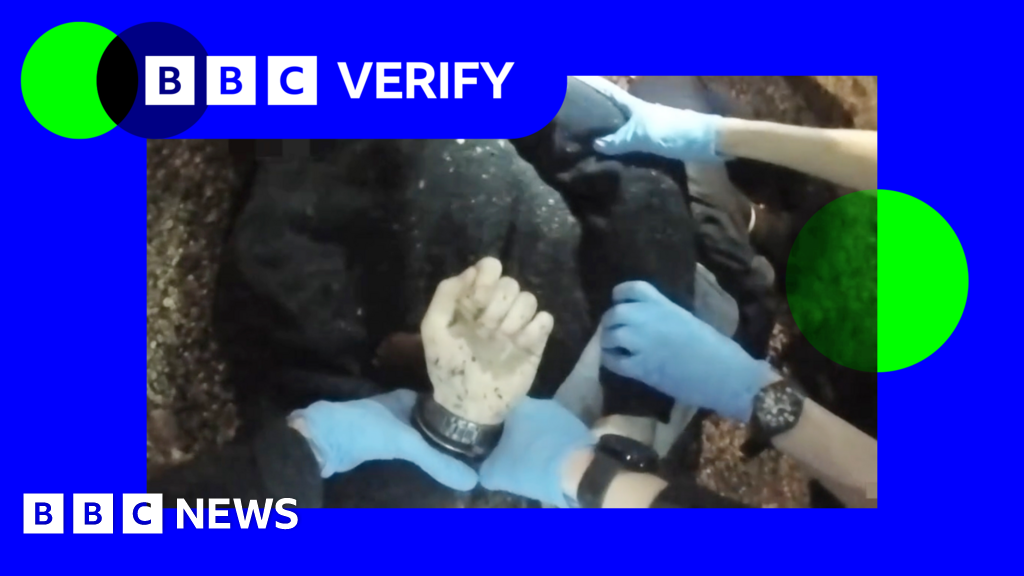
An 18-year-old Southampton student, Henry Nowak, was handcuffed after being stabbed by Vickrum Digwa, 23, who lied to police at the scene, claiming he had been the victim of a racist attack.
Digwa has been jailed for life with a minimum 21-year term.
Nowak’s parents said they hold Digwa solely responsible for the murder of their son, but the way he was treated by police was inhumane and degrading. Hampshire police has apologised to Henry’s family and the case has now been referred to the Independent Office for Police Conduct.
BBC Verify has analysed bodycam footage that was released by the police, with the permission of Nowak’s family, and looked at the key moments before Henry Nowak’s death. Merlyn Thomas reports.
Advertisement
Additional reporting by Emma Pengelly. Produced by Tom Joyner. Graphics by Sally Nicholls.


















































You must be logged in to post a comment Login