Connect with us

NewsBeat

Chaos continues at UK airport as runway defect sees flights cancelled or diverted with homecoming Brits forced to land hundreds of miles from home

Published

on

Passengers at Bristol Airport have faced travel chaos after a defect was discovered in the runway (file image)

Advertisement

A runway defect at Bristol Airport has caused travel chaos as flights are cancelled or diverted hundreds of miles away.

Hundreds of flyers were stranded on Friday night as the airport was forced to close with dozens of people waiting in crowds at their departure gates.

Although flights did resume at 8am this morning, the airport warned that disruption would continue throughout Saturday.

Many holidaymakers were left with long and expensive journeys home after their planes were diverted to different airports across the country.

Advertisement

Dave Blackwell, who was travelling from Rhodes, found himself 246 miles away from Bristol after his plane landed in Newcastle.

‘We were in Rhodes Airport for three hours with no information. Now we have all been told our flight is going to Newcastle and then a five or six-hour bus ride – why Newcastle? How appalling,’ he told BBC News.

Other flights were diverted to Bournemouth, Birmingham and Cardiff.

Last night, passengers reported that there was little communication from the airport with no announcements on the tannoy system for over an hour.

Advertisement

EasyJet were said to be the only representatives in the departure lounge, which warned people travelling to and from the airport to expect significant disruptions.

Passengers at Bristol Airport have faced travel chaos after a defect was discovered in the runway (file image)

Pictured: Passengers queue outside Bristol Airport. Many flights were cancelled or diverted hundreds of miles away

Pictured: Passengers queue outside Bristol Airport. Many flights were cancelled or diverted hundreds of miles away 

Advertisement
Hundreds of people were pictured waiting inside the airport terminal

Hundreds of people were pictured waiting inside the airport terminal 

Furious passengers stuck in the chaos complained of being left stranded in the airport and ‘appalling communication’.

One wrote on X: ‘EasyJet holding everyone hostage at Bristol Airport! Let us out! Let us out! Communication is appalling.’

A second added: ‘It’s disgusting. They’ve locked me in the gate 26 toilets. All I did was ask them why it was cancelled.’

Advertisement

A third wrote: ‘Bristol Airport, what’s happening tonight? We are stuck in the airport with no clear guidance for 3 hours. Any information would be appreciated.’

One concerned parent said: ‘EasyJet I am livid!!!! Your flight from Dubrovnik to Bristol tonight has been cancelled and there are no staff there to assist.

‘My daughter has been told to go on your website and book another flight to Gatwick!! No mention of hotel! Pathetic!! Please dm me now!’

While another enraged passenger said their flight had been diverted hours away from Bristol to Newcastle.

Advertisement

In a statement, Bristol Airport said: ‘Flights resumed at 8am today after we temporarily suspended operations yesterday. There’s some disruption to flights today. 

‘Customers should contact their airline with flight queries. We’re very sorry for any inconvenience caused while essential runway repairs were carried out.’

Advertisement

Source link

Advertisement
Continue Reading
Click to comment

You must be logged in to post a comment Login

Leave a Reply

NewsBeat

An ‘explosive diarrhoea’ parasite is sweeping the world… and now it has reached the UK and Europe: Here’s how you can avoid the grim bug that grips hold of your guts for weeks and starts with a bubbling, balloon-like feeling

Published

on

Some sufferers have described having to use the toilet up to 20 times a day, while others told of a bubbling, or balloon-like feeling in the stomach

It’s the explosive diarrhoea bug that’s struck down tens of thousands of Americans this summer. Cyclosporiasis, a parasitic infection that spreads via contaminated food or water, has hit more than 22,000 people across 45 states.

Linked to an iceberg lettuce farm in Mexico, it swept quickly through the US, killing two and leaving hundreds hospitalised over the past few weeks alone.

And health chiefs now warn the debilitating infection – which causes weeks of violent diarrhoea, abdominal cramps and vomiting – has reached the UK.

At least 67 Britons have fallen ill with cyclosporiasis since May. Officials are urging all travellers to take precautions when visiting or returning from North, Central and South America.

Advertisement

It may sound terrifying but experts say that, armed with the correct information, the parasite, called cyclospora, needn’t be a cause for concern.

‘It’s not something you want to get,’ says Dr Paul Hunter, microbiologist and professor of medicine at the University of East Anglia, ‘but there are clear ways to reduce your risk, on holiday or at home.’

What exactly is the cyclospora parasite?

Cyclospora is a single-cell organism, meaning, in layman’s terms, it is microscopically tiny.

It is a parasite that lives and multiplies in the small intestine, burrowing into cells that line the gut wall. The frequent, watery diarrhoea associated with the bug is the body’s attempt to expel them.

Advertisement

Some sufferers have described having to use the toilet up to 20 times a day, while others told of a bubbling, or balloon-like feeling in the stomach

Symptoms typically go on for a couple of weeks but can last up to a month, says Dr Lindsey Ann Edwards, senior lecturer in microbiology at King’s College London.

She adds: ‘The main sign is very watery diarrhoea over a prolonged period. While other bugs may clear up after a few days, cyclosporiasis continues.’

Advertisement

Some sufferers have described having to use the toilet up to 20 times a day, while others told of a bubbling, or balloon-like feeling in the stomach.

The parasite can also cause abdominal pain and nausea, but rarely vomiting.

Can I catch it from an infected person?

Cyclosporiasis differs from more common bugs in how it is spread. ‘The parasite can’t be passed on between humans, unlike many other diarrhoea-causing infections,’ says Professor Hunter.

In fact, people become infected with cyclospora only when they consume food or water that contains the parasite.

Advertisement

‘If you were just at dinner with, or even lived with, an infected person, you likely wouldn’t get it,’ says Professor Hunter.

Instead, outbreaks, such as the one in the US, occur when infected faecal matter comes into contact with crops, usually due to contaminated water supplies used to wash or grow produce.

Prof Hunter adds: ‘It’s raw vegetables and fruit – crops you won’t typically cook – that tend to spread cyclospora, as boiling can kill the parasite.

‘Salad leaves in particular are full of nooks and crannies and have a lot of surface area for the parasite to lay eggs on. And you don’t cook them – making them a perfect vehicle for cyclospora.’

Advertisement
Raspberries and blackberries have been behind a number of outbreaks for the same reason as salad leaves now are ¿ they¿re hard to clean well and full of little troughs and pits

Raspberries and blackberries have been behind a number of outbreaks for the same reason as salad leaves now are – they’re hard to clean well and full of little troughs and pits

Is it only salad I need to be worried about?

The US outbreak has been linked to Taylor’s Farm, a farm in Mexico that supplies bags of shredded lettuce to fast-food giant Taco Bell as well as grocery stores.

But previous outbreaks have been caused by a range of other fresh vegetables and fruit, including, most commonly, raspberries. ‘Anything that you eat without peeling or cooking could carry the parasite,’ says Professor Hunter.

Raspberries and blackberries have been behind a number of outbreaks for the same reason as salad leaves now are – they’re hard to clean well and full of little troughs and pits.

Advertisement

‘Vegetables with a waxy skin, like cucumbers, or that you typically peel – like oranges or carrots – are less likely to cause infections.’

How come it is now spreading to the UK?

Cyclospora is most prevalent in tropical regions such as South and Central America, Southeast Asia or the Middle East, as the parasite’s eggs can usually only survive in warm, humid conditions.

These regions typically also have poorer water treatment and sanitation infrastructure, making crop contamination more likely.

But while rare, there have been cyclospora outbreaks in the UK and Europe. Imported produce can bring in the infection, although most commonly people pick it up abroad, says Dr Edwards.

Advertisement

‘The parasite tends to incubate for around ten days, so people can go on a week-long holiday but then develop symptoms two or three days after getting back.

‘In the current outbreak, it seems most people have picked it up travelling to Mexico and the US.’

Will washing fruit and veg get rid of it?

‘It’s always a good idea to wash fresh fruit and vegetables,’ says Professor Hunter. ‘But with cyclospora, washing produce – while removing maybe 80 per cent of the parasites – won’t stop you getting sick, as the eggs, once laid, are difficult to dislodge.

‘Cooking is really the only way to kill off the bug.

Advertisement

‘I’ve always cautioned against eating uncooked vegetables – especially salads – when abroad.’

People with healthy immune systems can also usually get over the infection without treatment, but their symptoms can last up to a month and may relapse

People with healthy immune systems can also usually get over the infection without treatment, but their symptoms can last up to a month and may relapse

What’s the best way to treat an infection?

Once diagnosed via a stool sample, cyclosporiasis infections can be easily treated with antibiotics.

Trimethoprim-sulfamethoxazole, commonly sold as Bactrim, Septra or Cotrim, is taken twice daily for seven to ten days.

Advertisement

People with healthy immune systems can also usually get over the infection without treatment, but their symptoms can last up to a month and may relapse.

Hydration is key, says Dr Edwards, because of how much fluid is expelled. Sufferers should drink a lot of water, broths and take electrolytes and antibiotics.

Should I be worried about getting it?

Not unless you are planning an imminent trip to the US or Mexico.

If you are, at mealtimes or in restaurants, stick to cooked vegetables or ones that are peeled.

Advertisement

Those with a weakened immune system, as well as the elderly and children, should also be careful, adds Dr Edwards.

‘It’s not usually deadly – and given the number of infections in the US, two deaths makes sense statistically,’ she says.

‘But if you have underlying health conditions, it can make it much more difficult for your body to get rid of the parasite. Constant diarrhoea can cause severe dehydration, which can be deadly.’

Anyone returning from abroad who develops symptoms should seek help from their GP.

Advertisement

Source link

Continue Reading

NewsBeat

Wales breaking news plus weather and traffic updates (Saturday, August 8)

Published

on

Wales Online

Flights have resumed at Bristol Airport after a chaotic Friday night and Saturday morning which saw passengers stranded and diverted as operations grounded to a halt.

The airport suspended all flights on Friday evening due to a runway defect. All flights were suspended until 8am on Saturday, sparking major disruption for passengers.

The airport said early on Saturday morning: “Due to a defect on the runway, we have temporarily suspended operations as a precaution, in order to inspect and repair the section affected.

Advertisement

“We apologise for any inconvenience. Safety is always our number one priority.”

In an updated statement issued at 8am on Saturday, the airport said: We’re very sorry to customers affected and any impact this has had to their summer holiday. We continue to work closely with all airlines affected.

“The safety of passengers and staff is of paramount importance, which is why we made the decision to temporarily suspend flights as a precaution and to allow for the runway repair to be carried out.”

You can follow all the latest here.

Advertisement

Scroll down for more updates:

Source link

Continue Reading

NewsBeat

The never-before-seen pictures of Liam Payne’s last hours: Haunted and prowling a Buenos Aires hotel, begging call girls to help him make crack, the Mail shares the startling revelations inside explosive police files

Published

on

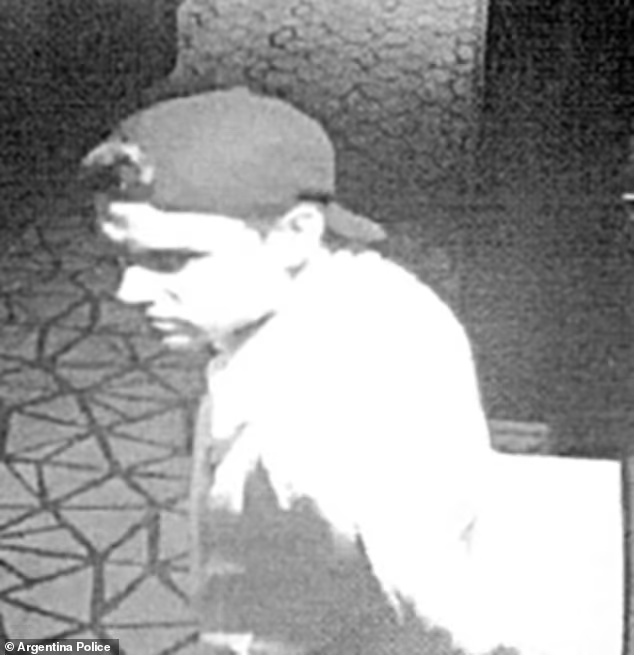
Liam Payne is seen looking hollow-eyed and gaunt, stumbling through the corridors of the CasaSur Hotel just one hour before he plunged from the balcony of Room 310

He was a pop superstar adored by millions, a devoted son and father, a man who had amassed a fortune of £22million and appeared to have the world at his feet.

Yet in the final days of his life, former One Direction singer Liam Payne was in the grip of a devastating spiral of drug and alcohol abuse, paying sex workers to keep him company in a soulless hotel room while bingeing on crack cocaine and whisky.

While much has been written about Liam’s death, the full heartbreaking facts have not been revealed – until now.

Today, The Mail on Sunday can disclose details of the singer’s death from an extraordinary trove of 3,000 documents, photographs, sworn statements and official reports gathered by investigators after he died in Buenos Aires on October 16, 2024.

Advertisement

One haunting CCTV image shows him hollow-eyed and gaunt, stumbling through the corridors of the CasaSur Hotel just one hour before he plunged from the balcony of Room 310.

The report also lays bare his family’s despair, with a sworn statement from Liam’s grief-stricken father Geoff telling prosecutors his son ‘went away’ when he was in the grip of his demons saying: ‘He was not in control with what he did. He was not Liam.’

While some information is too graphic and personal to be shared, the cache of evidence paints the clearest – and most profoundly painful – portrait yet of a man completely out of touch with reality in the hours before his death.

Advertisement

Liam Payne is seen looking hollow-eyed and gaunt, stumbling through the corridors of the CasaSur Hotel just one hour before he plunged from the balcony of Room 310

Prostitutes Aldana Serrano and Lucila Goitea in the hotel lobby. The file is filled with new images showing the escorts imploring hotel staff to help them, after they argued with Liam over their payment

Prostitutes Aldana Serrano and Lucila Goitea in the hotel lobby. The file is filled with new images showing the escorts imploring hotel staff to help them, after they argued with Liam over their payment

The MoS can reveal the documents show Liam:

  •  Begged one prostitute to bring him ‘five grams’ of cocaine ‘so I can make crack’.
  • Was addicted to ‘sexting’ and sent a prostitute a graphic naked photo on the morning of his death.
  • Told his best friend he was ‘afraid’ he might have accidentally sent a nude photo to a minor.
  • Became so volatile hotel staff warned each other to be careful how they handled him to ‘stop him from continuing to be aggressive’. One waitress was told to take security with her when she took five bottles of whisky to his room.
  • Racked up a $550 booze bill on his last day – despite a psychiatrist’s letter warning him not to mix alcohol with the prescription drugs he was taking.
  • Swung around a pole in the street at 3am as he waited for drugs to be delivered – leading investigators to conclude he may have had the upper body strength to believe he could safely climb down from his hotel room balcony (more on which later).

To fully understand how quickly Liam turned from sober friend and father – he ‘adored’ his nine-year-old son Bear (with singer Cheryl Cole) – into a man one witness described as ‘possessed’, you have to start at the beginning of the case file.

Liam was in Argentina to renew his US visa and to watch his former One Direction bandmate Niall Horan in concert.

Advertisement

He spent two weeks on holiday with his girlfriend Kate Cassidy, but when she left him alone to return to their home in Wellington, Florida, Liam spiralled. He was asked to leave one hotel for ‘acting belligerent’ and checked into the CasaSur on the afternoon of October 14.

His father Geoff later told prosecutors that Liam could keep his addictions under control as long as he always had someone with him to prevent him going off the rails.

Geoff said his son became ‘another person’ on drugs. His family had last seen him on August 29 when the singer was filming a Netflix show in Manchester and he appeared ‘well, stable, clean of any drugs or alcohol’.

That meant that, when police initially labelled his death as a ‘possible suicide’, Geoff was insistent this could not be the case.

Advertisement

‘I have no doubt that Liam wanted to live,’ he said. ‘It doesn’t cross my mind that it was possible that he wanted to hurt himself.’

Yet staff at the CasaSur became aware that something was badly wrong within hours of Liam checking in that day.

Liam chatting with the two prostitutes in the hotel. By 7am on October 16, the day he died, Liam had messaged his best friend Roger Nores saying: ‘Buddy, I think I’m going to f*** a prostitute'

Liam chatting with the two prostitutes in the hotel. By 7am on October 16, the day he died, Liam had messaged his best friend Roger Nores saying: ‘Buddy, I think I’m going to f*** a prostitute’

Liam is seen swinging around a pole in the street at 3am as he waited for drugs to be delivered - leading investigators to conclude he may have had the upper-body strength to believe he could safely climb down from his hotel room balcony

Liam is seen swinging around a pole in the street at 3am as he waited for drugs to be delivered – leading investigators to conclude he may have had the upper-body strength to believe he could safely climb down from his hotel room balcony

Advertisement
Liam is seen with the two call girls in the hallway of the hotel as he takes them to his room

Liam is seen with the two call girls in the hallway of the hotel as he takes them to his room

The hotel room where Payne had been staying in Buenos Aires. The TV was left with a broken screen

The hotel room where Payne had been staying in Buenos Aires. The TV was left with a broken screen

Liam's black Yankees cap was found near his body. He’d smashed through a patio umbrella and died instantly from massive internal injuries

Liam’s black Yankees cap was found near his body. He’d smashed through a patio umbrella and died instantly from massive internal injuries

He started calling the front desk asking for drugs and was ordering bottle after bottle of Johnnie Walker Black label whisky from room service.

Advertisement

The files contain messages from a ‘Reception’ group WhatsApp chat on October 14, where hotel manager Gilda Martin wrote: ‘This person is going to be very intense throughout his stay.

‘It’s important that we tell him “no”, always kindly and with excuses. This is to stop him from continuing to be aggressive. Or at least not so much.’

Reception replied: ‘Will do whatever we can as long as he doesn’t get violent.’

Reception messaged a room service waitress called Adri, requesting that she deliver five bottles of whisky to Room 310, but warned: ‘Take security with you.’

Advertisement

Liam was also begging staff for drugs. Hotel employee Ezequiel Pereyra and waiter Braian Paiz have been charged with bringing cocaine to him during his two-day bender. Both have pleaded not guilty to all charges and are negotiating plea deals with prosecutors to avoid jail.

By 7am on October 16, the day he died, Liam messaged his best friend Roger Nores saying: ‘Buddy, I think I’m going to f*** a prostitute.’

Roger admitted he knew his friend had addiction issues with drugs and alcohol – and sexting.

In his later statement to police, Roger referred to allegations made by an ex-girlfriend of Liam’s, Maya Henry, who released a book a month before Liam’s death accusing the singer of sending sexually explicit texts to women over the internet, some of whom, Maya alleged, were under-age. Roger said: ‘I didn’t ask him many questions. He did tell me that he was afraid to think that he might have sent a nude photograph to a minor without realising it, but he did not accept any kind of responsibility.

Advertisement

‘In fact, the only thing he did was direct his anger towards his [ex]-girlfriend who did not support him very much.

‘I know that he was addicted to sexting. I never saw him doing it but he had told me about it. His major problem was that, as well as his addiction to drugs and alcohol.’

At 10.30am, the case files show Liam messaged prostitute Aldana Serrano on WhatsApp after finding her profile on an Argentine escort site. Liam showed up on her phone as ‘LP’.

LP said: ‘We should get cocaine’, and sent a graphic nude picture of himself.

Advertisement

She replied: ‘When it arrives.’ Aldana later told investigators her English was poor and she meant to say, ‘When I arrive’.

LP then told her: ‘Can you get? We need 5 grams so I can make crack.’

Aldana offered to bring her friend Lucila Goitea and Liam said he would pay the girls $5,000 to spend the day with him.

This was followed by another picture of himself lying in his hotel bed. The two women were shocked when they eventually arrived at Liam’s room.

Advertisement

While pictures have previously emerged of a smashed TV set, Room 310 was ‘carnage’.

Packets of baking soda found in the hotel room suggest he melted the cocaine down into rocks which he smoked

Packets of baking soda found in the hotel room suggest he melted the cocaine down into rocks which he smoked

A bottle of Johnnie Walker Double Black whisky was also found in his room

A bottle of Johnnie Walker Double Black whisky was also found in his room

Packets of pills were lined up along the back of the sofa. They included Klonopin (a powerful prescription sedative), the sleep aid melatonin and an over-the-counter ‘energising’ drug used to increase sexual performance

Packets of pills were lined up along the back of the sofa. They included Klonopin (a powerful prescription sedative), the sleep aid melatonin and an over-the-counter ‘energising’ drug used to increase sexual performance 

Advertisement
Liam with prostitute Aldana Serrano in the lobby of the hotel. Liam had said he would pay the call girls $5,000 to spend the day with him

Liam with prostitute Aldana Serrano in the lobby of the hotel. Liam had said he would pay the call girls $5,000 to spend the day with him

A hotel worker delivers scotch and champagne to Liam's room

A hotel worker delivers scotch and champagne to Liam’s room

Sheets were pulled off the bed, there were streaks of blood on the bathroom sink, and drug paraphernalia littered the room, including burned Coca-Cola can lids, a blackened spoon and half-burned candles. Police and prosecutors believe Liam heated the powdered cocaine into a liquid ‘crack’ form of the drug which he snorted or injected.

Packets of baking soda suggest he also melted the cocaine down into rocks which he smoked.

Advertisement

There were ‘baggies’ of white powder and a crumpled $100 bill.

Packets of pills were lined up along the back of the sofa. They included Klonopin (a powerful prescription sedative), the sleep aid melatonin and an over-the-counter ‘energising’ drug used to increase sexual performance.

When the escorts arrived, Liam ordered more whisky and champagne, and room service receipts show he spent $550 on booze.

The women drank champagne and both had sex with him.

Advertisement

Then things turned sour.

They demanded their $5,000 payment in cash but he did not have enough cash to pay them and offered to wire transfer the money from his bank.

A furious row ensued. Liam offered his gold Rolex as payment and when they refused he smashed it against the wall.

The file is filled with new images showing the escorts in the hotel lobby, arguing with Liam and then imploring hotel staff to help them.

Advertisement

CCTV footage shows Liam pacing back and forth. He goes up and down to his room multiple times to take more drugs.

The women left around 3.30pm and Liam’s friend Roger arrived at 4pm, the footage shows.

The men talked, but Roger said his friend did not seem impaired and so he left again. Forty minutes later, Liam was dead.

Roger was originally charged with ‘abandoning’ Liam, but all charges were dropped and he was completely exonerated.

Advertisement

Certainly, Liam became increasingly erratic after his friend left.

At one point he lay on a sofa in the lobby and smashed his computer on the ground screaming ‘F*** this s***!’

He told a fellow guest: ‘I was in a boy band that’s why I’m so f*****d up.’ He then began convulsing in the lobby. A series of pictures show him passed out, and being carried back to his room by hotel staff shortly before 5pm.

Then, at 5.07pm, staff heard a loud ‘bang’.

Advertisement

Liam’s crumpled body was on the ground in the hotel courtyard. He’d smashed through a patio umbrella and died instantly from massive internal injuries, his baseball cap was a few feet away.

Liam in the lobby on the day of his death. The police files contain messages from a ‘Reception’ group WhatsApp chat on October 14, where hotel manager Gilda Martin wrote: ‘This person is going to be very intense throughout his stay'

Liam in the lobby on the day of his death. The police files contain messages from a ‘Reception’ group WhatsApp chat on October 14, where hotel manager Gilda Martin wrote: ‘This person is going to be very intense throughout his stay’

Liam in the hallway of the hotel. CCTV footage shows him pacing back and forth. He goes up and down to his room multiple times to take more drugs

Liam in the hallway of the hotel. CCTV footage shows him pacing back and forth. He goes up and down to his room multiple times to take more drugs

Liam's crossbody bag was found at the scene of his death, after he plunged from the balcony

Liam’s crossbody bag was found at the scene of his death, after he plunged from the balcony

Advertisement
Receipts from the hotel show him purchasing vast quantities of expensive alcohol

Receipts from the hotel show him purchasing vast quantities of expensive alcohol

Since his death, fans have come up with wild conspiracy theories. Some have suggested there was someone else in Room 310 with the star. But the case file says no evidence was ever found that anyone entered the room after he was carried back there.

And the file suggests an intriguing new theory about his death.

One of the new images shows Liam, dressed in a green top and grey jeans, swinging around a pole outside the hotel at 3.21am in the early hours of the morning before his death.

Advertisement

He was waiting for Ezequiel Pereyra to allegedly deliver drugs.

A source close to the investigation last week said police consider the pole picture ‘highly significant’ because it showed Liam’s upper body strength. This suggests that, rather than being suicidal, he may have been trying to climb out of his hotel room, confident he could hold his weight, before he lost his grip and died.

Pictures taken at the scene show distinctive palm prints on the glass around the balcony, which fingerprint analysis confirmed were Liam’s. The marks show his fingers apparently slid on the glass. It is also known that, before he fell, Liam threw a leather duffel bag from his third-floor balcony onto the balcony of the second-floor room below his.

During his One Direction days, the singer was known to have climbed out of hotel windows to ‘escape’ fans.

Advertisement

The source said: ‘Liam was a fit young man. Who you see the image of him swinging around the pole, with his body at a 90-degree angle to the ground, you see how strong he is.

‘His bodyguard told us he escaped out of hotel windows before. The forensic examination of the palm prints show Liam may have climbed over the railing and attempted to use his strength to drop onto the second-floor balcony.

‘Maybe he thought he could swing down to the second floor and then safely to the ground? The trouble is he was so impaired by drugs and alcohol his fingers slipped on the glass and he fell.

‘The pole picture is huge. Liam threw a bag over the balcony and then attempted to get down.

Advertisement

‘People have been asking for two years what happened? This is what we believe happened.’

The hotel room is seen covered in evidence markers following Liam's death. Drug paraphernalia littered the room, including burned Coca-Cola can lids, a blackened spoon and half-burned candles

The hotel room is seen covered in evidence markers following Liam’s death. Drug paraphernalia littered the room, including burned Coca-Cola can lids, a blackened spoon and half-burned candles

There were ‘baggies’ of white powder found in Liam's hotel room, too

There were ‘baggies’ of white powder found in Liam’s hotel room, too

Waiter Braian Paiz seen with Liam in the lobby of the hotel. He and hotel employee Ezequiel Pereyra have been charged with bringing cocaine to Liam during the singer’s two-day bender

Waiter Braian Paiz seen with Liam in the lobby of the hotel. He and hotel employee Ezequiel Pereyra have been charged with bringing cocaine to Liam during the singer’s two-day bender

Advertisement
In his statement, Liam’s dad Geoff poignantly said his son was an artist who liked to sketch, and would always carry a set of pencils around with him

In his statement, Liam’s dad Geoff poignantly said his son was an artist who liked to sketch, and would always carry a set of pencils around with him

Shocking pictures in the file show Liam’s crumpled body in the courtyard. They reveal he was carrying a ‘man bag’ across his body that contained his passport, money, a bottle of Johnnie Walker, his phone and a set of colouring pencils. In his statement, Liam’s dad Geoff poignantly said his son was an artist who liked to sketch, and would always carry a set of pencils around with him.

Toxicology reports showed Liam had high levels of cocaine in his blood and urine and traces of the drug in his nose and stomach.

His alcohol level was more than four times the drink-drive limit. There were prescription sedatives and anti-depressants in his blood.

Advertisement

A letter from his US psychiatrist, Dr Rachel Rohaidy, addressed to Liam, had warned him about mixing prescription drugs with alcohol.

She said he needed ‘a higher level of care’ than she could offer.

Dr Rohaidy wrote: ‘I will no longer be able to render psychiatric care to you. You should avoid heavy drinking while on medication.

‘You must take your medications exactly as prescribed. This means taking the medication orally, as instructed, and not by any other means, such as snorting.’

Advertisement

The investigation into Liam’s death continues in Argentina but investigators say they believe it will be wrapped up ‘soon’ once the plea deals are arranged with the two men charged with allegedly supplying him with cocaine.

One mystery remains: what happened to the gold Rolex that Liam is said to have smashed in a temper?

Police had search warrants for the prostitutes’ houses but came up empty-handed.

A source last week told the MoS police are working on the theory that someone who went into his room after his death may have removed it.

Advertisement

For now, the 3,000-page enquiry into Liam’s death remains the closest we are likely to come to discovering exactly what happened on the fateful day that Liam Payne’s demons overcame him – and which led to a global superstar dying alone, thousands of miles from home.

Additional reporting by Eliana Silver

Source link

Advertisement
Continue Reading

NewsBeat

Immunotherapy was supposed to save my life. It beat my breast cancer but left me battling this lifelong illness. So is the ‘miracle cure’ being offered to MILLIONS really worth it?

Published

on

The previous eight months had been the hardest of my life, as I’d endured gruelling treatment for an aggressive form of breast cancer, writes Kate Harrison

My surgeon’s kind face gave nothing away as I sat down to hear how my operation had gone. He knew, as I did, that what he was about to tell me would shape the rest of my life.

Finally, he smiled. ‘The pathology report is clear,’ he said. ‘All the cancer cells have been killed. It’s the best possible result.’

My partner, Richard, was hugging me before the words had fully sunk in.

The previous eight months had been the hardest of my life, as I’d endured gruelling treatment for an aggressive form of breast cancer.

Advertisement

Before my operation, I’d undergone 14 rounds of chemotherapy alongside immunotherapy – one of the newest cancer treatments available, which harnesses the immune system to hunt down and destroy cancer cells.

It had worked. But as the fear of dying finally began to lift, I knew my extraordinary news had come at a price.

The immunotherapy had turned my immune system against my own body, leaving me with life-threatening – and potentially long-lasting – side effects.

Because, as I discovered, a super-charged immune system doesn’t have an off-switch. And even though my last dose of immunotherapy was 17 months ago, I am still living with the side effects today. And now research shows that I’m far from alone.

Advertisement

Immunotherapy has, with good reason, been hailed as revolutionary. Introduced less than two decades ago, it has transformed the outlook for cancers that were once considered almost impossible to treat.

The previous eight months had been the hardest of my life, as I’d endured gruelling treatment for an aggressive form of breast cancer, writes Kate Harrison

The most dramatic example is advanced melanoma, the deadliest form of skin cancer. Until little more than a decade ago, fewer than 5 per cent of patients were alive ten years after their diagnosis. Today, thanks to immunotherapy, more than half survive that long, and some are considered cured – an astonishing turnaround that many cancer specialists once thought impossible.

Advertisement

Similar breakthroughs have followed in some forms of lung and kidney cancer. Researchers are also seeing encouraging results in pancreatic cancer and other notoriously difficult tumours, raising hopes that immunotherapy’s success story is only just beginning.

But, as I discovered first-hand, this extraordinary treatment can come at a cost. Patients often develop side effects caused by their immune system attacking healthy tissue. Some, like me, are left with health problems that persist long after treatment has ended.

The most frightening part is that it’s impossible to predict who will develop these complications, or which organ the immune system will attack.

I was the fittest I’d ever been when I was diagnosed with cancer. Aged 56, I ran three times a week, had been a vegetarian since my teens, didn’t smoke and drank in moderation. I’d even written books about health.

Advertisement

I found the lump in my right armpit in November 2024 during my regular breast self-check. I reassured myself: it’s not in my breast so it’s probably nothing.
It wasn’t nothing.

A month later, after scans and a biopsy, I heard the words we all dread: ‘You have cancer.’

Not just any breast cancer, but triple negative breast cancer (TNBC) – a rarer, more aggressive form that is harder to treat because it lacks the receptors that are targeted by many of the most effective drugs.

Advertisement

The lump in my lymph node had grown to the size of a brussels sprout. It was an irony that wasn’t lost on me: I received my diagnosis just before Christmas. Stranger still, doctors couldn’t find the original tumour in my breast.

The treatment was almost as frightening as the diagnosis. I faced six months of chemotherapy, followed by surgery and radiotherapy. Even then, there were no guarantees.

In clinical trials, around one in four women like me who received standard treatment alone saw their cancer return within three years.

But there was one reason to hope. Just two years before my diagnosis, the NHS had approved pembrolizumab, an immunotherapy drug, for patients like me. It belongs to a new generation of treatments that work by taking the brakes off the immune system, allowing it to recognise and attack cancer cells that would otherwise slip under the radar.

Advertisement

My oncologist was candid about the risks. By unleashing the immune system against the cancer, the drug could also cause it to attack healthy organs. My thyroid was one possibility. My lungs, liver, bowel, skin or heart could also be affected. I could say no.

But knowing the poor prognosis women with TNBC face, I wanted to throw everything at the tumour. Besides, I was already signing chemotherapy consent forms listing scores of nasty complications. A few more seemed the least of my worries. I said yes.

Treatment started the day before Christmas Eve. It wasn’t pleasant, but side effects such as nausea were mostly controlled by the party bag of medications I received after my weekly infusions.

I wore an icy ‘cold cap’ to try to save some of my hair, and tried to keep walking the dog and working.

Advertisement

But overnight in early March everything changed. I developed acute diarrhoea, up to 14 times a day. As I got weaker, my consultant diagnosed colitis – inflammation of my large intestine.

My immune system was attacking my digestive system. Colitis can be life-threatening, so I spent every day in the emergency department receiving high-dose steroid infusions, along with other specialist medications.

I’d undergone 14 rounds of chemotherapy alongside immunotherapy – one of the newest cancer treatments available, which harnesses the immune system

I’d undergone 14 rounds of chemotherapy alongside immunotherapy – one of the newest cancer treatments available, which harnesses the immune system

After decades of healthy eating, I had to ditch my five-a-day for what is known as a low-residue diet – low in fibre to reduce the amount of work my damaged bowel had to do – consisting of white bread, jacket potatoes and the occasional banana.

Advertisement

The cancer treatment had to stop completely while the oncology team tried to calm down my fiery immune system.

It took a month for the treatment to kick in and ease my symptoms, and the steroids left me so wired I couldn’t sleep.

When insomnia struck, I’d lie awake researching the condition for the blog I’d started after my diagnosis. I wanted to understand what had happened to me. The answer lay in something known as immunotherapy toxicity.

By revving up the immune system to attack cancer, immunotherapy can also cause it to attack healthy parts of the body – as I’d been warned. But what I hadn’t fully grasped was that unlike chemo, where side effects are unpleasant but usually short-lived, immunotherapy toxicity can flare up years after treatment.

Advertisement

Professor Richard Simcock, chief medical officer at Macmillan Cancer Support, explains: ‘One of the hardest aspects of immunotherapy toxicity is its unpredictability. We don’t yet have a way of understanding who will be affected, what side effects they may get and, crucially, how long problems may last.

‘All of this massively contributes to the uncertainty.’

I had to stop pembrolizumab after just three doses instead of the planned 17 but I was able to restart chemotherapy. By June, I could no longer climb the stairs without stopping to catch my breath, and I’d developed a relentless dry cough.

One night, after a blood transfusion, my temperature soared and I struggled to breathe. We called 999 and, within minutes, I was in an ambulance, blue lights flashing as we raced to A&E. I was given an oxygen mask as doctors tried to work out what was wrong. Antibiotics made no difference – I was getting sicker by the hour.

Advertisement

My chest felt as though it were being crushed in a metal vice.

Too frightened to sleep, and convinced I was dying, I searched my symptoms online. The most likely culprit? Pneumonitis. My super-charged immune system was now attacking my lungs.

Finally, after 48 terrifying hours, a specialist toxicity team started me on huge doses of IV steroids. Within hours my breathing improved. By day two I could manage without oxygen.

My surgery was delayed while my lungs recovered, but by the end of July I had the best news of my life: there was no sign of cancer. It’s impossible to know which of the five medications killed off my tumour but I toasted the team, the chemo and the pembrolizumab that night.

Advertisement

Except my immune system hadn’t quite finished with me.

As soon as I came off steroids, my colitis returned with a vengeance, scuppering plans for an August enjoying my recovery.

The saving grace was the fantastic immunotherapy toxicity team here in Sussex, where expert nurses delivered more steroid infusions and kept my morale high. My colitis improved enough for me to have radiotherapy.

But I also had severe joint pains, probably caused by the steroids weakening my muscles. I started doing gentle physio and drinking all the protein smoothies I could stomach. But by January this year I felt 96, not 56, as the pains spread to my hips, knees, wrists, elbows, even my heels.

Advertisement

Could my immune system have found a new target? Sure enough, when I restarted steroids, the pain started improving overnight, confirming a diagnosis of inflammatory arthritis.

But steroids are not a long-term solution. I can live with the swollen moon-face they cause, but the reduced immunity they cause means I catch every bug going.

Doctors want to find an alternative but some of the newer treatments are not available on the NHS. For now I’m trying another drug that leaves me nauseous and dog-tired three days out of seven. If that fails, I may get compassionate funding for the more expensive meds.

At first I assumed I was just unlucky. But now we know that wasn’t it. The biggest study in Europe followed 545 patients who had the same treatment as me, in 34 UK hospitals. Two-thirds suffered an immune-related side effect, nearly half needed unplanned stays in hospital, and four patients died, including three whose lungs were attacked by pneumonitis.

Advertisement

The team that treated me was set up by Professor Anna Olsson-Brown, chief executive of the Immuno-Oncology Clinical Network (IOCN) and chair of the UK Society for Medical Oncology.

She says: ‘Severe or life-threatening toxicity affects somewhere between one in five and one in two patients, depending on the treatment, with many left with long-term, life-altering, symptoms.

‘With 25,000 patients treated with immunotherapies last year in England alone, these toxicities are not a rare complication. They are a routine part of the treatment.’

The effects go beyond individual patients. The list price of a full course of pembrolizumab is nearly £90,000, though the NHS does get a discount. But emergency admissions, specialist drugs and years of follow-up add to the burden on struggling cancer units.

Advertisement

I was lucky to have access to a specialist team, but these services are few and far between.

Doctors talk about a golden age of cancer care thanks to treatments such as immunotherapy. But I’ve learned we need to choose what is right for us. Always ask to have the effects explained more than once, or to see the research.

I’ve also learned that you have to be your own champion. Non-specialist medics don’t always understand immunotherapy side effects, but it’s your body and you have the right to be taken seriously.

During sleepless nights, when the cocktail of pills or joint pains keep me awake, I relive those terrifying times in A&E. Did I make the wrong decision in agreeing to immunotherapy? Deep down, I know I’d still say yes.

Advertisement

It’s very likely it helped get rid of my cancer, just as it has for tens of thousands of people. I just hope that medics also discover new ways to treat the sting in the tail.

Kate’s blog, My Big Cancer Plot Twist, includes advice and links for anyone affected by cancer.

The aggressive treatments that work where nothing else has 

First rolled out in the UK in the mid 2010s, modern immunotherapy medications are widely considered to be the future of cancer treatment.

The drugs work by harnessing the immune system to attack cancer cells, and can be given on their own or alongside other therapies.

Advertisement

Today there are different types of immunotherapy, most of which are delivered intravenously as an infusion or injection.

Checkpoint inhibitors are drugs that block the proteins normally responsible for acting as ‘brakes’ on the immune system – allowing the body to attack cancer cells more aggressively.

These are currently being used by the NHS to treat melanoma as well as lung, kidney and bladder cancer.

CAR T-cell therapies, meanwhile, used to fight leukaemias and lymphomas, see a patient’s immune cells removed, altered in a lab to better hunt cancer cells, then put back into the body.

Advertisement

And cancer vaccines – currently being trialled to treat early-stage bladder cancer – train the immune system to recognise specific cancer cells and mount an attack against them.

Immunotherapies have proved life-saving when traditional treatments failed, but experts say more research is needed to understand the potential long-term side effects of the drugs.

Advertisement

Source link

Continue Reading

NewsBeat

‘I’m SNP to my core’ says Sturgeon as she rules out joining Greens

Published

on

Daily Record

Nicola Sturgeon was speaking with broadcaster Iain Dale at the Edinburgh Festival Fringe.

Former First Minister Nicola Sturgeon has ruled out joining the Scottish Greens as she proclaimed herself “SNP to my core”.

Advertisement

The comments come after the ex-party leader criticised the SNP campaign in a new foreword of her memoir released last week, claiming it lacked “vision” and “big-picture thinking”, while praising the Scottish Greens.

But speaking to broadcaster Iain Dale during a show at the Edinburgh Festival Fringe, Ms Sturgeon said she would not be jumping ship.

“No,” she said when asked about a party switch.

“I am SNP to my core… I joined the SNP at 16, I will die in the SNP.”

Advertisement

She added: “I am not joining any other party. I will never be a member of any other party – ever.”

Some of her former colleagues in government pushed back on her criticism this week, with Education Secretary Mairi McAllan – who served as special adviser under Ms Sturgeon – saying accusations the SNP ran a bad campaign were “nonsense”.

First Minister John Swinney said the party’s push for a fifth term in office was “strong”.

On Saturday, the ex-first minister – who appointed Mr Swinney as her deputy – praised him.

Advertisement

“The SNP’s just won an election, overwhelmingly, deservedly so,” she said.

“John Swinney is one of my favourite people on the face of the planet.

“We’ve been close colleagues, friends, for many, many years.

“I think he is doing an outstanding job as First Minister and it makes me really proud to see how well he’s doing.”

Advertisement

But she added that, with the rise in Reform support, parties could face a shift to the right as the political climate moves, warning the SNP to resist such a move.

“If I make a point at all, that is relevant to my own party as much as it is to anybody else, it’s stand up for what you believe in,” she said.

Get more Daily Record exclusives by signing up for free to Google’s preferred sources. Click HERE.

Source link

Advertisement
Continue Reading

NewsBeat

Adam and Ryan Thomas get ‘cruel’ twist in ‘disaster’ Deal or No Deal special

Published

on

Manchester Evening News

Kelvin Fletcher and Sue Cleaver were there to support their former co-stars

Adam and Ryan Thomas were dealt a “cruel” twist of fate during their Deal or No Deal appearance as they settled for the banker’s final offer after instantly losing out on the jackpot.

Stephen Mulhern fronts a new edition of the classic format where one celebrity player has to bravely decide to keep what’s in their mystery box or go with a deal from the banker.

However, on Saturday (August 8), it was Thomas brothers Adam and Ryan who joined forces, hoping to win a whopping amount of cash for their chosen charity, Arthritis UK, after Adam’s diagnosis.

Advertisement

Their first pick proved to be a bad choice as they instantly lost £100,000 – the largest amount available to them – with Stephen branding it the “worst” first move yet.

It wasn’t until their fourth try that they finally managed to remove a box from the lower blue side. They then turned down the banker’s offer of £4312 in the hope that they could get even more from the floor. Things started picking up for the brothers after a rocky start as they chose multiple blue boxes in a row.

However, as the 25,000, 50,000 and 75,000 also left the game, things weren’t looking great for Adam and Ryan. After a tricky game, they decided to accept the banker’s offer of £2,010 instead of risking losing £5,000 on the final stretch.

During the celebrity specials, the stars are surrounded by their loved ones and for the Thomas brothers it was filled with former soap stars.

Advertisement

Corrie’s Sue Cleaver was there to support Ryan as she played his on-screen mum, Eileen Grimshaw. When Sue decided to leave Corrie last year, Ryan returned himself to bid her farewell on the cobbles.

Eileen was feeling overwhelmed as George Shuttleworth who has been feeling neglected by Eileen over recent weeks, decided it would be the perfect time to propose.

She was saved from giving a response, however, as Jason strolled in with his suitcase and announced: “The rover returns” as he was greeted by surprised faces.

Advertisement

For Adam’s days on Emmerdale, former co-star Kelvin Fletcher who played Andy Sugden arrived in the studio as well as Sheree Murphy who played Tricia Dingle.

Also in the studio was third Thomas brother Scott Thomas, Strictly professional dancer Luba Mushtuk, and Ryan’s partner Lucy Mecklenburgh, and Adam’s wife Caroline.

On X (formerly known as Twitter), fans felt sorry for the brothers “bad luck” throughout the game. @engteachervng wrote: “They could donate more than that themselves! They’re decent lads, what bad luck.”

@2001_joemendy added: “What the……This is a disaster” as @jeffnewton1 said: “For a charity game this is cruel as the 10 grand goes. Only 5k left along with 1p £10 £100 and £500. At least they’re still laughing.”

Advertisement

Source link

Continue Reading

NewsBeat

Moment stalker is found hiding under the bed by armed police after hitting three people while speeding

Published

on

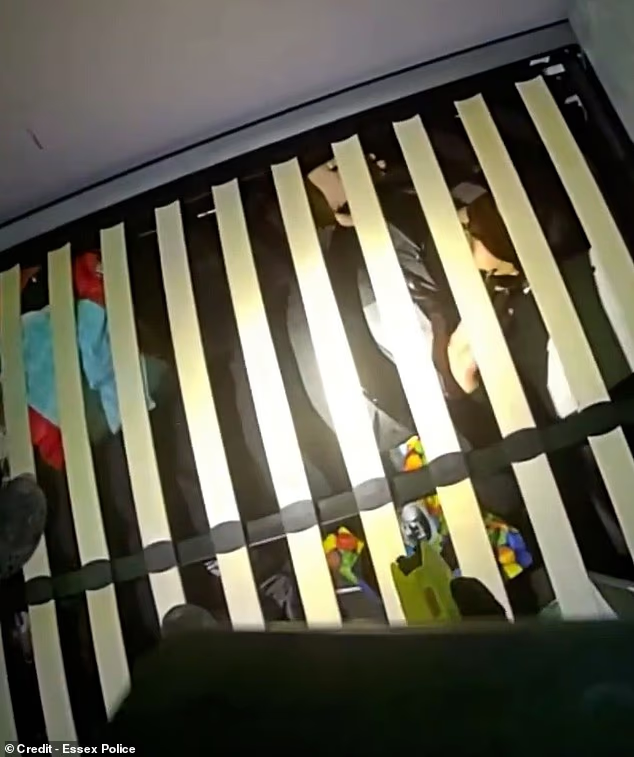
This is the moment armed police found a stalker hiding under a bed after he mowed down three people while speeding through the streets

This is the moment armed police found a stalker hiding under a bed after he mowed down three people while speeding through the streets.

Joseph Wicks, 27, of Colchester, mounted the pavement and hit pedestrians in a Fiat 500 on Queen Street on November 30 last year.

He fled the scene before police later found him hiding beneath a bed frame.

Footage shows officers telling Wicks ‘the game’s up’ as they shine a torch into his hiding place before arresting him.

Advertisement

During the driving incident, Wicks narrowly missed other members of the public as he drove the wrong way down one-way streets, sped along narrow roads and ignored red traffic lights.

He eventually abandoned the car in Wivenhoe Quay, where police discovered his fingerprints inside the vehicle, identifying him as the driver.

While Essex Police were investigating the incident, Wicks went on to commit further offences six months later.

A campaign of stalking and harassment against a woman culminated in an incident on May 8 this year, when Wicks was reported to have attended the victim’s address.

Advertisement

He shouted, swore and acted aggressively, banging on the front door and demanding to be let inside.

After Wicks returned to his van, a man approached and opened the passenger door to confront him about his behaviour.

This is the moment armed police found a stalker hiding under a bed after he mowed down three people while speeding through the streets

Advertisement
Joseph Wicks fled the scene before police later found him hiding beneath a bed frame

Joseph Wicks fled the scene before police later found him hiding beneath a bed frame

While Essex Police were investigating the incident, Wicks (pictured) went on to commit further offences six months later

While Essex Police were investigating the incident, Wicks (pictured) went on to commit further offences six months later

The man reported seeing a metal baseball bat and what appeared to be a handgun inside.

Wicks left the area but continued to bombard the woman with threatening phone calls and messages.

Advertisement

Following the report of a potential firearm, armed officers began searching for Wicks.

The following day, on May 9, officers located his van and discovered the baseball bat, but no firearm.

On May 11, officers arrived at another address, where several people claimed they had not seen Wicks.

However, police searched the property and found him hiding underneath a bed.

Advertisement

Wicks was arrested and charged with a string of offences, including dangerous driving, driving while disqualified, driving without insurance, failing to stop for police, three counts of assault by beating, three counts of attempting to cause actual bodily harm, stalking, possession of an imitation firearm with intent to cause fear of violence, sending threatening communications and criminal damage.

While Wicks admitted to many of the charges, he denied having an imitation firearm.

Appearing for sentence at Ipswich Crown Court on Friday, July 31, Wicks was jailed for four years and six months. He was also disqualified from driving for two years and six months.

Inspector Tom Stokes, of our Force Support Unit, said: ‘Our officers are trained to deal with some of the most challenging and high-risk situations policing can present.

Advertisement

‘Every deployment requires calm judgement, clear decision-making and the ability to assess rapidly changing circumstances while keeping the public, colleagues and themselves safe.

‘In this case, officers were tasked with locating and arresting a man linked to a series of serious offences, including dangerous driving which put members of the public at risk and a report involving what was believed to be a firearm. 

‘When information suggests there may be a weapon involved, we must plan carefully and act decisively.

‘The professionalism shown by the officers involved meant they were able to safely enter the address, carry out a thorough search and locate Wicks despite efforts to conceal himself. 

Advertisement

‘Their actions ensured a high-harm offender was brought before the courts and held accountable for his actions.

‘Much of the work carried out by armed officers happens out of the public eye, but it is built on extensive training, teamwork and a commitment to protecting communities across Essex. We will continue to target those who pose the greatest risk and ensure they are brought to justice.’

Source link

Advertisement
Continue Reading

NewsBeat

Seven men, aged 31 to 73, are arrested after ‘murder’ of father, 56, during mass brawl

Published

on

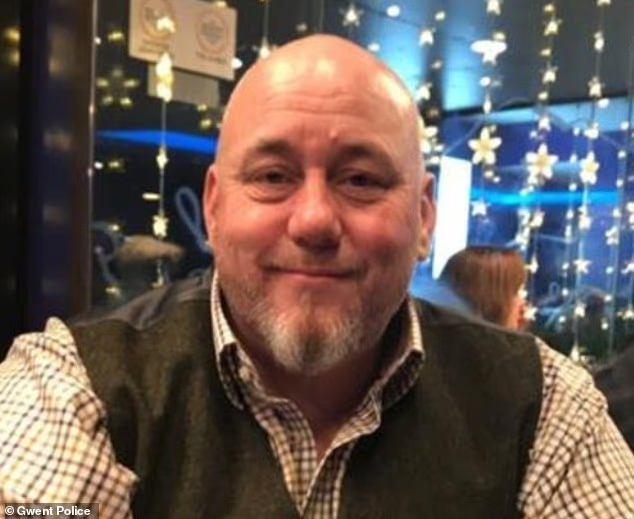
Tony Jones, 56, was killed during a mass brawl in Pontnewynydd, near Pontypool, Wales

Advertisement

Seven men have been arrested after a 56-year-old man was killed during a mass brawl in Wales. 

Tony Jones suffered life-threatening injuries in the incident in Pontnewynydd, near Pontypool, Gwent on Thursday evening.

Mr Jones, of Brecon, was taken to hospital but died later from his injuries.

Armed police raced to the scene alongside paramedics and the National Police Air Service.

Advertisement

Gwent Police said seven men – aged 31, 39, 40, 45, 59, 61, and 73 – have been arrested in connection with the disorder.

All seven remain in police custody. A murder investigation has now been launched.   

Tony Jones, 56, was killed during a mass brawl in Pontnewynydd, near Pontypool, Wales

Advertisement

The force is appealing for anyone with information to come forward.

Detective Superintendent Laura Bartley said: ‘We recognise that reports of this nature will cause concern in our community, but we have officers working around the clock conducting inquiries as part of the investigation.

‘We’re trying to establish the movements of those involved both before and after the disorder and are asking motorists who were driving along Hospital Road, Mill Road and the surrounding areas between 6pm and 9pm on Thursday to check their dashcam footage.’

Advertisement

Advertisement

Source link

Continue Reading

NewsBeat

Investigation continues after man seriously injured in Bolton incident

Published

on

Investigation continues after man seriously injured in Bolton incident

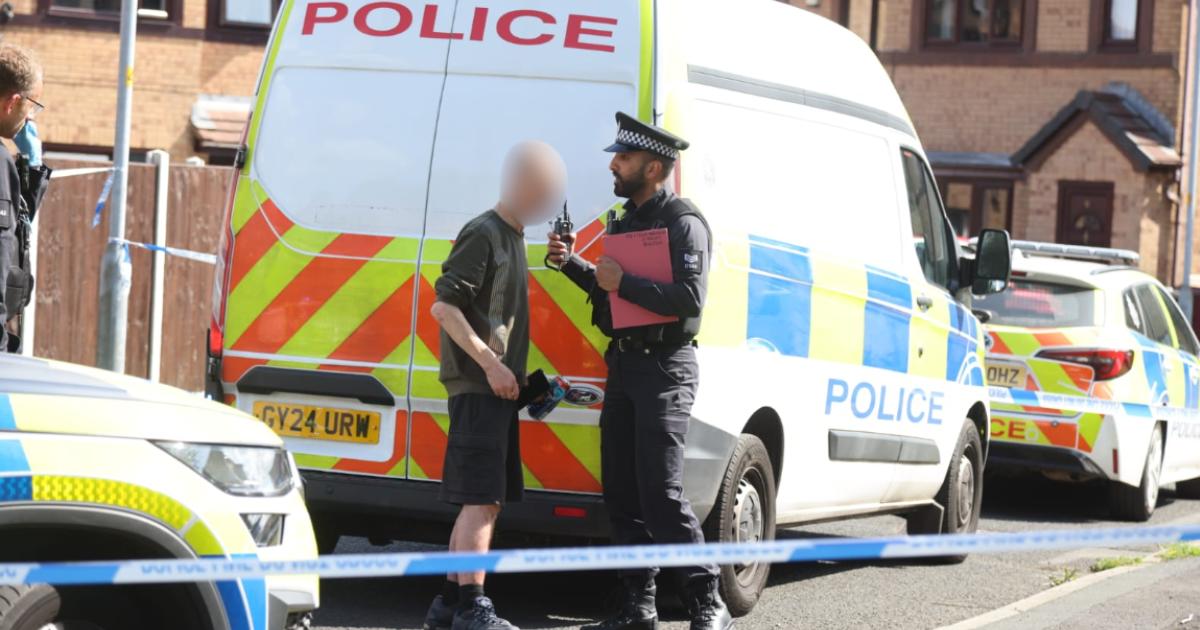
Greater Manchester Police have confirmed there is no further update following the incident in Spinning Meadows, Halliwell, on Friday afternoon (August 7).

Officers were called to the quiet cul-de-sac at around 2.25pm following reports of a man with injuries “consistent with a knife wound”.

A large number of police officers attended the scene, while an air ambulance also landed at the grounds of nearby Bolton Rugby Club.

The man was taken to hospital with serious injuries.

Advertisement

Several police vehicles were at the scene, with a section of the road taped off between two houses.

Ambulance crews were also in attendance, with some arriving by helicopter.

Spinning MeadowsGMP officers at the scene (Image: Phil Taylor)

Eyewitnesses reported that a “machete” had been involved in the attack, although this has not been confirmed by police.

Other witnesses said they had heard people at the scene suggesting the incident may have been connected to “bikes”.

Advertisement

However, this remains unconfirmed and is based solely on reports from people at the scene.

An emergency crew member was seen carrying a bleed kit, which is used to treat serious wounds.

Spinning MeadowsOne person who was seen speaking to police at the scene also appeared to have blood on them (Image: Phil Taylor)

As of 4.30pm on Saturday (August 8), no arrests have been made, and GMP said there is no further update at this moment.

The investigation remains ongoing, and the situation could change as police enquiries continue.

Advertisement

We will provide further updates from GMP as they become available.

Source link

Advertisement
Continue Reading

NewsBeat

Team Trump account trolls Taylor Swift after she allegedly gets her music removed from TikTok posts

Published

on

President Donald Trump's social media staff took a jab at Taylor Swift - pictured on June 9 - after she supposedly had her song august removed from his campaign's TikTok account

President Donald Trump’s social media staff took a jab at Taylor Swift after she supposedly had her song august removed from his campaign’s TikTok account.

Trump’s TikTok team posted another video using Swift’s song Red from her 2012 album of the same name.

It was accompanied by a mock-up photo of the album cover but instead of a close-up portrait of Swift wearing her signature red lipstick was a picture of Trump wearing his signature red MAGA cap and a faux ‘Red (Donald Trump‘s Version)’ playlist.

‘Did you know Taylor Swift wrote a whole album about the color of the Republican Party,’ read the needling message.

Advertisement

By Saturday midday, the Red audio track had also been removed from Team Trump’s TikTok by either Swift, 36, or someone in her camp. A pop-up note said: ‘This sound isn’t available.’

The latest musical tug-of-war comes after Swift, whose new husband was slammed for his ‘dad bod,’ allegedly disabled a Team Trump video on TikTok featuring her song august.

President Donald Trump’s social media staff took a jab at Taylor Swift – pictured on June 9 – after she supposedly had her song august removed from his campaign’s TikTok account 

Advertisement
The trolling post included a mock-up of Swift's Red album cover but instead of a close-up portrait of the singer wearing her signature red lipstick was a picture of Trump wearing his signature red MAGA cap and a faux 'Red (Donald Trump's Version)' playlist

The trolling post included a mock-up of Swift’s Red album cover but instead of a close-up portrait of the singer wearing her signature red lipstick was a picture of Trump wearing his signature red MAGA cap and a faux ‘Red (Donald Trump’s Version)’ playlist

The trolling White House clip that was posted four days ago showed the backs of Trump, 80, who said he ‘hates’ Swift, and First Lady Melania Trump, 56, as they watched fireworks light up the night sky.

The text appearing on the image read: ‘Mood because it’s August and Donald Trump is your president.’

Swift’s song august initially played on the soundtrack, and at the bottom of the post was a message from Team Trump saying: ‘I’m sure @Taylor Swift is going to be super excited we used her song!’ along with the hashtags #taylorswift #maga #august.

Advertisement

By Friday night, the audio was gone and replaced with a message that said: ‘The copyright owner hasn’t made this sound available in your country,’ and which just shouted Swift, whose ‘fairytale’ wedding left some guests ‘weirded out.’

The Daily Mail has reached out to a representative for Swift and the White House for comment but has not yet received a response.

The song august is from the singer–songwriter’s 2020 Folklore album. It’s a bittersweet track about a delicate and fleeting summer romance told from the perspective of a fictional teenage girl named Augustine. 

Swift’s fans rejoiced in the comments with one writing: ‘TAYLOR REMOVING THE AUDIO QUEEEEEEN.’ Another echoed: ‘TAYLOR QUEEN SWIFT.’

Advertisement

A third applauded the singer’s actions by saying: ‘TAYLOR REMOVED THE SOUND HAHAHA,’ and a fourth chimed in: ‘She removed it, clocked you guys.’

The latest musical tug-of-war comes after Swift allegedly removed her song august from a Team Trump TikTok video that showed the POTUS and First Lady Melania Trump watching fireworks

The latest musical tug-of-war comes after Swift allegedly removed her song august from a Team Trump TikTok video that showed the POTUS and First Lady Melania Trump watching fireworks

Swift, 36, now owns the copyright of all her songs and recordings including august and Red

Swift, 36, now owns the copyright of all her songs and recordings including august and Red

Team Trump TikTok followers were quick to comment about the president's 'obsession' with Swift after the latest stunt; the singer is pictured in 2024

Team Trump TikTok followers were quick to comment about the president’s ‘obsession’ with Swift after the latest stunt; the singer is pictured in 2024

Advertisement

And yet another Swiftie couldn’t resist teasing: ‘Hahahahaha you messed with the wrong successful woman,’ followed by the taunting words of another fan: ‘I hope taylor swift sues you and wins.’

Swift now owns the copyright of all her songs and recordings, including august and Red. 

She officially regained ownership of her original master recordings in May 2025 after a six-year battle.

This isn’t the first time Team Trump has borrowed a Swift track for its TikTok account. In November of last year, a video included the singer’s song Father Figure, which was also removed.

Advertisement

But another clip added in November plugging the president still includes Swift’s The Fate of Ophelia on its audio track. 

Friction between Trump and Swift began in October 2018 when the pop star endorsed Democratic candidates in Tennessee, prompting Trump to remark he liked her music ’25 percent less.’

But their hostile feud really erupted in September 2024 after Swift publicly endorsed Kamala Harris for president. 

‘I’m voting for @kamalaharris because she fights for the rights and causes I believe need a warrior to champion them,’ she wrote on Instagram.

Advertisement
Trump said, 'I HATE TAYLOR SWIFT!' after she publicly endorsed Kamala Harris for president in 2024; the president is pictured on Friday

Trump said, ‘I HATE TAYLOR SWIFT!’ after she publicly endorsed Kamala Harris for president in 2024; the president is pictured on Friday

The POTUS took a softer stance when responding to news of Swift's engagement to Travis Kelce, stating that he wished them 'a lot of luck' and calling Kelce a 'great player' and Swift a 'terrific person,' despite their ongoing political discord; Swift and Kelce are pictured in 2024

The POTUS took a softer stance when responding to news of Swift’s engagement to Travis Kelce, stating that he wished them ‘a lot of luck’ and calling Kelce a ‘great player’ and Swift a ‘terrific person,’ despite their ongoing political discord; Swift and Kelce are pictured in 2024

Trump swiftly retaliated on his Truth Social account, posting: ‘I HATE TAYLOR SWIFT!’

The POTUS took a softer stance when responding to news of Swift’s engagement to Kansas City Chiefs tight end Travis Kelce in August 2025. 

Advertisement

He stated that he wished them ‘a lot of luck,’ calling Kelce a ‘great player’ and Swift a ‘terrific person,’ despite their ongoing political discord.

But last month, minutes after Madison Square Garden’s billboard lit up with ‘JUST&T MARRIED,’ announcing Swift and Kelce had tied the knot, the official White House social media accounts on X and Instagram shared an AI-generated image with ‘TRUMP IS YOUR PRESIDENT’ alongside the caption: ‘IT’S HAPPENED!!!’

Source link

Advertisement
Continue Reading

Trending

Copyright © 2025