

Connect with us

NewsBeat

City Hall bosses are being ‘rewarded for failure’ over fare dodging, London Tory claims

Published

on

City Hall bosses are being 'rewarded for failure' over fare dodging, London Tory claims

“They’ve seen their fares go up. They do not care about New York. And quite frankly, I just want to make sure that here in London, the Mayor of London does not increase fares anymore until his office, finds a way to reduce the level of fare evasion, because we are literally subsidising criminal activity on our network.”

Source link

Continue Reading
Click to comment

You must be logged in to post a comment Login

Leave a Reply

NewsBeat

Dublin fire: Inferno near airport as smoke seen for miles and 999 crews swarm

Published

on

Daily Mirror

Fingal County councillors Cathal Boland and Eoghan Dockrell spoke to DublinLive at the scene of the fire.

Cllr Boland said: “When I was in Ballyboughal this afternoon, I came out of Giddy Up, the coffee cart, and I looked up to find this enormous blooming black smoke.

“I immediately tried to contact people I knew along the way, but I tracked down here and realised that there was a traffic problem.

“Traffic was back down the rural lane that the fire was on, so I immediately began to direct traffic.

Advertisement

“There’s been great cooperation from the public.”

Cllr Dockrell added: “I know that there were some people in nearby houses who were asked to move away.

“As far as I’m aware, nobody is injured and everyone is safe presently.

“This has been one of the largest fires to take place in north Dublin, and certainly Ballyboughal, in years and years.

Advertisement

“We have to say thank you to Gardai and the firemen for all the work they’ve been doing the past few hours.”

Flames and smoke pictured at a car scrap yard in Wimbletown(Image: Dublin Fire Brigade)

Source link

Advertisement
Continue Reading

NewsBeat

Thetford anti-immigration protests: Further arrests after two nights of disorder

Published

on

Daily Mirror

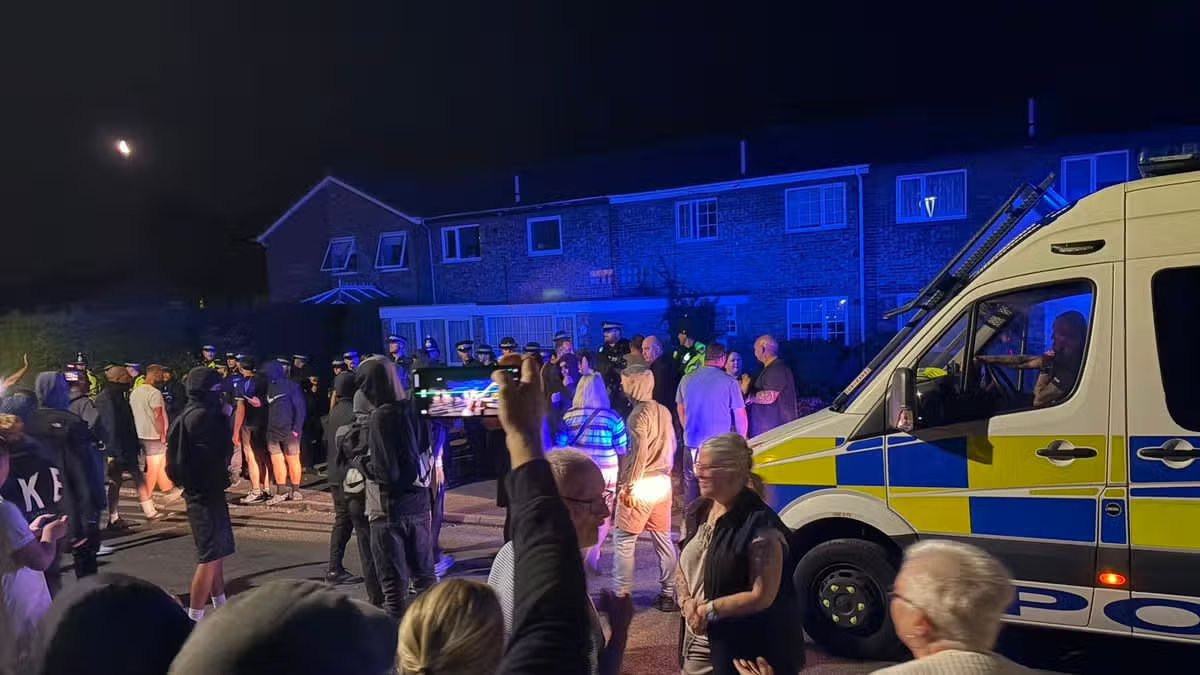
Two men were arrested on Thursday following two nights of disorder in Thetford, Norfolk, after people attempted to storm homes linked to asylum seekers and police officers were assaulted

Further arrests have been made in Thetford after crowds attempted to storm homes linked to asylum seekers and police officers were attacked.

Advertisement

Two men were arrested on Thursday, Norfolk Police confirmed, following two consecutive nights of unrest in the market town. One was arrested on suspicion of inciting racial hatred in connection with events on Wednesday. The other was held on suspicion of being drunk and disorderly and failing to provide his details to officers when requested.

Police powers were stepped up on Thursday evening in the aftermath of the earlier disorder. This followed officers being “subjected to significant aggression” on Wednesday, with one struck by a rock, one bitten and another spat at

Two officers were taken to hospital after responding to the scene at Clover Way that evening, which police described as “fast-moving and volatile” with tensions mounting as a crowd advanced towards a residential property.

Advertisement

On Tuesday night, windows were smashed, fences broken and attempts were made to force entry into a residential property, police said.

The protesters’ attempts to break into homes were fuelled by fears that the properties were being used to house asylum seekers.

Video footage circulating on social media appeared to show police escorting a number of asylum seekers away from properties in the area.

Eyewitnesses and social media users had condemned the police response, with reports suggesting that a woman in a mobility scooter was pepper-sprayed on Wednesday. The force defended their actions as proportionate and appropriate, including the deployment of Pava spray.

They stated that Pava, a handheld incapacitating substance similar to pepper spray, was deployed in response to an individual’s behaviour within the crowd.

A police spokeswoman added: “We understand that concerns have been raised about a woman using a mobility scooter who was affected during the incident.

“It was not the intention for any bystander to be impacted; however, where people remain within an area of active disorder and do not follow police instructions to move away, there is a risk they may be affected by tactics deployed to protect public safety.”

Advertisement

A resident of Clover Way, who wished to remain anonymous, revealed that at around 9.30pm on Wednesday “lots of young boys… came up on bikes and chucked eggs at the house”. The largely seated demonstration began “peaceful” until additional officers arrived and formed a line, she said.

Subsequently, “it started to get a little bit rowdy” and “people took a step forward towards the police”.

Nobody attempted to enter the property, she said, noting that police “started pepper-spraying people”, including “a lady in a wheelchair”.

There were “a few young idiots picking up stones, lobbing them at a police car”.

“They brought a riot van down and blocked the front of the house,” she said, adding that officers brandished batons, made arrests and instructed people to disperse. Norfolk Police confirmed that two arrests were made on Wednesday night on charges including public order offences, harassment and possession of an offensive weapon.

One man in his 40s remains in police custody.

Brian Thompson, 68, of Fairfields, Thetford, has been charged with possession of an offensive weapon, namely a wooden bat. He has been released on bail and is due to appear before Norwich Magistrates’ Court on August 25.

Advertisement

A man in his 30s, who was arrested on Wednesday in connection with Tuesday’s incidents on suspicion of a public order offence, has since been released and issued with a conditional caution.

Source link

Continue Reading

NewsBeat

Body found in search for missing man last seen heading to climbing spot

Published

on

Manchester Evening News

He was believed to have been intending to go rock climbing before he was reported missing on Wednesday, August 5

A body has been discovered during the search for a missing rock climber.

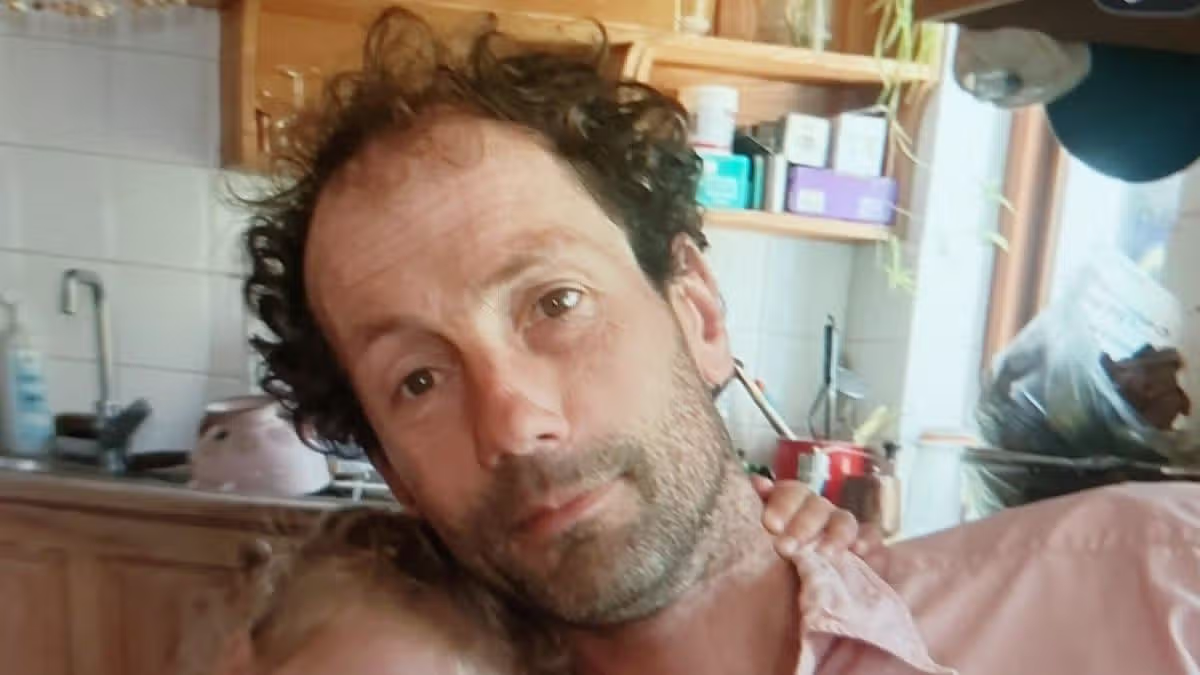
Ben, from St Davids in Pembrokeshire, is believed to have been planning to go rock climbing before he was reported missing on Wednesday, August 5.

Advertisement

Dyfed Powys Police confirmed that on Thursday, a body was found in the coastal area of Caer Bwdy, Pembrokeshire.

In a statement released on Thursday evening, the force said: “Formal identification has not yet taken place, and while the family have been informed of this development, we are not in a position to confirm the identity of the deceased at this time. They are being supported by specially trained officers.

“We ask that the family’s privacy is respected while enquiries continue.”

Ben, 47, is thought to have been heading out for a rock climbing trip when he left his St Davids home on Wednesday, August 5 at around midday, reports Wales Online.

Advertisement

It is understood he had planned to travel to either the Carreg y Barcud area, near Trelerw, or Caer Bwdy Bay, on the outskirts of St Davids in Pembrokeshire.

After hours passed without any contact, Ben’s family raised the alarm and emergency services were alerted.

Both a Coastguard vessel and helicopter have been deployed as part of the search operation.

Source link

Advertisement
Continue Reading

NewsBeat

Major disruption for Bolton commuters after rail power failure

Published

on

Major disruption for Bolton commuters after rail power failure

Several trains to and from Bolton have been delayed, with some services running more than 30 minutes behind schedule as passengers face delays during the afternoon.

According to National Rail, the problem has been caused by a failure of the electricity supply at a rail communications centre, affecting signalling and operational systems across parts of Greater Manchester, the Midlands and the North West.

The disruption is impacting several train operators, including Northern, Avanti West Coast, East Midlands Railway, London Northwestern Railway, Merseyrail, TransPennine Express and Transport for Wales.

Advertisement

Responding to passengers on social media platform X, Northern warned that services were likely to be delayed because of the power outage.

In one reply, the operator said: “It is likely to be delayed due to the power outage. I am sorry for the disruption this will cause.”

Northern also apologised to affected passengers, adding: “We are really sorry for the disruption to your journey.

“Please make sure to apply for a refund by calling us on 0800 200 6060 or emailing sales.support@northernrailway.co.uk.”

Advertisement

The train operator said the power failure had also affected its control building, making it difficult to arrange alternative travel for passengers.

A spokesperson added: “The power issue is affecting all lines and our control building so we are unsure when any alternatives would be able to be booked at this time.

“We are working to get this fixed as soon as we can.”

National Rail said the incident was first reported shortly after 2pm and warned that trains could continue to be cancelled, delayed or revised while engineers work to restore power.

Advertisement

Disruption is currently expected to continue until around 4pm, although this could change.

Passengers travelling to or from Bolton are being urged to allow extra time for their journeys and check the latest travel information before setting off.

Those delayed may also be entitled to claim compensation through their train operator’s Delay Repay scheme.

Advertisement

Source link

Continue Reading

NewsBeat

Lessons from Canada on assisted dying

Published

on

Lessons from Canada on assisted dying

Prime Minister Andy Burnham has argued that parliament should wait before returning to assisted dying until palliative and social care are properly funded. His intervention comes before MPs are due to debate a new assisted-dying bill for England and Wales on September 11.

Public debate often centres on people with terminal illnesses who are experiencing unbearable suffering and want greater control over how they die. Burnham’s argument raises a wider question: can a choice be fully voluntary when access to palliative care, social care, suitable housing or practical support restricts the alternatives someone believes are available?

Supporters argue that failures in care should be addressed without indefinitely denying terminally ill adults an autonomous choice. Our comparative analysis of parliamentary debates in Canada and England and Wales nevertheless shows why the language surrounding that choice deserves attention.

Advertisement

Politicians sometimes present choosing when and how to die as an expression of independence, courage or dignity. Others suggest that avoiding dependence on relatives or public services can be part of behaving responsibly in later life. A 2025 ethical analysis argues that framing assisted death as both an autonomous choice and a social responsibility could create pressure on older people who need care.

This does not establish that requests are generally caused by poverty, pressure or inadequate services. But it does raise questions about how circumstances can shape a decision without amounting to direct coercion.

Different systems

Canada’s medical assistance in dying law, known as Maid, allows practitioner-administered and self-administered deaths, although every recorded Canadian Maid provision in 2024 was practitioner-administered.

The terminally ill adults (end of life) bill would create a narrower system in England and Wales. It would apply to adults with decision-making capacity who have an inevitably progressive illness or disease and are reasonably expected to die within six months. They would have to take the final action that causes their death themselves.

Advertisement

Suffering is not a separate eligibility requirement. The bill instead requires a clear, settled and informed wish, made voluntarily and without coercion or pressure from another person.

MP Lauren Edwards reintroduced the bill in June 2026 after the previous version passed the Commons but fell because it did not complete its Lords stages before the parliamentary session ended. Its second reading is scheduled for September 11.

Canada’s law also changed after its introduction. Following the Supreme Court decision in Carter v Canada, parliament legalised Maid in 2016 for adults with a grievous and irremediable condition, advanced irreversible decline, enduring intolerable suffering and a reasonably foreseeable natural death.

In 2021, parliament removed foreseeable death as an eligibility requirement. Canada now distinguishes between Track 1 cases, in which natural death is reasonably foreseeable, and Track 2 cases, in which it is not. England and Wales would not inevitably follow the same course, but Canada shows that eligibility rules and safeguards can be substantially revised after legalisation.

Advertisement

What Canadian evidence can show

Health Canada recorded 16,499 Maid provisions in 2024. Of these, 95.6% were Track 1 and 4.4% were Track 2.

The distribution across neighbourhood income groups was broadly similar to that of all people who died from natural causes. Track 2 recipients were slightly more likely than this comparison group to live in the lowest-income neighbourhoods. Compared with Track 1 recipients, they were also slightly younger and more likely to be women or live alone. More lived in neighbourhoods with high residential instability.

These area-level measures do not reveal an individual’s income, housing conditions or reasons for requesting Maid. They cannot establish whether disadvantage contributed to a particular decision.

An Ontario chief coroner’s committee examined three deliberately selected Track 2 deaths involving possible social or structural vulnerability, including isolation, unsuitable housing and inadequate support. The committee stressed that the cases were not representative. They show the questions unmet needs can arise during an assessment without indicating how often these circumstances occur.

Advertisement

Practitioners reported that 74.1% of all recipients had received palliative care, compared with 23.2% of Track 2 recipients. The groups had different illnesses and proximity to death, and the figures do not establish whether available care was appropriate or adequate.

Small qualitative studies show that bereavement experiences vary. Interviews with nine people found that knowing the date of death could allow farewells and family rituals while creating an emotionally intense countdown. A separate study of 12 people who had experienced disagreement around Maid, documented unacknowledged pain and disenfranchised grief. Neither study shows how common these experiences are.

Choice and social circumstances

Our analysis suggests that praising assisted death as inherently brave or dignified risks creating an implicit contrast with people who continue to need care. Treating avoidance of dependence as socially responsible may reinforce fears of becoming a burden.

Advertisement

The England and Wales bill requires two doctors and a review panel to assess eligibility. Doctors must examine relevant records, make inquiries of health and social care professionals where appropriate, and discuss available treatment, palliative care, hospice care, symptom management and psychological support.

These are substantial safeguards. The bill does not, however, list an applicant’s reasons or unmet social needs as separate eligibility tests. Nor does it expressly require assessors to decide whether inadequate care or housing has narrowed the alternatives the applicant believes are available. A person may feel like a burden even when nobody has pressured them directly.

Reliable monitoring would therefore need information about applicants’ circumstances, access to care and reasons for requesting assistance. Canada’s data shows how difficult it is to assess inequality when official records rely heavily on neighbourhood measures and contain limited information about unmet needs.

Personal choice remains central to the case for assisted dying. Parliament should also consider how care shortages, isolation and fear of dependence may shape that choice before changing the law.

Advertisement

Source link

Continue Reading

NewsBeat

Westhoughton Park Road motorcycle and van crash

Published

on

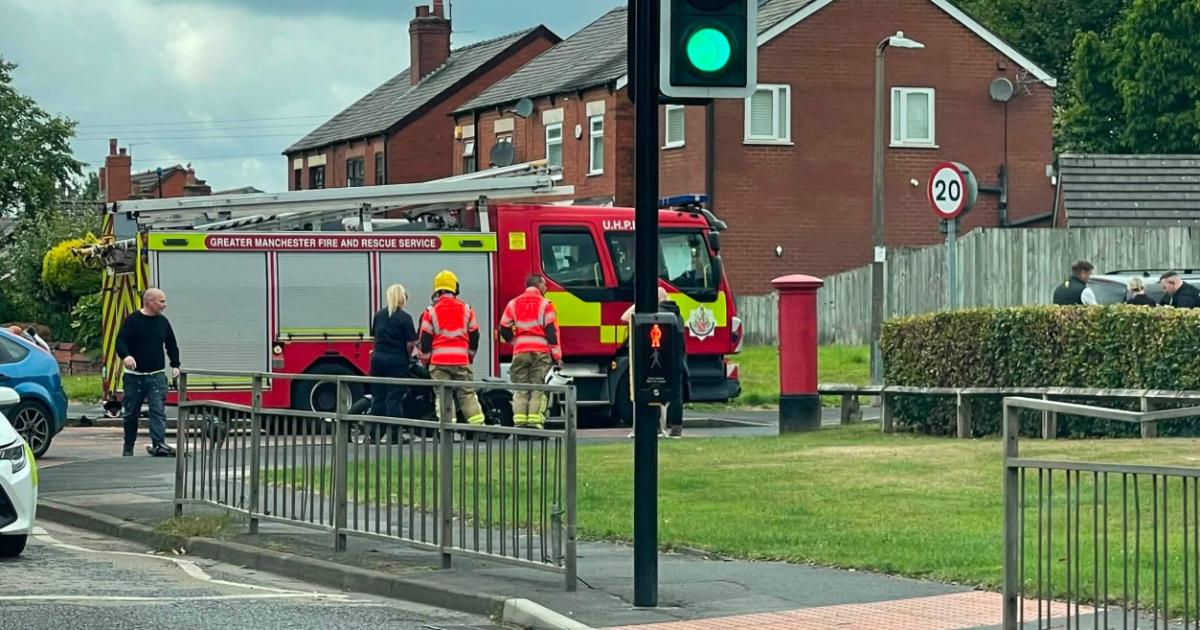
Westhoughton Park Road motorcycle and van crash

The incident began at around 12.55pm this afternoon (Thursday, August 6), when fire services were called to the scene due to a collision between the motorcyclist and a van.

One fire engine was called to the scene, taking around 35 minutes to ensure the area was safe before leaving.

(Image: David Wilkinson)

A spokesperson for Greater Manchester Fire and Rescue: “At 12.55pm on Thursday, August 6, one fire engine from Bolton Central was called to a road traffic incident between a motorbike and van on Park Road, Westhoughton.

“Crews arrived quickly and made the area safe and were on the scene for approximately 35 minutes.”

Advertisement

Greater Manchester Police also stated: “It was a minor road traffic collision involving a motorbike and a van. No injuries reported, no arrests made.”

The incident took place at the junction between Park Road and Captain Lees Road, near the Unsworth Group Practice.

Westhoughton Cllr David Chadwick said: “It’s a difficult one. As we get more and more development in the area it increases the likelihood of these things happening.

“Park Road has become an arterial route.”

Advertisement

Park Road is a particularly busy road, and is frequently the site of crashes.

In April, Park Road was the site of a motorcycle crash which left the rider ‘seriously injured.’

There was another collision later that same day, this time involving a car.

Cllr David Wilkinson, who saw the latest crash, said: “By the time I arrived we just saw the fire engines and all the motorbikes.

Advertisement

“Everybody was just stood around looking at it.

“It seems like every time I look on my phone at the moment there’s another crash story.

“It’s one of the reasons I get so concerned about potholes. With four wheels it can be dangerous, but with two wheels you can be killed.”

Adding to difficulties for drivers, there is also work being undertaken further up the road on a large pothole.

Advertisement

Source link

Continue Reading

NewsBeat

Family of British missionary found dead in Athens suitcase speak of ‘deep pain’

Published

on

Manchester Evening News

Elisabeth-Jane Ross, 38, known as Lisa, was found dead in a derelict building in the Kypseli area of Athens on Saturday, July 18

The family of a Scots woman murdered in Greece have spoken of their “deep pain” following her tragic death. Elisabeth-Jane Ross, 38, known as Lisa, was discovered by a homeless man in an abandoned building in the Kypseli district of Athens on Saturday, July 18.

The missionary has been described by her loved ones as “selfless”, with those closest to her adding that she “dedicated her life to helping others in need”. Sharif Ahmadzai, 26, appeared before a court in the Greek capital facing suspicion of killing the aid worker, alongside weapons offences and robbery charges.

Advertisement

Lisa had travelled to Greece from Edinburgh on Friday, June 26 and had initially been staying with friends in Piraeus, a port district of Athens.

Her family said: “Lisa will always be remembered by us as kind, principled and selfless.

“Her integrity was absolute, and she dedicated her life to helping others in need. We are in deep pain, and we ask for time and privacy as we come to terms with our loss.”

Advertisement

On Thursday, Ahmadzai — a professional boxer from Afghanistan — attended the Court of First Instance in Athens, where he was held on charges of illegal weapons possession and homicide with intent. Ahmadzai’s solicitor Christos Erdos confirmed his client remained silent throughout Thursday’s hearing, reports the Daily Record.

He entered no plea in connection with any of the three charges he faces. It is understood he denies murder and claims he discovered Lisa already dead on the bathroom floor.

The court complex is situated on the city’s Evelpidon Street, a short distance from the derelict building where the charity worker’s body was discovered. Floral tributes have been laid on the ground beside the structure, with one card bearing the words “Elisabeth-Jane Ross. Rest in peace” written in Greek.

Police confirmed the suspect was taken in for questioning after investigators examined nearby surveillance camera footage. Following the alleged killing of Ms Ross, Ahmadzai is accused of sending a series of messages from her phone to her friends and family before switching the device off.

Advertisement

He is then alleged to have purchased another phone and texted her friends in Athens, including his wife, while impersonating an unnamed jihadist claiming he had killed the Scot because of her religion, Greek newspapers Proto Thema and Ta Nea reported.

The newspapers revealed that his wife, a US citizen named Alaina Hall, told police she had grown suspicious of her husband’s involvement in the killing when she awoke to find him absent from their apartment and tracked his phone to the location where Ms Ross had been staying.

Ahmadzai’s lawyer has also claimed that his rights “have been violated”. In a statement released to the media, Paraschis-Erdas and Associates said that the leak of “information and documents” amounted to the violation.

Advertisement

The firm claimed that there were “no injuries whatsoever” and that “there was a complete absence of any obvious cause of death”.

The statement went on to say: “His approach toward the prosecutorial and investigating authorities was therefore not one of refusal to cooperate, but rather one of reservation, so that he could provide a full statement once the case file had been completed with the above essential documents.

“These documents had not been sought by the pre-trial investigating authorities. The sole objective is to establish the substantive truth, for the benefit of both sides.”

Ms Ross is thought to have passed away several days before she was discovered, during a period when temperatures soared to 36C. Authorities were able to confirm her identity through fingerprint analysis.

Advertisement

The Foreign and Commonwealth Office stated: “Our thoughts are with Elisabeth’s family during this difficult time. We are providing consular support and are in contact with the local authorities.”

A Police Scotland spokesperson commented: “We are aware of the death of a Scottish woman in Athens and are liaising with authorities in Greece. Officers are providing support to her family in Scotland.”

Source link

Advertisement
Continue Reading

NewsBeat

First week of Burlesque the Musical in Sunderland dates axed

Published

on

First week of Burlesque the Musical in Sunderland dates axed

The show had been scheduled to open today (Thursday, August 6), at Sunderland Empire, but has now been postponed until Thursday, August 13, due to “technical requirements”.

The delay has led to the cancellation of performances originally planned for the first week – and affected ticket holders have been offered vouchers to rebook.

However, one fan claimed: “The same tickets are more! How do you work that out?”

Advertisement

Another simply said: “Not impressed!”

The postponement came just days before the start of the show’s UK tour, which was originally meant to begin in Woking before being shifted to Sunderland.

Burlesque the Musical is based on the 2010 film starring Christina Aguilera and Cher, which featured hit songs such as Express, Show Me How You Burlesque, and Cher’s Golden Globe-winning You Haven’t Seen the Last of Me.

The stage adaptation made its debut in Manchester in the summer of 2024 before moving to Glasgow and then London’s Savoy Theatre.

Advertisement

It was due to return to London for a run at the new Arts Theatre in Marble Arch this September, but that engagement has now been postponed until 2027.

The revised schedule means Sunderland is now the first stop of the tour, though its run at the Empire will be shortened by a week due to the delays.

The last-minute change has caused frustration for many who had planned to attend during the original opening week.

Advertisement

Source link

Continue Reading

NewsBeat

Rapist ‘had been dead for some time’ before being found in Cambs prison

Published

on

Cambridgeshire Live

He was sentenced to 16 years in prison in 2015

A rapist who died inside a Cambridgeshire prison “had been dead for some time” before his body was found by prison officers. Jason Sedgwick, 40, died at HMP Littlehey on January 25 following convictions for a number of sex offfences which happened in Long Eaton in Derbyshire more than 10 years ago.

Advertisement

He pleaded guilty to rape in 2015 and was handed a 16-year jail sentence. Derby Crown Court heard how he had raped a woman on the grounds of Long Eaton Library after a night out. He was also sentenced for two sexual assaults which happened before the rape. He denied the charges but was found guilty by a jury on both counts.

The Prison and Probation Ombudsman (PPO) launched an investigation inth Sedgwick’s death in January after his cause of death was confirmed to be cardiac arrhythmia and ischaemic heart disease. The PPO found that prison officers failed to properly check on Sedgwick during routine head counts, which meant he had likely been dead for some time before his body was found.

The report also found that his health was not properly monitored. Sedgwick had a BMI of 40 in 2022, which is well above the NHS‘ ‘obese’ threshold which is set at 30. In a post-mortem, Sedgwick’s weight was recorded as 128kg, 10kg less than when his last BMI measurement had been taken four years prior.

Sedgwick was transferred to HMP Littlehey in June 2021 from HMP Nottingham, and before this change he had seen a nurse and had been prescribed 28 days’ worth of medication for sciatica, anxiety and depression. But when a GP saw Sedgwick for a medication review 10 days before his death, he was still taking the sciatica medication, which he was then advised against because of the risk of developing stomach and kidney issues.

Advertisement

Sedgwick said he wanted to continue on the medication as it was managing his pain and his blood pressure was acceptable. But the PPO found that he didn’t regularly attend the prison’s healthcare department and he hadn’t undergone an NHS health check before his death. The health check would have measured his liver function and cholestrol levels to determine his risk of having a heart attack or a stroke.

Following his death, more than 1,000 tablets were found under his bed. Whilst toxicology reports didn’t identify an excess of medication in his system at his time of death, the PPO said it was “concerning” that this had not been monitored.

The PPO also said that the officer’s head count on the day of the 40-year-old’s death was “ineffective”. When Sedgwick’s cell was checked during the 7am roll check on the day of his death, the prison officer didn’t turn on the night light. He claims it was dark and he didn’t have a torch as these aren’t provided by the prison. He claimed he could hear Sedgwick snoring and “interpreted it as a sign of life before moving on with his checks”.

At 8.45am on the same morning, another officer started unlocking prisoners and when opening Sedgwick’s cell, found him face down on the floor. When he was found, he was “cold and rigid”. An ambulance was called and he was pronounced dead at 9.21am.

Advertisement

The prison’s head of safety told the PPO that at the time of Sedgwick’s death, the prison didn’t give staff torches however they have now been purchased for night staff.

An inquest into Sedgwick’s death on July 9 concluded that he died of natural causes. He’s the 42nd inmate to die at the prison since January 2022. Of those previous deaths, 37 were natural causes and four were self-inflicted.

The Prison Service has been contacted for comment.

Source link

Advertisement
Continue Reading

NewsBeat

‘All we get is retirement flats they can’t sell’ in Cambridgeshire town

Published

on

Cambridgeshire Live

Cambourne residents have voiced strong objections to retirement flat plans, with concerns over expected amenities including a pub for the South Cambridgeshire town

CambridgeshireLive readers have been debating proposals for Cambourne’s centre, the prospect of a new pub, and whether previous pledges have been honoured. Numerous comments centred on trust, finances, and what the town genuinely requires at present.

Residents have been left feeling frustrated over plans for retirement apartments after being “promised” a pub or community facility. Should the application receive approval, land off Back Lane, north of the Holiday Inn Express in Cambourne, would be transformed into 58 retirement apartments.

Advertisement

South Cambridgeshire District Council’s Planning Committee is scheduled to examine the proposals at a meeting on August 12, 2026. Cambourne Town Council said the application has “attracted significant interest and objections from members of our community”, noting that the Committee’s decision will be “an important one for Cambourne”.

The application, lodged by McCarthy Stone Retirement Lifestyles Limited, seeks to provide 58 apartments for individuals of retirement age and older. Of the 58 apartments, 39 would comprise one-bedroom units and 19 would be two-bedroom properties.

One of our readers, Fatsi comments: “We were promised 2 million pounds of new shops, then they said there were sewer pipes in the way. They closed down the police station and still haven’t told us why. We were promised a McMullens pub on that land, and all we get in Great Cambourne is retirement flats they can’t sell.”

Calumen Nomen said: “Pubs are closing by the dozen. No one is going to open a new one as long as this miserable excuse for a government is in place.”

Advertisement

2ndincommand writes: “Developers say all sorts of things in their applications. When Cambourne was first mooted, there was a golf course and an ice rink in it. What happened to them?”

Over on our Facebook page, Kevin S asks: “Does any company WANT to put one of their pubs there?”

Jayne R comments: “Retirement apartments, when I went to the concept centre years ago, when Cambourne was in its infancy, there were no plans for anything like that or social housing. Now they want a pub? Oh well, another slum in the making. Cambourne already has plenty of retirement flats which aren’t selling. More social facilities are needed in the centre of the town.”

What do you think would be the best option for Cambourne? Leave your thoughts below in the comments section or HERE.

Advertisement

Source link

Continue Reading

Trending

Copyright © 2025