Some city roads are closed as emergency services deal with a fire. Emergency services, including fire and police, attended a building fire in Russell Street,Peterborough, on Tuesday (February 18).
Advertisement
More than 30 firefighters were called to the fire just after 7.30am. Multiple crews arrived to find the fire “spreading quickly”.
While emergency services are at the scene, a number of roads are closed. These are roads surrounding Russell Street, including Cromwell Road and Gladstone Street.
Cambridgeshire Police has warned people to “avoid the area”. In a social media post, a police spokesperson said: “We are currently at the scene of a fire in Russell Street, Peterborough.
“As a result there are a number of emergency service vehicles on the road and road closures in the surrounding area. Please avoid the area and find an alternative route if possible.”
Scotland and parts of northern England are expected to be affected by Storm Dave in the coming hours.
Disruption could be seen on roads, as well as on rail, air and ferry services, so whether you’ve got travel plans or are interested in seeing where the storm is, here’s how you can track it.
⚠️⚠️ Amber weather warning issued ⚠️⚠️#StormDave brings strong winds across northern England, southern Scotland and northwest Wales
Brits can track Storm Dave via the Met Office website today through to tomorrow.
Advertisement
The Met Office’s tracker allows you to see the movement of Storm Dave and the impact of the storm.
You can see the rainfall, wind gusts, cloud cover and temperature as the storm moves across the UK.
#StormDave has been named and is forecast to bring damaging winds across northern parts of the UK, with some disruptive snow possible in northwest Scotland later on Saturday and into Easter Day #WeatherAwarepic.twitter.com/J0NZYD2SPC
Up to 30 centimetres of snow could fall, with the Met Office issuing a yellow severe weather warning in Scotland for heavy snow and blizzards, causing some travel and power disruption.
Advertisement
Meanwhile, an amber weather warning for wind has been issued for parts of northern England, Scotland and Wales tonight.
The Met Office has upgraded a severe yellow weather warning for wind to amber, meaning flying debris could lead to “injuries or danger to life”.
What different Met Office weather warnings mean
The amber warning covers parts of Lancashire, North Yorkshire, Northumberland, North Wales and Scotland, and comes into effect at 7pm this evening and is due to remain in place until 3am on Sunday.
When is Storm Dave expected to hit the UK?
The warnings are in place this evening and tomorrow morning, with the storm expected to hit during this period.
Advertisement
Storm Dave will hit hardest on Saturday evening, before beginning to weaken on Sunday as it moves into the North Sea.
Recommended reading:
The Met Office has issued multiple warnings for wind covering the whole of mainland Scotland, Northern Ireland, parts of northern England and North Wales from Saturday evening into Sunday.
Greg Dewhurst, a Met Office meteorologist, said: “There is cold air across Scotland at the moment and, as the rain pushes across this afternoon, it is going to turn to snow.
Advertisement
“We’ll see heavy snow forming across parts of the Highlands as we go through the rest of the afternoon into the evening time and early hours, as much as 20 to 30 centimetres could fall over the higher ground, and five to 10 centimetres over lower ground.”
Will you be tracking Storm Dave? Let us know in the comments.
Nick Woltemade only joined Newcastle United last summer (Picture: Getty)
Dietmar Hamann has described Nick Woltemade’s struggles at Newcastle United as ‘remarkable’ and says it has presented Eddie Howe with a ‘really tricky situation’.
The 24-year-old enjoyed a bright start to his St James’ Park career, however, scoring six goals before the start of November and impressing with his all-round play.
Advertisement
But Woltemade’s contributions began to fall away over the winter period and the German has now scored just once in his last 22 appearances in all competitions.
The towering forward has even been used slightly deeper by an increasingly desperate Howe but Newcastle legend Alan Shearer has dismissed the notion he can play in midfield.
Hamann insists his compatriot’s drop-off is ‘very strange’ and has raised the possibility that Woltemade will now be sold after just one season.
Get your football fix
Metro‘s weekly newsletter In The Mixer delivers punchy analysis and breakdowns of the biggest football stories directly to your inbox.
Woltemade enjoyed a bright start to his Newcastle career (Picture: Getty)
‘I couldn’t believe the developments in the last few weeks and months regarding Nick Woltemade,’ Hamann told BoyleSports.
‘There was a story in one of the German papers that he hasn’t settled in the North-east, which I personally think is a paradise for a footballer, because if you’ve got a bit of success, they treat you as a hero.
Advertisement
‘He had a great start and was adored by the faithful, adored by the fans. It’s obviously a very strange situation because if you had told me this after six or eight weeks, where he scored a few goals, I would have said he’s going places and he’ll be one who might be there for a few years, who is loved and adored by the people.
Eddie Howe is faced with a ‘really tricky situation’ (Picture: Getty)
‘To have the turnaround now in a short space of time is really remarkable. What you hear and what you see probably makes me think that there might be a summer exit, which is obviously not a good situation for the club because they paid an awful lot of money.
‘Do you force him to stay here? Is that a good solution? And who’s going to pay the money for him now?
‘So, yeah, I think it’s a really tricky situation for both of them, for both parties, but especially for the club.’
If Newcastle do end up selling Woltemade, Hamann believes former Manchester United and Chelsea transfer target Victor Osimhen would be the ‘perfect’ replacement.
Advertisement
Victor Osimhen has long been linked with a Premier League move (Picture: Getty)
Osimhen has scored an impressive 56 goals in 70 games since joining Galatasaray in 2024 and helped Napoli win the Serie A title before his move to Turkey.
‘I think Victor Osimhen is one of the top five centre forwards in Europe,’ ex-Newcastle, Liverpool, Manchester City and Bayern Munich midfielder Hamann added.
‘I couldn’t believe that he ended up in Turkey. Obviously, Napoli paid an awful lot of money for him, but I’m very surprised that none of the English teams signed him, because they all struggled for centre forwards in the summer.
‘They tried for players like Benjamin Sesko, and other players who have come in are only just starting to adapt now because they obviously needed some time.
‘I think he’s an outstanding player and I think he’s probably the reason why Galatasaray is doing well in the league.
Advertisement
‘I love watching him and I think, if he were to play in the Premier League, there are teams he would make much better.
‘Obviously, Liverpool have got two players there now, so he won’t end up there, but he’s an outstanding player. He’s got pace, he’s got power, he can finish, a wonderful player.
‘If Newcastle do sell Nick Woltemade, he could be the perfect fit.’
Motorists are being urged to avoid the area if possible
Peter Hennessy UK & World News Editor
03:55, 05 Apr 2026
A busy road has been closed by police after a serious crash.
Police Service of Northern Ireland [PSNI] have urged drivers to avoid the area if possible after the collision on Castlecat Road, Dervock in the early hours of Sunday, April 5.
Advertisement
Police say the road has been closed until further notice and drivers should use alternative routes if they are able to.
A spokesperson for PSNI said: “Road users are asked to avoid the Castlecat Road, Dervock, which is closed due to a serious one vehicle road traffic collision.
“Diversions are in place, and motorists should seek an alternative route where possible.”
A missing U.S. fighter pilot who was shot down in Iran has been rescued, Donald Trump has announced.
“WE GOT HIM! My fellow Americans, over the past several hours, the United States Military pulled off one of the most daring Search and Rescue Operations in U.S. History,” the president posted on Truth Social late Saturday night.
New VAT and Insurance Premium Tax rules will increase costs for Motability Scheme applications from 1 July 2026, with changes to mileage allowance and tyre replacement limits
The Motability Scheme is set to undergo significant changes as updated regulations drive up costs from July. The alterations stem from tax adjustments announced in the Labour Government’s Autumn Budget last year, which will have a direct impact on the scheme.
Advertisement
From 1 July 2026, VAT and Insurance Premium Tax (IPT) will apply to leases on the DWP Motability Scheme. Consequently, leasing a vehicle will become considerably more expensive, and the overall cost of delivering the Scheme will rise substantially.
There are several key points to note. The changes apply to new applications submitted on or after Tuesday, July 1 2026. The organisation states: “When considering changes, priority has been given to protecting what matters most to disabled people, reducing the impact of the tax changes as far as possible and providing good value.
“Alongside Motability Operations, we remain dedicated to providing the Motability Scheme now, and for years to come, with a continued strong focus on customer service, affordability and choice.”
VAT
For those who currently hold a lease, Motability officials confirm that nothing will change for the time being, reports Birmingham Live.
Advertisement
Where VAT is applied to a lease, it will not affect the lease payments deducted from your mobility allowance. Rather, VAT will be charged at the standard rate on other lease costs including your Advance Payment, excess mileage fees and early termination charges.
Mileage allowance
Regarding mileage allowance, new leases will feature:
Cars: 30,000 miles across three years
Wheelchair Accessible Vehicles: 50,000 miles across five years
Officials report that roughly three-quarters of customers travel within this revised allowance, with a typical annual mileage of around 7,500 miles. Those who exceed this limit will have the option to purchase additional miles, the foundation confirms.
It added: “We recognise that some customers may need to drive more miles for a variety of reasons, and we are currently looking at ways we may be able to mitigate the impact of these changes for customers in some limited exceptional circumstances.”
Tyre replacement
On tyre replacement, from 1 July, a Scheme lease will cover:
Advertisement
Up to six tyres during a three-year lease, with up to four replacements available for accidental damage
Up to 10 tyres during a five-year lease, with up to six replacements available for accidental damage
Most customers require two tyre replacements over the course of a three-year lease, and these updated limits have been set to reflect what the vast majority of drivers need through standard use, the foundation states. With regard to EU breakdown cover, drivers will still be permitted to take their vehicle abroad, but must request a VE103 form from the RAC and pay an administration fee.
EU breakdown cover
In the previous year, fewer than one per cent of customers made use of EU breakdown cover. For those already holding a lease, Motability representatives confirm that nothing will change during your current agreement at this stage.
They stress that these modifications apply solely to new applications made from 1 July 2026 onwards.
Manchester United have a number of transfer options open to them as we head towards the summer window
As Manchester United prepare to cement their place in the top four, attention has begun to turn to their summer business. The club may have some lofty ambition in the transfer market but there are also some deals which could be much easier to wrap up.
Advertisement
In recent windows, United have opted to include buy-back clauses when offloading some of their players. They haven’t always exercised them – as an example, they allowed Real Madrid a free run at Alvaro Carreras when the defender left Benfica – but they have options this summer.
If Michael Carrick is able to deliver Champions League qualification, it could make the club a more attractive proposition for incoming players. It could also leave the higher-ups feeling they have no choice but to hand the interim boss the reins on a permanent basis.
However, there are some players who United may be able to land relatively easil if they want to set up reunions. We’ve taken a look at four of those players here.
Academy midfielder Hannibal impressed when he came through the ranks and got a first team chance. His tenacity and fighting spirit earned plaudits but he couldn’t quite kick on.
The Tunisian scored his first United goal in a defeat to Brighton under Erik ten Hag early in the 2023/24 season but a loan spell at Sevilla in the second half of the campaign didn’t go to plan. He left permanently at the end of the campaign, joining Burnley in a deal worth up to £9.4million.
According to the MEN, United have a buy-back clause worth an undisclosed amount and also have a matching rights deal. This means if Burnley accept a bid for Hannibal from another club then his former employers are entitled to present an identical bid to the Clarets.
Advertisement
United are also believed to have a 50 per-cent sell-on clause for the 23-year-old. Burnley are on the verge of relegation from the Premier League this term but Hannibal – who played 37 league games in last season’s promotion campaign – has impressed despite the team’s struggles.
Mason Greenwood
United are not believed to have planned a return for Mason Greenwood when the forward joined Marseille for a shade under £30m in 2024. Even so, The Telegraph reported at the time that a buy-back clause was included in the deal despite ‘no expectation or intention’ of any return.
The Premier League club decided long before then that Greenwood didn’t have a future at the club. However, those reports of a clause left some wondering if the door was ajar.
Advertisement
He had spent a season on loan at Getafe before making a permanent move to Marseille. He has scored 47 goals in 74 appearances for the French club, playing for them in this season’s Champions League.
In addition to the buy-back clause, United inserted a sell-on clause in Greenwood’s Marseille move. Reports vary on the amount, though it’s believed to be between 40-50 per-cent of any profits made by the Ligue 1 outfit.
Facundo Pellistri
Uruguayan winger Pellistri joined United in 2020 but had to wait more than two years for his senior debut for the club. He spent time on loan at Alaves in the 2020/21 and 2021/22 seasons and played for his country at the 2022 World Cup before finally making it onto the pitch in United’s EFL Cup victory over Charlton in January 2023.
He played a total of 25 matches for the Old Trafford club, the last of those appearances coming in the 2024 Community Shield. A move to Panathinaikos followed, with the Greek club paying just over £5m plus potential add-ons.
Advertisement
At the time, the MEN reported that a three-year buy-back clause was included in the deal. United are also understood to have a 45 per-cent sell-on clause if the Greek side opts to cash in.
Now 24, Pellistri played his 50th Panathinaikos match earlier this season. He has scored four goals for the club, including one against Chelsea in last season’s Conference League.
Willy Kambwala
Young defender Kambwala was thrust into first-team action amid an injury crisis during the 2023/24 season. He started league games against West Ham, Liverpool and Bournemouth and made a further seven substitute appearances.
Advertisement
His form under Erik ten Hag prompted interest from the continent. After the French youth international rejected a new deal, Villarreal came in with a bid worth up to £9.6million.
According to The Guardian, United made sure to include a buy-back clause in that deal and in the sale of left-back Carreras earlier in the same window. Carreras joined Benfica for £5m and joined Real Madrid for close to £50m just one year later after United opted not to trigger their £25m option.
Kambwala played 19 league games for Villarreal last season as they finished fifth in La Liga and qualified for the Champions League. He has yet to play this season due to a hamstring injury but recently returned to the bench for a pair of league matches in March.
Join our new MAN UTD WhatsApp community and receive your daily dose of Manchester United content from Mirror Football. We also treat our community members to special offers, promotions, and adverts from us and our partners. If you don’t like our community, you can check out any time you like. If you’re curious, you can read our Privacy Notice.
WASHINGTON (AP) — The Trump administration is arguing that a judge’s order to halt construction of a $400 million ballroom creates a security risk for President Donald Trump as it asks a federal appeals court to pause the ruling.
In a motion filed Friday, National Park Service lawyers say that the federal judge’s order to suspend construction of the new facility is “threatening grave national-security harms to the White House, the President and his family, and the President’s staff.”
“Time is of the essence!” the lawyers write, citing materials that will be installed to make a “heavily fortified” facility. The ballroom construction also includes bomb shelters, military installations and a medical facility, according to the filing. The ballroom is part of President Donald Trump’s plans to quickly remake Washington.
U.S. District Judge Richard Leon in Washington on Tuesday ordered the temporary pause of the construction project that has included demolishing the East Wing of the White House. He concluded that unless Congress approves the project, the preservationist group suing to stop it is likely to succeed on the merits of its claims because “no statute comes close to giving the President the authority he claims to have.”
Advertisement
The judge suspended enforcement of his order for 14 days acknowledging that the administration would appeal his decision.
Leon’s ruling and the appeal come the same week a key agency tasked with approving construction on federal property in the Washington region gave final approval to the project.
In his ruling Leon, who was nominated by Republican President George W. Bush, suspended enforcement of his order recognizing that “halting an ongoing construction project may raise logistical issues.”
Leon also addressed national security in his ruling, saying that he reviewed information that the government privately submitted to him and concluded that halting construction wouldn’t jeopardize national security. He exempted any construction work that is necessary for the safety and security of the White House from the scope of the injunction.
Advertisement
Trump lashed out at the ruling, but also noted that it would allow work on underground bunkers and other security measures around the White House grounds to continue — even though those will be paid for by taxpayers. Trump has pledged that he, along with private donors, will cover the costs for the ballroom construction.
But the National Park Service argues in its motion that the president has “complete authority to renovate the White House” and the current state of the grounds, which is an open construction site, make it harder to protect the White House.
“Canvas tents, which are necessary without a ballroom, are significantly more vulnerable to missiles, drones, and other threats than a hardened national security facility,” the motion says.
The Trump administration is asking the appeals court to make a decision on its request by Friday. It also asked that the 14-day suspension of Leon’s order be extended by another two weeks so that the case can be taken to the Supreme Court.
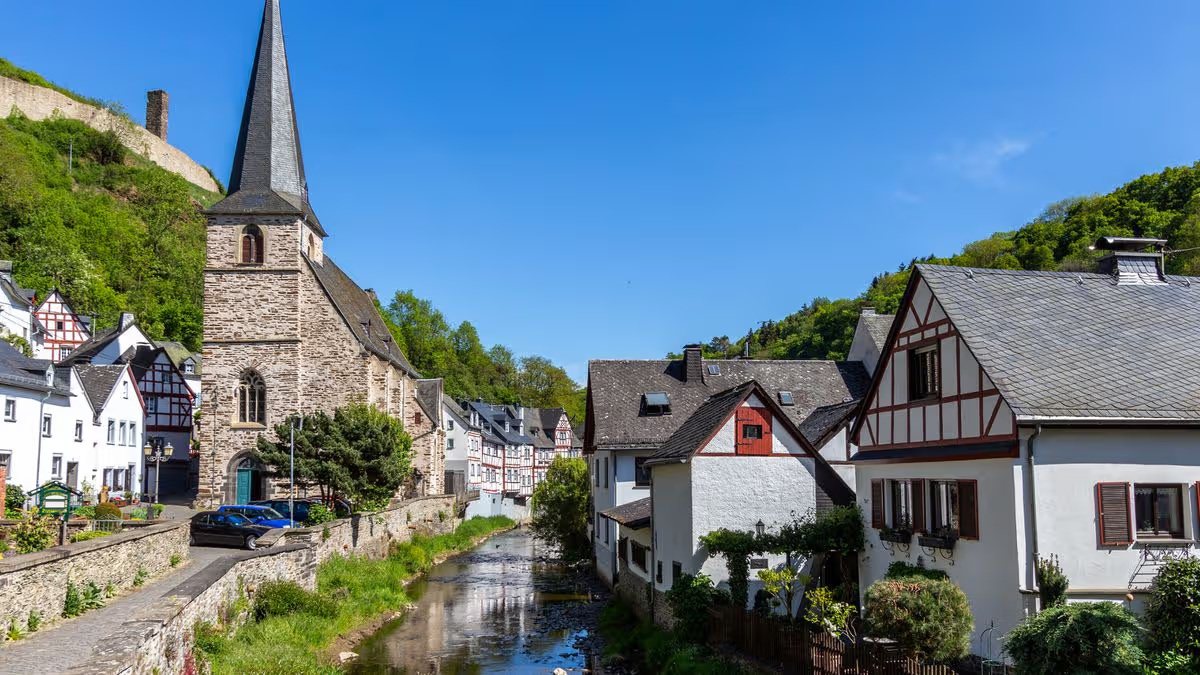
The charming medieval village is a tranquil and historic destination rather than an overcrowded tourist spot. You can walk through town or stop and enjoy some lovely pastries at the local cafe
Christine Younan Deputy Editor Social Newsdesk
05:08, 05 Apr 2026
Visiting a well-known tourist destination can often mean navigating large crowds, which is entirely understandable for those seeking a more peaceful experience. Overcrowded spots can feel overwhelming, with lengthy queues for food and drink adding to the frustration.
Fortunately, there’s one breathtaking village tucked away among rolling hills that boasts some of the most spectacular views imaginable. Better still, the location doesn’t attract overwhelming numbers of visitors, meaning you can truly unwind away from the hustle and bustle. So where exactly is this hidden treasure? Monreal in Germany is renowned for its half-timbered houses, narrow cobblestone streets and a charming riverside setting. Many would say this picturesque village feels like something straight out of a fairytale.
Advertisement
A TikTok channel recently shared footage of the tranquil destination, nestled in western Germany.
In the caption, it said: “Monreal is a charming medieval village in western Germany, beautifully nestled in a quiet valley surrounded by rolling hills.
“Known for its half-timbered houses, narrow cobblestone streets, and romantic riverside setting, the village feels like a scene from a fairytale.
“Overlooking the town are the ruins of two hilltop castles, adding a dramatic and historic touch to the landscape.
Advertisement
“With its peaceful atmosphere, picturesque, scenery and timeless architecture, Monreal stands as one of Germany’s most enchanting hidden gems.”
Content cannot be displayed without consent
What to do in Monreal:
You can visit the ruins of Löwenburg, known as the Castle of Lions, or Philippsburg, which both offer panoramic views of the town.
Traumpfad trails offer an enjoyable hiking experience for those who are passionate about walking. The Monrealer Ritterschlag trail winds through the town and its surrounding woodland.
The Half-Timbered Village, Fachwerkdorf, is a stunning attraction where visitors can stroll through the historic village centre, lined with traditional houses, many of which feature plaques detailing their heritage.
Advertisement
Nearby, the Nepomuk Bridge spans the Elzbach stream and is well worth a visit. After taking in the sights, you can unwind at one of the local cafés – Cafe Plüsch, for instance, is renowned for its coffee and pastries.
There is also a small pottery in the old schoolhouse, where visitors can explore numerous signs chronicling the village’s history as a hub for the textile industry.
Best time to go:
The village is widely regarded as a charming, peaceful and historic destination, rather than an overcrowded tourist hotspot.
Late spring or early summer (May to June) is considered the prime time to visit. Early autumn, such as September, is another excellent option, offering pleasant hiking conditions and manageable crowds.
Advertisement
For those seeking warm, sunny weather, late June to August is ideal. Monreal also makes for a wonderful destination during winter, thanks to its enchanting Christmas atmosphere.
The nearest major airports to Monreal are Frankfurt or Cologne/Bonn. Rail connections are accessible from these cities to the Monreal area.
BOSTON (AP) — A federal judge has halted efforts by the Trump administration to collect data that proves higher education institutions aren’t considering race in admissions.
The ruling from U.S. District Court Judge F. Dennis Saylor IV in Boston on Friday granting the preliminary injunction follows a lawsuit filed last month by a coalition of 17 Democratic state attorneys general. It will only apply to public universities in plaintiffs.
The federal judge said the federal government likely has the authority to collect the data, but the demand was rolled out to universities in a “rushed and chaotic” manner.
“The 120-day deadline imposed by the President led directly to the failure of NCES (National Center for Education Statistics) to engage meaningfully with the institutions during the notice-and-comment process to address the multitude of problems presented by the new requirements,” Saylor wrote.
Advertisement
President Donald Trump ordered the data collection in August after he raised concerns that colleges and universities were using personal statements and other proxies to consider race, which he views as illegal discrimination.
In 2023, the Supreme Court ruled against the use of affirmative action in admissions but said colleges could still consider how race has shaped students’ lives if applicants share that information in their admissions essays.
The states argue the data collection risks invading student privacy and leading to baseless investigations of colleges and universities. They also argued that universities have not been given enough time to collect the data.
“The data has been sought in such a hasty and irresponsible way that it will create problems for universities,” a lawyer for the plaintiffs, Michelle Pascucci, told the court, adding that the effort seem was aimed at uncovering unlawful practices.
Advertisement
The Education Department has defended the effort, arguing taxpayers deserve transparency on how money is spent at institutions that receive federal funding.
The administration’s policy echoes settlement agreements the government negotiated with Brown University and Columbia University, restoring their federal research money. The universities agreed to give the government data on the race, grade-point average and standardized test scores of applicants, admitted students and enrolled students. The schools also agreed to be audited by the government and to release admissions statistics to the public.
The National Center for Education Statistics is to collect the new data, including the race and sex of colleges’ applicants, admitted students and enrolled students. Education Secretary Linda McMahon has said the data, which was originally due by March 18, must be disaggregated by race and sex and retroactively reported for the past seven years.
If colleges fail to submit timely, complete and accurate data, the administration has said McMahon can take action under Title IV of the Higher Education Act of 1965, which outlines requirements for colleges receiving federal financial aid for students.
Advertisement
The Trump administration separately has sued Harvard University over similar data, saying it refused to provide admissions records the Justice Department demanded to ensure the school stopped using affirmative action. Harvard has said the university has been responding to the government’s requests and is in compliance with the high court ruling against affirmative action. On Monday, the Education Department’s Office for Civil Rights directed Harvard to comply with the data requests within 20 days for face referral to the U.S. Justice Department.
Using the 1981-2010 average of number of days where snow falls in a month, March sees 4.2 snow days whilst there are just 3.9 days on average in December.
The majority of Easter Days occur in April, when the chance of snowfall drops to just 2.3 days.
Taking that into account we can say that white Christmases and white Easters are about as frequent as each other when Easter is in March.
When snow does fall, it may be more inclined to settled during a March Easter compared to Christmas, as soil temperatures (away from the surface layer) are lower compared to December.
Advertisement
spring is a season of big weather contrasts and temperature swings. Days lengthen and the Sun gets stronger, but when cold air moves in from the north, we can be quickly plunged back into wintry weather.
So even when Easter falls in April, spring snow can still happen, especially over the higher ground of Scotland.


















































You must be logged in to post a comment Login