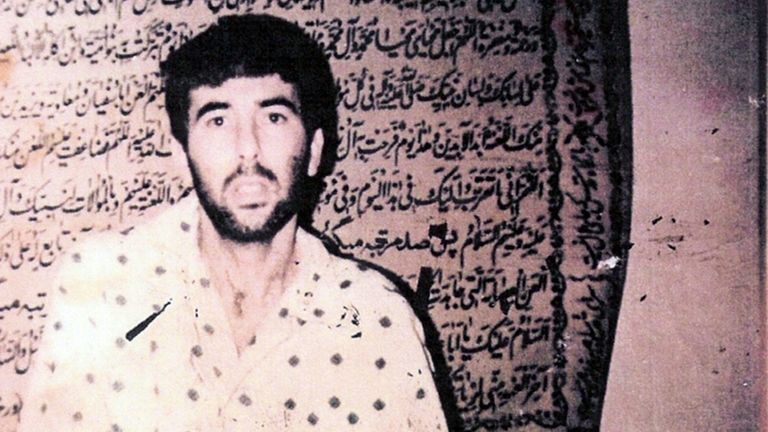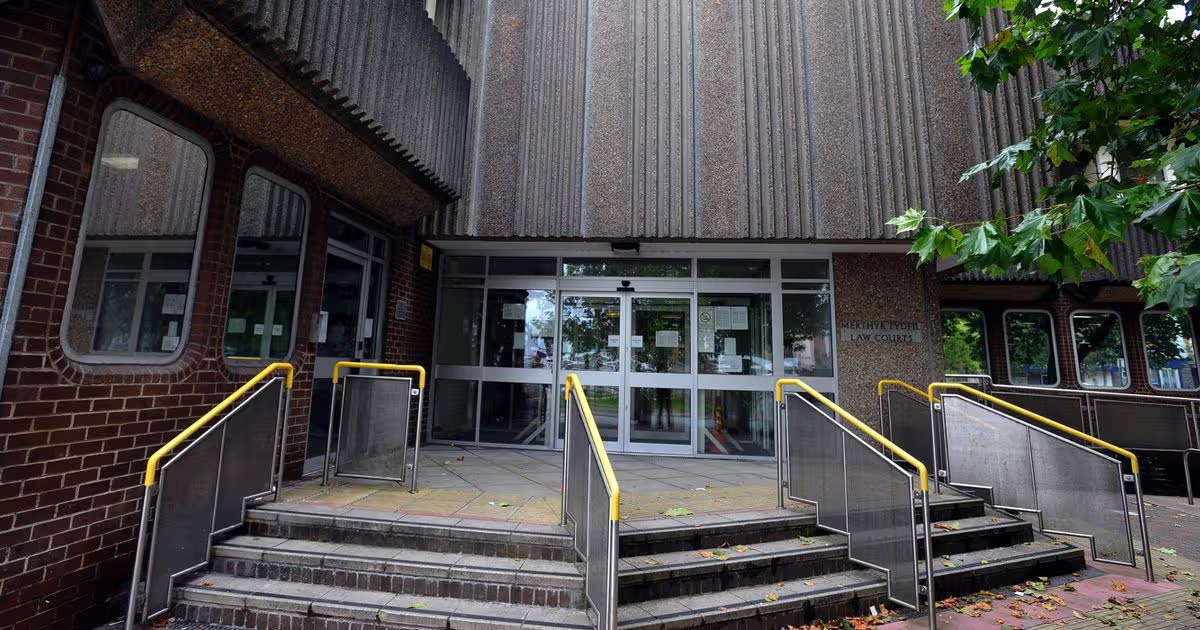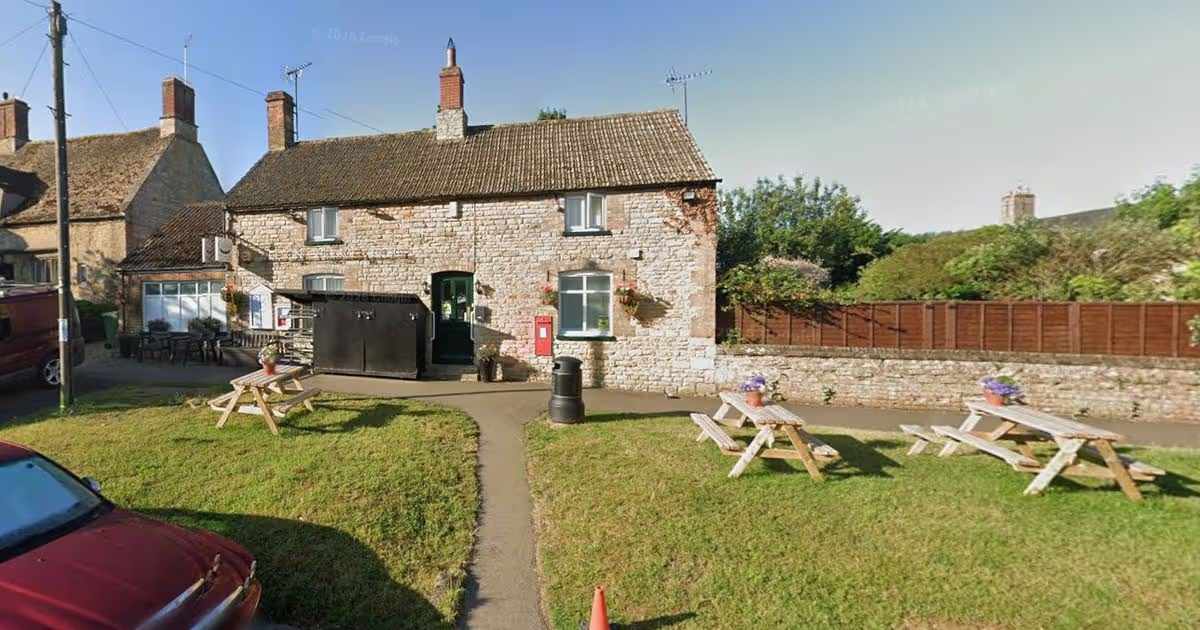

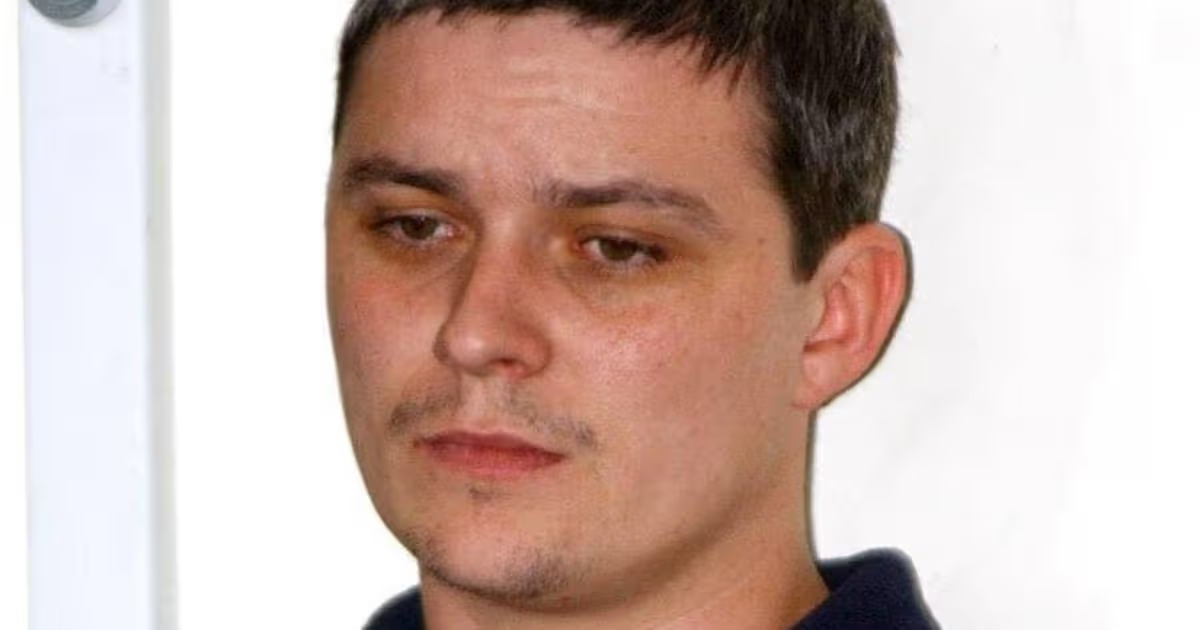
Despite his “swagger”, Soham murderer Ian Huntley was a target in prison long before the final attack that resulted in his death.
Soham killer Ian Huntley died in hospital almost a quarter of a century after his infamous crimes. Imprisoned for the murders of Holly Wells and Jessica Chapman in Cambridgeshire, his life support was turned off just over a week after a brutal prison beating.
On Thursday, February 26, the 52-year-old was attacked by a fellow prisoner at the notorious HMP Frankland in County Durham. The vicious assault left him blind and in a “vegetative state” as he spent just over a week in intensive care.
Huntley is one Britain’s most reviled child killers and he faced numerous beatings from other inmates during his incarceration. Past incidents included scaldings with boiling water and having his throat slashed, reports the Mirror.
Over the last 23 years, Holly and Jessica’s families have carried on living beneath the weight of incomprehensible grief. The pair were aged just 10 when they disappeared during a family barbecue on August 4, 2002.
A massive search was launched when they failed to return after leaving the barbecue to go and get sweets in the village of Soham. An image of the pair wearing their matching Manchester United shirts was released and it became seared into the minds of worried parents nationwide.
Helping in the search was a young Huntley, then 28, who’d been employed as a caretaker at the girls’ school.
Callous Huntley gave interviews to journalists during the search for the girls while he knew what had happened to them. Sickeningly, he even tried to console Holly’s father.
He informed police how he’d chatted with the missing youngsters on his doorstep moments before they vanished. It didn’t take long for police to grow sceptical of his version of events and the truth of what really unfolded that day started to come to light.
Nearly a fortnight after they were last seen, on August 17, a gamekeeper stumbled upon the burnt remains of Holly and Jessica in a ditch close to an RAF base.
It eventually came to light that Huntley had lured the pair into his home after he falsely clamed that his girlfriend, Maxine Carr, a teaching assistant at their school, was inside. He then killed the girls and hid their bodies in a ditch.
Three days after the girls were found, Huntley was charged with their murder and, in December 2003, he received two life sentences, with a minimum of 40 years imprisonment.
Ms Carr was also jailed for three-and-a-half years for perverting the course of justice but was cleared of two charges of assisting an offender. She was released after serving half her sentence and granted a new identity.
Sharon and Leslie Chapman, Jessica’s parents, have rarely discussed the case and their loss publicly. However, Kevin and Nicola Wells, Holly’s parents, have spoken about what happened to them and provided glimpses into how their lives were transformed.
In the immediate aftermath of their daughter’s death, Kevin was plagued by the fear that he and Nicola might become part of the statistic of couples who separate following the loss of a child.
Reflecting on this period during the 2012 ITV documentary, Soham: A Parents’ Tale , which marked the 10th anniversary of the murders, Kevin shared: “She [Nicola] was lost in a kind of wilderness, whereas I was more hard-line about my emotions.
“For the first five months after Holly died, we broke down together, but after that, we processed our grief at different speeds. It was one, almost two years before we found each other again, but grief gives you a different sense of the passage of time, and it slipped by unnoticed.”
In 2005, Kevin penned the book Goodbye, Dearest Holly which documented some of what the family went through. In an interview with the Mail on Sunday, he said: “They say 95 per cent of the parents of murdered children split up. We were determined to be among the five per cent who survive, but for a year, perhaps 18 months, I couldn’t reach my wife.”
In the years that followed, the Wells family faced plenty of upheaval and, in 2006, made the difficult decision to move out of their Soham home, finding the memories of Holly too agonising to face.
Money was also an issue. Struggling financially after having to sell Kevin’s business at a loss, the couple were forced to remortgage their house and accept £6,000 from a charity to cover bills. Thankfully, the family were able to gradually get back on track. After launching his contract cleaning business from scratch in 2005, Kevin was later joined by his son Oliver, who was just 12 years old when his sister vanished.
Reflecting on how, over the following two years, he and Oliver “went up ladders and chit-chatted about life until it felt OK again”, Kevin said: “Getting back to work was not just about money in the bank, it was also about what it represented – an everyday life, a familiar pattern, some kind of control.”
Later, Kevin dedicated himself to preserving his daughter’s legacy. He ran the London Marathon in memory of Holly and Jessica in 2012, raising almost £8,000 for the Grief Encounter Project – a charity he now serves as a patron of – which had supported his family.
That same year, the family returned to their former residence in Soham, where it’s believed Huntley’s name is never spoken.
In 2015, Kevin offered insight into how their family home had evolved, telling Good Morning Britain: “We still think of Holly every day; we have her pictures in and around the house, but it’s not a shrine – we don’t live in the past.”
Asked about his views on Carr’s release, Kevin responded: “We don’t reflect on it at all. It’s been through the court process, and we accept the outcome and focus our attention on other areas.”
Reflecting on how he navigated those harrowing early years, Kevin previously shared: “Murder has the capacity to destroy more lives than the one taken. I recognised that from the start, so I tried to take control, to make plans and to exert positive thought. I clung to my family, my community, my work, sometimes to God and sometimes to a late-night tumbler of whisky. I chose to believe in the future, a future that I could craft from the life we once had. Really, all I wanted was for us to be the ones who’d make it out the other side.”
Growing up without his younger sister proved difficult for Oliver. In 2012, by then a dad to two children himself, he spoke publicly for the first time about his bereavement.
He said: “I wish I could see her now, see what she’d have looked like. We do chat about her quite regularly, which I think is a very nice thing. It’s strange being three of us, when there used to be a fourth.”
Meanwhile, mum Nicola felt her daughter’s absence through the activities the little girl had once thrived in. Reflecting on “the busyness” of Holly, she recalled: “The music and dancing and drawing, the reading, the homework, the friends, the Brownies, the Majorettes. I used to grind my teeth at the hours I spent driving her to activities. Now I long to be able to do it.”
Jessica’s parents Leslie and Sharon did issue a rare statement marking the 10th anniversary of their daughter’s death and backing police proposals for a national database tracking sex offenders. They said: “We hope [the database’s] use will mean other families don’t suffer the same loss and heartbreak as we did.”
Given the nature – and notoriety – of his crimes, Huntley was never popular with his fellow inmates.
A source told the Newcastle Chronicle before his death: “He’s up there with one of the most hated prisoners. It could have been anyone. The majority would attack him for the reputation, not because of what he has done. They will want to be the one that done in Ian Huntley.”
The killer had a “swagger” inside prison, a source told the Mirror, like he was “trying to be somebody”. But he was also regularly trying to get his name into the public sphere from inside jail, they said.
Another prison source previously described Huntley as an “up and down” person, whose moods swing from extremes – acting the “big man” towards his fellow prisoners one moment and then becoming incredibly moody and reclusive.
One anecdote from sources behind bars claims Huntley flew into a fit of rage after lags taunted him over his beloved Manchester United shirt – the same kind his victims were wearing when he killed them. Huntley later cut the shirts from their bodies and tried to hide them in a bin.
In a warped twist, his shirt was also emblazoned with the number 10, according to The Sun – the same age as Jessica and Holly were when he murdered them. Guards searched his cell after hearing his fellow inmates chanted, “Huntley, Huntley, where’s your shirt?”
Framed photos of Maxine Carr – the girlfriend who provided him with a false alibi – were also reportedly confiscated. A source claimed: “They’re shouting insults and calling him ‘sicko’ and stuff. They’ve also mocked him about losing the Carr pictures. Huntley’s livid. He’s been going up the wall.”
Meanwhile, Huntley previously pleaded with a female penpal to send him a photograph of her in a Manchester United shirt as he awaited trial. The Daily Mirror revealed how he asked the penpal three times, and on one occasion told her from prison that he would be “punishing” her if she didn’t do as he asked.
In other penpal letters, he admitted he could lose his temper with a “bang”. “When I’m down, I’m a miserable git and when I’m cheerful I’m a barking woof woof. All I can say is that I hope my future has plenty of woof woof woof moments. God I am nuts,” he reportedly wrote.
Get more Daily Record exclusives by signing up for free to Google’s preferred sources. Click HERE