Ian Huntley was allegedly attacked with a metal bar at a maximum security jail
Tom Wilkinson, Press Association
11:57, 03 Jun 2026Updated 12:06, 03 Jun 2026
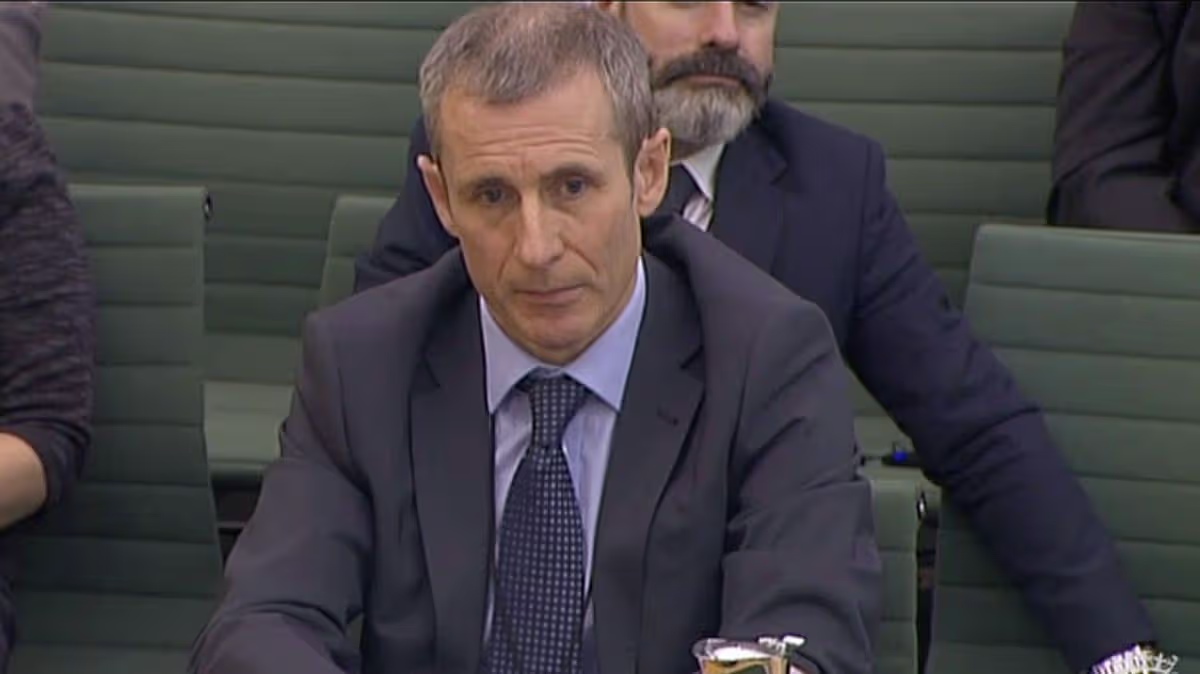
A trial date has been set for an inmate charged with the prison murder of Soham killer Ian Huntley. Anthony Russell, 44, appeared at Newcastle Crown Court by videolink from HMP Frankland, near Durham, on Wednesday for a brief hearing during which he did not enter a plea.
Russell is charged with a single offence of murdering the 52-year-old, who was allegedly attacked with a metal bar in a workshop at the maximum security jail on February 26. Huntley was taken to the Royal Victoria Infirmary in Newcastle, where he died on March 7.
Advertisement
Russell, wearing a brown T-shirt, appeared before Mr Justice Hilliard. The judge set a trial date for November 23, with a further pre-trial hearing on July 3.
Huntley was serving a life sentence for the 2002 murders of 10-year-olds Holly Wells and Jessica Chapman. The ex-school caretaker killed the best friends after they left a family barbecue to buy sweets in Soham, Cambridgeshire, on August 4 2002. He dumped their bodies in a ditch 10 miles away.
They were not found for 13 days despite a search involving hundreds of police officers. At the time, Huntley lived with Maxine Carr who was a teaching assistant at Holly and Jessica’s primary school.
He denied murdering the girls but was convicted after a trial at the Old Bailey in 2003. He was jailed for life with a recommended minimum term of 40 years.
Man United have agreed a deal with Atalanta to sign Ederson, who is expected to be an upgrade on Manuel Ugarte.
Manuel Ugarte has struggled with the Premier League’s intensity since his arrival in England, but it was concerning to watch him suffer against Grimsby Town at the start of the season.
Advertisement
Although Grimbsy’s first goal on the night of United’s humiliation at Blundell Park could have been stopped by four other players, Ugarte failed to react quickly to losing the ball at the beginning of the move.
Ugarte and Amad collided on the halfway line. The Urguary international did not get back up to his feet quickly enough to sprint back.
Click here to find out the latest Manchester United news in our daily newsletter
There were 11 seconds between Ugarte going to the ground and the goal. He reached the penalty area as the ball left Charles Vernam’s boot, suggesting he could have got closer if he had reacted immediately.
Advertisement
There is no guarantee that Ugarte would have been able to reach Vernam to stop his shot if he’d reacted quicker, but maximum effort is obviously the bare minimum expectation. The problem is that Ugarte was trying – he just didn’t have the athleticism to recover quickly enough.
Ugarte’s running statistics were decent at Paris Saint-Germain, but playing in the Premier League is a different kettle of fish from competing in Ligue 1, as the intensity is relentless, and there is no time to dither.
That has not been the only worry with Ugarte, whose passing is not a strength, which is a problem in a division where it has become increasingly important for deep-lying midfielders to set the tempo.
Those two areas are strengths for Ederson, who should be an upgrade on Ugarte after his arrival from Atalanta. The Reds have reached an agreement with the Italian club to sign the midfielder for £35million, plus £4 million in potential add-ons, and the deal will be completed by early July.
Advertisement
The 26-year-old can play as a deep-lying midfielder or as a No.8 because of his ability to pass through the lines. At Atalanta, he regularly finds wing-backs with long passes from midfield, a trait that is not in Ugarte’s skill set.
Ederson can dribble out of tight spaces, like Kobbie Mainoo, and relieve pressure when United are under pressure from the opposition. In comparison, United fans sit nervously when Ugarte gets in those scenarios.
The Brazilian has a better engine than Ugarte as well, building a reputation in Italy for his running power and high energy levels, averaging 10.6km per game in the Champions League this season.
Advertisement
Ederson looks better suited to the demands of the Premier League, but crunching the numbers in the market also led United to sign Ugarte, who has never looked comfortable with English football.
United’s record of signings from Serie A is another reason to be a tad cautious about the Ederson transfer, however, there has been a feeling in Italy that he was destined for a bigger move, and that he will receive international recognition from Brazil when the time is right.
The 26-year-old has cut it against English opposition too, having impressed when Atalanta beat Liverpool 3-0 at Anfield – covering almost every blade of grass – in the first leg of the 2024 Europa League semi-final.
Advertisement
Atalanta hammered Bayer Leverkusen in the Europa League final, and Ederson was singled out for praise by his manager. “I’ve been fortunate enough to coach a lot of very good players,” Gian Piero Gasperini said.
“In terms of physicality, regains and the timing of his runs, Ederson is definitely an extraordinary player, one cut out for teams at the very highest level. It surprises me he still doesn’t play for Brazil, even if he’s often been called up. But that’ll come.”
Ederson was not included in Brazil’s squad for the World Cup, but there are talented players ahead of him in his position, with the likes of Casemiro, Newcastle star Bruno Guimaraes, and Fabinho making the cut instead.
United admire Guimaraes and would take him in a heartbeat from Newcastle if a deal could be agreed, as most clubs would. That’s not going to happen, but the Reds have got their own version for a cheaper fee with Ederson.
Advertisement
Sky Sports, HBO Max, Netflix and Disney+ with Ultimate TV package
This article contains affiliate links, we will receive a commission on any sales we generate from it. Learn more
Sky has upgraded its Ultimate TV and Sky Sports bundle to now include HBO Max, Netflix, Disney+, discovery+ and Hayu, as well as 135 channels and full Sky coverage of the Premier League and EFL.
Sky broadcasts more than 1,400 live matches across the Premier League, EFL and more with at least 215 live from the top flight alongside Formula 1, darts and golf.
Dr Caitlin Todd will sexually assault Charity this week
Emmerdale is to explore the devastating effects of sexual violence and the complex feelings of isolation survivors can experience, particularly in the context of female-on-female assault.
Advertisement
The powerful storyline airs on Sunday, 7th June, when the character Charity Dingle, played by Emma Atkins, is sexually assaulted by her blackmailer, Caitlin Todd, played by Caroline Harker.
In the coming weeks, Charity will struggle to come to terms with the attack, having to choose between confiding in her loved ones or internalising the trauma.
Emmerdale producer, Sophie Roper, explains the importance of the storyline: “Charity’s storyline will explore the impact of sexual violence, and though this heinous act is fundamentally about power, we’ll explore the complexities of how Charity processes her trauma when the perpetrator is a woman.
With little conversation surrounding female-on-female assault, we’ll explore the overwhelming feelings of isolation many survivors experience and will examine the disparity between the legal term sexual assault and the fact that many women in Charity’s position feel this minimises what’s happened to them, because they feel like they’ve been raped. Though difficult viewing at times, Charity’s resilience will inspire hope as she confronts what has happened to her.”
Advertisement
Emma Atkins commented: “This has been one of the most demanding and significant storylines I’ve had to navigate as Charity. We know her as a tough, resilient character, but this trauma will expose a deep, raw vulnerability that has been heartbreaking at times to play.
“I hope this storyline gives even one person the courage to speak out or helps others understand the quiet devastation of trauma.”
In confirmed spoilers, Charity is desperately trying to find a way to pay off Todd, so Sarah’s 21st birthday isn’t ruined. Overwhelmed with guilt and drinking heavily, Charity confronts Todd and dares her to expose the secret. Todd backs down, seemingly unable to publicly destroy Sarah’s life.
Advertisement
Todd tries to justify her blackmail to Charity and admits to enjoying Charity’s chaotic life. A temporary truce is formed when Todd implies the secret is safe, but it’s not long before Todd’s malicious nature resurfaces when Charity is subjected to an assault.
Emmerdale airs on weeknights at 8pm on ITV1 and is available to stream on ITVX and YouTube from 7am.
Londoners endured a 24-hour Tube strike yesterday, with torrential rain and even hail making journeys even more miserable.
Advertisement
Commuters survived the first wave of the two-day strike sweeping London this week as the dispute between the RMT union and TfL over working hours remains unresolved.
Tuesday’s walk-out saw the return of hordes of strikelists, while the Elizabeth line, one of the few routes not included in the strikes, suffered a signal fault, affecting trains to and from Heathrow.
Businesses around Liverpool Street station told Metro their takings were down on the first strike day, while commuters rushed to nab Lime bikes by pre-booking them.
The Farringdon Elizabeth line station was also rammed on the first day of the June strikes (Picture: Vuk Valcic/ZUMA Press Wire/Shutterstock)
Cycle paths were full to the brim despite the wet weather, and Metro saw both pedestrians and riders rush through red lights at rush hour.
As there is no immediate resolution in sight in the bitter row, commuters should brace for another strike scheduled to go ahead tomorrow.
Advertisement
When will the Tube strike end?
There is no Tube strike today, so commuters can enjoy some respite before the next 24-hour walkout.

The strike will start on Thursday, June 4 at 00:01, and end at 23:59.
The crowd control barriers had been hauled out at Liverpool Street Elizabeth line station exit to funnel passengers yesterday (Picture: Noora Mykkanen/Metro)
Which lines are affected?
Latest London news
To get the latest news from the capital, visit Metro’sLondon news hub.
Advertisement
Some Underground routes have fared better through the strikes, while the likes of Circle and Piccadilly have had no service.
Here is what kind of disruption is expected tomorrow.
No service on the entire line – The Circle and Piccadilly lines
Partially suspended – The Metropolitan line between Baker Street and Aldgate, the Central line between White City and Liverpool Street
Tube services will be severely limited before 6.30am tomorrow, and passengers are advised to finish journeys before 9pm, TfL said.
Once the night turns into Friday, the June Tube strikes are over, and normal service is expected from then on.
Advertisement
What TfL services are running tomorrow?
The Elizabeth line, London Overground, Docklands Light Railway, buses, tram and National Rail are running business as usual tomorrow, although they will be busy.
Liverpool Street station, the UK’s busiest railway station, was packed during the strikes as commuters opted for rail and Overground instead of the Tube (Picture: Noora Mykkanen/Metro)
How did Tuesday’s Tube strike affect you?
A lot, I had to change up my routine and how I travel
Not much, some minor tweaks to travel
Not at all (working from home or not using the Tube)
Advertisement
Stay up to date with the stories everybody’s talking about by signing up to Metro’s News Updates newsletter.
Then there are the dockless e-bikes like Lime and Forest, and Santander cycles, which have surged in popularity during previous strikes.
Advertisement
Lime told Metro that it increases drivers and foot patrollers on the streets to swap out batteries and redistribute bikes during the strikes.
One Lime fan, Lydia Dunne, 33, had secured a bike near Liverpool Street where bikes were scarce as commuters poured out of the offices by pre-booking it.
‘Otherwise it’s impossible to get one,’ she told Metro, pointing to the nearly empty bike parking area on Bishopsgate Plaza.
Lydia Dunne, originally from London, opted for an e-bike despite the unpredictable weather (Picture: Noora Mykkanen/Metro)
Passengers were dealt a major blow yesterday when the Elizabeth line was disrupted due to a signal meltdown.
The purple line was busy throughout the day, and hotspots like Liverpool Street saw bottlenecks form at the platform exit.
Advertisement
Liverpool Street railway station concourse was extra busy, with more commuters than usual opting for trains.
Hospitality bears the brunt of the Tube strike
Along with commuters, hospitality businesses reported a drop in revenue during the first day of June Tube strikes.
Rossana Merlin, the manager of Okja next to Liverpool Street station, said the new cafe selling plant-based baked goodies and coffee opened last week, but takings were down on Tuesday.
She said: ‘We usually have 80 transactions between 8am and 12pm, but today we only had around 60.
Advertisement
Rossana Merlin, from new plant-based cafe Okja on Liverpool Street, said takings were down but the business had prepared (Picture: Noora Mykkanen/Metro)
‘But we knew to expect it so we cut down accordingly to avoid waste.
‘It could also be partially because of the weather.’
Bar staff at the nearby Railway Tavern said the pub is usually busier on Tuesdays all day, because it is the one day in the week when most work-from-home office staff are in.
When the US and Israel launched their strikes on Iran on February 28 and Iran retaliated by targeting the Gulf Arab states, I was closely monitoring social media accounts from the region. I research Middle East politics, with a focus on the Gulf, and the social media platforms I use are full of people living in the region – including western migrants, or as they tend to style themselves, expats. To my surprise, from many of them I saw the same message: “It is safe and normal here.”
This was not a trivial claim – these messages were sent as the countries they live in came under attack. But the attitudes they exhibited reflect a broad strategy long cultivated by Gulf Arab regimes. This aims to instil in the people that opt to live there a sense of security, as well as aspiration for the lifestyle on offer and loyalty towards the country for making that lifestyle available.
More importantly, the expats’ reactions exposed the role that foreign residents and influencers have played in advancing a particular understanding of “normality”. Not only do they accept authoritarian rule in the Gulf, they have been pushing out messages about insecurity elsewhere.
To be clear, a lot of foreign workers did leave the Gulf, reportedly in the tens of thousands, when the conflict began. But even so, many of the initial reactions on social media, whether people stayed or opted to leave, projected this sense of security.
Advertisement
Part of the US security hub
These regimes have developed an image designed to attract global connectivity, foreign capital and flows of people and goods. The UAE, especially Dubai, has become a symbol of tax-free residency and luxury tourism. Qatar has established itself as reliable gas exporter and world-class mediator. Saudi Arabia has launched a sweeping reform project recasting national identity and the kingdom’s global role in championing “moderate Islam”, while Bahrain has worked early since independence to become a regional banking hub.
These state-building processes thrived under the security umbrella of US and other western military bases across the Middle East. Firmly embedded in the US sphere of influence, Gulf monarchies have benefited from precious diplomatic cover and access to global markets. Other regional regimes, meanwhile – notably Iran – were excluded. This was more often due to their hostility towards the US than for their brutal repression and disastrous governance at home.
By directing global attention to threats such as Iran, Gulf regimes forged a strong sense of domestic normality. But in recent years, a less reliable US regional policy has made the security arrangement increasingly uncertain, prompting Gulf regimes to explore alternatives. Without renouncing deeper engagement with the US, they welcomed cooperation with other powers outside the region, like China, as well as the possibility of closer relations with Israel and even a modus vivendi with Iran.
Despite ongoing rivalries, including within the regional forum, the Gulf Cooperation Council (GCC), regional conflict de-escalation and management appeared to be the preferred means to continue insulating the Gulf normality. Yet the ongoing destruction in Gaza, closer US-Israeli alignment in the latter’s pursuit of regional dominance, and the ensuing pressure on Iran’s network of proxies has undermined this delicate balance.
The attack on Iran exposed foreign residents’ role in sustaining the image of “normality”. Until then, expats and influencers embodied this normality by displaying safe, privileged and apolitical lives.
I saw posts attempting to divert attention from the threat of war in the Gulf by people claiming to feel safer under missile attacks in Dubai and Doha than “after 9pm” in London or Manchester. Other posts preferred the prospect of missile attacks to being “bombed by 50% taxes”.
These sorts of comments tend to mimic narratives pushed by far-right movements in the west around crime, taxation and immigration.
A viral trend concentrated in the UAE but replicated across other Gulf countries featured influencers responding to the question “Aren’t you scared?” with imagery of members of the ruling families and messages such as: “No, because I know who protects us.” The UAE president’s much-publicised walk in Dubai Mall followed this paternalistic framing of security.
Advertisement
After the initial shock, many influencers returned to the old form of messaging, not posting about the war and focusing on showing their privileged “everyday” lives.
Controlling the message
It’s important to remember that Gulf Arab regimes possess robust censorship apparatuses and broad national security and anti-cybercrime laws that penalise content deemed to “cause panic” or “disturb public order”.
Authorities in Saudi Arabia were swift to remind residents that “photography serves the enemy”, banning unofficial sharing of damage caused by the war, while the UAE threatened severe sentences for people posting negative messages. There have been reports of people detained for posting the wrong content – more than 300 in Qatar alone. Heightened security concerns exposed western expats to coercive practices typically reserved to political dissidents.
Having invested efforts in insulating their domestic projects from external threats through seeking political accommodation with neighbours, including Iran, Gulf leaders may now pursue a different strategy. In fact, we’re already seeing some different approaches as various Gulf countries work out their own best approach to the changing situation in their region. Some, like Bahrain, remain hostile to Iran. Others, including Saudi Arabia, are more nuanced in their approach, looking overall to ensure security in the region.
Advertisement
But for regimes and expats alike, this is a time of reckoning for the parameters sustaining “normality” in the Gulf. Most certainly, the region will never be the same.
Korsaks also controlled the victim’s finances and monitored her movements
11:38, 03 Jun 2026Updated 11:48, 03 Jun 2026
A man has been jailed for more than two years after subjecting his partner to controlling abuse. Janis Korsaks, 42, of Hornbeam Close, March, started to become increasingly violent towards his victim after she tried to end their relationship due to his drinking and aggressive behaviour.
On November 8 last year, Korsaks repeatedly pressured the victim to go downstairs to talk. He later punched her as she lay in bed and threatened her. The police were called at around 2.30am the next morning and arrested Korsaks.
Leading up to his arrest, Korsaks subjected the victim to a sustained campaign of physical and emotional abuse. He made multiple threats of what he would do if she left him.
Advertisement
Korsaks had controlled his victim’s finances and monitored her movements. He demanded to know her location to follow her and, on one occasion, turned up unannounced at her workplace to try and take her home.
Korsaks was sentenced to two years and two months in prison at Huntingdon Law Courts on Thursday, May 28, after he admitted to engaging in controlling and coercive behaviour in an intimate relationship. He was also handed a seven-year restraining order.
Two counts of threats to kill, two counts of assault by beating, two counts of intentional strangulation, and threatening a person with a bladed article were ordered to lie on file.
DC Jake Boreham-Dennis, who investigated, said: “This was a sustained pattern of controlling, coercive and violent behaviour that left the victim living in fear. Korsaks used threats, intimidation and violence to try to control her, and his behaviour escalated when she tried to leave.
Advertisement
“I hope this sentence provides some reassurance to the victim and shows we will take action against those who commit domestic abuse. If you are experiencing this type of behaviour, please know you are not alone – support is available and we will listen.”
To get more news and top stories delivered directly to your phone, join our new WhatsApp community.Click this linkto receive your daily dose of CambridgeshireLive content.
We also treat our community members to special offers, promotions, and adverts from us and our partners. If you don’t like our community, you can check out any time you like. If you’re curious, you can read ourPrivacy Notice.
Two people have been injured following a crash on the A505 on Wednesday, June 3. Cambridgeshire Police were called at 6:35am this morning to reports of a crash involving a HGV and other vehicles.
The crash happened near Duxford. Two people have been injured. One of the two have sustained serious injuries.
The A505 has been blocked in both directions between Duxford and Pampisford following the collision.
Advertisement
A spokesperson for Cambridgeshire Police said: “We were called at 6.35am this morning to reports of a collision on the A505 near Duxford. A HGV and other vehicles were involved and two people have been injured, one seriously. Motorists are urged to avoid the area because of disruption.”
For Greg Sanderson, a former teacher and education policy adviser, restoring trust begins in the classroom. UK schools are required to promote “British values”, one of which is democracy. But telling kids “how cool democracy is” probably won’t work, he says. What if they experience it first-hand?
Advertisement
School councils are a common way to enable what educators call “pupil voice” – but often these are more tickbox than transformative, since the most confident kids tend to represent the class while others have little say. In fact, only two in five pupils surveyed in 2011 thought their school council listened to them. “You have a mini-Westminster in your school, forgetting the fact that Westminster sometimes doesn’t work that well,” Sanderson says.
Advertisement
Convinced that things could work differently, he founded Smart School Councils (SSC), a charity, in 2014. Schools log onto a platform to find thousands of discussion questions relating to issues at school or in the news, adapted to every age group. Simple-to-use software allows pupils to run weekly meetings around these questions, capture responses and share their findings, with minimal teacher involvement. Crucially, class meetings can fit into 15 minutes, and they allow even the youngest kids to participate: even five-year-olds sometimes lead discussions.
Pupils can also propose ideas and form “action teams” to improve school life. At Halling Primary School in Kent, southeast England, children’s suggestions included “buddy benches” to help lonely kids find a playmate, the creation of “houses” (divisions for competitions), new clubs, and repainting the playground. These ideas were logged and presented to educators by the school’s “communications team”, which consists of a group of year five and year six pupils whose roles and responsibilities were also developed by SSC. “We try to make every pupil’s voice heard,” explains Jess, a nine-year-old who even has a job title: suggestion box leader and staff liaison officer.
All this is a far cry from the “real old-school” council at Halling Primary, before it switched to SSC’s model three years ago, says assistant headteacher Ellie Nott. “The meetings took place, but no real positive change happened.” The new model has long-term benefits, in her view. “Children… realise that for positive change to happen, they need to do something about it,” she says. Knowing your voice matters could directly counter political apathy: “If you can look back and say, ‘I had an idea when I was six, and somebody listened, and then it happened’, that will stand children in good stead, hopefully, to vote when they’re older, and maybe even go to a peaceful protest if that’s what they want to do.”
Advertisement
Students at Halling Primary School in Kent putting democracy into practice. Image: Anna Patton
SSC has grown fast in the last few years, with some 750 schools now signed up – mostly in England, plus some in the rest of the UK, and a handful of international ones. Thirteen per cent are special educational needs schools, and one fifth are located in England’s most deprived areas.
According to the organisation, almost 90% of pupils at participating schools feel listened to (compared with 36% beforehand), and more than 90% of teachers say the process improves pupils’ listening and speaking skills. That makes for better discussions. Rachel Gray, a teacher at Kells Lane Primary in Gateshead, northeast England, sees her pupils actively listening: “They’re actually responding based on what someone else has said and considering that, rather than just waiting to speak,” she says. Nott cites improved confidence and peer relationships. What’s more, children who feel they’re listened to are much more likely to speak up when they have concerns. “It keeps them safe,” she says.
Advertisement
Money remains a challenge. Sanderson wants to reach thousands of schools, but his venture sits at a “weird cross-section” – it is effectively a tech startup, but structured as a charity – making it harder to find investors. Schools need to pay an annual subscription to use the platform of between £199 and £549 depending on the size of group (although some can get subsidies from philanthropic funders). Many have little or no budget to implement new ideas; Halling Primary gets £500 a year from its parent-teacher association but that’s not the case everywhere.
What I’ve learned is that speaking out is good. It makes your life better
But SSC has some influential backers. Musician Brian Eno, whose foundation is among the charity’s funders, describes it as “such a powerful demonstration of what is possible when people– even children as young as four – are given a meaningful opportunity to make their voices heard”. Jon Alexander, the author and co-host of the How To Save Democracy podcast, recently joined the charity’s board, describing its work as “phenomenal”. And Alastair Campbell, the former Labour adviser and co-host of the podcast The Rest is Politics, raved about the potential of SSC meetings after attending one himself in 2024.
Oracy, the ability to express oneself well in speech, is increasingly a focus in the UK curriculum. That’s a validation for Sanderson, who started SSC following his own experience as a working-class, state-school-educated kid at university who felt daunted by the confidence of his privately educated peers. “I honestly felt like there was something wrong with me,” he says. He soon realised that the problem was wider: people like him just didn’t get much practice in speaking up.
Advertisement
Halling Primary gets £500 a year from its parent-teacher association but that’s not the case everywhere. Image: Anna Patton
Although SSC doesn’t have hard evidence that its work leads to greater political engagement, many see a direct link. The UK’s Electoral Commission has recommended teaching oracy and debating as one way to get more young people ready and willing to vote. That’s even more urgent with the voting age set to be lowered to 16 across the UK (this is already the case in Scotland). But, whatever the threshold, teenagers don’t suddenly become politically engaged, Sanderson says. The process needs to start early, and discussing what needs to change and how to do that can make political processes “a little bit more real”. Kells Lane Primary pupils have discussed how to stop boys dominating the ball court, for instance. Halling pupils are currently debating if Friday’s extracurricular activities should be modified.
Voicing one’s opinions doesn’t come naturally to everyone. “Not everyone likes to be the one to go up [and speak] in front of everyone. I get that, because it is kind of scary,” says 10-year-old Nia from Halling Primary’s communications team. She encourages others to try expressing themselves anyway: “Sometimes we have to push them to their limits.”
Advertisement
As her teammate Abi, 10, puts it, “What I’ve learned is that speaking out is good… there’s no looking back. It makes your life better.
Main illustration by Elin Svensson
Be part of the solution
At Positive News, we’re not chasing clicks or profits for media moguls – we’re here to serve you and have a positive social impact. We can’t do this unless enough people like you choose to support our journalism.
Advertisement
Give once from just £1, or join 1,800+ others who contribute an average of £3 or more per month. Together, we can build a healthier form of media – one that focuses on solutions, progress and possibilities, and empowers people to create positive change.
Residents have been calling for action to be taken against the ‘overconcentration of HMOs’
Campaigners have praised the newly formed council’s promise to improve regulation of HMOs in a cross-party agreement. Cambridge City Council voted in a new Labour leader on Monday night after an earlier meeting ended in deadlock.
Advertisement
The minority administration agreed to bring forward new controls to improve regulation of smaller HMOs and develop the case for an Article 4 Direction. This would require HMOs housing three to six people to seek full planning permission where currently this is only required for seven or more occupants.
Cllr Tim Bick, leader of the Liberal Democrat group, said: “This is a complex subject and the council may not have all the powers we would like it to have, but we want to deploy what we can to make whatever difference we can.”
Donna Ferguson, chair of Guest Road Area Residents’ Association in Petersfield, said she was “overjoyed” but also called for the council to consider a numerical threshold. She said almost a third of properties in their area are registered HMOs, meaning they house at least five people – but smaller HMOs do not need to be registered.
There are 58 parking spaces for the around 100 properties in the area, including the 32 HMOs which are entitled to three residential parking permits each.
Donna said the terraced homes, intended for families, now have “far more” adults than intended leading to fly-tipping as “there isn’t enough space for the bins”. She said the council’s local plan states that “overconcentration of HMOs” can “have a harmful impact on the community”.
She noted at least 51 local councils have already passed an Article 4 Direction, and “many of them uni towns – York, Manchester, Oxford”.
She said: “I just couldn’t understand why Cambridge, a uni town, doesn’t have these measures in place – I even saw that Peterborough had recently applied for an Article 4 Direction.”
Advertisement
At least 27 local authorities have also limited HMOs to a threshold of 10 per cent of properties within a certain radius – usually 50 to 100 metres – and Donna is calling for Cambridge to do the same.
She started a petition which has more than 100 signatures at the time of writing and you can visit here. Even with the council considering options, she said it’s “even more important now” to sign the petition to show there is support for the measure.
She said: “It’s not saying we want to stop HMOs – we really welcome students who have always been a part of our community, or tenants perhaps struggling with unaffordable rents. I know tenants who have come to us in the residents’ association to ask, ‘can you do anything? Our landlord won’t do anything’ – it’s the landlords, not the tenants.”
Advertisement
Donna said she hopes the stricter regulations will deter “speculative applications” from “potential venture capitalist developers”.
She said: “I’m very pleased and want to say thank you to the councillors who are supporting this – I think it’s fantastic and hope they can work together to do something.”
Leading Labels has announced it is closing its remaining 15 stores across the UK.
Major fashion retailer Leading Labels has announced it is closing all of its stores across the UK after falling into liquidation.
The chain was founded in 1993 and sells major fashion brands like Calvin Klein, Wrangler, Joules, and Ben Sherman at a discount.
After 33 years, it has confirmed that its remaining 15 shops will close as it launches closing-down sales across all branches.
The Leading Labels website has also gone offline, with additional reports suggesting that the company’s customer service phone line and email are no longer working.
Advertisement
According to the Retail Gazette, Jeremy Bleazard of XL Business Solutions Limited was appointed as liquidator at the end of May and the chain had overdue accounts listed on Companies House as far back as 2024.
Sign up for all of the latest stories
Start your day informed with Metro’s News Updates newsletter or get Breaking Newsalerts the moment it happens.
Advertisement
The retail chain sells major fashion brands like Calvin Klein at a discount.
Which Leading Labels shops are closing?
All of the retail chain’s remaining 15 stores are set to close across the UK, although official closure dates have yet to be confirmed.
The Los Angeles County District Attorney’s Office confirmed this week that both the Los Angeles Police Department and Los Angeles County Sheriff’s Department have submitted investigative presentations relating to claims made by a single alleged victim.
According to Venusse D. Dunn, chief of communications for the DA’s office, the case remains under review.
The alleged victim is publicist Jonathan Hay, who filed a civil lawsuit against Combs in July 2025 accusing the music mogul of sexual battery, according to the Daily Mail.
Advertisement
Combs has denied all allegations against him.
In a statement previously provided to CNN, attorney Jonathan Davis, representing Combs, said: ‘As Mr. Combs’s legal team has repeatedly stated for over a year now, he cannot address every meritless allegation in what has become a media circus.’
Jonathan Hay filed a civil lawsuit against Combs in July 2025 (Picture: Instagram/@jonathanhaycelebrity)
He continued: ‘Let me make it absolutely clear, Mr. Combs categorically denies as false and defamatory all claims that he sexually abused anyone. He looks forward to vindicating himself in court, where such matters are decided – and not in the media – based on admissible, material evidence, not rank speculation and unsubstantiated allegations.’
Hay, meanwhile, described himself as a ‘survivor’ in a statement to the Daily Mail following confirmation of the criminal review.
‘Having my painful experiences heard and validated by the LAPD and the Los Angeles County District Attorney’s Office is an undeniable turning point,’ he said.
Advertisement
‘This progress marks a significant victory in my fight for total accountability. I am certain that justice will be achieved and that full responsibility will be enforced.’
Combs is currently serving a prison sentence (Picture: Reuters)
He has denied all allegations against him (Picture: Agency/NurPhoto/Shutterstock)
According to Hay’s lawsuit, the alleged incidents took place in Los Angeles in 2020 and 2021 while he was working on a remix tribute project connected to late rapper The Notorious B.I.G. alongside the rapper’s son, CJ Wallace.
The lawsuit alleges that during one studio session in September 2020, Combs criticised the music being produced and encouraged Hay to take ketamine.
Hay further claims he later accompanied Combs and members of his entourage to a Los Angeles warehouse where clothing belonging to The Notorious B.I.G. was being stored before donation to the Rock and Roll Hall of Fame.
Hay alleges in the civil filing that he was then left alone with Combs, who allegedly masturbated onto one of the late rapper’s shirts and ordered him to ‘finish him off’. The lawsuit further alleges Combs threw the shirt at him afterward.
Advertisement
Hay claims a tshirt that previously belonged to Notorious B.I.G. featured in the assault (Picture: Getty Images/Michael Ochs Archives)
A second alleged incident outlined in the lawsuit claims Combs forcibly made Hay perform oral sex in March 2021.
Wallace has denied allegations that he or others conspired to facilitate any assault.
According to court filings cited by the Daily Mail, Wallace later filed a defamation lawsuit against Hay, accusing him of engaging in a ‘smear campaign’ after disputes over unreleased music connected to The Notorious B.I.G.’s estate.
In a statement to CNN, Wallace’s attorney Jeremiah Reynolds said: ‘Jonathan Hay’s allegations against CJ Wallace will be shown to be a complete fantasy, totally devoid of reality. We look forward to Hay eventually being held liable in court for defamation.’
The developments come as Combs continues serving a federal prison sentence after being convicted on two counts of transportation for the purposes of prostitution.
Advertisement
He was found not guilty of more serious charges including racketeering conspiracy and sex trafficking.
He is currently expected to remain in custody until 2028.
Got a story?
If you’ve got a celebrity story, video or pictures get in touch with the Metro.co.uk entertainment team by emailing us celebtips@metro.co.uk, calling 020 3615 2145 or by visiting our Submit Stuff page – we’d love to hear from you.
You must be logged in to post a comment Login