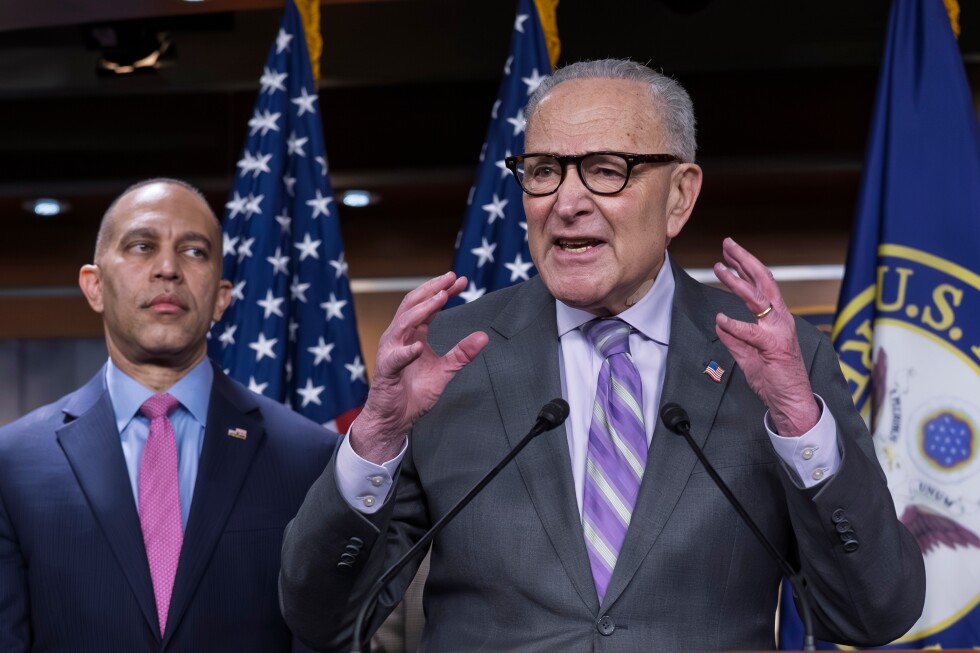


WASHINGTON (AP) — Democrats have begun tentative talks with the White House on their demands for “dramatic” new restrictions on President Donald Trump’s immigration crackdown, discussing a possible agreement just days before funding for the Department of Homeland Security is set to expire.
Senate Democratic Leader Chuck Schumer said Monday that Democrats had sent the White House their list of demands for Immigration and Customs Enforcement and other federal law enforcement agencies. The White House said Monday evening it had responded with a counterproposal.
Neither side released their specific proposals publicly, but Senate Majority Leader John Thune, R-S.D., said there is “forward progress.”
“The Dems and the White House are trading papers, which is a good sign,” Thune said as he left the Capitol. “Hopefully they can find some common ground here, and both sides at this point I think are trying to do that.”
Advertisement
Time is running short, with another partial government shutdown threatening to begin Saturday. Among the Democrats’ demands are a requirement for judicial warrants, better identification of DHS officers, new use-of-force standards and a stop to racial profiling. They say such changes are necessary after two protesters were fatally shot by federal agents in Minneapolis last month.
“Republicans, the clock is ticking,” Schumer said on the Senate floor. “We have sent you our proposals and they are exceedingly reasonable.”
Still, despite the bipartisan talks, it was unclear if the two sides could find agreement on the charged issue of immigration enforcement, especially as rank-and-file lawmakers in both parties were skeptical about finding common ground.
Republicans have balked at the Democrats’ requests and some have demands of their own, including the addition of legislation that would require proof of citizenship before Americans register to vote and restrictions on cities that they say do not do enough to crack down on illegal immigration.
Advertisement
And many Democrats who are furious about ICE’s aggressive crackdown have said they won’t vote for another penny of Homeland Security funding until enforcement is radically scaled back.
“Dramatic changes are needed at the Department of Homeland Security before a DHS funding bill moves forward,” House Democratic Leader Hakeem Jeffries said Monday. “Period. Full stop.”
The funding issue came to a head after ICU nurse Alex Pretti was shot and killed by a U.S. Border Patrol officer in Minneapolis on Jan. 24, and some Republicans suggested that new restrictions were necessary. Renee Good was shot by ICE agents on Jan. 7.
Advertisement
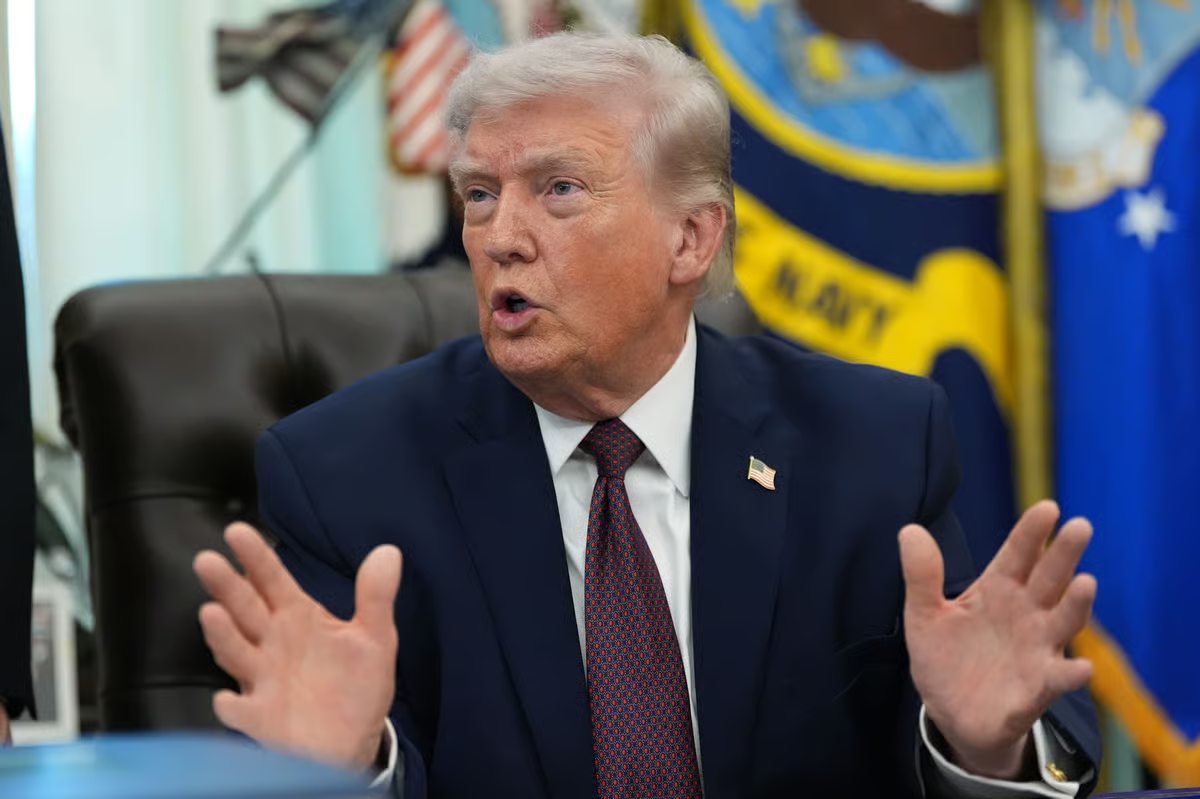
While he agreed to separate the funding, Trump has not publicly responded to the Democrats’ specific demands.
White House press secretary Karoline Leavitt said late last week that the Trump administration is willing to discuss some items on the Democrats’ list, but “others don’t seem like they are grounded in any common sense, and they are nonstarters for this administration.”
Democratic demands
Schumer and Jeffries have said they want immigration officers to remove their masks, to show identification and to better coordinate with local authorities. They have also demanded a stricter use-of-force policy for the federal officers, legal safeguards at detention centers and a prohibition on tracking protesters with body-worn cameras.
The Democrats say Congress should end indiscriminate arrests, “improve warrant procedures and standards,” ensure the law is clear that officers cannot enter private property without a judicial warrant and require that before a person can be detained, it’s verified that the person is not a U.S. citizen.
Advertisement
Republicans have said they support the requirement for DHS officers to have body-worn cameras — language that was in the original DHS bill — but have balked at many of the other Democratic asks.
“Taking the masks off ICE officers and agents, the reason we can’t do that is that it would subject them to great harm, their families at great risk because people are doxing them and targeting them,” said House Speaker Mike Johnson, R-La., on Monday. “We’ve got to talk about things that are reasonable and achievable.”
Tennessee Sen. Bill Hagerty said on “Fox News Sunday” that Democrats are ”trying to motivate a radical left base.”
“The left has gone completely overboard, and they’re threatening the safety and security of our agents so they cannot do their job,” Hagerty said.
Advertisement
Consequences of a shutdown
In addition to ICE and U.S. Customs and Border Protection, the homeland security bill includes funding for the Federal Emergency Management Agency and the Transportation Security Administration. If DHS shuts down, Thune said last week, “there’s a very good chance we could see more travel problems” similar to the 43-day government closure last year.
Lawmakers in both parties have suggested they could separate out funding for ICE and Border Patrol and pass the rest of it by Friday. But Thune has been cool to that idea, saying instead that Congress should pass another short-term extension for all of DHS while they negotiate the possible new restrictions.
“If there’s additional time that’s needed, then hopefully Democrats would be amenable to another extension,” Thune said.
Many Democrats are unlikely to vote for another extension. But Republicans could potentially win enough votes in both chambers from Democrats if they feel hopeful about negotiations.
Advertisement
“The ball is in the Republicans’ court,” Jeffries said Monday.
___
Associated Press writers Joey Cappelletti and Lisa Mascaro contributed to this report.
In another nightmare performance for Spurs, Atletico were three ahead after just 15 minutes in the first leg of their last-16 tie with Kinsky responsible for two of the goals.
Kinsky, who was making only his third appearance of the season, was then substituted by Igor Tudor in the 17th minute with Guglielmo Vicario replacing him goal for the remainder of the game.
The 22-year-old, who joined Spurs in a £12.5 million deal from Slavia Prague 14 months ago, was blanked by Tudor on the touchline before he headed straight down the tunnel.
Advertisement
‘I want to send him a message of support,’ Porro told Movistar Plus after Spurs defeat when asked about Kinsky’s substitution.
‘It’s a tough time for him right now. The lad has been working really hard. He also had Vicario ahead of him who was doing well, and when you get a chance, these things happen… sometimes that’s football.
Igor Tudor blanked Antonin Kinsky on the touchline after he was subbed (Getty)
Your football fix
Metro‘s Head of Sport James Goldman delivers punchy analysis, transfer talk and his take on the week’s biggest stories direct to your inbox every week.
‘It reminds me of my slip in Scotland with Spain. You have to pick yourself up. I haven’t been able to talk to him yet, but I’ll give him a big hug now.’
Tudor, meanwhile, revealed after his fourth defeat in charge of Spurs that he had spoken to Kinsky in the dressing room.
‘We need to apologise to the fans, incredibly difficult to explain, these 20 minutes I’ve never seen in my life in the Champions League at this level, very strange to explain,’ Tudor said.
Advertisement
‘I’m sorry for the guy also, I needed to take him [off] to preserve him, to help him, to help the team, it was not a nice thing.
‘But Toni understands, he’s a very good goalkeeper, a really good guy, we need to stay together now, try to help each other in a difficult moment.’
Asked if he had spoken to Kinsky, Tudor replied: ‘Of course, of we speak.
‘He understands everything, it’s a big lesson, unfortunately it happened in this big game.
Advertisement
‘Sport is like this, it’s not even about him it’s about us. We need to keep working.’
Atletico head coach Diego Simeone was also asked about Tudor’s decision to substitute Kinsky.
‘No, I hadn’t seen that at a professional level,’ Simeone said.
‘It’s not my problem, it’s theirs, their coach’s and the goalkeeper’s, and we’re focused on ourselves, not on someone else’s decision-making.’
Atletico were three ahead after just 15 minutes in the first leg of their last-16 tie in Madrid with Kinsky responsible for two of the goals.
Kinsky, who had not made an appearance for Spurs since October, was then substituted by Igor Tudor in the 17th minute with Guglielmo Vicario replacing him goal for the remainder of the match.
The 22-year-old, who joined Spurs in a £12.5 million deal from Slavia Prague 14 months ago, was also blanked by Tudor on the touchline before he headed straight down the tunnel.
Advertisement
‘I feel really, really sorry for him,’ Schmeichel told CBS Sports when asked about the decision to substitute Kinsky.
‘You make mistakes, you know, he’s put him in goal. Obviously, he’s costing the team the opportunity to win. Not that Tottenham have any opportunity to win. I mean, it was a terrible performance.
Antonin Kinsky was replaced after 17 minutes following his two mistakes (Reuters)
Your football fix
Metro‘s Head of Sport James Goldman delivers punchy analysis, transfer talk and his take on the week’s biggest stories direct to your inbox every week.
‘But when this happened, when you look at the clock there, 14:55, what does Igor Tudor then? Well, he substitutes him.
‘That’s going to have ramifications for the rest of his career. This will be a moment that everybody in football will always remember every time they see and hear his name.
‘You make your choice as a coach and yes, it wasn’t going your way and you’re 3-0 down, there’s no way that this team would ever come back from that. You’ve got to stick with him and at least stick until half-time.
Advertisement
‘What he’s done there, for me, he’s absolutely killed his career. That’s going to take something to get over that.’
Igor Tudor says Antonin Kinsky ‘understands’ his decision (Getty)
Meanwhile, Tudor insists Kinsky ‘understands’ the decision to substitute him so early in the game.
‘What happened is very rare. I’ve been coaching for 15 years, I’ve never done this. It was necessary to preserve the guy, preserve the team. Incredible situation, nothing to comment,’ Tudor said.
‘It was, before the game, the right choice to do in the moment like we are, with the pressure on Vicario, another competition. Toni is a very good goalkeeper. It was for me the right decision. After this, of course, it’s easy to say that it was not the right decision. So I explained to Toni also, speaking after: he’s the right guy and a good goalkeeper.
‘Unfortunately, it happened in this big game, these mistakes. He was sorry. The team is with him, me too. I was speaking with him. He understands the moment, he understands why he goes out. As I said, he’s a very good goalkeeper. We are with him, we are all together. It’s never about one player. It’s happened. It’s the Champions League again. We paid [for] this start of the game.
Advertisement
‘It was too much for us in this moment when we are fragile, when we are weak. I recognise what we are and which problems we have. I recognise that every game something happens. Sometimes it’s very difficult to explain. When these things happen, in the moment where we are now, unfortunately, it’s like that. Even these slippery things happen, it explains the moment [we are in].’
Collagen is a key protein found in many bodily functions. While we do naturally produce our own collagen stores, production levels tend to slow down as we get older causing a range of potential aesthetic and functional issues. Vicky Pennington, nutritionist at Boots, explained: “Collagen is one of the human body’s most abundant proteins and it’s essential for building muscle and cell repair.”
Popularity of collagen supplements is growing on social media but the nutritionist urged people to look elsewhere first: “Before you think about taking collagen supplements, it’s important to ensure that you’re doing as much as you can naturally to maintain collagen levels.
“This means eating a healthy diet including a mixture of nuts and seeds, a variety of colourful fruits and veggies, fish and grass-fed protein. Marine collagen, from wild-caught fish such as salmon is absorbed up to 1.5x more efficiently than cow or pig sources, so opt for fish when you can.”
Collagen has been lauded by some on social media for its effect on the skin, and this may be worth the hype, as Vicky explained: “Collagen is essential for so much more than skin elasticity and hydration. It plays a key role in support for holistic skin maintenance, healthy bones and joints, muscle repair and protecting organs, including the gut.”
Another common misconception about collagen is when people should start taking it. Vicky continued: “Taking collagen won’t have an instant impact, but taking it consistently over a long period of time is shown to have the best effect.
“There is no perfect time to begin taking collagen. When you reach 40+, collagen production declines quicker so many choose to start taking collagen supplements in their 20s and 30s.”
Kirstie Thorley-Mitchell, head of wellness at Boots, revealed that people in their 20s seem to be on top of the trends: “Collagen supplements are more popular with younger generations, a recent survey by Boots revealed that half of Gen Z and millennials have tried collagen, compared to just 20% of people in their 60s.
“If you do want to supercharge your collagen intake to replace lost collagen or encourage your body to produce more of it, then collagen supplements might be for you.
“Collagen supplements come in multiple forms including tablets, powders, capsules, gummies and drinks, so there’s a way for everyone to incorporate it in their everyday routine.
“For anyone feeling overwhelmed with the choice of options available, Boots has introduced new wellness training to over 500 Health & Wellness Specialists in 140 stores nationwide.”
Advertisement
Some of Kirstie’s top collagen picks include Free Soul Collagen Gummies for £14.99, Absolute Collagen’s Liquid Marine Collagen sachets for £30 and Boots Marine Collagen tablets for £33.
NHS consultant’s perspective on collagen
One senior doctor spoke to the BBC about collagen supplements in 2025 but was more sceptical. Professor Faisal Ali, a consultant dermatologist at Mid Cheshire NHS Trust, said: “The best thing you can do for your skin is using decent sunblock. We know the sun has a huge impact on ageing our skin.
“Sun cream, healthy diet, and if you smoke, stop. These will have a far greater impact than collagen supplements.”
The key to a well-cut lawn is neat edges – but they’re hard to achieve. Often, a lawn mower is too bulky and if there’s a flowerbed or rockery, you risk damaging your flowers, your lawn mower or both. The best strimmers, whether petrol, electric or cordless, make it easy.
In fact, if your garden needs serious landscaping, turn to a strimmer first. “If the grass is longer than your lawn mower can handle, the strimmer can take that down ready for you to go over it with the mower,” explains James Broadhouse, a professional groundskeeper of 12 years (known online as Jimmy The Mower). For something tougher, like a bramble patch, a powerful strimmer or brushcutter will also help.
Below we’ve reviewed this year’s best strimmers from brands including Stihl, Ryobi and Bosch. You’ll also find answers to popular questions about them. But first, here’s our top five:
According to Broadhouse, the key things to look for in a strimmer are a robust build, comfortable handling and, if it’s cordless, a decent battery life.
“Most homeowners probably shouldn’t be looking at a petrol strimmer,” says Broadhouse. “A can of petrol is only really fresh for a couple of months, after which, if you haven’t used it all, it just goes to waste.” That said, heavy-duty or commercial users, will benefit from the extra power and range petrol models provide.
Broadhouse also recommends choosing a cordless strimmer over a corded one, because of the potential safety risk a trailing power cord poses.
Advertisement
Look for interchangeable heads for different kinds of mowing. Most strimmers will display their noise and vibration output, which can help narrow down your options. They are heavier than they look, so it’s worth visiting your local garden centre to try a few and see what feels manageable.
The mum’s secret behind bars romance was rumbled when the convict became ‘overprotective’ of her and began attacking other prisoners
Adam Everett Crown Court Reporter
22:47, 10 Mar 2026
A prison officer sent naked pictures and videos of sex acts to a serving inmate after the two formed an “intimate relationship” behind bars. Zoe Oldham also received bank transfers from a family member of the criminal in question, Lewis Smith.
But their secret romance was rumbled when he became “overprotective” of her and began attacking other prisoners whom he believed had stepped out of line with the mum. The authorities then discovered a mobile phone hidden within a sock in his cell, with more than 1,000 messages which were uncovered as a result having laid bare the true nature of their relationship.
Liverpool Crown Court heard today, Tuesday, that Oldham had been a guard at HMP Risley in Warrington for five years by 2023, when she engaged in an “intimate relationship” with Smith over the course of several months. This “included her sending images of her genitals” and money being transferred into the 29-year-old officer’s account.
Advertisement
Simon Christie, prosecuting, described how there was also a “strong inference that there was a sexual relationship”, although no specific acts were ultimately identified. Concerns were first raised over the two in March of that year after Smith “became overprotective over Ms Oldham and carried out assaults on prisoners who he believed had disrespected her”.
This led to a search of the 32-year-old inmate’s cell, which revealed a mobile phone hidden inside a sock. When analysed, the device was found to contain a total of 1,184 messages which had been exchanged between the couple.
Mr Christie added: “Amongst the other images found were full face images of the defendant, images of her in her underwear, images of a female masturbating with a sexual aid and images of female genitals sent to the defendant Smith. He, in return, sent topless pictures of himself. The two of them say on many occasions how much they love each other.”
Oldham, of Marlborough Road in Accrington, Lancashire, was also said to have given Smith her bank details, leading to funds of “at least” £350 being transferred into her account via his sister. She has no previous convictions.
Advertisement
Damian Nolan, defending, told the court: “I am probably going to concede that the gravamen in this case is the public interest in ensuring that the prison system operates in a carefully ordered way. If it does not, the ramifications can be significant.
“But this offence can be committed in a number of different ways. We would submit that, ordinarily, the courts will be particularly concerned if items were being taken in, either weapons, phones, drugs or other associated paraphernalia. Thankfully, this is not one of those cases. But what she has done is allow her office to be corrupted by, essentially, a combination of Smith’s actions and her actions.
“This is not someone who has been reckless throughout while she was a prison officer. It is asserted that, on a previous occasion, she had, in fact, reported inappropriate contact from a serving prisoner. She was commended for doing that and indicated that she would not go back on the wing until that had been dealt with.
“This all arose at a particularly vulnerable time for her personally. She is the mother of a young child. She was at a vulnerable time in her relationship with the father of her child. I am informed that, for some time, they have been back together as a couple and live together as a family. She had to move out of her own accommodation because she lost her job.
Advertisement
“This has been the most salutary of lessons for her. She lost this employment. She tried other employment, but that fell away when this was reported. This has, in effect, haunted her since she was first arrested.
“The first date placed on this indictment is now almost three years ago. She got subsequent employment, but social media did its best so that she had to resign from that company. She hopes that, because she did that, she can reobtain that employment. She is, at the moment, on state benefits, but she is very much keen to work and put this aberration on her otherwise exemplary character behind her.
“No one knows more than her just what a grave error of judgement she made with Smith. She has been haunted by that and will remain so. The court can mark the offence by saying, in effect, that this was worthy of a prison sentence but suspended, so that she can continue to rehabilitate.
“Obviously, there is a very stark choice. While she has had to make certain arrangements, the ideal would be that she is not separated from her young daughter. It is clear that she has learned a lesson. She will not work in the public sphere in that way again.
Advertisement
“The court can be satisfied that she will return to a law abiding life. She is a good mother, as all the references attest to. She wants to set good standards for her daughters. She has slipped, but that does not stop her from being a good mother.
“The ultimate sacrifice, namely going to prison immediately, in my submission, can be avoided in this case. The height of it is an intimate relationship, embarrassing to her. All of her family and everyone that she knows know what she did. Three years have passed since the commission of the offence. She has demonstrated humility about that.”
Oldham admitted one count of misconduct in a public office during an earlier hearing. Appearing in the dock wearing a brown fur coat and sporting long brown hair, she was jailed for eight months.
Sentencing, Judge David Swinnerton said: “You were, in March 2023, working as a prison officer at HMP Risley. You had been there for about five years by then. You were not a very junior officer. You had some experience.
Advertisement
“What was discovered upon seizing a phone found in the cell of Lewis Smith, hidden in a sock, was that you and he, he being a serving prisoner, spent some months conducting an intimate relationship. That is not to say that there was physical sexual activity between you, but the nature of your messaging was intimate and romantic. That went on for some months. This was not just a one off. You knew full well that it was wrong.
“It is a slightly double edged sword. You chose not to report the initial contact because you were not satisfied with the way that the prison service had dealt with contact from a previous prisoner. You had been trained what the right thing to do was.
“You must have known how undermining it is of prison discipline if officers have relationships like this with prisoners. You are not only letting down the public, who place trust in those that are employed as prison officers, but you also badly let down your colleagues. It makes their lives more difficult and risky when prisoners are able to manipulate officers.
“You did not take anything into the prison for him. If you had, your position would have been much, much worse. But you made yourself very, very vulnerable. You accepted money from him. Two separate sums of money were transferred to your account by his sister, you having provided a serving prisoner with your bank account details.
Advertisement
“If you had stopped for a moment to think, you would have realised just how foolish that was, just how vulnerable that made you and just how vulnerable that made the security and safety of the prison. With relationships like this, there might be a risk that you will be leant upon, even blackmailed. You knew full well, throughout the months that this went on, that this was wrong.
“The authorities make clear that punishment and deterrents are always very important elements in such cases. Really, the cases where suspension is justified are exceptional.
“You are of previous good character. This began at least three years ago and ended two-and-a-half years ago now. In that time, you lost your job as a prison officer. You sought other employment, which you lost after publicity about what you have done. But you have stayed out of trouble. You have tried to work and continued to look after your daughter.
“It is an important factor, of course, that you have a now five-year-old daughter that you are the primary carer for, albeit you are now living at your father’s house with him and her father. You do not present a high risk of reoffending
Advertisement
“Immediate custody will result in a significant harmful impact on others. You have a dependant child, albeit she can stay where she is and has her father and grandfather with her. But I have to weigh against that the seriousness of the offending.
“I have taken the view that appropriate punishment can only be met by immediate custody. Prison officers have to realise that they cannot form these inappropriate relationships. It carried on for months. You won’t be away for very long, but the punishment is going away at all. The message is that immediate imprisonment follows, almost always, in cases of this nature.”
Smith, of Abbey Hey Lane in Gorton, Manchester, was handed a further eight months imprisonment by the same court in December last year. He pleaded guilty possession of a mobile phone in a prison and possession of a class C drug in a prison, the latter count relating to anabolic steroids which he was found with while serving at HMP Wymott in Lancashire.
At least six people have died in a bus blaze in Switzerland, which was allegedly started by a man inside the vehicle, according to police and local media reports.
Police said the blaze took place in Kerzers, a town in the western canton of Fribourg, at around 6.25pm on Tuesday. The victims have not yet been identified.
Five people have been injured, including an emergency responder, and three of them have been taken to hospital in critical condition, Fribourg police said in a statement.
Image: Investigators examine the charred shell of the bus. Pic: AP
Man ‘set himself alight’ in possible ‘wilful act’
Advertisement
It is unclear whether any other people have been hurt in the blaze, as officials said it is not known how many people were inside the bus when the fire, which “totally engulfed” the vehicle, started.
A man inside the bus “poured out petrol and set himself alight”, a witness claims in a video shared with Swiss newspaper Blick. This account was corroborated by other witnesses, according to the report.
The fire could have been a “wilful act”, the spokeswoman of Fribourg’s police said at a news conference, adding the force had “information that a person is the cause of the fire”.
She said that while police have received information that someone had poured petrol over themselves, she could not confirm this.
Advertisement
Another spokesperson said the fire could have been “deliberately” started, and added police would not reveal whether the alleged perpetrator is among the injured or dead.
Image: Firefighters and police officers install barriers to secure the area. Pic: AP
Police have not ruled out a terror act and said an investigation is under way.
Officers are set to remain at the scene, where the burnt-out bus is shielded from view by barriers. Residents have been asked to avoid the area.
President ‘saddened’ by another deadly blaze
Schweizerische Post, the company operating the bus, said in a statement to Swiss paper Der Bund: “Our thoughts are with the injured and the families of the deceased.”
Advertisement
Swiss President Guy Parmelin said in a post on X: “It distresses and saddens me that yet more people in Switzerland have lost their lives in a serious fire.
“The background is being clarified. To the relatives of the deceased from Kerzers, I extend my condolences. And I think of the injured & the emergency services.”
Image: Barriers surrounding the charred remains of the vehicle. Pic: AP
The bus fire comes just months after a bar blaze in the Swiss mountain resort of Crans-Montana killed 41 people and injured 115 more in the early hours of 1 January.
Most of those who died were teenagers, and many were foreigners, including several from France and Italy.
Pressure washers have endless uses, from cleaning your car or bike to the patio, the gutters, a well used barbecue, dusty garden chairs and even your windows. Some even use them to clean carpets and chimneys, which seems foolhardy, but the trick is to use the best pressure washer for the job since the likes of Kärcher and Clarke differ from Bosch and Worx.

Using high pressure is essential to lift any sort of deeply ingrained dirt, but lower-pressure washers are more economic if you’re just cleaning mucky boots. Either way, these handy devices use less water than trying to clean stubborn dirt with a hose because they require far less water to make an impact.

Pressure washers can cost anything from £50 to £650, but you can find in-depth reviews of all the biggest brands in the business below, and some advice from a professional gardener on how to use them. First, here’s a quick look at our top five:
The key thing to look at is the cleaning pressure. Anything over 150 bar is high, capable of blast-cleaning concrete, while anything under 50 bar is low and best left for plastic garden furniture. Consider the quality of the materials too, metal pumps are better than plastic ones, for example.
Also take into account any additional features and accessories it comes with – such as nozzles, spray washers or a remote control – since these can be expensive to buy separately. Hose length, noise level, weight and value for money are also important. They generally draw between 1,400 and 2,800 Watts, which at today’s prices will cost between 37p and 74p an hour to run
The Pentagon said the United States has sunk 16 mine-laying ships soon after President Donald Trump threatened Iran over reports of mines in the Strait of Hormuz.
“I am pleased to report that within the last few hours, we have hit, and completely destroyed, 10 inactive mine laying boats and/or ships, with more to follow!” Trump wrote on Truth Social Tuesday afternoon.
U.S. Central Command later wrote on X the military destroyed a total of 16 mine-laying ships near the Strait of Hormuz.
Trump’s announcement came minutes after the president warned against Iran placing mines in the waterway that carries about a fifth of the world’s oil supply.
Advertisement
“If for any reason mines were placed, and they are not removed forthwith, the Military consequences to Iran will be at a level never seen before,” Trump wrote on Truth Social earlier Tuesday.
The Pentagon says the US has sunk 16 mine-laying ships after Trump threatened Iran over reports of mines in the Strait of Hormuz (AFP/Getty)
CBS News had reported Iran may be getting ready to deploy mines in the Strait of Hormuz, citing U.S. officials.
People familiar with U.S. intelligence reporting on the matter told CNN Iran had already laid a few dozen mines in the key waterway in recent days.
Advertisement
Trump said the U.S. was using “the same Technology and Missile capabilities deployed against Drug Traffickers to permanently eliminate any boat or ship attempting to mine the Hormuz Strait.”
The president was seemingly referring to the controversial boat strikes the U.S. has carried out in the Caribbean and Pacific, which have killed more than 150 people.
Defense Secretary Pete Hegseth said Tuesday the U.S. “will not allow terrorists to hold the Strait of Hormuz hostage.”
“At the direction of President Trump, @CENTCOM has been eliminating inactive mine-laying vessels in the Strait of Hormuz—wiping them out with ruthless precision,” Hegseth wrote on X. “To the weakened Iranian regime: you have officially been put on notice!”
Advertisement
The Strait of Hormuz is a waterway bordered in the north by Iran that carries about a fifth of the world’s oil supply (AFP/Getty)
Iran has threatened to attack any ship that tries to pass through the Strait of Hormuz, which is bordered in the north by the Middle Eastern country.
Ebrahim Jabari, a senior official with Iran’s Islamic Revolutionary Guard Corps, said last week, “The strait is closed. If anyone tries to pass, the heroes of the Revolutionary Guards and the regular navy will set those ships ablaze,” according to Reuters, which cited Iranian state media.
Tankers that travel through the Strait of Hormuz transport oil and gas from Iran, Saudi Arabia, Kuwait, Iraq, Qatar, Bahrain, and the United Arab Emirates, the Associated Press reported. Most of the oil carried through the waterway is sold to Asia.
Advertisement
Oil prices surged Monday to nearly $120 a barrel, the highest since 2022. Oil prices later recovered, dropping back below $90 after Trump told CBS News the Iran war is “very complete, pretty much.”
Iran has “no navy, no communications, they’ve got no air force. Their missiles are down to a scatter. Their drones are being blown up all over the place, including their manufacturing of drones,” Trump said.
But uncertainty about how long the U.S. will continue its military campaign against Iran remains during the second week of the conflict.
Advertisement
The Iran war, which began more than a week ago, has caused uncertainty in the oil and gas industry (Middle East Images)
A new Quinnipiac University poll found 18 percent of American voters think it will take weeks for the Iran war to end, 32 percent think it will take months and 26 percent think the conflict will last longer than a year.
Iranian Foreign Minister Abbas Araghchi has decried Trump’s argument for starting the Iran war.
“The claim that Iran was planning on attacking the U.S. or U.S. Forces, whether preventively or preemptively, is a sheer and utter lie,” Araghchi wrote on X Tuesday. “The sole purpose of that lie is to justify Operation Epic Mistake, a misadventure engineered by Israel and paid for by ordinary Americans.”
Advertisement
Trump has insisted Israel did not force America’s hand to launch military strikes against Iran, in an effort the U.S. has dubbed Operation Epic Fury.
“I might of forced their hand,” the president told reporters.
The track climbed the UK charts and became Swift’s sixth number one single earlier this year after the singer released an accompanying star-studded music video which featured actor Cillian Murphy, singer Lewis Capaldi, TV presenter Graham Norton, About Time star Domhnall Gleeson and actresses Greta Lee and Jodie Turner-Smith.
Self-driving cars are very much a reality and no longer a vision from science fiction. In the UK, automated vehicles (AVs) such as self-driving shuttles are already being tested on public roads.
Self-driving taxi services are expected to launch in 2026, and the Automated Vehicles Act is scheduled for implementation in 2027. This act establishes the legal groundwork for driverless cars to operate on Britain’s roads.
As these vehicles move from research labs to our streets, one question becomes critical: how will they communicate safely with the people around them? Researchers and designers have proposed installing equipment on the vehicles called external human–machine interfaces. These are designed to help driverless vehicles signal their behaviour to pedestrians and other road users (cyclists, wheelchair users and human drivers).
The driverless vehicles would employ pulsing lights around the vehicle, text displays showing the car’s intentions, and auditory cues that announce forthcoming actions, such as “I’m stopping” or a truck-like reversing sound.
Advertisement
However, much of this research still overlooks people with disabilities, including pedestrians with hearing loss. When accessibility isn’t built in from the start, the resulting designs often fail. So how can this be improved?
There are many examples of where current driverless vehicles fall short. Text-only displays may appear universal, but they can be less accessible for people whose primary language is sign language. They are also inacessible to blind people. Auditory cues, such as hums or droning sounds, could help the blind, but are difficult or impossible to detect for many people with hearing loss – even those with hearing aids.
Speech-based cues, meant to help people with low vision, can unintentionally introduce new risks. Hearing loss can distort speech, so a message like “I’m stopped” may be heard only as “stop” – completely altering its meaning.
One size fits all
Driverless vehicles are not inherently unsafe for deaf and hard of hearing people – the challenge lies in a design process that assumes a universal, one-size-fits-all approach. Historically, communication interfaces in regular vehicles have been built with an assumed “typical” hearing pedestrian in mind.
Advertisement
When accessibility becomes an afterthought, communication becomes unreliable, and the systems meant to increase safety may end up excluding the people who need them most. Technology alone cannot solve this problem.
Cars could use lights and text to signal their ‘intentions’ to deaf people. Peakstock / Shutterstock
Only thoughtful, inclusive design can. Our research shows that combining visual (pulsing lights and a text display) and audio (speech) cues can significantly increase trust and support safer decisions for pedestrians in general. But much more development is needed to ensure these communication interfaces are equitable for all people with special needs.
This gap between technological promise and lived experience reflects a broader pattern. Even though the Automated Vehicles Act aims to improve accessibility, most research in this area in this area still neglects people with special needs, including those with hearing loss.
If we want driverless vehicles to create more accessible streets – and not merely introduce new barriers – then people with special needs must be included in research, design and policy from the beginning.
Advertisement
Drawing on a series of user studies, we offer several practical recommendations to guide industry, researchers and policymakers toward a safer, more inclusive driverless car ecosystem.
Manufacturers should include diverse populations in the design and evaluation of their vehicles. We found that pedestrians with hearing loss may experience external human–machine interfaces differently from hearing people. Designers cannot fully anticipate the potential risks unless they inclusively involve user testing groups.
People need to understand not just that a vehicle exists, but what it intends to do. Displaying the vehicle’s “state”, such as “stopped”, and transitions, such as “slowing down”, helps pedestrians accurately judge the situation and feel more assured.
Combining audio and visual cues increases trust, acceptance and perceived safety. No single mode of communication is effective for everyone, but together, they offer back-ups and clarity.
Advertisement
Relying on just one type of visual cue is risky – lights, text or icons can fail in certain conditions. Providing combined visual information helps ensure that if one fails, another still supports pedestrian understanding.
Urban soundscapes can interfere with with audio cues, especially for pedestrians with hearing loss. Studying external human–machine interfaces in realistic environments is essential for ensuring they work when it matters.
Vehicle manufacturers must work with hearing aid and cochlear implant manufacturers to help ensure that audio cues are distinguishable, rather than confusing.
In many cases, barriers to inclusion arise not from technology itself, but from a lack of awareness or consultation. When people with special needs are excluded from design decisions, systems are built on assumptions rather than lived experience.
Advertisement
When they are actively involved, however, we are a step towards an inclusive and equitable future. Driverless vehicles have the potential to make our roads safer for everyone. But that future depends on purposeful, inclusive design choices today.
If developers, policymakers and researchers commit to engaging with deaf and hard of hearing people, along with others, we can help create streets that are safer, more accessible and more equitable for all.