The DWP has confirmed early state pension and benefit payment dates for May 2026 as the UK prepares for two Bank Holidays
The Department for Work and Pensions has announced the dates when millions of people across Britain should anticipate receiving their benefit and pension payments during the forthcoming bank holidays. Next month sees two bank holidays in the UK: the early May Bank Holiday, falling on Monday, May 4, and the spring Bank Holiday on Monday, May 25.
Advertisement
Because of these bank holidays, the DWP has confirmed that any payments scheduled for either date will be issued earlier than usual. GOV.UK states: “Benefits are usually paid straight into your bank, building society or credit union account. If your payment date is on a weekend or a Bank Holiday you’ll usually be paid on the working day before.”
Anyone expecting a payment on Monday, May 4, will receive their funds on Friday, May 1 instead.
Those awaiting their payment on Monday, May 25 should anticipate it arriving on Friday, May 22.
Universal Credit, Personal Independence Payments, Jobseeker’s Allowance, Employment and Support Allowance, Disability Living Allowance, and Attendance Allowance will all be distributed ahead of schedule, reports the Express.
Advertisement
Nevertheless, it is crucial to understand that these early Bank Holiday payments will not affect subsequent payment dates. These will continue to be issued on their regular schedule.
Should a payment fail to arrive on the anticipated date, claimants are encouraged to verify their bank account and online DWP account before getting in touch with the department.
Those needing to contact Universal Credit can ring their helpline on 0800 328 5644 from Monday to Friday, 8am to 6pm, excluding public holidays. The same applies to state pension payments, with anyone expecting theirs on Monday, May 4 receiving it on Friday, May 1 instead. Those anticipating payment on May 25will get it on May 22.
The day pensioners typically receive their payment is determined by the final two digits of their National Insurance number.
Advertisement
Those with numbers ending 00 to 19 are paid on Mondays, 20 to 39 on Tuesdays, 40 to 59 on Wednesdays, 60 to 79 on Thursdays and 80 to 99 on Fridays.
The Coronation Street icon has been undergoing treatment for cancer while being seen leaving the ITV show on medical grounds
Beverley Callard has told fans she has been forced to miss the I’m A Celebrity… South Africa final on medical advice after being diagnosed with early-stage breast cancer.
Advertisement
Ahead of Tuesday’s (April 21) episode of the I’m A Celebrity… Get Me Out of Here spin-off, it was confirmed that a campmate had to leave the South African savanna unexpectedly on medical grounds before it was revealed that former Coronation Street star Beverley Callard was the one who informed her campmates that she was unable to stay in the competition.
She was seen gathering her fellow campmates, Beverley was seen telling them on the ITV show: “I didn’t feel very well this morning… and the medics have advised I can’t return to camp. I’ve got to go home.” With tears in her eyes she added: “I don’t want to go. I’m absolutely gutted. I wanted to finish.”
Click here to sign up for more Coronation Street updates in our newsletter
Following the episode, Beverley, who is famed for playing Liz McDonald in ITV’s Corrie, and first took part in I’m A Celeb back in 2020 when the programme was relocated to a Welsh castle, took to Instagram to share a video message with her followers. In it, she said: “Well, I’ve just watched by exit on I’m A Celeb and it made me cry all over again. Of course, I didn’t know then that I had cancer but I just knew that it was the last couple of days there that I hadn’t felt very well.
Advertisement
“What happened was, I went into the Bush Telegraph and apparently, I lost consciousness for a little while. I just wasn’t feeling myself. They took me to a medical hut and they were amazing; they really looked after me and they said you can’t go back.” She added: “And I said ‘don’t say that, don’t send me home, I’ll be fine. I wanted to succeed and make it through to the end but that was the start of everything. It’s made me really emotional but I will beat this. I will beat it.”
Beverley, who publicly shared her breast cancer diagnosis in February, also captioned the post: “That was such an emotional watch… especially knowing what I know now. I wanted to prove that age is just a number and I feel so proud of what I achieved. Just got to get through this real life trial now #imaceleb.”
Now, Beverley has confirmed that she is no longer able to attend the show’s live final on Friday (April 24) after doctors had confirmed it was unsafe for her to fly from her base in Ireland to London for the programme. Sharing the news in an Instagram video, the soap star said: “Yesterday, I should have flown to England to get ready for the I’m A Celeb final.
Advertisement
Get MEN Premium now for just £1 HERE – or get involved in our WhatsApp group by clicking HERE
“I was so excited and looking forward too it but on medical advice, I can’t go, I am gutted. I was dying to see them all and it would have been brilliant. I can’t go and yesterday, the flights were booked and everything but no, they said, it is basically too long a day with flying there and then a very late night [with filming]. I will be watching.”
While not able to attend in person, she added: “I will be on Zoom chatting to everyone. So I’ve got to make the best of a bad job but I am resting and I am doing as I am told. Thanks to everybody.”
Mohammad Shethwala and his wife Sadikabanu Tapeliwala were a young couple with a dream, selling everything they had and borrowing money off neighbours to fund a move from India to Britain, where she had been admitted for a Masters at Ulster University’s London campus.
She graduated in 2023, the same year they had their first child Fatima, and both husband and wife found enough work to slowly build a life together, even sending small amounts back home to support the family and friends who had believed in them.
Shethwala, who was back in London at the time, was devastated. Now, 10 months on, he is faced with another loss: the prospect of being forced to leave the UK, the country where he says every memory of his young family was made.
Advertisement
“I have already lost them,” the 28-year-old tells The Independent in an interview. “I want to hold on to the dream at least and fulfil it, to honour the memories I have.”
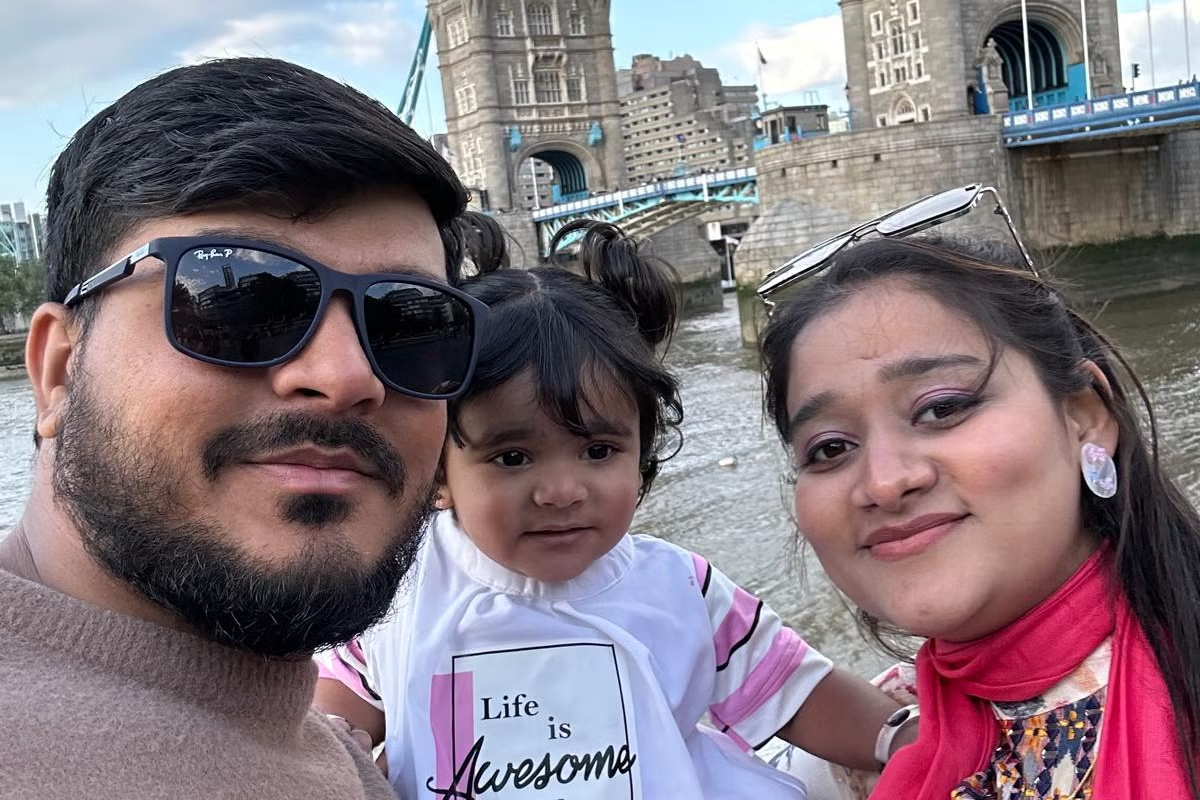
Mohammad Shethwala, 28, lost his wife in Air India crash in June last year (Supplied)
When Tapeliwala was granted her student visa in 2022, Shethwala joined her in Britain as a dependant. Their route to the UK, he says, was financed not by wealth but by sacrifice.
“We did not have money at the time to afford education in the UK,” he says. “People in our neighbourhood lent some money. Both our mothers also sold their jewellery, their life savings, to send us abroad.”
His father ran a small shop in India, earning no more than Rs 10,000 ( £78) to Rs 15,000 (£118) a month. Tapeliwala’s father sold goods door-to-door by bicycle.
Once in Britain, the couple worked relentlessly. His wife’s student visa limited her hours, Shethwala says, so he took multiple jobs, including delivery work. They spent their first year paying back the debt to those neighbours and friends. “After that, we were able to support both families,” he says.
Advertisement
At first, they had not planned to settle permanently. But Britain began to look less like a stopgap and more like a home.
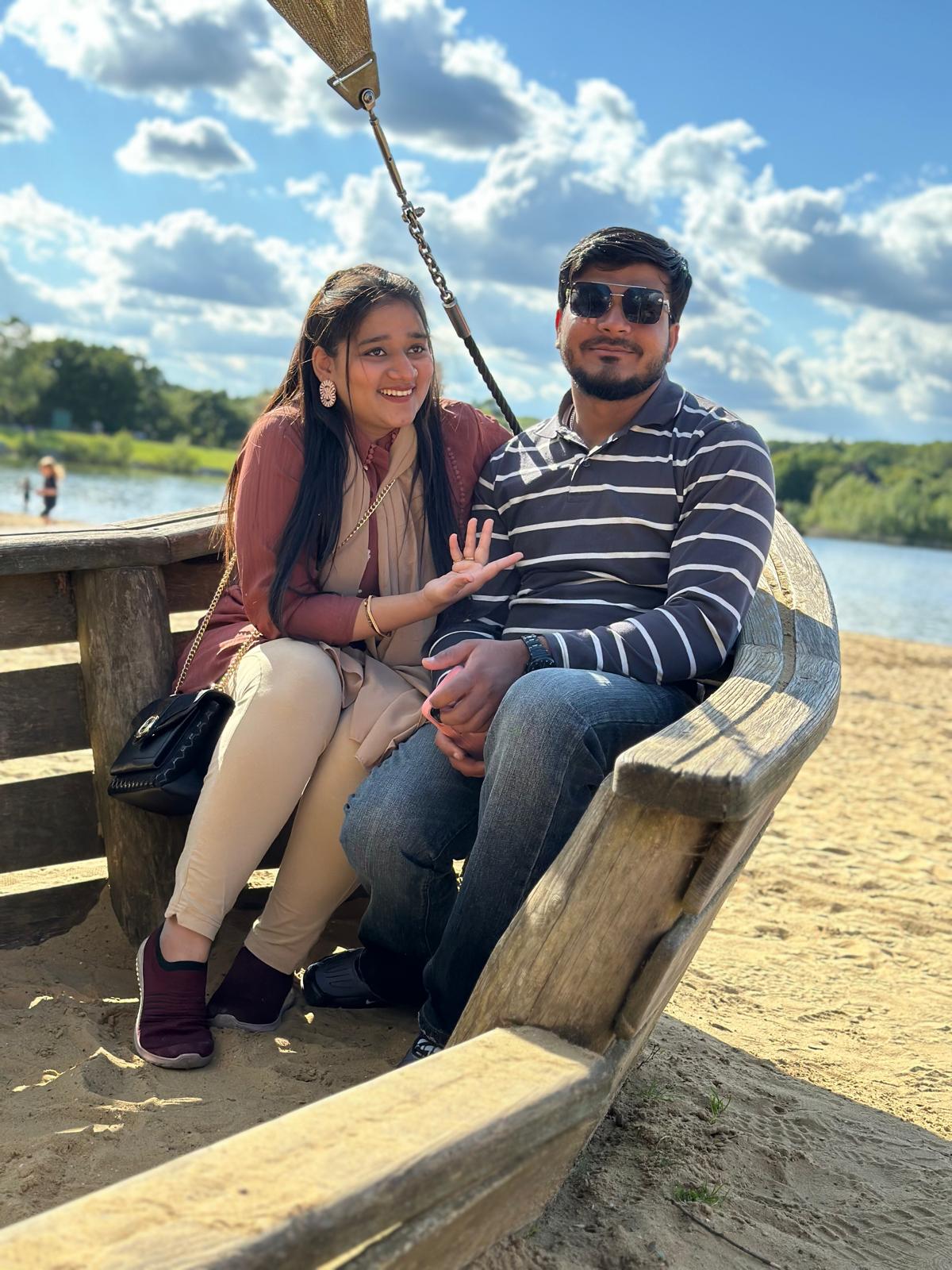
Mohammad Shethwala moved to the UK with his wife Sadikabanu Tapeliwala in 2022 for her further education (Supplied)
“When we spent some time here, we decided it would be wise to settle here,” he said. “Our family background in India was not strong. But since moving here, we were able to support both her family and mine. We would not have managed it in India.”
By spring 2025, the family’s plans appeared to be falling into place. According to Shethwala, his wife had secured work connected to her studies and was preparing to switch into the Skilled Worker visa route after probation. The move would have given the family a more secure footing.
Then came a family wedding in India. Because both adults were working, they had hoped to travel together, he says, but could not get leave at the same time. He stayed behind. His wife and daughter went ahead.
On the morning Tapeliwala and Fatima were due to return to Britain, he says he called them to check in.
Advertisement
“She was at the airport,” he says. “My family were urging that I leave my daughter behind with them [in India]. My wife asked me if I should. But I was hesitant. My daughter was already away from me for a month.”
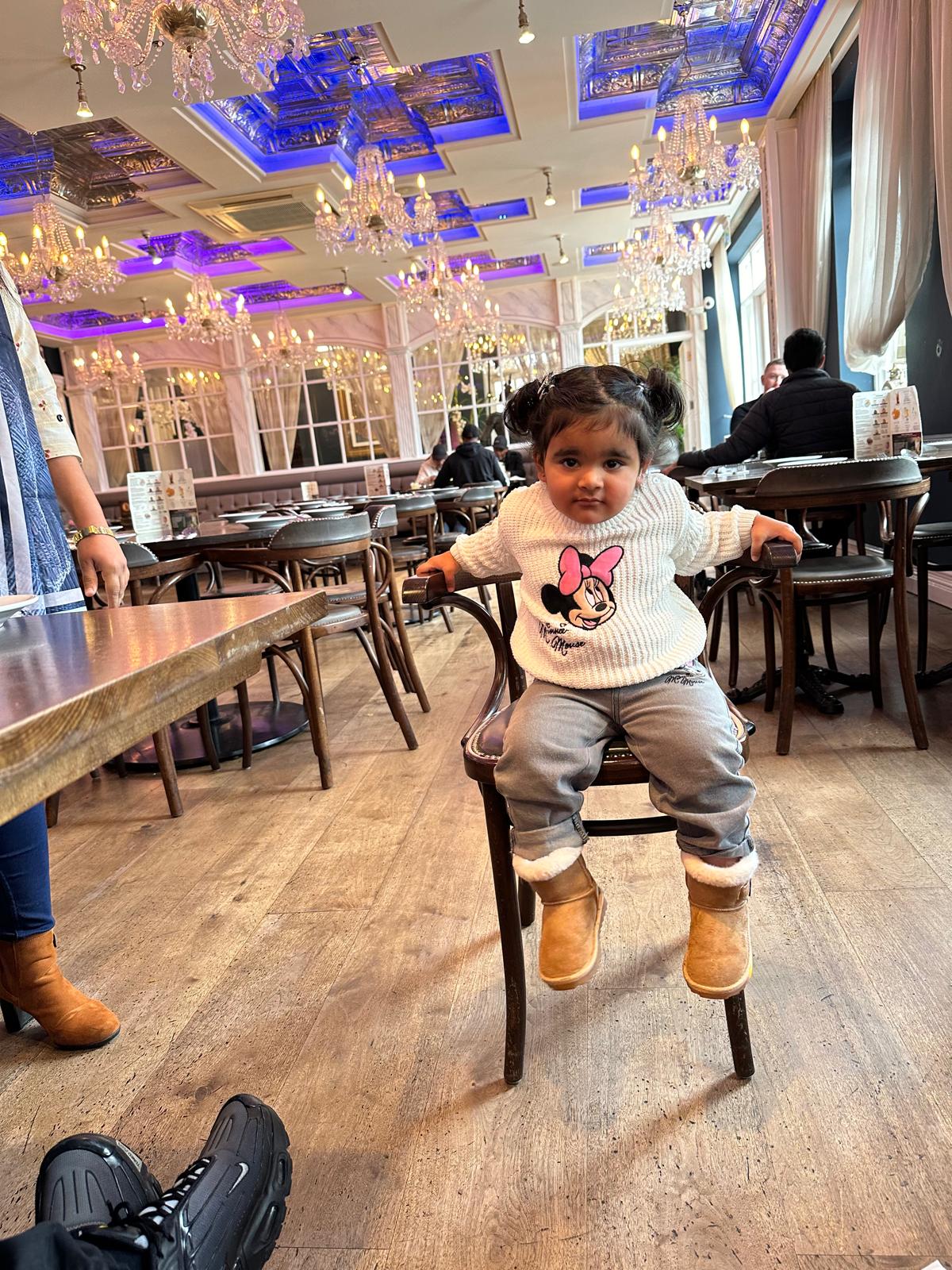
Their daughter, Fatima who was born in the UK in 2023, also died in the plane crash in India (Supplied)
Fatima, he recalled, was crying at the airport. His wife said she had to go, to complete their check-in, and that she would call again once she was seated on the plane.
“That call never came,” he says.
Later that day, as he prepared to collect them from the airport, messages began arriving about a crash. He phoned the friend who had booked the tickets. Then came confirmation from multiple sources: it was the same flight.
“I was speechless,” he said. “I could not grapple with what was happening.”
Shethwala booked the first available flight to India, and until he reached there relatives tried to shield him from the worst news, insisting his wife and daughter were safe and in hospital.
(EPA)
When he arrived in Ahmedabad and went to the civil hospital, staff asked for a blood sample.
“I assumed, if they are taking my blood sample, it is to identify the body,” he says.
A friend who had travelled with him then admitted the truth. “We did not tell you,” Shethwala recalled being told, “because we wanted you to reach India safely.”
His daughter’s remains were handed over to the family on 17 June. His wife’s followed later, on 21 June.
“It was given in a coffin,” he says. “I did not open the coffin before cremation.”
For days, he said, he could not accept what had happened.
Advertisement
“It was like a nightmare and that at any moment, I will wake up and find them both right in front of me.”
Then, as he describes it, another blow followed the first.
“The moment I managed to stabilise, the visa issue came like a dagger,” he said.
Because his immigration status depended on his wife’s visa route, her death left his own future uncertain. According to Shethwala, had she lived, the family expected to move onto a Skilled Worker visa. He says he still has her job offer letter.
Advertisement
“If my wife were alive, we would have had the skilled worker visa,” he said. “Things would have been different.”
He later applied for Further Leave to Remain on compassionate grounds, arguing that his circumstances were exceptional. A psychiatric report detailing his mental health was submitted with the application, he says.
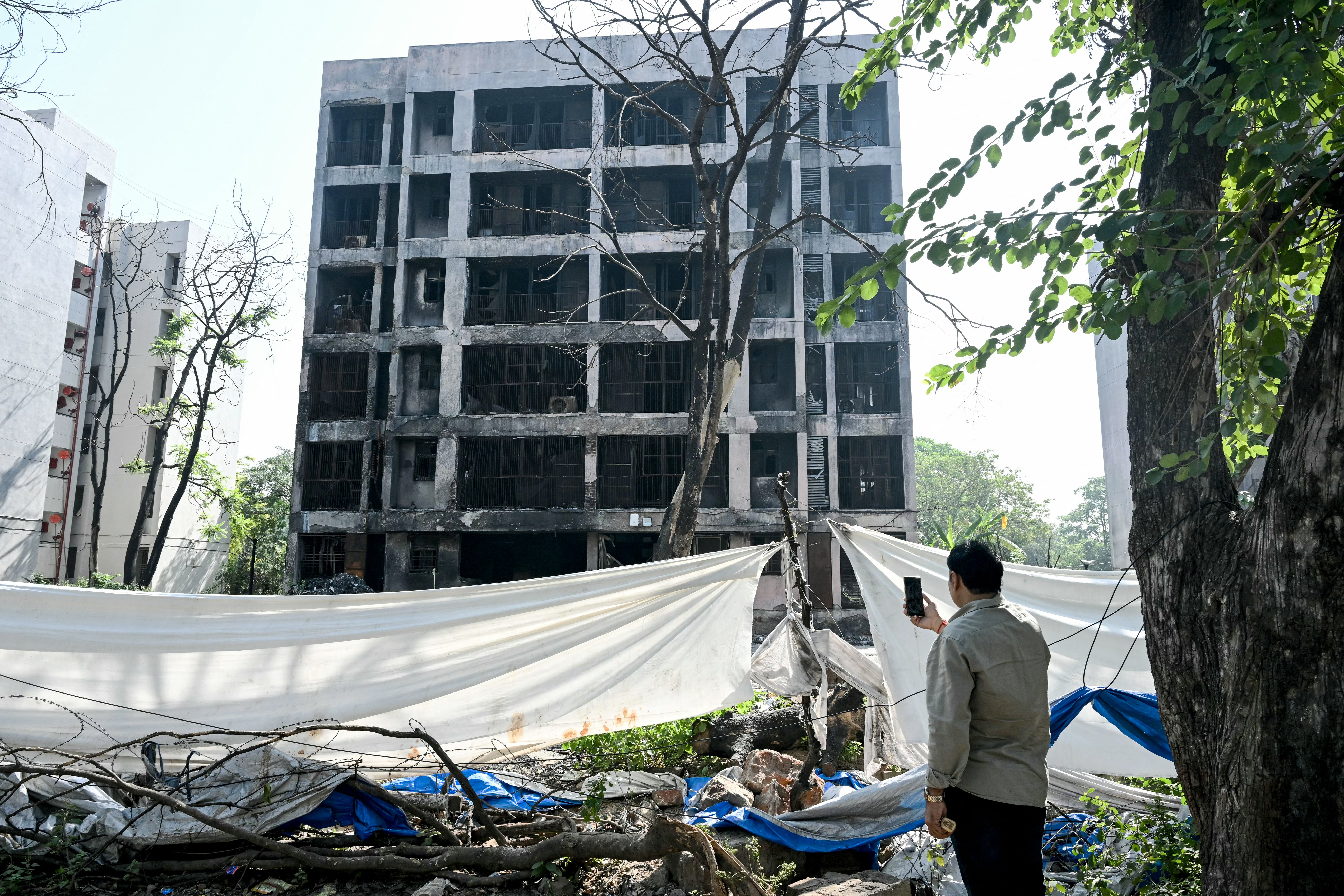
A man takes visuals of a charred building at the accident site of Air India flight AI171 that crashed into a residential area near the airport on June 12 in Ahmedabad (AFP/Getty)
But on 9 April, around nine months after the crash, he received notice that his application had been refused. He says he was then granted temporary immigration bail while expected to leave the country.
“I was not given an opportunity to even appeal,” he says.
The Home Office has not publicly commented on the individual case, and did not immediately respond to a request for comment from The Independent.
Advertisement
In reported correspondence, officials are said to have maintained that Shethwala’s circumstances did not meet the threshold for exceptional leave to remain in Britain and that support, including mental healthcare and family connections, would be available in India.
As Shethwala describes spending sleepless nights in a flat once filled with nursery rhymes, he is speaking to lawyers about whether he has any recourse to appeal.
“We believe this is a genuine humanitarian case and request fair and kind consideration,” says Ayush S Rajpal, case manager at Chionuma Law.
“Our client has lived in the UK for four years and built his life there with his wife,” he tells The Independent. “He is working and settled, and it would be very difficult for him to find similar work in India. After losing his wife, he is facing financial and emotional difficulties and is under psychiatric care. In these circumstances, we kindly request that he be allowed to remain in the UK on compassionate grounds.”
Advertisement
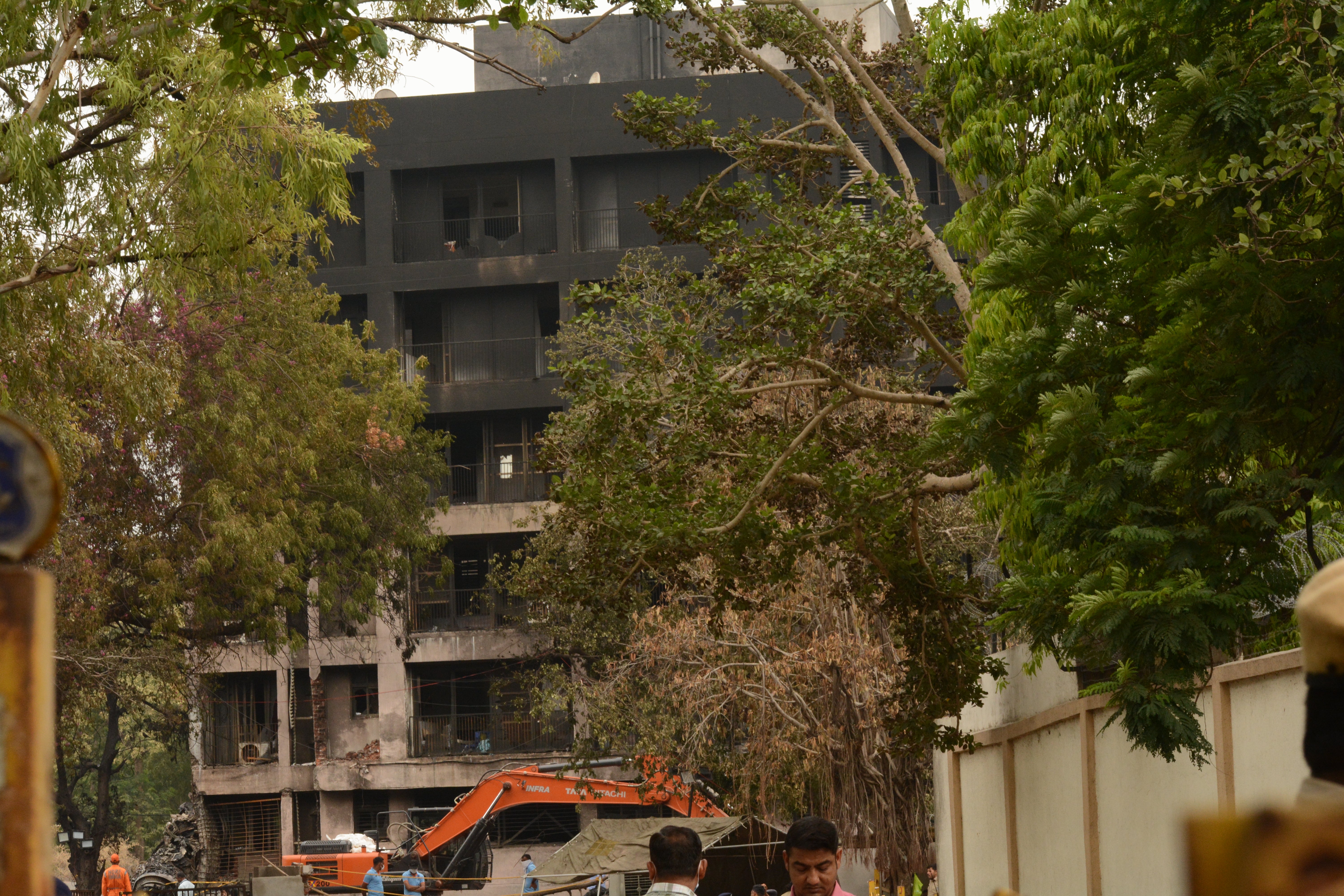
Building of BJ medical college damaged after the Air India plane crash (Namita Singh/The Independent)
Shethwala says returning to India would not bring peace.
“My relatives kept saying, ‘What will you do in London? Just return,’” he says. “But to leave the country for me is to also leave those memories bound to this place.”
He says he is not trying to exploit a loophole or rewrite the rules. He says he simply wants time: time to work, time to recover, time to remain in the place where the future he and his wife imagined briefly felt possible.
Four teenage boys have been arrested on suspicion of murder after a 44-year-old was killed in a crash – this is a breaking story
07:35, 24 Apr 2026Updated 07:44, 24 Apr 2026
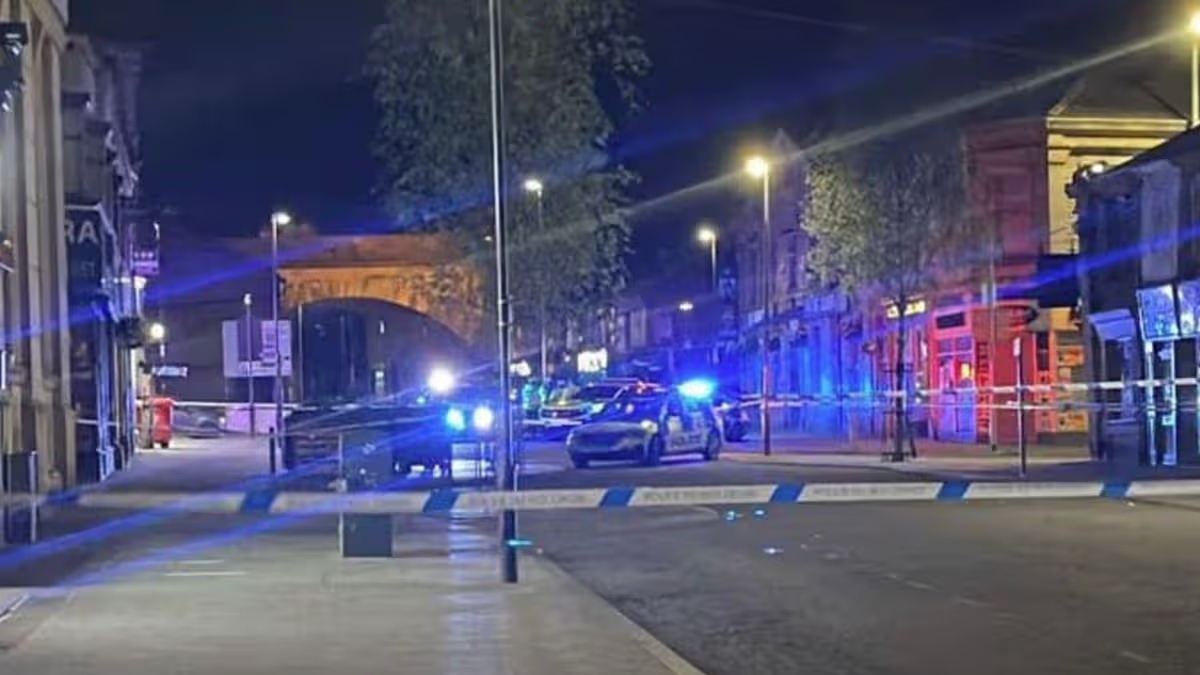
Four teenage boys have been arrested on suspicion of murder after a 44-year-old was killed in a crash near a pub.
Emergency services were called to Accrington, Lancashire, on Wednesday evening after reports that a man had been struck by a car. The victim, named as Matthew Weller, was found with serious injuries near the Nag’s Head pub, at the junction of Blackburn Road and Birch Street, Lancashire Police said. He was rushed to hospital, where he was pronounced dead a short time later.
The force said a VW Passat car failed to stop at the scene and was later found abandoned in Barden Road. Following enquiries, detectives arrested three 17-year-old boys from Accrington and one 18-year-old man from Blackburn on suspicion of murder.
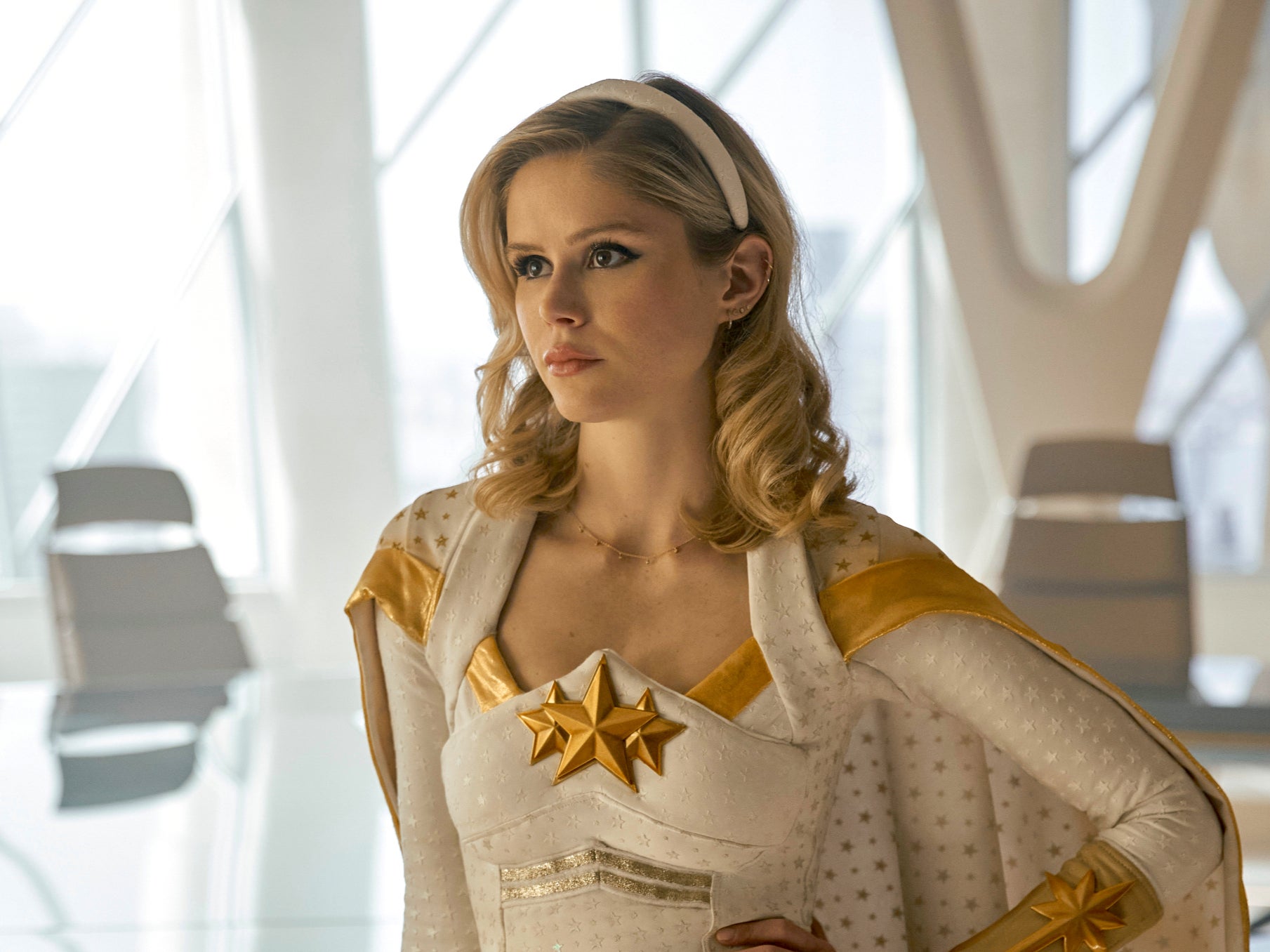
The Boys star Erin Moriarty said she hurt herself several times while filming the latest season as the shoot coincided with her Graves’ disease symptoms peaking.
Moriarty, who plays Annie January aka Starlight in the Prime Video series, shared the details on her social media shortly after the release of the fourth episode of the fifth and final season.
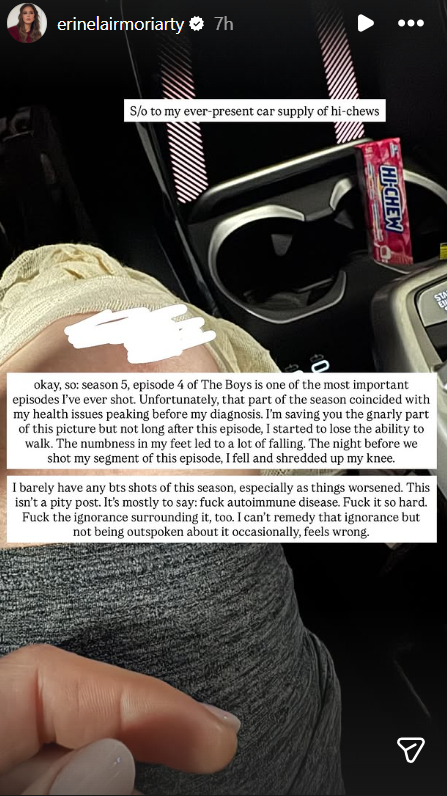
“Okay, so: season 5, episode 4 of The Boys is one of the most important episodes I’ve ever shot,” she wrote on Instagram, over a picture of her bandaged leg.
“Unfortunately, that part of the season coincided with my health issues peaking before my diagnosis. I am saving you the gnarly part of this picture but not long after this episode, I started to lose the ability to walk.”
Advertisement
“The numbness in my feet led to a lot of falling,” she continued. “The night before we shot my segment of this episode, I fell and shredded up my knee.”
Erin Moriarty says she hurt herself several times while shooting for ‘The Boys’ (Instagram/Erin Moriarty)
The actor revealed her Graves’ disease diagnosis in June last year, saying it had left her nauseous and exhausted. “One thing I can say: if I hadn’t chalked it all up to stress and fatigue, I would’ve caught this sooner,” she said at the time, adding that she felt her strength increasing within 24 hours of beginning treatment.
Graves’ disease is a form of hyperthyroidism. It is caused when the body’s immune system produces antibodies that disrupt the thyroid gland to make excessive thyroid hormone.
According to the NHS, symptoms may include a fast heart rate or palpitations, tremors, diarrhoea, difficulty sleeping, weight loss, irregular periods, and feeling hot, hungry, or anxious.
Some patients may experience neck swelling or bulging eyes, known as Graves’ ophthalmopathy.
Advertisement
Erin Moriarty plays Annie January aka Starlight in The Boys (Prime Video)
Watch Apple TV+ free for 7 day
New subscribers only. £9.99/mo. after free trial. Plan auto-renews until cancelled.
ADVERTISEMENT. If you sign up to this service we will earn commission. This revenue helps to fund journalism across The Independent.
On Thursday, Moriarty said her injury and the worsening symptoms affected her ability to fully enjoy the production.
“I barely have any [behind-the-scenes] shots of this season, especially as things worsened,” she said.
Advertisement
“This isn’t a pity post. It’s mostly to say: f*** autoimmune disease. F*** it so hard. F*** the ignorance surrounding it, too. I can’t remedy that ignorance but not being outspoken about it occasionally feels wrong.”
The Boys, which debuted in 2019, explores what happens when superheroes become as popular as celebrities, as influential as politicians, and as revered as gods – and abuse their superpowers rather than use them for good.
It comes amid strains in relations between the two countries
The UK was back on Donald Trump’s mind as he threatened ‘a big tariff’ in retaliation to a digital services tax introduced by Westminster six years ago. The tax, which has been enforced since 2020, imposes a two per cent levy on the revenues of several major US tech companies – including social media firms.
Advertisement
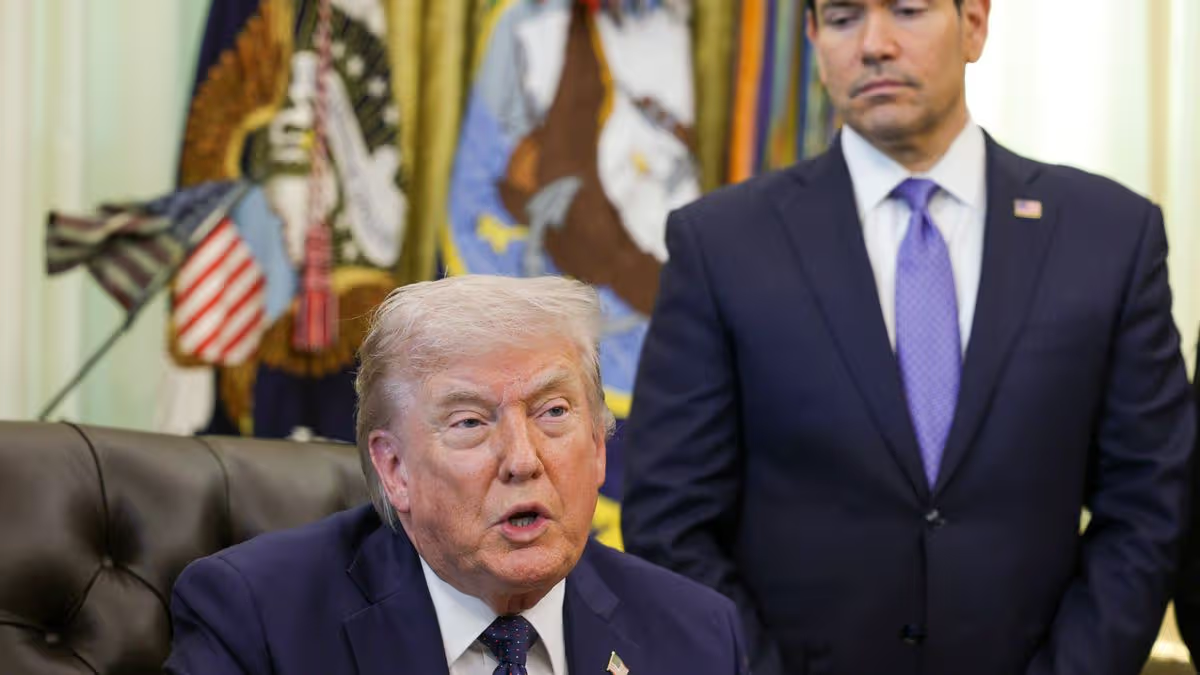
But amid strains in relations between the two countries during the Middle East war, Mr Trump raised the issue with journalists at the Oval Office on Thursday (April 23). He told reporters: “We’ve been looking at it and we can meet that very easily by just putting a big tariff on the UK, so they better be careful. If they don’t drop the tax, we’ll probably put a big tariff on the UK.”
The tax targets companies whose worldwide revenues from digital activities exceed £500 million, with more than £25 million of the revenue from UK users. According to a 2025 Treasury review, the levy raised more than £800 million in 2024–25, up from £678 million in 2023–24.
Click here to get the biggest stories straight to your inbox in our Daily Newsletter
Mr Trump argued the laws, which have long been a source of tension in UK-US relations, targeted ‘top companies in the world’. “The UK did it, a couple of other people did it,” he said. “They think they’re going to make an easy buck, that’s why they’ve all taken advantage of our country.”
Advertisement
The digital services tax went unchanged under the UK–US trade deal agreed in May 2025, despite being a point of discussion. Asked how high the tariff would be, the president said it would be ‘more than what they’re getting’ from the levy.
“What we’ll do is we’ll reciprocate by putting something on that’s equal or greater than what they’re doing,” he said. The latest remarks add to wider strains in UK-US relations, which have deteriorated after Sir Keir Starmer ruled out British involvement in the conflict in the Middle East.
Mr Trump’s comments on tariffs come months after similar US threats to impose new tariffs and export controls on countries with digital taxes or regulations affecting American tech giants. A number of European countries, like France, Italy and Spain, have a digital services tax.
Advertisement
In a post on Truth Social from August 2025, Mr Trump said he would ‘stand up to countries that attack our incredible American Tech Companies’. “Digital Taxes, Digital Services Legislation, and Digital Markets Regulations are all designed to harm, or discriminate against, American Technology,” he wrote.
“This must end,” he said and vowed that ‘unless these discriminatory actions are removed’, he would ‘impose substantial additional tariffs’ on the offending nation’s exports to the US. Press Association approached Downing Street for comment.
Earlier this month, Mr Trump suggested the terms of the UK-US trade agreement brokered last year ‘can always be changed’ in an interview with Sky News. Speaking at Prime Minister’s Questions in the House of Commons, Sir Keir addressed pressure from the US over the Iran war.
He told MPs: “My position on the Iran war has been clear from the start. We’re not going to get dragged into this war. It is not our war.
Advertisement
“A lot of pressure has been applied to me to take a different course, and that pressure included what happened last night. I’m not going to change my mind. I’m not going to yield. It is not in our national interest to join this war, and we will not do so. I know where I stand.”
Aim at Prince Harry and rules out nuclear attack on Iran
Mr Trump also took aim at Prince Harry speaking to journalists in the Oval Office.
Asked about Harry’s comments calling on him to do more to bring the war to an end, Trump initially said: “How’s he doing? How’s his wife? Please give her my regards, OK?”
He went on: “I don’t know. I know one thing, Prince Harry is not speaking for the UK, that’s for sure. I think I’m speaking for the UK more than Prince Harry, that’s for sure. But thank him for his advice.”
Advertisement
Meanwhile, Nigel Farage has admitted he is ‘starting to worry slightly’ about Mr Trump’s judgement amid the war in Iran. Admitting his ‘friend’ might not be ‘everyone’s cup of tea’, the Reform leader told the Mail: “I do, as a friend, worry slightly about his judgment on this, yes. I do. It will be a terribly sad end to an amazing political career if the man that was always anti-war in the end gets (brought) down by this – I struggle to understand it.”
On Thursday, Trump ruled out using nuclear weapons in Iran, saying the mere question was “stupid”.
Asked by a female reporter whether he would consider it, Trump reacted angrily, barking: “No. Why would I need it? Why would a stupid question like that be asked? Why would I use a nuclear weapon when I’ve totally and in a very conventional way decimated them without it. No I wouldn’t use it. A nuclear weapon should never be allowed to be used by anyone.
If you’ve been running for a while, you might be thinking about signing up for a marathon or shorter-distance event. Or, maybe you’re newer to the sport but want to sign up for a race to keep you motivated.
Mounsey says there is no singular answer to what the ‘best’ shoe is for an event, explaining that “runners train and race in different types of shoes, prioritising comfort and cushioning for daily mileage and then switching to a race day shoe for propulsion and speed.”
Newkey-Burden awarded the New Balance FuelCell SuperComp Elite v5 his best pair overall, and said these are the ones he’ll be wearing to run the London Marathon this year. He says these feel “cushioned and smooth” on my longer runs. “For shorter park runs the acceleration was equally evident. New Balance describes the SuperComp Elite v5 as a shoe for ‘podium ambition’. For me, these near‑flawless trainers deserve a gold medal of their own.”
Advertisement
Another pair he shouted out for marathon training is the Ena Athletics Proto Runner 1, “Whatever the heritage, the shoe is best described as comfortable and stable, making it suitable for longer training runs, especially for those preparing for marathons.”
If speed’s what you’re after, he recommends the Sudu SRM: “Overall, the Sudu debut is light, springy and secure, a shoe that feels designed for runners chasing a faster time. For anyone targeting a new Parkrun personal best, it could be a solid option.”
I live in Liverpool with my two dogs. I’ve been there my whole life and no matter where I am, that is always “home” to me.
I guess the 2012 Olympics was technically my first work in London?
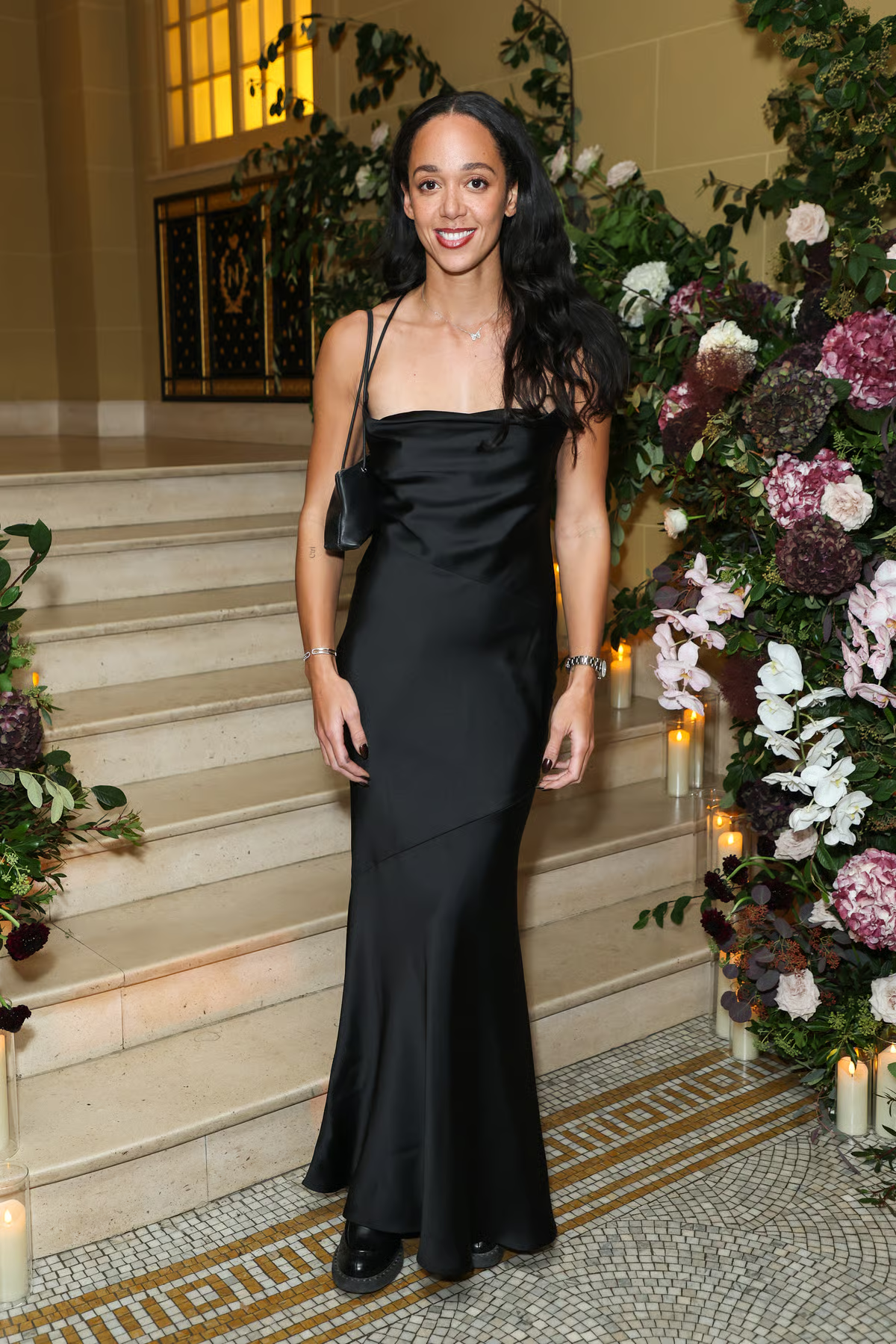
Katarina Johnson-Thompson
Where do you stay in London?
Advertisement
What was your first job here?
I’ve never had a formal job per se, but I guess the 2012 Olympics was technically my first work in London, if that counts?
Katarina Johnson-Thompson at the London 2012 Olympic Games
Getty Images
Where would you recommend for a first date?
Advertisement
There is a restaurant called Nina in Marylebone and it’s perfect for a first date because it’s dark, has great cocktails and amazing sharing food.
Which shops do you rely on?
I get my sunglasses and reading glasses from Cutler & Gross in Shoreditch. My eyesight is so bad but they get my frames exactly right. Goodhood, Spitalfields is nearby and has great homeware and clothes. Lastly, Daunt Books in Marylebone because I’m always looking for good books and the tote bags are cute.
I would make the Lime bikes free
Advertisement
Katarina Johnson-Thompson
What’s the best meal you’ve had?
North Audley Cantine (NAC) in Mayfair. Everything on the menu is 10/10 and I take everyone I can when I’m in town.
What would you do if you were Mayor for the day?
Advertisement
I would make the Lime bikes free. If we’re supposed to be using alternative transport options, why are all the bikes so expensive?
Where do you go to have fun?
When meeting friends for a drink, I like to go to the Twenty Two hotel bar. It always has really nice cocktails.
The Twenty Two
What’s the best thing a cabbie has ever said to you?
I can tell you the worst. I was once speaking to a cab driver and they were surprised when I said I was from Liverpool — I definitely haven’t lost my accent! I was quite offended…
Advertisement
London is at its most beautiful in the early morning. It makes me feel strangely smug when I get up before everyone else
Katarina Johnson-Thompson
I usually run up the Ally Pally hill — it’s pretty steep so it’s good for my fitness training.
What’s your London secret?
Advertisement
I like to get up super early when I’m here, before the rest of the city wakes up. I always think London is at its most beautiful in the early morning. It makes me feel strangely smug when I get up before everyone else.
What are you up to for work?
I’m preparing for the Commonwealth Games and the European Championships this summer and I’m also working with Radox, a partner of the TCS London Marathon, so I’ll be cheering runners on with them at the sidelines.
Dame Denise Lewis — she was my hero long before I started, which is pretty cool. She has helped me throughout and is always at the other end of the phone, for which I’m so grateful. She’s an Olympic gold medallist, so hopefully her wisdom rubs off on me.
Advertisement
Denise Lewis
Getty Images
What’s your favourite work of art in London?
Anything from Unit London gallery in Mayfair — I love art and try to go to Unit every time I’m in town. I always want to buy everything.
Dogs. And little body lotions from hotels.
Advertisement
Where do you go when you need headspace?
I love a walk and yap with a friend around Hampstead Heath. I like how big it is. I’ve been so many times and I still haven’t covered it all.
What is your top tip for anyone running the TCS London Marathon?
Mental and physical self-care practices are hugely important to keep your mind and body at peak performance under pressure, whether that’s breathwork or even singing a song. I have rituals I do before big events to keep me calm.
Advertisement
And your top recovery tip?
Make sure you hydrate and eat lots of protein after the race. I know it’s tempting to drink and celebrate — you deserve it — but remember to have lots of water to help your body after putting it through such a big challenge.
Where would you go for your ultimate post-marathon meal?
Katarina Johnson-Thompson is an ambassador for Radox, the official bath and shower gel partner of the TCS London Marathon
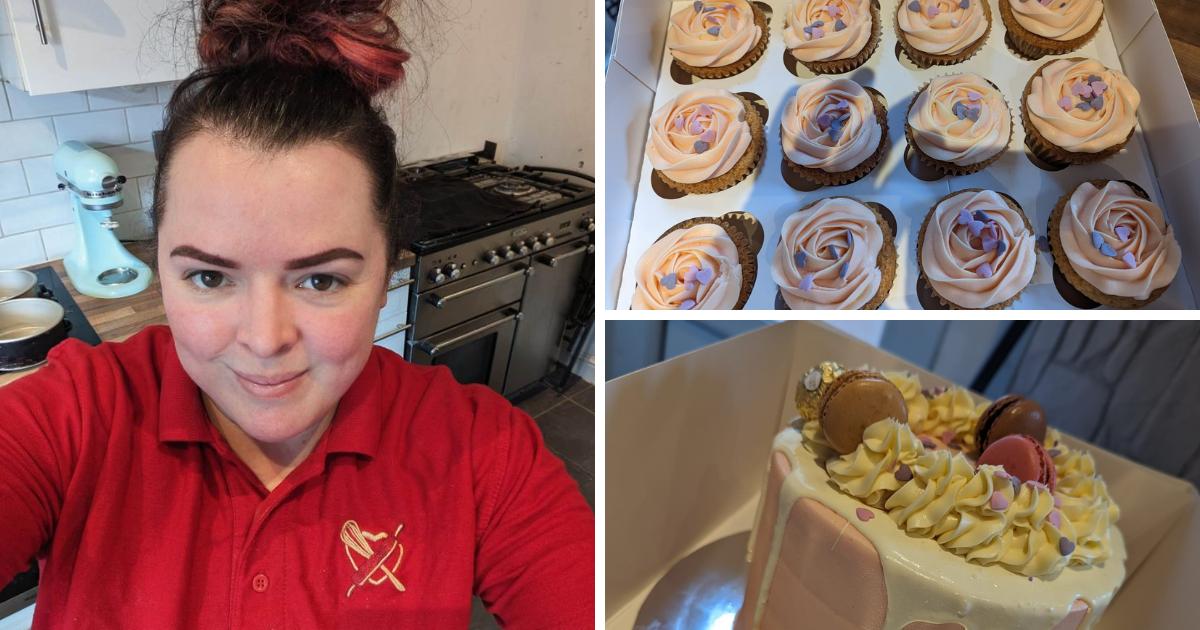
Cherelle White runs her business, Delight Bites, out of Radcliffe.
The 43-year-old regularly uploads photos of cakes and catering that she has done on social media in order to promote her business.
The mum-of-five said it was last year when a customer informed her that a rival baker in the Bury area had been using these photographs on her own page, claiming they were her own.
She said she blocked the user, Lou’s Cake Box, online so that this could not happen again and had not thought about the situation until Tuesday, April 14.
Advertisement
Cherella White, owner of Delight Bites (Image: Cherella White)
This was when a customer who had ordered a special cake, half decorated Manchester United themed and half decorated Manchester City themed, sent her a message to tell her she had spotted the picture of the cake being advertised on another page.
Cherella said she believed the baker had edited the picture so that the name on the cake had been changed.
She said: “It’s really deflating to be honest because obviously a lot of hard work goes into each and every cake that I make.
“I’m just wondering what customers who are ordering with her are actually getting, because if she’s not actually posting genuine work, I’m not sure what customers would be getting from her.
Advertisement
The picture of the half and half cake Cherella White alleges was copied (Image: Cherella White)
“Obviously, with us being small businesses and for somebody to be doing that, I think to be stealing your work and portraying it as their own is just it’s disgusting really.
“As a small, independent business, I put a huge amount of time, effort and passion into every order I create. Seeing my work used without permission is not only upsetting but also potentially damaging, as customers may believe they are ordering from me or receiving the same standard elsewhere.
“I felt it was important to raise awareness, not just for myself but for other small businesses that work incredibly hard to build their reputation honestly.
“I hope this encourages people to support genuine small businesses and to always check who they are ordering from.”
Advertisement
The picture of the cake Cherella White alleges has been copied (Image: Cherelle White)
After Cherella posted about the photos on her page, other bakers came forward in the comment section, claiming they had a similar experience with the same business.
Bella Bakes Bolton, owned by Bella Riding, claims the same baker copied the captions they shared on their social media posts.
Bella, 23, said she noticed last week that one of her captions had been copied and pasted by the baker and shared on its page to advertise products.
She said: “We only knew because we put on a heart cake and we said it was for a very bougie 10-year-old.
Advertisement
“I was reading her post, and at the bottom it says, a heart cake for a very bougie 10-year-old with a picture of a superhero cake she’d done.
“That’s kind of when we knew, right, she is copy and pasting.
“Which is really frustrating because we, as well as lots of other bakers, work hard on not only making the cakes, but then writing about the cakes.
“We never copy, don’t use Chat GPT or anything like that. It all comes from us.
Advertisement
“So to see someone else think, oh, I’ll just copy and paste that is really frustrating.”
Bella said she did not believe her images had been copied, but that it was sad to hear others might have been subjected to this.
She said: “It’s the hard work and effort that we bakers put into creating these cakes, and they’re all bespoke cakes as well.
“For someone to just then try and pass that off as their own, it’s quite disheartening, really.
Advertisement
“It’s really tight-knit. We all give each other advice, or if we’re not available to do cakes, we’ll pass them on to other bakers.
“So for that small minority to kind of be doing that ruins all the good that everybody else does.”
Hayley Comiskey-Harwood, owner of Comiskey’s Creations, claims the baker also copied her captions from social media.
A caption Comiskey’s Creations alleges has been copied (Image: Comiskey’s Creations)
The 39-year-old said she blocked the baker around six months ago after she realised this was happening.
Advertisement
Hayley said: “You create your work, you create your platform and your images and your cakes, which you do from scratch and then somebody else uses your content, it’s not very good really.
“She obviously doesn’t know how much damage she’s doing because, you know, at the end of the day, there are ideas which she’s stealing and we just come up with them ourselves.
“It’s hard, it’s a dog-eat-dog world, and at the end of the day, we’re all trying to make a living, and she’s posting things that she’s not come up with. I don’t think that’s very fair.”
She said from now on, she will be putting a watermark on the pictures she shares on her page.
Advertisement
Hayley added: “It’s frustrating because you work so hard to get where you are, and then you just see she is trying to shortcut to make her business established.
A caption Comiskey’s Creations alleges has been copied (Image: Facebook)
“Everyone’s got the right to run a business as long as it’s done properly, but when you’re resorting to copying and pasting people’s posts and stealing pictures, that’s just not on.”
Lou’s Cake Box was contacted by the Bury Times and declined to comment.
Oil prices held above $105 a barrel on Friday as the Strait of Hormuz remained closed, with both the US and Iran seizing ships.
Brent crude climbed 0.63 per cent to $105.73 a barrel, and US West Texas Intermediate advanced 0.32 per cent to $96.17, as the naval standoff keeping the waterway shut showed no sign of resolution.
Asianequity markets were mixed despite the persistent energy pressure. MSCI’s broadest index of Asia-Pacific shares outside Japan rose 0.3 per cent and was on track for a weekly gain of 0.8 per cent, while Japan’s Nikkei added 0.45 per cent.
Stocks in South Korea, China and Hong Kong fell. Nasdaq futures and S&P 500 futures advanced 0.6 per cent and 0.1 per cent respectively after closing lower in the cash session overnight, while European futures pointed to a softer open.
Advertisement
A customer picks up a petrol pump at the first LMCT+ petrol station on 23 April 2026 in Melbourne, Australia (Getty)
Israel and Lebanon agreed to extend their ceasefire for three weeks following a White House meeting on Thursday. “The Meeting went very well!” Donald Trump posted on social media.
The broader US-Iran ceasefire has also held, but the conflict has evolved into duelling naval blockades as both sides seek economic leverage to secure a deal on favourable terms.
Iran seized two cargo ships in the strait on Wednesday and continued to demand that vessels receive its permission to cross, while the US has intercepted several Iranian oil tankers and maintained its blockade of Iran’s ports since 13 April.
“The longer the strait remains closed, the greater the economic costs – raising the likelihood that one side will be forced to back down,” Commonwealth Bank of Australia wrote in a note on Friday, adding that it judged the US would be the first to concede given mounting political and economic pressure, though warning that the risk of major military escalation remained.
“The thing is, a ceasefire is a funny term to use in conjunction with a blockade and rolling tensions and animosities,” Vishnu Varathan, head of macro strategy for Asia-Pacific at Mizuho told Reuters. “It’s not going to be a linear de-escalation. Investors have just been looking for excuses to put on optimistic trades opportunistically. I don’t think anybody in the market truly believes that this will be over in a week or two.”
Advertisement
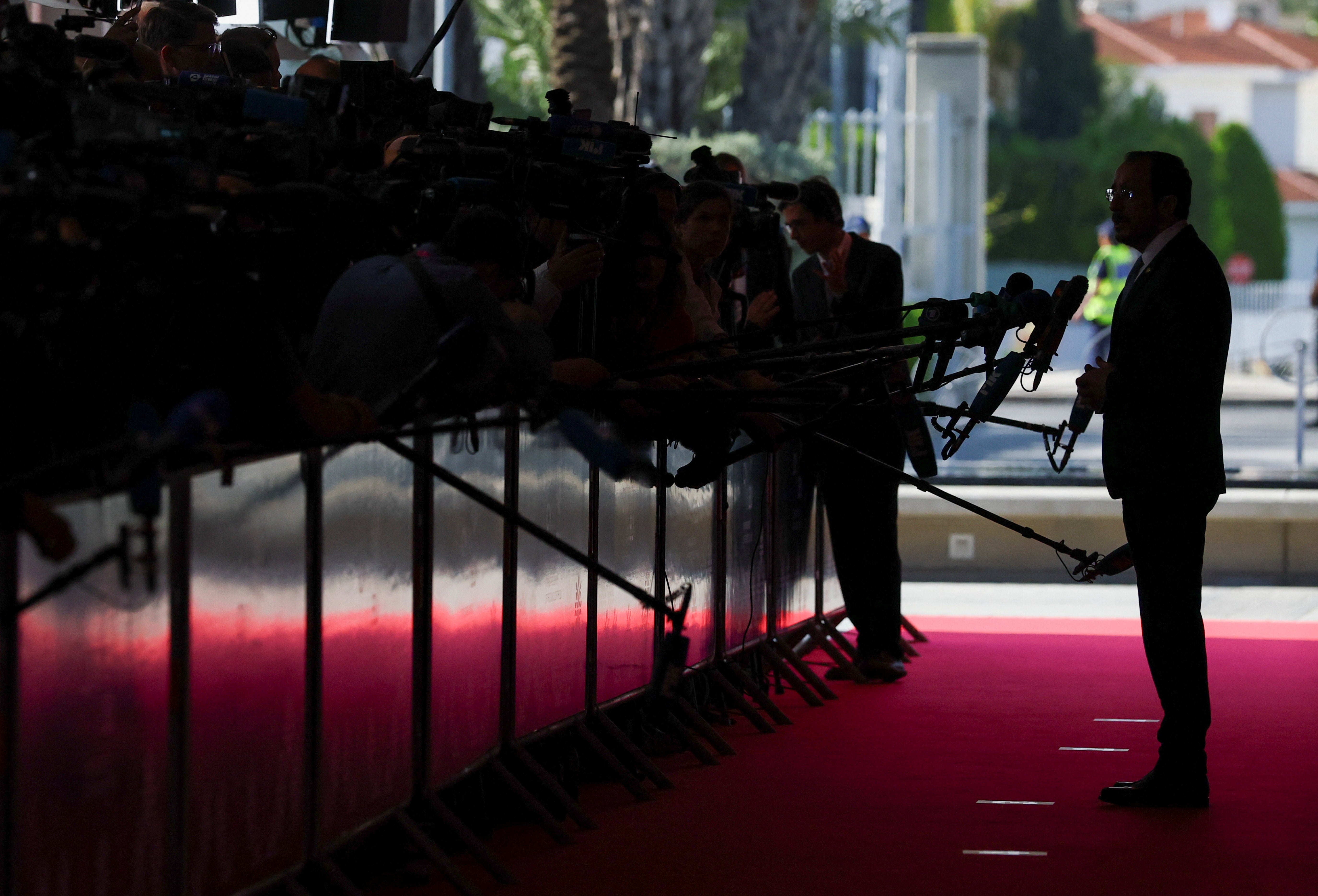
Cyprus President Nikos Christodoulides addresses the media on the day of a summit of the European Union and regional partners’ leaders in Nicosia (Lefkosia), Cyprus, 24 April 2026 (Reuters)
Fatih Birol, head of the International Energy Agency, told CNBC on Thursday that the world was facing “the biggest energy security threat in history.”
Around 20 million barrels of oil and petroleum products were shipped through the strait daily before the war began.
“As of today, we’ve lost 13 million barrels per day of oil and there are major disruptions in vital commodities,” he said, urging governments to bolster their resilience with alternative energy sources. Currency markets were relatively calm. The euro fell to $1.1684 and was set to lose nearly 0.7 per cent for the week, while sterling held at $1.3469.
The Japanese yen edged to 159.78 per dollar, just below the 160 level widely seen as a potential trigger for intervention, with Japan’s finance minister renewing warnings of decisive action in close coordination with Washington. Central bank decisions from the Federal Reserve, the European Central Bank and the Bank of England are all due next week, with investors watching for guidance on how policymakers plan to respond to war-driven inflation. Gold was flat at $4,691.60 an ounce.
The announcement by the government that a legal ban will be placed on mobile phones in English schools marks a continued shift in tone, if not necessarily in substance, around the control of devices in educational settings.
What is being presented as a decisive intervention into children’s wellbeing is, in practice, the legal amplification of a reality that already exists across most schools. According to research last year by the Children’s Commissioner, around 90% of secondary schools and almost all primary schools already restrict phone use in some form.
These restrictions range from outright bans to locking phones away or “not seen, not heard” approaches (where phones are allowed on school premises, and may be kept in pupils’ bags, but must not be used). The ban will make existing guidance for schools statutory.
This raises an immediate question: if the practice is already widespread, why make it law?
Advertisement
There are, on the surface, reasonable arguments for moving from guidance to legislation. First, this gives school leaders clarity. A statutory footing removes ambiguity and may strengthen schools’ position when challenged by parents.
Second, it provides consistency between schools. A legal requirement creates a baseline expectation across the system, reducing variation between schools.
And finally, there is political signalling. The government is able to demonstrate action on an issue that resonates strongly with public concern.
However, the policy also illustrates a dynamic in education and online safety policy I have written about at length – a move from practice to performance.
Advertisement
If nearly all schools already restrict phones, then the legal change risks being largely symbolic. Sector leaders have acknowledged that “a statutory ban… doesn’t really change very much”.
More critically, it reframes a question of professional judgement as one of compliance. Since 2011, headteachers have had the authority to discipline pupils and set behaviour policies, including banning phones. What changes here is not capability, but the removal of discretion or, arguably, trust in school leadership.
Need for clarity
And, paradoxically but predictably, while the policy may be unnecessary for some, it is insufficient for others. Campaigners and politicians have already criticised the move for potentially retaining flexibility – particularly the “not seen, not heard” model – which they argue fails to meaningfully remove phones from the school day.
Olivia Bailey, parliamentary under-secretary of state in the Department of Education, insisted in the most recent debate that “We are categorically crystal clear that there is no access to phones at any point during the school day”, and that references to “not seen, not heard” approaches had been removed from guidance.
Advertisement
But she also stated: “It is not for me to determine how a headteacher enforces their discipline and behaviour policies in their school.” Therefore, there is a chance a school adopting such an approach might not be challenged without a particularly fastidious Ofsted inspection.
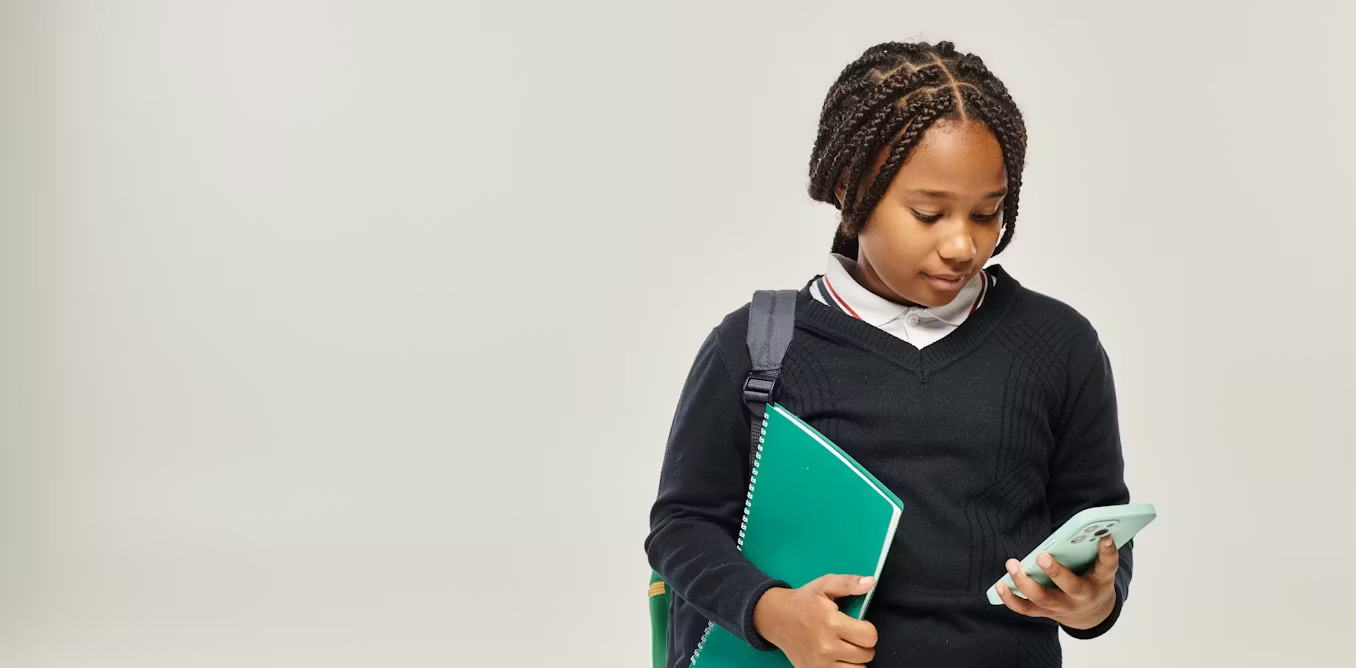
The majority of schools already restrict phone use. Rawpixel.com/Shutterstock
Perhaps the most significant gap in the policy, therefore, is not its intent, but its execution, which has resulted in professionals asking for more guidance. Schools currently use a range of methods: confiscation, lockers, locked pouches, or behavioural rules. These approaches carry costs – financial, logistical, and in how they affect relationships between staff and pupils. Sector leaders have already pointed to the need for funding to support secure storage systems. Enforcement, too, remains ambiguous.
A legal requirement does not eliminate the day-to-day realities of managing compliance. This includes managing pupils concealing devices, disputes with parents, uneven application across staff and varying support from senior leaders around classroom discipline.
Facing pressure
The government had previously resisted calls for a statutory ban, arguing it was unnecessary. The new announcement appears to have been driven less by new evidence and more by political pressure in the House of Lords and from campaign groups.
Advertisement
There is a broader cultural push toward restriction, whether school phone bans or proposals for wider social media limits. Some countries have already put social media bans in place, although their effectiveness remains to be seen.
Banning phones in classrooms is not, in itself, particularly controversial. Many schools have done so for years with little fuss. What is new is not the ban, but the decision to legislate it.
That shift tells us less about phones and more about the current policy climate: one in which guidance becomes law, discretion becomes compliance, and familiar practices are recast as solutions to increasingly expansive problems.


















































You must be logged in to post a comment Login