

Elon Musk and Europe’s hard-right figures today celebrated the historic state election victory of the Alternative für Deutschland party in Germany.
The tech billionaire wrote ‘Well done!’ after the party won a decisive victory in Germany’s eastern state of Saxony-Anhalt, far ahead of mainstream rivals.
In an interview following the results, AfD co-founder Alice Weidel said she expected the current German Chancellor, Friedrich Merz, to be ‘replaced before Christmas‘.
But preliminary results show the party fell short of the outright majority needed to govern alone, with 43.8 per cent of the vote to the conservative Christian Democratic Union’s (CDU) 17.2 per cent.
The AfD was pursuing an absolute majority in the state legislature to govern alone and overcome the so-called firewall of mainstream parties’ refusal to work with the group.
Now, tricky negotiations on who will run the state lie ahead, with final results showing the AfD falling three seats short, with 39 lawmakers in an 83-member parliament.
‘We have received a very clear mandate to govern here,’ Weidel told reporters.
‘We ran on a clear platform of representing the interests of our country, not those of Ukraine or any other country,’ she added.
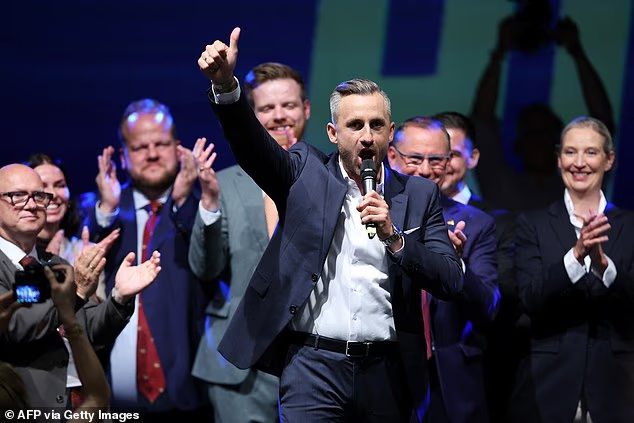
Ulrich Siegmund, hard-right Alternative for Germany (AfD)’s main candidate in the Saxony-Anhalt state election, gestures as he addresses supporters at the AfD’s election party following Saxony-Anhalt’s state elections in Magdeburg, eastern Germany on September 6

The AfD was seeking an absolute majority in the state legislature to govern alone and overcome the so-called firewall of mainstream parties’ refusal to work with the party
‘If we receive the mandate to govern at the federal level and assume governmental responsibility, we will cut all unnecessary spending. We will control our borders. We will deport all those required to leave the country and all criminals. We will close the borders.
‘I also expect early federal elections, and I expect the current chancellor to be replaced before Christmas.’
The AfD more than doubled its showing five years ago in the region of 2.1 million people west of Berlin.
Meanwhile, the CDU, the party of Germany’s unpopular leader, Chancellor Merz, slumped to a disastrous result, winning only 15 seats.
The centre-left Social Democrats got 9.3 per cent, the Greens 8.9 per cent and the Left Party 8.6 per cent, all winning eight seats apiece.
The results put a hard-right party within reach of power at the state level for the first time since World War Two.
But because the AfD fell just short of an outright majority, it may not end up governing Saxony-Anhalt.
Rival parties have vowed that they would not form a coalition government with the AfD, whose leaders have previously used Nazi slogans and minimised the Holocaust.
German intelligence has designated the party as a ‘suspected’ extremist group.

Now, tricky negotiations on who will run the state lie ahead, with final results showing the AfD falling three seats short, with 39 lawmakers in an 83-member parliament
French government ministers expressed their worries on Monday over the impact of the victory.
‘It clearly sends out a very, very worrying signal,’ French Finance Minister Roland Lescure told RTL radio.
‘This shows that we face a major challenge in the face of a populist wave which is spreading around the world today and which we must resist,’ added Lescure.
Lescure’s views echoed similar comments made late on Sunday by France’s European Affairs Minister Benjamin Haddad.
‘To see the far-right prevail in the German regional election marks a very grave moment for Europe,’ he wrote on X.
‘We must listen with humility to the anger, fears and worries and duly respond to these concerns. But nationalism and xenophobia will never be the answer,’ added Haddad.
Ulrich Siegmund, the AfD’s lead candidate, rejoiced at the results, saying ‘we have written history’.
The anti-migration, Russia-friendly politician told public broadcaster ARD that voters had sent a signal that ‘things cannot carry on like this’.
He added that ‘a very good campaigner for us in this election campaign was Friedrich Merz’.
Turnout was very high, at 77.8 per cent, with the AfD appearing to have won over many people who did not vote at all five years ago.
Italian Deputy Prime Minister and leader of hard-right League party Matteo Salvini hailed the victory, declaring that ‘another Europe is possible’.
Spain’s Vox leader Santiago Abascal called the result ‘a great hope for Germany and for Europe,’ while Portugal’s André Ventura celebrated AfD’s ‘historic’ victory, linking it to public anger over immigration.
Geert Wilders, leader of the hard-right Freedom Party in The Netherlands, wrote ‘congratulations’ to Siegmund and Weidel on X.




























































You must be logged in to post a comment Login