The Mandy Dingle actress shared her link to the singer in an old series
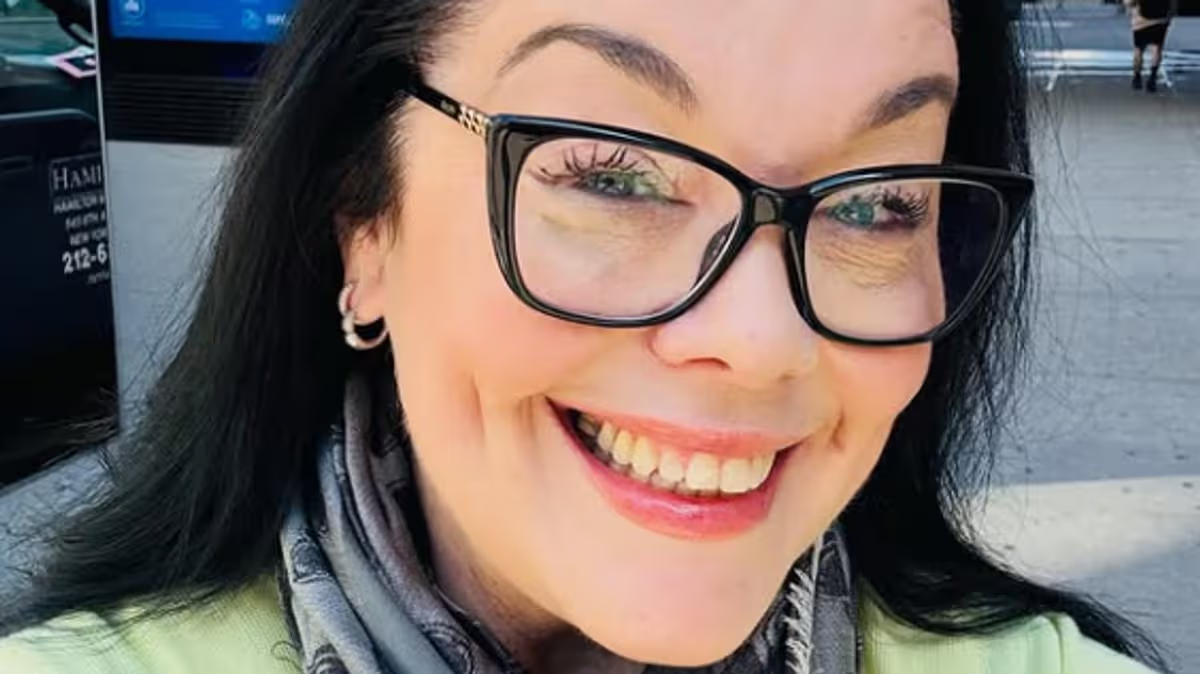
Emmerdale star Lisa Riley took to her social media as she shared an old TV link to a member of One Direction.
Advertisement
Actress Lisa Riley made her Emmerdale debut as the iconic and charismatic Mandy Dingle back in 1995, and although she made a brief departure she returned full-time in 2019.
However, Lisa hasn’t only starred in Emmerdale, as she played the role of Rebecca Patterson in hit ITV series Fat Friends from 2002. Written by Kay Mellor, the series followed the lives and weight-loss struggles of a group of people at a “Super Slimmers” club in Leeds.
Click here to get the biggest stories straight to your inbox in our Daily Newsletter
Lisa worked alongside James Cordon who played Jamie Rymer on the series, as well as the rest of the star-studded cast which included Sheridan Smith, Ruth Jones and Gaynor Faye.
Advertisement
However, taking to her Instagram, Lisa revealed that there was another unexpected star who appeared on the TV show alongside her – One Direction member Louis Tomlinson.
Next to a picture of her during an episode, she wrote: “‘WAY BACK WHEN WEDNESDAY’ last night someone sent me this absolute BELTER!!!
“This is a scene from @itv ‘Fat Friends’ where Me @lisajaneriley and James @j_corden our characters, best mates, Rebecca and Jamie are in hospital-as my character Rebecca is about to go into labour -look closely to see who the young lad in the waiting room is???? It’s gorgeousness himself @louist91 soooo cute!!! Good memories before he became part of the global sensation @onedirection”.
Content cannot be displayed without consent
Fans in the comments couldn’t believe it was him, as @jessluciile replied: “MINI LOUIS OMG” and @harrietplusbabies added: “Omg I’ve watched these so many times and I’ve never noticed @louist91 Love Fat Friends!”
Advertisement
Louis Tomlinson shot to fame after his audition on the X Factor back in 2010. He auditioned singing “Hey There Delilah” by the Plain White T’s and receiving three “yeses” from the judges.
However, he failed to progress as a solo artist but was later brought back to form One Direction along with Harry Styles, Niall Horan, Zayn Malik and Liam Payne.
Fat Friends wasn’t his only acting move, as he also had roles in the BBC drama Waterloo Road and the ITV drama If I Had You, as well as starring as himself in iCarly and Family Guy.

The changes will not affect payment rates but aim to bring greater consistency to how decisions are made across the three systems
Linda Howard Money and Consumer Writer and Ashlea Hickin Content editor
20:02, 16 Apr 2026
The UK Government has introduced fresh legislation overhauling how key disability and health-related benefits are assessed, with the potential to affect millions of claimants throughout the country.

The amendments apply solely to Department for Work and Pensions (DWP)-administered benefits, including Personal Independence Payment (PIP), Employment and Support Allowance (ESA), and the health element of Universal Credit. The most recent figures reveal there are now over 3.9 million PIP claimants in England and Wales.

While the new rules leave payment rates unchanged, they seek to bring greater uniformity to how decisions are reached across the three systems. The revised regulations are intended to align assessment processes, particularly where comparable health conditions or disabilities are being considered under different benefits.
Advertisement
For claimants, this could result in a more standardised approach to how evidence is examined and how eligibility decisions are determined.
The UK Government stated the changes are designed to simplify the system and ensure people are treated fairly, regardless of which benefit they are claiming, reports the Daily Record.
It is worth noting that the majority of existing claimants are unlikely to experience any immediate change to their payments.
However, those submitting a new claim, undergoing a review, or appealing a decision may find differences in how their case is managed. These changes form part of a sweeping overhaul of health-related benefits, including recent amendments to the Universal Credit health element that came into force earlier this month.
Advertisement
Under the new arrangements, fresh claimants assessed as having limited capability for work and work-related activity will receive a reduced monthly payment of £217.26, rather than the £429.80 currently paid to existing claimants.
This latest legislative update is separate from the payment adjustments introduced on April 6 through the annual uprating process, but sits within a broader drive to reshape how the benefits system supports those living with long-term conditions.
Disability benefits, including PIP, are intended to assist people with the additional costs associated with living with a health condition or disability, while ESA and Universal Credit provide income support for those unable to work.
The DWP has faced persistent scrutiny regarding the way benefit assessments are conducted, with campaigners and charities voicing concerns about consistency and fairness in decision-making.
Advertisement
By harmonising rules across several benefits, the DWP seeks to reduce confusion and deliver better outcomes for claimants navigating the system.
Those currently in receipt of benefits are not required to take any action as a result of these changes.
However, anyone intending to submit a new claim or facing a reassessment is strongly advised to ensure their medical evidence and supporting documentation is fully up to date.
IEA Executive Director Fatih Birol said we are heading for “the largest energy crisis we have ever faced,” stemming from the pinch-off of oil, gas and other vital supplies through the Strait of Hormuz.
The impact will be “higher petrol (gasoline) prices, higher gas prices, high electricity prices,” said Birol.
In an interview with Associated Press published today, he warned that flight cancellations could begin “soon” if oil supplies remain blocked by the Iran war.
Advertisement
And some parts of the world will be hit worse than others.
He shared that “the front line is the Asian countries” that rely on energy from the Middle East, naming Japan, Korea, India, China, Pakistan and Bangladesh.
“Then it will come to Europe and the Americas,” Birol continued.
Advertisement
Birol said Europe has “maybe 6 weeks or so (of) jet fuel left,” after the effective closure of the Strait of Hormuz led to “the largest energy crisis we have ever faced.”
And if the Strait of Hormuz isn’t reopened, Birol said that for Europe: “I can tell you soon we will hear the news that some of the flights from city A to city B might be cancelled as a result of a lack of jet fuel.
Where is it going to have the most effect?
“The countries that will suffer the most will not be those whose voices are heard a lot.
International Energy Agency chief says that Europe has ‘maybe six weeks’ of jet fuel left, says current shock is ‘the largest energy crisis we have ever faced’, according to AP report.
“It will be mainly the developing countries. Poorer countries in Asia, in Africa and in Latin America,” said the Turkish economist and energy expert who has led the IEA since 2015.
The US is currently blockading Iranian ports, while Tehran has laid mines in the vital waterway to restrict traffic through the strait.
Nearly 20% of the world’s traded oil passes through the Strait of Hormuz in peacetime.
Birol warned that not reopening the waterway within weeks could compound the repercussions for global energy supplies.
Advertisement
Are you worried about the energy crisis? Let us know in the comments.
‘Britain must not back away from its support for the Ukraine – we have stood by a nation under siege and we should not flinch now’
Russia threat is no bluff
Vladimir Putin’s regime has crossed another dangerous line.
Advertisement
After unleashing a night of devastation on Kyiv, Russia is now openly threatening British targets, listing locations in England as potential strikes.
It is not bluff. It is a calculated escalation designed to intimidate, and it should alarm us all. We have seen before that the Kremlin is willing to carry out hostile acts on British soil.
The Salisbury poisoning was not just an outrage; it was a state-sponsored attack that killed Dawn Sturgess and put innocent lives at risk.
Now Moscow is again turning its sights towards the UK, attempting to bully Britain into backing away from its support for Ukraine. That must not happen.
Advertisement
We have done the right thing in standing by a nation under siege, and we should not flinch now. We must be clear: this is intimidation, pure and simple.
Putin’s aggression thrives on hesitation. The response throughout Europe must be unity, resolve and an unshakeable commitment to stand firm.
More embarrassment for Reform UK
Another day, another Reform UK embarrassment.
A local election candidate who once met King Charles has been exposed for spewing vile anti-Muslim hatred online, including a call to “blast them all off the face of the earth”.
Advertisement
As with other such Reform candidates, these are not slips of the tongue. They are extreme, dangerous views that have no place in public life.
Daniel Devaney’s belated admission that he was “well out of order” is nowhere near enough. The real question is how Nigel Farage’s party allowed him anywhere near the ballot paper.
With repeated failures in vetting exposed, Reform cannot shrug this off as a one-off. It is not. Politics demands responsibility. When parties cut corners, this is the result – hatred dressed up as candidacy.
Up, up and away
It is both moving and quietly heartbreaking to see the Up series reach its final chapter. The original “Big Brother”, it followed real lives with honesty, long before reality TV was born. Now, as some stories end, it reminds us how precious – and fragile – every life truly is.
ORLANDO, Fla. (AP) — Tiger Woods ‘ attorney intends to fight an attempt by prosecutors to subpoena the golfer’s prescription drug records following his arrest last month in Florida on suspicion of driving under the influence.
Attorney Doug Duncan said this week in a court filing that Woods has a constitutional right to privacy when it comes to his prescription medications. The attorney asked a judge overseeing the case in Martin County, Florida to hold a hearing to determine if the drug records are necessary for the criminal investigation.
If the judge determines the drug records are necessary, Duncan asked for a protective order limiting their release only to prosecutors, law enforcement officers, state experts and Woods’ defense team.
Woods has pleaded not guilty to driving under the influence. A sheriff’s office report said deputies found two pain pills in his pocket and he showed signs of impairment after his SUV clipped a truck’s trailer and rolled over on its side.
Advertisement
Woods was traveling at high speeds on a beachside, residential road on Jupiter Island with a 30 mph (nearly 50 kph) speed limit when his Land Rover caused $5,000 in damage to the truck, according to an incident report. Woods agreed to a Breathalyzer test that showed no signs of alcohol, but refused a urine test, authorities said.
Prosecutors told the court they would issue a subpoena seeking copies of all prescription medication records for the legendary golfer on file at Lewis Pharmacy in Palm Beach, Florida from the start of the year through the end of last month.
Prosecutors also demanded in court papers on Wednesday that Woods reveal the names and locations of any witnesses he plans to present in his defense.
MINNEAPOLIS (AP) — A federal immigration agent accused of pointing his gun at occupants of a car after pulling alongside them on a Minneapolis-area highway is wanted on felony assault charges, Minnesota prosecutors said Thursday.
Hennepin County Attorney Mary Moriarty said she believes it is the first criminal case brought against a federal immigration officer involved in the Trump administration’s crackdown on immigration enforcement that surged federal authorities into cities including Los Angeles, Chicago and New Orleans.
“There is no such thing as absolute immunity for federal agents who violate the law in the state of Minnesota,” Moriarty told a news conference, saying the agent acted outside the scope of a federal officers’ authority.
An arrest warrant filed in Hennepin County, which includes Minneapolis, says Gregory Donnell Morgan Jr. is charged with two counts of second-degree assault. Minnesota authorities say Morgan, 35, was on duty as an Immigration and Customs Enforcement agent when the incident occurred Feb. 5.
Advertisement
The driver and front-seat passenger of a car called 911 saying the driver of an unmarked SUV pulled alongside them, rolled down his window and pointed a handgun at them both. The car’s driver told investigators they feared it was a “crazy person driving down the road aiming guns at people,” according to the warrant.
A spokesman for Moriarty’s office said no arrangements have been made for Morgan to surrender and that there is an active nationwide warrant for his arrest. If convicted, Morgan faces up to seven years in prison for each assault charge.
Department of Homeland Security and Justice Department officials didn’t immediately respond to emails seeking comment.
A person returning a call to a possible phone listing for Morgan said it was a wrong number for him. A message sent to a possible email address for Morgan bounced back as undeliverable. No one immediately returned a phone message left at a number for a person listed as sharing an address with Morgan. It was not immediately known if he had an attorney who could speak for him.
Advertisement
Accused agent told state investigators he ‘feared for his safety’
Moriarty said during a news conference that Morgan was driving a rented, unmarked SUV on the shoulder of the highway when a car also moved into the shoulder to try to slow Morgan down, its driver not knowing he was an officer. After the car returned to the legal lane, she said, Morgan pulled up alongside and pointed his service weapon at the two people in the car.
According to the warrant, Morgan then merged his SUV back into traffic ahead of the victims, who took cellphone photos of the SUV’s license plate.
The warrant does not identify the victims.
Morgan and his partner, who was not charged, told investigators they were returning at the end of their shift to the federal building being used to stage officers. The arrest warrant says Morgan “made no claim that he was conducting any law-enforcement operation or activity or responding to any emergency situation.”
Advertisement
Sign up for Morning Wire:
Our flagship newsletter breaks down the biggest headlines of the day.
Advertisement
Morgan told investigators with the Minnesota State Patrol that the other vehicle “swerved over in front of him and cut him off,” the warrant said. Investigators wrote that Morgan said “he feared for his safety and the safety of others” when he drew his gun and yelled: “Police! Stop!”
The warrant says the victims couldn’t tell Morgan was a law enforcement officer and couldn’t hear him because their windows were up.
Advertisement
Trump administration has warned against arresting federal agents
The charges could intensify a clash between the Trump administration and Minnesota officials over the crackdown. Todd Blanche, the acting attorney general, has warned that the Justice Department could investigate and prosecute state or local officials who arrest federal agents for performing their official duties.
Moriarty said she is not concerned about blowback from federal authorities and that her office will “hold people accountable if they violate the laws of the state.”
Michael Gerhardt, a constitutional law professor at the University of North Carolina at Chapel Hill, said federal officers are granted immunity for actions within the scope of their official responsibilities.
He said the actions described in the arrest warrant don’t seem relevant to the officer’s duties. But because he was on-duty at the time, the officer could petition to move the charges to federal court and make a claim for immunity.
Advertisement
“When you look at it more closely, flashing a gun is a serious threat,” Gerhardt said. “And there’s a good argument that isn’t part of his official duties … it’s abusing his powers.”
Minnesota still investigating killings of 2 US citizens by federal officers
DHS deployed about 3,000 federal officers to the Minneapolis-St. Paul area from December through February in what the department called its “ largest immigration enforcement operation ever.” The Minnesota operation led to thousands of arrests, angry mass protests and the fatal shootings of two U.S. citizens.
Backlash over the officers’ aggressive tactics mounted, and two of the crackdown’s most high profile leaders were soon gone. Trump fired Homeland Security Secretary Kristi Noem in March shortly after the Minnesota surge ended. That same month, Gregory Bovino, the Border Patrol sector chief who led immigration operations in several large cities, announced his retirement.
Minnesota authorities continue to investigate the conduct of federal officers during the immigration crackdown, insisting they can’t trust the federal government to investigate itself. Minnesota sued the Trump administration last month for access to evidence in three cases involving shootings by federal officers, including the killings of Renee Good and Alex Pretti.
Advertisement
___
Lauer reported from Philadelphia and Bynum reported from Savannah, Georgia. Associated Press reporters Alanna Durkin Richer in Washington and Hannah Fingerhut in Des Moines, Iowa, contributed.
Scotland fly-half Helen Nelson, who ranks fourth highest for the number of kicks out of hand in the English top-flight, may well look to exploit space around Kildunne, while Rhona Lloyd, who will line up opposite Kildunne, has scored 11 league tries for Sale so far this season.
Elsewhere prop Maud Muir wins her 50th cap for England as she starts at tighthead in place of Sarah Bern, who is part of a set of replacements which includes 112-cap Marlie Packer and Gloucester-Hartpury’s Mia Venner.
England are hunting their eighth successive Women’s Six Nations title, but are attempting to maintain their streak without a host of names who helped them to the World Cup last year.
Number eight Alex Matthews will miss the meeting with Scotland with a shoulder injury, while earlier on Thursday it was announced that prop Hannah Botterman had joined those sidelined for the tournament with an ankle injury.
Advertisement
Head coach John Mitchell will hope that the enforced changes will prove the making of a next generation of players, while maintaining the Red Roses’ grip on the tournament.
However Scotland, who will play in front of a 25,000-plus crowd at Scottish Gas Murrayfield in the biggest stand-alone women’s sporting fixture in their country’s history, will be primed to exploit any wobbles.
England: Sing; Breach, Jones (capt), Rowland, Kildunne; Harrison, L Packer; Clifford, Cokayne, Muir, Burton, Ives Campion, Short, Kabeya, Feaunati,
Replacements: Powell, Carson, Bern, Lutui, M Packer, Robinson, Aitchison, Venner
There aren’t many single words that conjure up as much horror and emotion as ‘Chernobyl’. The name of the ill-fated nuclear power plant will live long in the memory – though perhaps the estimated 20,000 years of radiation damage it did to its surrounding area will be a touch longer.
The Chernobyl disaster, which occurred 40 years ago this month, was sparked with a simple push of a button. A power plant operator pressed a switch marked AZ-5 as part of a standard safety test – and created some very unwanted history.
Igor Kirshenbaum, one of the Soviet operators working in reactor number 4 of the Chernobyl Nuclear Power Plant on that fateful day of April 26, 1986, described the moment everything changed. “There was silence for a few seconds,” he said. “Then there was a rumble. Thunder. Dust falling from the ceiling.”
At 1.23am, the reactor went into meltdown and caused an explosion and fire which spread radiation across much of the Soviet Union and Europe, even reaching as far as Scotland. It is reckoned that the disaster released 400 times more radioactive material than the atomic bombings of Hiroshima and Nagasaki combined.
Advertisement
Two workers died instantly and 28 more passed away in the weeks that followed from radiation. It is unlikely the full scale of the damage will ever be known, but thousands of people have suffered long-term health effects, especially thyroid cancer, and many believe it caused birth defects for years to come.
Soviet authorities initially tried to blame the disaster on human error, but it was proved to be a design fault in the control rods for the reactor core that led to the meltdown – and it was triggered by that push of the AZ-5 button.
As reported by The Express, National Geographic is broadcasting a four-part series called Chernobyl: Inside the Meltdown to mark the 40th anniversary. The powerful exposé starts this Sunday, April 19, tells the story from the moment the reactor exploded up to the present day, with the site once again becoming geopolitically sensitive as the war in Ukraine wages on.
Advertisement
After the explosion, local firemen were the first on the scene, bravely charging into the disaster with little in the way of protective equipment or the true danger they were putting themselves in. Most of them died in the ensuing weeks, having been doused in lethal radiation.
In the nearby city of Pripyat, life continued as normal, with authorities refusing to acknowledge the scale of the deadly risk. Olena Mokhnyk was a young girl living close by. She said: “I remember there was an unusual view on the power plant. I said, ‘Mum, is it on fire?’ But we just went to bed like it was a normal Saturday night.”
Wyatt Andrews, Moscow correspondent for US TV network CBS, told the documentary: “This was a global disaster with global implications – a threat to the entire planet. But secrecy was baked into the Soviet soul.”
It was only the following afternoon that locals were evacuated, with more than 200,000 people taken away from their homes, never to return. The area immediately around Chernobyl is expected to be uninhabitable for at least 20,000 years, even with the power plant now being entombed in something known as New Safe Confinement.
Advertisement
The decision to seal the reactor in steel and concrete came five months after the disaster, in September 1986. To do this, they first needed to clear all the radioactive debris – and one of the volunteers for this unappealing task was Sergei Belyakov, a 30-year-old army reservist and chemical technologist who lived nearby.
Wearing lead breastplates and respirators, he and others scrambled onto the roof of the neighbouring reactor and used shovels to scoop up the material and chuck it into the damaged reactor. They should have been in that environment for no more than 45 seconds each time.
But, as Belyakov explains, this wasn’t always the case. “I will never forget it until my deathbed,” he says. “The terrible images I have in my mind.
Advertisement
“I felt incredible rage to the point that I wanted literally to fall down and tear it apart with my teeth because it was such an intense desire to do what they were asking us to do.”
Desperate to clear the debris, he spent 23 days cleaning up Chernobyl that summer, to get it ready for its huge sarcophagus. In the years since, the now-70-year-old has experienced a vast array of health issues, including to his kidneys, liver, eyesight, circulation and immune system.
Mentally, he has been haunted by nightmares and once suffered a nervous breakdown. But Belyakov, who now lives in Singapore, would do the same again. “Absolutely. Yes, no question,” he says.
Advertisement
In the UK, Tim Eggar was a 34-year-old minister at the Foreign Office in London and the man responsible for nuclear matters. He was asleep in the early hours when his landline rang.
He heard the word “nuclear” and feared the Soviet Union had launched a missile attack. He said: “I thought, ‘Oh s***, it’s a nuclear attack!’ Just for a nanosecond. Remember, this was the Cold War.”
Eggar, now 74, was particularly concerned with the dozens of Brits, mostly students, living in Kyiv and Minsk, and he also had to consider how the radiation would affect the UK. Thousands of sheep in Scotland, Wales, and Cumbria, were slaughtered to prevent contaminated meat from entering the food chain.
Some historians claim the accident – and the resulting cover-up by Moscow – accelerated the downfall of the Soviet Union a few years later. Fast forward four decades and the war in Ukraine has brought Chernobyl into sharp focus again.
As part of their invasion in 2022, Russian forces briefly captured the site. They disturbed nearby soil and released radioactive dust. Even more worryingly, a Russian drone strike hit the New Safe Confinement in 2025, with Ukrainian president, Volodymyr Zelensky, accusing his enemies of deliberately trying to trigger a nuclear incident.
But, 40 years on, the last word should go to the human victims whose lives have been so disrupted by Chernobyl. Olena Mokhnyk was forced to flee her home twice – once in 1986, as a little child, because of the nuclear accident and again in 2022, as a parent, when the Russians invaded Ukraine.
Living with her children in Luxembourg, she said: “It feels as if the situation repeats itself. I hoped for better for my kids but it didn’t happen. I always teach my children to be adaptable and be resilient. And Ukrainians are proved to be resilient.”
Advertisement
Chernobyl: Inside the Meltdown airs Sunday and Monday at 9pm exclusively on National Geographic
City Hall recommends “simpler” and safer system at Shaftesbury Square, as well as more room for walkers
Belfast Council has sung a rare song of praise for the Stormont Department for Infrastructure in voicing its full support for the Dublin Road Botanic Avenue cycling scheme, which has been put out for consultation.
Advertisement
At a committee meeting at City Hall this week, elected representatives unanimously agreed to a glowing consultation official response to the DfI proposals.
Officers for the council’s City Growth and Regeneration Committee said City Hall “strongly supports the proposed Dublin Road and Botanic Avenue improvements”, while giving a series of recommendations, including “meaningful” local engagement, a “simplification” of Shaftesbury Square with better pedestrian crossings, “decluttered pavements” and enhanced safety.
DfI has commenced preliminary engagement on proposals to enhance pedestrian and cycling infrastructure along Dublin Road, Shaftesbury Square and Botanic Avenue. The scheme includes a dedicated cycle track, improved pedestrian crossings, and public realm upgrades.
Advertisement
The council report says: “The corridor is a strategically important link between the city centre, the university quarter, major employment clusters and South Belfast communities. It is also a key section of the civic spine identified within the “A Bolder Vision” document for Belfast.”
Officers state: “Most importantly, (the DfI plan) represents the type of bold, people-centred intervention that will help Belfast transition toward a more inclusive, sustainable and vibrant city centre.”
The Belfast “A Bolder Vision” document is a joint initiative by Belfast City Council, the Department for Communities, and the Department for Infrastructure to transform the city centre into a more accessible, sustainable, and “people-focused” environment. It focuses on prioritizing active travel, green spaces, and reducing car use.
Officers state: “The Dublin Road–Botanic corridor is an important and significant segment of the Civic Spine, one of Bolder Vision’s four key moves. Its transformation is essential to delivering Bolder Vision’s ambition for a connected, vibrant and people focused city centre. The scheme supports commitments to remove severance, create lively and inclusive streets, embed climate-led placemaking, and improve perceptions of safety, particularly for women, girls and vulnerable users.”
Advertisement
The council response read: “Bankmore Square is a key gateway into the city centre. The proposed improvements should reinforce this role by creating a seamless, legible and generous connection between the square and the active travel corridor.
“Shaftesbury Square remains one of the most challenging junctions in the city. Its current layout creates severance, poor pedestrian experience and safety concerns. The council strongly supports efforts to simplify the junction, reduce vehicle speeds and provide continuous, protected cycling provision.
“Pedestrian crossings should be direct, generous and aligned with desired lines. This location also presents an opportunity to begin the transformation of the square from a traffic dominated space into a civic node, with tree planting, lighting and placemaking elements that reflect Bolder Vision’s ambitions.”
It continued: “Botanic Avenue is a vibrant mixed use corridor with high footfall, a strong evening economy and a significant student population. The proposed improvements should reflect its character and function. Wider footways, decluttered pavements, improved crossings and pedestrian priority side streets will support local businesses and enhance safety.
Advertisement
“Lighting, sightlines and design should explicitly address perceptions of safety, particularly for women and girls. There is also a strong opportunity to integrate street trees, SuDS and biodiversity features to create a greener, more climate resilient street.
“The council emphasises the importance of embedding inclusive design from the outset. Streets must work for people with a disability, older people, children, neurodivergent users and those with visual and mobility impairments.
“The council also encourages the department to undertake meaningful and ongoing engagement with residents, businesses, community organisations and institutions along the corridor. Given the scale of change proposed, it is essential that those who live, work and trade in the area are fully involved in shaping the final design, ensuring that the scheme supports local economic vitality, accessibility and community wellbeing.”
Green Councillor Áine Groogan said at the City Growth and Regeneration Committee meeting this week: “I completely agree with the response there. The reason I speak is that it is very rare that I give compliments to the Department for Infrastructure. So it needs to be noted that when they do good work, we give them kudos for that.”
Advertisement
She added: “I hope it marks a departure for the department.”
It’s been almost four decades since the dawn of the Mitchell era in Walford, with Grant and Phil (Steve McFadden) rocking up in the Square all the way back in 1990, with Sam following shortly after.
While all three characters have popped up at various points throughout the subsequent three decades – with Phil remaining a permanent fixture of the Square for pretty much of all it – the trio have rarely been together at the same time outside of that initial stint so this reunion truly is a big moment for the show.
Grant, meanwhile, made a historic return last year as part of EastEnders’ 40th anniversary to be there for brother Phil amid his mental health crisis and, as fans hoped at the time, he’s on his way back to be there for Nigel.
Estranged son Mark Fowler Jr (Stephen Aaron-Sipple) is initially responsible for bringing Grant back, suggesting that he contact the show legend after receiving word that Nigel’s pneumonia has worsened.
Advertisement
Will Mark and Grant get along? (Picture: BBC/Jack Barnes/Kieron McCarron)
Nigel’s condition worsens (Picture: BBC / Jack Barnes / Kieron McCarron)
Sam tells him it’s fruitless, revealing that she’s tried getting in touch with Grant numerous times to no avail – and she’s struck with just how far they’ve drifted apart following the death of their mum Peggy (Barbara Windsor).
Grant’s return will officially reunite him with sister Sam, who he last shared the screen with in 2016, thus making it the first time all three Mitchell siblings have been together in over a decade.
While actor Ross shared the screen briefly with star Kim Medcalf during her initial stint in 2005, most of his scenes with Sam have been opposite previous actress Danniella Westbrook.
Don’t miss a Soaps scoop! Add us as a Preferred Source
As a loyal Metro Soaps reader, we want to make sure you never miss our articles when searching for stories. We have all the latest soaps news, spoilers, videos, and interviews, with a vibrant community of highly engaged readers.
Advertisement
Click the button below and tick Metro.co.uk to ensure you see stories from us first in Google Search.
Now you can ensure you never miss a story from the Soaps team
Mark is responsible for reuniting the Mitchells (Picture: BBC / Jack Barnes / Kieron McCarron)
Discussing his EastEnders return, Ross Kemp said earlier this year: ‘I’m truly delighted to be stepping back into Grant Mitchell’s shoes and returning to EastEnders later this year.
‘As well as exploring Grant’s attempts to reconnect with his son Mark, it’s especially an honour to be part of Nigel’s powerful ongoing dementia storyline, which holds deep personal meaning for me due to a close family connection in real life.’
Advertisement
EastEnders airs Mondays to Thursdays at 7:30pm on BBC One or stream from 6am on BBC iPlayer.
If you’ve got a soap or TV story, video or pictures get in touch by emailing us soaps@metro.co.uk – we’d love to hear from you.
You must be logged in to post a comment Login