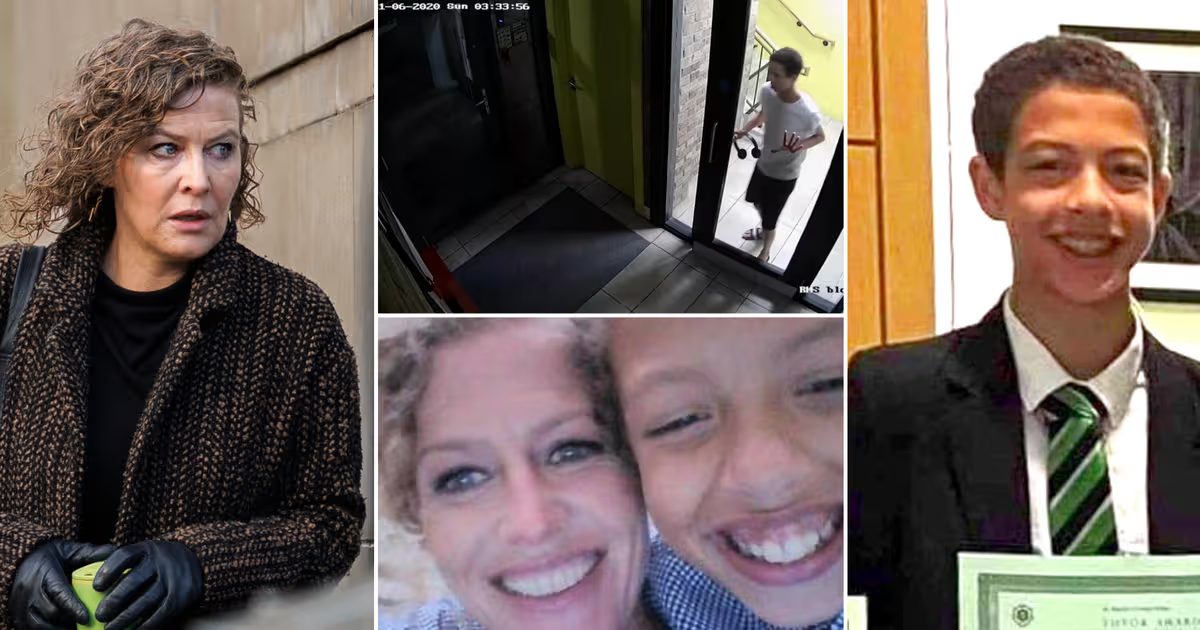
This week the inquest heard from the 14-year-old’s friends and a number of witnesses
Everything you need to know after week two of inquest into Noah Donohoe’s death
The second week of the inquest into the death of Belfast schoolboy Noah Donohoe took place at Laganside Court from Monday, January 26, to Thursday, January 29. Witnesses this week included two of Noah’s closest friends, Jay Tierney and Charlie Rocks, as well as a number of witnesses who saw him cycling in North Belfast, as well as those living in Northwood Drive.
One of Noah’s best friends, Jay Tierney, told the inquest on Monday that the 14-year-old was “excited for the future” in the days before he went missing in June 2020. He described Noah as “eccentric but not in a bad way” and “unpredictable,” saying the pair supported each other during the Covid-19 lockdown.
He said that they went on a long walk around Belfast on June 20, the day before Noah went missing. Noah chatted with him about a book, 12 Rules For Life by Jordan Peterson, but would not tell him what it was called because he felt Mr Tierney “didn’t need it”.
On Tuesday, the jury watched CCTV footage of Noah cycling naked in the moments before he went missing in 2020. The inquest also heard from Noah’s friend, Charlie Rocks, who said he had had no concerns about the mental health of his school friend at the time.
The jury heard evidence from a motorist, Donna Blain, who saw Noah on the same evening after he had fallen from his bike. She first contacted police during the period between Noah going missing and his body being discovered and then gave a statement 10 months after the schoolboy’s death.
Ms Blain was driving from the Shore Road on to North Queen Street when she saw Noah, who appeared to have fallen from his bike and was lifting it back off the ground.She said she did not know what caused the fall. The witness told the inquest that Noah was looking around as if embarrassed before he cycled off. She said he left his coat behind on the ground. She also said she did not see anything that gave the impression that Noah had been injured.
On Wednesday, a witness described the moment Noah fell from his bike on the day he went missing. Amanda Seenan, has said that they saw the teenager fall from his bike with this taking place as she was travelling behind him in a Black Vauxhall Corsa. In a statement she gave to police, she said: “He was to my left, I noticed the male took a tumble off his bike. He was just approaching the bus layby when he fell. I slowed down as I was about to come to the end of the road and see if the male was okay. I could see, though, that the male had jumped up and got onto his bike again.”
Ms Seenan said she was “confused” by a police theory that the schoolboy suffered a head injury. She told the inquest she did not see Noah suffer any such injury despite witnessing the fall she described as “not light.”
Another witness, Sinead Quinn, told the hearing she saw Noah in the moments after he had fallen from his bike, but did not see the fall itself. She said she saw a green coat on the road after the incident and sounded her horn in order to alert Noah to it, but he continued cycling. She said: “I beeped the horn to point this out to him. He looked startled, he didn’t lift the coat, but just cycled on, which I thought was strange.”
Nathan Montgomery, another witness, told the hearing that he had seen Noah cycle past his car on North Queen Street as he was leaving a Chinese takeaway. As he travelled in a red Audi toward the Seaview area to return home, he saw Noah again cycling in the direction of the York Road junction. Mr Montgomery said that while driving behind Noah, he had seen him “sway slightly” in the road which made him wary about passing him in his car and took additional care.
The jury heard on Thursday from the witness who found Noah’s bike on the evening he went missing. Karen Crooks, a resident of Northwood Road, also told the jury she had never been made aware of the dangers to children of a storm drain at the rear of her home before Noah’s body was found.
The court also heard from Kerry Fraser, who had been at her partner’s house in Northwood Road in north Belfast the evening that Noah left his home. Her statement was read to the court. She said she saw a male riding past the house. She said: “He was totally naked. I thought it was a man who had had too much to drink on Father’s Day and was having a prank. He was tall, had an afro hairstyle, and was black. He was sitting down cycling and did not appear to be distressed, although he was cycling quickly. I got up and went to the window and looked out, but he was away. I thought he must have gone into one of the houses.”
Douglas Balish is now a celebrated chef at one of the UK’s top hotels
Nicola Croal Trends, Showbiz and Lifestyle Writer and Joanne Ridout
04:30, 25 Feb 2026
Advertisement
It’s important to never forget that one decision can completely change your whole life path and for award winning Scots chef Douglas Balish it came when he was getting his hands dirty in a sink full of used dishes. The then 20-year-old, originally from Troon but now based in Wales, studied psychology in university when he took up a kitchen porter job in an Ayrshire restaurant.
This was just the first step in his remarkable culinary career which has now seen him work in award winning restaurants across the world with just £2,000 in his pocket. Balish’s admirable work ethic and eagerness in his first role as a dishwasher meant that the restaurant’s staff were soon asking him to help out with other responsibilities and after buying his first cookbook at 20-years-old, that’s where his love for cooking began.
Fast forward twenty years, and the now 40-year-old is a celebrated executive chef at luxury country hotel Grove of Narberth in Pembrokeshire, Wales, where he was awarded the title of Hotel Chef of the Year at the 2025 Hotel Cateys, which is recognised as a huge honour in his industry. However, Balish’s humble nature still shines through as he insists that the award is a team effort by all the staff, Wales Online reports.
He says: “It goes to one person but that doesn’t really feel fair, one person can’t do everything, everyone’s got to be behind it and on board with it so from the kitchen and front of house one doesn’t work without the other.” However, going from being a young dishwasher to the chef of a high end hotel in the space of two decades has not just come as a stroke of luck for Douglas, who has been proactive in guiding the development of his career, including taking multiple risks to get to this award-winning level.
Advertisement
Content cannot be displayed without consent
He says: “When I started out I was absolutely useless, but I enjoyed doing it, so after I’d done that for a few months I couldn’t see myself sitting in a classroom for the next four years, I don’t think it would have been for me, I could see myself getting bored or distracted.
“I think I’m probably the least qualified, education-wise, in the kitchen as I just went straight into a job. I worked in Scotland for a few years but then decided that if I was going to do this I need to do it properly, so I went off to Jersey to work in a Michelin star restaurant.”
This restaurant was called Bohemia, where he was employed for five years, working his way up from the very bottom level to sous chef before moving elsewhere to a lower standard eatery. However, his ambition was set on achieving something even more challenging which his seven years of experience had all been working towards.
There was one specific restaurant in the world that had inspired him ever since he was a young man but it was thousands of miles away.
Advertisement
However, that didn’t stop Balish as he picked up the phone and called Quay in Sydney, which is hailed as Australia’s most celebrated and influential restaurants, which boasted Three Hats in the Good Food Guide for 23 consecutive years.
He said: “It’s where I’ve always wanted to work, so I contacted the chef there and said ‘do you have any jobs’ and he said contact me if you’re ever in Australia, so I got straight on a plane, and knocked on their door as soon as I got there and started working there next day.
“It was a bit of a risk, I could have ended up having to work anywhere just to earn money, and Sydney is quite an expensive place to live so I had to get a job quickly, as I got there as I only had £2,000 in the bank.
“I thought that would last a while but the rent there was around 500 dollars per week, so I realised my savings weren’t going to last very long. Thankfully the risk paid off and it was amazing, I really, really enjoyed it.”
Advertisement
Douglas then received a call from Great Fosters in Surrey, where he was asked to run the restaurant and develop his ideas.
He was persuaded to come back to the UK and took another risk, going from being unknown to a Michelin star in just 18 months.
His rapid success did not got unnoticed in the industry and with it came the call from Neil Kedward, co-owner and co-founder of Grove of Narberth with wife Zoe, who asked if he would move to west Wales to spread his culinary magic.
He says: “I’d only been to Wales once before and that was Cardiff so at that time I didn’t realise what an amazing place it was, but the closer we got to Narberth, the more I saw, I thought Wales was incredible.
Advertisement
“We got through the gates of the hotel and it was March and all the daffodils were coming up and it looked incredible and I was, ‘ok then, we’re done’, it looked stunning.”
Stepping inside the once derelict country house into the hotel created by Neil and Zoe drew Douglas in.
He said: “It was homely, welcoming but luxury at the same time, and as soon as we walked through the front door it was like walking into somebody’s house, it was so special and that was it really from that moment on, we were seriously considering this move.
Advertisement
“We want people to come here and feel like they are in good hands, we want to make everything perfect for them, that they don’t want to go home, for it to be relaxing, away from stress. Yes, it’s a business, but at the end of the day the staff working here look after people, it’s what we want to do, what we’re here for.”
He added: “When I lived in Surrey for five years I had no idea who our next door neighbours were, but the day we moved in here the neighbours were all round, had made us a cawl, it was lovely. And we just love it here – the people, the area – it’s great. It’s an amazing place, it has it all, and the beaches are incredible.”
Since joining Grove of Narberth Douglas and his team have revolutionised the food and drink menus in the business to an award-winning level.
Their culinary offers have now won many accolades including the 2024/2025 Michelin Key and 4 AA Rosettes for dining and, of course, Hotel Chef of the Year 2025.
Advertisement
The hotel on the whole has won awards too. These include Tripadvisor’s 2024/2025 “Best of the Best”, placing it within the top 1% worldwide, Small Luxury Hotels of the World’s hotel of the year 2023/24, and Independent Hotel of the Year 2024 and there have been accolades for the venue’s staff too.
Douglas says the dining experience at the hotel has been developed over a period of years with the core of the construction of the menus always about using produce and ingredients from local suppliers and the result is a strong network of relationships.
He explains: “In the beginning it took me a while to find the suppliers and that was the hardest part, finding the people who could work with us and wanted to work with us for our special requirements, such as meat that’s aged for a certain amount of time, fish brought straight to us to be very fresh, vegetables with particular picking times. I’m quite demanding on what we get.
“This has taken a bit of time to get where it is now, but the ethos is what everything is built around, showcasing Pembrokeshire and Welsh ingredients, but doing it in a slightly different way to how it’s traditionally done in this part of the world by using our experience of working in other places and from our travels, using different cuisines to amplify the Welsh products, such as an Asian influence or using French techniques, things like that.
Advertisement
“The ingredients are from Wales and we try to highlight the suppliers that we’ve got because they are amazing, they are as good as anything else around the rest of the world. We want to build a relationship with people who have the same ethos, to be the best that we can be, but now we have amazing connections, we’re really lucky.”
Looking back, Douglas’ success story has given him valuable insight that he is keen to share with others in the hope of helping people in the industry.
Douglas’ personal experiences has led him to believe that anyone who wants to progress in the industry just needs to have a plan to learn.
He explains: “Get yourself into a job that’s a good level, if you go to somewhere that’s really, really good and learn the proper ways to do things, you can drop that experience into any sector later. Say if you wanted to do a fast food truck, and I’m all for that, if you know the right way to do things in the first place – how to get the most flavour out of things, how to get the most taste out of great ingredients, all the health and safety aspects.
“Find somebody who wants to teach you, not every good place wants to nourish you and make you better, some places will just take from you and you’ll work, work, work and then you leave there thinking you’ve done the same thing for two years. You need someone who will take you under their wing and help you to learn.”
Douglas also says that experience at the start of your culinary career is more important than the salary.
He said: “The money comes later, don’t be chasing an extra two thousand pounds a year, survive on what you can and learn as much as you can, and that will help you for the future.
Advertisement
“There are places that pay over the average but everything comes in a packet, you don’t make anything, you don’t learn anything, reheating something, it puts a cap on your potential if that’s all you’re doing.
“By the time you know it you’re 25 and still don’t know anything and you’ve maxed out at the level that you are at, and you have to make a decision then, are you going to stay at that level or drop back down and be paid less and start learning again, and then you can choose what to do in the future once you have that knowledge.”
It’s an element of development that Grove of Narberth can offer too, as the hotel is part of The Seren Collection that includes Beach House, Oxwich, Lan Y Mor, Saundersfoot and Penmaenchaf, Dolgellau.
Douglas said it’s important to him that the company develop staff, saying that the other restaurants offer a chance to share staff, to develop their skills at the other sites away from Grove of Narberth.
Advertisement
But it’s not just the staff and the menus of fine dining that have been developed by Douglas and the team, but building a relationship with the community extends to young people in schools too.
Douglas says: “We have been doing a competition with primary school age children in Ceredigion where they can work with their teachers and do team work around food – where it comes from, packaging, how it’s grown- giving them an understanding, and then they do a three course meal.
“For us it was about getting to an earlier age group and plant some seeds about good food, how are we going to live more sustainably, what produce is healthy and that you can cook for yourself and feed yourself and family when you’re older.
“In 2026 we want to extend it into Pembrokeshire and Carmarthenshire and maybe into Cardiff and Swansea in 2027.”
“He went to work on a building site that morning and, heartbreakingly, did not make it home to his partner Bex and their daughters.”
A dad has been killed while working at a new-build housing estate as his “heartbroken” family pays tribute.
Advertisement
Brian Rodgers, 42, died in an industrial accident in Sprowston, near Norwich, at around 11am on Tuesday, February 17.
The father-of-two, originally from the West Coast of Scotland, was employed as an agency general operative for Tilia Homes.
A police probe, assisted by the Health and Safety Executive, has now been launched into his death.
A tribute from his family reads: “As a family we are truly heartbroken. Brian was a wonderful fiance, father, and brother and our home and lives feel empty without him.
“It is clear from the overwhelming response we have had from friends, work colleagues, neighbours and acquaintances, that he was greatly loved and respected by all of those he came into contact with.
“He brought love, laughter, care, support, comfort and joy to all of us and enriched our lives beyond measure. He will be greatly missed and never forgotten.”
His sister, Wilma Rodgers, also paid tribute to her “kind-hearted” brother. She said: “On Tuesday, February 17, my brother Brian tragically passed away. He went to work on a building site that morning and, heartbreakingly, did not make it home to his partner Bex and their daughters. He was just 42 years old.
Advertisement
“Brian was killed in a workplace incident – a sudden, unimaginable loss for everyone who knew him. He was a hugely popular and kind-hearted man who would help absolutely anyone.
“Brian could strike up a conversation with anyone he met. Although he wasn’t originally from Norwich – having grown up on the west coast of Scotland – he had made Norwich his home for almost 20 years.
“This devastating loss will affect the family in countless ways, including financially.”
His sister has launched a GoFundMe to help ease the “financial pressures” on his family while they “grieve such a tragic loss”.
Brian’s partner, Rebecca Day, spoke about the difficulty of losing her soulmate as she encouraged people to donate. She added: “We have a really long road ahead of us and navigating this without Brian is going to be so difficult. Again, I thank everyone for your love, support and kindness during this awful time.”
Advertisement
A spokesperson for the force said: “A man was sadly declared dead at the scene. The circumstances remain under investigation with officers from Norfolk Police working alongside colleagues from the Health and Safety Executive (HSE).”
A HSE spokesperson added: “We are aware of the incident and making enquiries.”
A spokesperson from Tilia Homes said: “A serious incident occurred at our Furlong Heath development in Sprowston on 17th February, resulting in the tragic death of one of our agency general operatives. The site is now closed, pending a thorough investigation by the relevant authorities.
Advertisement
“Our thoughts and deepest condolences are with the individual’s family, friends and colleagues at this incredibly difficult time. We would like to thank the emergency services for their swift response and professionalism in attending the scene.
“Our immediate focus is on the wellbeing of everyone affected by this incident. The safety and welfare of those who work with us is our highest priority, and we will be providing support to our employees, subcontractors and partners at the development. This includes access to appropriate welfare and counselling services to ensure that those impacted receive the care and assistance they need.”
Inspectors from the Care Quality Commission (CQC) have improved the rating for child and adolescent mental health wards (CAMHS), run by Leeds and York Partnership NHS Foundation Trust, from requires improvement to good.
It follows an inspection carried out on October 28 and 29 last year.
The wards inspected were at Mill Lodge, off Huntington Road in York, and Red Kite View, in Leeds. Mill Lodge is a 10-bed general adolescent ward while Red Kite View contains two wards, a 16-bed general adolescent unit and a separate six bed Psychiatric Intensive Care Unit (PICU).
Advertisement
CQC said it found a breach of regulation in safe care and treatment when managing medicines and completing mandatory training at the trust.
Leeds and York Partnership NHS Foundation Trust has been told to submit a plan showing what action it is taking in response to these concerns, the watchdog added.
The trust’s overall CQC rating remains good.
Inspectors said trust leaders had “not ensured” all staff at the CAMHS service were trained in safeguarding to keep people safe.
Advertisement
But they said the trust had “plans in place to ensure all staff were trained after the inspection”.
Trust has ‘made improvements’ to service after CQC raised concern, says watchdog
CQC said service staff “didn’t consistently follow good practice with regards to medicines management, including how it was given to people and records showing what they’d been given”.
However, CQC said it found that the trust “had made improvements to the service” since its 2024 inspection, when the watchdog concluded that the service was “not performing as well as it should”.
Recommended reading:
Advertisement
Inspectors said individual care plans at the service were developed, regularly reviewed and updated after their most recent inspection.
They found that staff “worked well across different teams to help support people” and “treated people with compassion and kindness and respected their privacy and dignity”, according to CQC.
The watchdog also said inspectors found that staff at the service “understood their individual needs and supported them to understand and manage their care, treatment or condition”.
CQC added that the “service supported people to live healthier lives and where possible, reduce their future needs for care and support”.
Advertisement
Leeds and York Partnership NHS Foundation Trust has been approached for comment.
Community groups, businesses, charities and schools have until Friday, April 10 to apply for support for schemes that make it safer and easier for people to walk, wheel and cycle.
David Skaith, the Mayor of York and North Yorkshire, launched the £1 million Active Travel Fund to support projects in the region that improve walking routes and increase accessibility.
Recommended reads:
These can include initiatives such as installing dropped kerbs, building skills and confidence through cycle training or creating safe spaces to learn, encouraging behaviour change – such as School Streets, bike buses and park and stride schemes; and providing secure cycle storage.
Advertisement
Mr Skaith said: “Walking, wheeling and cycling should be part of a safer, happier school run.
“It’s fun, it’s healthy, and it’s precious quality time for children at the start and end of the day.
“That’s why I’m kick-starting a revolution in active travel. Through the Mayor’s Active Travel Fund, I’m putting power into the hands of local people to create safer routes to build healthier, greener, and better connected places for generations to come.
“We’re backing communities with this £1 million investment, supporting practical, local initiatives that make a real difference on our streets and outside our school gates.”
Advertisement
The funding forms part of a wider £4 million programme to double investment in walking, wheeling and cycling across the region.
More than £2 million is already available to public bodies, including local councils, with successful applications due to be announced in the next few weeks.
The Mayor launched the fund at Oatlands Junior School in Harrogate, where a range of measures has led to more than 90 per cent of children walking, wheeling or cycling to school.
These include a bike library, park and stride, 20mph speed limits and regular Dr Bike sessions to keep cycles in top condition.
Advertisement
Rhiannon Letman-Wade, active travel commissioner for York and North Yorkshire, said: “The schemes running in Harrogate are exactly the kind of projects we want to see more of across the region.
“They show how a community can secure much-needed improvements and create safer streets for children and the wider community.
“This fund is about empowering communities to take the lead, supported by targeted investment, so that together we can provide opportunities for people across our city, towns, rural and coastal areas to make more affordable and sustainable travel choices.”
For details and an application form, visit yorknorthyorks-ca.gov.uk/project/mayors-active-travel-fund/
Advertisement
The Active Travel Fund is part of the Mayor’s £7 million Moving Forward campaign to create a healthier and more thriving York and North Yorkshire through investment in schemes that support movement, health and connection to the outdoors.
What do you think?
Feel strongly about an issue? Write us a letter. Please write no more than 250 words and you must provide your full name, address and mobile number. Send your views by email to: letters@thepress.co.uk
Four years ago, on February 24 2022, Russian president Vladimir Putin announced that his forces had begun a full-scale invasion of Ukraine – the reasons for which we have explored here. Within minutes, explosions were heard in major Ukrainian cities as Russian troops flooded across the border.

Russian forces made swift gains, capturing key areas near the capital of Kyiv. But the offensive soon stalled and, by December, Russia had been forced to withdraw its forces and consolidate in the east where the war has ground on ever since.
We asked Stefan Wolff, Tetyana Malyarenko, Scott Lucas and Mark Webber, four regular contributors to the Conversation UK’s coverage of Ukraine, for their take on the most surprising development of the war so far and its likely trajectory from here.
A very traditional war – with added drones
Stefan Wolff, Professor of International Security, University of Birmingham; Tetyana Malyarenko, Professor of International Security, and Jean Monnet, Professor of European Security, National University Odesa Law Academy
Advertisement
For us, the most surprising development remains Moscow’s decision to launch a large-scale ground invasion of Ukraine in the first place. Even though many Russian and western analysts expected a swift Ukrainian defeat, this always seemed unlikely from the perspective of Ukraine.
The mobilisation of Ukrainian society early on in the war testified to this and underlined that there was no realistic scenario under which the Kremlin could swiftly achieve its goals – to oust President Volodymyr Zelensky and “demilitarise” and “denazify” Ukraine.
Much less surprising was Russia’s transition to a war economy and a traditional war of attrition, which became a foregone conclusion as soon as Moscow’s plan for a victory parade in Kyiv within weeks of the full-scale invasion turned out to be a pipe dream.
Combat methods have evolved over the past four years, especially regarding the integration of drones. Russia has exploited drone technology to attack the whole range of critical infrastructure in Ukraine, not just military targets. But the foundation of Russian and then Soviet military doctrine – the use of mass armies and tactics of mass destruction – has remained untouched.
Advertisement
Moving forward, both sides have sufficient resources and external support to maintain the status quo. They will continue to fight each other in the hope of exhausting their opponent. But neither side is likely to reach this point of exhaustion soon. And until it does happen, political, economic and social stagnation in both Russia and Ukraine will continue to take its toll on their citizens.
Ukrainian rescuers work at the site of a Russian strike in a residential area in Kyiv on February 22. Stringer / EPA
Putin’s hopes are pinned on Trump
Scott Lucas, Professor of International Politics, University College Dublin
On the day the war broke out, I was in a discussion group of political and military analysts. When we got the news that Russian special forces had landed at the Hostomel airbase near Kyiv, each of us thought the capital would fall within a few weeks.
However, four years have passed and Ukraine now controls more territory than it did in June 2022. This is despite facing the second-most powerful military in the world, Russia’s disinformation assault and political warfare trying to split Europe, and abandonment by the Trump camp.
Advertisement
The Russian president’s unwillingness to give up his quest for Ukraine as part of a “Greater Russia” and the Trump camp’s willingness to sacrifice Ukrainian and European security are less of a surprise.
Putin made clear in an essay in 2021 that this would be his legacy project. So any soundbites about “peace around the corner” – particularly from Trump’s envoys Steve Witkoff and Jared Kushner – are cynical declarations or wishful thinking.
The Kremlin will not accept less than the seizure of all of the strategic Donetsk region, the rest of the country without effective security guarantees, and the fall of the Zelensky government. Putin cannot accept less because this would be the failure of his project at the cost of 1.3 million casualties and counting.
His hope is that Trump’s envoys will enable him to achieve what he cannot on the battlefield. The Trumpists do not believe in alliance but in transactional relationships, which is why the Kremlin is now dangling joint economic projects in front of the US government.
Advertisement
But, irrespective of this, I see no change in the war’s trajectory in the near future. A negotiated end to the invasion is close to impossible because of the Kremlin’s quest for “victory” through Kyiv’s capitulation. That capitulation is unlikely.
Russia has made only marginal advances on the ground. And Zelensky is maintaining his line over sovereignty, territory and security. Although Ukraine’s energy infrastructure has been seriously damaged, most Ukrainians support continued resistance.

While cumbersome in its support, which has been complicated by pro-Kremlin figures like Hungary’s Viktor Orbán and Slovakia’s Robert Fico, the EU is also stepping up its backing of Kyiv and partially filling the gap that has been left by Trump.
The Kremlin is facing a tightening of economic constraints on its quest. It is cutting social spending and increasing taxes to maintain the war. However, as there has been no widespread public pressure domestically that could curb the Kremlin’s ambitions, the invasion will grind on.
Advertisement
A Ukrainian servicemen stands guard in the Donetsk region of eastern Ukraine on February 17. Ukraine’s 93rd Mechanized Brigade Press Service Handout / EPA
Two ways to overcome the stalemate
Mark Webber, Professor of International Politics, University of Birmingham
For me, the biggest surprise so far has been the resilience and adaptability of the Ukrainian war effort. Most observers, myself included, assumed in 2022 that the Ukrainians would buckle under the Russian onslaught.
Nato-led training programmes have undoubtedly been important for Ukrainian defenders. But seemingly more vital has been the determination provided by national identity. Putin’s 2022 claims that Ukraine had been committing genocide against Russian speakers and that its government was a neo-Nazi dictatorship were both spurious and counterproductive.
I too believe Russia’s war methods in Ukraine were grimly predictable. Waves of infantry assaults designed to overwhelm defences through sheer volume have been a recurring strategy in previous Russian military campaigns in Chechnya, Georgia and Syria.
But this strategy has resulted in a stalemate in Ukraine with the frontlines effectively frozen. There are two things that could alter this. The first is a change of approach by China, which has effectively subsidised Russia’s war effort through technology transfers and energy purchases.
Advertisement
Beijing could cut off some of the technology it provides Russia and exert pressure on Moscow to encourage flexibility in the peace negotiations. But, at present, it has no interest in abandoning Russia. Their alliance is a way of balancing the US and Nato in the global competition for influence.
The second possible agent of change is a massive armament effort on behalf of Ukraine. This would require Germany, France and Britain to boost already significant arms provisions and to allow their use in a manner that is not constrained by fears of escalation.
However, this scenario also seems unlikely. These three countries lack the domestic political imperative to back Ukraine to victory. And the US, which was overly cautious even under the presidency of Joe Biden, has now left the field of battle.
Andrei Lankov, a prominent Russian scholar on North Korea who teaches at a Seoul university, was detained in Latvia while delivering a lecture, Russian media reported.
Mr Lankov confirmed to multiple news agencies that he was detained by Latvian police just minutes before delivering a lecture on North Korea and placed on a blacklist by the country’s authorities.
Mr Lankov said police officers took him to an immigration office and then placed him in a car that took him to the border with Estonia. He was eventually expelled from the country.
At around 11pm Moscow time, Mr Lankov said that he was still being held, adding that lawyers were working on his case and friends were helping with logistics.
Advertisement
“About thirty minutes before the event, police and immigration came and told me that the foreign ministry of Latvia included me on its list of undesirable people,” he told NK News.
While Latvian authorities haven’t issued an official clarification, Me Lankov believes it could be related to his views on North Korea. “I believe they see my writing style as excessively objective and they see it as a problem,” he said. “I say positive things about North Korea sometimes, and when negative, not in a hysterical style.”
Officials at South Korea’s Kookmin University, where Lankov is a professor of history, said they were trying to assess the situation.
Mr Lankov’s lawyer later confirmed that the scholar was blacklisted from the country, however, the designation didn’t prevent him from entering the country, according to the Russian Anti-War Committee.
Advertisement
“Overall everything is fairly clear. The authorities do not like the fact that I refuse to turn real-life situations into politically convenient caricatures,” the scholar said in a post on Telegram.
A native of Leningrad, now called St Petersburg, Mr Lankov lived for years in North Korea as an exchange student in the 1980s and has studied the country throughout his career. In the 1990s, he worked in South Korea and Australia, and since 2004 has taught in Seoul. He holds dual Russian and Australian citizenship.
Mr Lankov has been known for his realist view of North Korea, which he often describes as a Machiavellian regime squeezing limited resources and manipulating major powers to ensure its survival. He has also expressed critical views of Russia’s war in Ukraine and Moscow’s use of North Korean troops to sustain its campaign.
In April 2025, a court in Moscow reportedly fined him 10,000 rubles (£92) for taking part in the activities of an organisation that had been recognised as “undesirable” in Russia. Mr Lankov told RBK at the time that he learned about the case from journalists.
PC Steve Newman sent a message to the fellow officer “out of the blue” in the early hours saying he wanted to have “pure sweaty, breathtakingly great sex” with her in October 2023.
A misconduct hearing at Houghton Le Spring Police Station ruled his comments were inappropriate and amounted to sexual harassment.
A month later at a Northumbria Police work Christmas party he started to make complimentary comments about her to another colleague who she was dating, then “took hold of the back of [her] head, pulled her towards [him], and kissed her on the forehead”.
Advertisement
The woman, who is referred to only as Officer A, said she was left “shocked” PC Newman had texted her in the early hours of the morning making “sexually explicit suggestions out of the blue”.
She told the hearing she “could not believe the audacity” of PC Newman, adding she “would not touch [him] with a bargepole”.
Officer A stated her relationship with PC Newman was “strictly work based” and the pair did not see each other outside of it.
She told the three-day hearing how on October 30, 2024, Newman had approached her at work asking if she was attending the Christmas party. He then asked if she had a partner within the police force, which she did not want to disclose. When PC Newman went to leave, she said he turned and shouted across the room, “Well, I’ll book a taxi early so that we can go back to yours”.
Advertisement
Officer A said she saw this as a sexual advance and felt “mortified” and “wanted the ground to swallow [her] up.”
While at the Christmas party a month later, Officer A said Newman approached her and her partner on the dance floor, saying “you look lovely in your dress”, which made her feel “very uncomfortable”.
The hearing heard how Newman then grabbed Officer A around the back of the head and kissed her on the forehead.
The woman said she was “disgusted” by his behaviour, and that Newman had “sexually assaulted [her] in front of [her] partner.”
Advertisement
She said the events with Newman had emotionally impacted her and her career.
PC Newman told the hearing that he “thought he had a friendship” with the woman, and that she had previously “confided in him” about personal information.
He also said he was a “very huggy person”, who would greet colleagues with “hello, you’re looking handsome” or “all reet bonny lass”.
During the hearing, he accepted the content of the message was sent “to see if there was any interest in anything purely sexual”.
Advertisement
PC Newman also said he sent it because “shy bairns get nowt”.
He said he kissed Officer A on the forehead as he is “very huggy with both male and female friends.”
He also admitted in evidence that he did have a sexual interest in Officer A, had always been attracted to her, and he was “testing the waters”.
The panel stated the case was of a high seriousness, and his actions amounted to sexual harassment.
Advertisement
It said immediate dismissal without notice was the only proportionate sanction.
PC Newman will also be placed on the College of Policing’s barred list.
Democrat Rep. Al Green held up a sign reading “black people aren’t apes” as Trump gave his State of the Union speech
Donald Trump faced a powerful protest as he delivered his State of the Union address this evening, with a placard declaring “black people aren’t apes” confronting him.
Advertisement
Democratic Representative Al Green brandished the sign as Donald Trump entered the House of Representatives chamber for the yearly speech to a joint congressional session tonight. He was subsequently removed from the chamber during proceedings, reports the Mirror..
Rep. Green was ejected from Trump’s joint address to Congress the previous year after shouting at the President in opposition to Medicaid reductions.
Ensure our latest stories always appear at the top of your Google Search by making us a Preferred Source. Click here to activate or add us as your Preferred Source in your Google search settings.
This year’s demonstration relates to footage Trump shared on his Truth Social platform earlier this month, which portrayed Barack and Michelle Obama as apes. Trump maintained he hadn’t viewed the entire video before directing an assistant to publish it on his account.
Advertisement
Several Democratic congresswomen turned up to the address dressed in ‘suffragist’ white to demonstrate solidarity with women’s rights.
Rep. Teresa Leger Fernández of New Mexico, who leads Democratic Women’s Caucus, told CBS News: “This year, there are specific attacks on women’s ability to vote. The Democratic Women’s Caucus is wearing white both to honor that fight that women have always had and to signal we are still in the fight.”
Certain members of Congress are boycotting this evening’s address, following guidance from Democratic leadership encouraging them to absent themselves rather than create disruption through attention-seeking protests.
Advertisement
Trump enters the State of the Union facing the most damaging approval figures of any president in recent memory. A Washington Post/ABC News survey this week revealed 60% of Americans expressed dissatisfaction with Trump’s performance – with 47% registering strong disapproval.
A mere 39% voiced approval of his work, marking the weakest rating for any President approaching a second-year State of the Union in contemporary times.
Trump’s disapproval last touched 60% in the immediate aftermath of the January 6th Insurrection during the closing days of his initial presidency.
Scarcely 29% of Americans believe the nation is progressing positively, the latest AP-NORC survey indicates. The majority, 69%, reckon matters are deteriorating.
Advertisement
This gloom exceeds levels recorded when Trump assumed office last year. Last March, roughly 6 in 10 Americans felt the country was moving in the wrong direction.
That’s partly down to Republicans’ outlook becoming considerably bleaker last autumn, following the assassination of conservative activist Charlie Kirk. Whilst Republicans have regained some optimism in recent months, only around six in 10 now believe the country is on the right track, compared with approximately seven in 10 last March.
Anna Warnecke, the chief executive of Kynren, said: “The Lost Feather represents one of the boldest creative statements we have ever made.
“What is now rising from the ground is more than an arena – it is a space designed to move people emotionally and leave a lasting impression.”
Advertisement
An artist’s impression of the arena. (Image: KYNREN)
The project comes with a focus on educating the audience about conservation and the relationship between humans and birds.
The production plans to increase public understanding of the need to protect bird species both locally and globally.
Timber has arrived for the next stage in the construction of Kynren – The Storied Lands. (Image: North News & Pictures Ltd)
Kynren’s theme park is currently under construction in Bishop Auckland. (Image: KYNREN)
With their experience in conservation organisations and free-flight programmes, the specialists are ensuring the attraction is more than just a performance space.
The Lost Feather will form part of Phase One of The Storied Lands.
Advertisement
The extension will also host other live-action shows, including a medieval horse show, a Viking show, and ‘Legend of the Wear’, a retelling of the Lambton Worm myth.
In just over eight months, voters will pass judgement on Trump’s second presidential term in November’s midterm elections. They could preserve his Republican majority in Congress or hand power to the Democrats, assuring two years of legislative gridlock and aggressive oversight that could, in his own words, see him impeached once again.