

PATH_Paddington_(c)Alex-Brenner__12_5293-ARW-dxd-Edit-2_s.jpg?trim=0,172,0,718&quality=75&auto=webp&width=960)

.jpg?crop=8:5,smart&quality=75&auto=webp&width=960)


![FROM ITV STRICT EMBARGO - No Use Before Tuesday 28th March 2023 Coronation Street - Ep 1092021 Wednesday 5th April 2023 Brian Packham [PETER GUNN] tells Mary Taylor [PATTI CLARE] about his plans to visit Isabella in Napoli and how he needs her help. Mary assumes he???d like her to accompany him and confirms that she???d be delighted. Picture contact - David.crook@itv.com Photographer - Danielle Baguley This photograph is (C) ITV and can only be reproduced for editorial purposes directly in connection with the programme or event mentioned above, or ITV plc. This photograph must not be manipulated [excluding basic cropping] in a manner which alters the visual appearance of the person photographed deemed detrimental or inappropriate by ITV plc Picture Desk. This photograph must not be syndicated to any other company, publication or website, or permanently archived, without the express written permission of ITV Picture Desk. Full Terms and conditions are available on the website www.itv.com/presscentre/itvpictures/terms](https://metro.co.uk/wp-content/uploads/2026/03/SEI_290864128-7e3e.jpg?quality=90&strip=all&w=646)


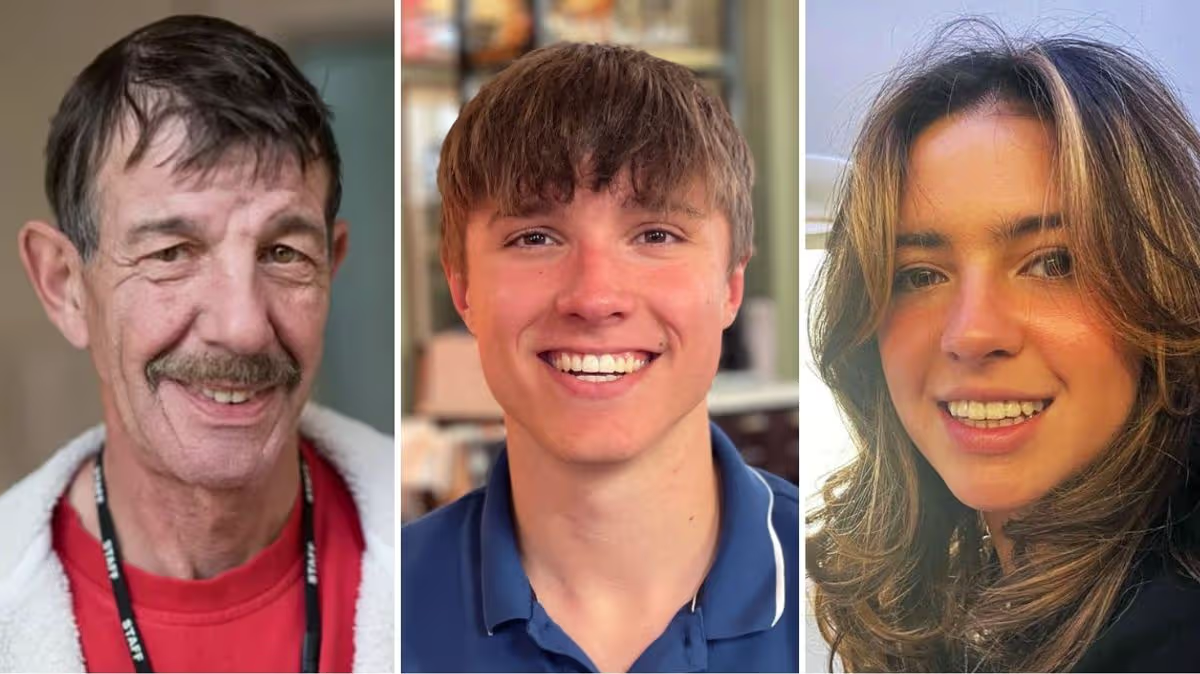
Students Grace O’Malley-Kumar and Barnaby Webber were killed by Valdo Calocane in Nottingham on June 13, 2023. He also stabbed caretaker Ian Coates, 65, more than an hour later.
TWO students fatally stabbed by a paranoid schizophrenic were tested for alcohol and drugs after they died – but their killer Valdo Calocane was not.
Grace O’Malley-Kumar and Barnaby Webber, both 19, were killed by Calocane in Nottingham on June 13, 2023. He also stabbed caretaker Ian Coates, 65, more than an hour later.
After stealing Mr Coates’ van, Calocane ran over and seriously injured three pedestrians. Calocane admitted manslaughter and attempted murder and was indefinitely detained at a high-security hospital on the grounds of diminished responsibility in January 2024.
READ MORE: “I don’t know how the police could sleep at night”: son of Nottingham attack victimREAD MORE: Nottingham attacks: Victim’s body kept at crime scene for 15 hours, inquiry hears
Grace’s father, Sanjoy Kumar, told an inquiry into their deaths he felt it was “disgusting” that they had been tested.
He said they were told to sign human tissue forms – forms he had never seen himself as a GP and a forensic medical examiner with the Metropolitan Police – otherwise their daughter’s body would not be released to them.
Dr Kumar said: “You had to sign them, but what was not highlighted was that this is a point in time where you are also signing to say that samples could be taken. That was absolutely not pointed out.
“They took samples from our children to test for drugs and alcohol. I was really struck by that being really quite disgusting.
“Our children were tested, but the culprit wasn’t and from there on in, in terms of previous interactions and mental health, that was not made into a big thing at all, that was a flyaway comment.”
Dr Kumar said he found it “shocking” that police notes mentioning a “very minor” assault by Calocane on a police officer two years before the fatal attacks did not reflect how serious the incident was.
He told the inquiry: “When a police officer sustains a punch to the face where you have a haematoma, that is the definition of an ABH injury.
“You have senior police officers coming to the inquiry saying it was a minor offence – I feel very strongly about that. It is unacceptable to strike a police officer in my view.
“To downplay their injuries and not even know the classification of their injuries, is, for someone in that position, really quite despicable.”
Dr Kumar also said he was “dissatisfied” the killer’s mental health at the time of the Nottingham attacks had not been properly examined.
He told the inquiry: “I vociferously complained about the fact that this person’s mental health had not been looked at properly on the day. I was totally dissatisfied that a 360-degree view had been taken.”
He added: “This is a person who, I was told, had been arrested on Tuesday and had been there (in custody) on Tuesday, Wednesday, Thursday, Friday, and went to magistrates’ court on a Saturday.
“And none of those officers had complained about seeing someone who’s acutely mentally unwell. That is enormously, enormously unusual.”
Dr Kumar said he believes his previous experience as a forensic medical examiner affected what information the police told him.
He said: “My belief on reflection is that I think detectives… knew what I did, what I had done, what my experience was, and I think there was possibly a strategy not to tell me things, because at every point I was being told things, I was questioning things.”
He added: “At each point we are having to cling on to little things and extract as much information as we can because really at every point we are not being given information.”
He also said he “just couldn’t understand” why a hair sample was not taken while Calocane was in custody, adding: “It may have proved nothing but it may have proved everything.”
Dr Kumar said a hair sample did not require Calocane’s consent: “If you’re a detective of any description at all, and I think every detective watching this is going to agree, if you are here to detect crime, that means forensics is really important.
“And a basic part of that forensics is head hair. It may have proved nothing but it may have proved everything. The point is that it wasn’t done and it wasn’t taken, and I just couldn’t understand that.”
The inquiry continues.


.jpg)




































You must be logged in to post a comment Login