The UK Government has issued an update on the lifespan of Freeview as it moves to digital broadcasting.
The future of Freeview has been determined by the UK Government as many Brits are worrying that terrestrial television will be “switched off” in the not too distant future. While the benefits of internet-only TV are being investigated, fear has sparked for those who struggle to connect to or afford broadband.
Advertisement
While many people across the UK already use the internet to watch their favorite TV shows, there is a large portion of Brits worried about the impact axing Freeview will have on the more vulnerable in society. In fact, over recent weeks a Change.Org petition has acquired over 110,000 signatures.
This fear sparked following recent research from Sky that called upon the government to discontinue traditional broadcasting and “move fully to internet-based TV in the 2030s”. This call led to the Secretary of State for Culture, Media and Sport, Lisa Nandy, being asked what impact turning off Freeview would have on poor broadband areas.
At the moment, the shutdown on Freeview is actively being considered in the UK, reports Chronicle Live. As the government investigates how to transition into digital-only TV, terrestrial broadcasting will potentially be turned off by 2034.
It is reported that 94 per cent of UK households currently have access to the internet. This means that if changes aren’t made, hundreds of thousands of households could be left without TV, which will most likely be the more vulnerable members of society.
Advertisement
As support has risen for both sides, Minister of State for State for Media, Tourism and Creative Industries Ian Murray has issued a statement from the government.
He said: “Digital inclusion and ensuring that all households across the country have access to high-quality, reliable broadband is a priority for the Government.
“The Department for Culture, Media and Sport is working closely with the Department for Science, Innovation and Technology to ensure that all aspects of digital inclusion are considered as part of any decisions we make on the future of digital terrestrial television.”
Advertisement
He added: “The Department is leading a project to assess the future of TV distribution and we are committed to maintaining access for all. Digital Terrestrial Television (DTT) is protected until at least 2034, safeguarding access for millions of households.
“Before any decision is made close consideration will be given to how any changes would impact audiences, especially those who rely on DTT as their primary means of watching television.”
The Change.Org petition, which was started by Dennis Reed, reads: “Terrestrial television, received through an aerial, often known as Freeview, is under serious threat of being scrapped. Within months the Government will decide whether to turn off terrestrial signals and rely solely on internet-based TV (IPTV) in the future.
“This would mean that every household would be forced to take out an expensive fixed broadband contract if they wished to continue watching their favourite TV programmes. Radio reception and signals for emergency services could also be put at risk.
Advertisement
“Millions of older and disabled people, and those on low and modest incomes, would lose their essential access to TV to keep them in touch with the world and to prevent isolation and loneliness.”
Freeview currently serves 16million homes across the UK, making it the primary television platform for 40 per cent of households with a TV and the nation’s largest TV service.
Using traditional aerials to provide access to your everyday TV channels, some MPs have emphasised that these homes need to be safeguarded from losing the service they rely on.
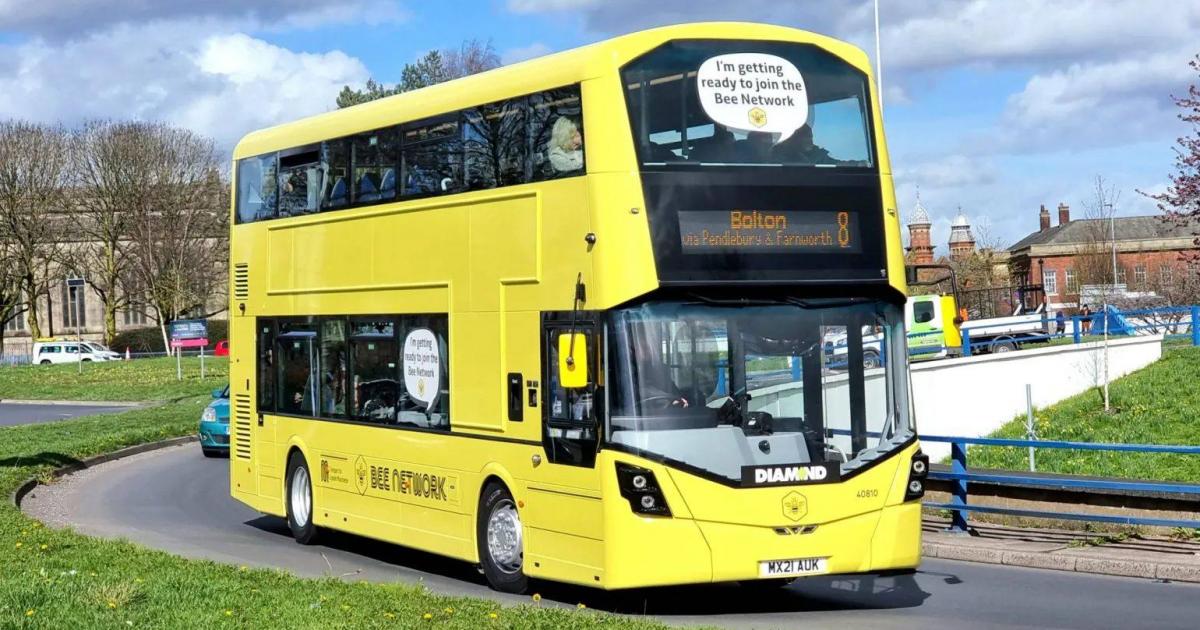
Public transport has undergone a huge transformation in recent years, with buses being brought under public control and those serving Bolton being among the first.
According to Transport Focus, only 63 per cent of UK bus passengers believed they were getting value for money in 2025, down from 73 per cent in 2024.
But Greater Manchester bucked this trend – with 79 per cent saying the Bee Network offered value for money, up from 73 per cent the previous year.
Greater Manchester also shows the biggest improvement, rising seven percentage points from 79 per cent to 86 per cent, putting it above the England average.
Advertisement
Fran Wilkinson, Customer and Growth Director at Transport for Greater Manchester, said: “These results show the Bee Network is making a real difference to passengers.
“We’ve worked hard to keep the cost of travel down, capping fares and making multi-modal travel by bus and tram cheaper and more convenient and it’s great that passengers are already feeling the benefit of this.
“This report, which shows a significant improvement in passenger satisfaction, explains why more and more people are using public transport in Greater Manchester.
“Bringing buses under public control has allowed us to freeze fares at £2 for another year, make improvements to services, introduce new routes and increase reliability.
“We are now looking at providing free travel for some children in temporary accommodation too.”
Bolton resident Wendy Pye said the bus pass changes were ‘welcome’ (Image: Dan Dougherty)
And 86 per cent of those surveyed said they were ‘satisfied’ with the service overall, up from 79 per cent in 2024 – the highest increase of any area in the UK.
Transport Focus surveyed 47,863 passengers throughout the UK to complete its survey, covering 43 separate areas.
Advertisement
Greater Manchester’s 79 per cent approval rating for value for money puts it high above the national average of 63 per cent.
Its overall satisfaction rate of 86 per cent puts it slightly above the 85 per cent national average.
Bus passengers across England have reported further improvements in satisfaction with their journey with overall satisfaction rising to 85 per cent in the third year of the independent watchdog’s Your Bus Journey survey.
The results of the annual Transport Focus survey show an improvement on last year’s score of 83 per cent, although results continue to vary significantly between local authority areas. Passengers in both Greater Nottingham and Warwickshire are the most satisfied with their journeys at 93 per cent. Passengers in Thurrock (Essex) are the least satisfied in England, scoring 73 per cent.
DUBAI, United Arab Emirates (AP) — U.S. President Donald Trump’s surprising claim this week that talks with Iran were yielding great progress has only raised more confusion over a war whose goals were already unclear. The most basic question: What talks?
Iran denied any negotiations were taking place, pledging to fight “until complete victory.” Pakistan, Egypt and Gulf Arab nations are trying behind the scenes to piece together talks, but their efforts still seem preliminary. Israel is vowing to keep up its attacks.
Here is a look at what’s known and not known about possible talks to wind down the war.
Advertisement
President Donald Trump listens to a reporter during the swearing in for Homeland Security Secretary Markwayne Mullin in the Oval Office of the White House, Tuesday, March 24, 2026, in Washington. (AP Photo/Alex Brandon)
Advertisement
President Donald Trump listens to a reporter during the swearing in for Homeland Security Secretary Markwayne Mullin in the Oval Office of the White House, Tuesday, March 24, 2026, in Washington. (AP Photo/Alex Brandon)
A reopening of the Strait of Hormuz — a vital waterway for oil shipments that Iran made virtually impassable when the war began — is now also a priority, for Trump and the global economy.
As Trump talks of engaging with leaders in Iran, he has backed off promoting the Islamic Republic’s collapse. Israeli Prime Minister Benjamin Netanyahu, however, continues to say the war aims to help Iranians overthrow the theocracy.
Trump claimed that U.S. envoy Steve Witkoff and Trump’s son-in-law Jared Kushner held talks Sunday with an Iranian leader. He did not say who that was.
Advertisement
Reports focused on Iranian Parliament Speaker Mohammad Bagher Qalibaf as a possible interlocutor. But Qalibaf quickly denied talks were taking place in a post on X.
The U.S. agreed “in principle” to join talks in Pakistan, according to three Pakistani officials, one Egyptian official and a Gulf diplomat, while mediators were still working to convince Iran. The officials all spoke on condition of anonymity because they were not authorized to provide the details to the media.
The Egyptian official said efforts are centered on “trust-building” between the U.S. and Iran, aiming to reach a pause in fighting and a “mechanism” to reopen the Strait of Hormuz.
Advertisement
Vehicles drive under billboards showing portraits of the late Iranian Supreme Leader Ayatollah Ali Khamenei, foreground, and his son Ayatollah Mojtaba Khamenei, the successor to him, along a highway in Tehran, Iran, Tuesday, March 24, 2026. (AP Photo/Vahid Salemi)
Advertisement
Vehicles drive under billboards showing portraits of the late Iranian Supreme Leader Ayatollah Ali Khamenei, foreground, and his son Ayatollah Mojtaba Khamenei, the successor to him, along a highway in Tehran, Iran, Tuesday, March 24, 2026. (AP Photo/Vahid Salemi)
Advertisement
Advertisement
Who speaks for Iran in any talks?
Iran’s leadership appears to have remained relatively cohesive, despite weeks of heavy bombardment and the killing of its supreme leader and many top-ranking military figures.
But who actually is in charge is not known. The new supreme leader, Ayatollah Mojtaba Khamenei, hasn’t been seen or directly heard from since he was named to replace his slain father, Ali Khamenei.
Advertisement
Within the Islamic Republic are other centers of power, including the military and the powerful paramilitary Revolutionary Guard, as well as political figures like Qalibaf, Foreign Minister Abbas Araghchi and President Masoud Pezeshkian.
It’s not certain anyone entering talks with the U.S. would have backing from the military or Guard. In the ongoing war, Iran’s military has conducted strikes based on orders of local commanders, rather than from any political leadership, Araghchi has said.
Advertisement
The spokesman of Iran’s top military command, Maj. Gen. Ali Abdollahi Aliabadi, vowed on Tuesday that the fighting “will continue until complete victory.” It was a message of defiance to Trump’s claim that Iran was petitioning for peace, but possibly also a warning to anyone within the Iranian leadership not to back down in talks.
Was Trump just trying to buy time?
Trump’s sudden declaration of progress in talks on Monday came just as the deadline was about to run out on an ultimatum he had made over the weekend threatening to “obliterate” Iran’s power plants unless the country releases its stranglehold on the Strait of Hormuz. Iran threatened to retaliate against power, water and oil infrastructure across the Gulf.
Trump on Monday pushed the deadline back five days and said there’s a “very good chance” a deal could be reached this week. That was a relief to global oil and stock markets.
Trump’s move could signal he’s wary of the war’s possible long-term damage to the U.S. and global economy, though his administration has insisted that any pain from spiking oil prices will quickly be reversed once the war is over.
Advertisement
“Trump could be actively seeking an offramp,” the Soufan Center, a New York-based think tank, wrote in an analysis.
On the other hand, the Soufan Center noted, Trump could be buying time for thousands of Marines heading to the region to arrive.
The Marine deployment could be a tactic to pressure Iran on negotiations. But it has also raised speculation that the U.S. may try to seize Kharg Island in the Persian Gulf, which is vital to Iran’s oil network, or carry out an operation to remove enriched uranium from inside Iran. Either would mean a greater escalation and a longer war.
Trump has said he has no plans to send ground forces into Iran but has not ruled it out. Israel has suggested ground forces could participate in the war.
Advertisement
What is there to talk about?
Nuclear negotiations were already taking place when the U.S. and Israel launched their surprise attack on Feb. 28, killing the elder Khamenei in the opening salvos of the bombing campaign.
That only deepened Iranian mistrust of Americans in negotiations, especially after Trump’s unilateral withdrawal in 2018 from a landmark nuclear agreement reached with the United States three years earlier. Iran and the U.S. held negotiations in early 2025, and when a two-month deadline set by Trump ran out, Israel hit Iran in a surprise attack that the U.S. joined in a 12-day war, striking Iranian nuclear facilities and military positions.
Trump said Monday that any deal to end the war will entail the U.S. removing Iran’s enriched uranium, which is critical to its disputed nuclear program. Iran refused that demand in the past, insisting it has the right to enrich uranium for peaceful purposes.
A less ambitious goal for talks could be to reach a ceasefire and the reopening of the Strait of Hormuz.
Advertisement
But Araghchi seemed to reject any partial deal in an interview with Al Jazeera last Wednesday. “We don’t believe in ceasefire. We believe in the end of war … the end of war in all fronts,” Araghchi said, emphasizing the need for solutions to conflicts throughout the region.
Smoke billows following an Iranian missile strike in Tel Aviv, Tuesday, March 24, 2026. (AP Photo/Ohad Zwigenberg)
Advertisement
Smoke billows following an Iranian missile strike in Tel Aviv, Tuesday, March 24, 2026. (AP Photo/Ohad Zwigenberg)
Advertisement
Advertisement
Advertisement
Advertisement
What about Israel?
Notably, Israel is not involved in the move for negotiations.
Israel has depicted itself as following Trump’s lead, and it seems unlikely to continue with its strikes on Iran if the U.S. declared an end to the war. Still, it has pursued its own war aims beyond the Americans’. Its bombing last week of Iran’s offshore South Pars natural gas field triggered intensified Iranian attacks on the Gulf Arab states, and Trump told Israel to halt such attacks.
In a statement late Monday, Netanyahu acknowledged Trump’s diplomatic efforts but said Israel would continue to strike its enemies for the time being.
Also, an end to the war on Iran does not mean an end to Israel’s bombing campaign in Lebanon. There, Israel has seized a new opportunity to try to crush Hezbollah after the militants fired rockets in support of Iran.
Advertisement
——
Keath reported from Cairo, Ahmed from Islamabad, Pakistan.
Police are assisting with a road closure while the vehicle is recovered
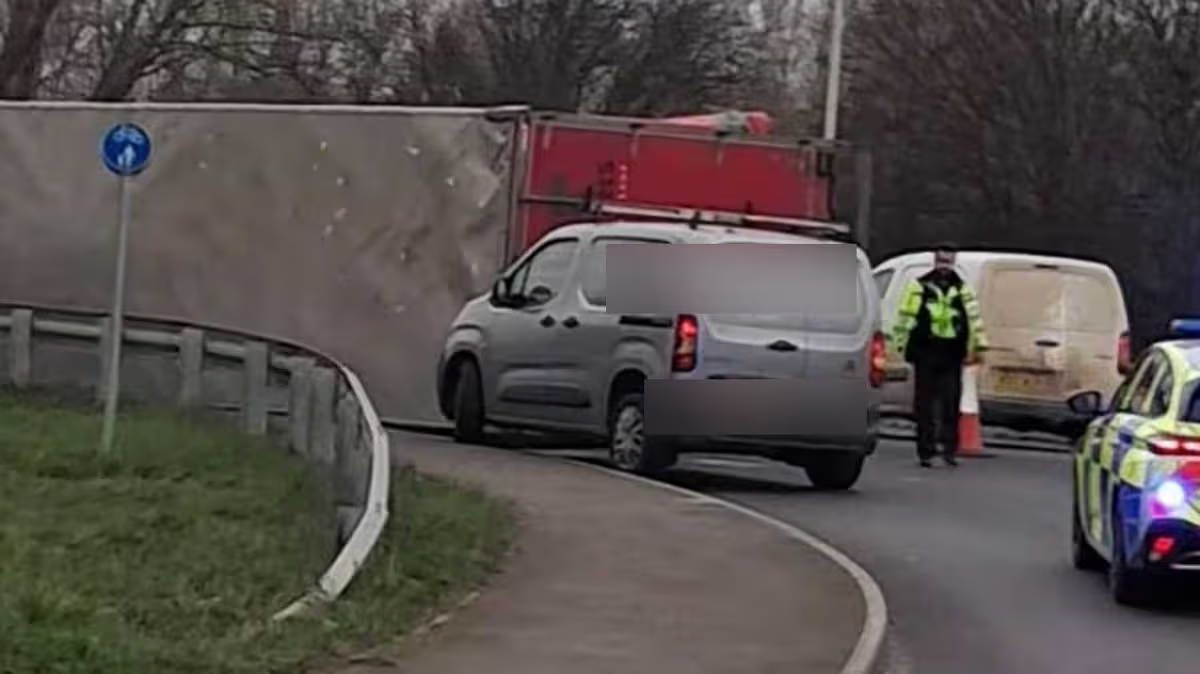
A major Cambridgeshire road has been closed after a lorry overturned at a roundabout. Police were called at around 6.30am today (March 24) to reports of an overturned lorry on the A47 roundabout near Guyhirn.
Advertisement
Officers attended and are assisting with a road closure on the roundabout, which connects the A47 to the A141, while the vehicle is recovered. Cambridgeshire Police has confirmed that there were no injuries.
A spokesperson for Cambridgeshire Police said: “We were called at 6.27am to reports a lorry had overturned on the A47 roundabout near Guyhirn.
“Officers attended and are assisting with a road closure on the A141 while the vehicle is recovered. We advise motorists to avoid the area. No injuries were sustained.”
Traffic monitoring site, Inrix said: “A47 Westbound closed, queueing traffic due to accident, an overturned vehicle involved from A141 March Road (Guyhirn Roundabout, Ring’s End) to B1167 Wisbech Road (Thorney).”
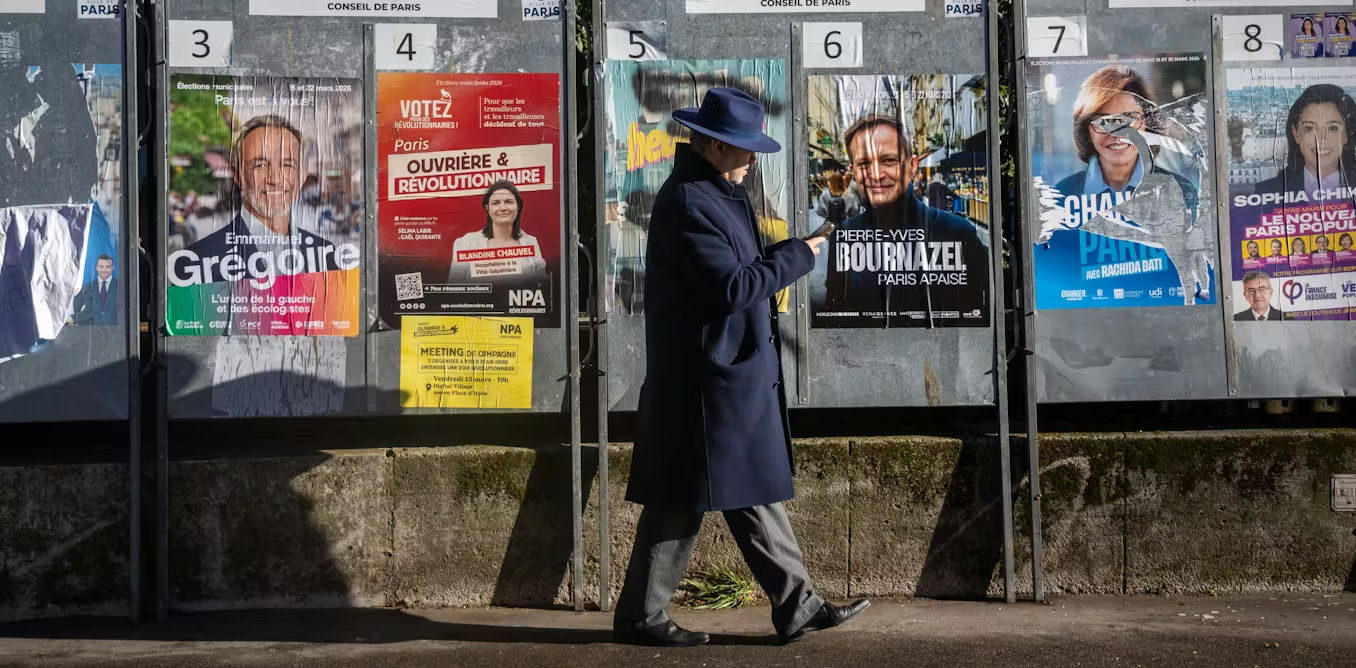
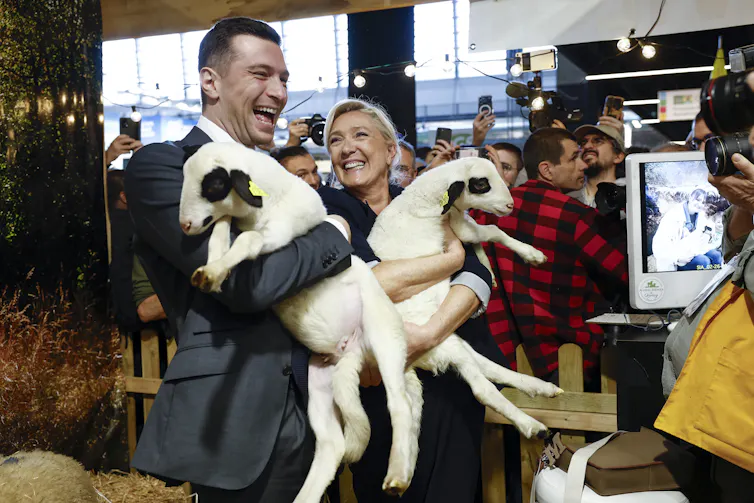
Despite achieving historic scores and taking control of over 60 municipalities in the French local elections, the far-right Rassemblement National (National Rally, RN) will be disappointed by its failure to make a breakthrough in the larger towns and cities. The headlines coming out of France after the second round of elections on March 22 tell of the resilience of the mainstream centre left and centre right, whose candidates held on to every major city hall in the country.
The two parties that dominate France’s political extremes – the far-right RN, led by Marine le Pen and Jordan Bardella, and Jean-Luc Mélenchon’s far-left La France Insoumise (France Unbowed, LFI) – made some gains in smaller towns. But they failed to capture a single one of the large cities.
This matters because France goes to the polls again in 2027 to elect its next president. The local elections were widely seen as a dress rehearsal – and the results expose the limits of both parties’ strategies. For the RN, the failure to break through in cities such as Marseille and Toulon — combined with the refusal of the centre-right Les Républicains (LR) to enter into alliances with RN candidates — shows that, for the far right, the path to the Élysée Palace remains highly complicated.
For LFI, a similar inability to translate national prominence into local power raises questions about Mélenchon’s capacity to unite the left ahead of next year’s presidential campaign.
Advertisement
For the RN, the dream result would have been a win in Marseille. Capturing France’s second city would have been a massive statement of intent. After the first round of the local elections on March 16, however, a victory in the port city seemed unlikely – especially after the refusal of the centre-right candidate, Martine Vassal, to enter into any alliance with the RN.
‘Le grande confusion’: all sides have claimed victory, but there are no real pointers ahead of next year’s presidential election. France 24 screenshot.
Vassal’s decision is emblematic of one of the big lessons of these elections: the centre-right LR has resisted the temptation to ally itself with the far right, even where doing so might have delivered local power. The centre-left mayor of Marseille, Benoît Payan, drew his own red line, refusing to merge his electoral list with LFI. He still held on to his job comfortably, winning 54% in the second round, well ahead of the RN’s Franck Allisio on 40%. The double refusal in Marseille – the centre right rejecting the far right, the centre left rejecting the radical left – encapsulates the resilience of the political mainstream in France’s major cities.
Battle for credibility
While taking Marseille was always going to be a long shot, the RN had invested heavily in winning back another important port city on the south coast: Toulon. This is the city where in 1995 the party, then called the Front National (FN) and led by Marine Le Pen’s late father, Jean-Marie, made a historic breakthrough, taking control of the council. This was the first time the far right had captured a major French city since the second world war.
Advertisement
But the FN mayor, Jean-Marie Le Chevallier, endured a disastrous time in office. He fell out with his own city councillors and in 1999 ended up quitting the party after a spat with Le Pen (père). The failure to manage Toulon city council (Le Chevallier scored less than 8% when he was up for reelection in 2001) became an albatross around the party’s neck for many years to come.
As we have argued in our research on the RN in local government, overcoming this reputation for incompetence has been an important goal for all the party’s mayors elected since 2014. Recapturing Toulon would have been highly symbolic. But the RN candidate (and current MP) Laure Lavalette, despite leading after the first round, eventually fell short with 48% in the runoff against centre-right incumbent Josée Massi.
The result shows the enduring power of the front républicain: the tactical alliance of voters from across the political spectrum to keep out the far right.
No clear path to victory: RN leader Marine le Pen and party president Jordan Bardella campaigning in Paris, February 2026. EPA/Yoan Valat
Nevertheless, RN supporters could console themselves with some important victories in smaller towns across the south including Carcassonne, Menton and Orange – another municipality originally captured by the party in 1995. The RN also held on to the vast majority of the towns it was already governing, several of which it won outright in the first round. This includes Perpignan, still the largest town run by the party. In these established strongholds, RN mayors have worked to normalise the party’s reputation and professionalise its approach to local governance.
The success of this strategy is shown by the re-election of the longstanding mayor of Hénin-Beaumont, Steeve Briois, with a commanding 78% of the vote in the first round. His success seems to have had a kind of “coattail effect” across the former coal mining basin in France’s far north – with RN victories in a number of neighbouring towns. The consolidation of a solid block of RN-run municipalities in northern France, alongside those in its traditional heartland of the south-east, is one of the most striking outcomes of these elections.
Advertisement
Signs of things to come?
Yet arguably the most significant result for the far right came in a battle between former allies on the centre right. In Nice, France’s fifth-largest city, Éric Ciotti – who broke with the centre-right LR in 2024 to ally himself with the RN ahead of the legislative elections – defeated his former mentor, the outgoing mayor Christian Estrosi.
Ciotti’s victory raises an uncomfortable question for LR. Even as the party nationally held the line against allying with the far right, one of its most prominent former figures has demonstrated that crossing that line can be electorally rewarding. Whether Ciotti’s path remains an isolated case or becomes a template for other ambitious centre-right politicians will be one of the key dynamics to watch as the 2027 presidential campaign takes shape.
These local elections confirm that the RN’s road to the Élysée runs through a France that is not yet willing to hand over the keys. However, the cracks in the adherence of some significant political figures to the front républicain, cracks which became visible in Nice, even if not yet spreading to voters at large, suggest that “not yet” may not necessarily mean “never”.
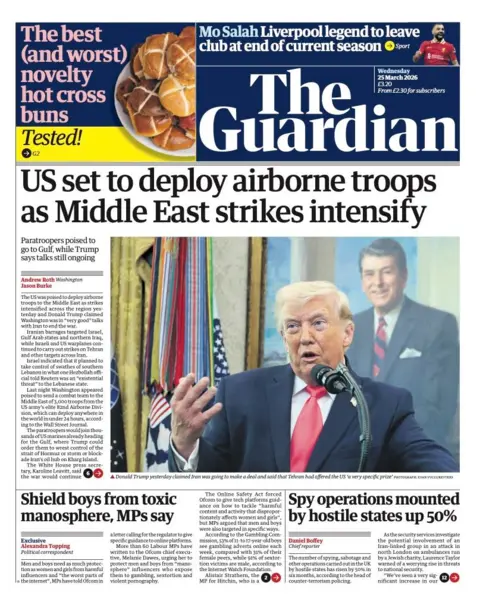
Paratroopers are “poised to go to the Gulf”, the Guardian reports, as talks remain ongoing between the US and Iran. According to Donald Trump, Washington was in “very good talks” with Iran to end the war, the paper says. Meanwhile, “Iranian barrages targeted Israel, Gulf Arab states and northern Iraq”, the paper says.
It’s hoped that the location will make pick up and drop off easier for parents
The opening of a new school-based nursery is set to offer families in and around Orton more opportunities to take advantage of accessible and affordable childcare. The new nursery will be based within St John’s Church School at Riseholme. The expectation is that it will open when the new school year starts in September 2026.
Advertisement
Funding for this new nursery has been provided by Best Start in Life, an initiative by central government which aims to support working families and improve access to early education. Across the country, more than 300 schools have been successful in securing a share of £45 million funding to build or expand nurseries on their sites.
Sam Carling, MP for North West Cambridgeshire, welcomed the news. He said: “Access to affordable childcare is one of the biggest challenges many families raise with me locally.
“That’s why it’s really positive to see the Government investing in Orton to expand nursery provision and create more places close to home.”
School-based nurseries are designed to make daily routines easier for families by reducing the need for multiple drop-offs and pick-ups. The hope is that this approach will help parents who may otherwise be struggling to return to – or remain in – work.
Advertisement
Mr Carling agreed that creating additional nursery places close to home should be a more effective way of helping parents manage their busy working lives while also ensuring children enjoy access to high-quality early education from a young age.
“School-based nurseries can make a genuine difference,” he said, “helping parents balance work and family life, simplifying the school run, and ensuring children get a strong start in their early years.”
It is believed more than a million parents are now taking advantage of government-funded childcare support. Alongside new nursery places, eligible families can also benefit from up to 30 hours of funded childcare.
Mr Carling said that, as well as funded childcare hours, central government was aiding families by offering additional support, such as free breakfast clubs and action to reduce the cost of school uniforms.
Advertisement
“Together, these steps are about easing the pressure on household budgets and making sure children growing up here have every opportunity to thrive,” he said.
What’s in store for you today? (Picture: Metro.co.uk)
The Sun in Saturn is aligned with Pluto, creating a sensible cosmic blend. Dedication comes easily today, so make the most of this.
Taurus, Cancer and Virgo, you may feel you are finally being seen for who you are. Hard work pays off, so keep persisting.
Don’t let the serious tone of the day stop you from enjoying the possibilities that this placement brings. Rely on your drive, and you will prosper.
Ahead, you’ll find all star signs’ horoscopes for today: Wednesday March 25, 2026.
Advertisement
Like checking your horoscope every morning?You can now sign up to our free daily newsletter to get a personalised reading for your star sign delivered straight to your inbox.
As the Sun merges with Saturn in your sign, your confidence in your authority can be enhanced. You’re no longer proving yourself; you’re defining yourself. Responsibility is a better fit for you than expected. Aligned with Pluto, your personal decisions ripple outward, reshaping friendships, networks, and long-term goals. You’re fast becoming someone completely new.
Something quiet but powerful is shifting beneath the surface. You’re releasing old fears, habits, or self-limits that no longer serve you, and inner work connects directly to your future direction. What you let go of now creates space for greater recognition later. For now, reflection is productive, and you’ll come up with strategies that both build and restructure.
You’re being asked to commit to goals, friendships, or plans that have staying power. No more scattered enthusiasm, as your influence within groups now grows quietly but powerfully. People will listen when you showcase your leadership qualities. You’re learning which ideas are worth using and which are just conversations. Think long term and collaborate wisely.
Career matters demand maturity, boundaries, and a clearer sense of authority. You’re being taken seriously now, even if it feels slightly daunting. It means shared responsibilities, and you’ll find issues around power also evolve fast. What you create must be honest, not habitual. You don’t need to please everyone; just choose what you want to work at long-term
The Sun-Saturn merger in Aries suggests your beliefs, plans, or big dreams require commitment. You’re learning that confidence grows stronger when backed by discipline. Aligned with Pluto in Aquarius, partnerships and collaborations reshape how you see your future. Power comes from shared vision, so connect with those who challenge you to mature.
You’re being asked to take something seriously, and you’ve already sussed where the weak points are. Daily habits and work patterns are transforming from the inside out. Small changes have powerful consequences now. Your intense focus can be inspirational rather than pouring on pressure. Streamline what drains you and invest in what truly matters, and you’ll skyrocket.
Cosmic messages for Cosmic messages for Virgo today
Libra
September 24 to October 23
Relationships step into serious territory with the Sun in Aries blending with Saturn, so commitments need clearer terms, stronger boundaries, and honest effort. This isn’t about romance losing sparkle, it’s about making it real. With Pluto in the mix, love, creativity, or collaboration shift profoundly. You’re learning what equality means, not just what looks fair.
Does your life need a smarter structure? What you’re aiming for is discipline with purpose, as it will refine outdated work habits. Home life or emotional foundations are transforming too. Old patterns won’t support the future you’re building. You’re learning that power comes from consistency, not intensity alone. Small changes can have a lasting impact on efficiency.
Today’s first Sun-Saturn tie in Aries for 29 years means creativity, romance, or personal projects ask for commitment, not just enthusiasm. Leisure and hobbies become meaningful when you show up consistently. Allied with Pluto, conversations, learning, or personal stories carry power. Your words shape futures, including your own. Choose what you create and communicate with firm intention.
Foundations are under renovation as home or family demand more attention and sound decisions. This is about responsibility that engages with your feelings, not about duty alone. Finances, values, or self-worth are evolving alongside these changes. What you build now needs to feel secure. You’re learning that true authority starts at home, within yourself.
A serious line-up today suggests your choices and commitments are a major focus. What you say now shapes reality, so speak with intention. This is also a time when personal reinvention accelerates. Old versions of you quietly retire as authority grows from authenticity. Discipline becomes a creative tool, not a cage. You’re learning how to steer without explaining yourself.
Reality is calling, and it’s kinder than you expect. With the Sun associating with Saturn, money, priorities, and self-worth need a clearer structure. This is about valuing yourself enough to be consistent. Aligned with Pluto, deep inner shifts support this practical reset as old fears around security lose their grip. You’ll find discipline can be steadying, not limiting.
Your daily Metro.co.uk horoscope is here every morning, seven days a week (yes, including weekends!). To check your forecast, head to our dedicated horoscopes page.
As a loyal Metro reader, we want to make sure you never miss our stories when searching for your news. Whether it is the latest politics news explained, live football coverage or a showbiz scoop.
Advertisement
Click the button below and tick Metro.co.uk to ensure you see stories from us first in Google Search.
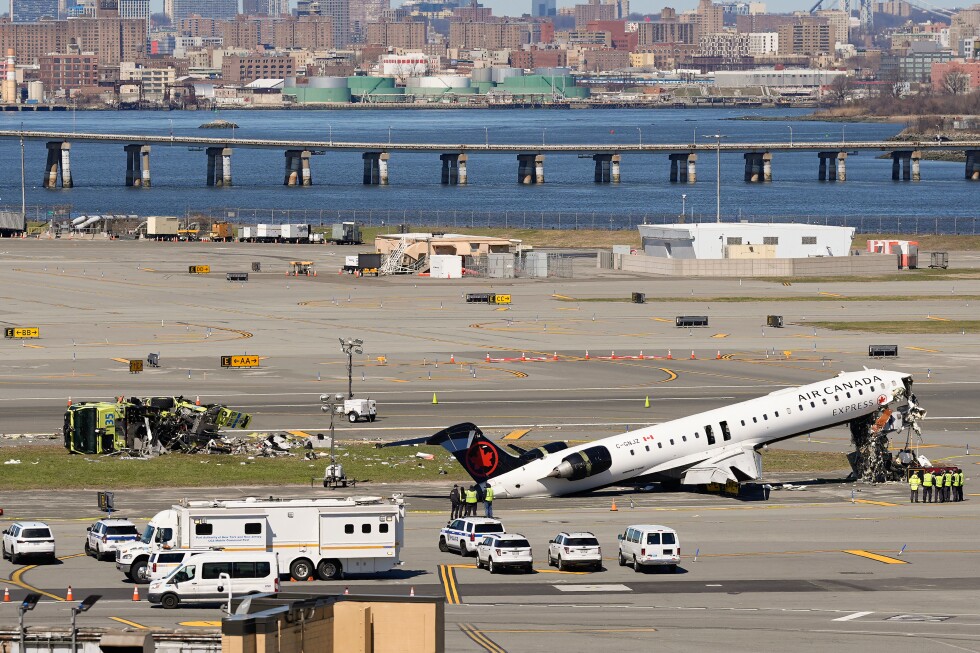
The pilots killed in Sunday’s collision between a plane and a fire truck on a runway in New York were two young, ambitious Canadian men that had long dreamed of becoming pilots.
Mackenzie Gunther and Antoine Forrest were operating the Air Canada jet that was landing at New York’s LaGuardia Airport on Sunday when it collided with a fire truck. Officials still haven’t identified the two men publicly, but a family member who spoke to The Associated Press and a Canadian college that one of the men attended separately confirmed their identities.
About 40 of the roughly 70 passengers and crew members on the regional jet from Montreal, and two people from the fire truck, were taken to hospitals, some with serious injuries. Most were released by Monday morning, authorities said.
“These were two young men at the start of their careers,” FAA Administrator Brian Bedford told reporters Monday. “It’s an absolute tragedy that we’re sitting here with their loss.”
Advertisement
An investigation is underway into the cause. Federal officials said on Tuesday that a runway warning system failed to sound an alarm moments before the collision, and are looking into the role of the air traffic controllers and what they were doing while juggling a late night emergency involving another plane. The crash occurred during an already messy time at U.S. airports because of a partial government shutdown.
Here is what is known so far about both pilots.
Antoine Forest
Jeannette Gagnier, the great aunt of one of the pilots, identified him as Antoine Forest. Gagnier, who said that Forest looked to her as a grandmother figure, told AP that he always wanted to be a pilot. His LinkedIn page showed he had worked for two airlines the past five years.
Forest’s Facebook page said that he was from Coteau-du-Lac, a small city in southwestern Québec. The mayor of Coteau-du-Lac, Andrée Brosseau, offered condolences to Forest’s family in a translated post on Tuesday from French.
Advertisement
“Antoine was one of our own. In a community like ours, everyone knows someone who knew him. His passing represents an immense loss for our entire community,” Brosseau wrote.
Antoine’s brother, Cédric Forest, shared a picture of his brother and him when they were kids. “Have a safe flight, my brother! Oh yes, we’ve often heard that phrase, but this time will be the last,” he wrote on Facebook. “You were coming and going in the wind, always full of new projects in mind. Gone again in the wind too soon to say goodbye I love you brother you can leave with your head held high.”
A woman who said she is Forest’s girlfriend and also a young pilot shared a photo of the couple on her Facebook account on Tuesday captioned “the love of my life.”
Mackenzie Gunther
Toronto college Seneca Polytechnic said in a statement on Tuesday that Mackenzie Gunther graduated from its Honors Bachelor of Aviation Technology program in 2023.
Advertisement
He joined the Jazz Aviation Pathways Program, a training program operated by Air Canada, immediately after graduating. The flight that crashed on Tuesday was a Jazz Aviation plane operating on behalf of Air Canada.
“Seneca sends our deepest condolences to Mr. Gunther’s family and friends, and to his former colleagues and professors. He will be deeply missed,” the school’s post said.
The school lowered its flags to half-staff to honor Gunther on Tuesday.
Some have said it was a miracle that more people weren’t hurt, and at least one passenger Clément Lelièvre credited Gunther and Forest’s “incredible reflexes” with saving his life and those of others. The pilots braked extremely hard just as the plane touched down, he said.
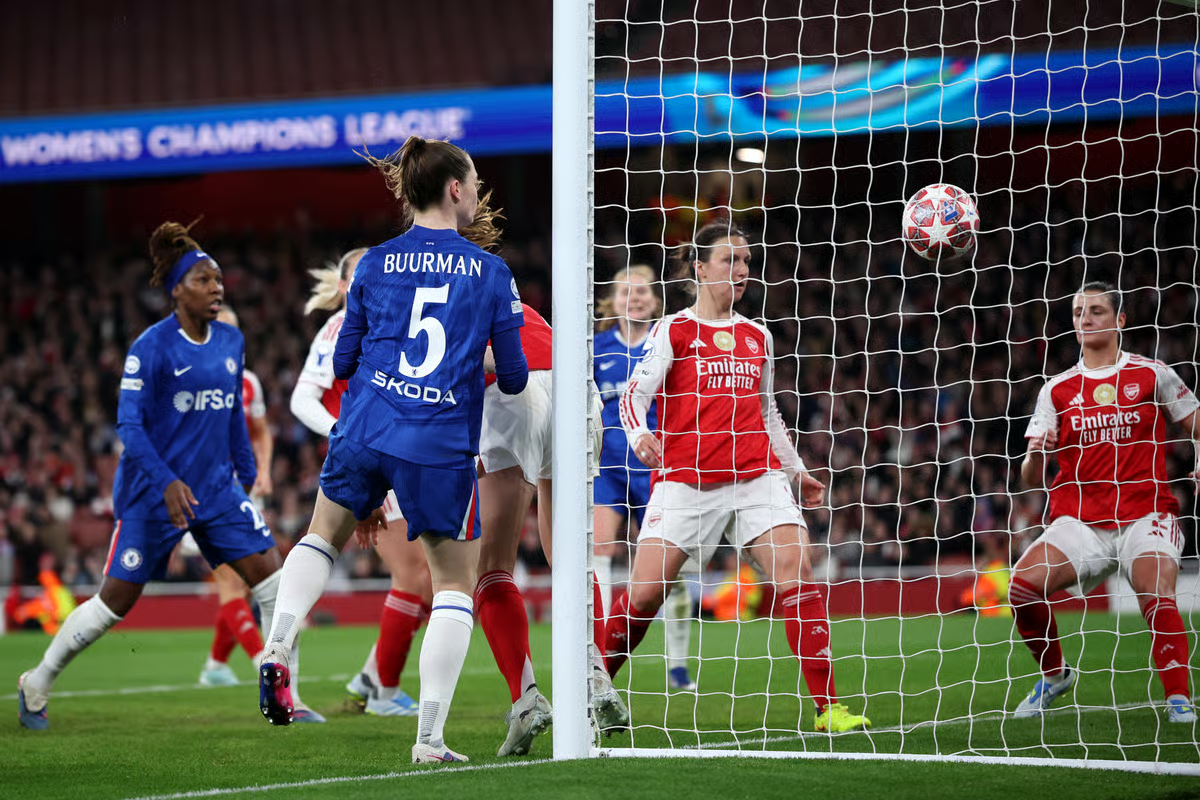
Asked what the fourth official told her after Buurman’s header was chalked off, she replied: “Nothing! Nothing, it is always the same. You go to them and ask them to check the situation and make sure they made the right decision, they just always say ‘we are checking’, but they make the wrong decision.















































You must be logged in to post a comment Login