Connect with us

NewsBeat

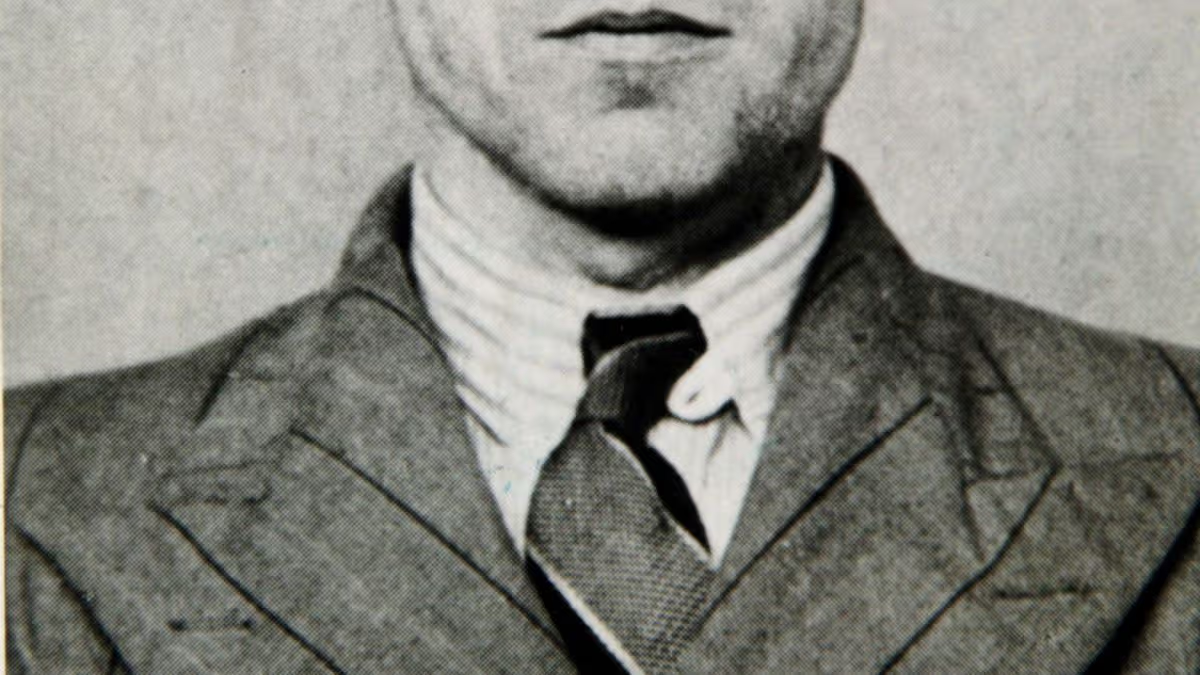
Glasgow razor killer ‘Fiend of the Gorbals’ gouged, slashed and stabbed innocent victims

Published

on

Daily Record

A Scots killer who developed an insatiable appetite for violence gouged, slashed, and stabbed innocent victims with a razor.

Patrick Carraher became the second man hanged at Barlinnie prison as a result of his sickening crimes. The blood-thirsty criminal terrorised the streets of Glasgow with a razor blade which he concealed menacingly in his hand.

The nicknamed “Fiend of the Gorbals” was born in 1906 into a working-class family. He developed a hefty appetite for street fighting from a young age and was sent to a borstal – a type of youth detention centre – aged just 14.

His first experience of imprisonment didn’t set him on the straight and narrow, though. He spent the rest of his life in and out of Scottish prisons while causing bloody mayhem on the streets as a free man.

Advertisement

In 1938, Carraher stabbed 23-year-old James Emden but served just three years behind bars after he was convicted of culpable homicide. Every stint as a lag only made him more of a hardened criminal and he began using violence to maintain his tough exterior and lifestyle.

In fact, he revelled in his time in jail where knife was crime was the norm, and razor slashing became his terrifying act of choice.

Advertisement

Writing in his book Killers, Crooks and Cons: Scotland’s Crimes of the Century, Reg McKay, Daily Record journalist and Scottish author wrote: “By 1938, aged 32, he had stabbed, slashed and gouged his way through life.

“More often than not, the victims were hapless, innocent bystanders. Worse, he had developed a serious booze problem, making his temper simmer constantly.”

Carraher got banged up in Barlinnie just as World War II broke out and Glasgow was safer without his trail of destruction. But when the war ended in 1945 and he was let out, it was clear his violent reign was far from over.

His final act of terror was on 23 November 1945, when he murdered soldier John Gordon during a drunken fight.

Advertisement

Gordon had returned home and was having celebratory drinks at a Glasgow pub with his brothers when he had an argument with Carraher’s right-hand man Daniel Bonnar – who was also the brother of The Fiend’s girlfriend.

The soldier fled the scene but the two thugs tracked him down looking to settle the feud and things quickly turned into a horrifying street fight.

McKay wrote: “When the fight started, Bonnar once again ran but Carraher simply reached out and punched John Gordon in the neck. Well, that’s what it looked like.

Advertisement

“But as people, including his own girlfriend would later testify, Carraher had slipped a razor sharp chisel into his pocket as he left home.

“He hadn’t punched John Gordon but plunged the blade into his neck. The man died in hospital in less than an hour.”

The Daily Record covered the trial in 1946 which saw Carraher accused of killing Gordon. He denied the charges. We reported that Carraher sat in the dock and “turned frequently to smile at two women in the public seats”.

Advertisement

The defence tried to argue that the two-inch long chisel blade could not have produced a wound of four inches deep. They also tried to bring in doctors to say he was psychopath, claim diminished responsibility and hope for a lesser sentence. But it wasn’t enough and the jury took just 20 minutes to find The Fiend guilty.

Advertisement

A total of 10 judicial executions by hanging took place at HMP Barlinnie, replacing the gallows at Duke Street Prison before the death penalty was eventually abolished in the UK in 1969.

In 1946, Carraher was hanged there and by that time he had spent almost half his life locked away for his harrowing crimes.

Many Scots believed that The Fiend of the Gorbals should never have been freed to roam the streets of Glasgow after his first run-in with the law.

Get more Daily Record exclusives by signing up for free to Google’s preferred sources. Click HERE.


Advertisement

Source link

Continue Reading
Click to comment

You must be logged in to post a comment Login

Leave a Reply

NewsBeat

Laver Cup: Carlos Alcaraz saves match points as Team Europe take lead

Published

on

Carlos Alcaraz raises his arms in celebration

Two-time Wimbledon champion Carlos Alcaraz narrowly avoided back-to-back singles defeats for the first time in 18 months as Team Europe took a 7-5 lead over Team World at the Laver Cup.

The world number three saved two match points before overcoming Taylor Fritz 6-3 4-6 13-11 in a dramatic deciding tie-break at London’s O2 Arena.

It was Alcaraz’s first singles outing since his late-night quarter-final exit to Ben Shelton at the US Open.

“The drop shot is part of my game,” Alcaraz said after sealing victory with a trademark touch.

Advertisement

“In those really close and important moments, I tried to use it because it was a really good weapon for me in this match.”

American Fritz, whose only previous victory against the Spaniard came during Team World’s triumph in last year’s competition, kept errors to a minimum.

However, Alcaraz struck 42 winners to Fritz’s 20, bringing an audience that included Roger Federer and Andy Murray to their feet.

Facing match point at 8-9 down in the tie break, Alcaraz fired an ace before leaning on a drop shot to stave off a second. He converted his third match point when Fritz failed to retrieve another delicate drop shot over the net.

Advertisement

Earlier on Saturday, Andre Agassi’s Team World had threatened to run away with things.

Alex de Minaur fought back from a set down to shock Alexander Zverev 2-6 7-6 (7-5) 11-9, while American debutant Learner Tien edged Italy’s Flavio Cobolli 6-3 2-6 10-7.

Following Alcaraz’s singles heroics, Zverev returned to the court alongside Casper Ruud to secure an important 6-4 7-6 (9-7) doubles victory over Alexander Bublik and Brandon Nakashima, keeping Europe ahead going into the final day.

Match wins are worth three points on Sunday, with the first team to reach 13 points lifting the trophy.

Advertisement

Europe are chasing their sixth Laver Cup title, while holders Team World are aiming for their third.

Source link

Continue Reading

NewsBeat

Labour at war over migrants and economy: Cabinet ministers trade blows on eve of Burnham’s crunch party conference… so is the PM’s honeymoon finally over?

Published

on

Andy Burnham pictured with his wife Marie-France van Heel in Liverpool on September 26. Labour descended into open warfare over immigration and the economy on Saturday night

Labour descended into open warfare over immigration and the economy on Saturday night, souring Andy Burnham‘s first party conference as Prime Minister.

Cabinet ministers are at loggerheads over a planned crackdown on migrant visas, while another grandee blasted the leadership for putting union demands ahead of economic growth.

The very public rows threaten to overshadow what Mr Burnham had planned would be a triumphant party conference, which gets under way in Liverpool on Sunday.

Those hopes took a blow when Angela Rayner doubled down on her criticism of Home Secretary Shabana Mahmood’s plans to make it harder for migrants to gain permanent residence in the UK, which she previously branded ‘un-British’. 

Advertisement

One Labour MP called the former deputy prime minister’s fresh intervention a ‘drive-by shooting’, while a senior party official told The Mail on Sunday: ‘It’s quite mad she’s chosen this moment to attack.’

The row deepened on Saturday when fellow Cabinet minister Lisa Nandy issued a stern slapdown of Ms Rayner by publicly backing Ms Mahmood.

Meanwhile, another MP suggested that Mr Burnham ‘remind [Rayner] of the benefits of keeping her mouth closed’.

Opening a separate front, former business secretary Peter Kyle accused the Prime Minister of not doing enough to boost growth.

Advertisement

Andy Burnham pictured with his wife Marie-France van Heel in Liverpool on September 26. Labour descended into open warfare over immigration and the economy on Saturday night

Angela Rayner, pictured in Liverpool on September 26, criticised Home Secretary Shabana Mahmood's plans to make it harder for migrants to gain permanent residence in the UK

Angela Rayner, pictured in Liverpool on September 26, criticised Home Secretary Shabana Mahmood’s plans to make it harder for migrants to gain permanent residence in the UK

He said Mr Burnham needed to act with ‘more urgency’ and should delay expansions to workers’ rights demanded by the party’s union paymasters that would tie businesses up in more red tape.

Advertisement

Mr Kyle, a close ally of Sir Keir Starmer, compared Britain’s ailing economy to a car ‘on a motorway driving in the right direction but only at 30mph’, adding: ‘Why wouldn’t we put our foot down and get there quicker?’

The bitter rows dividing the party come as:

  • Insiders say Mr Burnham is still planning a snap election, despite claims he had ‘bottled it’, claiming the PM’s promised ‘ten-year plan’ is a ‘Trojan horse’ for a manifesto;
  • Up to 100 MPs have joined a new group of rebels, led by former minister Darren Jones, who are ‘ready to pounce’ on Mr Burnham if his leadership falters;
  • Labour sources warned that Mr Burnham ‘doesn’t have the balls’ to face down union demands to ‘spend, spend, spend’;
  • Mr Burnham’s wife Marie-France van Heel quit her job as a senior marketing executive so she can support the Prime Minister full-time as an effective ‘first lady’.

Housing Secretary Ms Rayner fired the first shots of the civil war on Saturday by insisting the visa clampdown effectively ‘changed the goalposts’ for migrants already living in Britain, particularly those working in social care.

A senior party official suggested Ms Rayner intended her intervention to win her more support within Labour’s rank and file, as her profile was in decline since Louise Haigh became de facto deputy PM in July. 

The well-placed insider said: ‘She’s unhappy that she doesn’t have as much support as she did in her last stint – obviously because she isn’t DPM and that hasn’t sunk in. Her nose is out of joint with all the influence Lou has.’

Advertisement

Culture Secretary Ms Nandy sided with the Home Secretary on Radio 4’s Today programme on Saturday. She said Ms Mahmood was ‘taking great care… and she has the support of the Cabinet in doing so’.

As Labour’s internal strife played out, Tory leader Kemi Badenoch said: ‘If Andy Burnham’s Cabinet are already at war with each other over small changes to the immigration system, how can they ever be trusted to stop the boats?’

Meanwhile, Labour peer Lord Glasman, founder of the party’s Blue Labour movement, called for an end to the infighting.

He said: ‘I would expect all ministers to act within the framework of collective responsibility. It is clear that Shabana Mahmood’s approach is the right one.

‘People are rightfully concerned about illegal migration as well as the scale of legal migration. This government’s fate lies in whether it has the courage to confront that.’

Advertisement

But privately some party insiders expressed doubt that Mr Burnham has the resolve to back Ms Mahmood’s reforms. One said: ‘I’m afraid the Prime Minister strikes me as utterly confused.’

Further exposing divisions in the party, Ms Rayner received public support from Folkestone MP Tony Vaughan. He said she was ‘right’ to object to the changes, which would see new arrivals to the UK have to wait ten, or even 15, years to be granted indefinite leave to remain, up from the current five.

He said: ‘Why should workers on health and social care visas who have come here to look after our loved ones have to wait 15 years for settlement? It is economically and morally wrong and will damage our health and social care system.’

Mr Kyle’s critical comments on Mr Burnham’s economic agenda marked his first public intervention since leaving government.

Advertisement

He said that while Labour had ‘inherited a growth emergency’ from the Tories, he believes ‘that emergency persists’ two years on.

Mr Kyle said the Government must be willing to take decisions that involve ‘short-term’ pain in return for longer-term economic gain – including delaying the planned expansion of workers’ rights championed by Ms Rayner.

He argued: ‘We might need to look and have honest conversations with unions about how we sequence some of the rights… to make sure that we get growth into the economy in the shorter term.’

One of Labour’s big plans for an economic boost hit a major setback on Saturday night as it was announced that Heathrow’s third runway is likely to be delayed until 2039, four years later than first planned.

Advertisement
Privately some party insiders expressed doubt that Mr Burnham has the resolve to back Ms Mahmood's reforms (Pictured: Ms Mahmood on September 15)

Privately some party insiders expressed doubt that Mr Burnham has the resolve to back Ms Mahmood’s reforms (Pictured: Ms Mahmood on September 15)

Mr Burnham hoped to get his first conference as Labour leader back on track on Saturday night, with a new pledge to help people on to the property ladder.

The Prime Minister said October’s Budget will introduce a new equity loan scheme for first-time buyers, which mean they will require just a 2.5 per cent deposit.

The plan, akin to the Tories’ Help to Buy scheme, will provide a 20 per cent equity loan on new-build homes, with an initial interest-free period. The funding, Labour say, will come from ‘reprioritising existing government budgets’.

Advertisement

On an average first-time home costing £230,000, a buyer could put down a deposit of £5,750 and access a loan of up to £46,000.

Source link

Continue Reading

NewsBeat

Smaller trains, a planned cut to late night services, I don’t like the direction of travel Translink are on

Published

on

Belfast Live

There’s no point in having a £340m station in Belfast if train and bus services are going downhill

Advertisement

Belfast’s Grand Central Station epitomises what we want Northern Ireland to look like in 2026. It’s unquestionably an impressive symbol of the city, the kind of welcome you want tourists to get when their bus or train pulls into Belfast for the first time.

Compare it to the Dublin equivalent. Connolly Station is grubby, compact, located in a frankly undesirable part of the city, it’s somewhere to hurry in and out of.

Grand Central Station meanwhile cost an eye-watering £340 million to build with Marks and Spencer food outlet, several premium coffee outlets, a Brewdog and Boots. Bus and train stations are traditionally somewhere you don’t want to spend much time, but this is an exception. You can arrive early for your train and bus, and enjoy a pint or a coffee.

It’s also a world away from the creaking old Great Victoria Street Station. Gone are the days when you used to brave the wind and the rain at the height of winter waiting for a train home. With the proliferation of bays at Grand Central, train delays seem less common that they did before on the Lisburn line that I use to commute to the Belfast Live office.

Advertisement

But a direction of travel has been emerging over recent months and it’s taking us a less promising destination.

Translink, riddled in financial problems, has already said it needs to save £10m and the cutbacks include a cut to late-evening bus and rail services, between Mondays and Wednesdays.

As a snapshot of what that will look like, I attended the CMAT concert on Bank Holiday Monday in Custom House Square. If Translink get their way and the services finish at 10pm, I would have been looking at a taxi or a long walk home. Mind you, the hourly wait between trains on that Monday night wasn’t altogether impressive either.

If Belfast wants to be taken seriously as a nightlife destination, then cutting services on Ulsterbus, Metro and NI Railways isn’t an option.

Advertisement

The Portadown to Belfast railway line meanwhile is the busiest in Northern Ireland. Without doubt, the key times are the morning and evening rush hours. So why, since the schools returned in late August, has the quality of services in the morning peak taken a nosedive?

The least you expect when you turn up for a direct service to Belfast at rush hour is for the service to be as it says on the tin. Lisburn is the busiest station on the route, and yet on numerous occasions during September, passengers arriving for the 8.06am direct service to Grand Central Station have been told that the service has been reduced to just three carriages.

So either you attempt to scramble your way through the crush and squeeze your way onto the 8.06am, or take the alternative all-stops service. What’s the big deal you might ask? Well one service is scheduled to take nine minutes, the other is closer to half an hour. Standing room only is ok for nine minutes, half an hour, not so much.

Advertisement

It reached a nadir on Tuesday morning when passengers were told that they weren’t allowed to board the 8.06am train because it was already full.

The worrying thing has been the Translink reponses to my queries. No confirmation that this is a one-off, a warning that ‘on occasion’ the capacity of services will be reduced. Well unfortunately those occasions have been far too common for everyone’s liking so far since the schools returned.

I used the same service on Wednesday and Thursday and the relief was palpable among my fellow passengers when the proper service pulled in.

Sign up to Belfast Live’s daily newsletter here and get breaking news and top stories direct to your inbox.

Advertisement

Source link

Continue Reading

NewsBeat

Private helicopter crashes near Montreal killing all four people on board

Published

on

Private helicopter crashes near Montreal killing all four people on board

A helicopter has crashed in a small town outside Montreal in Canada, killing all four people on board.

Authorities said emergency services were called at around 2.30pm ET after the helicopter crashed in a field off Highway 10 on Saturday.

First responders said the helicopter was still on fire when they arrived at the site, located roughly 50km southeast of Montreal in Quebec province.

Audrey-Anne Bilodeau, a spokesperson for Sûreté du Québec provincial police, said the helicopter reportedly experienced difficulties before crashing in the municipality of Sainte-Brigide-d’Iberville.

Advertisement

The first responders found the crashed aircraft and later discovered the bodies of the four occupants. They were all declared dead at the scene.

Police said they have not yet confirmed the identities of the victims of the crash, with law enforcement still probing the cause of the incident.

Sergeant Bilodeau said the process of identification may “take a few days”. He said the helicopter seems to have been a private aircraft.

Canada’s transportation safety board has deployed a team for the investigation, which is being led by Sûreté du Québec’s major crimes unit.

Advertisement

Federal transport minister Steven MacKinnon offered his condolences in a post on social media.

“My thoughts are with everyone affected by this tragedy,” he wrote.

MacKinnon said that safety of civil aviation operations is a top priority for Transport Canada, adding that the federal government was monitoring the situation and would provide necessary support.

He also announced that Transport Canada would appoint a “minister’s observer” to monitor the response, provide the minister with investigation updates, and help identify regulatory issues or safety deficiencies.

Advertisement

Source link

Continue Reading

NewsBeat

Far too many people now swipe left – and it could spell the end of the world: SARAH VINE

Published

on

Society is suffering from a so-called 'romance famine', that is to say a difficulty for couples to form relationships, in part driven by modern swipe-left-for-no, right-for-yes dating app culture

My mother always used to say (usually when my brother or I had done something idiotic) that if people thought about having children for more than five minutes, humans would swiftly die out.

She’s right, of course. Having babies requires a blind, some might even say reckless, leap of faith, both in terms of the basic practicalities (house, money, education etc), but also emotionally.

Motherhood is a minefield, and thoroughly unpredictable, no matter how carefully you prepare for it (or think you’ve prepared for it). You realise quickly that if anything were to happen to this mewling bundle of dubious-smelling fluids, you would be devastated.

At the same time you are beset by a growing panic at the realisation that your carefree life, as you once knew it, is effectively over.

Advertisement

But it’s fine because Mother Nature, clever thing that she is, floods your system with the most powerful drugs known to mankind – hormones – thus ensuring the future of humanity.

For countless generations, this has been the way of the world. But not any more. People are starting to think twice before having babies, and it’s taking its toll.

The developed world, including Britain, is experiencing unprecedented low rates of reproduction. According to the Office for National Statistics, the UK birth rate is at a record low of 1.39 children per woman, and the figure for white Anglo-Saxon British women is even lower, at 1.1 (although the ONS also notes that mothers from other backgrounds, in particular those of Asian heritage, maintain significant rates, between 2.5 and 2.9 children per woman).

The overall cultural and social repercussions are clear. Large numbers of women deciding either not to have children at all, or having fewer, or having them late (the average age of new mothers in the UK is 31) has serious knock-on effects. For a population to remain stable, a ‘replacement rate’ of 2.1 children per family is required; we are a long way off that.

Advertisement

Society is suffering from a so-called ‘romance famine’, that is to say a difficulty for couples to form relationships, in part driven by modern swipe-left-for-no, right-for-yes dating app culture

The situation is so dire that one commentator, the crossbench peer Camilla Cavendish, has compared it to the Black Death. In her new book, Generation Maybe, she notes that a trend that began in the West has spread globally, with countries like China, Japan, Russia and even staunch Catholic nations such as Colombia and Italy reporting record low birth rates.

Perhaps we don’t need to worry about being wiped out by AI – we’re managing it all by ourselves. The question is, as Cavendish asks, why? And what can be done?

Advertisement

It’s clear that this is a problem that can no longer be deposited at the door of stroppy feminists or ‘have-it-all women’ (as has been the case in the past). There are other factors at play.

One is what Cavendish calls a ‘romance famine’, that is to say a difficulty – or maybe a reluctance – for couples, particularly men, to form committed relationships, in part driven by modern swipe-left-for-no, right-for-yes dating app culture (and, I would hazard, the proliferation of online porn).

This is an astute and accurate observation – although I would not say it’s an entirely new phenomenon, just a further iteration of an ongoing shift in attitudes.

When I was in my early 30s, for example, I was dumped by a man I had thought would be the father of my children. We were in what I believed was a long-term relationship; he had other ideas. With hindsight, I dodged a bullet.

Advertisement

But his actions might have deprived me of the chance to have children, had I not been lucky enough to meet and marry my ex-husband.

There are plenty of women of my generation who found themselves in similar situations, hence the rise in IVF treatments, which has tripled over the past 30 years as women come to motherhood later. The assumption that they are prioritising career is popular, but not always correct. In many cases it’s down to a lack of men willing to step up and commit.

Another factor Cavendish identifies is the rise in ‘greedy’ jobs, which are unstable, underpaid and make no concessions for the needs of a young family. This feeds into a general sense of economic and political uncertainty – and a growing feeling of pessimism, especially in the younger generation.

Only the other week my daughter suddenly announced that she wasn’t sure she was going to have children. When I asked her what had prompted this, she replied she had just listened to a podcast about AI, and had concluded that, given the impending jobs apocalypse, there was probably no point. I told her not to be silly – but in the back of my mind I wasn’t so sure.

Advertisement

If not AI, then climate change, or Russia invading… there are any number of things going on right now that would make me question the wisdom of having a child.

And when I think of the joy that my two have brought me over the years, and of how so very much they add to my happiness and general entertainment, that makes me very sad indeed. Without children there is no hope for the future, and sometimes hope is all we have.

Don’t pick on an emu!

A viral video of a man attempting to wrestle an escaped emu to the ground in Devon reminds me of one of my favourite episodes from history, Australia’s Emu War, in which the army attempted to cull 20,000 emus that were terrorising local farmers and destroying crops. Even though they used up 10,000 rounds of ammunition, fewer than 1,000 of the birds were killed, resulting in widespread ridicule for the mission’s commander, one Major Meredith.

Apparently the birds split into fast-moving formations of about 50-strong each, deploying guerrilla tactics to evade the bullets and outrunning the military vehicles at speeds of up to 30mph on rough terrain. Not such a bird-brain after all.

Advertisement

Traitors with talent

The new series of Celebrity Traitors boasts a stellar line-up: Ross Kemp, Richard E. Grant, Bella Ramsey, James Blunt, Miranda Hart, Michael Sheen – even Jerry Hall, left. These are people who have genuine talent and real careers in their respective fields, and not – as is so often the case these days with ‘celebrity’ line-ups – just a bunch of wannabes. There are also a very high proportion of actors – which will make for a more gripping show. 

  • The strongest indication yet that Andy Burnham will not call a snap election comes from the fact that his wife has given up her corporate job to be a full-time ‘first lady’. So much for all the briefing that she was less than impressed by the thought of life in Downing Street – she’s clearly got her bum in the butter and is loving every second of it. Roll on 2029. 
  • Poor Ed Sheeran, who has found out to his detriment who his friends really are. This extended to his cousin, Jethro Sheeran, who appeared on YouTube to explain why he, too, had stabbed his relative in the back. Branding Ed a ‘snake and a coward’ and claiming he was by far the more talented Sheeran, Jethro (who goes by the stage name of ‘Alonestar’) proceeded to subject viewers to a demonstration of his rapping ‘skills’. Whatever other worries Ed may face, I don’t think ‘Alonestar’ is one of them. 

What is it about Labour and booze? Tony Blair abolished licensing hours – and now Andy Burnham wants to bring back alcohol on the terraces. Do they hope people get so drunk they don’t notice the mess the country’s in?

Source link

Advertisement
Continue Reading

NewsBeat

York Crown Court backlog rises 8 per cent to 457 open cases

Published

on

York Crown Court backlog rises 8 per cent to 457 open cases

The court had 457 open cases as of June 30, 2026, up from 423 on March 31, 2026.

The rise in backlog at York Crown Court is part of a broader national issue, but not all courts are experiencing the same trend.


Recommended reading:

Advertisement

Out of the 68 crown courts in England and Wales, 29 reported a decrease in open cases during the second quarter of the year.

This is according to an analysis of Ministry of Justice data by the Press Association.

Thirty-eight courts, however, saw their backlog increase, while one remained unchanged.

The largest numerical increases were seen in London-based courts: Snaresbrook, Isleworth, and Woolwich, with Newport Crown Court on the Isle of Wight experiencing the most significant percentage increase, at nearly 19%.

Advertisement

Some courts have managed to cut their backlog significantly.

Gloucester and Manchester Minshull Street courts reduced their backlog by more than 10% between March and June 2026.

Another 11, including Cambridge, Carlisle, Derby, Great Grimsby, Guildford, Kingston Upon Thames, Luton, Mold, Newcastle Upon Tyne, Salisbury, and Worcester, cut their backlog by between 5% and 10%.

The backlog of cases in crown courts has been a growing concern.

Advertisement

Source link

Continue Reading

NewsBeat

Host Jalen Brunson brings the Knicks to premiere of ‘SNL,’ with many nods to team’s NBA title run

Published

on

Host Jalen Brunson brings the Knicks to premiere of 'SNL,' with many nods to team's NBA title run

Jalen Brunson brought four of his NBA champion teammates to “Saturday Night Live.”

The reigning NBA Finals MVP had four of his New York Knicks teammates — Karl-Anthony Towns, Mikal Bridges, O.G. Anunoby and Josh Hart — in the audience for his monologue Saturday night, in his role as host of the NBC program’s 52nd season premiere.

Brunson poked fun at how he’s not going to sing, how ESPN’s Stephen A. Smith — a Knicks fan, portrayed during the monologue by longtime “SNL” star Kenan Thompson — owed him an apology for questioning his abilities, and even quipped about how much he’s looking forward to getting back to the Knicks’ home court at Madison Square Garden.

“The exact spot where Taylor and Travis got married,” Brunson said, referring to the wedding of Taylor Swift and Travis Kelce at the team’s arena.

Advertisement

But the best assists came from Towns, Bridges, Anunoby and Hart, who all asked Brunson questions as part of the monologue.

Towns asked if someone can foul out of “SNL.” When told it’s not possible, Towns said, “so I can be here, like, the whole show? Nice.”

Bridges asked Brunson if his arms were long, but lamented that he’ll never fly. Anunoby, who got a huge ovation, asked Brunson if he recalled missing a shot late in Game 4 of the NBA Finals against San Antonio — a series that the Knicks won in five games.

The Game 4 shot that Anunoby was referring to was a last-second tip-in — off a Brunson miss — that basically ensured the Knicks would win the game.

Advertisement

“That was awesome,” Anunoby said.

Hart — who co-hosts a podcast with Brunson — asked his Villanova and New York teammate about how he left $113 million on the bargaining table when signing with the Knicks. Brunson, in turned, asked why Hart poked Brunson in the backside when the Knicks won the NBA Cup last season.

Brunson then brought his teammates to the stage for one last roar from the crowd.

Brunson became the first active NBA player to host the show since LeBron James — then of the Cleveland Cavaliers — in 2007 and the first pro athlete in the role since Kelce, the Kansas City Chiefs tight end, in 2023.

Advertisement

The other NBA players to host besides Brunson and James: Michael Jordan in 1991, Charles Barkley on four occasions (including one as an active player in 1993) and Bill Russell in 1979. Russell’s stint came 10 years after he retired as a player.

Brunson, Jordan, Barkley and James all hosted season-premiere episodes of “SNL.” And Brunson promised late heroics, just like what he delivered in crunch time of the Knicks’ games in the title series against the Spurs in June.

“I’m going to approach this the same way I approach a Knicks finals game,” Brunson said. “The first three quarters of the show are going to be god-awful. The last sketch is going to be amazing.”

___

Advertisement

See AP’s full NBA coverage here

Source link

Continue Reading

NewsBeat

Kevin Sinfield route and timings for York MND challenge

Published

on

Kevin Sinfield route and timings for York MND challenge

Sir Kevin will arrive in York on Monday (September 28) for the second day of his final ‘7 in 7’ challenge, in which he will try to complete an ultra-marathon every day for seven days.

It will be Sir Kevin’s seventh endurance challenge, inspired by former Leeds Rhinos team-mate Rob Burrow, who died in 2024 after living with MND for four-and-a-half years.

He will start at Hull KR and will take in the other 11 English top-flight rugby league grounds before concluding at Old Trafford in time for the Super League Grand Final on October 5.

Kevin Sinfield after crossing the finish line outside York Minster (Image: Danny Lawson/PA Wire)

Sir Kevin, 46, who has already raised more than £11 million for MND causes, will set off for York from Shiptonthorpe, near Market Weighton, at 8.40am on Monday.

Advertisement

He is due to follow the A1079 to Pocklington, calling at the Old Forge Tea Rooms in the town at 9.11am.

The emotional moment Kevin Sinfield carried Rob Burrow aross the finish line of the 2023 Rob Burrow Leeds Marathon (Image: Danny Lawson/PA Wire)

Sir Kevin will set off from the tea rooms at 9.40am and continue along the 1079 to the University of York.

He will head along Hull Road where he will be cheered on by school children before turning onto Yarburgh Way, Crossways, Sussex Road, then take Field Lane to Heslington before travelling along Main Street.

He is due to arrive at the University of York athletics track, off Newton Way, at 12.15pm.

Advertisement

The Princess Royal, the MND Association’s Royal Patron, is due to meet Sir Kevin at the university.

Sir Kevin will set off from the university at 12.40pm for the LNER Community Stadium where he is expected to arrive at 1.15pm to visit York Knights.

He will run through the university’s campus, then along University Road and Green Dykes Lane, Melrosegate, turn onto Starkey Crescent, then Fourth Avenue, Tang Hall Lane, Walney Road and Heworth Village to Hempland Lane.

Advertisement

Sir Kevin will cross Stockton Lane and follow Woodlands Grove, turning onto Westlands Grove, then Straylands Grove, before heading to the stadium via Malton Road.

From the stadium, Sir Kevin will set off at 1.40pm to run to Bishopthorpe Palace via York city centre.

Kevin Sinfield at York Racecourse (Image: Richard Sellers/PA Wire)

He is due to run back along Malton Road, then Heworth Green, Monkgate and Goodramgate.

The athlete will pass York Minster in Deangate, continuing to Duncombe Place, Museum Street, then cross Lendal Bridge and turn onto Station Rise passing the Grand Hotel, onto Tanner Row.

Advertisement

Sir Kevin will continue along Toft Green and pass through Micklegate Bar then turn onto Nunnery Lane.


Recommended reading:


He will turn onto Bishopthorpe Road and continue along the road until turning off for Campleshon Road and head to York Racecourse.

He is due to arrive at York Racecourse, which named a race after his 7 in 7 challenge during the Ebor Festival, at 2.17pm.

Advertisement

Sir Kevin will leave the racecourse at 2.40pm then head to Bishopthorpe Palace following Bishopthorpe Road.

He is expected to arrive at the palace at 2.55pm.

On Tuesday, Sir Kevin will set off from Bishopthorpe for Wakefield.

Advertisement

Source link

Continue Reading

NewsBeat

Iran says it will wait for official US response after Trump rejects Strait of Hormuz proposal

Published

on

President Trump holds an umbrella as rain drops fall around him. He wears a dark suit and a white baseball cap with USA written on the front and an American flag on the side.

Iran has said it will wait for an official response from US negotiators after President Donald Trump rejected a proposal to reopen the Strait of Hormuz to commercial shipping within seven days.

In a post on Telegram, Iranian Foreign Minister Abbas Araghchi acknowledged Trump’s rejection, but accused the president of previously making contradictory statements.

Earlier, Trump told reporters at the White House that Tehran’s proposal was not “acceptable” and that they wanted to make a deal to open the strait immediately because “they’re losing so badly”.

On Friday at the UN, Araghchi told reporters that an agreement could be reached if “necessary conditions are met” between the two countries.

Advertisement

Araghchi said the conditions to open the strait were the same that had been included in a memorandum of understanding between the US and Iran that was signed in June.

Iran said it had raised reopening the strait and ending hostilities during negotiations on the sidelines of the UN General Assembly in New York this past week.

The vital waterway through which around a fifth of the world’s gas and oil supply usually flows has been effectively closed since the outbreak of war in February.

“I’m rejecting their deal,” Trump said on Saturday, adding that the US already had “total control” of the strait, with “massive amounts of oil” passing through it.

Advertisement

Araghchi wrote on Telegram that Trump “has made many good statements, as well as many contradictory ones, which unfortunately we hear frequently”.

“We are waiting for the mediators to convey the definitive views to us, and we will make a decision based on them,” Araghchi said.

Oman, which has been acting as a mediator between the US and Iran, called for all parties to continue having open dialogue to resolve the crisis.

Oman’s foreign minister, Sayyid Badr bin Hamad bin Hamood Albusaidi, told the UN General Debate that “all parties” should cooperate with Oman in efforts to safeguard navigation in the strategic waterway.

Advertisement

Trump’s rejection of Iran’s proposal was backed by the US ambassador to Nato, Matthew Whitaker.

Speaking to Fox News on Saturday, Whitaker said that Iran had offered “half measures” and “illusory deals to make themselves look good on the world stage”.

“President Trump’s right to reject it,” he said.

Meanwhile, Treasury Secretary Scott Bessent said on Saturday that economic pressure from the US was taking a toll on Tehran.

Advertisement

Posting on X, Bessent said Turkey, Oman and the United Arab Emirates had halted flights from various Iranian airlines, and some banks in the UAE and Turkey had stopped transactions with Iran.

The Trump administration has dubbed an economic blockade on Iran as “Operation Economic Outcast”, and is using sanctions to pressure Tehran to stop attacks on vessels in the Strait of Hormuz.

But some economists have questioned whether the latest sanctions will be effective, as this depends on the reaction from Iran’s major trading partners.

These include China, the biggest buyer of Iranian oil, which has ignored previous US sanctions and continued to do business with Tehran.

Advertisement

Source link

Continue Reading

NewsBeat

Russia’s new jet-powered drones mark latest evolution in air war above Ukraine

Published

on

Russia’s new jet-powered drones mark latest evolution in air war above Ukraine

The air war between Russia and Ukraine has evolved constantly since the start of the conflict. The latest example is Russia’s deployment of a new type of long-range, jet-powered drone, which is having a significant effect on Ukraine’s ability to defend its cities against aerial attack.

In an interview on September 14, Ukrainian Air Force spokesperson Colonel Yuriy Ihnat told the Financial Times that Ukraine was intercepting only about 60% of attacks by the new Geran-5 drone. This compares with the 95% interception rate Ukraine’s air defences achieve against other drone variants.

The Geran-5’s cylindrical fuselage and straight wings make its profile closer to that of a cruise missile than a conventional long-range drone. Russian sources indicate it has a range of up to 1,000km and a maximum operating altitude of around 6,000 metres, which is higher than earlier drones.

Geran-5 drones also travel faster than previous models, with an estimated top speed of approximately 600 kilometres per hour. And unlike earlier variants, these drones are fitted with anti-jamming capabilities. Together, this makes them particularly difficult for Ukraine’s ground-based air defences to intercept.

Advertisement

Inhat said Ukraine has been forced into the “very intensive use” of its fighter jets since Russia began using the Geran-5 in August, with pilots shooting down these drones directly.

But the effectiveness of the Geran-5 extends beyond its speed and range. According to Yuri Knutov, a Russian military expert, these drones incorporate machine vision linked to a digital terrain map, which enables them to identify and select targets autonomously.

Russia has been using the jet-powered Geran-5 drone against Ukraine since August.

Ukraine air war

Immediately after Russia’s full-scale invasion in 2022, the air war over Ukraine followed expected lines, with both sides relying heavily on combat aircraft. These aircraft had two specific roles: to engage opposing aircraft directly, and to strike targets in support of forces on the ground.

However, the situation soon changed. With air defence systems taking such a toll on aircraft from both sides, the air war over Ukraine became more stand-off in nature. More long-range tactics were employed instead.

Advertisement

From 2023, the Russians in particular came to make full use of the glide bomb. These bombs, fitted with stabilising wings and navigation aids, could be launched around 70km away from their target, beyond the reach of most anti-aircraft defences. They represented a less risky means of delivering ordnance to the battlefield.

However, drones swiftly became the dominant tool of air power. They have no crews to risk and, given their relative simplicity, can be produced at low cost in large numbers. Smaller drone variants have been used by both sides close to the frontlines, while larger, long-range drones have struck targets deeper inside Ukraine and Russia.

The issue with the earlier long-range drone variants was that they were relatively easy to shoot down. This is because, being propeller-driven, they are slow. For several years, the principal Russian long-range drones have been the propeller-driven Geran-1 and Geran-2 – upgraded Russian copies of the Iranian Shahed-136 drone.

Drones have become the dominant tool of air power in the war between Russia and Ukraine.
Naeblys / Shutterstock

The first jet-powered drone, the Geran-3, was deployed in 2025. It was significantly faster than the Geran-2, travelling at 330km/h compared with the Geran 2’s 185km/h. While it had a considerably shorter range of just 600km, against the Geran-2’s possible 2,500km, it could fly higher, reducing its vulnerability to air defences.

Advertisement

Later that year, the jet-powered Geran-4 appeared in the skies above Ukraine with an increased top speed of 500km/h and range of 850km. And in August 2026, the Geran-5, with its faster speed and even longer range, was first used operationally by Russian forces.

Ukraine’s military intelligence service has published details of the components identified in the Geran-5 drone, highlighting the extent to which its supply chain draws on foreign technologies. These include a Chinese-supplied jet engine, digital processors made in the US, and transistors manufactured in Germany.

The component list suggests Russia has established resilient supply chains that enable it to circumvent western sanctions and procure commercially available technologies from multiple countries, before manufacturing the final system domestically.

Russia’s most recent drone models consist of many foreign-made components.

Russia is also able to mass-produce these new jet-powered drones. Ukrainian military intelligence reports that Russia is prioritising Geran-4 and Geran-5 production in order to build up stocks ahead of an autumn and winter campaign against Ukraine.

Advertisement

This may prove devastating, as Ukraine is running low on its stock of western-supplied Patriot ground-to-air and air-to-air missiles. These missiles are the only truly effective means of shooting down the Geran-5 drone.

Ukraine’s deputy head of military intelligence, Major General Vadym Skibitskyi, relayed these fears in August. He announced that Ukraine now needed new interceptor missiles “with the appropriate speed” to intercept the latest jet-powered Gerans.

Source link

Advertisement
Continue Reading

Trending