Connect with us

NewsBeat

Heartless man visited the homes of eight pensioners and demanded money for made up building work

Published

on

Wales Online

One of Rennie Price’s victims was 98 during what was described in court as a ‘despicable’ spree of offending in Neath

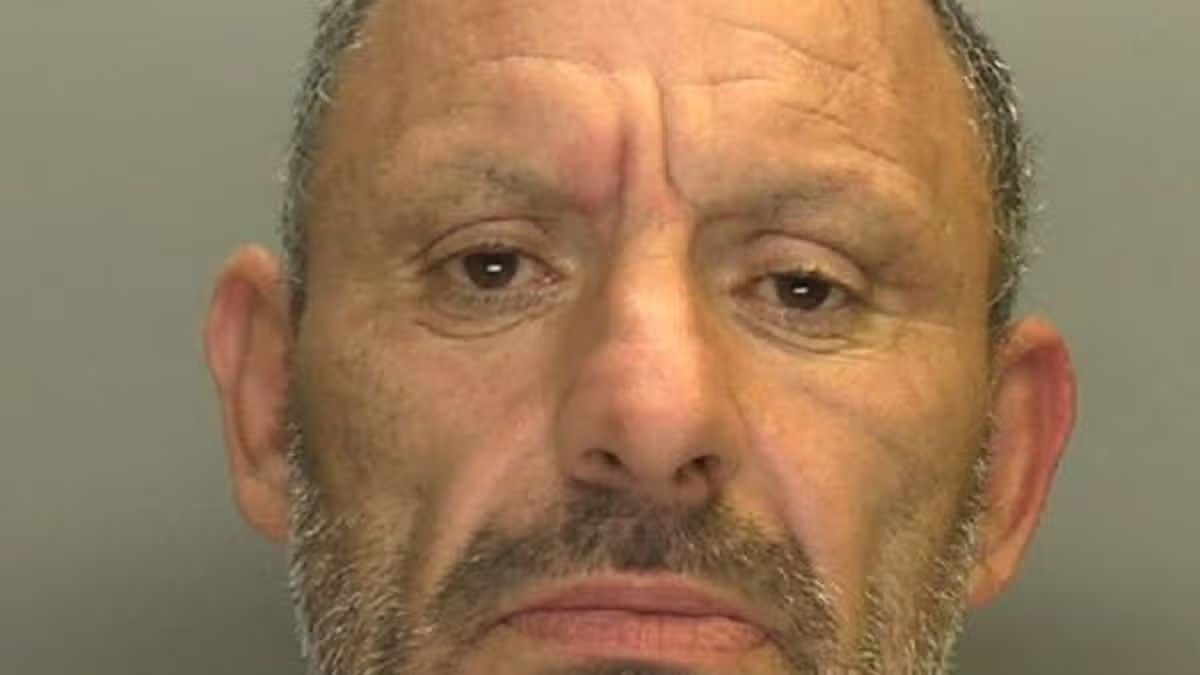
A man targeted elderly and vulnerable pensioners, including one who was aged 98, pretending he had carried out work on their properties before demanding money in what has been described as a “despicable” spree of offending. Rennie Price was branded a “conman” by a prominent Swansea Crown Court judge.

Advertisement

The court heard how between February and May this year, Price attended the houses of elderly people in the Neath area. It began on February 26, where he demanded £120 from his first victim, 79-year-old Maureen Hughes, after telling her he had completed work on her house without her request, claiming he spotted defects whilst working on a neighbour’s roof.

He attended the post office with her, where she withdrew the money and gave it to him. Ms Hughes reported the matter to police after she later spoke to her neighbour, and they told her they had not had any work done on their property. Don’t miss a court report by signing up to our crime newsletter here.

Prosecution barrister Georgia Donohue told the court that the second victim was Trevor Thomas, aged 85. He had been at home with his wife on May 12, when Price knocked on his door and said that he had repaired damaged tiles on his roof, charging him £250 on the spot. Mr Thomas went to Neath police station when he later discovered no work had been carried out on his home.

The third victim, a man in his seventies, had Price knock on his door, and offer to clear the guttering of his house and repair roof tiles for £120, and requested further large sums of money from him, which he refused and closed the door.

Advertisement

Price continued to knock, and said he would meet him at the bank to receive the money. The victim also attended Neath police station to report the matter.

On May 14, Price attempted to obtain money from 87-year-old Anne Clark. The court heard how he spotted her near a bank and pretended to know her, asking “how are you keeping”, before telling her she owed him £120 for work he had completed on her house. She told him she did not have any money, and he pointed towards the bank. She refused and Price walked away.

Gwynfor Hughes, 79, was Price’s next victim on May 20. Price had attended his home and offered to remove an old wardrobe and carry out work in his garden, warning him to stay inside as he was “using chemicals”. Mr Hughes, who handed £140 to Price, later stepped outside to find Price had left and no work had been carried out.

Two days later, Joyce Thomas, 82, was approached by Price. He told her he had seen tiles come loose on her house and advised her work had to be done urgently as rain had been forecast. He charged her £240 and urged her to attend a cash point. The court heard the matter, reported to the police, left her feeling “stressed, worried and scared” in her own home.

Advertisement

On May 23, Price attended the home of Susan Baker, 69, claiming he had completed roofing work for her, telling her he was “from Limerick, now living in Skewen”. She knew no work had been completed and asked for proof, to which he said he would provide an invoice and photographs.

He entered her house and asked for £220 for work he claimed to have completed. Ms Baker said she had no money but could write a cheque, which Price rejected, stating he had “completed the work as a favour” and to prevent ceiling defects.

Price left after Ms Baker’s neighbour intervened. The court was told how she had been feeling “flustered and pressured into giving money” when he attended, and that since the incident, she has “kept her doors locked and will only open the door when she knows who it is.”

The following day, on May 24, David Lewis, a man in his eighties, was also approached by Price, who told him he had asbestos dust on his roof garage. He asked Mr Lewis for £150, and he said he would only pay once the work had been completed. Price then asked for £25, but he again refused.

Advertisement

Dennis Hathaway, 89, was approached by Price on May 26. He called out to Mr Hathaway by his name and told him he had “fixed his roof” and requested £120. He was given £60, but no work had been completed.

Price’s oldest victim, John Pritchard-Jones, 98, was approached on the same day, May 26. He told him that he had repaired loose tiles on his roof, but Mr Pritchard-Jones could see there were no loose tiles on his property.

Price pointed toward scaffolding on the street as a sign work was allegedly being carried out in the area and asked for £120. Mr Pritchard-Jones told him it was too much, to which Price responded: “How much you got on you?” He took £40 from the pensioner and left.

Diane Dark, 77, was approached by Price on May 27. He told her he had been working on a property next door and claimed he removed moss from roofing. He offered to paint her door and requested £60 to buy paint, but then requested £100 to enable him to buy brushes.

Advertisement

Ms Dark later spoke to a man carrying out work at a neighbouring property and asked if he was working alone, and he said yes. She then reported the matter to the police.

A total of £2,075 was taken from eight complainants, the court heard.

Price, 53, of Cwrt Neville in Wern, Llanelli, appeared at Swansea Crown Court via Swansea prison video link for sentencing having pleaded guilty to 11 counts of fraud.

Sali Harmes, barrister, representing Price, said: “Mr Price tells me he does not wish to shy away from how serious these matters are and recognises it was selfish. It was a string of offending which was despicable.

Advertisement

“He wants me to pass on his apologies to the court and to the victims, and says he is ashamed by his actions. He wants to make amends and wants to pay the victims back in full.

“His offending was motivated by financial selfishness and money he needed to fund his new found drug addiction to alcohol and crack cocaine.

“It is clear that this is a case that crosses the custody threshold, with an extremely high chance of a custodial sentence.

“He is someone who needs all the help available to him.”

Advertisement

Sentencing Price, his honour Judge Paul Thomas said: “In 2014 you went to prison for defrauding people. It seems you have returned to your old ways.

“This year you set out on a deliberate campaign of planned dishonesty over several weeks. Your plan was to swindle elderly and vulnerable people claiming you’d done work that you clearly hadn’t done.

“Nearly all victims were in their seventies or eighties, one as old as 98.

“It was brazen, cynical and heartless.

Advertisement

“It’s not just about financial loss, it is the feelings of stress and pressure on people during the final years of their lives, and the embarrassment over the feeling of being conned, and their erosion of trust in people generally.

“These courts have a duty to protect people from conmen like you. There were 11 different victims.”

Price was jailed for 20 months.

Get daily breaking news updates on your phone by joining our WhatsApp community here. We occasionally treat members to special offers, promotions and ads from us and our partners. See our Privacy Notice.


Advertisement

Source link

Continue Reading
Click to comment

You must be logged in to post a comment Login

Leave a Reply

NewsBeat

Student, 14, shoots three teachers and three pupils dead and leaves 15 others injured in Bangkok high school massacre

Published

on

A student reunites with a relative after being evacuated from Debsirin Nonthaburi School

At least seven people were killed and dozens more were injured on Friday when a student opened fire at a school in Thailand before turning the gun on himself. 

The gunman started firing from inside the Debsirin Nonthaburi School on the outskirts of Bangkok, shortly after 10am local time. 

Thai Police spokesperson Trairong Piwpan confirmed three teachers and three students were killed in the shooting during an interview with news broadcaster Channel 3.

He added that the motive for the shooting was still being investigated and that the gun was believed to have been taken from a member of the student’s family. 

Advertisement

The suspect was reportedly seen reloading ammunition inside the building, according to sources at the scene.

Images from the scene about an hour after the shooting showed people standing outside the school comforting one another and police and first responders walking around inside the school. 

A witness told reporters that students hid inside a classroom while they heard gunshots from another building before police officers knocked on the door and cleared a way for them to leave the building. 

Photos published by local media show the suspect wearing a purple school uniform and carrying a black cross-body bag, with several bullet casings visible on the ground. 

Advertisement

Lt. Col. Dechrapee Kongdee, the Nonthaburi provincial police commander, confirmed earlier that the ⁠suspected gunman, understood to be a 14-year-old student, had ​taken his own life, while a man and a woman were found dead at his home. 

A student reunites with a relative after being evacuated from Debsirin Nonthaburi School

An injured teacher receives medical attention inside an ambulance at Debsirin Nonthaburi School

An injured teacher receives medical attention inside an ambulance at Debsirin Nonthaburi School

Advertisement
Students flee from the Debsirin Nonthaburi School after the shooting took place

Students flee from the Debsirin Nonthaburi School after the shooting took place

Prime Minister Anutin Charnvirakul offered his condolences and said he had ordered relevant officials to take care of the victims. 

‘It’s such a terrible incident. It should never have happened. How could this happen in our country?,’ he told reporters at Bangkok’s Government House. 

The Debsirin School is a well-known secondary school in Thailand and has branches across the country.

Advertisement

The original Debsirin School in Bangkok was founded by Thai King Chulalongkorn in 1885. 

Its school in Nonthaburi, where the shooting has taken place, is situated in the northwestern outskirts of Bangkok.

Deputy interior minister Polapee Suwunchwee told local broadcaster Thai PBS that the suspect used a handgun and the interior ministry was investigating how the student obtained it. 

Emergency radio communications requested a medical team to respond to the 6th floor of Building 5, where one victim was undergoing CPR.

Advertisement

Police Colonel Phatsakorn Chaitaweewong, superintendent of Plai Bang Police Station, confirmed the shooting took place inside the school and urged the public not to livestream the incident, saying authorities have not yet brought the situation under control. 

Armed police officer enters Debsirin Nonthaburi School, following a shooting incident at the school

Armed police officer enters Debsirin Nonthaburi School, following a shooting incident at the school

The suspect was reportedly seen reloading ammunition inside the building, according to sources at the scene. Pictured: The gun used in the shooting

The suspect was reportedly seen reloading ammunition inside the building, according to sources at the scene. Pictured: The gun used in the shooting

Deputy Interior Minister Polapee Suwunchwee  said the suspect used a handgun (pictured) and the interior ministry was investigating how the student obtained it

Deputy Interior Minister Polapee Suwunchwee  said the suspect used a handgun (pictured) and the interior ministry was investigating how the student obtained it

Advertisement
Students run as they evacuate from Debsirin Nonthaburi School, the site of a shooting incident, in Bang Kruai district in Nonthaburi province on the outskirts of Bangkok

Students run as they evacuate from Debsirin Nonthaburi School, the site of a shooting incident, in Bang Kruai district in Nonthaburi province on the outskirts of Bangkok

A schoolgirl cries outside her school where deaths and injuries were reported after a shooting in Thailand's Nonthaburi province, Friday, Aug. 7, 2026

A schoolgirl cries outside her school where deaths and injuries were reported after a shooting in Thailand’s Nonthaburi province, Friday, Aug. 7, 2026

The officer said: ‘The public and parents should avoid the area and follow official updates.’

Armed response units were deployed and were working to secure the school. Students and staff were also being evacuated from the campus as the operation continues.

Advertisement

Thailand has one of the highest rates of gun ownership in the region, with around 10 million firearms estimated to be in circulation – one for every seven inhabitants. 

In February, police shot and arrested a teenage shooter who opened fire at a school in the south of the country in February, leaving the school principal dead and two students injured.

The teen had used a police officer’s weapon in the shooting.

A local police chief said at the time that the suspect was hospitalised for psychiatric treatment in December and had been discharged.

Advertisement

The teen stabbed a police officer with a knife and stole his weapon – a 9mm pistol – just before the incident, and then used it to carry out the attack.

In 2022, an ex-policeman armed with a gun and a knife stormed into a nursery in the country’s north and murdered 24 children and 12 adults, one of Thailand’s deadliest massacres.

This is a breaking news story. More to follow 

Source link

Advertisement
Continue Reading

NewsBeat

I visited a hidden Hertfordshire gem with a Natural History Museum and independent shops

Published

on

Cambridgeshire Live

I visited a town in Hertfordshire, under two hours from Cambridge, and it was a hidden gem

The UK is home to countless hidden gems that attract little to no tourist footfall. Whether it’s the Cotswolds or further afield in North Wales, exploring these lesser-known spots is something of a passion.

One such discovery is a charming town in Hertfordshire, boasting a stunning high street and an abundance of places to eat.

Advertisement

Among Hertfordshire’s finest destinations is Tring, a town brimming with natural beauty, fascinating history and thriving local businesses. Sitting just one hour from London, it remains remarkably underrated and is well worth a visit, whether you’re passing through or keen to venture somewhere new.

Perched on the edge of the Chiltern Hills, Tring is a historic market town in western Hertfordshire that has been welcoming visitors for centuries. With a population of just over 12,000, it combines all the charm of a traditional English town with the practicality of a well-connected commuter hub.

Although evidence suggests the area has been inhabited since prehistoric times, Tring rose to prominence during the medieval period, receiving its market charter in the 14th century.

Its position along key coaching routes helped the town to prosper, drawing in trade and travellers alike.

Advertisement

Today, visitors are greeted by elegant Georgian and Victorian architecture lining the high street, which is dotted with independent retailers, traditional pubs and artisan shops.

Things to do in Tring

Natural History Museum

One of Tring’s most celebrated attractions is the Natural History Museum at Tring, one of the UK’s most remarkable museums. The museum exists thanks to Lionel Walter Rothschild, the eldest son of the famous banking family.

From an early age, he developed a passion for animals, gathering specimens from across the world and ultimately assembling one of the largest private zoological collections ever created.

Advertisement

In 1892, he made the museum accessible to visitors, showcasing thousands of mounted mammals, birds, reptiles and insects collected from every corner of the globe. His collection gained international acclaim, and following his death, it was handed over to the Natural History Museum in London, which maintains the Tring Museum to this day.

The museum proved captivating, with beautiful wooden cabinets containing everything from brightly coloured birds to rare mammals.

Explore the high street

Tring’s wide high street forms the centre of the town. Packed with independent boutiques, antique shops, gift shops and cafes, it’s an ideal way to pass a leisurely morning.

Advertisement

The blend of Georgian architecture and vibrant shopfronts generates an inviting atmosphere throughout the town.

Tring park

Once part of the Rothschild family’s estate, Tring Park offers expansive views over Hertfordshire and the neighbouring countryside.

It boasts woodland trails, open grassland and scenic viewpoints that make it particularly favoured amongst walkers and runners. The Grand Union Canal is also a popular destination for walkers and cyclists.

Food and drink

For a town of its size, Tring boasts a remarkable array of independent cafés, pubs and restaurants, making it a sought-after destination for food enthusiasts.

Begin your day at Black Goo Coffee, one of Tring’s most beloved spots. Renowned for its expertly crafted coffee, the café also offers an excellent food menu.

For a quintessential British pub experience, the Tufted Duck, formerly known as the Akeman, provides seasonal menus, locally sourced produce and a wonderful beer garden. This characterful pub serves mouth-watering food, including traditional Sunday roasts.

Those with a passion for Italian cuisine frequently make their way to Nonna’s, a family-run restaurant celebrated for its freshly prepared pasta and authentic pizzas.

Advertisement

Beer enthusiasts would be well advised to visit Tring Brewery. The award-winning brewery has been crafting traditional ales in the town since the early 1990s, supplying numerous pubs throughout Hertfordshire and Buckinghamshire.

Nearby attractions

Ashridge Estate

Just a short drive from Tring lies the breathtaking Ashridge Estate, one of the National Trust’s most stunning rural destinations. Ancient woodlands, rolling hills and miles of walking trails draw visitors throughout the year, while the food and drink on offer are equally impressive.

Whipsnade Zoo

Less than 15 minutes from Tring, Whipsnade Zoo ranks amongst Europe’s largest wildlife conservation parks. Home to elephants, rhinos, lions, giraffes and hundreds of other species, it makes for a thoroughly rewarding day out for the whole family.

Advertisement

Berkhamstead

The nearby market town of Berkhamstead provides another wonderful destination, boasting the striking remains of Berkhamstead Castle, charming independent retailers and a lively café scene centred along its bustling high street.

Source link

Continue Reading

NewsBeat

Transfer news LIVE: Shock Arsenal FC move, Alvarez talks; Man Utd done deal; Chelsea medical; Liverpool latest

Published

on

Transfer news LIVE: Shock Arsenal FC move, Alvarez talks; Man Utd done deal; Chelsea medical; Liverpool latest

The summer window is entering its final weeks as Arsenal, Chelsea, Manchester United, Liverpool and Tottenham all step up their push for new signings. Arsenal will announce the arrival of Bruno Guimaraes today, while they are said to have made a shock enquiry over Cristian Romero and agreed personal terms with Julian Alvarez after Vinicius Jr signed a new contract at Real Madrid.

Source link

Continue Reading

NewsBeat

The clever ways to make the most of citric acid in the home, according to readers

Published

on

The clever ways to make the most of citric acid in the home, according to readers

Citric acid has long been a favourite for descaling kettles and coffee machines, but its uses extend far beyond banishing limescale.

After Sarah-Jane Hoadley shared her top cleaning jobs for citric acid, readers flooded the comments with their own tips. They revealed just how versatile this inexpensive household staple can be, whether that’s using the powdered form, or lemons, in which it occurs naturally. 

From removing rust from tools to unblocking sinks and even making homemade elderflower cordial, here’s what our readers had to say. 

Advertisement

A cleaner barbecue

With barbecue season well underway, reader Tom Spencer tells us about his top tip.

“Cleaning with lemons is all over the internet nowadays,” he says. “I use cut lemons or limes to clean the barbecue grates after scraping with the wire scraper once at a high temperature. It is as simple as rubbing the halved lemon onto the bars. The acid does the rest, and gets any little bits off. Then put olive oil onto some kitchen roll and rub the bars so the food doesn’t stick.”

Summer drinks

Speaking of summer, citric acid can also be used in various cocktail, cordial and wine recipes, as detailed by Janet Adams, 74, from Scotland.

“I bought the citric acid last year to make elderflower wine. I was somewhat nervous about putting it in, acid after all,” she says. Janet has a host of self-seeded elder trees on the land where she lives. “Last year was the first time I put them to any use.”

Advertisement

When making cordial, the flower heads have to be picked on a hot day when the perfume is strong. They do get soaked overnight, but “be careful to allow anything crawly to escape before that”, Janet adds.

Source link

Continue Reading

NewsBeat

What went right this week: the good news that matters

Published

on

What went right this week: the good news that matters
The US murder rate plummeted again

The US has recorded another sharp fall in its murder rate, with homicides down 18% in the first six months of the year compared to the same period in 2025. 

That’s according to analysis from the Council on Criminal Justice (CCJ), which said that the US homicide rate has likely reached a “historic low”. 

It’s not just the murder rate that’s falling. The CCJ said that four types of crime have fallen by more than half in recent years: homicide (51% lower than 2022), carjacking (73% lower than 2023), residential burglary (56% lower than 2018), and vehicle theft (down 51% compared to 2023). 

Advertisement

While the White House has framed the data as a triumph for the Trump administration, crime rates in the US have been falling for years, albeit with some exceptions, notably shop-lifting and drug offences.      

“Murder and other crime rates are falling across the map, in cities with different political leadership, housing and economic conditions, policing and prosecution strategies, violence reduction models, and levels of federal enforcement activity,” said Adam Gelb, the CCJ’s president. 

“Local policies and programmes surely matter, but the striking consistency of the decline suggests that macro-level forces are exerting enormous influence as well.” 

Image: Andreas Strandman

Advertisement

Source link

Continue Reading

NewsBeat

How Queen Caroline turned King Arthur into an 18th-century royal PR strategy

Published

on

How Queen Caroline turned King Arthur into an 18th-century royal PR strategy

Amid family feuds, damaging headlines and questions about its future role, Britain’s royal family has spent much of the past decade managing its public image. But the importance of good royal PR dates back centuries.

Long before communications teams and media advisers became fixtures of royal life, Queen Caroline (1683-1737) attempted a remarkable piece of image management. Faced with the challenge of making a German royal dynasty seem unmistakably British, she turned to one of Britain’s most powerful national stories: the legends of King Arthur and Merlin.

As the wife of the king of Great Britain and Ireland, George II (1683-1760), Caroline belonged to the House of Hanover. The German dynasty had inherited the British throne only two decades earlier and was still viewed with suspicion by many of their subjects. At the same time, an increasingly public feud between the king and his heir, Frederick, Prince of Wales, threatened to undermine the image of stability that a country recently torn apart by civil war, religious schisms and political revolution so desperately needed.

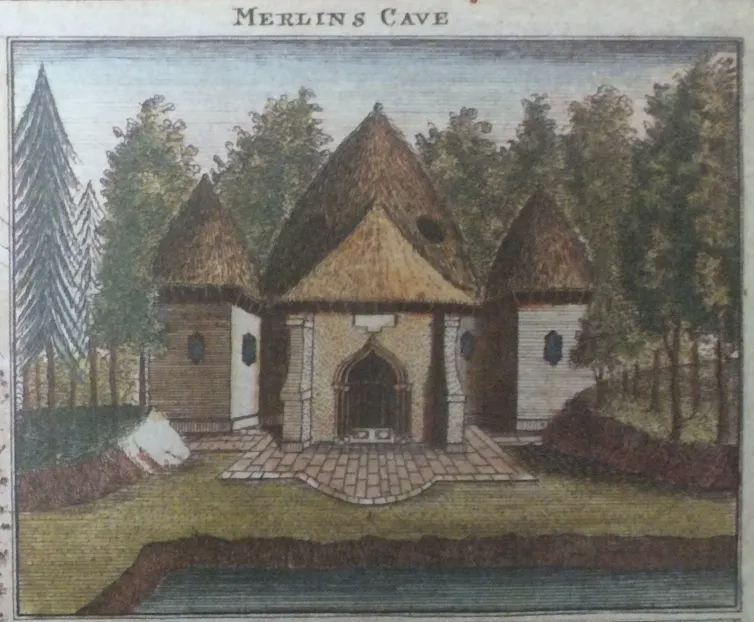
Caroline’s solution to this problem was unexpected. In 1735, she commissioned a curious attraction in the gardens of her palace at Richmond. Known as Merlin’s Cave, it looked like something from a fairy tale: a gothic thatched building filled with wax figures of Merlin, legendary prophets and other figures from Britain’s distant past. Many contemporaries thought it bizarre, with one critic dismissing its inhabitants as “a great many strange puppets”.

Advertisement
Portrait of Caroline of Ansbach in Manner of Michael Dahl (1730).
Shire Hall

Yet Merlin’s Cave was far more than an eccentric garden folly. Although an unlikely tool of statecraft, Caroline’s use of Arthurian iconography sought not only to strengthen the Hanovarian claim but also to promote a shared British identity at a time of political uncertainty.

Myth as messaging

Although the House of Hanover had inherited the British throne in 1714, it did not yet possess a deep-rooted place in the nation’s imagination. George I (who reigned 1714-1727) preferred his native Hanover to his new dominion and had relied heavily on interpreters and intermediaries throughout his reign. This exposed the dynasty to accusations that they were foreign rulers.

Supporters of the exiled Stuart dynasty, known as Jacobites, continued to regard James II’s son, the “Old Pretender” James Francis Edward Stuart, as Britain’s legitimate king. They had attempted ill-fated but bloody uprisings in 1715 and 1719. On his accession to the throne in 1727, George II therefore faced a challenge that was both political and cultural: he needed to not only rule Britain, but to persuade his people that he belonged there.

Arthurian legend offered a solution to this problem. Unlike the Jacobite claim, which emphasised hereditary right, it provided access to something broader and potentially more powerful: the idea of a shared British past. Arthur and Merlin were useful precisely because they belonged to no single dynasty. They could be appropriated to cultivate a different kind of legitimacy – one founded on patriotism, national identity and Britain’s historical traditions.

Advertisement

Queen Caroline was well placed to appreciate Arthur’s political usefulness. Unlike her husband, who famously cared little for the arts, Caroline was an enthusiastic reader who understood the political value of culture. Raised in the intellectually vibrant courts of Berlin and Hanover, she had access to extensive libraries that exposed her not only to Arthurian myth but to traditions linking the House of Guelph – the Hanoverian dynasty – with medieval English royalty.

While earlier monarchs such as Henry II and Edward I had often appropriated Arthur directly as a model of kingship, Caroline shifted attention towards Merlin. Throughout Arthurian tradition, Merlin acts as an adviser, genealogist and interpreter of Britain’s future. He guides Arthur while also foretelling the destiny of the realm. By placing Merlin at the centre of her cave, Caroline was employing these associations to connect the past, present and future in ways that linked the Hanoverians both to Britain’s ancient heritage and its future success.

A drawing of Merlin's Cave, a building within a manicured garden
Merlin’s Cave from John Rocque’s Plan of the Royal Gardens (1754).
British Library

This symbolism became even more pointed because the royal family itself was divided. George II and Caroline had a strained relationship with their son, Frederick, and contemporary supporters interpreted Merlin’s inclusion as a call for reconciliation. In a 1735 poem inspired by Merlin’s Cave, the Anglo-Welsh writer Jane Brereton has Merlin urge Frederick to fulfil his filial duty and “perpetuate Brunswick’s Race”, suggesting that at least some observers understood the Cave’s symbolism as a plea for dynastic harmony as well as political stability.

Not everyone was convinced, however. Caleb D’Anvers – a pseudonym for Nicholas D’Anvers, editor of the satirical journal The Craftsman – mocked Merlin’s Cave as an eccentric curiosity. Opposition writers, meanwhile, turned Merlin into a vehicle for attacks on both Caroline and her ally Sir Robert Walpole. Yet the very nature of these responses suggests that Caroline’s critics understood the political message she was trying to convey. Their objections stemmed not from confusion, but disagreement.

In the deeply divided political culture of the 1730s, Whig celebrations of Britain’s legendary past could easily become targets for Tory and Jacobite satire. The negative responses to the cave demonstrate that Caroline’s political opponents recognised her intentions well enough to parody them.

Advertisement

Merlin’s Cave therefore offers a revealing glimpse into the political uses of myth in 18th-century Britain. In turning to Arthurian legend to promote the image of a stable, legitimate and distinctly British monarchy, Caroline understood a lesson that monarchies continue to grapple with today: legitimacy depends not on inheritance, but on the stories people tell about who belongs to the nation and who should shape its future.

Source link

Advertisement
Continue Reading

NewsBeat

Mapped: The most dangerous parts of NI according to crime rates

Published

on

Belfast Live

The figures also reveal the safest place to live in Northern Ireland

People in South Belfast are more likely to witness crime than residents of any other part of Northern Ireland.

The latest PSNI recorded crime figures show that there has been a rise in some serious types of offending, including rape and all sexual offences (by 4%), stalking and harassment (1%), robbery (19%), drug offences (5%), and possession of weapons (14%).

However, the general trend of falling crime over the past decade has continued. In the year ending March 2026, 93,601 offences were recorded, a 2% drop on the previous 12 months.

Advertisement

The figures also reveal that some parts of the country are far more dangerous places to live than others. The highest volume of offences last year were recorded in Belfast, a total of 30,994 offences.

That means a third of all recorded crime in Northern Ireland last year took place in Belfast.

Crime rates, which account for population size, are generally considered the fairest way to compare crime across areas of wildly different sizes.

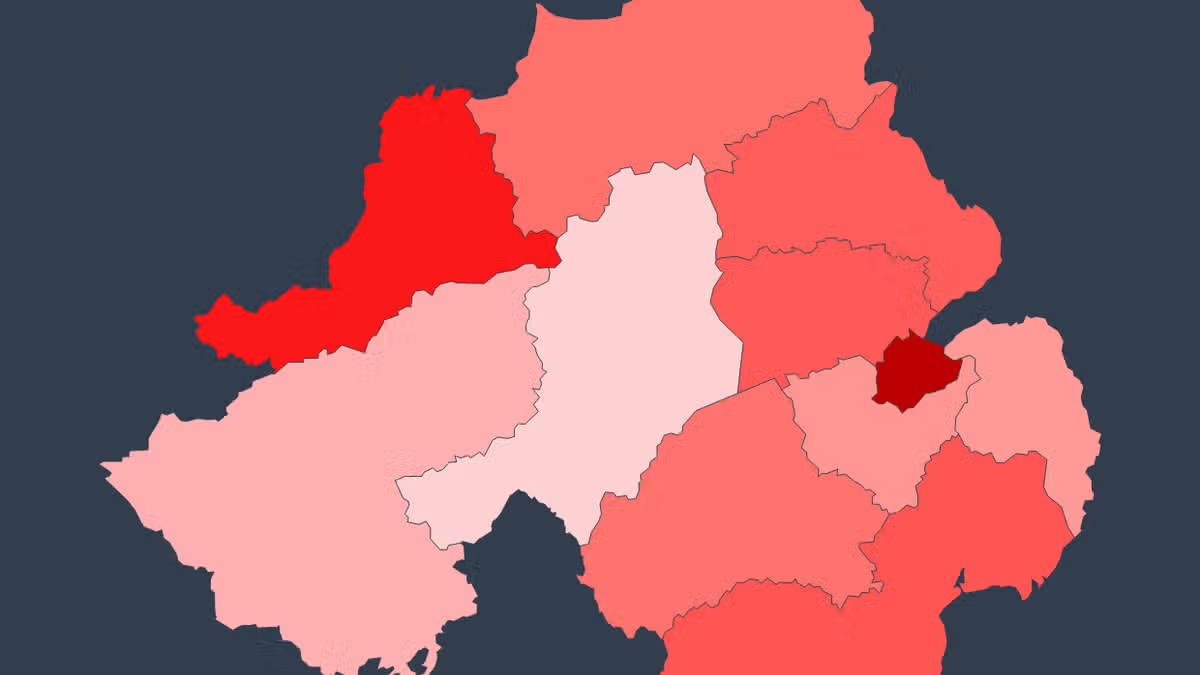
You can see how it compares where you live using our interactive map:

Advertisement

They show that Belfast also has the highest crime rate in Northern Ireland, of 88 crimes per 1,000 residents.

Population figures are not readily available for the four policing districts within Belfast – North, South, East, and West – so the crime rate is for the city as a whole. However, estimates based on census population ward figures show that residents in South Belfast are most likely to witness crime.

Last year, South Belfast, covered by the local policing team based on Lisburn Road, experienced the highest volume of crime, with 10,117 recorded offences. South Belfast also had the highest crime rate, followed by North, West, and then East Belfast.

However, higher crime rates in South Belfast may be driven by visitors to the district for its nightlife or shopping.

Advertisement

Outside of Belfast, residents of Derry City and Strabane were most likely to experience crime with a crime rate of 61 crimes per 1,000 residents, significantly lower than Belfast.

Meanwhile, Mid Ulster was the safest place to live in Northern Ireland, with the nation’s lowest crime rate of 29 crimes per 1,000 residents.

For all the latest news, visit the Belfast Live homepage here and sign up to our daily newsletter here.

Source link

Advertisement
Continue Reading

NewsBeat

Unpaid but unwavering, Congo health workers fight spread of Ebola despite months without pay

Published

on

Unpaid but unwavering, Congo health workers fight spread of Ebola despite months without pay

BUNIA, Congo (AP) — Wiza Bondele goes to work every day at a hospital in Congo with one goal in mind: to slow the fastest-growing Ebola outbreak on record.

At an Ebola treatment hospital in the eastern Ituri province, the epicenter of Congo’s ongoing outbreak, Bondele disinfects contaminated areas, checks visitors’ temperatures and enforces handwashing protocols — work that puts him at risk of getting infected.

But like hundreds of other front-line health workers, including burial teams and drivers, Bondele says he has been working without pay since the outbreak was declared in mid-May in one of Congo’s most remote and conflict-hit regions.

Poor welfare for front-line workers has been a key source of concern in the outbreak. The payment issues and attacks on health teams and facilities have forced some health workers to walk off the job, disrupting critical care in the outbreak that authorities say continues to spread at an alarming rate and faster than efforts to track it.

Advertisement

Ebola spreads through direct contact with the bodily fluids of infected people or contaminated materials, a risk Bondele is well aware of.

“Sometimes patients are bleeding or vomiting blood. We clean and disinfect those places,” the 29-year-old infection control worker told The Associated Press while on duty. “With risks like that, we deserve salaries.”

Confirmed cases in the outbreak have exceeded 4,000, including over 1,800 deaths, according to the latest government data. It is the second-largest Ebola outbreak on record, behind the 2014-2016 West Africa outbreak that recorded more than 28,000 cases, including over 11,000 deaths. Another from 2018-2020 killed at least 2,200.

This outbreak has been linked to the Bundibugyo virus, for which there are currently no approved vaccines or treatments.

Advertisement

Workers continue despite financial strain

A veteran of Congo’s 2018 Ebola response, Bondele returned when the virus resurfaced, believing his experience could help protect his community in Ituri, which accounts for nearly 90% of the Ebola cases.

Instead, he found himself among many workers who have continued reporting for duty without receiving the monthly salary of $510 that Bondele said they were promised.

Officials have told them that the outstanding payments will be made, he said. Workers have registered their numbers to get paid through mobile money transactions, signed attendance sheets and waited for payment notifications, but only some were eventually paid.

Bondele said even colleagues who were paid have told him they have not received the full amount.

Advertisement

Congolese authorities did not immediately respond to a request for comment on Thursday. Officials in the past have blamed logistical issues for the payment delays.

Without his salary, paying rent, buying food, phone credit, covering transport costs and paying water bills have all become daily struggles. He also supports his wife, child and other relatives, responsibilities he says have become increasingly difficult to meet.

Advertisement

One morning, the hardship became painfully visible.

Setting off for work on his motorcycle, Bondele said he ran out of fuel along the way. With no money to refill the tank, he left the bike with neighbors and walked the remaining 13 kilometers (8 miles) to the hospital. By the time he arrived, he said his shoes had fallen apart.

Despite the unpaid wages and hardship, Bondele and hundreds of workers continue to show up to the hospital seven days a week. He said his work is too important to abandon.

“I hope their conscience tells them that I deserve to be paid,” Bondele said, referring to officials.

Advertisement

Strikes and protests have led to disruptions

Bondele was among hundreds of Ebola response workers in Bunia who staged strikes and protests over unpaid wages in recent weeks, at times abandoning health facilities and disrupting parts of the response as the outbreak continued to spread.

“We realized they (the authorities) weren’t doing anything, and that’s when we went on strike,” he said.

They warned that unpaid wages were undermining morale and affecting patient care. In a statement, staff at one treatment center said they would remain on strike until “concrete solutions” were found to resolve months of unpaid wages and bonuses.

Dr. Adelard Lufungula, operations manager for the government’s Ebola response, said last month that the payment problem was being resolved, with workers now paid through mobile money instead of cash and the backlog expected to be cleared soon.

Advertisement

For Bondele, the explanations have done little to ease the uncertainty.

“I wonder whether it is injustice or whether there simply isn’t enough money,” he said.

Insecurity and residents’ mistrust complicate the response

The strikes come as the Ebola response is already battling armed conflict, widespread misinformation and deep public mistrust, all of which have made it harder for health workers to contain the outbreak.

“It is very difficult to get people to understand,” Bondele said. “Sometimes while raising awareness I can be threatened or beaten, and I have to run away.”

Advertisement

Some communities continue resisting basic prevention measures such as regular handwashing, he said.

Restrictions on traditional burials, where families are prevented from touching the highly contagious bodies of loved ones, have fueled resentment in some communities. Rumors claim that the virus is a hoax, that health workers are profiting from the outbreak or that hospitals are withholding lifesaving treatments.

The misinformation has repeatedly turned violent. Angry crowds have torched Ebola treatment centers, stormed hospitals to retrieve relatives’ bodies and attacked teams carrying out safe burials. Health officials say the mistrust has also made contact tracing and early treatment more difficult, particularly in remote communities affected by rebel violence.

As visitors line up for temperature checks and disinfectant is sprayed to keep the virus at bay, Bondele continues the work he says he joined out of passion.

Advertisement

“Working this job takes a lot of courage,” he said. “But today, I am discouraged.”

___

Banchereau reported from Dakar, Senegal.

___

Advertisement

For more on Africa and development: https://apnews.com/hub/africa-pulse

The Associated Press receives financial support for global health and development coverage in Africa from the Gates Foundation. The AP is solely responsible for all content. Find AP’s standards for working with philanthropies, a list of supporters and funded coverage areas at AP.org.

Advertisement

Source link

Continue Reading

NewsBeat

Michael Carrick’s telling response after being told to sell eight players by Man Utd hero

Published

on

Daily Mirror

Manchester United boss Michael Carrick has not yet followed transfer instructions previously laid out by Paul Scholes

Michael Carrick has not sanctioned any major sales so far this summer at Manchester United. This is despite United hero Paul Scholes recommending eight stars be sold.

Advertisement

Carrick is currently taking charge of his first pre-season and there are just a few weeks until the Premier League returns. With only three first-team signings made so far in Andrey Santos, Youri Tielemans and Karl Darlow, more additions are expected.

However, there has yet to be a major exit from the club, aside from Casemiro’s departure. In April, Scholes was asked for a series of United stars who were surplus to requirements and of the eight players he listed, only one appears set to leave as things stand.

FOLLOW OUR MAN UTD FB PAGE! Latest United news and more on our dedicated Facebook page

Joshua Zirkzee was among the players that Scholes believed should be sold and the former Bologna forward is edging closer to a return to Italy. La Gazzetta dello Sport claims that Zirkzee is willing to join Juventus, who are pursuing a loan arrangement with an option to buy.

Advertisement

Scholes and Carrick spent seven seasons together in United’s midfield during their playing days. However, whilst the pundit’s suggestion to move on Zirkzee may materialise, the other seven stars Scholes mentioned could all remain part of United’s squad next term, with Carrick’s response clear.

The 51-year-old stressed the importance of United revamping their defence. Speaking on The Good, The Bad and The Football podcast, Scholes said of Leny Yoro: “I think he’s struggled, me. I think there’s something in there, I think he needs a bit of time, but if you had to make a choice now, I’d probably sell him.”

He also argued that the shift away from ex-boss Ruben Amorim’s three-at-the-back system would have implications for Noussair Mazraoui. Mazraoui has been linked with a departure this summer, though he remains part of Carrick’s side. Highly-rated defender Yoro has also expressed a desire to make his mark at United next season.

Advertisement

Countdown to Kickoff: The Ultimate 26/27 Sky Sports Bundle

This article contains affiliate links, we will receive a commission on any sales we generate from it. Learn more
Content Image

Sky’s Ultimate TV and Sky Sports bundle includes at least 215 live Premier League clashes across the 2026/27 season with more than 1,400 live games across the EFL and beyond, plus F1, golf and darts.

Every subscription now comes with 135 channels alongside free subscriptions to HBO Max, Netflix, Disney+, discovery+ and Hayu.

Turning to midfield, Scholes felt Manuel Ugarte would depart and the Uruguayan was linked with a move before picking up an injury at the World Cup. Mason Mount also featured on Scholes’ eight-man list, though the England international has caught the eye during pre-season.

Advertisement

Additionally, Scholes felt the moment had arrived to say goodbye to Harry Maguire, who continues to have a key role at United. He said: “I’m thinking about a Manchester United team you want to win the league and the Champions League and that’s where United should be aiming. I’m not sure you’d do that with Maguire.”

Elsewhere, United have held an interest in Newcastle United full-back Lewis Hall in the transfer window. Focusing on the left-back position, Scholes previously urged the club to offload long-serving Luke Shaw due to doubts about his reliability, despite him having featured in every Premier League fixture last season. He was equally prepared to let Patrick Dorgu leave.

Scholes said on Dorgu: “They brought him in as a wing-back and he’s not really played much there. I’d probably sell. I’m not sure what position he is. Again, if you keep him then he’s just a squad player.”

Advertisement

Overall, of the eight players Scholes recommended be sold, only Zirkzee appears set for an imminent exit. There has been little speculation regarding the remaining seven of Yoro, Mazraoui, Shaw, Dorgu, Mount, Ugarte and Maguire.

Join our new MAN UTD WhatsApp community and receive your daily dose of Manchester United content from Mirror Football. We also treat our community members to special offers, promotions, and adverts from us and our partners. If you don’t like our community, you can check out any time you like. If you’re curious, you can read our Privacy Notice.

Source link

Advertisement
Continue Reading

NewsBeat

Inside life of Mad Dog biker gang founder from YouTube channel to pipe bomb plot

Published

on

Daily Record

From a small YouTube channel with barely 50 subscribers to a cushy jail cell curtesy of pipe bomb plot, Dan Laponder has had an unusual rise to infamy. A founder and former president of the the Mad Dogs Motorcycle Club, Laponder is well known among bikers.

He was one of the lead figures when the gang broke away from Blue Angels – Scotland’s oldest motorbike outlaw gang – in 2023. That move sparked conflict between the two tribes who have remained at war ever since.

Violent confrontations have seen several bikers injured – including former Mad Dogs president Mark “Bruni” Brown who has been forced to step away from gang. Two years ago, Laponder planted a pipe bomb under a rival’s father’s van amid the feud and he was subsequently jailed for nine years.

As the gang war between the two groups wages on, just who is Dan Laponder? Daniel McMillan Laponder, now 45, was originally a member of the Blue Angels and he rose to become a leading figure within the gang.

Advertisement

He was always destined to be a key figure in the biker gangs of Britain – his younger brother David followed as he became a member of the Sons of Hell biker gang in Tameside. In November 2020, David was sentenced to nine years behind bars after striking Daniel Gibbons – the president of the Warrington branch of the gang – over the head with a meat cleaver eight times during a ‘frenzied attack’.

In February 2023, he opened a YouTube channel – easy entry locksmith – which he used as “a record of my locksmith training”. The videos, which include “drilling a yale lock”, “snapping a lock” and “practice opening a car with non destructive entry kit” show Laponder testing his skills.

Advertisement

He barely speaks in the videos which show different locksmith techniques and were published between April and November 2023. It was around this time that he led the split from the Blue Angels.

The exact reason for the unceremonious break is unknown but Laponder took a bunch of bikers with him to found Mad Dogs Motorcycle Club. Two further videos entitled “digger driver vibes” and “digger v dumper driver race” and published on his YouTube channel in 2024 show Laponder driving construction vehicles.

All told, his 24 videos have racked up 22,200 views and he has drawn a whopping 51 subscribers. In May 2024, Laponder thanked killer John Bingham for “a very generous financial contribution” to the club.

Bingham, who had been cleared of murder after admitting stabbing love rival Alister Milroy to death in 2013, leapt from a car before threatening a female motorcyclist in a road rage incident. With the two gangs separated, they began a brutal war which has led to serious injuries, fire attacks and even a pipe bomb plot.

Advertisement

Laponder’s part in the feud has landed him a cushy life in jail after he was sentenced in November 2024. The then 43-year-old targeted David Rollo senior’s work van outside his home in Lennoxtown on June 8 that year.

Mr Rollo’s son is a member of the Blue Angels and Laponder chose the vehicle as his target during the gang feud. An off duty firefighter was alerted after the van was spotted on fire.

He attended to assess the situation and, underneath the van, he observed a device – a pipe bomb – made up from bottles, a copper pipe and RF receiver with an antenna. The bomb squad was quickly alerted and the area locked down as experts worked to defuse the device and make it safe.

Advertisement

Laponder was linked to the pipe bomb after DNA and fingerprints were recovered from the bottles and tape. A forensic investigation on the device found that it comprised of petrol and ball bearings with a remote activation attached to it.

At the time, he was living on a barge in Kirkintilloch and police attended his home on July 3 where he was found with a loaded side-by-side, double barrel, break action shotgun. When quizzed by officers, Laponder stated: “I’m not a Blue Angel anymore, I retired a year ago.”

Laponder was asked about the bomb and replied: “Link the dots, we’ve been getting attacked all the time. What is a remote detonator? It goes off with a remote, perhaps it was a shot across the bow.”

A garage linked to the Mad Dogs Motorcycle Club was raided and two remote firing systems similar to the one used in the bomb attack were recovered. Laponder pleaded guilty on October 15, 2024, to a charge of wilful fire raising and a charge under the Firearms Act 1968.

Advertisement

He was sentenced to nine years behind bars the following month and his since been incarcerated at HMP Greenock. Despite his convictions, Laponder last month claimed his “window” for a low-security transfer is just months away. If so, he would be moved to HMP Castle Huntly near Dundee.

The low-supervision facility, set on a 15th-century castle estate, allows inmates deemed low-risk more freedom to go into the community to prepare them for release. In a social media post from his cell, Laponder boasted about his easy life behind bars, revealing he has penned a tell-all book about his crimes to set the record straight, recorded an acoustic album, and been handed a plum job mentoring new inmates.

He said: “My window to go to open prison is in six months, so that is my focus… I’ll be back on top soon enough.”

The post added: “Well it’s coming up on two years I’ve been in prison. Time has gone by quite fast, probably because I have kept myself busy. Sooooooo what have we achieved in prison?

“I’m competent now on the guitar and I’m getting better by the day, I’ve been practicing for hours ever day learning scales, chords, progressions, different picking techniques so I’m happy where I am. I can play a few tunes on the harmonica but I’ve only got one in the G so only a couple of my own songs I can play both at the same time.

“My own songs I’ve written around 100 of, I’ve got some in the Koestler awards this year and we started recording an album up at music class using a desktop studio. It sounds good though lol. It’s just acoustic right now but in my head there’s loads going on, I’ll need to wait until I get out and find musicians to help me bring it all to life.

“I’ve written two books, one is a tutorial on how I taught myself guitar and the other is a short story of how I came to be in here, I thought people would be interested to hear the truth. I’ve got some poems down but most of my folders are full of scripts for a social media channel idea I have.

Advertisement

“Talking about ideas I’ve got some inventions to patent when I get out. Last year I won an award for a painting I done but I’ve not been painting much I’ve got five of my own hanging up in my cell, them and some pics of Razor Candy, I started learning Spanish and Sign Language.

“I’m still finding time to smash the gym no one has knocked me off the board yet. The jail made me peer mentor so when new prisoners come in I show them around and tell them how everything works.

“I do miss my wee man terribly though. My window to go to open prison is in 6 months so that is my focus so I can get home to see him.

“Home? I have no home! I need to start all over again. I ain’t got a pot to piss in or a window to throw it out of, mans got skills though I’ll be back on top soon enough. Hey – I can always go busking now, anyway hasta luigo for now.”

Advertisement

Get more Daily Record exclusives by signing up for free to Google’s preferred sources. Click HERE.

Advertisement

Source link

Continue Reading

Trending

Copyright © 2025