Connect with us
DAPA Banner
DAPA Coin
DAPA
COIN PAYMENT ASSET
PRIVACY · BLOCKDAG · HOMOMORPHIC ENCRYPTION · RUST
ElGamal Encrypted MINE DAPA
🚫 GENESIS SOLD OUT
DAPAPAY COMING

NewsBeat

Horror moment Tour de France cyclist crashes face-first into car’s rear windscreen – as bloodied rider is left needing 20 stitches before withdrawing from race

Published

on

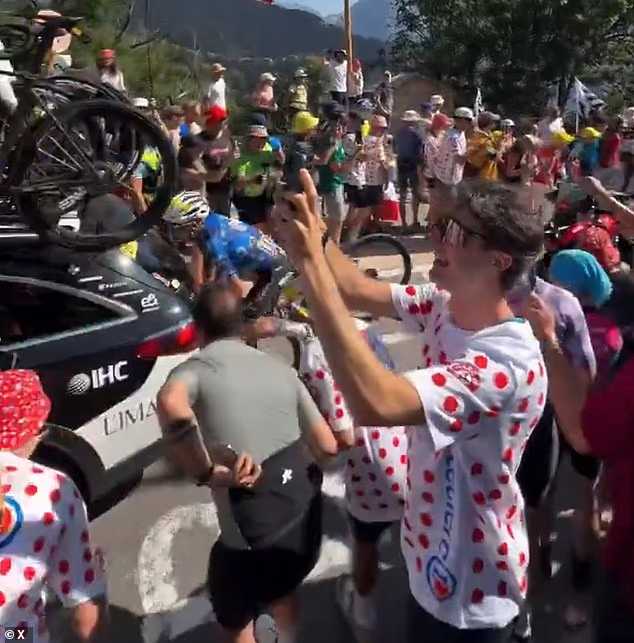
Einer Rubio collides head-first with the UAE Team Emirates-XRG car after it stops abruptly to avoid hitting a spectator that had fallen into its path

A Tour de France rider needed 20 stitches after crashing face-first into the back of a car.

In a freak incident, Movistar’s Einer Rubio collided with the back windscreen of the car when it braked to avoid hitting a spectator during yesterday’s Stage 19.

Video footage of the incident, posted on X, showed Rubio hurtling into the UAE Team Emirates-XRG vehicle after it stopped abruptly, smashing the rear windscreen and leaving his face covered in blood.

The Colombian had been 27th in the race for the yellow jersey, but has since had to withdraw. His facial injuries were treated immediately at the scene, before he was taken to a medical truck. 

Advertisement

He was later seen sporting bandages on his face, and was transported by helicopter to a hospital in Grenoble, from which he was discharged last night.

In a statement, Movistar said: ‘Einer Rubio has received around 20 stitches in the face following the accident he suffered during the ascent to Alpe d’Huez. 

Einer Rubio collides head-first with the UAE Team Emirates-XRG car after it stops abruptly to avoid hitting a spectator that had fallen into its path

Advertisement
Rubio is sent hurtling to the ground in front of lines of shocked cycling fans

Rubio is sent hurtling to the ground in front of lines of shocked cycling fans

The Colombian receives medical treatment on the scene. He needed 20 stitches and was later taken to hospital in a helicopter

The Colombian receives medical treatment on the scene. He needed 20 stitches and was later taken to hospital in a helicopter

‘The Colombian is to be transferred to a hospital in Grenoble, where new tests will be carried out to determine the extent of the injuries.

UAE Team Emirates-XRG team manager Joxean Fernandez, who was driving the car that Rubio crashed into, apologised publicly for his actions — but clarified he was trying to save the life of the spectator. 

Advertisement

‘I feel the need to explain what happened from my position inside the car during yesterday’s stage,’ wrote Fernandez, commonly known as Matxin, on Instagram.

‘In the final kilometers of the Alpe d’Huez climb — with thousands of fans right next to the road and the immense pressure typical of a decisive Tour stage — a spectator suddenly ran out and fell right beneath our vehicle. My only reaction was to brake immediately to avoid running him over. It all happened in a split second, and my only thought was preventing a far worse tragedy.

‘After braking, we heard a loud impact behind us, but amidst the noise, the tension, the crowd, and the responsibility of continuing to protect the race leader, I didn’t learn the full extent of the accident — or that Einer had to withdraw from the Tour — until we reached the finish line. I immediately contacted the Movistar Team to check on the situation and ask what had happened.

‘I fully understand that seeing only part of the footage can lead to criticism and questions. However, those of us involved in cycling know that in such extreme situations, decisions are made in fractions of a second — and always with the aim of protecting human life.

Advertisement
Rubio had been 27th in the race for the yellow jersey, but has since had to withdraw

Rubio had been 27th in the race for the yellow jersey, but has since had to withdraw

Einer Rubio (right) alongside his Movistar team-mates earlier this month

Einer Rubio (right) alongside his Movistar team-mates earlier this month

UAE Team Emirates-XRG team manager Joxean Fernandez (left), who was driving the car that Rubio crashed into, apologised publicly for his actions

UAE Team Emirates-XRG team manager Joxean Fernandez (left), who was driving the car that Rubio crashed into, apologised publicly for his actions

‘I deeply regret the consequences of this accident. If the decisions I made in that moment ended up affecting a rider in the peloton, I can only say that it pains me deeply. At the same time, I believe it is important to remember that the safety of riders, teams, and fans also depends on the responsible behavior of those who enjoy this sport from the roadside.

Advertisement

‘I offer all my support and affection to Einer; I am deeply sorry for what happened and sincerely hope to see you back competing where you belong very soon. This has not been an easy day for me.’

Former Tour de France champion Alberto Contador was among those to offer their support to Fernandez, saying: ‘Matxin, anyone would have reacted the same way — or perhaps (if they had) a second later, we would be mourning the spectator’s death. 

‘In light of the thousands and thousands of fans who (walk) the road on foot for the Alpe d’Huez, the organisation should fence the climb to ensure the safety of both people and cyclists.’

Rubio’s crash was not the first incident involving fans during this year’s Tour. On Thursday, Richard Carapaz narrowly avoided colliding with a spectator posing for a photo.

Advertisement

Four-time champion Tadej Pogacar has again dominated this year’s Tour, and smashed the record for fastest-ever ascent of Alpe d’Huez en route to winning yesterday’s stage. The Slovenian’s time of 35min 26sec beat the previous mark, set by Marco Pantani in 1995, by 1min 14sec.

Source link

Continue Reading
Click to comment

You must be logged in to post a comment Login

Leave a Reply

NewsBeat

‘If you don’t run, it devours you’: Spain declares national emergency and France calls in army as 270,000 flee wildfires spreading across Europe

Published

on

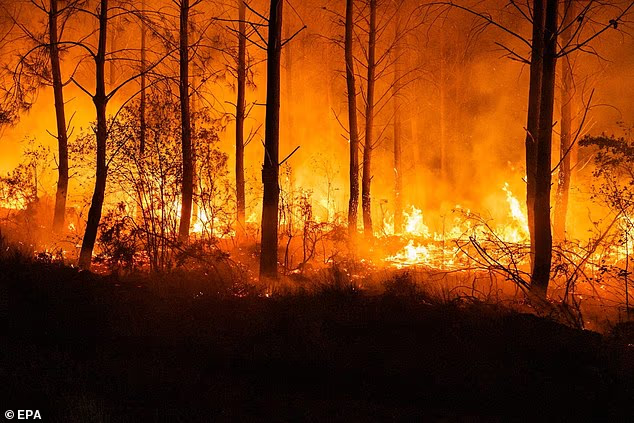
Dramatic pictures released by French authorities show an intense wildfire burning in Biscarrosse, southern France, on Saturday morning

Spain has declared a national emergency and France has called in the army as more than 270,000 people evacuate amid massive wildfires that continue to ravage Europe.

Huge forest blazes have become out of control and are threatening towns across the two countries, with Brits evacuated from hotels and high winds on Saturday are expected to spread the flames further.

Nasa has been forced to abandon a communications complex in Spain, impacting the agency’s ability to communicate with space probes, while an additional 500 troops have been sent in to south-west France to assist firefighters.

Some 197,000 people have been evacuated from the region, while in Spain, the figure has hit at least 70,000 with another 20,000 told to remain indoors.

Advertisement

As a blaze in France rages just 12 miles west of Bordeaux, a fire near Madrid is ‘at its peak’ and is at risk of merging with a second blaze today, something government official Nicanor Sen Velez said would be ‘very bad news’.

Residents have been left terrified as they flee their homes, with one Spanish resident describing how ‘if you don’t run from it [the fire], it devours you’.

A national wildfire emergency has now been declared in Spain and the European Union has been drafted in to help and is deploying seven planes to the two countries to help firefighting efforts.

Elsewhere, wildfires have also been reported in Sicily, Italy and Alijó, Portugal, as another record-breaking summer has left ‘tinderbox’ conditions across Europe, with the threat of yet more fires breaking out still severe.

Advertisement

And in Britain, a large fire in Cairngorms National Park in Scotland has seen some 500 firefighters tackling the blaze – with experts warning changing wind today could see it get worse. A major incident has been declared.

Dramatic pictures released by French authorities show an intense wildfire burning in Biscarrosse, southern France, on Saturday morning

Huge forest blazes have become out of control and are threatening towns across Europe (Pictured: Blaze in Biscarrosse)

Huge forest blazes have become out of control and are threatening towns across Europe (Pictured: Blaze in Biscarrosse)

Advertisement
A huge fire is also ongoing in the Cairngorms National Park in Scotland (pictured on Friday)

A huge fire is also ongoing in the Cairngorms National Park in Scotland (pictured on Friday)

Firefighters in France try to prevent the spread of a blaze in Lege-Cap-Ferret, south-west France

Firefighters in France try to prevent the spread of a blaze in Lege-Cap-Ferret, south-west France

A firefighter targets water onto a blaze in south-west France late on Friday

A firefighter targets water onto a blaze in south-west France late on Friday

Castilla-y-Leon district's firefighters battle a fire surrounding La Atalaya residential area in El Tiemblo on Saturday

Castilla-y-Leon district’s firefighters battle a fire surrounding La Atalaya residential area in El Tiemblo on Saturday

Advertisement
Spanish firefighters hoped to get control of wildfires raging near Madrid on Saturday but an official warned that erratic winds threatened to fan the blazes further

Spanish firefighters hoped to get control of wildfires raging near Madrid on Saturday but an official warned that erratic winds threatened to fan the blazes further

Firefighters wait on a road near Lacanau, south-west France, on Saturday

Firefighters wait on a road near Lacanau, south-west France, on Saturday

Bystanders look on as fire and smoke billow across Castres-Mazamet aerodrome, near Labruguiere in south-western France on Friday

Bystanders look on as fire and smoke billow across Castres-Mazamet aerodrome, near Labruguiere in south-western France on Friday

Firefighters battle a wildfire in Fresnedillas area, near El Escorial, north of Madrid, Spain on Saturday

Firefighters battle a wildfire in Fresnedillas area, near El Escorial, north of Madrid, Spain on Saturday

Advertisement
Aerial images show the devastation left behind in Spain by huge wildfiers - some 63,000 people have been evacuated in the country

Aerial images show the devastation left behind in Spain by huge wildfiers – some 63,000 people have been evacuated in the country

A burnt out car on Sicily Island in Italy on Friday, after a wildfire ravaged the area

A burnt out car on Sicily Island in Italy on Friday, after a wildfire ravaged the area

A fire map from Nasa shows the concentrated blazes to the west of Madrid and Bordeaux

A fire map from Nasa shows the concentrated blazes to the west of Madrid and Bordeaux

Dozens of firefighters have been injured, authorities have said, but no fatalities have been reported. 

Advertisement

In France, thousands of people were evacuated from suburbs near Bordeaux on Saturday as wildfires in areas around the city showed no signs of abating.

Local official Sophie Brocas said the areas of Le Haillan, Eysines and Merignac were being fully cleared of residents. 

Prime Minister Sebastien Lecornu said more than 141,000 people had so far been evacuated from the Gironde and Landes regions with motorists also advised to avoid the region. 

The fire has so far ravaged 40,000 hectares of land, and 500 soldiers are currently deployed to assist firefighting efforts, with that number set to rise to 1,000 over the weekend.

Advertisement

‘The fires that are hitting our country have reached a level that has never been seen before,’ Lecornu wrote on X on Saturday. 

So far this month, temperatures have averaged 32.2 degrees Celsius (90 Fahrenheit) across the broader Aquitaine region, which is 7.3C (13.1F) above the normal high for July between 1961 and 1990.

Mass evacuations have been taking place throughout the day – including by boat – from Cap Ferret in southwestern France, some 40 miles from Bordeaux, where wildfires have burnt through thousands of hectares of forest and destroyed luxury villas.

Many had been woken in the middle of the night and had bagged as many of their belongings as possible and scooped up their pets to head to Hall 3 of the Parc Des Expositions De Bordeaux.

Advertisement

Around 1,000 camp beds had been made available, all of which had been snapped up by 4am this morning. At least 5,000 people were crammed into the stuffy hall by 8am, some of whom had arrived seven hours earlier.

Trestle tables were set up filled with board games, toys and books for children. Bottles of water were handed out to those who were seeking shelter.

Valerie and Peter Horrilo left their home in Saint-Aubin-de-Médoc at 1am after getting the alert.

Sitting on a camp bed, 56-year-old Valerie said: ‘We’ve tried to sleep but it’s difficult, there’s a lot of news and the lights are on. I’ve used my earplugs, which have helped a little, but it’s not been the best night of my life.

Advertisement

‘As we got into the car to leave home, all our neighbours were doing the same.

‘Everyone was very calm. We’d been expecting to be evacuated at some point in the evening because the local authority had warned us that the smoke was drifting over towards our direction.

Thousands of people in southwest France have been evacuated to Hall 3 of the Parc Des Expositions De Bordeaux

Thousands of people in southwest France have been evacuated to Hall 3 of the Parc Des Expositions De Bordeaux

Evacuated residents Loic Dumont (centre) with his sister Sandrine (left), son Enzo, 18 wife Marie, 44 and daughter Zoe, 15

Evacuated residents Loic Dumont (centre) with his sister Sandrine (left), son Enzo, 18 wife Marie, 44 and daughter Zoe, 15

Advertisement
Valerie and Peter Horrilo left their home in Saint-Aubin-de-Médoc at 1am after getting the alert

Valerie and Peter Horrilo left their home in Saint-Aubin-de-Médoc at 1am after getting the alert

People sleep on carpet tiles in France after being evacuated from wildfire zones

People sleep on carpet tiles in France after being evacuated from wildfire zones

Evacuated residents queue for food after fleeing their homes in the dead of night at Bordeaux's exhibition hall

Evacuated residents queue for food after fleeing their homes in the dead of night at Bordeaux’s exhibition hall

Some 1,000 camp beds had been set up in the hall, with around 5,000 people having arrived by 8am on Saturday

Some 1,000 camp beds had been set up in the hall, with around 5,000 people having arrived by 8am on Saturday

Advertisement
Local residents evacuated to Bordeaux Expo Centre take a nap outside

Local residents evacuated to Bordeaux Expo Centre take a nap outside

A map shows the risk of wildfires breaking out across Europe for this week

A map shows the risk of wildfires breaking out across Europe for this week

‘We had a bag packed with clothes so when the phone alerts sounded, we were all ready to go.

‘From our home we can see and smell the smoke and ash falls from the sky like snow, but the fire is far away. We still have some Covid face masks left over and we’ve been using them when we’ve been outside.

Advertisement

‘We don’t know when we’ll be allowed back, I hope soon but it depends on the wind direction. We’re also due some rain, which is badly needed.’

Peter, 63, added: ‘We were on holiday in Greece two years ago when a typhoon forced us to sleep on the floor of a local airport so we have a little experience of this, but I’ve never been made to leave my home before.

‘We are trying to make the best out of a bad situation, we are safe at least and as comfortable as possible.’

Loic Dumont, 49, left home at 1am in Saint Aubin with wife Marie, 44, son Enzo, 18 and 15-year-old daughter Zoe as well as their three dogs and pet cat.

Advertisement

He met his sister Sandrine Dumont at the shelter after she too had been forced to evacuate.

He said: ‘We were expecting to have to leave home at some point so we already had the bags in the car.

‘When we got here in the middle of the night it was a little busy but thousands of people have arrived since and the hall is now nearly full.

‘We didn’t want to take up any of the camp beds because there were older people who needed them more but we asked volunteers who are helping at the shelter if they had anything we could sit or lie on.

Advertisement

‘They managed to find us half a dozen of what look like carpet tiles that make lying on the hard floor a bit more comfortable. I couldn’t sleep so ended up going to my car and trying to get a few hours rest instead.

‘We’ve got enough food and snacks and everyone is banding together. I hope we’ll be able to go home soon as we’re not near the fires at all, it’s just the smoke drifting over that may be harmful.’

Xavier Delort, 57, was sitting with friends at a table reading the local Sud Ouest newspaper with a dramatic front page picture of the forest fire accompanied by the headline ‘L’apocalypse’.

In broken English, he said: ‘Everything is ok. We’re here just as a precaution. We’re feeling good.’

Advertisement

Sitting across from Mr Delort was Cecilia Racheme, 47, who had jumped in a cab at 4am with her two sons, aged 16 and six, from their home in Mérignac, a suburb east of Bordeaux’s centre.

Some 140,000 people have been evacuated in France due to raging wildfires

Some 140,000 people have been evacuated in France due to raging wildfires

French firefighters tackle a blaze in Lege-Cap-Ferret in south-west France on Friday

French firefighters tackle a blaze in Lege-Cap-Ferret in south-west France on Friday

The blaze in Scotland (pictured) could get worse today as changing winds make it increasingly unpredictable

The blaze in Scotland (pictured) could get worse today as changing winds make it increasingly unpredictable

Advertisement
Flames in a forest in El Tiemblo, 80km west of Madrid, on Saturday

Flames in a forest in El Tiemblo, 80km west of Madrid, on Saturday

A wildfire burns near Lacanau, to the west of Bordeaux, on Saturday

A wildfire burns near Lacanau, to the west of Bordeaux, on Saturday

Dozens of firefighter trucks are parked in a support line between the villages of Lacanau and Saint-Helene in the Bordeaux region, south-west France, today

Dozens of firefighter trucks are parked in a support line between the villages of Lacanau and Saint-Helene in the Bordeaux region, south-west France, today

A burned house and vehicle in Lanton, in the Lege-Cap-Ferret region on Saturday

A burned house and vehicle in Lanton, in the Lege-Cap-Ferret region on Saturday

Advertisement
A view of the damage in the Casaboli Forest following a wildfire, near Palermo on Sicily island

A view of the damage in the Casaboli Forest following a wildfire, near Palermo on Sicily island

A firetruck moves to battle a wildfire affecting Castile y Leon province, in the village of El Tiemblo, Spain, on Friday

A firetruck moves to battle a wildfire affecting Castile y Leon province, in the village of El Tiemblo, Spain, on Friday

Firefighters assess the area outside the village of El Tiemblo during efforts to battle a wildfire affecting Castile y Leon province, Spain

Firefighters assess the area outside the village of El Tiemblo during efforts to battle a wildfire affecting Castile y Leon province, Spain

She said: ‘I was worried because the SMS alert came during the early hours when it was dark and I didn’t know how far the fires were.

Advertisement

‘We could smell the smoke and so that unnerved me a little.

‘As much as I want to go home, I’m concerned that we’ll be in danger from the smoke and possibly the flames if they spread this far.

‘We’ve bought some food and snacks from home. I hope this is all over soon.’

Most of those in the exhibition centre seeking shelter from the wildfire are local French families but one British father of two had been evacuated with his wife and young children from a hotel close to Bordeaux Airport.

Advertisement

He declined to give his name but said he was on holiday from Solihull in the West Midlands, adding: ‘We’d been in a campsite near Gastes but moved over to Bordeaux to get away from the fire.

‘We’d been in a hotel overnight when the alert came at 4am for us to vacate. Luckily, this has happened right at the end of our two week holiday and we’re hoping to fly back home later today… as long as the flight isn’t cancelled.’

In neighbouring Spain, firefighters hoped to get control of wildfires raging near Madrid on Saturday but an official warned that erratic winds threatened to fan the blazes further.

The fires in the parched countryside have forced 63,000 people to flee their homes or remain indoors, the interior ministry said, in what officials have called the region’s worst fire on record.

Advertisement

Thick grey smoke filled the sky west of the capital and the smell of burning reached the streets of central Madrid.

With temperatures dipping, ‘there is a real opportunity now to tackle this fire with some guarantee of success’, the central government’s delegate in Madrid, Francisco Martin, told reporters late Friday.

On Friday, ‘the temperature has dropped, the wind has eased and the relative humidity has risen,’ he said.

But he warned that Saturday would be ‘difficult’ as ‘the wind is expected to rise in the morning, with rather erratic gusts’.

Advertisement

The Madrid regional government’s emergency management chief Carlos Novillo had told reporters earlier Friday that the fire was ‘at its peak and… currently beyond the capacity of firefighters to contain’.

Two separate wildfires combined on Friday to become one huge blaze, which was close to merging with yet another near Avila in the neighbouring Castilla y Leon region.

The fires have burned 25,000 hectares, the Spanish interior ministry said today, ravaging nearly 10,000 hectares in the Madrid region and ‘between 13,000 and 15,000’ in the neighbouring province of Avila.

The total is more than twice the surface area of the city of Paris.

Advertisement

The Madrid regional government said on X that more than 2,000 people were being looked after in 14 emergency evacuation centres.

Interior Minister Fernando Grande-Marlaska told reporters Friday there were nine other fires at various locations in Spain.

In Scotland, the Cairngorms fire is at risk of flaring up again on Saturday after a change in wind direction.

Some 500 firefighters have been tackling it over the last nine days, alongside specialist wildfire appliances, all-terrain vehicles, helicopter water-bombing operations and partner agencies. 

Advertisement

People in the Nethy Bridge area were evacuated overnight as a precaution after Police Scotland declared the blaze a major incident.

Residents are being directed to a dedicated respite centre at the Macdonald Aviemore Hotel, and access roads into Nethy Bridge have been closed. 

Police Scotland Superintendent Judy Hill said: ‘The weather conditions experienced within the Cairngorms over the last 24 hours have added further complexities to this situation.

‘With evidence suggesting the fire is spreading towards Nethy Bridge, the decision has been taken to declare a major incident and evacuate residents as a precaution.

Advertisement

‘Additional police resources are being deployed to assist in contacting those who need to leave their properties and to maintain cordons around restricted areas while our fire service colleagues continue to tackle the wildfire.

‘We understand this is a very concerning time for residents, businesses and visitors to the Cairngorms region.

‘Please be assured that the multi-agency response remains fully committed to bringing this incident to a safe conclusion as quickly as possible.’

The Scottish Fire and Rescue Service said it has maintained a ‘significant operational response’ since the wildfire was first reported on July 15.

Advertisement

The smoke from the fire can now be seen as far away as Aberdeen. 

Source link

Continue Reading

NewsBeat

NHS waiting lists are finally getting shorter, but not fairer everywhere

Published

on

NHS waiting lists are finally getting shorter, but not fairer everywhere

After years of grim records, the NHS in England finally has some good news to report. The waiting list for planned hospital care has begun to edge down, and the share of patients treated within the 18-week target has climbed, from 59.8% in March 2025 to around 63% a year later. Ministers, who have promised to restore the 92% standard by 2029, are keen to claim momentum.

Until recently, it was difficult to say whether that recovery was reaching everyone equally. That changed in July last year when NHS England began publishing waiting-time data broken down by deprivation, age, sex and ethnicity for the first time. New analysis of this data by the Health Foundation, an independent health policy charity, gives us some answers.

The charity found that, nationally, the differences are narrow. In April 2026, 62.5% of people living in the most deprived areas had waited less than 18 weeks, compared with 63.6% in the least deprived. That 1.1 percentage point gap is the smallest since the NHS began publishing this breakdown, down from around 1.8 points in June 2025.

It would be easy to file that under “problem largely solved”. But a percentage point stops looking small when you work out what it means for real patients.

Advertisement

That 1.1 percentage point gap may sound small, but it amounted to around 7,400 people in the most deprived areas waiting more than 18 weeks for treatment in a single month. Repeat that month after month and that “trivial” gap becomes a great many people waiting in pain and anxiety.

Where are the gaps biggest?

Inequalities between rich and poor areas exist across almost every speciality. They are largest in plastic surgery, where patients in the richest areas are seven percentage points more likely to be treated on time than those in the poorest areas. Dermatology and urology also have large gaps, at five percentage points each.

The national figure also hides big local differences. Nearly two-thirds of the NHS bodies responsible for planning health services (integrated care boards) in their local area have bigger gaps than the national average. In other words, averaging the whole country together makes the problem look smaller than it is in many places.

The ethnic differences follow a similar pattern. People from Indian, Pakistani and Bangladeshi backgrounds consistently wait longer, at 60-61% seen within 18 weeks.

Advertisement

Again, the aggregate understates it: in dermatology, just 54% of south Asian patients were seen within 18 weeks, compared with 63% of white British, Irish and other white patients – a nine-point gap. For Black African, Caribbean and other Black patients, the difference is around six percentage points.

However, people living in poorer areas and some minority ethnic groups are younger on average, and the NHS quite properly prioritises patients who are older, more seriously ill, or at greater risk if they wait.

Dermatology illustrates this challenge. Patients suspected of having skin cancer are often moved up the queue, and skin cancer is more common in older people and those with lighter skin. So some differences in waiting time may reflect legitimate clinical priorities rather than discrimination.

Patients suspected of skin cancer are moved up the queue.
Evgeniy Kalinovskiy/Shutterstock.com

But that explanation only stretches so far. Earlier analysis found that inequalities in waiting times persisted even after taking age into account. Combined with the fact that gaps appear across almost every speciality and much of the country, this suggests they cannot simply be explained by differences in patient populations or geography.

Advertisement

Research suggests that practical barriers may also play a role – from struggling to get to appointments and finding transport to problems accessing interpreters, taking time off work and navigating a complicated NHS system.

Reasons to be optimistic

Despite this, the findings are genuinely encouraging.

Inequalities in the longest waits (over 52 weeks) have narrowed substantially, driven largely by five areas with high levels of deprivation: Birmingham, Solihull, Greater Manchester, Lancashire and South Cumbria. Meanwhile, some of the best-performing systems, such as Gloucestershire, record among the smallest differences. Places are managing to be fast and fair at the same time.

That matters, because it lays to rest a stubborn assumption. Speed and fairness have long been treated as a trade-off, as though narrowing gaps must inevitably mean missing targets. The past year offers real-world evidence that this is a false choice: several of the systems that cut their longest waits fastest were those serving the most deprived populations.

Advertisement

None of this happened by accident. It took a decision to start publishing the data, and sustained work in places like Lancashire and South Cumbria to act on what they showed. How many people are waiting and who is waiting longest remain different questions – but for the first time we can answer both, and both answers are moving in the right direction.

This is a genuine opportunity, and now is the time to act on it, while the recovery is still gaining ground. It means sharing what the best-performing systems have learned, continuing to track progress as waiting times fall, and treating fairness as an ongoing part of the job – not something to deal with once targets are hit. The task now is to keep that going.

Source link

Advertisement
Continue Reading

NewsBeat

The sex position both men and women secretly think is ‘one of the worst ever’

Published

on

The sex position both men and women secretly think is 'one of the worst ever'
Sex positions are purely preferential but there’s one that both sexes aren’t a fan of (Picture: Getty Images)

While men aren’t a fan of the classic cowgirl, and women hate it in reverse, how we like it in bed will always be a hot topic.

Of course, everyone has their own personal preferences, but there’s one position that both men and women agree is ‘one of the worst ever’.

What is it, you ask? It’s the 69, and both sexes have the exact same complaint… they don’t like multi-tasking.

It’s an understandable gripe, with countless men and women taking to Reddit to decry the oral act.

Advertisement

Here’s what the guys had to say…

One 28-year-old guy wrote: ‘Not a fan. I love giving. I love receiving. 69 makes it hard for me to enjoy either part. I don’t like someone’s crotch in my face when I’m receiving… and the BJ is really overwhelming for me when I’m trying to give pleasure.’

Ask Metro


Use AI to go deeper into the stories you care about – powered by Metro and trusted publications.

Advertisement

The off-putting nature of this multi-tasking was summed up perfectly by a fellow male Redditor, who said: ‘It’s like two people giving each other a massage. Feels like for the relaxation to be fully enjoyed, one person should go at a time.’

Cuddling
Men aren’t a fan because they either want to give during oral sex, or receive (Picture: Getty Images)

Sign up to The Hook-Up, Metro’s sex and dating newsletter

Love reading juicy stories like this? Need some tips for how to spice things up in the bedroom?

Sign up to The Hook-Up and we’ll slide into your inbox every week with all the latest sex and dating stories from Metro. We can’t wait for you to join us!

Advertisement

Others shared how they’d never climaxed or made their partner climax while 69-ing, while others admitted they’d get more pleasure taking turns.

‘The main problem with this position is that you are both givers and takers at the same time,’ added another. ‘As a giver it’s hard to focus, and as a taker you can’t relax. It’s one of the worst positions ever.’

Here’s what the women thought, too…

In the case of the 69, it’s clear men and women are singing from the same hymn sheet.

‘I don’t enjoy oral unless I can really concentrate on every subtle thing that he does and how good it feels,’ explained one woman. ‘Otherwise it just feels like someone tickling me in an uncomfortable way.

Advertisement

‘And when I have a d**k in my face, I am pretty unaware of anything going on with the rest of my body. It’s just so demanding and there in my face. So it end up being a blow job in an uncomfortable position with someone tickling me somewhere and an obligation to enjoy it.’

In fact, a study of more than 2,000 women found that, for 29%, the 69 was the most disliked sex position. Site Seduce AI, which conducted the study, found women cited the division of attention between giving and receiving pleasure to be a turn off.

They also felt they couldn’t focus on their own sexual feelings, which caused frustration and a lack of sexual satisfaction. Honestly, getting to the finish line can be hard enough as it is.

One woman added: ‘I don’t like it. It’s supposed to be double fun, but I can’t focus on any of the two and as a result neither of the two is fun.’

Advertisement

Others shared they were ‘surprised anyone actually likes it’.

Couple in the bedroom
Some women also feel self-conscious with their behinds on display (Picture: Getty Images/iStockphoto)

For some women, it’s too close for comfort

But unlike men, women shared another pitfall they felt stopped them from being able to enjoy the position.

‘There’s nothing appealing about it, and I’d feel self-conscious in that position,’ one lady admitted.

It’s not hard to see how having your naked behind on full display less than two inches from someone’s face might make you a bit nervous – it’s pretty exposing.

Another woman agreed, adding: ‘It’s a really awkward blowjob angle and his nose ends up too close to my butthole for comfort.’

Advertisement

The 69 is the marmite of sex

‘No sex position is for everyone but people have a lot of divisive opinions about 69-ing – they either love it, or they hate it,’ sexologist and author of Kink Curious, Gigi Engle, tells Metro.

‘In my experience, most people don’t like it.’

For Gigi, she agrees it can be a lot of work and can result in a loss of focus.

‘Giving a blowjob to a penis can be a lot of work, and takes a lot of focus, it can also be pretty exhausting on the jaw for some people,’ she explains.

Advertisement

‘The part women tend not to like about it is it can be difficult to enjoy the oral they’re giving you, because you can’t focus on your own pleasure and experience.’

Our bed is short
No sex position is for everyone (Picture: Getty Images)

She also adds that the 69 won’t be a favourite for people who like lots of eye-contact during sex, but she does think it’s a great position in its own right.

‘No sex position is for everyone, but 69-ing can be really fun, the focus just needs to be less about climaxing and more about experiencing the pleasure you’re giving each other,’ she says.

‘It doesn’t need to be about putting on a performance, just enjoy the intimacy of pleasuring your partner, while they’re pleasuring you.’

Proving there’s no one fits all when it comes to sex, though, once writer who recently took part in Metro’s How I Do It sex diary revealed how it had become her favourite way to end a night.

Advertisement

‘These days, 69 is definitely our ‘go to’ position for passion. We always finish together and my orgasms are so much more intense (and frequent),’ she said.

‘We may not have as much penis in vagina sex as we used to back in the day and pre-kids, but all our sexual encounters are so much more satisfying.’

Ultimately though, if the 69 is a turn off for you, that’s totally fine. As Gigi says, it’s ‘different strokes for different folks’.

Do you have a story you’d like to share? Get in touch by emailing MetroLifestyleTeam@metro.co.uk

Advertisement

Source link

Advertisement
Continue Reading

NewsBeat

Twenty firefighters hospitalised after explosion sparked massive blaze that destroyed three fire engines at Essex industrial unit

Published

on

An aerial image of the site showed the extent of the blaze yesterday which involved more than 100 firefighters

Advertisement

Twenty firefighters were hospitalised after a fire which followed an explosion at an industrial unit housing fertiliser in Essex yesterday.

More than 100 fire crew had responded to the fire, which came after an explosion heard across the county thought to have come from the industrial unit which housed fertiliser.

Three fire engines and two fire officer cars were also wrecked, according to Rick Hylton, chief fire officer at Essex County Fire and Rescue Service.

Four of the hospitalised firefighters were treated for minor injuries, while the rest were checked for hearing loss.

Advertisement

All have now been discharged, Mr Hylton said, adding crews would remain at the scene but that the fire had been put out.

He said it was one of the ‘most challenging and complex incidents’ his force had responded to in years.

Firefighters worked ‘tirelessly in extremely challenging and hazardous conditions’ from yesterday to this morning to stop the ‘large and rapidly developing’ fire from spreading further, he added.

Residents described hearing loud booms from a farm estate just before 6pm yesterday and were warned by emergency services to keep doors and windows closed. 

Advertisement

An aerial image of the site showed the extent of the blaze yesterday which involved more than 100 firefighters

Aerial footage showed buildings and vehicles on fire by Southend Road, between East Hanningfield and Rettendon, as dozens of fire engines and ambulances lined the roads nearby. 

According to reports, the explosion was heard up to nearly 15 miles away from the scene of the fire. Some said they heard the blast in Southend, around a 30-minute drive away.

Advertisement

Another resident reported on social media that a relative’s house had been damaged by the sheer force of the shockwave.

The first emergency call about the fire was made at around 4.50pm yesterday before a major incident was declared just under an hour later following the fertiliser unit explosion. 

It is understood a field and industrial units caught fire before fertiliser inside one of the units exploded while fire crews were on the scene. 

At a press conference today, Mr Hylton said an investigation into the fire’s cause was underway and urged the public not to speculate.

Advertisement

He said: ‘The fire and explosion has also destroyed three fire engines and two officer cars that were being used to respond to the incident. This underlines the scale and intensity of the conditions our crews faced.

‘I also want to provide an update on the welfare of our firefighters. I can confirm that 20 firefighters attended hospital following the incident.

‘Of that 20, four suffered minor injuries, and the remainder were precautionary assessments, including checks for issues such as hearing loss following the explosion.

‘I am pleased to confirm all of those firefighters have now been discharged from hospital.’ 

Advertisement
An explosion rocked homes across Essex as the fire erupted at an industrial unit in Southend Road, between East Hanningfield and Rettendon

An explosion rocked homes across Essex as the fire erupted at an industrial unit in Southend Road, between East Hanningfield and Rettendon

The chief fire officer added: ‘The incident is now under control, although firefighters will remain at the scene, dealing with the remaining hotspots and supporting the transition into the recovery phase.’

‘Firefighters arrived quickly and were faced with a large and rapidly developing fire involving several units and surrounding farmland.

‘At 5.46pm, following an explosion involving fertiliser within one of the industrial units, Essex County Fire and Rescue Service declared a major incident.

Advertisement

‘We took that decision because of the scale and complexity of the incident, the significant resources required to bring the fire under safe control, and the need to co-ordinate a multi-agency response.’

Advertisement

Source link

Advertisement
Continue Reading

NewsBeat

The Grossest Things People Do At Coffee Shops

Published

on

The Grossest Things People Do At Coffee Shops

I work from cafes most days. My regular place is good, but sometimes on my travels, I see things that make me question my caffeine addiction.

More than once, I’ve watched someone finish a glass of water and put their empty cup back in with the clean ones. So, now when I pick up a glass and it’s damp, I can’t tell if it’s wet from use or wet because it’s been washed, and I go without. It’s one of many unhygienic behaviours that seem rife in coffee shops.

Daniel Day via Getty Images

You may want to think twice before pouring from that shared milk carafe into your coffee.

Matt Woodburn-Simmons worked as a barista for years and now runs the Home Coffee Expert website. His first rule is: do not touch the milk.

Advertisement

In the hotter months, especially, people drink straight from the communal carafe, he said. “Full lips wrapped around it and chugging the milk while waiting for their coffee. I imagine people would rather their milk was not French kissed by a stranger before use.”

The honey is nearly as bad. Woodburn-Simmons watched people squeeze it onto a finger and lick it or wipe the drip from the nozzle and lick that, too. “Hundreds of fingers a day going onto the end of the honey nozzle is a superspreader event waiting to happen,” he said.

Shanina Knighton, an infection preventionist and nursing professor at Case Western Reserve University, can explain why the milk is so bad.

“Milk is about the friendliest thing you can hand a bacterium,” she said. “It is full of protein and sugar, it sits warm or lukewarm in the line, and it leaves a thin film on everything it touches. That film is where the trouble starts.

Advertisement

“Once a little milk dries onto a spout, a gasket or the inside of a dispensing tube, it gives bacteria a place to settle, and what grows there is a biofilm, a sticky layer of microbes that anchors to the surface and laughs off a quick rinse.”

I would never touch the milk, ever.

Topping up a half-empty jug only makes it worse. “When someone adds new milk on top of the old without emptying and washing the container first,” Knighton said, “whatever was living in that residue gets a fresh meal and a running start.”

Woodburn-Simmons saw that happen often. “Milk jugs with a crust around the spout,” he said, refilled multiple times and never cleaned. “I would never touch the milk, ever.”

Advertisement

Lids are also a concern. Elliot Sterling once watched a man find the communal milk almost empty, shake it vigorously over his cup, and then place his whole hand flat on the lid stack and drag it smoothly down the entire row. “Three people used those lids after him,” Sterling said, “and I used them as well before I realised what was happening.” He takes his from the middle of the stack now.

“People separate a stack by pawing through several lids before they commit to one,” Knighton said, “and the part they are handling is the same part that ends up against someone’s mouth. Most of what we touch in a day never reaches our lips, so it forgives a lot. A lid rim does not.”

“Lids themselves were never cleaned, just left on the assumption they were fine,” Woodburn-Simmons said. When the morning rush hit, the wipe-downs lapsed too. “Wiping down the area became an only-when-absolutely-necessary job,” he said, which on a bad morning meant “three to four hours.” He still remembers the puddles of spilled milky coffee left to spoil and people setting their lids down in them.

The horror stories continue. At a Toronto coffee shop, Philip Stoelman saw a customer lick the communal stir spoon and drop it straight back in the jar. “That person didn’t even think twice,” he said. Stoelman has carried his own stir stick ever since. JoAnne Loftus switched to a water bottle after watching someone in an Austin cafe rinse a used mug in the self-serve water-glass bin and refill it. “They didn’t even use the sink,” she said.

Advertisement
At a Toronto coffee shop, Philip Stoelman saw a customer lick the communal stir spoon and drop it straight back in the jar.

Tatiana Terekhina via Getty Images

At a Toronto coffee shop, Philip Stoelman saw a customer lick the communal stir spoon and drop it straight back in the jar.

Knighton has her own story. She once ordered an iced latte and watched the worker handle a credit card, then reach in and “grab the tip of my straw with their bare hand.” She asked for a fresh one. The worker held up the box kept under the counter. “Every straw in it had a visible coating of dirt,” she said. “They were clear straws, so there was no missing it.”

Woodburn-Simmons has a longer list. Customers clipped their nails while they waited, “nail clippings going everywhere.” Parents handed sugar packets to children who sucked on them and put them back – “kids being germ factories.” One person even fished an unused sugar packet out of the bin and put it back.

By now you might want to swear off self-serve stations entirely, but you don’t have to. “Bacteria live on practically everything we touch,” Knighton said, “so the real question is never whether something is there, but whether enough of the wrong kind is there to matter.”

Dr. Shilpi Agarwal, a board-certified family physician, has two rules at the station. The first is about the lid. “Customers often put their lid face down on the counter,” she said, after a mouth or dirty hands have already been on it. “Place down a napkin, then place your lid on there rather than resting it on the bare counter.”

Advertisement

The second rule skips the station altogether. “Ask for a top-off of warm milk,” she said, so the barista handles the dairy, and you never touch the jug. “Only touch what you need.”

Knighton’s test for a bad station needs no equipment. “Learn to read a station by its moisture rather than its shine,” she said. “Standing liquid, crusted residue, overflowing trays and a sticky dispensing area tell you far more about how a place is run than a spotless countertop ever will.”

I’m still a coffee addict, though after speaking to Woodburn-Simmons, I’m beginning to consider quitting. “The general public are way more disgusting than you think they should be,” he told me.

Advertisement

Source link

Continue Reading

NewsBeat

Lumo unveils redesigned Pride train showcasing LGBTQ+ partners

Published

on

Lumo unveils redesigned Pride train showcasing LGBTQ+ partners

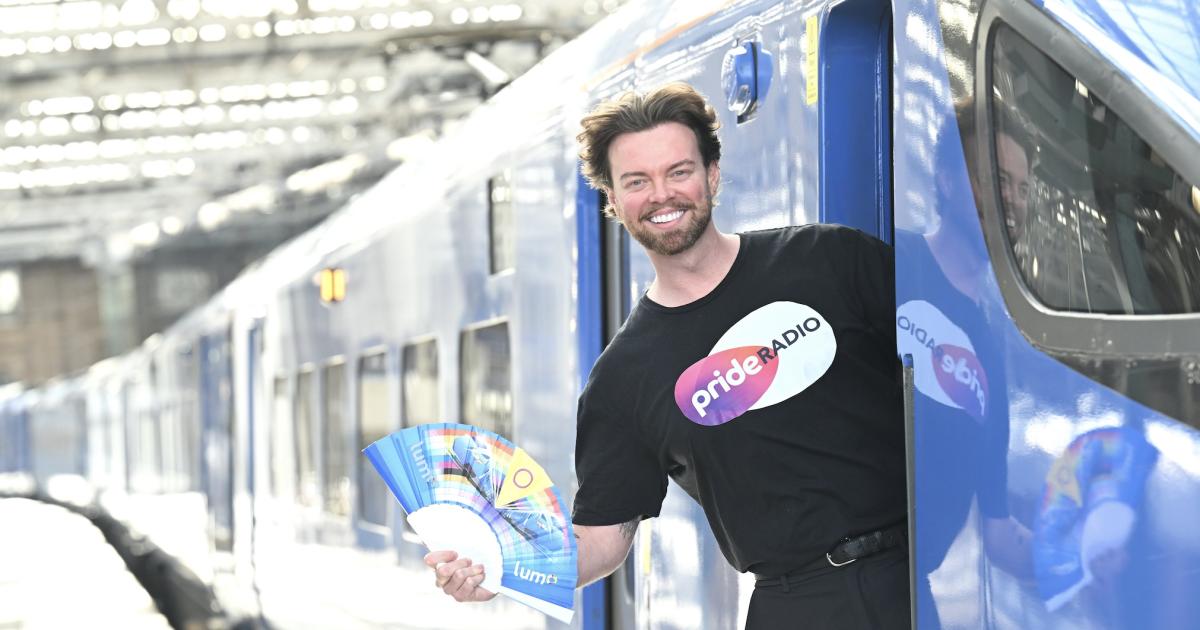
Newcastle-based Lumo is increasing its support across England and Scotland during Pride season, using digital billboards and dedicated train branding to highlight LGBTQ+ organisations.

The initiative is being amplified with outdoor advertising support from Ocean Outdoor, which has donated screen space in the city.

How the screens will look in Newcastle city centre (Image: Lumo)

Richard Salkeld, director of communications and partnerships at Lumo, said: “At Lumo, we believe everyone should feel able to be themselves and travel with confidence, which is why we’re proud to be supporting more Pride events and organisations than ever before this year.

“We’re delighted to be working alongside Pride Radio, Ocean Outdoor and our many Pride partners to help celebrate the incredible LGBTQ+ communities across the North East of England and beyond.

Advertisement

“Whether that’s through our Pride train, showcasing Pride organisations across the UK or supporting Pride Radio’s broadcast to audiences around the world, we hope our contribution helps ensure more people can feel included, represented and connected.”

How the screens will look in Newcastle city centre (Image: Lumo)

The operator has made a £1,000 donation to Gateshead-based Pride Radio, a not-for-profit station that broadcasts across the UK and internationally.

Pride Radio is broadcasting Newcastle Pride to audiences in 127 countries, including 38 where it is illegal to be LGBT+ and seven where it is punishable by death.

Peter Darrant, CEO of Pride Radio, said: “Pride Radio and Lumo share something special.

Advertisement

“We’re both proudly based in the North East but connect people far beyond our region every day.

“Together with Lumo and Ocean Outdoor, we’re taking Pride beyond the streets of Newcastle, helping more people experience the energy of Newcastle Pride, share in the celebrations and feel connected to our amazing city and its LGBTQ+ community wherever they are.

“That’s what Pride is all about.”

Lumo is also supporting Newcastle Pride by assisting with travel arrangements for headline artists and performers attending the city centre event.

Advertisement

Earlier this month, the company launched a dedicated ‘Pride train’ featuring artwork and branding from the LGBTQ+ groups it supports.

Keith Crisp, representing Ocean Outdoor, said: “Like Lumo, Ocean has a long tradition of supporting Pride events in the communities where we live and work.

“We are pleased to extend that to Newcastle using five of our large format screens to celebrate and support the LGBTQ+ community.”

Earlier this year, Lumo was named Best Small Employer in Scotland, in part thanks to the company demonstrating a clear commitment to inclusivity from how it supports customers, colleagues and the communities served.

Advertisement

Source link

Continue Reading

NewsBeat

NASA helped me uncover proof that God exists… here’s the simple formula that shows the Bible was right all along

Published

on

Using equations based on orbital speeds, distances in space and the physics of turbulence, Dr Nathanael-Israel Israel said he had uncovered evidence that the biblical account of creation was literally true

A scientist says he has found a mathematical formula that does what philosophers and theologians have tried to do for centuries: prove that God exists.

Using equations based on orbital speeds, distances in space and the physics of turbulence, Dr Nathanael-Israel Israel claimed he uncovered evidence that the biblical account of creation was literally true.

His calculations suggested that the Earth formed in 2.82 days and that the sun and moon were completed in 3.69 days, figures he said closely mirrored the timeline laid out in Genesis.

Israel clarified that his formula produced separate figures of 3.32 days for the moon and 3.69 days for the sun, placing the completion of both celestial bodies on the fourth day.

Advertisement

Because he believed no other major religion offered the same sequence of events, he argued that his work pointed specifically to the existence of the Christian God.

‘People say you can’t prove God, but the question is, “How can you prove God?” I’m the first person in history to offer this mathematical framework,’ Dr Israel told the Daily Mail.

The Georgia-based scientist insisted that his formula was so simple that even schoolchildren could perform the calculations using publicly available NASA data.

The NASA measurements used in his equations included the sizes and speeds of celestial bodies and the distances separating them, with a particular focus on the Earth, moon and sun. 

Advertisement

Using equations based on orbital speeds, distances in space and the physics of turbulence, Dr Nathanael-Israel Israel said he had uncovered evidence that the biblical account of creation was literally true

However, Israel’s conclusions have not been independently verified or accepted by the wider scientific community, and using official NASA measurements does not itself validate the assumptions or conclusions behind his formula. 

Mainstream astronomy holds that the sun formed before the Earth over billions of years, sharply conflicting with Israel’s claim that the planet was completed in less than three days and before the sun. 

Advertisement

He said the findings overturned the long-held notion that faith and science were fundamentally incompatible.

And after spending more than a decade developing his theory, Israel believes he has finally produced scientific evidence for the existence of God.

The scientist laid out his theory in his self-published book, Boldest Scientific Formula of God and Creation, in which he argues that mathematics and physics can be used to demonstrate the literal truth of the Genesis creation account.

Israel, who was born and raised in the West African nation of Benin before moving to the US two decades ago, said he had never viewed science and religion as opposing forces.

Advertisement

Instead, he spent 12 years examining scientific data and compiling variables from astronomy, physics, and other disciplines in an effort to understand the mechanics of creation itself.

‘When it comes to science, I know what I’m talking about. I’m not a preacher, I’m not a pastor, I’m not a novice who is just doing some pseudoscience. It took me 12 years of hard work,’ he said.

His calculations suggested that the Earth formed in 2.82 days and that the sun and moon were completed in 3.69 days, figures he said closely mirrored the timeline laid out in Genesis

His calculations suggested that the Earth formed in 2.82 days and that the sun and moon were completed in 3.69 days, figures he said closely mirrored the timeline laid out in Genesis 

Israel earned a PhD in Plant, Insect and Microbial Sciences with an emphasis on Plant Biology and Genetics from the University of Missouri.

Advertisement

He also earned bachelor’s and master’s degrees from the University of Abomey-Calavi in Benin and became a member of several scientific organizations in the US, including the American Association for the Advancement of Science and the American Chemical Society.

‘My PhD is in plant, insect and microbial science, so I’m a life scientist. But I’m not afraid or shy to say I’m a Christian. I believe in God,’ he said.

‘To come to this formula, I have had to go through hundreds of variables collected by scientists throughout the century, some of which were available on the NASA website and on many other space and agency websites.’

Unlike many researchers who attempted to reconcile religion and science, Israel said his work did not rely on traditional Creationist arguments.

Advertisement

He dismissed efforts to prove the Bible by challenging evolution or debating the existence of dinosaurs, arguing that mathematics offered a far stronger foundation.

At the heart of his theory was what he described as a simple formula rooted in orbital mechanics and turbulence.

‘The formula is based on the orbit and the orbital speed of the Earth,’ he explained.

Using publicly available measurements, including the Earth’s distance from the sun and its speed through space, Israel said he could calculate how long it took the planet to reach its current position.

Advertisement

To produce the figure of 2.82 days, Israel divided the distance between the Earth and sun by the sun’s escape velocity. He then added the time obtained by dividing the Earth’s circumference by its orbital speed.

The values used were an Earth-sun distance of 149.6 million kilometers and a solar escape velocity of 617.6 kilometers per second.

He calculated the Earth’s circumference using its radius of 3,963 miles, multiplying that figure by two and pi, then divided the result by the planet’s orbital speed of 18.5 miles per second. 

Written as a single calculation, his formula is: (149,600,000 km ÷ 617.6 km/s) + ([2 × π × 6,378.14 km] ÷ 29.78 km/s) = approximately 243,530 seconds, or 2.82 days.

Advertisement

Those calculations, he claimed, revealed that the Earth formed in 2.82 days, which the scientist suggested aligns with the Book of Genesis, which says: ‘In the beginning God created the heavens and the earth.’

The same framework suggested that the sun and moon were completed in 3.69 days, corresponding to the fourth day in the biblical account.

Israel said he applied the same basic formula to the moon and sun, producing formation times of 3.32 days and 3.69 days, respectively. He did not provide the full calculations for those two figures, saying they are detailed in his book.

‘The simple formula I discussed and discovered was able to help me also to explain the variation of life and chemicals and to scientifically prove that what the Bible has been saying for 3400 years, Jesus is correct,’ Israel said.

Advertisement

When asked why dividing distance by speed should represent the time required for creation, Israel pointed to the apparent alignment between his results and the Genesis chronology.

He said his formula showed that the Earth’s formation was completed in 2.82 days, placing it on the third day, while the moon and sun were completed in 3.32 and 3.69 days, placing both on the fourth day.

Israel argued that this sequence matched Genesis 1:1–19, which describes the Earth before the appearance of the two lights in the sky. However, his interpretation and formula have not been established as scientific consensus.

The calculations stemmed from a broader theory about the origins of the universe.

Advertisement

According to Israel, everything began as a massive body of material that he called the ‘Turbulent Prima Materia.’

He theorized that this primordial mass fragmented through the forces of fluid dynamics and turbulence, breaking apart repeatedly until it formed the precursors of the sun and the bodies orbiting it.

As these fragments separated, the material that would eventually become the Earth, moon and other objects escaped from the precursor of the sun and settled into their current positions.

His formula attempted to reconstruct that process by examining the distances between celestial bodies, the speeds needed for those bodies to break away from their larger parent masses and the orbital characteristics they exhibit today.

Advertisement

The enormous size of the sun’s precursor, he argued, explained why the sun formed after the Earth and moon.

‘You see, so that’s the bottom line of my discovery. I’m breaking down for you in the language that even elementary school students can understand,’ he said.

Israel said his framework differed from every other scientific approach that either attempted to prove God or argued against the existence of a creator.

‘My framework is different than all other scientific frameworks that try to prove God, or deny God,’ he said.

Advertisement

‘It’s not a framework based on evolutionism; it’s a simple framework I break down in just a few pages.’

He believed the implications of his work extended far beyond science and could challenge the beliefs of both skeptics and Christians.

According to Israel, many believers had been searching for evidence in the wrong places.

Rather than focusing on fossils or attempting to disprove established scientific theories, he argued that the answer lay in mathematics.

Advertisement

He further contended that his calculations pointed specifically to the Christian God because ‘only the Bible gave us a clear chronological story of creation.’

Source link

Continue Reading

NewsBeat

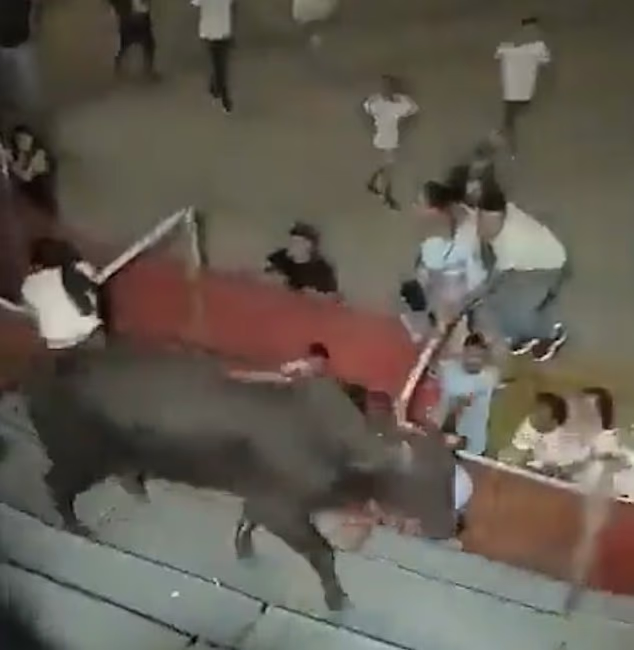
Terrifying moment bull leaps into the crowd at Colombian festival injuring four as spectators run for their lives

Published

on

A raging bull injured four people at a festival in Colombia after it launched itself into the crowd

Advertisement

A raging bull has seriously injured four spectators after it leapt into a crowd during a bullfight at a Colombian festival on Monday.

Crowds of people ran for their lives in the Castilla district of Coyaima, when the bull launched itself up into the stands and charged at festivalgoers.

The rampage took place at a ‘Corraleja’ event, a traditional bull festival where the animal is released into the ring and members of the public can dangerously tease it.

Video footage showed the bull seconds after it was released chasing people in the ring before it jumped over a tall red fence and into a large crowd.

Advertisement

Cheers of excitement quickly turned into screams of panic as people fled the stands, with some even jumping into the ring to escape.

One woman was hit and trampled by the bull as she tried to run away around the stand.

A fearless man then grabbed the bull by the tail, allowing others to quickly escape.

Advertisement

A raging bull injured four people at a festival in Colombia after it launched itself into the crowd

Video footage showed the bull running around the stands in the Castilla district in Coyaima on Monday

Video footage showed the bull running around the stands in the Castilla district in Coyaima on Monday

Seconds after the bull was released, it jumped into a large crowd and started charging at spectators

Seconds after the bull was released, it jumped into a large crowd and started charging at spectators

Bizarrely, as the carnage unfolds, a matador calmly walks across the bullring brandishing his red cape in an apparent attempt to get the bull’s attention.

Advertisement

Four people were seriously injured and have since been treated by emergency responders and taken to hospital.

An investigation is still ongoing into the incident to confirm the severity of their injuries and the exact number of people hurt by the bull. 

Ricardo Suárez, Tolima’s Secretary of the Interior, told local media: ‘The bull jumped towards the barrier where spectators were standing and attacked some of them.

‘This is the consequence of the violence that we humans continue to promote.

Advertisement

‘We must move towards new forms of entertainment and new spectacles that genuinely enrich Tolima’s culture.

‘This proves that such barbarity is neither culture nor bravery. Bullfighting must end in Tolima. It is a grotesque practice that contributes absolutely nothing to society.

‘We cannot seek enjoyment at the expense of the suffering of sentient beings – animals, and bulls that do not understand what is happening to them.’

This is not the first incident where a bull has gored festivalgoers this summer.

Advertisement

Just one week earlier than the Colombian bull rampage, a British pensioner became the oldest participant injured at this year’s San Fermin festival.

The 86-year-old tourist, from Halesowen in the West Midlands, was one of ten people injured during the final day of the festival on July 14.

The holidaymaker suffered multiple injuries, including a goring to his left elbow and wounds to his eyebrow and right hand. 

He was then rushed to hospital and treated for his injuries. 

Advertisement

William Mitchinson, 24, was the second Brit to be hospitalised after being knocked to the ground while trying to outrun the six bulls and accompanying steers.

He spoke outside Navarra University Hospital after leaving with his ankle in a brace.

‘I ran until the bull trampled me,’ he said. ‘I’d seen the festival on social media, and it looked like good fun.

‘It’s my first visit to Pamplona. I might come back another year – but only for the party.’

Advertisement

Officials confirmed two other runners had suffered goring wounds during the run, which lasted two minutes and 25 seconds.

Advertisement

Source link

Advertisement
Continue Reading

NewsBeat

Ariana Grande launches Brighter Days Ahead Foundation to support causes she connects with

Published

on

Ariana Grande launches Brighter Days Ahead Foundation to support causes she connects with

For years, pop star Ariana Grande gave away money, mostly quietly and without much structure. There were annual gifts to England’s Royal Manchester Children’s Hospital. Sometimes a night’s performance proceeds were handed to nonprofit groups. She anonymously funded a holiday gift drive for transgender young people in addition to launching a $3 million fundraising event for transgender youths in 2022.

Now those scattered acts of giving have a name and a public face: the Brighter Days Ahead Foundation. Launched in May, it will focus on causes Grande has advocated for in the past, including LGBTQ+ rights, reproductive health, immigrant rights, and mental health. Grande is doing this at a moment when philanthropic support for these causes is eroding, said Shauna Nep, Grande’s philanthropic adviser.

“We’re seeing the support for the kinds of issues she cares about going down drastically and the attacks going up aggressively,” Nep said.

This summer, Grande is using her Eternal Sunshine Tour to fund and promote the foundation, highlighting national and local nonprofits at each tour stop. Names of her grantee organizations are shown on screens in the center of the arena during the pre-show countdown. And fans who donate to the nonprofit can enter a sweepstake for a chance to win a trip to see her final tour date in London.

Advertisement

“The fan experience is still completely intact,” Nep said. “We’re meeting them where they are instead of taking them away from anything.”

Tour funds will be split among the featured local organizations, though none have been distributed yet. The grants announced so far have come entirely from Grande’s personal giving, a foundation spokesperson said.

In many ways, Grande, who also starred in the “Wicked” movies, is following in the footsteps of earlier generations of entertainers who lent their names to once controversial causes like HIV/AIDS and created their own foundations to help move large sums of money.

But today, celebrities’ platforms are larger than ever, giving them even more sway, noted Genevieve Shaker, who teaches courses on celebrity philanthropy and fundraising leadership at Indiana University’s Lilly School of Philanthropy.

Advertisement

“In the past, prior to social media, celebrities might be more dependent on traditional media to share stories about what they’re doing,” she said. “Now they have their own kind of media empire where they can leverage lots of channels to communicate, including about philanthropy and causes and nonprofits.”

Nonprofit Trans Lifeline is grateful for celebrity support

Trans Lifeline, which runs a crisis hotline for transgender people, is one of the nonprofits Grande has supported. The group has received $125,000 total — $75,000 in emergency funding last June and $50,000 when the foundation formally launched in May.

The money helped Trans Lifeline relaunch a microgrants program that distributed $100,000 directly to trans people across the country in partnership with five grassroots organizations, said Dante Alviar Horton, its executive director. Some of the funding also went toward improving benefits for the organization’s direct service crisis workers.

Trans Lifeline relies almost entirely on individual donors. Visibility gained from celebrity supporters has helped sustain the group, Alviar Horton said. He pointed to Trans Lifeline’s recent collaboration with designer Conner Ives on the “Protect the Dolls” T-shirt campaign, which raised more than $500,000 after celebrities like Pedro Pascal began wearing the shirts publicly.

Advertisement

“I was grateful that there were people in the celebrity sphere that cared enough to be like, ‘This matters,’” Alviar Horton said.

Celebrity philanthropy has often been dismissed as image management, allowing entertainers to have red carpet moments without putting much money or thought behind their advocacy efforts. Grande resisted creating a formal foundation for years for exactly that reason, Nep said.

Advertisement

“She does not want anyone to think that she thinks of herself as a philanthropist,” Nep said. “She knows she’s an artist.”

However, Nep, who has worked with the singer since 2018, encouraged Grande to formalize her giving so she could strategically move money to nonprofit groups and more easily collaborate with funding partners.

Grande’s Brighter Days Ahead Foundation is a fiscally sponsored project of the Entertainment Industry Foundation, a public charity established in 1942 to support Hollywood’s philanthropic efforts. It allows celebrities, including Charlize Theron and Olivia Rodrigo, to easily create nonprofits to raise and distribute funds.

The largest of her foundation’s four funds is “Protect and Defend,” which supports organizations doing legal and legislative work for transgender youths, immigrants, and reproductive rights. The foundation is the largest funder for several of the grassroots organizations it supports and typically provides unrestricted grants. These groups typically get little support from institutional and government funders. Transgender-focused organizations, specifically, have seen funding dwindle as needs increase, Nep noted.

Advertisement

Grande’s advocacy looks to meet the moment

Grande has been a longtime advocate for causes at the center of her philanthropy. In 2019, she donated roughly $250,000 in concert proceeds to Planned Parenthood after several states passed abortion restrictions. She has publicly discussed her struggles with post-traumatic stress disorder, anxiety, and depression, expressed appreciation for her gay and transgender fans, and has spoken out against the Trump administration’s immigration policies.

Grande’s activism and personal connection to these issues echo an earlier era when celebrities led the charge on funding for AIDS and HIV, Shaker said. Elizabeth Taylor co-founded the American Foundation for AIDS Research, or amfAR, in 1985 after watching friends suffer from HIV/AIDS and its stigma. For similar reasons, singer Elton John founded the Elton John AIDS Foundation in 1992, the same year he first publicly identified himself as gay.

The political climate facing transgender people today rivals what HIV/AIDS advocates confronted decades ago, said Anne Aslett, CEO of the Elton John AIDS Foundation.

Back in the 1980s and ’90s, John was watching close friends like singer Freddie Mercury succumb to AIDS-related illnesses, she said.

Advertisement

It was “really, really tough” to raise money for HIV/AIDS work among the broader public, including within the entertainment industry, she said. Because of his global stardom, John was able to humanize the cause for people, even those who didn’t share his views on politics or sexuality, Aslett said.

From the outset, the foundation was shaped by his authentic interest in supporting AIDS research and his insistence on listening to people with lived experience of the epidemic, Aslett said. That is what has helped sustain the organization for more than three decades, she said. But that personal interest and connection aren’t enough to really drive philanthropic success.

“Artists are hard-wired to pay attention to human emotion,” Aslett said. “They’re very empathetic. But that alone isn’t enough. They have to have a good structure underneath to make it work.”

_____

Advertisement

Stephanie Beasley is fellowship director and a senior writer at the Chronicle of Philanthropy, where you can read the full article. This article was provided to The Associated Press by the Chronicle of Philanthropy as part of a partnership to cover philanthropy and nonprofits supported by the Lilly Endowment. The Chronicle is solely responsible for the content. For all of AP’s philanthropy coverage, visit https://apnews.com/hub/philanthropy.

Source link

Advertisement
Continue Reading

NewsBeat

BBC reveals 5 new Strictly Come Dancing professionals

Published

on

BBC reveals 5 new Strictly Come Dancing professionals

Coming from a range of backgrounds and countries, the BBC has said that they are some of the most exciting talents in dance today.

The new dancers join Strictly’s 14 returning professionals for the upcoming series.

BBC reveals 5 new Strictly Come Dancing professionals

The first is Maddie Ingoldsby from Bournemouth, who is a UK National Ballroom Champion and eight-time Amateur 10-Dance World Champion.

Maddie played Annie in the West End as a child and has also appeared on Strictly before, making her television debut on Strictly: It Takes Two – before going on to perform in a Pros’ group number on the main show’s Christmas special.

Advertisement

Ms Ingoldsby said: “Joining Strictly as a professional dancer is truly a dream come true.

“My heart is so full of gratitude, excitement, and anticipation as I begin this incredible new chapter.

“Dance has always been where I feel most myself, and to now share my heart, my creativity, and my love for it on a show that has inspired millions is an honour beyond words.”

The second is Aleksandra Isaeva, a multiple Ukrainian National Latin Champion currently living in Italy.

Advertisement

She said: “I’ve been living and breathing dance for as long as I can remember, so joining the Strictly family is a true honour.

“The thought of learning from and sharing this experience with such extraordinary dancers, choreographers, and the whole Strictly family still gives me goosebumps.

“I can’t wait to pour my whole heart into every performance, inspire others, and be inspired along the way.”

Her dance partner, Cristian Priori, is also joining the show and is a four-time Italian Latin Champion.

Advertisement

He said: “Saying yes to Strictly was an easy decision.

“Dance has always been my way of expressing myself, and I’m so excited to begin this new chapter.

“I’m ready to give my all, enjoy every moment of this amazing journey, and embrace everything it has to offer.

“Strictly is where passion, hard work and entertainment come together, so being part of it is a real privilege.”

Advertisement

Undefeated South African Latin Champion Lethabo Monametsi also joins the line-up.

She said: “This moment is bigger than me.

“I step into it with profound gratitude and deep humility, knowing it is the culmination of years of unwavering love, belief, and support from the people who dared to dream alongside me.

“Representing South Africa on the Strictly Come Dancing stage is far more than a career milestone, it is an honour beyond words, and I cannot wait to embrace every extraordinary moment of this journey.”

Advertisement

Two-time National Latin Champion in his native country, Canada, Mark Karmalita rounds out the newcomers.

He said: “Joining Strictly feels incredibly special, and I’m honoured to be stepping into a ballroom with so much history and heart.

“I can’t wait to bring my own style, connect with the audience, and enjoy every moment along the way.”

Sarah James, executive producer at BBC Studios, said: “Aleksandra, Cristian, Lethabo, Maddie and Mark are all outstanding world-class dancers and we can’t wait to see them shine under the Strictly glitterball this September.”

Which professionals are returning for Strictly 2026?

Some 14 dancers have been confirmed to be returning for the new series.

Advertisement

They are:

  • Alexis Warr
  • Aljaž Škorjanec
  • Amy Dowden
  • Carlos Gu
  • Dianne Buswell
  • Jowita Przystal
  • Julian Caillon
  • Kai Widdrington
  • Katya Jones
  • Lauren Oakley
  • Nancy Xu
  • Neil Jones
  • Nikita Kuzmin
  • Vito Coppola

Four Strictly stars have left ahead of the new series, which were Karen Hauer, Luba Mushtuk, Michelle Tsiakkas and Gorka Marquez.

Meanwhile, Johannes Radebe is moving from a dancing to presenting role, alongside Emma Willis and Josh Widdicombe.

Contestants for Strictly Come Dancing 2026 so far

There have been seven contestants confirmed for the upcoming Strictly series.

Advertisement

They are:

  • Lacey Turner (EastEnders’ Stacey Slater)
  • Dani Dyer  (TV personality – returning after injury in 2025)
  • Delta Goodrem (Australian singer)
  • Chris Appleton (Hair stylist)
  • Cach Mercer (Reality TV star)
  • Will Best (TV and radio host)
  • Dame Sarah Storey (Britain’s most successful Paralympian)
  • Jaime Winstone (Actress)

All four Strictly judges, Craig Revel Horwood, Motsi Mabuse, Anton Du Beke and Shirley Ballas (head judge), will each be returning.

Strictly is due to return to BBC One and BBC iPlayer this September.

Will you be watching the new series of Strictly? Let us know in the comments.

Advertisement

Source link

Continue Reading

Trending

Copyright © 2025