If you want daffodils to come back year after year, daffodil care is key once they have finished flowering.
Angela Patrone Senior Lifestyle Reporter
03:39, 19 Apr 2026
Daffodils are a reliable sign of spring and bring beautiful colour to gardens. What’s more, daffodil bulbs naturally deter squirrels and other rodents, making them an excellent option if you’ve previously had trouble with troublesome small animals treating your garden bulbs as a meal.
These bright flowers are incredibly straightforward to cultivate, naturalise effectively and return in increasing numbers each year, provided they receive proper care.
Advertisement
On his gardening TikTok account, @joesgarden, Joe revealed a “quick tip to keep daffodils flowering year after year”. All that’s required is some clean, sharp secateurs and 10 seconds of your time.
One challenge gardeners might encounter when growing daffodils that flowered the previous year is that they can emerge “blind” – producing foliage but no blooms.
Content cannot be displayed without consent
Prevent this by deadheading the faded flowers and allowing the foliage to die back naturally without tying it into a knot. This will usually need doing from mid to late April.
Joe explained the process. He said, “Once the heads die back, locate the seed pod, grab your snippers and just cut.
Advertisement
“Leave the foliage to die back to return the energy straight back into the bulb.”
Ensure you avoid tying up daffodil leaves or trimming them back while they’re still green, as this could diminish flowering next year.
Keep your plants watered and fed if they’ve been in the pot or the ground for some time, as they will be lacking nutrients.
Additionally, if the bulbs have been in the ground for several years, they may have become overcrowded. Should this be the case, dig them up and replant the larger, healthier bulbs, as smaller ones could take several years to reach flowering size.
Advertisement
Since daffodils finish flowering by mid-spring, they ought to be planted together with plants that flourish during summer, such as dahlias, geraniums and peonies.
What is your current role and what does it involve?
I’m the Group Executive Chef at Elle R Leisure, a family-run hospitality group in the North West. My role covers everything kitchen-related across all our hotels and restaurants — menus, training, food safety, financials, stock, wages, the lot. My main focus right now is our latest venue, Longridge House — a boutique hotel, restaurant and wedding venue in the heart of the Ribble Valley, just 30 minutes from Preston. It’s a new venture and I’ve been involved from the ground up, which has been brilliant.
How long have you been a chef?
31 years. I started when I was 15.
Advertisement
How did you first get into cooking?
By accident. I took home economics at school because not enough people had signed up for my first choice. Turns out I had a bit of a knack for it — I entered a competition to design a dish for Little Chef restaurants and ended up going down to London to cook for Lloyd Grossman. Won some money for the school, and my teacher pulled me aside afterwards and said, “you’re good at this, do you want to try and find a job?” I said yes — and she helped me find my first job in the kitchen.
Where did you learn your craft?
On the job, mostly. I started working evenings and days off while I was still at college, just made myself dependable and worked my way up. I was sous chef by 19. The real education came later when I worked at a place in Edinburgh where we used every cheap cut imaginable, nothing wasted. Lamb heart, faggots, the lot. When you can make those taste good, you’ve actually learned how to cook.
Advertisement
This month’s Meet the Chef, James Scott (Image: Supplied)
What was your first job in hospitality?
The Channing Hotel — a small boutique hotel in Edinburgh, five minutes from my school. I started on the veg section, which was very much the bottom rung. Old school restaurants used to serve sides of vegetables with your main, so someone had to be in charge of that. That someone was me.
What is your signature dish?
Right now, everything I’m doing with fire. When we were planning Longridge, the idea of cooking over wood and fire really grabbed me — I bought books, did research, visited restaurants doing it properly. The flavour you get from cooking over different woods is something you genuinely can’t replicate any other way. We use a Namibian hardwood that gives off a lovely sweet aroma.
Advertisement
We also do a lot of brining — our 24-hour brined chicken goes into a 5% salt brine overnight with garlic, thyme and lemon, then we dry it in the fridge so the skin crisps up beautifully on the barbecue. It’s the kind of cooking that looks simple but has a lot of thought behind it. We have a bespoke-built barbecue at Longridge that we designed ourselves — it does rotisserie, direct grilling and plank cooking all in one.
The team who built it weren’t sure they could pull it off, but what they delivered is genuinely beautiful. I’m looking forward to our Fire Feast Night at Longridge House on June 20th, an outdoor dining experience where our head chef and I will cook over open flames in the gardens, serving a feast of fire-cooked dishes.
Longridge House (Image: Supplied)
What’s been your worst cooking disaster?
I nearly got sacked in my first job. The chef asked me to seal 40 fillet steaks ready for the oven. I sealed them off, put them in… and completely forgot about them. By the time he asked for them, every single one was overcooked and had shrunk to nothing.
Advertisement
An awful lot of money, just gone. He could have fired me on the spot — he was within his rights. Instead he just looked at me and said, “when I say seal it, I mean seal it.” I worked for that man for nine and a half years after that. I should say it’s not just professional kitchens where things go wrong. I once put a disposable barbecue on my mum’s garden table — she’d just had the whole garden paved and I didn’t want to mark it. Came back out five minutes later to find the table completely in flames.
What are your culinary ambitions?
Honestly, I achieved most of mine earlier than I expected — head chef at 22, a Michelin Bib, top 100 restaurants. After that I made a decision to just say yes to opportunities and see where they led. That’s worked out pretty well so far.
What do you like to eat?
Advertisement
Scallops, without question — my favourite ingredient. And pastel de nata from Portugal, which is possibly the best thing you can eat. I love the Chinese barbecue restaurants in Manchester’s Chinatown. Great produce, simple cooking, honest flavour. Not a million miles from what we’re doing at Longridge, just with different wood.
How do you achieve a work/life balance?
I’m probably not the best person to ask. But what I can say is that the people you work with in this industry become your friends — your social life and your work life overlap in a way that doesn’t happen in many jobs. And when I am at home, I’m properly present. That matters more to me now than it used to.
The interior of The Dining Room at Longridge House (Image: Supplied)
Restaurant opening times: Wednesday – Friday 12 noon – 9.00pm. Saturday and Sunday 8am to 10am noon to 9pm. Closed Monday and Tuesday.
Longridge House, on the edge of the Forest of Bowland, is surrounded by beautiful Lancashire countryside, offering staying guests the chance to unwind in stylish boutique rooms and all visitors, the opportunity to sample great seasonal food and the warmest hospitality. For their latest events and offers go to www.longridgehouse.com
Advertisement
Longridge House is a Visit Lancashire Partner. Visit Lancashire, through their Taste Lancashire campaigns and activities, showcase Lancashire’s leading food and drink providers and producers, locally, nationally and internationally. For more information go to www.visitlancashire.com/Taste
RECIPE
Longridge House – Wood roasted tomatoes & whipped feta Bruschetta with honey and sumac
This is the make-at-home version; it serves 2.
Advertisement
Tea smoked tomatoes
120g cherry vine tomatoes
10g loose leaf tea – use your favourite black tea, Darjeeling, Assam or Lapsang Souchong would work
Extra virgin olive oil
Maldon salt.
James’ Wood roasted tomatoes & whipped feta Bruschetta with honey and sumac (Image: Supplied)
Wash the tomatoes but keep them intact on the vine. Drizzle with extra virgin olive oil and season with Maldon salt. In a pan add the tea to the base. Place a doubled over layer of tin foil for the tomatoes to sit on without touching the tea. Cover tightly with tin foil. Turn up the heat until the tea starts to smoke. Turn off the heat and let it sit for 10 mins Roast or grill the tomatoes in a high heat until the skin blisters and the tomatoes start to cook.
Whipped feta (makes 340g, save some for later)
220g feta
100g cream cheese
1/4 lemon juice and zest
25ml extra virgin olive oil
Maldon salt to taste.
Place all the ingredients in a blender or food processor and blend until smooth. Check the seasoning.
To put the dish together
Advertisement
2 thick slices of good sourdough
1 garlic clove
10ml extra virgin olive oil
120g tea smoked tomatoes
100g whipped feta
Pinch sumac
10g of good quality honey
A few basil leaves.
Rub the sourdough with the extra virgin olive oil and garlic. Toast on both sides, put on a plate. Top with the whipped feta covering the bread. Sprinkle over the sumac and drizzle with the honey. Top with the warm tomatoes and rip some basil leaves over the top
“It seems clear SNP HQ had lost all sight of the fact they were now playing with lives, rather than the usual political games as they attempted to round up complainers.”
There are few people in Scottish politics who do not express the view privately that senior SNP figures conspired to bring down Alex Salmond.
Advertisement
The generally accepted version of events is that Nicola Sturgeon’s inner circle thought the former FM was planning a return to Holyrood and that represented a direct threat.
A new sexual harassment policy within the Scottish Government, which could pursue former ministers, was drawn up and Salmond was targeted with it in 2017. Historic claims of sexual harassment – which they may well have believed to hold merit – were levelled against him.
That internal investigation then spun out of control and ended up in a criminal probe. Salmond went on to win a judicial review which found the government complaints process to have been unlawful and biased, and he was then cleared of all criminal charges at the High Court in Edinburgh.
The ex-SNP leader himself admitted to being “no angel” and conceded that at times he should have been “more careful with people’s personal space”. But he died without any court having found him guilty of any crime and that outcome must remain the foundation of an honest discussion.
Advertisement
The communications between top SNP figures we published today raise legitimate questions about what was happening behind the scenes in the months leading up to that trial. It seems clear SNP HQ had lost all sight of the fact they were now playing with lives, rather than the usual political games as they attempted to round up complainers.
Advertisement
Allegations of sexual misconduct must always be treated with seriousness and sensitivity for alleged victims. But fairness cuts both ways. There is no doubt that if found guilty on even one charge Salmond’s reputation would have been devastated.
Indeed many believe the stress of the affair was a factor in his untimely death from a heart attack at age 69. Like him or loath him, Salmond was a towering figure whose impact will be felt for generations.
Until the full truth of this sorry affair emerges the SNP and Scotland’s democratic and legal establishments will have questions to answer.
Get more Daily Record exclusives by signing up for free to Google’s preferred sources. Click HERE
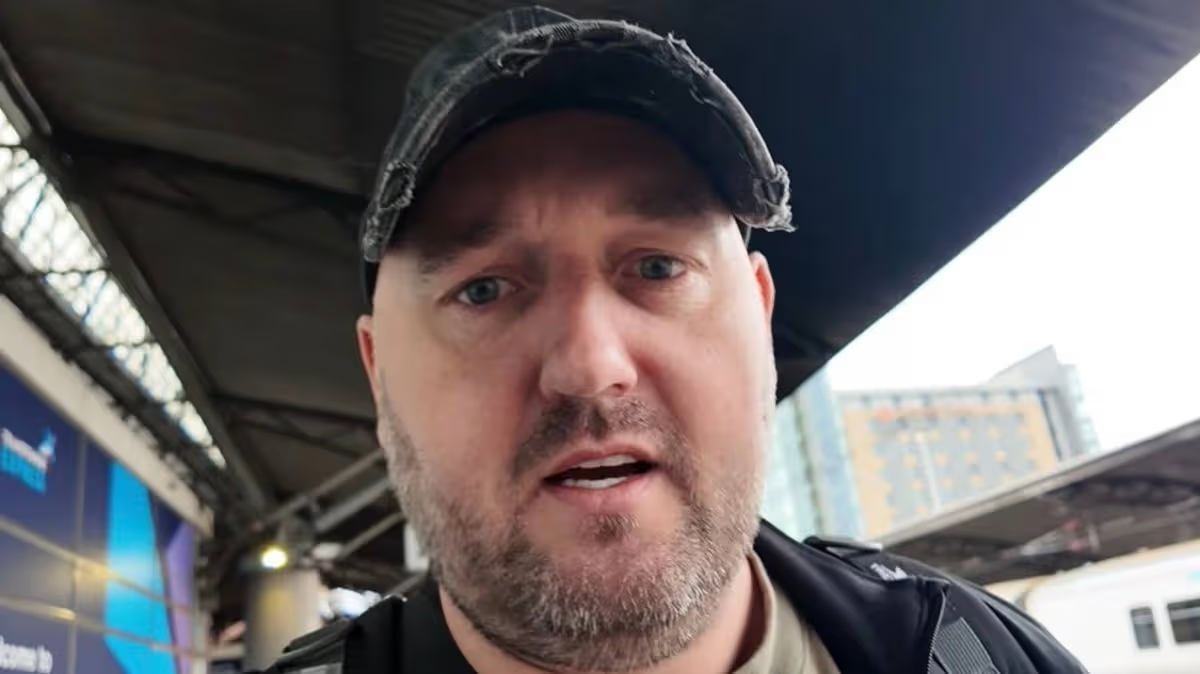
A content creator flying from Manchester Airport said panicked passengers started shoving each other over fears that new Entry/Exit System rules would leave them queuing for hours at Tenerife
A content creator has revealed how “panicked” passengers began shoving one another amid fears that new travel regulations would leave them facing hours-long queues. The new Entry/Exit System (EES) travel requirement has sparked chaos across numerous European airports, with some Britons even missing flights due to lengthy waiting times in countries including Spain, Portugal and Poland.
Advertisement
The rules require non-EU nationals, including Brits, to register their biometrics rather than having their passports stamped at border control, causing significant disruption throughout the continent. Just Deano, who touched down in Tenerife this week, reported considerable chaos from flustered fellow travellers, despite sailing through immigration himself in a matter of minutes.
The Yorkshireman, who hails from Huddersfield, made the journey to the popular Spanish island from Manchester Airport aboard an EasyJet flight. Prior to landing, he told his subscribers: “What you’re really interested in is probably how long it’s going to take me to get through to immigration because I’ve seen reals and posts and videos about this – and apparently it is a nightmare.
“So, this is the best flight ever video, but hopefully it don’t go wrong at the immigration.”
Yet upon landing, it wasn’t the queues that proved problematic — it was the behaviour of fellow passengers themselves, according to Deano. He said: “Ok, so it’s quarter to nine now, let’s see how long it takes. Everyone is panicking over this issue. So everyone is pushing and shoving past each other. It’s chaos. Absolute chaos. But we will see how long it takes.”
The camera then cut to the next scene where Deano said: “All that fuss for nothing! It’s 20.52. That took me seven minutes from getting off the bus from the plane to getting through.
“I didn’t have to fingerprint. I don’t know if that’s because I’ve done it before. I’m not really sure but all that fuss for nothing. Seven minutes, that’s all it took. People panicking, pushing and shoving. Crazy. Absolutely crazy. We’re out and we’re good to go.
“We went to the e-gate machine. It didn’t ask for my fingerprints, probably because I have already done that in different countries. And then you went past and did the whole look at the photo, another automatic e-gate.”
The EES was brought in to replace the passport stamp, automatically recording when a traveller enters and exits a country within the EU.
This means British nationals must register details including fingerprints, facial images and passport scans on their first visit to the Schengen area.
However, following its recent rollout, numerous passengers at Tenerife South Airport reported that some machines failed to function properly, with fingerprints being rejected. Others claimed they missed their flights as a result of the lengthy delays. One frustrated Brit commented: “The key is to arrive three hours early so at least you are in the front of the queue when problems start.”
Advertisement
Another remarked: “Love Tenerife but HATE the airport.”
Police have even been required to intervene to manage the chaos, but Deano reported he experienced no such difficulties during his journey to Tenerife, where he is remaining for one week.
Following the posting of his video, which you can view in full here, one individual responded: “I would hate to be a Brit traveller now.”
Advertisement
Another commented: “You did well getting through new border gates. Took me 4 hours last week getting through Barcelona. 3 non EU planes landed at similar times so had 500 people getting angry and impatient to get through.”
A third remarked: “You were extremely lucky to get through so quickly probably yours was the only flight landing around that time.”
There is anger directed at Rosenior, but many Chelsea supporters also point the finger at Eghbali, Boehly and the rest of the BlueCo ownership.
The latest protest saw supporters march from The Wolfpack Inn pub to Stamford Bridge before kick-off, having grown from a turnout of about 200 before the Brentford match to more than 500 before Saturday’s tie.
There were flares, banners and chants directed at the owners, as well as calls in support of former owner Abramovich.
Under the terms of the takeover agreement in 2022, the current ownership group cannot sell the club until at least 2032. However, there are signs they are willing to listen to some of the criticism, including calls to recruit more experienced players.
Advertisement
“We recognise we need balance. You tweak a model, you improve and you learn from mistakes,” Eghbali said. “We have a strong core, but we need to add experience to take the team to the next level and achieve consistency. That is not lost on us.”
However, failure to qualify for the Champions League would undermine any rebuild. Chelsea have already spent about £1.5bn on signings under the current ownership and, despite recouping approximately £750m in sales, they remain under financial scrutiny from Uefa, having faced fines for breaching their regulations.
The club has announced Premier League record pre-tax losses in its latest accounts and – without the additional revenue generated by Europe’s premier competition through broadcasting, sponsorship and ticket sales – questions remain over whether Chelsea can recruit effectively in the summer.
Before kick-off, Cole Palmer told TNT Sports: “If we’re not in the Champions League, everything changes.”
Advertisement
Asked about Palmer’s comments and the potential financial implications, Rosenior replied: “The honest answer is I don’t know. We’re still fighting and we’ll address that situation at the end of the season, whatever the situation is.”
Meanwhile, Enzo Fernandez’s agent, Javier Pastore, has said his client would view missing out on Champions League football as an issue, despite the midfielder’s two-match internal ban – imposed following comments linking him with a move to Real Madrid – coming to an end on Saturday.
While the protest movement has largely been driven by younger supporters, there are signs of apathy among older match-going fans. Boos were heard at full-time, with the atmosphere inside Stamford Bridge growing quieter with each game.
Gary Freeman had guided tours in the area for more than 30 years (Picture: Jamie Pyatt News Ltd)
The co-owner of a South African safari reserve was killed by a charging elephant while leading a walking tour.
Gary Freeman, who helped to run Klaserie Private Nature Reserve in the north-east of the country, is said to have previously told his guests he would rather die in an elephant attack than shoot one.
According to the Daily Mail, the 65-year-old tried to scare away the animal by pulling out his firearm but did not fire at it.
The group of four tourists on the trip helped him into the guide vehicle after the incident on April 9 but he soon ‘succumbed to his dreadful injuries’, a source told the newspaper.
Advertisement
Friends and colleagues of the experienced guide described him as a ‘true gentleman’ on social media.
A tribute from Klaserie reserve said: ‘His presence, kindness, and contribution to this landscape will be deeply missed by all who knew him.
Sign up for all of the latest stories
Start your day informed with Metro’s News Updates newsletter or get Breaking Newsalerts the moment it happens.
Advertisement
‘Our heartfelt condolences go out to Hanneke, his family, friends, and colleagues during this incredibly difficult time. We ask that their privacy be respected as they navigate this loss.
‘In moments like these, the strength of the Klaserie lies in its community — in supporting one another with care, compassion, and understanding.’
According to reports in South Africa, the elephant involved in the incident was a female.
Advertisement
The animals can reach 3 tons in weight and average at around 8ft 6in tall.
Male African elephants can reach around six tons, while females are half that size (Picture: Klaseriereserve.co.za)
Brigadier Hlulani Mashaba, a spokesman for Limpopo Police, said: ‘The deceased, who is the owner of the game reserve, was touring with the tourists and at some point alighted from their vehicle and walked on foot.
‘As the group were walking an elephant suddenly emerged and charged at him. He tried to scare it off with the revolver he was carrying but he was ultimately attacked by the elephant.
‘The driver and tracker together with other tourists took him to a safe place and summoned the emergency medical personnel. Upon their arrival, he was unfortunately certified dead.
‘There is no evidence that suggests the firearm was used.’
Advertisement
Mr Freeman was leading the tour along the banks of the Klaserie River at the time (Picture: Claire Galaway – Insidehook)
Gary Freeman Safaris was founded in 1993, according to its website, and specialises in wilderness walking tours.
A description says: ‘The objective of the trail is to expose the trailists to the game reserve environment, looking at all aspects, both large and small.
‘Time is spent unravelling the intricacies of the bush and admiring many of the smaller species that would otherwise be overlooked if traveling in a vehicle.’
Mr Freeman had been involved in environmental education for almost 40 years, starting in 1987.
“Households are already absorbing the impact, and in that context, by the time payments arrive, the immediate shock will have passed through family budgets, often in ways that are not easily reversed.”
08:28, 19 Apr 2026Updated 08:31, 19 Apr 2026
Advertisement
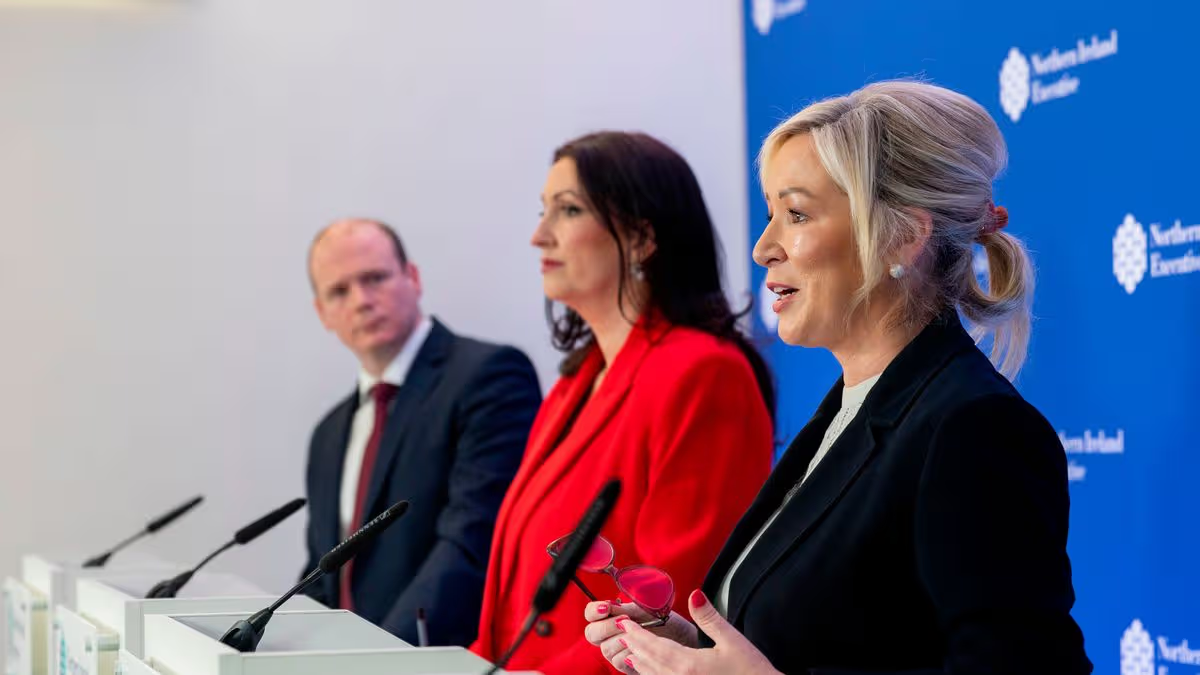
For the first time in six months, the First and deputy First Minister stood shoulder to shoulder and delivered a single, consistent message after an Executive meeting.
That is not how this Executive usually presents itself. Joint appearances by Michelle O’Neill and Emma Little-Pengelly were frequent in the early days of the re-established Executive before, at least temporarily, having been set aside.
The headline announcement was a £36.4 million support package, including £100 vouchers for around 300,000 households reliant on heating oil. It is a tangible intervention, and in the current climate, not an insignificant one. But no one around the table seriously tried to present it as a solution to the problem at hand.
Instead, the tone was careful and almost deliberately restrained. Ministers acknowledged the limits of what they were announcing. Gordon Lyons was the most explicit, stating plainly that the support “doesn’t go the full way”. That candour points to a wider reality about how Stormont is now operating.
There has been a gradual but noticeable shift in how ministers frame these moments. Where once there might have been an attempt to stretch the significance of a package, there is now a tendency to situate it within a broader argument about constraint. The Executive is doing what it can, but what it can do is not enough.
That line of reasoning has become increasingly familiar. When decisions become difficult or when interventions fall short of what is required, responsibility is drawn upwards, towards Westminster, in what has been termed ‘blaming the Brits’. In many cases, that argument has substance. The most immediate and effective levers, including taxation, VAT and fuel duty, do not sit in Stormont.
But it is also true that this framing has become something of a political reflex. It sits alongside a record settlement of £18.2 billion for 2025/26, the largest in the history of devolution. That does not mean the pressures are not real, or that departments are not stretched. They are. But it does complicate the narrative that Stormont is operating without meaningful resources.
Advertisement
What Thursday demonstrated is how those two realities now coexist. The Executive is both better funded than at any point since devolution and, at the same time, increasingly insistent that it cannot meet the scale of current challenges without further intervention from London.
That tension was visible in the decision to invite Hilary Benn to attend the Executive meeting. It was an unusual move, and a revealing one. Secretaries of State are not typically asked to sit in on devolved discussions. When they are, it is because the boundary between devolved responsibility and reserved power is being actively tested.
His absence leaves the impression of a government being asked to engage directly with a devolved administration in difficulty and choosing not to do so in that forum.
That inevitably colours the Executive’s next step of requesting a meeting with Keir Starmer. On paper, it is a logical escalation. In practice, it comes at an awkward time. With elections approaching in Great Britain and Starmer’s authority appearing less certain than it once did, Northern Ireland risks becoming a secondary concern.
Advertisement
If a Secretary of State cannot attend an Executive meeting during a regional crisis, there is a reasonable question about how quickly or how seriously a Prime Minister will engage.
In the meantime, the Executive is left managing within its limits. The £100 voucher scheme is a case study in that constraint. It is targeted, relatively straightforward, and politically achievable. But it is also slow. The infrastructure to deliver it will take at least three months to put in place.
Prices have already risen sharply. Households are already absorbing the impact, and in that context, by the time payments arrive, the immediate shock will have passed through family budgets, often in ways that are not easily reversed.
This is the gap at the centre of the current response. Stormont can agree support, but not always deliver it at pace. Westminster can act quickly, but has so far chosen not to use the mechanisms that would provide the most immediate relief.
Advertisement
What is different now is the level of agreement about that diagnosis. The joint press conference, the first in half a year, was not intended to present a comprehensive solution. Instead, it was about setting out a shared understanding of the problem and, just as importantly, where the Executive believes responsibility now sits.
Whether that argument lands is another question. A united Executive can make a clearer case, but it cannot compel a response. If that response is not forthcoming, the risk is that the familiar pattern deepens, whereby Stormont announces what it can, Westminster is asked to do the rest, and the gap between the two becomes the space in which public frustration grows.
Dame Emily Thornberry, chair of the Foreign Affairs Committee, has said new revelations have “called into question” evidence Sir Olly gave to MPs in November, during which he did not disclose that the government’s security vetting agency advised the Foreign Office to deny Mandelson a high-level security clearance.
The community centre is set to open in summer 2027
A library and meeting rooms in a new community space will be built as part of a major 120-home development. The Nest, a new community centre, is set to open in East Barnwell in summer 2027, according to local charity Abbey People.
Advertisement
It forms part of the wider Barnwell Square development to deliver 120 modern council homes on both sides of Barnwell Road. According to Abbey People, who are in partnership with Barnwell Library, The Nest will include open public spaces, library services, and bookable meeting rooms.
Residents will be able to join groups, get support, use the library, or celebrate special occasions there. The charity said it will create “a visible, modern home for community life, supporting residents of all ages and helping the neighbourhood thrive”.
“Above all, The Nest is being created as a place where people feel comfortable, welcome, and truly at home in their community,” Abbey People said.
The Nest will be located inside a new building currently in the works at the corner of Barnwell Road and Newmarket Road. It will be in a mixed-use neighbourhood that will include a public library, a pre-school, open spaces, commercial units, and new council homes.
Advertisement
The Barnwell Square development replaces 18 ageing flats with 120 new council homes including four that have been designed for people with disabilities. The homes are being built by Cambridge Investment Partnership with housebuilder The Hill Group.
Everton host Liverpool today in, perhaps, the most important Merseyside derby in recent seasons.
Both Everton and Liverpool go into the Premier League showdown hoping to bolster their respective hopes of European qualification.
Everton, meanwhile, realistically need a win to remain in Champions League contention. That said, David Moyes’ side will still be in the hunt for a Conference League spot regardless of the outcome of hosting a Merseyside derby for the first time in their new stadium.
Date, kick-off time and venue
Advertisement
Everton vs Liverpool is scheduled for a 2pm BST kick-off today, Sunday, April 19, 2026.
The match will take place at the Hill Dickinson Stadium.
Where to watch Everton vs Liverpool
TV channel: In the UK, the game will be televised live on Sky Sports. Coverage starts at 1pm BST on Sky Sports Main Event.
Advertisement
Live stream: Sky Sports subscribers can also catch the contest live online via the Sky Go app.
Live blog: You can follow all the action on matchday via Standard Sport’s live blog.
Everton vs Liverpool team news
Everton could be boosted by the return of Carlos Alcaraz from injury. The midfielder has been out of action since the 2-1 home defeat by Bournemouth at the start of February, but is back in training.
Advertisement
Jack Grealish misses out, but the Toffees are almost at full strength for the Merseyside derby.
With Ekitike sidelined, the door is open for one of Mohamed Salah or Cody Gakpo to start in attack but it remains to be seen if Alexander Isak leads the line or is used as a substitute with his minutes being managed carefully.
Alisson Becker is expected to remain sidelined, along with Conor Bradley, Giovanni Leoni and Wataru Endo.
Alexander Isak is fit again but Liverpool have been cautious with his minutes
Advertisement
AFP via Getty Images
Everton vs Liverpool prediction
Form always goes out of the window when it comes to a derby and that will be the case for this encounter.
Liverpool have a buffer in fifth following that win over Fulham but know that a strong end to the season should see them finish much higher up in the table.
Advertisement
Everton, though, have European ambitions themselves and will want to mark the first-ever Merseyside derby at the Hill Dickinson Stadium in style.
The EU plans to take fingerprints and facial biometrics from British travellers to Europe are supposed to be complete – but there are many teething problems. The long-awaited “entry-exit system” (EES) was due to be rolled out over the course of 180 days from 12 October 2025 to 9 April 2026. It applies to all “third-country non-visa nationals” including UK passport holders.
The aims of the EES are:
To identify suspected criminals.
To combat identity fraud.
To police the limit on stays of 90 days in any 180 days that applies to UK and other nationalities.
The entry-exit system was initially developed while the UK was a member of the EU. After Brexit, Boris Johnson’s government negotiated for British travellers to become “third-country nationals”, and therefore subject to the EES.
The entry-exit system applies to the Schengen Area, comprising all EU nations except Ireland plus Iceland, Norway and Switzerland.
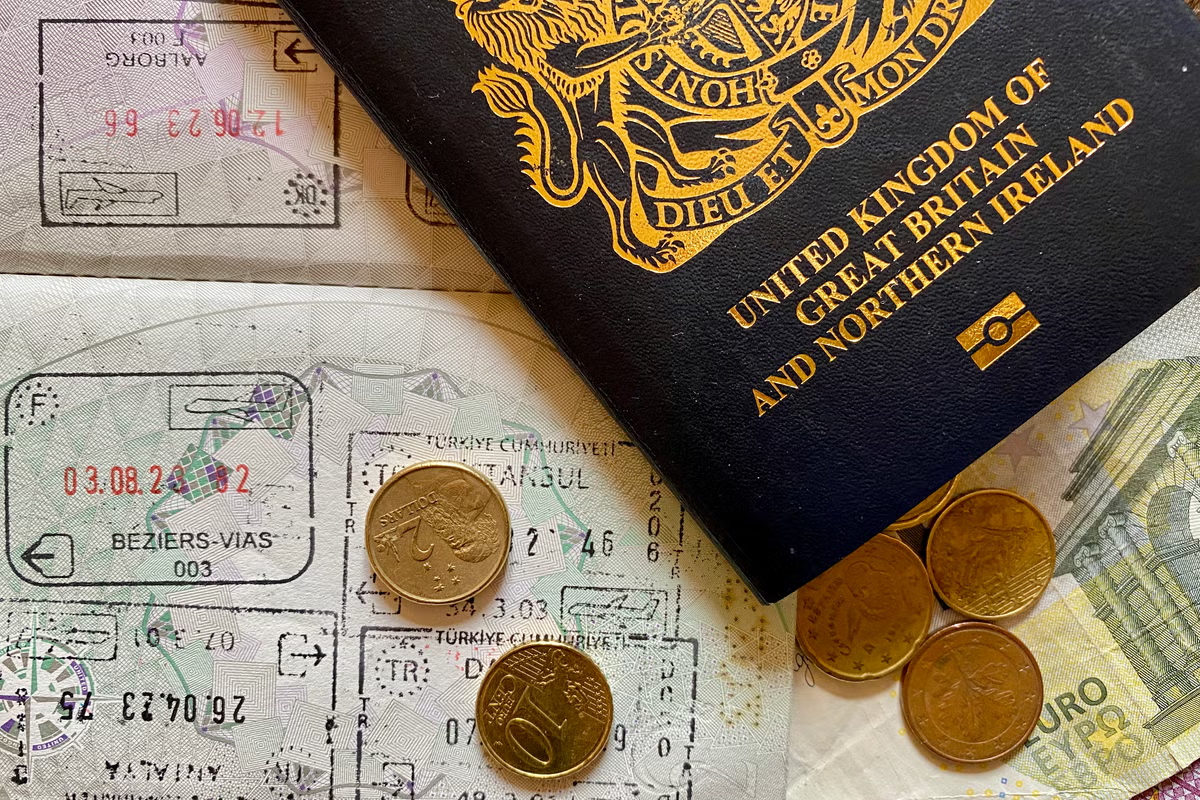
UK visitors to the Schengen area should see an end to entry and exit passport stamps (Charlotte Hindle)
British travellers, like other third-country nationals who enter without a visa, are restricted to 90 days’ stay in any 180 days within the Schengen area. But enforcement previously depended on checking passport stamps and is applied haphazardly.
The entry-exit system is supposed to connect every frontier in the Schengen area with a central database.
Advertisement
Any UK citizen with the good fortune to have an Irish (or other EU) passport can use that document: skip the queues, swerve the fingerprinting.
The procedure for Irish citizens has not changed. When entering or leaving the Schengen Area, they will simply be matched with their passport or passport card – no fingerprinting or facial biometric, and fast-track processing.
What is the “entry-exit system”?
“The most modern digital border management system in the world,” according to the European Commission. “An automated IT system for registering non-EU nationals who are travelling to the EU for a short stay.”
Advertisement
The system aims to capture data from all “third-country nationals” when they either enter or leave at an external Schengen border – such as flying from the UK to Spain or crossing by road from Greece to Turkey. It is not used at internal frontiers within the Schengen Area.
This procedure, says the European Union, replaces “the current system of manual stamping of passports, which is time-consuming, does not provide reliable data on border crossings, and does not allow a systematic detection of overstayers”.
How do the border checks work?
Advertisement
Inbound and outbound passengers go through the formalities at airports, land borders and ports in the Schengen area on arrival and departure.
Three locations in the UK have “juxtaposed” border controls, with French frontier police conducting checks on British soil: at the Port of Dover, Eurotunnel’s Folkestone terminal and the Eurostar hub at London St Pancras.
There is a supposed to be a difference between the first time you cross a Schengen area frontier where entry-exit system is in operation and subsequent entries and exits.
Initial crossing: Registration of your personal details, including fingerprints (not for under-12s) as well as a facial biometric.
Subsequent entries and exits: Facial biometric only.
But many British travellers report being asked for both face and fingerprints on multiple occasions.
How long does registration last?
Advertisement
Each new visit triggers another three years of validity of the initial registration. In other words, if you don’t cross a Schengen area frontier for three years, you will need to register again. It has been suggested that registration runs out when your passport does, but my reading of the legislation indicates that is not correct.
Unlike many border arrangements, the entry-exit system is concerned with the person, not the passport. The EES database has a record of Simon Peter Ritchie Calder, born in Crawley on Christmas Day 1955, with fingerprints and facial biometric ascribed to that person. The biographical information is extracted from whichever passport I happen to provide at the moment of registration.
On subsequent visits, the EES is agnostic about the passport I provide with name plus place and date of birth, so long as the biometric (overwhelmingly likely to be face rather than fingerprints) matches the record of that person.
This makes sense as it should end an illicit practice. At present people with two passports (whether both UK, or one British and one Australian, Canadian, etc) can stay more or less permanently – making judicious side-trips out of the Schengen area on one passport and back again on the other. Truck drivers in the Balkans have reportedly been caught using such techniques.
Advertisement
There are also reports of multiple registration being required in locations including Spain, Greece. Belgium and Switzerland.
Do I need to pay anything to use EES?
No, payment starts, in theory, later in 2026 with the Etias permit (see more below). Etias is dependent on the entry-exit system running smoothly.
When I get a new passport, must I register again?
Advertisement
Not according to the official Procedures for entering data in the EES. It says that if “the third-country national presents a valid travel document which differs from the one that was previously recorded” (ie a new passport), the individual’s online file will be updated with the fresh details.
I am only changing planes at an EU airport. Must I go through the entry-exit system?
It depends on your routing and final destination, and also on the way you have booked the travel.
You will not need to go through the entry-exit system if the answers to the following are both affirmative:
Advertisement
Flying from the UK into Amsterdam Schiphol, Frankfurt, Munich, Paris CDG or another hub, and connecting straight to a destination outside the Schengen area.
Travelling on a “through ticket”, eg Manchester-Munich-Mumbai on Lufthansa or Bristol-Paris-Dubai on Air France.
But you will need to go through EES if any of the following applies:
You are connecting to a final destination in the Schengen area, eg KLM from Newcastle via Amsterdam to Rome.
Your routing involves a segment wholly within the Schengen area, eg Edinburgh-Frankfurt-Munich-Seoul (where the Frankfurt-Munich leg triggers the entry-exit system).
You are “self-connecting”, eg flying London-Lisbon on easyJet and transferring onwards to the Cape Verde islands, also on easyJet. You must go through Portuguese immigration, including EES, before beginning the departure process again.
I am on a cruise from a British port. When do I register?
If you are returning on the vessel to the UK, probably never. The Home Office says: “Sailings that start and finish their journey outside of the Schengen area (for example, at a UK port) will generally be exempt from EES checks, including for any day trips into the Schengen area that are part of their itinerary.”
If you leave the ship in a Schengen area port, you will need to go through the entry-exit system at that location.
Is it all going according to plan?
No. The Port of Dover, Eurotunnel and Eurostar have invested heavily and now believe they can handle outbound passengers without undue delay. Eurotunnel expects the procedure to add two minutes per traveller using LeShuttle between Folkestone and Calais, and that it can process 700 cars per hour. But motorists and passengers at these departure points are being processed manually, rather than using the kiosks.
Advertisement
At London St Pancras International, three locations have been set up with EES kiosks for registration of passengers’ documents. But none of these facilities is currently being used.
Eleni Skarveli, the director of the Greek National Tourism Organisation in the UK, says this unilateral move, “is expected to significantly reduce waiting times and ease congestion at airports”.
Must I provide proof of travel insurance?
Advertisement
The standard Schengen area requirements are unaffected by the introduction of the entry-exit system. A third-country national must:
Justify the purpose of the intended stay (for example tourism, business or a family visit).
Demonstrate sufficient means of subsistence for their stay.
Provide evidence that they will return to their country of origin – or continue to a third country where they are sure to be admitted.
The European Travel Information and Authorisation System (Etias) is the next step in tightening frontier controls. It is an online permit, price €20 (£17), for third-country nationals who do not require visas. It is similar to the US Esta scheme, but valid for longer: three years. While those under 18 or over 70 will still need to apply for and hold an Etias, it will be free.
In order to work, Etias requires EES to be fully operational. Once the entry-exit system is completed and is running smoothly, Etias is set to follow six months later.
Advertisement
But initially a six-month grace period will be granted – so it will not be mandatory for prospective UK visitors to apply online for permission to enter the Schengen Area for at least a year after the complete introduction of EES, which may be some time in 2027.
Is Etias a visa?
Officially, no. Europe says that Etias is “a pre-travel authorisation system”. It is a similar concept to the US Esta, the Canadian eTA and the British ETA, which are not technically visas. They are issued to international travellers who do not require a full visa.
But as Etias requires visitors to apply in advance, provide lots of personal information, pay money and be issued with a permit to cross a border, it is not surprising that it is commonly termed a “euro-visa”.
Advertisement
How will I apply?
When finally the EU is ready, at the heart of the system is an Etias app and website.
You must provide all the usual personal details: name, date and place of birth, gender, home and email addresses, phone number(s), passport number and expiry date.
In addition you must give:
Advertisement
Your parents’ names.
Your level of education.
Your current occupation (including job title and employer, or educational establishment if you are a student).
The reason for the journey (holiday, business, visiting family, etc)
The country, and specific address, of your first night’s stay in the Schengen area.
(On the last point, the European Union helpfully points out that you are not bound to stick to that nominated location: “Once you have your travel authorisation in hand, you can change your plans.”)
You are required to reveal:
Any criminal convictions
Past travels to war or conflict zones
Whether you have recently been deported from the Schengen area.
I have a criminal conviction from long ago. Will I face problems?
Nothing will change with the entry-exit system. The EES is nothing more than the long-overdue digitisation of frontiers of the Schengen area, and personal background is not relevant. But in October 2026, if all goes according to plan, one’s history becomes of interest with the introduction of Etias.
It will be incumbent on the prospective visitor to answer truthfully on “details about any past criminal convictions”. But every indication is that only serious crimes (which I infer as those with a substantial prison sentence attached) and terrorist offences could result in an application for Etias being rejected. This is in marked contrast with the US Esta, for which convicted criminals cannot register.
What happens to the information I provide?
Advertisement
Every Etias application will be checked against EU and relevant Interpol databases, as well as “a dedicated Etias watch-list”.
The system will be tuned to pick out individuals suspected of being involved in terrorism, armed robbery, child pornography, fraud, money laundering, cybercrime, people smuggling, trafficking in endangered animal species, counterfeiting and industrial espionage.
Is Etias going to be the next online scam?
Yes, As with other online travel permits, commercial intermediaries are allowed – but according to Frontex, the EU organisation implementing Etias, there are many scam sites out there that are likely to apply fees way above the basic €20.
Advertisement
Any site other than europa.eu/etias is unofficial and should not be trusted.
One “imposter” site, based in California, claims “Etias will be operational from 2025”.
Another site offers a 40 per cent discount for early applications. Some use the EU logo, which is illegal.
Frontex, the EU border control agency, also warns about the risk of identity theft if you provide personal information to an imposter site.
Advertisement
How far in advance must I apply?
The European Union says: “We strongly advise you to obtain the Etias travel authorisation before you buy your tickets and book your hotels.”
The aim is for an Etias to be granted within minutes, though even a straightforward application could take up to four days.
If an application is flagged (ie there is a “hit” with one of the databases) the applicant may be asked to provide additional information. Alternatively, says the EU, the applicant may be asked “to participate in an interview with national authorities, which may take up to additional 30 days”.
Advertisement
Assuming yours is granted, there is no certificate issued, and nothing needs to be printed. The frontier guard will get the information he or she needs from the passport you used to apply.
In a case of mistaken identity, will I be able to appeal?
Yes. Details of how to appeal will be included with the notice of rejection.
Once I have an Etias, am I guaranteed admission to the Schengen Area?
Advertisement
No. “Mere possession of a travel authorisation does not confer an automatic right of entry,” says the EU. As with the US, travellers can be turned away for any reason.
There is likely to be a mechanism in place for an Etias to be rescinded.
Do I need to apply for an Etias every time I travel to Europe?
No. The permit will be valid for three years, or until your passport runs out, whichever is the earlier.
Advertisement
Will I need an Etias to travel to Ireland?
No. The Common Travel Area incorporating the UK, Ireland, the Isle of Man and the Channel Islands transcends European Union rules, and in any event, Ireland is not in the Schengen area.
If I have a long-stay permit from one of the EU nations, must I obtain an Etias?
No.
Advertisement
How are people without internet access supposed to apply?
They will be expected to get a friend, a family member or a travel agent to make the application for them, in the same way as the US Esta and similar schemes.
Just remind me about the 90/180 day rule?
This rule, to which the UK asked to be subject after leaving the European Union, means that British travellers cannot stay more than 90 days in any stretch of 180 days.
Advertisement
As an example of what it means: were you to spend the first three months of 2026 in the Schengen area, you would have to leave on 31 March and could not return until 90 days later, ie 30 June.
Is the UK being punished because of Brexit?
No. Work on strengthening the European Union’s external border began a decade ago. British officials participated in initial planning for the entry-exit system and online registration for third-country nationals.
The UK asked to be subject to all the extra red tape that everyone already knew was on the horizon. The EU agreed. So Brussels is delivering exactly what the British asked for.
Advertisement
Had we remained in the EU but outside Schengen, would we still be subject to all the new red tape?
No. Were the UK still in the EU, neither EES nor Etias would affect British passport holders.
Citizens of Ireland, which is in the EU but outside Schengen, need not go through the entry-exit rigmarole nor get an Etias. They simply have their passport/ID checked on arrival and departure, usually via a fast-track line.
That’s what the UK chose to give up.
Advertisement
What’s the back story behind the delays?
Originally the entry-exit system was due to start in 2021. But the body responsible for implementation – the European Union Agency for the Operational Management of Large-Scale IT Systems in the Area of Freedom, Security and Justice (EU-Lisa) – has repeatedly pushed back the date because the database was far from ready.
In August 2024, the EU’s Home Affairs commissioner, Ylva Johansson, said: “I have decided that the entry/exit system will enter into operations on 10 November. That will be a great day – entry-exit system day.” But a month before the big day, ministers decided to postpone the introduction.
Many airports, ports and railway stations have already installed expensive equipment, which has been lying unused. Officials in Brussels then kicked the can down the road to October 2025 – with a full roll out due to be completed by April 2026. But this latest deadliine has also been missed, with 7 September 2026 the new latest date for 100 per cent EES compatibility.
Advertisement
This piece was first published in August 2025 and is kept updated with the latest information


















































You must be logged in to post a comment Login