Connect with us
DAPA Banner

NewsBeat

How Britain’s housing crisis contributes to its declining healthy life expectancy

Published

on

How Britain’s housing crisis contributes to its declining healthy life expectancy

People in the UK are now spending fewer years in good health than they did a decade ago, according to a new analysis by the Health Foundation. The UK now sits near the bottom of a 21-country comparison, ahead only of the US.

A drop in healthy life expectancy is explained through many causes: obesity, alcohol, drugs, suicide, chronic disease, poverty and widening inequality. But one of the most powerful causes sits atop them all: housing. Where and how people live is one of the main factors explaining how health risks are created and distributed across society.

The UK Housing Review is an annual independent review of housing policy and evidence, written by housing experts and published by the Chartered Institute of Housing. Its latest edition, which we contributed to, identifies several interrelated ways that housing affects health.

A key one is affordability – housing costs shape where people can live, whether they can heat their homes, whether they can afford food and transport, whether they can move for work, whether they can leave unsafe or unsuitable housing and whether they live with chronic financial stress.

Advertisement

In the UK, housing costs are high by historical standards and poor housing remains widespread. The review notes that private rents are now at their highest recorded share of earnings, while millions of homes in England still contain serious health and safety hazards.

When housing is unaffordable, people are forced to make tradeoffs. For example, trading affordability for damp or overcrowded homes. They cut back on heating, food, medication, transport and social participation. They move further from public services, work and support networks. Affordability problems also force many people into cheaper, less secure, tenancies.

Poor housing quality directly shapes health. Cold, damp, mould, disrepair, poor ventilation and unsafe homes are directly linked to respiratory illness, cardiovascular risk, mental health problems and reduced wellbeing.


À lire aussi :
Cold homes increase the risk of severe mental health problems – new study

Advertisement

The Building Research Establishment, an independent research organisation, has estimated that poor housing costs the NHS in England £1.4 billion each year. More than half of this is attributed to cold homes, which increase the risk of respiratory illness, cardiovascular problems and poor mental health. They are especially dangerous for older people, babies and people with existing health conditions.

But the wider costs are even greater. Poor sleep, stress, disrupted schooling, insecure work, social isolation and caring strain all affect mental and physical health. They increase pressure on families and, over time, on health, education and social care systems.

Cold homes can cause serious and widespread health problems.
Jelena Stanojkovic

Historically in the UK, social housing has provided some protection to people unable to access good quality affordable housing in the open market. But the stock of social rented housing in the UK has declined. This means that people are increasingly dependent on (often expensive) market rental, where the quality, size and location of housing depend much more directly on income.

The rise of the private rented sector this century has meant that more households are exposed, not just to higher housing costs, but also to shorter tenancies and fewer protections than social housing traditionally provided.

Advertisement

The Renters’ Rights Act increases security, but does not remove “no fault” evictions altogether and does little to protect tenants from economic pressures that can result in eviction. The cognitive burden of worrying about eviction, arrears, repairs or the next rent increase is a direct health risk.

Recent evidence also suggests that insecure housing can result in measurably faster biological ageing, equivalent to the effects of more traditional health concerns like smoking.

Additional weeks of biological ageing per year from different factors
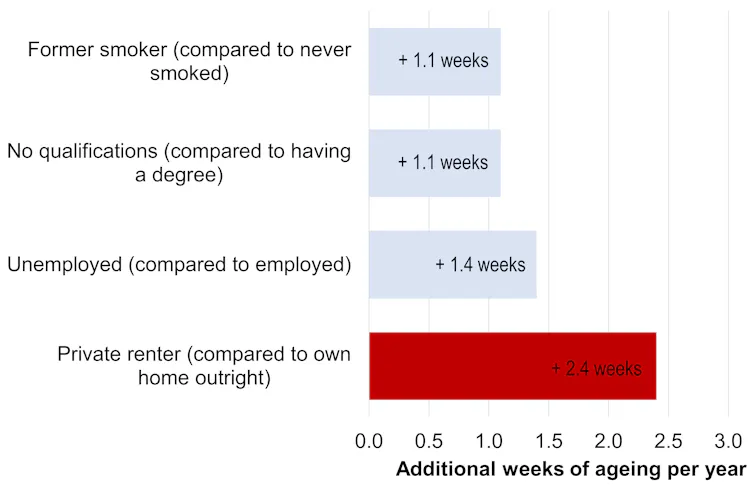
Bar chart showing additional weeks per year for private renting (2.4 weeks) compared to other social determinants of health including unemployment (1.4 weeks), having no qualifications (1.1 weeks) and being a former smoker (1.1 weeks)

Amy Clair

The number of people living in temporary accommodation has risen dramatically, reaching over 130,000 households at the beginning of 2025. This is a 156% increase compared with 2010, largely driven by the poor affordability and insecurity of the private rented sector and lack of social housing. Temporary accommodation is inadequate housing, particularly for children. Living in temporary accommodation was a contributing factor in the deaths of at least 104 children in England between 2019 and 2025, 76 of whom were under one year of age.

This is not about housing quality alone. Temporary accommodation reflects multiple risks brought together: poverty, overcrowding, poor conditions, instability, lack of space for safe infant sleep, poor access to services and wider racial and social inequality. The National Child Mortality Database identifies temporary accommodation as a contributing factor to vulnerability, ill health or death, not necessarily as the sole cause. Emerging evidence also links temporary accommodation with stillbirth and neonatal death.

Advertisement


À lire aussi :
Insecure renting ages you faster than owning a home, unemployment or obesity. Better housing policy can change this


Housing health inequality

ONS data shows a very large difference in healthy life expectancy between the most and least deprived areas. In 2022-24, healthy life expectancy in the most deprived areas of England was just 49.8 years for men and 48.2 years for women, compared with 69.2 and 68.5 years in the least deprived areas.

Housing contributes to this difference, determining whether people live in homes that support recovery or deepen stress, whether children grow up in stable and safe environments, and whether older people can remain warm and independent.

If the government is serious about its stated aim to “halve the gap in healthy life expectancy between the richest and poorest regions”, housing policy must become health policy.

Advertisement

That means investing in social housing, enforcing decent standards in the private rented sector, making homes warmer, safer and more accessible, and recognising temporary accommodation, overcrowding and insecurity as public health failures, not just housing management problems.

It also means changing the way that success is measured. Housing policy is too often judged by supply numbers, prices or tenure outcomes. These matter, but they are incomplete. A healthy housing system should also be judged by whether people can live in homes that are affordable, secure, decent, suitable and resilient to climate change.

The decline in healthy life expectancy is a warning light. It tells us that the UK is not only failing to keep people well for longer, it is failing to provide the foundations of health.


Advertisement

Source link

Continue Reading
Click to comment

You must be logged in to post a comment Login

Leave a Reply

NewsBeat

The four-day week won’t happen overnight, but it could transform how we live and work

Published

on

The four-day week won’t happen overnight, but it could transform how we live and work

A century ago, the five-day working week helped reshape society. It was introduced at scale by industrial pioneers to address not only worker wellbeing but also economic pressures.

US industrialist Henry Ford was among the first to give workers two full days off per week, 100 years ago this month. Ford suspected that giving workers a “weekend” would increase overall productivity – and he was correct.

Today, as advances in artificial intelligence accelerate and concerns about job security grow, a similar question is emerging. Could reducing working time again help societies adapt to these seismic changes?

The evidence increasingly suggests it can, but not in the simplistic way that is often portrayed. The four-day week is not just a workplace benefit. It is a potential tool to improve wellbeing, support families and rethink how work is distributed in society.

Advertisement

Research across multiple countries, including large-scale pilots in the UK and Portugal, shows that reducing working time can deliver meaningful benefits for both employees and organisations.

In a 2025 study of four-day week adoption, my colleagues and I found improvements in sleep, exercise and quality of working life. There were positive implications for both the mental and physical health of employees.

Our research showed productivity at work can also increase, alongside reductions in absenteeism and staff turnover. And it can be beneficial for an employer’s social image.

However, the most important insight is not about productivity but what happens outside work. After all, time is a social resource, not just an economic one.

Advertisement

When people move to a four-day week, they do not simply rest more. They reallocate time in ways that have broader implications for society.

Across our research, participants said they spend more time with family and friends, engaging in community activities and investing in their physical and mental health by exercising and practising hobbies and self-care activities.

These are not trivial changes. Over time, they contribute to stronger social ties, better mental health and more resilient communities.

There are also important gender implications. Early findings suggest that reduced working time can lead to fathers being more involved in caring for their children and other domestic responsibilities. While this does not automatically solve gender inequality, it creates conditions that make more equal divisions of labour possible.

Advertisement

In this sense, the four-day week is not just about work. It is about how societies organise care, relationships and everyday life.

The challenge in service sectors

Critics of a four-day week often point out that it is harder to implement in service sectors such as healthcare, childcare, manufacturing, hospitality or retail. This is true, but it is not a reason to dismiss the idea.

In these sectors, work is tied to time, presence and staffing levels. Reducing working hours often requires more complex redesign, including changes to rotas, additional hiring or upfront investment. Colleagues and I have highlighted this when addressing the UK case of the NHS.

But these challenges should be seen as design problems, not impossibilities. In fact, the potential benefits to society may be even greater in these sectors. Improved wellbeing and reduced burnout among healthcare staff and care workers can translate into better quality of service and fewer mistakes.

Advertisement

Reduced working hours for healthcare staff could lead to fewer clinical mistakes.
Iryna Inshyna/Shutterstock

A more important concern is inequality. If working time reductions are adopted unevenly, there is a risk that some workers will be excluded – often those in lower-paid or frontline roles. This is a valid concern, but not an argument against the four-day week. Rather, it is an argument for implementing it more thoughtfully.

Instead of asking whether all jobs can adopt the same model, the focus should be on how different forms of reduced work time can be adapted across sectors. This could include shorter daily hours, staggered schedules or phased time reductions.

The future of work

The renewed interest in reducing the amount of time we spend working is not happening in isolation. It is closely linked to broader debates about automation, productivity and the future of work.

Advertisement

If technological advances continue to increase productivity, a fundamental question arises: who benefits from these gains?

Historically – during the Great Depression, for example – working time reductions have been one way of redistributing those benefits. Compared with more radical proposals such as universal basic income, the four-day week offers a more direct and socially embedded way of sharing gains in productivity.

The four-day week is not a universal solution, and it will not look the same everywhere. But the evidence shows working less can go hand-in-hand with maintaining productivity.

It can also support a shift towards a society where time is valued not only as an economic input, but as a foundation for wellbeing, relationships and participation in community life.

Advertisement

A century after the five-day week helped define modern work, there may be another turning point on the horizon. This time, the real question is not whether we can afford to reduce working time, but whether we can afford not to.

Source link

Advertisement
Continue Reading

NewsBeat

Mark Allen frame ’embarrassment to snooker’ as unwanted record set through Crucible drama

Published

on

Wales Online

Steve Davis called for action at the end of Mark Allen’s Friday afternoon session with Wu Yize due to an agonisingly slow frame of snooker

Steve Davis labelled the 100-minute and 21-second frame between Mark Allen and Wu Yize at the World Snooker Championship an “embarrassment” to the sport. The snooker legend also called on the referees’ and players’ associations to take action to prevent a repeat of such an incident.

Advertisement

The pair became embroiled in a historically lengthy 14th frame at the Crucible on Friday evening, with both players adopting a cautious approach as all the reds remained clustered around the black near the far pocket. Allen, who held a 43-13 lead at the time, was intent on kissing the reds with the cue ball and sending it rolling to the opposite end of the table.

Yize, meanwhile, was content to gently roll it back towards the pack, ensuring contact was made without disturbing or displacing the black. The audience grew understandably restless as the frame dragged on, resorting to sarcastic applause and cheering after each shot, as BBC coverage displayed a graphic revealing that no ball had been potted for approximately 40 minutes.

At one point, a spectator was heard shouting: “Can we have a rerack?” to which referee Marcel Eckhardt responded: “Thanks for the advice but we can do it without you.”

The official was also forced to appeal to audience members to rein in their slow clapping and jeering on several occasions as tensions reached boiling point inside the Crucible Theatre. Eckhardt eventually took charge of the match following a word from a superior, informing both Allen and Yize that they had just three shots to alter the play or face a re-rack.

Advertisement

It was a decision that Allen contested given he held the upper hand. The Northern Irishman ultimately cannoned the reds into the black, potting the ball in a foul to hand Yize a significant advantage – before the Chinese star eventually clinched the frame 88-62 to level proceedings and bring a lengthy and difficult-to-watch session to a close.

Unimpressed by the spectacle, Davis gave his verdict live from the BBC Sport studio in the wake of the match. He said: “In a nutshell, that frame’s an embarrassment to snooker, and the referees’ and the players’ association need to try and work out a way that never happens again.”

Kyren Wilson also vented: “Marcel should have called that a lot earlier. That frame was going nowhere. Quite painful.”

Advertisement

Meanwhile, snooker supporters were quick to share their opinions on social media, similarly suggesting that Eckhardt ought to have asserted greater authority over the match.

One wrote: “The referee was out of his depth having a decision made for him,” while another added: “Ref had a shocker!!”

Another viewer commented: “Worse frame of snooker I’ve ever seen. Ref completely bottled it in the face of Allen’s reluctance to accept his decision.”

With Yize claiming the frame, the pair resume their contest on Saturday level at 7-7.

Advertisement

In the other semi-final, meanwhile, Shaun Murphy faces John Higgins for a place in the final, with the two players returning to the table at 8-8 in Friday’s concluding session of the day.

Sky Sports, HBO Max, Netflix and Disney+ with Ultimate TV package

This article contains affiliate links, we will receive a commission on any sales we generate from it. Learn more
Content Image

Sky has upgraded its Ultimate TV and Sky Sports bundle to now include HBO Max, Netflix, Disney+, discovery+ and Hayu, as well as 135 channels and full Sky coverage of the Premier League and EFL.

Sky broadcasts more than 1,400 live matches across the Premier League, EFL and more with at least 215 live from the top flight alongside Formula 1, darts and golf.

Source link

Advertisement
Continue Reading

NewsBeat

Gardeners’ World’s Monty Don addresses health struggle as he’s forced to make change

Published

on

Wales Online

Gardeners’ World presenter Monty Don has discussed his health issues, revealing he has had to adapt his gardening routine as he reflects on getting older

Gardeners’ World presenter Monty Don was compelled to make a “change” after opening up about a health issue. Monty’s lifelong devotion to gardening began during childhood when he would assist with pulling weeds from his family’s garden.

Advertisement

While Monty initially confesses he “hated it,” his enthusiasm for all things horticultural flourished and he became skilled at plucking chickens and tending a vegetable patch during his teenage years. This eventually led him to working as a gardener in the Aix-en-Provence region of France.

He has maintained remarkable gardens ever since, regularly offering viewers a glimpse into his Longmeadow home on Gardeners’ World. The 70-year-old has, however, altered the way he goes about his work over the years.

Speaking to Country Life magazine, Monty revealed he no longer listens to music while working. He said: “I used to, but I find now – in the last sort of five years or so – whether it’s part of my hearing going a bit so therefore I have to listen harder – it’s distracting.

“But when I used to work to music, it was always Baroque music, namely Bach. I don’t relax to music ever. What I found was it put me in the right space in order to focus.”

Advertisement

Monty continued by saying he finds music “almost the opposite of relaxing” yet acknowledges he considers the Baroque period’s style to be “sublime”. The television personality also confesses he “hates” background music. He maintains that playing music during a dinner party, for instance, implies that “music has no value”. He now finds himself torn between wanting to listen to music or tending to his garden, confessing: “I can’t do both simultaneously.”

Monty, who assumed the Gardeners’ World presenting role in 2003 following Alan Titchmarsh’s departure, has openly acknowledged he “hasn’t got endless time left”. He remains acutely conscious that he has now surpassed the age at which both his parents passed away.

This realisation has previously prompted him to reflect on his future with the popular programme. Speaking to The Guardian in November 2023, he remarked: “I haven’t got endless time left. If I’m still going strong in 20 years, that will be brilliant, but 20 years ago doesn’t seem so long ago.”

Advertisement

He suggested at the time that he might have departed the show before reaching 70. However, he has since given viewers reassurance that he has no immediate plans to step down. He informed The Telegraph: “But I’d be very happy to do another five years. If the BBC renew my contract, I’d happily take it.”

Should he eventually leave Gardeners’ World, Monty has indicated he would continue working in television, revealing his ambition to produce additional documentaries. The horticultural expert has already journeyed to gardens across America, Italy, France and beyond while creating programmes.

Gardeners’ World returns to BBC Four at 9pm this evening. This week, Monty will be sowing seeds to guarantee a consistent supply of herbs including thyme and sage, which struggle in his soil conditions.

Advertisement

Carol Klein, meanwhile, will be crafting a vegetable border interspersed with flowers to deliver colour throughout the year. Elsewhere, Advolly Richmond heads to Fife to discover more about the pink cupped daffodil.

Source link

Continue Reading

NewsBeat

Belfast City Marathon road closures and traffic advice for 2026 race day

Published

on

Belfast Live

Residents and motorists are encouraged to plan their journeys in advance and allow additional travel time

This Sunday the good people of Belfast will welcome thousands of participants to its streets for the 2026 Phoenix Energy Belfast City Marathon.

Advertisement

The 26.2-mile challenge will begin at Stormont Estate, travel through North, South, East and West of the city, and finish in Ormeau Park.

As a result, motorists can expect some disruption throughout the morning and early afternoon, although every effort will be made to keep this to a minimum.

READ MORE: Belfast City Marathon 2026 road closures, route, transport, results, Expo details and more ahead of race dayREAD MORE: Belfast City Marathon Results 2026: Official finish times

Roads will begin to close wholly or partially from approximately 6am until 4pm. Once all runners have passed each point on the route, the reopening of roads will be managed as quickly and safely as possible.

Advertisement

The 2026 Phoenix Energy Belfast City Marathon route follows a similar format to previous years, with some adjustments across sections of the course. You can view a full list of closures here https://canva.link/bcmroadclosure26

The area around Stormont Estate and Upper Newtownards Road will be closed to through traffic between approximately 6am – 10:30am, as runners make their way through East Belfast including Beersbridge, Castlereagh and surrounding areas.

A full road closure will be in place on sections of the Ravenhill Road and Ormeau Embankment from approximately 7am – 12pm, as participants move towards South Belfast.

Some disruption can be expected in Belfast city centre between approximately 8:30am – 1pm, with full road closures in place across key routes including Chichester Street, Donegall Square, Wellington Place and surrounding streets.

Further disruption can be expected in South Belfast, particularly along the Boucher Road and Lisburn Road areas, with closures in place approximately 8am – 1:30pm, as runners pass the halfway stage of the marathon.

In West Belfast, areas including the Falls Road and Andersonstown Road will experience lane and full road closures from approximately 9:30am – 2pm.

Full road closures will also be in place from approximately 9:30am – 3pm in parts of North Belfast, including key routes such as the Antrim Road and surrounding areas, as well as relay changeover points.

Advertisement

As the race enters its final stages, some disruption can again be expected in the city centre and along the Ormeau Road from approximately 9:30am – 3pm, as well as being partially closed from 8.30am – 4.30pm between Rosetta Roundabout and Ormeau Avenue, as participants make their way towards the finish line in Ormeau Park.

Residents and motorists are encouraged to plan their journeys in advance and allow additional travel time where necessary.

Full details of all road closures, timings and projected participant times are available at Belfast City Marathon: Premier Running Events In NI | Belfast City Marathon

Official Belfast Marathon finish times and results will be available here as soon as runners cross the finish line.

Advertisement

For all the latest news, visit the Belfast Live homepage here and sign up to our daily newsletter here.

Source link

Continue Reading

NewsBeat

Man charged over car bomb attack outside Dunmurry police station

Published

on

Man charged over car bomb attack outside Dunmurry police station

He has been charged with a number of offences, including attempted murder, possessing explosives with intent to endanger life or cause serious injury to property, causing an explosion likely to endanger life or cause serious injury to property, possession of articles for use in terrorism and hijacking.

Source link

Continue Reading

NewsBeat

Child rapist jailed for life ‘may never be released’

Published

on

Wales Online

Daniel Bremner filmed his abuse of four young girls and conducted a campaign of ‘predatory depravity’

A child rapist has been told he may never be released from prison after being handed a life sentence for a catalogue of sickening crimes against young girls.

Advertisement

Daniel Bremner systematically raped and sexual assaulted four different children in a campaign of abuse lasting years. The 35-year-old filmed some of the attacks on his phone.

Mold Crown Court heard that even after pleading guilty Bremner minimised his actions, blamed his consumption of alcohol and cannabis, and took little responsibility for what he did.

The court heard that the abuse came to light when one of the victims made disclosures in school. Bremner was arrested but denied any wrong doing. Officers then executed a search warrant at his home address and recovered evidence – some hidden in the attic – including a mobile phone.

When the phone was examined officers found dozens of videos Bremner had filmed showing him raping and abusing young girls. Officers also uncovered almost 2,200 indecent images including more than 200 of Category A showing the most extreme kinds of sexual abuse.

Advertisement

The initial arrest and investigation led to three further victims making complaints of rape and other forms of sexual abuse. For the latest court stories sign up to our crime newsletter

Daniel Bremner, now of The Nook, Mancot, Flintshire, had previously pleaded guilty to a total of 35 offences of rape, rape of a child under 13, sexual assault, sexual assault by penetration, sexual assault by penetration of a child under 13, inciting a child to engage in sexual activity, causing a child to watch sexual activity, making – that is possessing – indecent images of children, and taking indecent images of children when he appeared in the dock via videolink for sentencing. He had been due to attend court in person but refused to leave his cell.

The defendant has four previous convictions for four offences, namely battery in 2018 and then three counts of failing to comply with the requirements of the community order imposed for the assault.

Recorder Simon Mills said Bremner’s actions could only be described as “predatory depravity” and said the offending was of an “exceptionally high level of seriousness”. He said an experienced probation officer had concluded that Bremner poses a high risk to children, and he said that was an assessment with which he agreed.

Advertisement

He told the defendant: “The risk is, if you are free to or are able to, you will continue offending like this again. I can see no evidence beyond your guilty pleas that you have shown any desire to set yourself on a realistic path of rehabilitation.”

The recorder said having considered the facts of the case and the contents of the pre-sentence report – in which Bremner had sought to minimise his offender and to blame his consumption of alcohol and cannabis – a life sentence was justified.

Bremner was sentenced to life in prison with a minimum term of 15 years.

Recorder Mills said 15 years was the minimum time the defendant must serve before the Parole Board can consider him for release but he said he could see “no prospect whatsoever” that Bremner would be released at that point. He told the defendant: “Unless or until the Parole Board considers it appropriate to release you, you will remain in prison. It may be that you are never released from prison.”

Advertisement

The recorder said when or if Bremner is released back into the community he will be on life licence which means he can be recalled back to custody at any time if there are concerns about his behaviour. The defendant will also be a registered sex offender for the rest of his life.

North Wales Police declined to release a custody photograph of the defendant.

Source link

Advertisement
Continue Reading

NewsBeat

Why celebs WON'T sign autographs with blue pens?

Published

on

Why celebs WON'T sign autographs with blue pens?

!function(n){if(!window.cnx){window.cnx={},window.cnx.cmd=[];var t=n.createElement(‘iframe’);t.display=’none’,t.onload=function(){var n=t.contentWindow.document,c=n.createElement(‘script’);c.src=”//cd.connatix.com/connatix.player.js”,c.setAttribute(‘async’,’1′),c.setAttribute(‘type’,’text/javascript’),n.body.appendChild(c)},n.head.appendChild(t)}}(document);(new Image()).src=”https://capi.connatix.com/tr/si?token=19654b65-409c-4b38-90db-80cbdea02cf4″;cnx.cmd.push(function(){cnx({“playerId”:”19654b65-409c-4b38-90db-80cbdea02cf4″,”mediaId”:”58e4b6d8-4226-4375-bd92-cab4b6f8ff51″}).render(“69f32f45e4b0831c4cc7f3c9”);});

Source link

Continue Reading

NewsBeat

Ever wondered why some fruit and veg come in coloured nets?

Published

on

Ever wondered why some fruit and veg come in coloured nets?

!function(n){if(!window.cnx){window.cnx={},window.cnx.cmd=[];var t=n.createElement(‘iframe’);t.display=’none’,t.onload=function(){var n=t.contentWindow.document,c=n.createElement(‘script’);c.src=”//cd.connatix.com/connatix.player.js”,c.setAttribute(‘async’,’1′),c.setAttribute(‘type’,’text/javascript’),n.body.appendChild(c)},n.head.appendChild(t)}}(document);(new Image()).src=”https://capi.connatix.com/tr/si?token=19654b65-409c-4b38-90db-80cbdea02cf4″;cnx.cmd.push(function(){cnx({“playerId”:”19654b65-409c-4b38-90db-80cbdea02cf4″,”mediaId”:”0e713f3d-f803-4334-8d42-1059ceca0353″}).render(“69f4eca7e4b0510ddb7ce995”);});

Source link

Continue Reading

NewsBeat

Man charged with attempted murder over car bomb attack outside Dunmurry police station

Published

on

Belfast Live

A car exploded outside a PSNI station last Saturday as people were being evacuated

By A 66-year-old man has been charged with several offences following a car bomb attack on Dunmurry police station. On Saturday, a male delivery driver was hijacked in the Twinbrook area of west Belfast. A device was placed inside the vehicle and he was ordered to drive to Dunmurry police station. The car exploded outside the station as people were being evacuated. Nobody was injured. The 66-year-old man was arrested in the Dunmurry area under the Terrorism Act on Tuesday.

READ MORE: Stormont leaders slam ‘deliberate’ Mournes wildfires as lives put at riskREAD MORE: Three NI special school projects approved as SEN demand hits record high

He has been charged with a number of offences, including attempted murder, possessing explosives with intent to endanger life or cause serious injury to property, causing an explosion likely to endanger life or cause serious injury to property, possession of articles for use in terrorism and hijacking. He is expected to appear before Lisburn Magistrates’ Court on Saturday. A police spokesman said that as is usual procedure, all charges will be reviewed by the Public Prosecution Service.

Advertisement

For all the latest news, visit the Belfast Live homepage here and sign up to our daily newsletter here.

Source link

Continue Reading

NewsBeat

The reason a massive crane is dominating Darlington skyline

Published

on

The reason a massive crane is dominating Darlington skyline

Ground was broken on the five-storey site in January, and it is expected to open in the first quarter of 2028.

Drone images released this week show how work is progressing with the concrete frame of the building emerging and a giant crane now dominating the Darlington skyline.

Once open, it will form part of the wider Darlington Economic Campus (DEC), consisting of three buildings, including Feethams House and Bishopsgate House.

Advertisement

Located on a former car park opposite St Cuthbert’s Church and next to the Darlington East End Club, the site is now dominated by a bright red tower crane and busy construction activity.

Tees Valley Mayor Lord Ben Houchen said: “Great to see real progress on the new Treasury building on Brunswick Street, with work moving at pace on site.

“When it opens, more than 1,600 civil servants will be based right in the town centre bringing good jobs, more footfall for local businesses and long-term investment into Darlington.

This is exactly the kind of project we fought to bring here – backing our town centres and putting Darlington right at the heart of government outside London.”

Advertisement

Site cabins, storage areas, and equipment are scattered across the compound.

The Treasury’s move to Darlington, first announced by the Conservative Party in 2021, was seen as a landmark decision to make central government decisions up north. 


The facility has been hailed as a “thriving hub” by council leaders, with 1,925 civil service roles currently based in the town across ten major government departments. 

Advertisement

This includes the Department for Education, HM Treasury, Office for National Statistics, Department for Culture, Media and Sport, the Ministry of Housing, Communities and Local Government, the Department for Energy Security and Net Zero, the Department for Science, Innovation and Technology, and the Competition and Markets Authority.

The Labour Government continued the project after receiving planning permission in 2024.

Source link

Advertisement
Continue Reading

Trending

Copyright © 2025