Currently hitting headlines for being the sovereign state to which Greenland belongs, it’s also the birthplace of Lego and Hans Christian Andersen. Play is in this country’s DNA, making it ideal for a family getaway
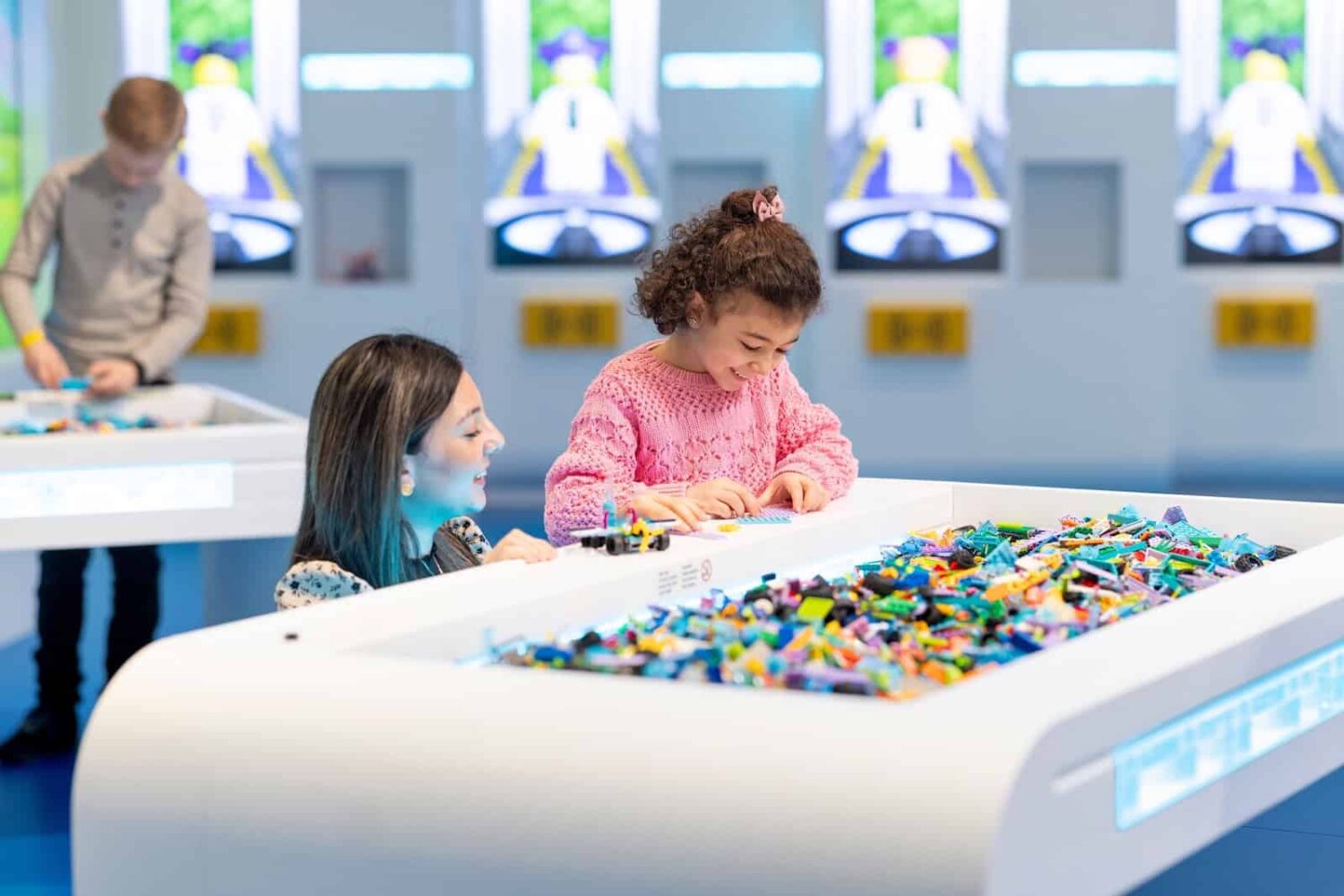
Children here don’t reach for devices – they reach for bricks. At Lego House in Billund, Denmark, my three-year-old kneels in front of a tumbling rainbow waterfall of blocks, fully absorbed in the creation of a Duplo mansion. Nearby, my six-year-old works on a Lego electric vehicle charging station, calm and content, focusing intently.
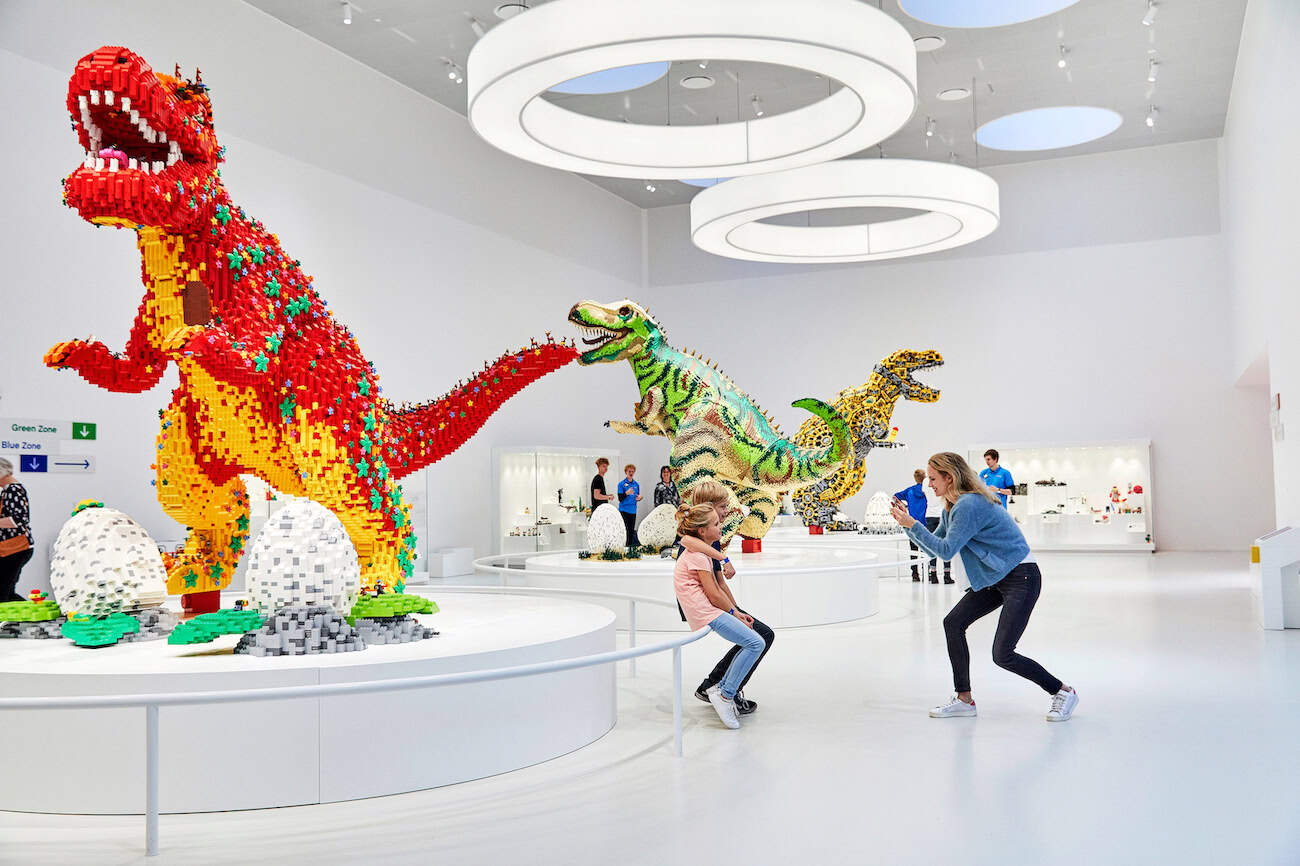
Lego House – a stone’s throw from the bustling Legoland theme park resort – is a sprawling temple to play. Part museum, part playground, it’s filled with 25m bricks and hands-on building zones that are designed for kids and adults alike. You can create and test Lego vehicles on ramps and tracks, make Lego flowers and ‘plant’ them into a shared creation garden. You can even order your lunch via mini Lego models that get scanned at your table; the meals arrive down a spiralling turquoise conveyor belt, presented by Robert and Roberta the robots. The building’s striking stacked-block structure and crisp white walls are designed to make the world-famous bricks stand out to maximum eye-popping effect.
Advertisement
In this room at least, there are no screens, no notifications, just the delicate rattle of pieces, and quiet concentration. In a world where our indoor environments are dominated by devices, it strikes me as unusual, even radical. And, as Denmark announces plans to restrict children’s access to social media, the country’s experiments with unplugged play – from Lego bricks to fairy tales – feel more urgent, and complex, than ever.
Advertisement
Since the company was founded in 1932, just metres away from where Lego House sits today, Lego has rooted its ethos in the concept of det gode leg – ‘good play’ – the idea that children learn best when they’re free to follow their curiosity, test ideas and make mistakes. The name Lego is itself clipped from the Danish leg godt, ‘play well’.
As we drive through the Jutland peninsula and on to the island of Funen, I’m reminded that this is a country where play is considered a tool for resilience. Imagination is almost a national virtue. Forest kindergartens, where Danish children spend their days climbing trees and building shelters, sit alongside degree-trained pædagoger, who specialise in nurturing curiosity rather than drilling phonics.
There are play-focused after-school clubs, maker-space libraries that offer everything from prototyping labs to woodworking and welding workshops, and a workplace culture that appears, at least, to put hygge and imagination on a par with productivity.
Advertisement
Lego House in Billund, Denmark, is part museum and part interactive playground. Image: Lego House
Even the national curriculum leans into this ethos, legally embedding play and experimentation as the foundation of early learning. It all adds up to a quiet assertion that imagination is something worth protecting.
Prof Helle Marie Skovbjerg, an expert on play and childhood at Design School Kolding, is among those exploring this national obsession. Genuine play, Skovbjerg says, must be allowed to unfold freely on its own terms, rather than as a tool for learning or even, shudder, preparing kids for a future jobs market. Play, she insists, is a “state of being” – a mood that opens us up to others and to new meaning.
Advertisement
So what can we learn from the ‘homeland of play’? Is this just quaint nostalgia packaged up to the tune, in Lego’s case, of profits of £1.6bn in 2024? Or could it be a deliberate counter-model to screen-saturated childhoods elsewhere?
Lego has rooted its ethos in the concept of det gode leg – ‘good play’ – the idea that children learn best when they’re free to follow their curiosity, test ideas and make mistakes
Advertisement
Someone who didn’t have to compete with the pull of screens in his time was Hans Christian Andersen, author of classic fairy tales including The Little Mermaid, The Princess and the Pea and The Snow Queen. Andersen was born into poverty in the city of Odense, but while he lacked in material terms, his imagination ran in wild and inexhaustible supply. A poor boy overcoming trials and tribulations to become world-famous, his biography is like a fairy tale in itself.
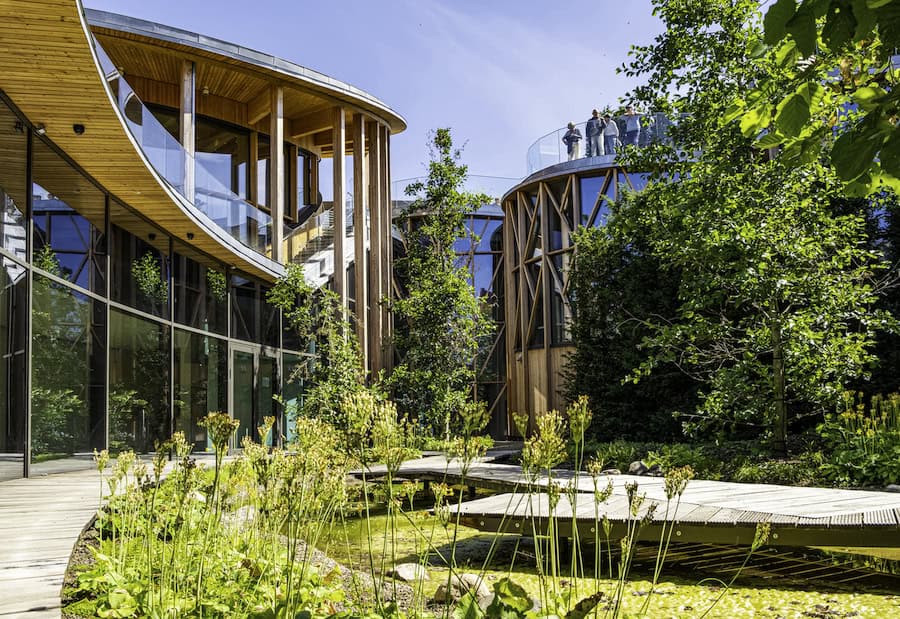
As well as his experimental, boundary-pushing writing style – childlike wonder meets surreal dread, surface-sweet, often sharp underneath – Andersen also drew and made papercuts and picture books. His weird and wonderful world is conjured up beautifully at Hans Christian Andersen’s House, a museum designed by Japanese architects Kengo Kuma and Associates, which opened in Odense in 2021. Here, you can summon the swans from The Ugly Duckling with a wave of your arms, use a special mirror to ‘try on’ ornate kimonos and enter the garden of giants, where even the tallest guest can feel as tiny as Thumbelina.
This is a country where play is considered a tool for resilience. Imagination is almost a national virtue
His life and work are woven together in a magically trippy way. As Henrik Lübker from the museum puts it: “H.C. Andersen’s House does not talk about H.C. Andersen – it speaks as H.C. Andersen.”
But for families, the standout feature of this most un-museum-like museum is Ville Vau in the basement. The name of this make-believe land, taken from one of Andersen’s children’s song books, has no literal meaning, but to borrow a famous Danish slogan, it’s probably the best make-believe centre in the world.
Advertisement
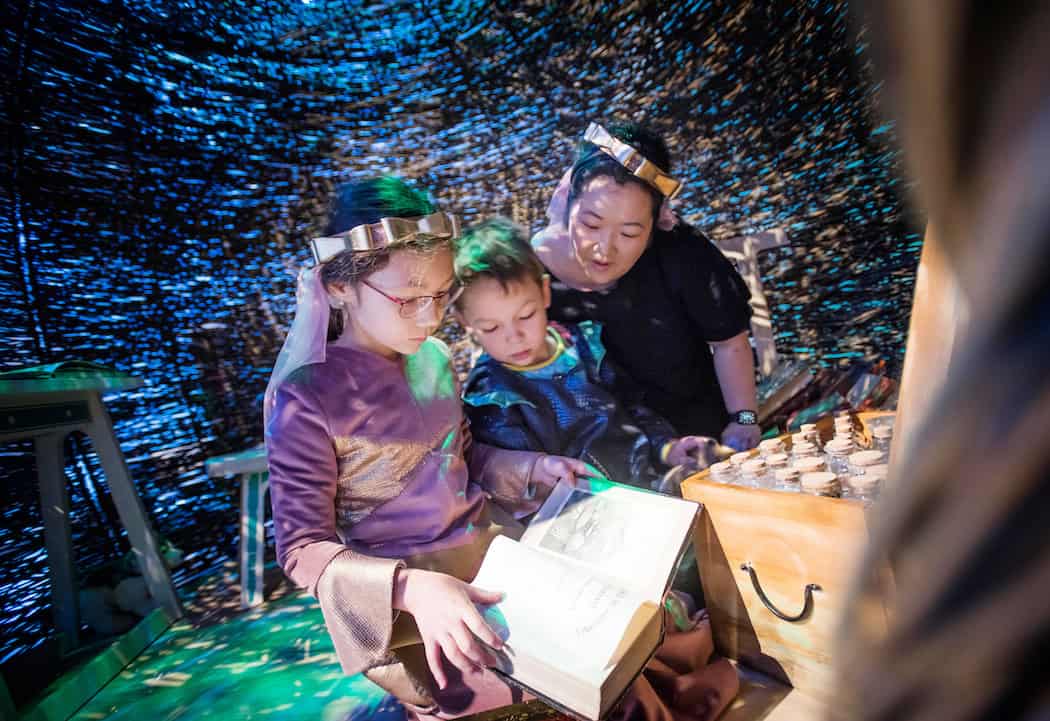
There are multiple zones, including a little town with shop fronts, a palace and a horse-drawn carriage. Huge tactile fabric pebbles sit alongside brimming baskets of pretend food and racks and racks of gleaming dress-up outfits, headwear and jewellery. It’s less ‘Look but don’t touch’ and more ‘Look and touch everything and dive with total imaginative abandon into your own stories and games until your parents literally drag you out at closing time’.
The space is dimly lit, which makes it feel mysterious and a little bit thrilling, everything is unapologetically child-height and best of all, created to top-tier theatrical production-level quality. You won’t find any shoddy polyester Disney princess costumes here, more like embroidered linen polka dot tunics in multiple size options and painstakingly crocheted Danish pastries in the make-believe bakery. My children are in heaven.
Advertisement
“It often feels to me as if every fence, every little flower says, ‘take a look at me, and my story will unfold within you,’” wrote Andersen. Aside from being amid mud, stones and sticks in nature, this is one of the spaces I’ve been in with my children where that sense of creative stimulation and flow has felt most alive. As if the stories themselves are pressing to be discovered.
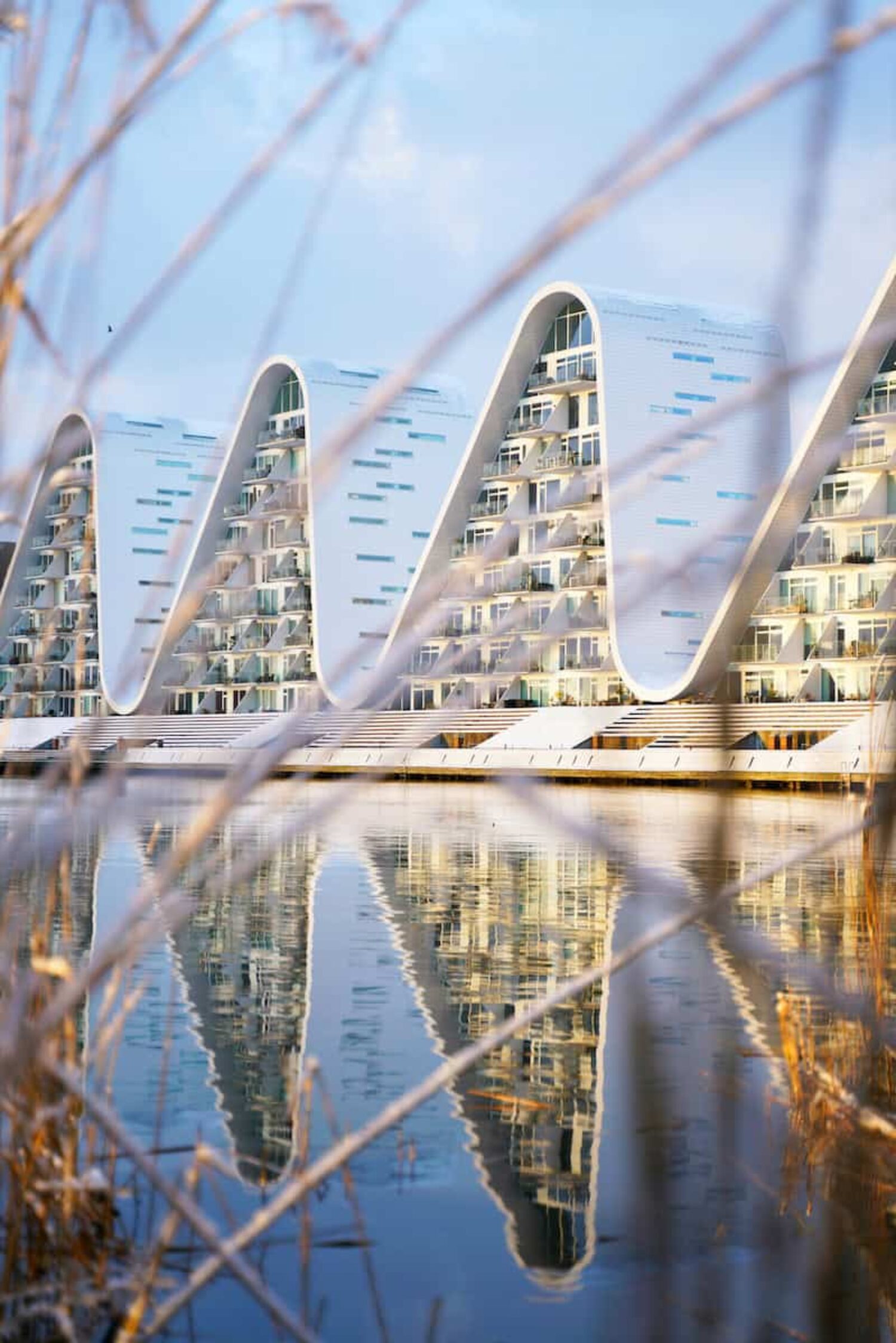
We travel on to the city of Vejle, where the graceful curls of the Bølgen apartment complex rise like liquid waves against the fjord. The kids haven’t watched (or asked for) any TV all week and their dad and I have been reaching for our phones less too. I’m thinking about how hollow the ready-made narratives offered by screens can feel. On the opposite end of the scale, I’m reminded about how my partner manages to summon up some fantastical, obscure characters from the depths of his tired brain at bedtime, rewarded by the rich closeness of a shared story.
Waves etched in concrete – the Bølgen complex in Vejle rises over the fjord. Image: Morten Elsborg
Advertisement
I’m grateful for Denmark’s reminders to take time to create alongside, or with, our children.
Neuroscientist Ruth Feldman published research in 2012 about how coordinated play between parent and a child releases oxytocin simultaneously in both. Her work showed that music, art and other tactile activities trigger this faster than verbal affirmation – helping to explain why creative sessions can shift a child’s mood quicker than lectures or advice. Their nervous system literally feels a sense of safety through creation. On the other hand, what does it say to their neural networks if we’re constantly clutching our phones? That danger could strike at any moment, we ‘might’ need to be ready.
You may well be sceptical about Denmark’s utopian promises. After all, the country has recently made headlines over immigration debates, housing shortages and tax controversies to mention a few, but some people here seem to understand the slow, quiet work that’s needed to create stories.
Advertisement
It’s making me think that imagination isn’t a luxury but a skill nurtured slowly, in playful moments: tinkering with bricks, in a fleeting fairytale corner of a museum. Perhaps we don’t need a Danish blueprint to reclaim it – just permission to let curiosity lead, to follow ideas wherever they tumble, and to remember that the most magical inventions often start with nothing more than a child kneeling on the floor, lost in play.
Unplugged inspiration: three more Danish detours to fire up your imagination
1) Forest Tower (Skovtårnet), near Copenhagen
Advertisement
A slow-rising spiral through the treetops of the Gisselfeld Castle’s forest, the Forest Tower turns a simple walk into a theatrical ascent. As visitors circle higher, the canopy thins and the structure’s form becomes more apparent, the architecture interacting with its surroundings. This is Danish creative problem-solving in practice: using design to frame nature in new ways and encourage visitors to notice familiar environments differently.
Image: Mads Tolstrup
Advertisement
2) Restaurant Remouladen, Vejle
Restaurant Remouladen serves Danish open sandwiches (smørrebrød) and simple mains built around traditional local ingredients. Recent dishes include yuzu-marinated herring on malt rye with daikon and grilled spidskål (pointed cabbage) with poached egg, cashew hummus and mixed greens. The kitchen captures how Danish cooking can evolve without losing its roots.
Image: Remouladen
Advertisement
3) Økolariet, Vejle
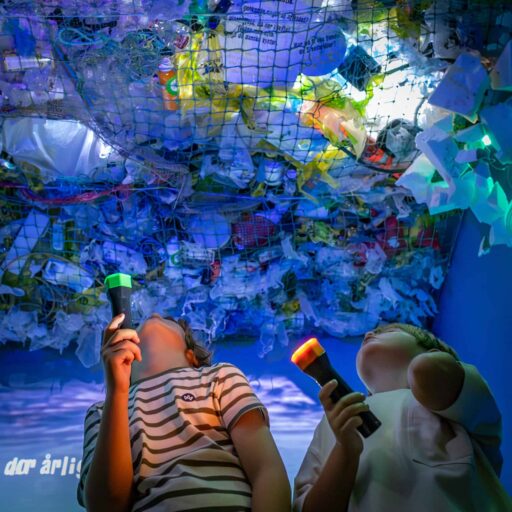
In Vejle, Økolariet is a hands-on sustainability centre where visitors can experiment and explore environmental issues in playful, unexpected ways. Generate energy with mini wind turbines, test water quality with simple kits, or watch food waste turn into compost. Økolariet makes climate action tangible and immediate, showing that learning can come from doing, not lecturing.
Advertisement
Image: Økolariet
Advertisement
Main image: Lego House
Travel to and from Denmark, accommodation, attraction entry fees and meals were partly covered by VisitDenmark
Advertisement
Support solutions in 2026
At Positive News, we’re not chasing clicks or profits for media moguls – we’re here to serve you and have a positive social impact. We can’t do this unless enough people like you choose to support our journalism.
Give once from just £1, or join 1,800+ others who contribute an average of £3 or more per month. Together, we can build a healthier form of media – one that focuses on solutions, progress and possibilities, and empowers people to create positive change.
It is “inconceivable” that Sir Keir Starmer and David Lammy were not told about Peter Mandelson failing the security vetting process for the role of US ambassador, a former foreign secretary has claimed, amid growing accusations that the prime minister scapegoated the head of the Foreign Office in order to save himself.
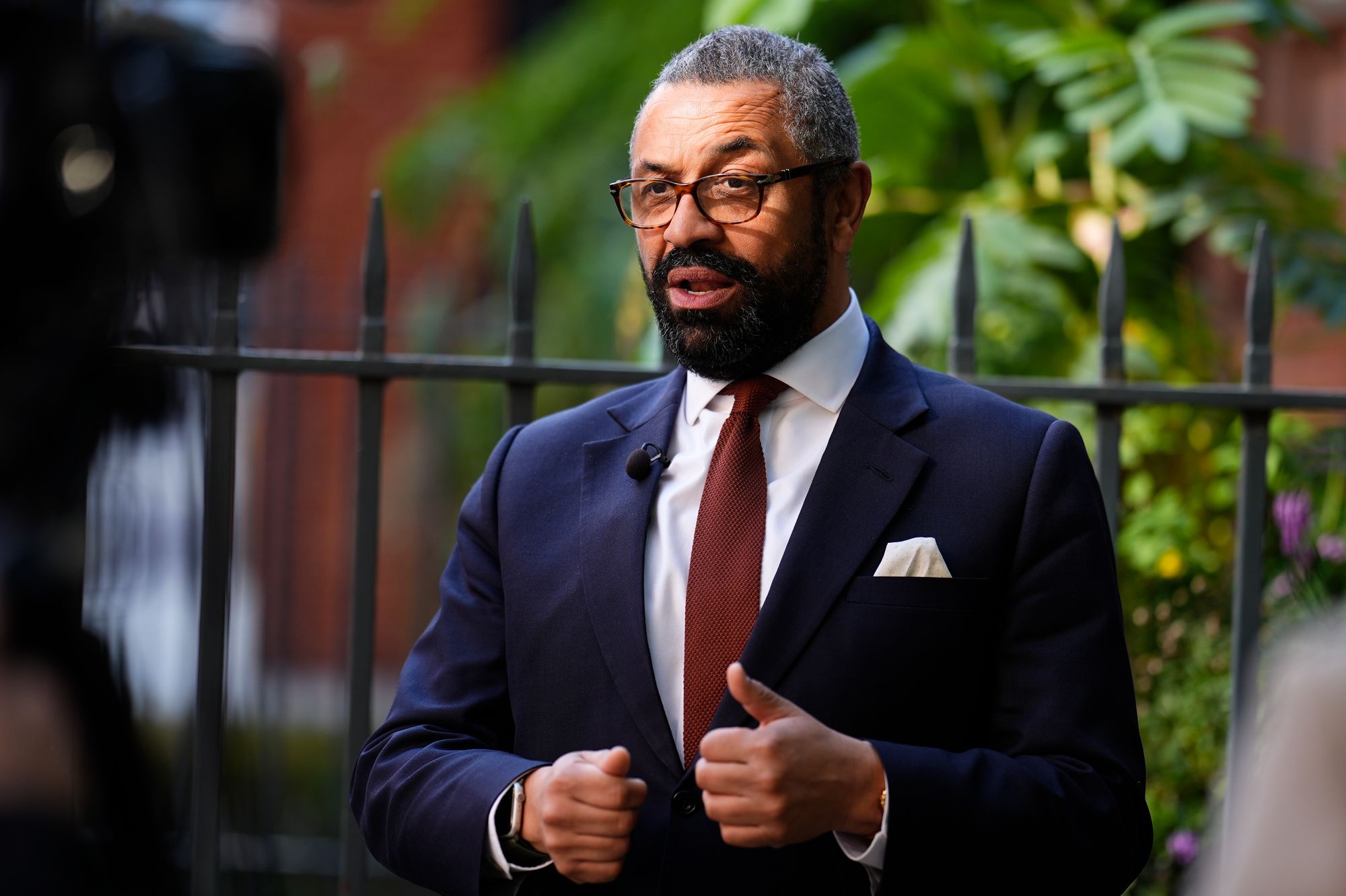
Describing his own recent experience, Sir James Cleverly, who was foreign secretary from 2022 to 2023, said: “I cannot envisage a universe where someone senior in the Foreign Office wouldn’t have sat down with the foreign secretary and said something to warn about this.”
It comes as former civil servants claim that the sacked permanent secretary to the Foreign Office, Sir Olly Robbins, was “thrown under a bus”.
Sir Keir has claimed he only discovered last week that Lord Mandelson had failed vetting, despite The Independent telling Downing Street and running a story on the revelation in September last year.
Advertisement
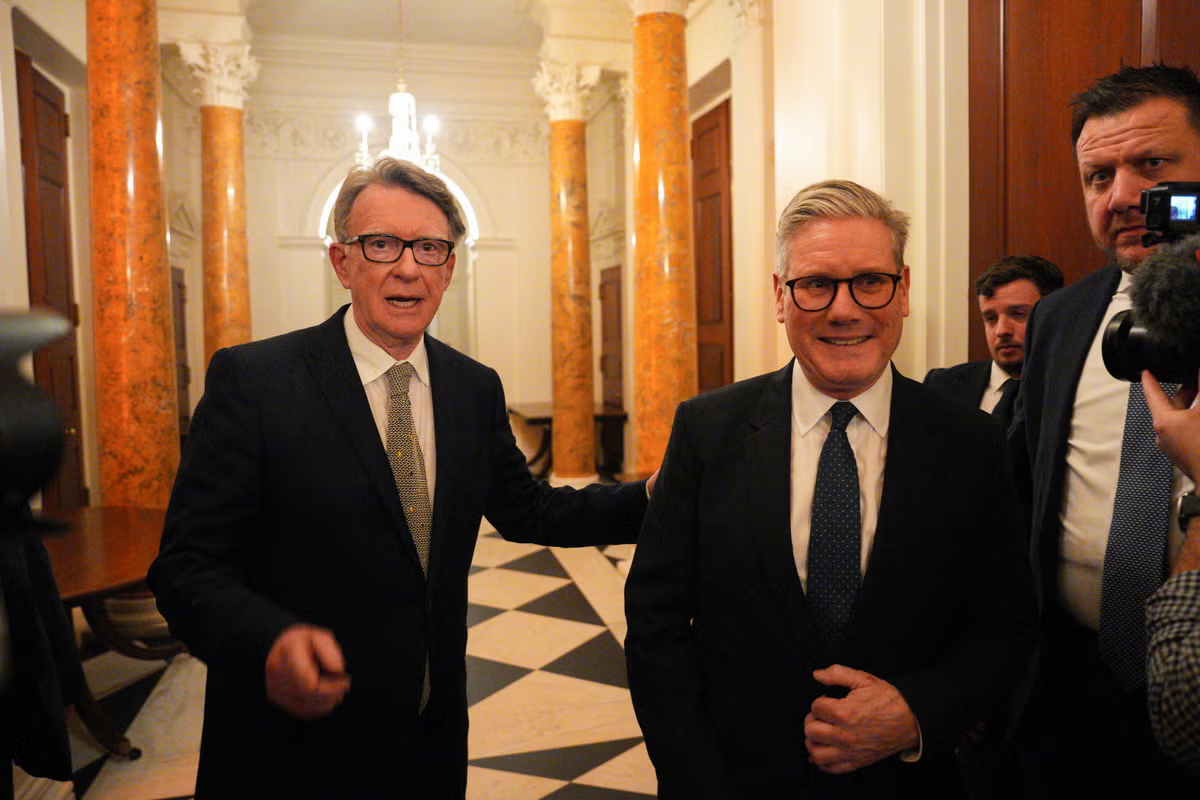
Prime minister Keir Starmer with Britain’s ambassador to the United States Peter Mandelson during a welcome reception at the ambassador’s residence in Washington in February last year (AFP/Getty)
The prime minister said it was “staggering” and “unforgiveable” that he had not been told earlier, adding that he was “furious”. He claimed that Downing Street and all his ministers had been kept in the dark.
In an interview with The Guardian, Mr Lammy said he had no knowledge of Mr Mandelson’s vetting process and that the prime minister would “absolutely no doubt at all” have blocked the Labour grandee from serving as the UK’s ambassador to Washington if had he known he failed security checks.
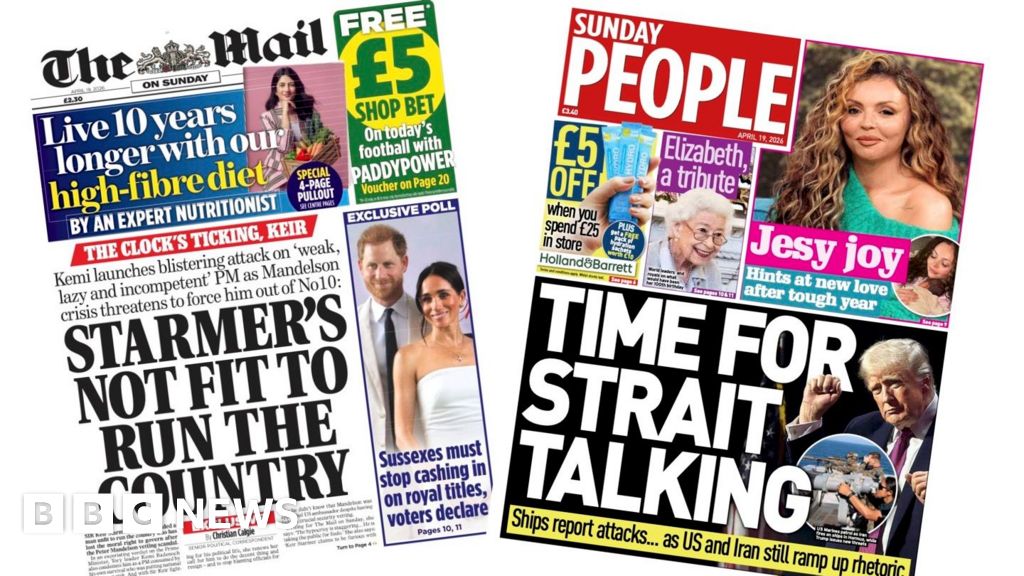
Reform UK leader Nigel Farage called for the prime minister to resign over the furore and Tory leader Kemi Badenoch wrote in the Mail on Sunday that Sir Keir was “unfit to govern”.
Sir Olly is widely expected to mount a staunch defence of his decision to approve Lord Mandelson’s appointment at a hearing of the Foreign Affairs Select Committee on Tuesday – which has been described as “judgement day” for Sir Keir – with former colleagues expecting the former civil servant to emphasise that the appointment was a ministerial decision pushed through by Downing Street.
As outrage grows at the scandal around Lord Mandelson’s appointment, and the prime minister’s claims that he wasn’t aware of the problems surrounding it, fresh doubts are being cast on Sir Keir’s version of events.
Advertisement
Questions have been raised about his claim, made in the Commons in February, that Downing Street was not aware that Lord Mandelson had failed security vetting.
Simon McDonald, a former permanent secretary in the Foreign Office, told Radio 4’s Today programme that Sir Olly had been “thrown under a bus”, and described him as a “scalp” who had been sacked in an effort to save the prime minister.
“I think this is the biggest crisis in the diplomatic service since I joined it in 1982,” said Lord McDonald.
Speaking on The Independent’s political podcast In the Room, former deputy cabinet secretary Helen MacNamara criticised the prime minister for axing Sir Olly, calling the decision “reactive” and echoing the metaphor about throwing him under a bus.
Advertisement
Other senior former colleagues of Sir Olly have suggested that what he is accused of is “completely out of character”.
With recent experience of making highly sensitive diplomatic appointments as foreign secretary, Sir James said it was “just not credible” that neither Sir Keir nor the then foreign secretary Mr Lammy – now deputy prime minister – did not know.
He said: “It is just inconceivable that Olly Robbins would have sat on this information knowing that it would eventually blow up.
“We are being asked to believe that Olly Robbins was sitting there thinking, ‘I actually know Mandelson didn’t get through vetting… I probably should tell the prime minister that before he embarrasses himself further.’”
Advertisement
James Cleverly was foreign secretary from 2022 to 2023 (PA)
He went on: “That is just not credible – the idea that absolutely nobody read The Independent’s piece in September; that seems at odds with what Olly Robbins has already told us.
“The only thing I can think is that Olly doesn’t have anything in writing to show he told anyone.”
Pointing to a letter sent by Sir Olly in July last year to shadow Tory minister Richard Holden, in which he stated that Lord Mandelson “was directly appointed by ministers”, Sir James suggested that the sacked senior mandarin “has left a trail of crumbs back to who was really responsible”.
He said that normally, diplomatic roles are given to career diplomats who have already been vetted, but with political appointments, “the foreign secretary is told firmly that is on him, and is warned of the risks”.
Sir James said: “I had this with two political appointments I tried to make which were much more minor than the ambassador to the United States. They make it very, very clear that you, personally, are importing a whole load of risk.”
Advertisement
He added: “This is why I think David Lammy may have even more problems than Keir Starmer.”
On the matter of any problems that might arise, Sir James said: “Of course I would relay that to the prime minister, especially in a case like this, where the appointment was being driven by Downing Street.”
Simon McDonald, a former Foreign Office minister, described the Mandelson affair as ‘the biggest crisis in the diplomatic service since I joined it in 1982’ (PA)
However, speaking to The Guardian, Mr Lammy said he had not been told about Mr Mandelson’s vetting process and that the PM would not have hired the former him if he’d known.
He added: said: “I have absolutely no doubt at all, knowing the PM as I do, that had he known that Peter Mandelson had not passed the vetting, he would never, ever have appointed him ambassador.
“The prime minister was not particularly close to Peter Mandelson. He hadn’t worked with him in the past, as some of us had. He was weighing a decision, but I’m quite sure had he known that, he would not have become ambassador. Therefore this is inexplicable.”
Advertisement
It is known from papers already released that Sir Philip Barton expressed concerns about the appointment before he quit early as permanent secretary at the Foreign Office in February 2025.
Other former top cabinet ministers and civil servants have also privately agreed with Sir James’s assessment, noting that such briefings to the prime minister and other senior cabinet ministers take place in STRAP rooms (secure and secret).
One former senior civil servant also pointed to a post on X by Dominic Cummings, in which Mr Cummings attacked claims that the prime minister hadn’t been briefed.
Mr Cummings, who served as Boris Johnson’s chief of staff, wrote: “The PM is often told by officials details from vetting, leak inquiries, investigations by intel agencies etc. This is because the PM in our constitution is often the only constitutional authority deemed able to make a political judgement about things including risk assessments of appointments.”
Advertisement
The former civil servant described the post as “completely accurate”.
Sir James’s doubts coincide with revelations that others in Whitehall – including new cabinet secretary Dame Antonia Romeo, the permanent secretary to the Cabinet Office, Cat Little, and government lawyers – were all aware of the problem as of March this year.
A source close to the deputy prime minister said: “The deputy prime minister has made it clear that he had no knowledge that the FCDO had overruled Peter Mandelson’s vetting outcome until Thursday afternoon.”
The Independent has approached Downing Street and Mr Lammy’s office for comment.
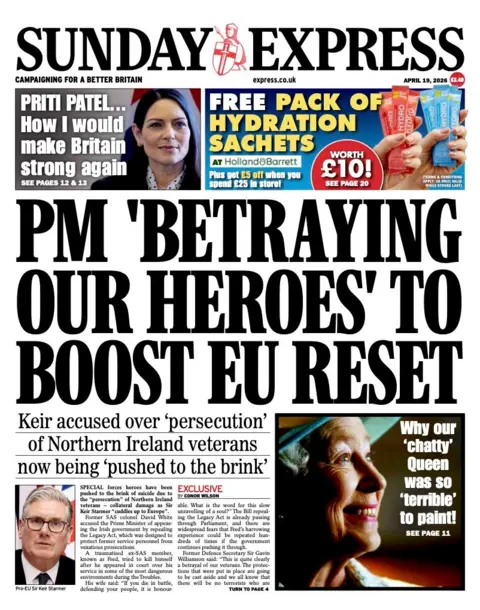
There’s more criticism levelled at the prime minister, with the Sunday Express saying Sir Keir is being accused of “betraying” Northern Ireland veterans over Labour’s plans to repeal the Legacy Act. The controversial clause, which protects former servicemen from prosecution for Troubles-era crimes, had already been found to be unlawful and was opposed by Northern Ireland parties and victims’ groups. The paper quotes a former SAS colonel who says veterans are being “pushed to the brink” while the PM “cuddles up to Europe”.
Cherry claimed the mood was “jovial, even celebratory”.
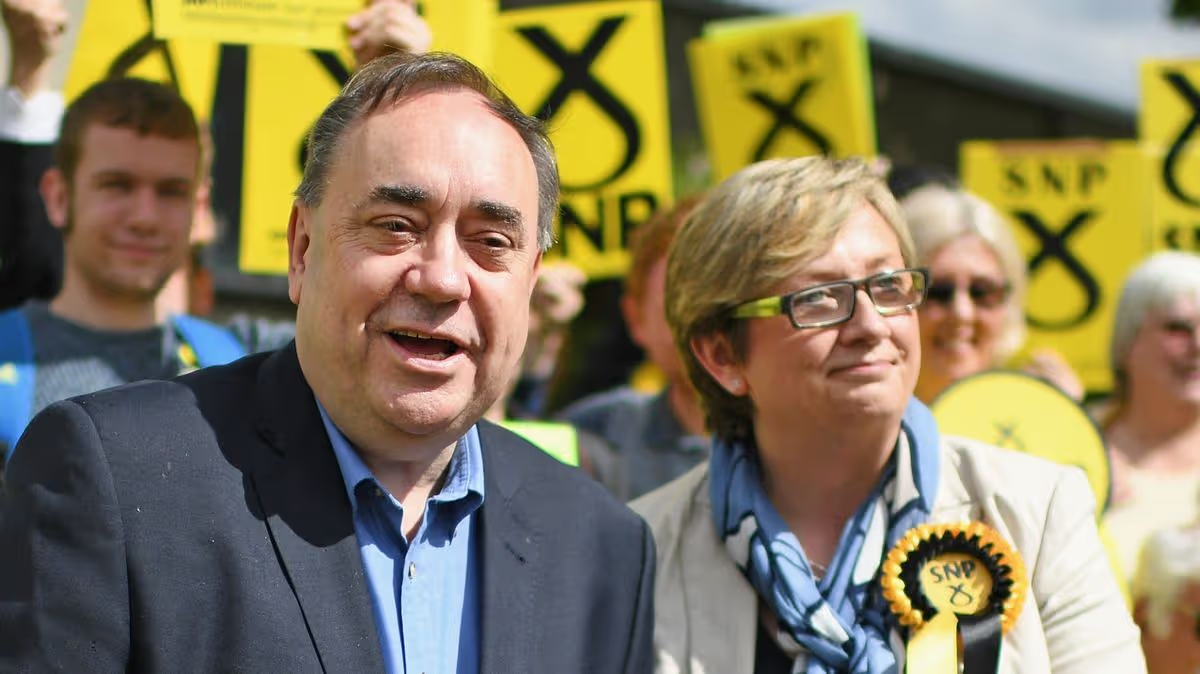
Joanna Cherry has dropped bombshell claims that SNP insiders were “jovial” over Alex Salmond being probed over sex attacks claims at Bute House.
Advertisement
The former MP has gave the jaw-dropping account in her new book, ‘Keeping The Dream Alive’, claiming that the party machine allegedly revelled in its former leader’s downfall, in excerpts published by the Times. Cherry claims that senior figures gathered at the plush Western House Hotel after the news dropped, but instead of showing sympathy or being in shock, the mood was “jovial, even celebratory”.
Cherry then goes on to say she believed there was a “witch hunt against Alex”.
Allegations of sexual misconduct against Salmond were first published by the Daily Record in 2018. Following a trial in 2020 he was acquitted on all charges.
In another explosive claim, Cherry says she became the target of vicious name-calling within Nicola Sturgeon’s inner circle. She alleges she was branded with the label ‘The B**ch’.
The former MP recounts being subjected to a barrage of abuse by colleagues over her decision to attend an LGB Alliance conference, with senior figures joining in the criticism.
Cherry also told the Times that while writing her autobiography she had become “absolutely disgusted by the SNP, and ashamed of being a member”.
Ms Cherry revealed she had left the party as she claimed its Holyrood election manifesto – unveiled on Thursday – had made clear the SNP “intend to continue ignoring the law” on biological sex. She also alleged the First Minister is “too afraid” to stand up to his party on the issue.
Advertisement
John Swinney has responded saying he is “satisfied” his Government has complied with a landmark Supreme Court ruling on sex and gender – despite claims from Cherry claiming that he is a “coward” who has failed to implement it.
Mr Swinney insisted he was “satisfied the Scottish Government has taken the necessary steps to implement the Supreme Court ruling”. The SNP leader spoke to journalists in Dundee as he unveiled the battle bus that will take him around Scotland campaigning in the run-up to the May 7 election.
Asked about Ms Cherry’s comments, the First Minister said: “An awful lot of this stuff is in the past, and I’m looking to the future.”
Advertisement
Pressed on her decision to leave the party she represented at Westminster, Mr Swinney added: “People make their own decisions about their politics.”
He continued: “So much of what is being talked about here is in the past and I am looking to the future.”
The First Minister also stressed: “I’m satisfied the Scottish Government has taken the necessary steps to implement the Supreme Court ruling.”
That ruling, from April 2025, made clear that the the terms “woman” and “sex” in the 2010 Equality Act “refer to a biological woman and biological sex”.
The Scottish Government is still facing a second legal challenge from the group that won that case, For Women Scotland, over the placement of transgender prisoners in women’s jails.
Advertisement
Mr Swinney told the Press Association: “There’s obviously still some parts of that that are still the subject of legal challenge in Scotland that I can’t comment on, it is for the courts to look at.
“But I am satisfied we have taken the steps to implement the Supreme Court ruling, which is in accordance with my view, that I have always asserted, that the Scottish Government must act within the law.”
Keeping the Dream Alive by Joanna Cheery is £20 and available from Icon books.
Get more Daily Record exclusives by signing up for free to Google’s preferred sources. Click HERE
In her 1998 essay What’s a Good Gay Film?, film critic B. Ruby Rich considered what queer audiences were looking for.
She wrote that queer cinema-goers were seeking “films of validation and a culture of affirmation: work that can reinforce identity, visualise respectability, combat injustice and bolster social status”. They were tired, she argued, of stereotypes of queer suffering and trauma. Instead, they required “nothing downbeat or too revelatory; and happy endings, of course”.
But if a straightforward happy ending is what you are after, Departures is not the film for you. This miraculously self-financed and stylish debut feature is not purely affirmative. At times, the screen shimmers with sadness. And yet, wryly and playfully, the film also resists becoming gloomy. Tonally sophisticated, it combines the bleak with the whimsical, ultimately sidestepping the crude dichotomy of happy or unhappy endings altogether.
The film opens with a love-scarred Benji (played by the film’s writer and co-director Lloyd Eyre-Morgan) recalling a recent relationship. In flashback, he remembers meeting handsome Jake (David Tag) in the airport as they both wait for a flight to Amsterdam. Jake bewilders Benji: his flirtation is suggestive but always deniable, never quite declaring itself. Charismatic and assertive, Jake engineers it so that they sit together on the flight, telling the air steward that he is Benji’s carer – a description which quickly becomes grimly ironic.
Advertisement
The trailer for Departures.
Later, Jake rejects the suggestion that he is gay but demands that Benji give him a blowjob regardless. Monthly trips to Amsterdam follow and the two men develop a form of intimacy, but one which affords the softer, more pliable Benji little power.
In such a brief synopsis, the scenario risks sounding cliched. Familiar narrative devices pile up: the physically asymmetrical gay relationship in which the self-consciousness of one man makes them susceptible to the coercive manipulations of the more assured partner in a whirlwind of sex and drugs and emotional control. A comparable dynamic played out in another recent queer film, Pillion.
Benji, longing for this to be more than a once-monthly dose of overseas sex, withstands put-downs and disappointments. His quiet, emotional expressions of desire (played movingly by Eyre-Morgan) contrast with Jake’s struggle to accept his attraction to men. Tag is excellent and his portrayal of Jake is sometimes harsh and defensive, but also shows vulnerability, which prevents him from becoming a one-dimensional monster. Because of these tensions, the relationship’s unhappy ending feels like a dead cert.
Advertisement
Lessons from Heartstopper
Departures takes familiar cliches and gives them new life, turning them into something unexpectedly revealing. Its understated story recalls many films about gay suffering – from A Single Man to All of Us Strangers – but it refuses to stay within that familiar emotional frame.
Instead, the film disrupts expectations through bold, stylised touches that feel borrowed, perhaps improbably, from the Heartstopper playbook. The result is a work that plays with recognisable influences while twisting them into something more strange, lively and original.
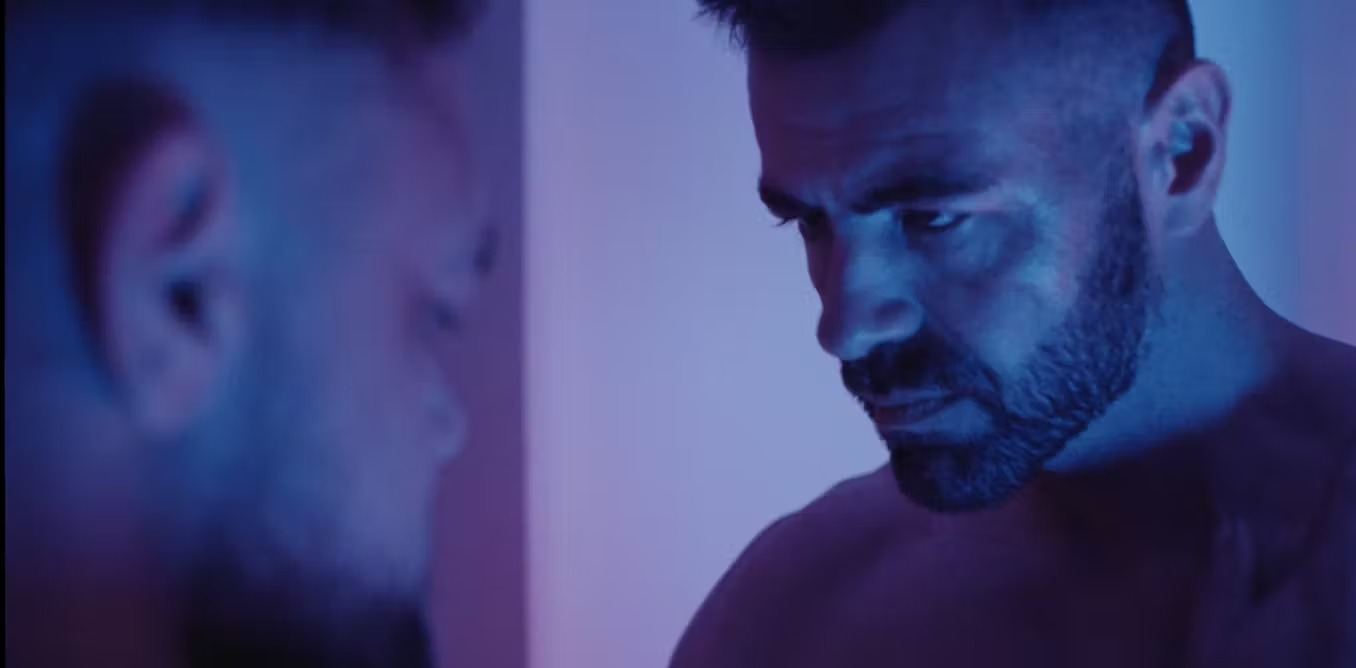
Benji and Jake, played by Lloyd Eyre-Morgan and David Tag. Peccadillo Pictures
Heartstopper, the popular Netflix queer teen drama, deliberately avoids the more difficult or painful stories often told about queer life. Instead, it offers the kind of wish-fulfilling, happy endings that Rich suggested many queer viewers have long desired. Every glance, touch and kiss between its characters is punctuated with playful on-screen doodles — bursts of electricity, fluttering butterflies and swirling text that insist we are watching Love with a capital L.
Departures borrows these same twee, saccharine stylistic gestures, but uses them in a very different context. Applied to a darker, sometimes even sordid story about control and sadness, they take on a mischievous, unsettling edge.
As Benji’s voiceover details his suffering, scratchy lettering and illustrations dance around the screen. When he first sees Jake and his weary voiceover acknowledges the pain to come, doodled hearts burst around the handsome stranger to the music of Gershwin’s Rhapsody in Blue. As Benji submissively performs oral sex for Jake, the Hallelujah Chorus plays and animated fireworks fill the screen. And as Jake prepares to get into a fight with Benji’s friends, the needle of a Toxic Masculinity Meter shoots up to maximum. Here is a version of Heartstopper for an audience which knows that happy endings are often only the stuff of comic books.
In Departures, the collision of the sombre, unsettling narrative with the comic stylings of those twitching onscreen graphics suggests a more complex emotional situation in which neither cynicism nor romanticism is left unchecked. Instead, they synthesise in a complex portrait of Benji, who can neither maintain nor give up his romantic belief that Jake might love him.
Colliding styles
One of the film’s most striking ways of expressing this tension comes in a series of non-narrative sequences. Here, the characters dance – or perhaps merely convulse – under harsh strobe lights, their bodies flickering in and out of view, shifting into new poses and even seeming to become different selves between flashes.
Advertisement
It’s a simple but powerful device, inspired by the club scenes the men encounter on their trips to Amsterdam. Yet it opens up something more unsettling: brief glimpses of gay men caught between pleasure and pain, ecstasy and distress, moving to the uncertain rhythm of a contemporary queer world where nothing quite feels stable or fixed.
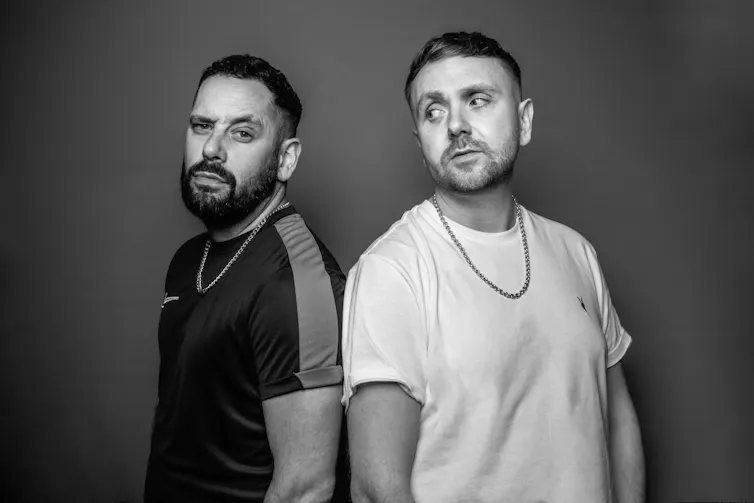
The film’s directors Neil Ely and Lloyd Eyre Morgan. Peccadillo Pictures
In the 1990s, Rich rejected the idea of easy affirmation, describing herself instead as an “old-time outlaw girl” who craved films “that push the edge, upset convention, defy expectation, speak the unspeakable, grab me by the throat and surprise me with something I’ve never seen before”.
Departures may work with familiar characters and a recognisable story, but its force lies in how it collides styles and tones in unexpected ways. It’s the kind of film that, in Rich’s terms, grabs you by the throat. What stays with me most is its sardonic yet romantic energy and the strangely undefeated presence of Benji at its centre.
This film deserves to find an audience who want more than easy viewing. It deserves viewers who will dance along to its tonal shifts and cherish the funny, sad, ironic almost-happy ending it serves up in its closing credits.
“I am not a politician; I speak of the Gospel.” Pope Leo XIV’s recent remarks, made during his apostolic journey to Africa, immediately suggest that his clash with Donald Trump operates on a different level to the US president’s usual political spats.
This is not the classic kind of confrontation that Trump has often had with foreign heads of state and government in the past, such as in recent months with the UK prime minister, Keir Starmer, whose refusal to fully back the US and Israel in their war against Iran attracted Trump’s ire. Rather, it is a clash rooted in fundamentally different moral and political visions: between a president who treats power in transactional terms and a pope who frames war, migration and human dignity as matters of moral principle.
When Cardinal Robert Prevost was named as Pope Leo in May 2025, Trump and his administration initially appeared to welcome the new pontiff warmly. In fact, in a post to his Truth Social platform the US president appeared to take credit for his election as pope, writing that Prevost “was only put there by the Church because he was an American, and they thought that would be the best way to deal with President Donald J. Trump”.
But the war in the Middle East launched by the US and Israel has made the differences between their positions clearer – further heightening tensions between them. On Palm Sunday, the week before Easter, it became clear that Leo had decided to take a firm line against the war in Iran, saying that Jesus “does not listen to the prayers of those who wage war, but rejects them, saying: ‘Even though you make many prayers, I will not listen: your hands are full of blood’”.
Advertisement
His Easter message was equally clear: “Let those who have weapons lay them down! Let those who have the power to unleash wars choose peace! Not a peace imposed by force, but through dialogue! Not with the desire to dominate others, but to encounter them.”
Day’s later the pope denounced the US president’s apparent threat to destroy the whole of the Iranian civilisation as “truly unacceptable” in comments which roundly criticised the war and called for a “return to dialogue, negotiations”.
Trump responded in harsh terms, describing the pope in a Truth Social post as “weak on crime” and “terrible for foreign policy”. He went on to say that he did not want a pope “who thinks it is OK for Iran to have nuclear weapons”, adding that “Leo should use common sense, stop doing the bidding of the radical left, and focus on being a great pope rather than a politician”.
Returning to Washington from Florida, Trump also told reporters: “I don’t think he’s doing a good job. I’m not a fan of Pope Leo.” The pope replied on Monday by saying that he was not afraid of the Trump administration and would continue to speak out against war.
Advertisement
Trump did not stop there. He went so far as to publish an image portraying himself as Jesus Christ, a move that appeared to go too far even for many of his conservative supporters. The reaction was strong enough to force him to delete the post and backtrack.
This could hurt the US president
Trump has clashed with the Vatican before, but this confrontation unfolds in a very different setting. Pope Francis, the first Argentine pope and the first pontiff from the global south, was often openly critical of Trump, particularly on migration. In 2016, he famously suggested that a leader who thinks only of building walls rather than bridges is “not Christian”, crystallising the tension between them.
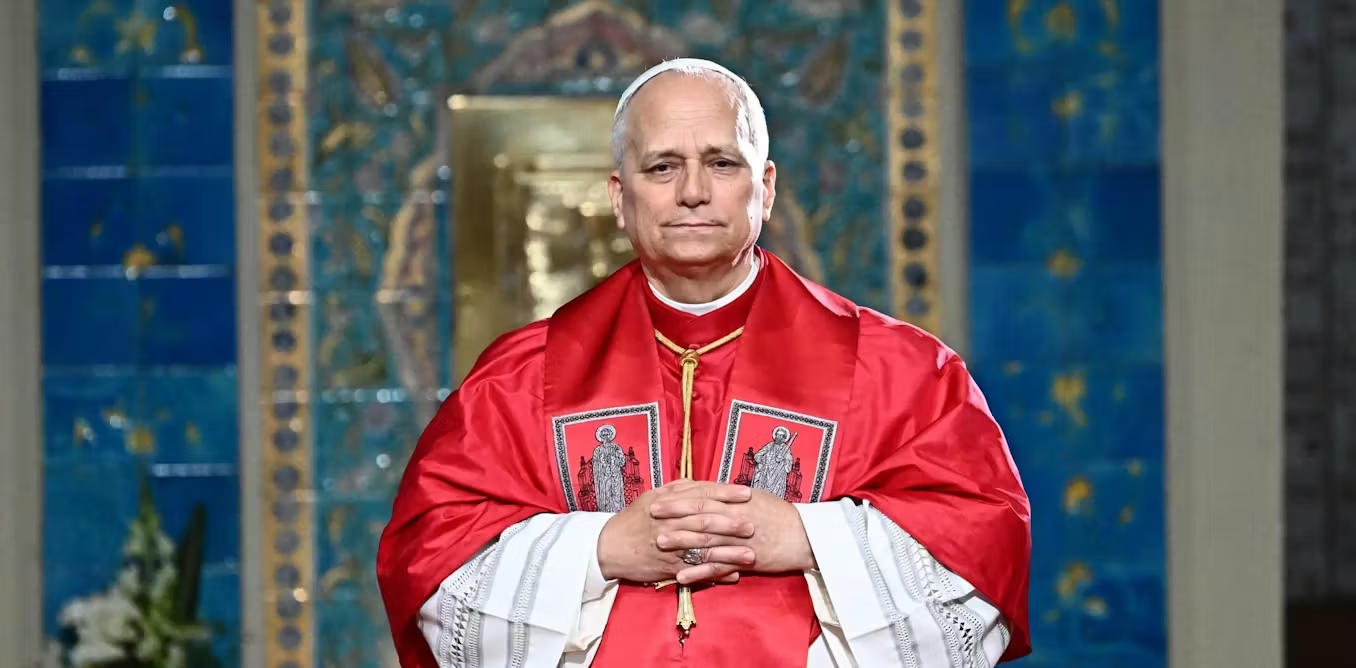
Pope Leo XiV calls for an end to war, March 29 2026.
The key difference was that Francis was also a divisive figure within sections of the American Catholic Church. He was frequently targeted by conservative Catholic commentators and church networks in the US, and in 2019 he remarked that “it’s an honour that the Americans attack me”.
Advertisement
Leo, by contrast, is the first US pope – and that changes the political equation. His voice is likely to carry different authority among Catholic voters, who are an important part of Trump’s electoral base.
In the last presidential election, 55% of Catholic voters supported Trump, including 62% of white Catholics. Senior Catholics also occupy prominent positions in his administration, including Vance and Trump’s secretary of state Marco Rubio.
That is why Leo’s criticism may prove more politically consequential. It does not come from an external moral voice alone, as was often the case with Francis, but from an American pontiff speaking into a church and an electorate that Trump cannot afford to ignore.
Early reactions suggest that many Catholic voices in the US have rallied behind Leo, making this not only a diplomatic clash, but a potentially significant domestic one too. (This could also really hurt J.D. Vance. As the likely contender to succeed Trump on the Repulican ticket, he is deeply invested in his Catholic faith and is about to publish a book devoted to his conversion.)
Advertisement
From an international perspective, the break with the pope has also had visible repercussions. Giorgia Meloni, the Italian prime minister, long regarded as Trump’s closest ally in Europe, went publicly in defence of Pope Leo, the bishop of Rome, drawing criticism from Trump himself, who defined the Italian prime minister’s behaviour as “unacceptable”.
To conclude, this is not a political confrontation like the many others the world has become used to with this US president. The stakes are higher at home and on the world stage. At home, it risks alienating many Catholic voters whose support will matter not only in the midterm elections but also in the next presidential race. Internationally, it may complicate Trump’s relationship with European conservative parties, many of which have long sought close association with the Vatican.
The pope, as the leader of a vast global community, cannot be treated as though he were just another political opponent.
A newly-announced shake-up is set to see households given about two months to settle bills rather than having to pay an entire year’s demand in two weeks.
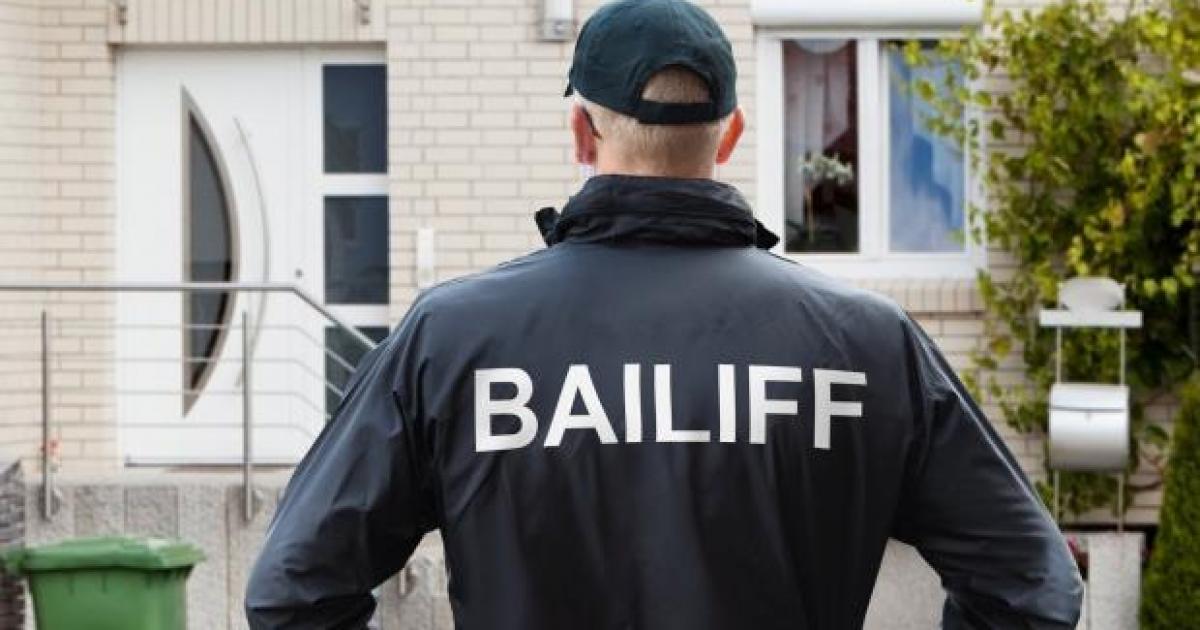
Local Government Secretary Steve Reed said the current system had left families terrified of bailiffs knocking on their door because of month’s council tax bill was missed.
Cllr Katie Lomas, City of York Council’s Labour financial spokesperson, said the changes would support the authority’s ongoing work to help people pay their bills.
Martin Lewis, of the Money Saving Expert personal finance website, said the current system was the most vicious and damaging form of legal debt collection.
Advertisement
It comes after shake-up was unveiled by the Government on Wednesday, April 15.
RECOMMENDED READING:
The announcement follows a campaign from Money Saving Expert’s Money and Mental Health Policy Institute to reform the system which has remained unchanged since council tax was introduced in 1993.
Changes are set to see people given 63 days to settle outstanding bills and councils will be required to work with them on agreeing repayment plans.
Advertisement
Billing for council tax will be shifted to 12-month payments by default, rather than the current 10 months schedule which is the norm for many local authorities.
Charges for costs councils incur by recovering outstanding payments through liability orders will be capped at £100.
Payment schedule changes are set to come into effect from next April with the rest of the changes due to be introduced a year later in 2028.
The name and definition of the Severely Mentally Impaired council tax discount is also set to be changed when parliamentary time allows.
Advertisement
Those changes aim to remove stigma which puts people off applying for support.
The Government said it would put an end to the current system which left families who fell behind on payments facing financial ruin.
Money Saving Expert’s Mr Lewis said the current system had caused counter-productive misery for millions.
Martin Lewis has campaigned for the changes (Image: Agency)
The financial advisor said: “Council Tax debt collection is so aggressive it’d make banks blush.
Advertisement
“How people who can’t find a month’s money are expected to find a year’s I don’t know.
“Yet if they can’t pay, within just three more weeks, they are often taken to court, have ‘admin costs’ added, and soon see bailiffs sent in.
“For councils too, it is worth remembering that this grotesque system is often catastrophic for people’s finances and wellbeing, leaving many needing more help and support, and ultimately the same council having to pick up the pieces.”
Local Government Secretary Mr Reed said the changes would make the system fairer and support families who have been left behind.
Advertisement
The Labour secretary of state said: “Too many families are facing aggressive enforcement action, with people left terrified of bailiffs knocking on the door because one month’s council tax bill was missed.”
York Council’s Labour Finance Executive Member Cllr Lomas said the work local officials already did helped people to get benefits and support they were entitled to.
Cllr Lomas said: “We’ve been providing the payment option of 12-monthly instalments for several years, encouraging the use of direct debit and keeping liability order costs 80 per cent below the Government’s £100 cap, for residents receiving council tax support.
“We provide council tax information with all bills as well as on our website and all residents can now register for e‑billing and we would encourage them to do so.
Advertisement
“We will also continue to send physical copies to all residents who want them or have no digital access.”
A trail of damaged homes and buildings dotted a wide swath of the U.S. on Saturday after a burst of destructive winds and reported tornadoes tore off roofs, uprooted trees and rendered rural roads impassable with debris.
No deaths were reported following Friday’s storms, which barreled through the Upper Midwest and delivered the latest round of severe weather to batter the region. Officials braced residents for a long recovery in some rural communities.
“We are extremely fortunate that this storm did not result in loss of life or serious injury,” Stephenson County Sheriff Steve Stovall said of the storm that hit Lena, Illinois.
Officials in Wisconsin and Minnesota echoed those sentiments.
Advertisement
In central Wisconsin, a reported tornado that tore through the cities of Kronenwetter and Ringle left behind damaged homes and some residents briefly trapped in their basements, Ringle Fire Chief Chris Kielman told reporters.
Marathon County Sheriff Chad Billeb said he had not seen this much devastation during his 34 years in law enforcement.
“A lot of people are going to need a lot of help,” Billeb said.
In Kronenwetter, neighbors were helping each other clear debris from their properties, and Wisconsin Public Service was working to restore power. Police Chief Terry McHugh said it could be a lengthy process.
Advertisement
He noted that the Community Foundation of North Central Wisconsin has partnered with United Way of Marathon County to help residents whose homes were damaged.
In Olmsted County, Minnesota, sheriff’s officials said tornadoes caused “multiple levels” of damage. At least 30 homes were damaged in Marion Township, with a number of those sustaining damage that was described as significant. Officials went door to door to check on people.
The National Weather Service said the damage was likely caused by tornadoes and surveys of the affected areas would be conducted over the weekend.
On Friday in Illinois, Leo Zach, 14, had just gotten to the high school band room for a music competition when the building started shaking and the power went out. The room was packed with students, and some were very scared and had panic attacks.
Advertisement
“I’m definitely on the luckier side of how that could’ve happened,” he said. “I was just trying to stay calm, help other people.”
When they got outside, they found some of the windows blown out in the gym and part of the school’s roof ripped off.
Photos and video posted online showed a garage totaled, bricks torn from buildings and fences demolished.
Lena is a village of nearly 3,000 people, located about 117 miles (188 kilometers) northwest of Chicago.
Advertisement
Rachel Nemon was going to pick up her stepson from Lena’s middle school when she had to pull into a car wash to take cover from the storm. She watched a large tree get ripped from the ground and sparks fly feet in front of her.
“This is something that you see online, not in real life, especially in a small town in Illinois,” she said.
The popular park was closed after ‘discarded items’ were reported to police
Husna Anjum Senior Reporter
22:35, 18 Apr 2026Updated 22:36, 18 Apr 2026
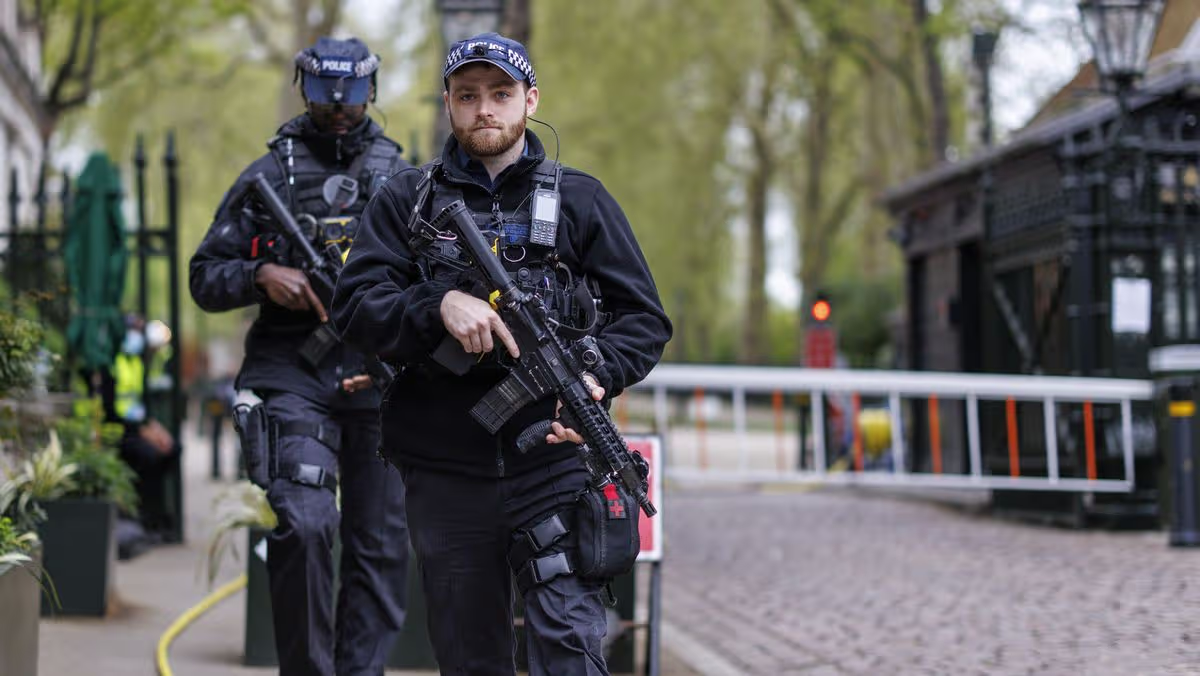
Kensington Gardens has reopened after police confirmed ‘no harmful substances’ were found. The popular park, situated next to Kensington Palace and Hyde Park, was closed according to The Royal Parks yesterday (April 17).
Specific details were unclear as the Met Police stated they were “assessing a number of discarded items”. Members of the public were asked to steer clear of the location ‘until further notice’.
Advertisement
One witness reported spotting a forensics team near the bandstand in the centre of the park. However today (April 18) police confirmed the re-opening of Kensington Gardens after ‘several suspicious items’ were found.
An update on the Met Police website revealed that among the items were two jars containing a ‘powdered substance’. There were also reports of an online video featuring a group who claimed to have targeted the nearby Embassy of Israel with drones carrying dangerous substances.
This prompted the police presence at the park, however it has now been confirmed no harmful or hazardous substances were identified. Commander Helen Flanagan, of Counter Terrorism Policing London, said: “We recognise this incident and consequent police activity may have caused concern among local residents and the wider public.
“We are grateful to them for their understanding while our work was undertaken. Although the items found have been assessed as being non-hazardous, we continue to investigate whether they may have any link to the online video.
Advertisement
“This work is being carried out by officers from Counter Terrorism Policing London and our enquiries remain ongoing. While the Embassy of Israel was not attacked, we continue to work closely with the Embassy and its security team to keep the site safe and secure.”
Ensure our latest stories always appear at the top of your Google Search by making us a Preferred Source. Click here to activate or add us as your Preferred Source in your Google search settings.
Ants are a common and frustrating pest, but this simple tip will stop them coming back.
Discovering a swarm of insects in your home can be deeply unsettling, particularly when you’re unsure of where they’ve come from. The question most of us ask when confronted with seasonal household pests, such as ants, is how to eliminate them quickly.
Advertisement
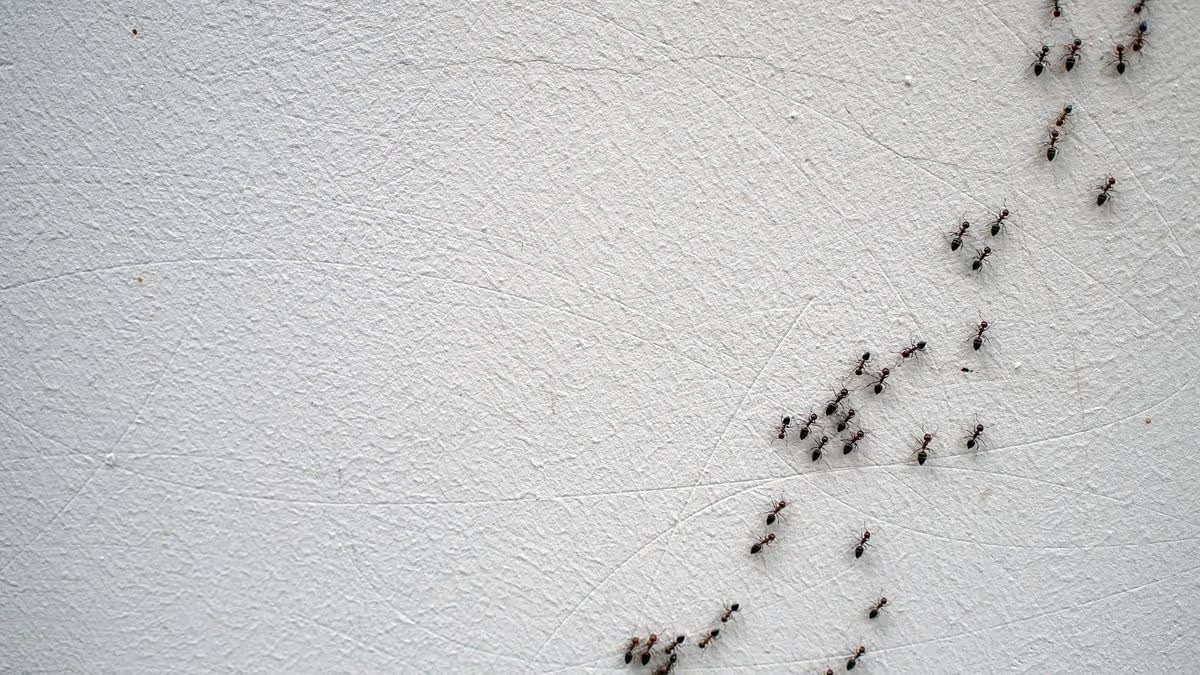
That’s precisely what fans of Mrs Hinch were discussing in the Facebook group ‘Mrs Hinch Cleaning Tips’. One worried homeowner sought advice after returning home to find “hundreds” of ants emerging from beneath the washing machine and kitchen cupboards, prompting a wave of responses.
Many suggested using a widely available spice that Nicole Carpenter, president of Black Pest Prevention, says “creates an unfavourable environment for ants, making them want to leave your space.”
Fellow Facebook group members shared their tried and tested remedies, with one user claiming: “Cinnamon works. I did it and they never came back.”
Another commented, “They hate cinnamon, it got rid of ours.” A third added, “We live out in the country, and for some reason, I get them in the kitchen every few years. I use cinnamon and they are gone in a day and don’t come back.”
Advertisement
Pest specialist Nicole clarified that while this warming, aromatic spice can be deployed to repel ants from your home, it’s worth noting that “the scent of cinnamon itself doesn’t kill ants”
Nevertheless, it functions as an effective deterrent owing to its powerful aroma, which disrupts the pheromone trails ants rely upon to locate food.
That said, it must be applied correctly to achieve the best results, reports the Express.
Advertisement
How to deter ants with cinnamon
Cracks and gaps in the foundation, walls, and around windows and doors are typical entry points for hungry ants.
It’s worthwhile inspecting poorly sealed or damaged door and window frames, which can offer straightforward access for these unwelcome visitors.
If you spot ants entering through these areas, mix cinnamon with a small amount of water and apply it using a cotton bud along their route into your property.
While cinnamon is frequently compared to vinegar and essential oils, which serve as alternative natural ant repellents, it functions differently to other substances.
According to Ismael Girard, CEO of Pest Agent, the key ingredient in cinnamon that may disturb ants is cinnamaldehyde.
He explained: “This substence tampers with ants’ pheromone trails, making it harder for them to navigate toward their food sources or return to their colonies.”
Ants are typically attracted to spaces like the kitchen, where they can easily locate food sources to transport back to the rest of their colony.
Advertisement
Consistent cleaning, appropriate food storage, and immediate cleanup of spills and crumbs are essential to avoid attracting ants.
BARCELONA, Spain (AP) — Progressive leaders from around the globe gathered in Barcelona on Saturday to try and galvanize their forces and defend a rules-based world order.
Democrats U.S. Sen. Chris Murphy and Minnesota Gov. Tim Walz were present alongside the leaders of Brazil, South Africa and high-ranking officials from other left-leaning governments.
While no foreign leader criticized Trump by name in public, the staunchly unilateral position of the American president that breaks with decades of U.S. foreign policy, including his derision of NATO and the United Nations, hung over the meetings.
Advertisement
“We all see the attacks against the multilateral system, the repeated attempts to undermine international law and the dangerous normalization of the use of force,” Sánchez said.
Trump again lashed out on Saturday on social media at Sánchez, who has faced Trump’s scorn for not allowing the U.S. to use jointly operated military bases in Spain for operations related to the Iran war and for refusing to raise military spending from 2% to 5% of GDP.
“Has anybody looked at how badly the country of Spain is doing. Their financial numbers, despite contributing almost nothing to NATO and their military defense, are absolutely horrendous. Sad to watch!!!” Trump posted on Truth Social.
Sánchez says the right’s time is running out
Spain, like the U.S. and other developed countries, is in debt, but it has one of the world’s leading economies under Sánchez.
Advertisement
Sánchez told the rally of progressive politicians and party members held later on Saturday that the populist right “screams and shouts not because they are winning but because they know their time is running out.
“They know their vision of how the world should be ordered is falling apart due to the tariffs and wars,” he said. “Their embrace of climate change denial, of xenophobia, or sexism is their greatest error.
“They have tried again and again to make us embarrassed of our beliefs. That ends now. From now on they can be the ones who feel ashamed.”
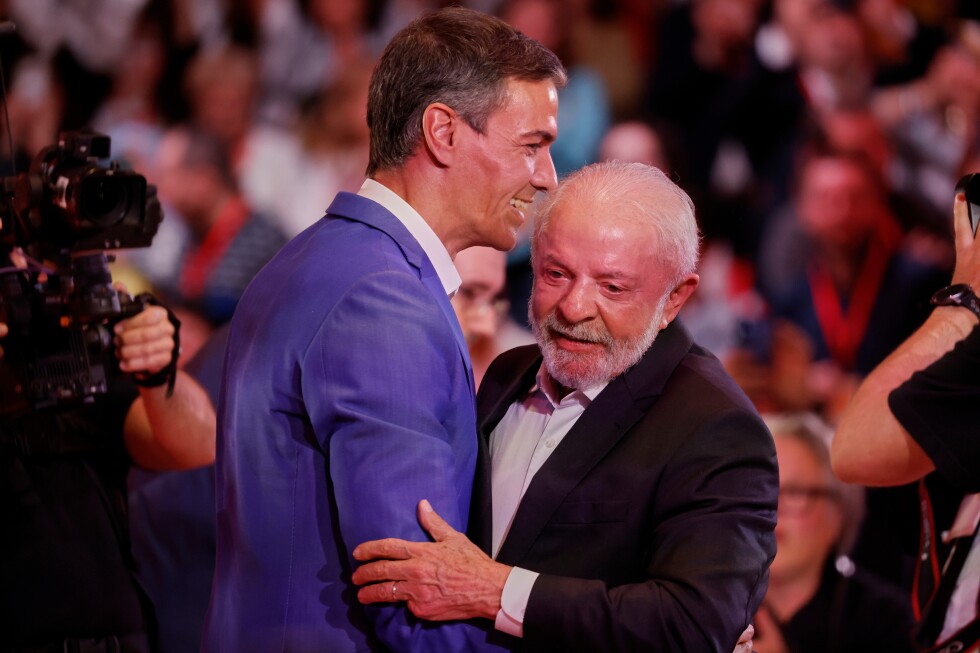
Brazilian President Luiz Inácio Lula da Silva, Mexican President Claudia Sheinbaum, South African President Cyril Ramaphosa and Colombian President Gustavo Petro, and other leaders and officials, including Cabinet members from the United Kingdom and Germany, were in attendance at the IV Meeting in Defense of Democracy that kicked off Saturday’s double-header of political events at the Barcelona convention center.
Advertisement
Sign up for Morning Wire:
Our flagship newsletter breaks down the biggest headlines of the day.
Advertisement
Later in the day, Sánchez, Lula and Ramaphosa stayed put to attend the inaugural Global Progressive Mobilization, where some 6,000 left-leaning elected officials, policy analysts and activists exchanged ideas.
“The far right is international, so we must be too,” German Vice Chancellor and Finance Minister Lars Klingbeil told a crowd of activists.
Advertisement
Democrats join rally
Sen. Murphy, a Democrat from Connecticut, spoke at the progressive rally and he didn’t shy away from blasting Trump while celebrating the loss of power of Trump’s ally Viktor Orbán in elections in Hungary last week.
“Donald Trump is out to end our democracy,” Murphy said. “We are not on the verge of a totalitarian takeover, we are in the middle of it.”
But, he said, “Americans are watching what is happening across the world, and the victory in Hungary just one week ago lifted our sails.”
Walz, Kamala Harris’ vice presidential candidate who has faced a violent U.S. Immigration and Customs Enforcement migration crackdown in Minnesota, threw barbs at U.S. Vice President JD Vance, who campaigned for Orbán and has backed far-right parties in Europe.
Advertisement
“Unlike our current vice president, I’m not here to arrogantly lecture or scold you, I am not here to pick a fight with the Pope or host a rally for any local wannabe authoritarians,” Walz said.
New York Mayor Zohran Mamdani, former U.S. presidential candidate Hillary Rodham Clinton and Sen. Bernie Sanders all sent video messages played at the rally.
Progressives exchange ideas
Among concrete proposals to come from the events, Ramaphosa said South Africa will present a draft resolution to establish an International Panel on Inequality, aiming to tackle the growing wealth gap both within and between nations, to the U.N. General Assembly in September.
Sheinbaum plugged her idea that governments commit to spending the equivalent of 10% of their military budgets on reforestation projects.
Advertisement
“Each year, instead of planting the seeds of war, we will plant the seeds of life,” she said.
Sánchez argued for the importance of regulating social media to stop the spread of hate speech and disinformation. His government also said that it is working with Lula’s Brazil on a tax for the ultrarich.
Lula, who met with Sánchez in a bilateral summit on Friday in Barcelona, kept the focus on how to invigorate the progressive moment. He avoided naming Trump except when he called for U.N. Security Council members to “fulfill their obligation and guarantee peace.”
“Stop this madness of war because the world cannot bear any more wars,” Lula said.










































You must be logged in to post a comment Login