Connect with us

NewsBeat

how digital circulation boosts the impact of a protest song

Published

on

how digital circulation boosts the impact of a protest song

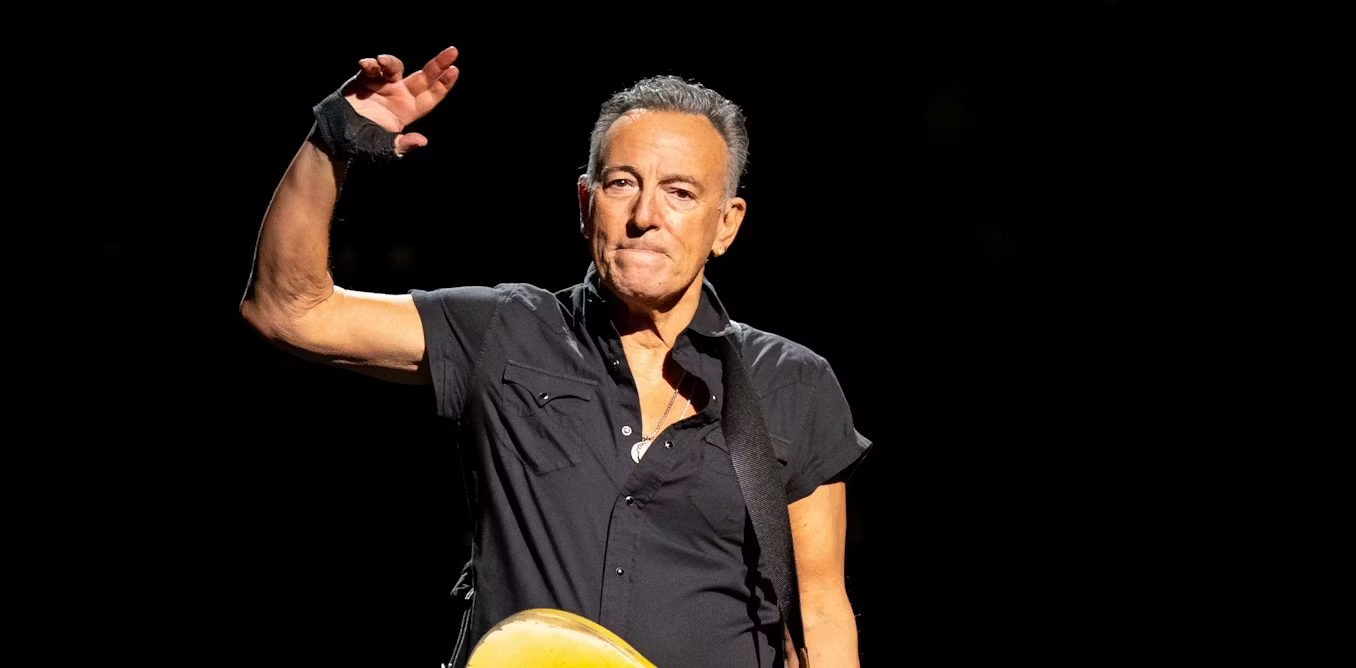
In moments of creeping authoritarianism, culture sometimes reacts faster than institutions. Bruce Springsteen’s rush-released song in the wake of killings of two Minneapolis residents by agents of US Immigration and Customs Enforcement (ICE) was not just an act of commentary, but a deliberate intervention in public discourse.

Streets of Minneapolis operates as an alarm signal, its directness placing it in the public square, where naming and narration carry political weight. What also distinguishes Streets of Minneapolis is not just its fidelity to the tradition of the protest song, but its mode of circulation as a rapid response in the digital age.

This is Springsteen at his most declarative, operating not in the interior emotional space of the confessional singer-songwriter but in the outward-facing register of public address. His specificity – naming people, streets, organisations and the “winter of ’26” – marks the song as political communication rather than personal reflection.

His framing of the killings involves a shift from individual tragedies towards a shared civic injury. The repeated invocation of “our Minneapolis” performs rhetorical work, translating private loss into a shared collective experience and situating it as a wider public concern that extends beyond the city itself.

Advertisement

That movement from the individual to the collective places Streets of Minneapolis within a wider lineage of protest song, creating narratives out of real events so they can be remembered and acted upon. In this sense, the song does not simply respond to politics, but actively participates in political thought and action. “We’ll take a stand” is not a metaphorical flourish but a direct appeal.

Springsteen makes this lineage explicit through the early acoustic section, replete with insistent harmonica, and a vocal delivery and intonation that consciously signal Bob Dylan’s early protest music. Structurally, too, Springsteen’s call to action echoes Dylan works like The Lonesome Death of Hattie Carroll – moral force emerging through the accumulation of detail and reportage.

While Dylan’s later career moved away from direct protest toward the personal and allegorical, Springsteen here leans into that more direct mode of storytelling. It follows the protest song logic whereby narration becomes an engine of persuasion, reshaping contemporary events into historical record.

Advertisement

The reference carries added resonance given Dylan’s Minnesota roots, serving as a reminder that place, memory and music have long been intertwined in American protest culture.

Springsteen quotes himself, too, both musically and thematically, with a clear nod in the title to Streets of Philadelphia and a closing musical call-back to Born in the USA, its own tub-thumping aesthetic belying the portrait of a disillusioned Vietnam veteran in the lyrics.

These are not just nostalgic gestures but also markers of continuity. By folding earlier works into this new song, he situates the current moment within a longer trajectory of American struggle, via musical linkages between himself and Dylan – and Woody Guthrie before that.

A memorial to Alex Pretti and Renee Good, both Minneapolis residents killed by ICE agents.
Zuma Press / Alamy

Digital circulation and rapid response

Where protest songs once depended on live performance, radio play and physical distribution, they now travel through platforms. Within hours of release, Streets of Minneapolis was embedded in news coverage, shared across social media and dissected in comment threads and reaction videos.

Advertisement

Listeners encounter it not only as a song but as a reference point to be reposted, quoted, argued or aligned with. In that process, its energy comes less from a single, fixed message than from how it is used, repeated and spread through ongoing conversations.

This dynamic places protest music alongside other contemporary forms of political communication, particularly those shaped by meme culture and the logic of the online platforms through which much creative work is experienced. Short excerpts, lyrical fragments and recognisable musical cues circulate easily across feeds, videos and posts, where they are paired with captions, visuals and commentary.

In recent election cycles, for instance, music has functioned less as a background soundtrack or simple celebrity endorsement than as material that can be repurposed – looped in clips, used ironically, set against images, or mobilised to signal approval or dissent. In this environment, music functions as a part of the communicative infrastructure, enabling participation as much as persuasion.

A record sleeve with the title Streets of Minneapolis.

Wikipedia

This also comes amid growing political conflict around culture itself. While there is a longer history of public disputes between the Trump administrations and the artistic community, these tensions have recently escalated into direct interventions, including the cancellation of shows and the temporary closure of the Kennedy Center, pointing to an environment in which music and performance are increasingly politicised and directly entangled with power.

Seen in this context, Streets of Minneapolis is both traditional and distinctly contemporary. It draws on the narrative starkness and moral framing of folk protest, but gains traction through digital circulation. The killings in Minneapolis of Renée Good and Alex Pretti were the immediate catalyst, but the song’s significance lies in how it carries that moment forward.

Advertisement

As authoritarian power shifts gear, from creeping practice to open and violent assertion, the protest song adjusts its form and reach. Streets of Minneapolis reflects that transition, drawing on Springsteen’s longstanding role as a public narrator of American life. It can’t halt state action, but it can help to prevent it from going unnoticed and unrecorded.


Looking for something good? Cut through the noise with a carefully curated selection of the latest releases, live events and exhibitions, straight to your inbox every fortnight, on Fridays. Sign up here.



Source link

Advertisement
Continue Reading
Click to comment

Leave a Reply

Your email address will not be published. Required fields are marked *

NewsBeat

How a Cambridge student group became a ‘conveyor belt of comedy genius’

Published

on

Cambridgeshire Live

The Footlights has turned out star names including Stephen Fry, John Cleese, Douglas Adams, David Baddiel and many more

For more than 50 years the Cambridge Footlights has been a conveyor belt of comic genius. A student sketch comedy troupe at the University of Cambridge which dates back to 1883, its alumni reads like a who’s who of British comedy – John Cleese, Eric Idle, Steve Punt, Hugh Dennis, all of the Goodies, Richard Osman, Jan Ravens, Nick Mohammed, Alexander Armstrong, Ben Miller, Phil Wang, Mirian Margolyes, David Baddiel and Douglas Adams are just a few of the big-name former Footlighters who have kept us entertained.

Advertisement

Now a new book has offered a fascinating and entertaining deep dive into the Footlights, with more than 70 former Footlighters recalling their experiences and giving insights into why the troupe has been such a prolific comedy production line.

The Cambridge Footlights: A Very British Comedy Institution was written by Robert Sellers, the author of more than 25 books on subjects such as cinema, theatre, television, music and popular culture, and was released this month by Bloomsbury.

“You could call it a factory for churning out comedians since the 50s,” said Robert. “So I thought it was an interesting institution to examine. I’m a huge Monty Python fan so I knew that most of the Pythons went to Cambridge. I’m also a big Goodies fan and all of them went to Cambridge.

“I’ve been aware of it for a while but what interested me before I decided to pursue it properly…was it still churning out these people?

Advertisement

“The high point was the 60s, 70s and early 80s – but it’s still remarkably consistent. Just look at The Inbetweeners, Richard Ayoade, David Mitchell and people like that. It’s still part of television, theatre and comedy. It’s still relevant.”

As he researched the subject and spoke to former Footlighters, it became apparent to Robert that the secret to the success of the Footlights conveyor belt of talent was the experience it gave those involved.

The opportunity to write and perform, not only in Cambridge but in the West End, theatres around the country and at the Edinburgh Fringe Festival, was both unique and invaluable.

“I wanted the book to be as much as possible an oral history,” said Robert. “I didn’t want it to be a staid, academic-type book. I wanted it to follow people through the years, their personal experiences. So I’ve interviewed over 70 people who are ex-Footlighters. It’s very much a personal history of their time there.

Advertisement

“A lot of people said it’s the experience that it gives you. A lot of people said it’s better than a drama school. In a drama school you’re performing to your own classmates for most of the time. With the Footlights, because of the revue and the tour they go on, and when they go up to the Edinburgh Festival, they’re performing in front of the public from a very early age.

“There’s a thing called smokers which they put on every few weeks for the college. Anyone from the college and the university can come and watch, and you have to write your own material. Someone told me that when they arrived, they were quite surprised that they had to write their own material. They thought they were given material and they’d just have to go on stage and be funny. But no, you had to write it and perform it, and a lot of people found that a real challenge. That helps enormously, that you’re writing material every three weeks.

“Someone told me that when he left the Footlights and was performing stand-up on this quite big venue, a fellow comedian said to them, ‘This is your first time here – this must be a big moment for you, performing in front of an audience’. But he had spent three years going to the Edinburgh Fringe and performing in front of 1,000 people and going on tour to theatres around the country.

“It’s a real ladder of opportunity – also for producers and directors. Some people might not necessarily want to be a performer, but a writer or a producer or a director.

Advertisement

“So they’ve left university having directed a professional production. It’s a huge advantage over your contemporaries and your competitors.”

The Footlights is still a thriving institution – and still supplementary to whatever academic course its members have chosen for their studies. “It was almost a release valve for their studies,” said Robert of the former Footlighters he interviewed.

“Once a week they could just be silly and do silly jokes. It was a wonderful release from the pressures of academia. It started as a hobby because people enjoyed doing drama and theatre but they had no ambition to be a professional performer.

Advertisement

“John Cleese had no ambition to be a comedian even though he was in the Footlights. He wanted to be a lawyer or a barrister. Graham Chapman wanted to be a doctor.

“It started to change in the 70s when people went to Cambridge purely to be a comedian and join the Footlights after seeing so many people come through in the 50s and 60s – Peter Cook, and people like that. So in the 80s sometimes people were taking the Footlights more seriously than their academic work.”

But while students from colleges throughout the university took advantage of the opportunity to indulge themselves in drama, women were excluded from being full members of The Footlights until 1964. “An interesting element of the book is the role of women in the Footlights,” explained Robert.

“I interviewed Graeme Garden and he wanted to introduce women during the year he was president. But one of the high principals who was on the board and had quite a lot of significance, said he would resign if women were made members.

Advertisement

“So the following year when Tim Brooke-Taylor was vice-president and Eric Idle was president, they said ‘this time we’re doing it – if the guy wants to resign we’ll call his bluff – but women have to be members this time’.

“Women could perform in the Footlights but couldn’t be members. They could do smokers and occasionally, like Miriam Margolyes, be in the revue show – but were treated abominably. Someone told me she (Margolyes) wasn’t even allowed to go to the after-show party, even though she’d been in the show. She went back home and cried all night.

“When Germaine Greer did a smoker, they just thought there was no way they could say ‘no’ to her. She was very powerful and that changed everything. She was the first female member.”

Not everyone who joined the Footlights went on to pursue a career in the entertainment industry, of course. One of the alumni Robert interviewed for his book was Peter Firth, who was 97 at the time, and was president of the Footlights in 1953. He went on to become a priest.

Advertisement

“He was a lovely guy and his memory was crystal clear,” said Robert. “He was president of his year and he put the revue on. It was such a success that a West End producer said, ‘Can you put it on in the West End please?’ But he knew he wanted to be a priest so he didn’t do it.

“But the following year the revue was again a success and the same producer came back and this time they said yes, and that became the first Footlights revue in the West End.

“It became a bit of an institution in the 60s and 70s that the Cambridge revue would not only do a tour round the UK and Edinburgh, but also go into the West End. It became a big deal although it doesn’t happen any more. One revue even went to Broadway.”

What became clear to Robert is that members of the Footlights fully acknowledged the privileged position that attending the University of Cambridge put them in.

Advertisement

“There were lots and lots of societies – each house had its own little comedy group,” he said. “I don’t think there’s any other institution in the country where you get that much practice. These guys left Cambridge pretty much a honed comedian.”

And for a time coming from The Footlights actually worked against any would-be comic looking to make their mark. The rise of alternative comedy in the 1980s meant that talent emerging from the Footlights was viewed as ‘the Establishment’ and therefore actively sneered at.

“For quite a long period of time, coming from The Footlights was actually a negative,” said Robert. “In the 1980s because of the rise of alternative comedy, if you came from The Footlights, you were almost cancelled – certainly looked down on. If you were Cambridge you were seen as rich and coming from a well-off family – you were dismissed as a rich tw*ts.

“Matthew Holness talks about it a lot – how hostile the environment was when he went to Edinburgh. David Baddiel told me that when he left the Footlights in the mid-80s he phoned up the Comedy Store in London to ask if he could do a gig or perform in some way.

Advertisement

“They said, ‘That’s fine, interesting’ and asked if he had any experience. David said he was vice-president of the Footlights and they hung up on him! For many years he never mentioned he was a Footlighter.

“Nick Hancock is from the Midlands and people assumed he was never anywhere near the Cambridge Footlights – and he never revealed he was a Footlighter.

“There was a lot of hostility, I think because of the revue called The Cellar Tapes. It was Emma Thompson, Hugh Laurie and Stephen Fry. They won the first ever Perrier Award and I think there was a lot of resentment.

“Stephen, Hugh and Emma were all from very privileged backgrounds. You’ve got the Young Ones sketch where they’re on University Challenge (Fry, Laurie and Thompson all appear as obnoxious toffs in the opposing Footlights College team). That sums up how the Footlights was seen at that time. They were ‘posh tw*ts’.

Advertisement

“But I spoke to a lot of people who were in it over the last few years and it’s different now. It’s very diverse. A lot of effort has gone into making it so, which is covered in the book as well.”

Source link

Continue Reading

NewsBeat

Rail lines currently blocked between York and Harrogate

Published

on

Rail lines currently blocked between York and Harrogate

National Rail said Network Rail engineers are expected on the line and urgent repairs are underway.

Trains running between the sites will be cancelled, delayed or revised, the agency said.

York-based train operator Northern has provided rail replacement transport for some services and said some of its affected journeys could be made via Micklefield.

Passengers are advised to check the National Rail website for journey planning and service updates.

National Rail said disruption is expected until 10pm this evening.

The Press has contacted Network Rail and will add any more information here when we receive it.

Advertisement

Source link

Continue Reading

NewsBeat

Strictly’s Shirley Ballas praises co-star for ‘save’ after on-stage ‘slip’

Published

on

Manchester Evening News

The BBC judge opened up about a moment that happened while the cast tour across the UK

Strictly Come Dancing star Shirley Ballas praised Vito Coppola as she shared an on-stage moment during the live tour.

Advertisement

Former professional dancer Shirley Ballas joined Strictly Come Dancing as the new Head Judge in 2017, making her debut in Series 15, replacing Len Goodman and judging alongside the established panel.

With Tess Daly and Claudia Winkleman having stepped down from their hosting duties after the latest series, Shirley recently shared: “Everyone was surprised. I share the changing room next to them, and they are full of giggles and laughter.”

With Tess and Claudia being a major part of the BBC dance show for many years, Shirley admitted: “They also showed me the way from when I joined until now, so it will be a sad day when they go.”

At the moment, Shirley has joined some of the Strictly cast as they head out on another live tour for the BBC show. With their opening night in Birmingham, the tour will then conclude on February 15 at The O2 Arena in London.

Advertisement

After the opening show, Shirley had shared: “I’m still on a high from last night’s opening @strictlycomedancinglive … Birmingham, you were beautiful. Thank you for coming out to see us. We are ready for the road. It’s going to be a blast. Hugs. X”.

Stars from the latest series who fans will be able to watch on tour are Ellie Goldstein and Vito Coppola, George Clarke and Alexis Warr, Harry Aikines-Aryeetey and Karen Hauer, Jimmy Floyd Hasselbaink and Lauren Oakley, La Voix and Aljaž Škorjanec, Lewis Cope and Katya Jones, and Vicky Pattison with Kai Widdrington.

Taking to her Instagram, Shirley posted a picture of her and professional dancer Vito Coppola on the stage where she praised her co-star for supporting her after a “slip” on the stage.

She penned: “When you slip and your partner has you safe in his arms. @vitocoppola simply the best xxx” to which Vito reposted the snap to his own Instagram story.

This comes just weeks after Shirley was rushed to hospital after falling backwards off a stool and hitting her head on a glass table. Following the incident, Shirley was given a brain scan and has since shared an update with her followers on social media.

In an Instagram story post, she wrote: “Thank you to all who reached out to see how I’m doing. Scary fall backwards hitting my head on the glass dressing table :(. Trip to hospital to get a brain scan.

“Fortunately for me no cracked skull,” she told fans. “I’ll rest a few days to heel my neck and back. [sic] Hugs thank you to @barbara_mccoll for getting my emergency appointment to Sammy Stopford for taking me, and sitting with me all day. [sic]”

Advertisement

After explaining the incident, she then ended the message with: “Gratitude as the Dr said I was very lucky,” before ending the message with a heart emoji.

Source link

Continue Reading

NewsBeat

Top Cambridgeshire chef shares his favourite places to eat in the county

Published

on

Cambridgeshire Live

If you are struggling to choose where to eat in Cambridgeshire, you might want to take these recommendations into consideration

If you are only visiting Cambridgeshire for a short period of time or do not want to spend money on a meal you are not sure you are going to enjoy, you might be on the lookout for some recommendations. There is no one better to get a restaurant recommendation from than a top chef.

Advertisement

Adebola Adeshina is the chef patron at the Chubby Castor, which can be found just outside of Peterborough. Mr Adeshina recently shared three of his favourite places to enjoy a meal in the county.

Whether you want a sit down meal or a quick coffee on the go, you might want to add these places to your must-visit list. You can find out which food spots he would recommend visiting when you are in the area below.

1. The Yard Castor

Location: 34A Peterborough Rd, Peterborough PE5 7AX

Found at the back of the Chubby Castor, the Yard Castor offers guests a place to enjoy a meal either outdoors or looking over the garden in the conservatory. The restaurant is known for its “posh pizzas” that are made in a wood fired oven that can be eaten at the Yard Castor or as a takeaway.

Advertisement

Mr Adesina said: “I think the number one obviously has to be the Yard for me simply because in the summer, I get to stay away in a corner somewhere where there is all this greenery. I can go under the trees and hide away from everybody else and enjoy that peace. I think that’s one of my favourite places to be when the weather is nice.”

2. Browns

Location: 23 Trumpington St, Cambridge CB2 1QA

Found in the old site of Addenbrooke’s Hospital, Browns offers guests the best of British cuisine on its a la carte menu as well as Sunday roasts and afternoon teas. The restaurant often has a lot of special deals and set menus so you can enjoy your meal out for less money.

On the restaurant, Mr Adesina added: “When I’m in the city of Cambridge itself, I like Browns. I think what they do as a business owner and as a chef, it’s great. I love what they do, the ambience and the service, it’s just relaxing. It’s nothing over the top. You get what you pay for and it’s just a nice vibe to be around.”

Advertisement

3. The Cambridge Oven

Location: 44 Hills Rd, Cambridge CB2 1LA

If you want somewhere to pop in for a quick coffee, you might want to try the Cambridge Oven. This tiny bakery makes it artisan breads and pastries from scratch everyday and also offers filled sandwiches you can takeaway and its popular cruffins, which is a mix between a croissant and a muffin.

Mr Adesina said: “I went to this café I think about a year ago. I remember I went to have a tour of Cambridge University with my children and that was one of the places we stopped off to have a coffee. So if you are in the area, that’s one of the places I recommend.”

Source link

Advertisement
Continue Reading

NewsBeat

Best Valentine’s supermarket meal deals for 2026 from Waitrose, M&S, COOK and more

Published

on

Best Valentine’s supermarket meal deals for 2026 from Waitrose, M&S, COOK and more

  • Price: From £70
  • The deal: Restaurant-quality deals designed by some of the UK’s biggest chefs
  • Drinks?: Not included
  • Availability: Available for delivery on February 13 and 14. Orders close at 4pm the day before chosen delivery date.

If it’s restaurant-level dining your heart desires (minus the queue and dozens of other eyeballs in the same room), Waitrose has you covered. The supermarket has once again rolled out menus with Dishpatch to deliver curated menus from long-established chefs like Paul Ainsworth, Michel Roux, Rick Stein, and Angela Hartnett.

On the most affordable end of the scale sits Hartnett’s veggie offering. For £70, eenjoy luxe picky bits to start — rosemary focaccia that warms a treat in the air fryer, fat Nocellara olives, smoked almonds and smoked aubergine dip that I could have eaten by the spoonful.

The main, slung into the oven just before serving the starter, was comforting baked gnocchi with a simple side salad. Initially, I wasn’t sold on the chocolate olive oil cake (it seemed on the small side), but its richness proved me wrong, satisfying all involved.

The glory of Dishpatch is the chef-standard work, most of which is already done. Those little finishing touches — warming bread, dressing the salad, smothering the cake in creme fraiche — made me feel like I’d made just enough effort.

Advertisement

Source link

Continue Reading

NewsBeat

Durham Stick Makers receive funding boost from Banks

Published

on

Durham Stick Makers receive funding boost from Banks

Durham Stick Makers, based in Fence Houses, has been awarded £1,836 from the Banks Community Fund to purchase specialist equipment that will help grow its membership and continue teaching the traditional craft of stick making.

The group meets twice weekly at the Fence Houses Community Centre and is the only club of its kind in the North East.

Members range in age from their 20s to their 90s and come from across County Durham and the wider region.

Advertisement

Michael Timmins, secretary of Durham Stick Makers, said: “Our group was born out of a desire to keep this endangered heritage craft alive, and our aim is to preserve it, educate future generations about it and engage with the local community.

“The social side of what we do is also really valuable, with the chance to spend time in a welcoming environment a couple of times a week being especially important for the well-being of many of our older members.

“As a small community group, we don’t really have the cash available to make a capital purchase like this in one go.

“Having the Banks Group’s support is going to make a real difference to our long-term future, and we’d love to see more people coming along to our classes and workshops in the coming months.”

Advertisement

The club is working to raise membership to at least 50 by next year, through evolving links with a number of Durham University colleges.

The grant has funded three new sets of frames, which are used to prepare the materials before work on carving them begins and will give them more capacity to accommodate the new members they are looking to attract.

The club teaches and promotes the heritage craft of constructing traditional walking sticks, canes and shepherds’ crooks from timber, animal horn and antlers—a skill which dates back more than 2,000 years.

Members have made a number of items for King Charles, Queen Camilla and the Duke of Northumberland.

Advertisement

They also carry out stick repairs for a nominal fee and offer charitable help to people who require a walking stick due to injury, age-related disabilities and financial difficulties.

Beyond its craft work, the group provides a valuable source of companionship and social interaction for members, especially those who may otherwise feel isolated.

Mr Timmins said attracting younger members is key to ensuring the tradition continues.

He said: “Giving a craft like stick making a sustainable future means gaining younger people’s interest in it, giving them the chance to learn all about it from those who have the knowledge they need and providing the equipment they need to put their learning into action.”

Advertisement

Kate Culverhouse, community relations manager at the Banks Group, said: “Incredible levels of skill and craftsmanship go into making these wonderful creations and it’s a pleasure to see these local experts at work.

“The Durham Stick Makers have a real commitment to pass their knowledge on to future generations and we’re very pleased to be supporting their drive towards doing so.”

The Banks Group’s community funds are independently managed by Point North, formerly known as the County Durham Community Foundation.

Anyone from a community close to a Banks Group project who is interested in applying for funding from the Banks Community Fund should contact the company via its website enquiry form to find out if their group or project is eligible.

Advertisement

Source link

Continue Reading

NewsBeat

BBC star directing police drama filmed in Belfast shares update and fans ‘can’t wait’

Published

on

Belfast Live

Known for her roles in Coronation Street, Waterloo Road and Casualty, Angela Griffin is directing Blue Lights series four as filming gets underway in Belfast

Filming for the fourth series of Blue Lights is now in full swing, as confirmed by director Angela Griffin.

The accomplished actress, recognised for her work in Coronation Street, Waterloo Road, Casualty, and Lewis, is well-versed in front of the camera.

Advertisement

Now, she’s stepping back behind it to direct the fourth instalment of the acclaimed BBC One drama, having thoroughly enjoyed her involvement in series three.

Since its debut in 2023, the BAFTA award-winning series has proven to be a massive success for the broadcaster, with a fourth series already commissioned.

The show’s gritty storylines, unexpected twists, portrayal of post-conflict Northern Ireland, and endearing ensemble of main characters have captivated audiences nationwide. Griffin herself was a devoted fan long before joining the production, reports the Mirror.

READ MORE: Blue Lights character set to return from the dead in series fourREAD MORE: Blue Lights series four plot revealed as filming begins in Belfast

Taking to Instagram at the weekend, Angela shared a photograph of herself proudly clutching her director’s clapperboard, writing: “Week one done.#BlueLights4 It’s cold, it’s windy, it’s cold, it’s rainy and it’s cold. But it’s brilliant. Firmly back in the saddle and loving it.

“Directing has three parts, the prep, the shoot and the edit… each one allows you to craft the story… but my favourite will always be the shoot, regardless of the weather.

“Being part of the crew, collaborating with cast and realising all the visuals we’ve discussed and planned for weeks is magical. It’s always better than I’ve imagined. Roll on week 2. #directorslife.”

Advertisement

**For the latest showbiz, TV, movie and streaming news, go to the new **Everything Gossip** website**

Angela’s announcement generated enthusiastic responses from her followers, with one fan commenting: “Love it! ! It’s going to be another unbelievable series xx.”

Another chimed in: “We can’t wait for the next series of Blue Lights.”

Advertisement

A third person remarked: “Just finished the last series, very late to the party. It was BRILLIANT. Delighted you’re working on the next.”

Someone else expressed: “Can’t wait to see the next series.”

Content cannot be displayed without consent

Despite having previously helmed episodes of Waterloo Road, a programme where she also featured prominently on-screen, Angela still considers herself a “proper baby” in the directing sphere.

Speaking to Radio Times recently, she explained: “I’ve acted for over 30 years but I am so new to the [directing] industry. So there’s nobody anywhere offering me anything. I’ve got to go through the process. I suppose there’s a slight thing of, ‘Does she know what she’s doing?’.

Advertisement

“I was really, really worried about what I had taken on and if I’d bitten off more than I could chew. But then, when the process started, it felt like the most natural thing I’ve ever done.

“Regarding her Blue Lights directing role, the opportunity followed a standard recruitment procedure, regardless of her established reputation in British television.”

There were no favours. There was no getting in round the back route of ‘Oh, I know this person, or I know this person’ – I didn’t know anybody at all and I’d never worked in Belfast,” Angela revealed.

Blue Lights is available to watch on BBC iPlayer

Advertisement

Source link

Continue Reading

NewsBeat

Pub in tiny Cambridgeshire village named one of the cosiest in Britain

Published

on

Cambridgeshire Live

The family that saved the pub from demolition still run it today

After a long walk through the Cambridgeshire countryside, there is nothing better than visiting a cosy pub and enjoying a pint with family and friends. The county is lucky to have so many wonderful pubs to try out but for you next trip, you might want to visit this particular pub found in the tiny village of Newton.

Advertisement

The Financial Times recently released a list of the cosiest pubs in Britain including the Queen’s Head in Newton. The pub dates back to the 1700s and was saved in 1962 from demolition by the Short family, who still run it to this day.

The Queen’s Head features a games room with a darts board and bar billiards and a pub bar with the original settle and a wood burner. The pub also has a cosy Saloon Bar that has a large open fire and the Old Bar, which was the pub’s bar back in the 1700s.

The pub has been decorated with “a quirky collection of paintings and taxidermy” that only add to its charm. As well as being a good option for the wintertime, the pub also has a terrace at the front and a beer garden for the summer.

The Queen’s Head is most well known for being the “brown soup pub”. The pub sells a different soup each day that can be identified using various shades of brown and are said to be “crammed full of fresh veggies and is homemade every day”.

As well as soup, the pub also serves sandwiches and its own ploughman’s on certain days of the week. You can also find a range of different food vans just outside the pub on Wednesday nights such as Steak & Honour and Pizza Mondo.

In terms of drinks, the Queen’s Head is known for its real ale that is served “straight from the barrel on our own custom-made stillage”. The pub also has a range of wines from Noel Young Wines and gins from Jakes Gin, which is distilled in Chrishall.

On the pub, the Financial Times said: “When you pay a visit to this time capsule of a freehouse 20 minutes’ drive south of Cambridge – preferably on a brisk winter afternoon after a good dog walk – turn left into the coddling warmth of the saloon.

“There you’ll find tables just a smidgen too small and real ale from Adnams in Suffolk poured straight from the cask. Ask the third-generation landlord Rob Short what colour the soup is today, and bathe in the glow as you dip your beef and horseradish sandwich in it.”

The Queen’s Head can be found on Fowlmere Road. The pub is open from 12pm to 2.30pm and 6pm to 10pm on Tuesdays, from 12pm to 2.30pm and 5pm to 10pm on Wednesdays to Thursdays, from 12pm to 2.30pm and 5pm to 10.30pm on Fridays, from 12pm to 3pm and 5pm to 10.30pm on Saturdays, and from 12pm to 4pm on Sundays.

Source link

Advertisement
Continue Reading

NewsBeat

Why Trump doesn’t want home prices to fall

Published

on

Why Trump doesn't want home prices to fall

WASHINGTON (AP) — President Donald Trump wants to keep home prices high, bypassing calls to ramp up construction so people can afford what has been a ticket to the middle class.

Trump has instead argued for protecting existing owners who have watched the values of their homes climb. It’s a position that flies in the face of what many economists, the real estate industry, local officials and apartment dwellers say is needed to fix a big chunk of America’s affordability problem.

“I don’t want to drive housing prices down. I want to drive housing prices up for people that own their homes, and they can be assured that’s what’s going to happen,” Trump told his Cabinet on Jan. 29.

That approach could bolster the Republican president’s standing with older voters, a group that over time has been more likely to vote in midterm elections. Those races in November will determine whether Trump’s party can retain control of the House and Senate.

Advertisement

“You have a lot of people that have become wealthy in the last year because their house value has gone up,” Trump said. “And you know, when you get the housing — when you make it too easy and too cheap to buy houses — those values come down.”

But by catering to older baby boomers on housing, Trump risks alienating the younger voters who expanded his coalition in 2024 and helped him win a second term, and he could wade into a “generational war” in the midterms, said Brent Buchanan, whose polling firm Cygnal advises Republicans.

“The under-40 group is the most important right now — they are the ones who put Trump in the White House,” Buchanan said. “Their desire to show up in an election or not is going to make the difference in this election. If they feel that Donald Trump is taking care of the boomers at their expense, that is going to hurt Republicans.”

The logic in appealing to older voters

In the 2024 presidential election, 81% of Trump’s voters were homeowners, according to AP VoteCast data. This means many of his supporters already have mortgages with low rates or own their homes outright, possibly blunting the importance of housing as an issue.

Advertisement

Older voters tend to show up to vote more than do younger people, said Oscar Pocasangre, a senior data analyst at liberal think tank New America who has studied the age divide in U.S. politics. “However, appealing to older voters may prove to be a misguided policy if what’s needed to win is to expand the voting base,” Pocasangre said.

Before the 2026 elections, voters have consistently rated affordability as a top concern, and that is especially true for younger voters with regard to housing.

Booker Lightman, 30, a software engineer in Highlands Ranch, Colorado, who identifies politically as a libertarian Republican, said the shortage of housing has been a leading problem in his state.

Lightman just closed on a home last month, and while he and his wife, Alice, were able to manage the cost, he said that the lack of construction is pushing people out of Colorado. “There’s just not enough housing supply,” he said.

Advertisement

Shay Hata, a real estate agent in the Chicago and Denver areas, said she handles about 100 to 150 transactions a year. But she sees the potential for a lot more. “We have a lack of inventory to the point where most properties, particularly in the suburbs, are getting between five and 20 offers,” she said, describing what she sees in the Chicago area.

New construction could help more people afford homes because in some cases, buyers qualify for discounted mortgage rates from the builders’ preferred lenders, Hata said. She called the current situation “very discouraging for buyers because they’re getting priced out of the market.”

But pending construction has fallen under Trump. Permits to build single-family homes have plunged 9.4% over the past 12 months in October, the most recent month available, to an annual rate of 876,000, according to the U.S. Census Bureau.

Trump’s other ideas to help people buy houses

Trump has not always been against increasing housing supply.

Advertisement

During the 2024 campaign, Trump’s team said he would create tax breaks for homebuyers, trim regulations on construction, open up federal land for housing developments and make monthly payments more manageable by cutting mortgage rates. Advisers also claimed that housing stock would open up because of Trump’s push for mass deportations of people who were in the United States illegally.

As recently as October, Trump urged builders to ramp up construction. “They’re sitting on 2 Million empty lots, A RECORD. I’m asking Fannie Mae and Freddie Mac to get Big Homebuilders going and, by so doing, help restore the American Dream!” Trump posted on social media, referring to the government-backed lenders.

But more recently, he has been unequivocal on not wanting to pursue policies that would boost supply and lower prices.

In office, Trump has so far focused his housing policy on lobbying the Federal Reserve to cut its benchmark interest rates. He believes that would make mortgages more affordable, although critics say it could spur higher inflation. Trump announced that the two mortgage companies, which are under government conservatorship, would buy at least $200 billion in home loan securities in a bid to reduce rates.

Advertisement

Trump also wants Congress to ban large financial institutions from buying homes. But he has rejected suggestions for expanding rules to let buyers use 401(k) retirement accounts for down payments, telling reporters that he did not want people to take their money out of the stock market because it was doing so well.

There are signs that lawmakers in both parties see the benefits of taking steps to add houses before this year’s elections. There are efforts in the Senate and House to jump-start construction through the use of incentives to change zoning restrictions, among other policies.

One of the underlying challenges on affordability is that home prices have been generally rising faster than incomes for several years.

This makes it harder to save for down payments or upgrade to a nicer home. It also means that the places where people live increasingly double as their key financial asset, one that leaves many families looking moneyed on paper even if they are struggling with monthly bills.

Advertisement

There is another risk for Trump. If the economy grows this year, as he has promised, that could push up demand for houses — as well as their prices — making the affordability problem more pronounced, said Edward Pinto, a senior fellow at the American Enterprise Institute, a center-right think tank.

Pinto said construction of single-family homes would have to rise by 50% to 100% during the next three years for average home price gains to be flat — a sign, he said, that Trump’s fears about falling home prices were probably unwarranted.

“It’s very hard to crater home prices,” Pinto said.

Advertisement

Source link

Continue Reading

NewsBeat

Anger over plans to build 117 new homes near Guisborough

Published

on

Anger over plans to build 117 new homes near Guisborough

The application by TCC Land Limited and Jollie Hollies Company Limited envisages the development would take place on an 12 hectare site currently used for agricultural purposes south of Stokesley Road and also describes plans for associated road infrastructure.

Approval at this stage would mean the principle of development had been established, allowing a developer to bring forward more detailed plans.

Dozens of objections have so far been raised with Redcar and Cleveland Council which has yet to determine the application, but has deemed the proposal to be in the ‘major’ category.

Advertisement

Guisborough Town Council has also objected, stating the scheme would be contrary to various elements of planning policy.

It said it was outside the development limits of Guisborough and also highlighted the site’s proximity to the North York Moors National Park.

Guisborough ward councillor Bill Suthers made similar points in his objection, stating the planned housing would extend beyond the residential boundary of Guisborough as defined by the council’s Local Plan.

He also said it would “negatively impact” on the national park setting and have the same impact on improvements to the Guisbrough Forest Walkway, in Pinchinthorpe. 

Advertisement

A design and access statement compiled on behalf of the applicant, accompanying the submission, said the development proposals could make a significant contribution to addressing local housing needs.

It said it would be a “high-quality and inherently sustainable neighbourhood of 117 dwellings, providing a variance of family homes”.

The site offered “excellent opportunities for the creation of a distinctive residential neighbourhood set within an attractive framework of open space and landscape”.

An excellent range of local facilities and services lay nearby in Guisborough, the statement said, as well as access to Middlesbrough and Nunthorpe via the A171.

Advertisement

It said a “key entrance” to be created on the northern boundary would comfortably accommodate cars, pedestrians and bicycles and be capable of servicing the site and providing a link to neighbouring communities.

Streets in the development  would be supplemented by a number of hard and soft public spaces, alongside a network of pedestrian and cycle routes and existing public rights of way.

The statement also said existing hedgerow and trees that run along the perimeter of, and through, the site will be retained where possible and enhanced. 

Redcar and Cleveland Council is having to navigate Government targets which last year determined more than 600 new homes should be built and completed in the borough each year, a 156 per cent increase on the previous 234.

Advertisement

Council chiefs have said the target is achievable if the right sites are allocated for development, but the authority will also have to demonstrate a five year supply in order that the target can be delivered, something that will not be possible until the adoption of a new Local Plan, expected some time in 2027.

This could lead to a “corridor of uncertainty” whereby would-be developers submit applications on unallocated land.

Last June the council issued a “call for sites” writing letters to landowners in the borough with about 100 submissions being received and subject to initial assessment.

Current housing completion targets, which extend over 15 years, mean the council could have to plan for as many as 10,000 new homes – the size of a small town – which would represent a 16% increase in the borough’s housing stock.

Advertisement


Source link

Advertisement
Continue Reading

Trending

Copyright © 2025