
The first lady of the US, a title typically held by the wife of the president, has never been a fixed cultural figure. Instead, she has functioned as a screen on to which the nation projects its ideals, anxieties and evolving ideas about womanhood and power.
With the release of Amazon’s new Melania documentary, which details Melania Trump in the 20 days before her husband’s second presidential inauguration in January 2025, that long tradition of reinterpretation is once again visible. It reminds us that the first lady is as much a cultural symbol as a political presence.
The earliest first ladies largely framed themselves as extensions of domestic virtue. Martha Washington, who became the nation’s inaugural first lady in 1789, set the tone as what some people have called a hostess-in-chief. She established her role as one of duty and moral stability, not ambition, helping prove the US could have national leadership without monarchy.
Everett Collection / Shutterstock
Throughout the 19th century, first Ladies like Dolley Madison (wife of James Madison) expanded the role subtly. They used social gatherings and personal charm to shape public opinion and support presidential authority. Madison used social spaces like drawing rooms as informal diplomatic zones, making it socially acceptable – and even expected – for political rivals to mingle politely.
These first ladies achieved this while still being publicly understood as guardians of home and civility. Cultural representations – from portraits to newspaper sketches – emphasised grace, femininity and restraint. This reinforced the idea that women’s power should remain indirect.
Embracing advocacy
In the 20th century, Eleanor Roosevelt marked a decisive shift by embracing advocacy. She became an active moral voice during the New Deal era, a period that saw President Franklin D. Roosevelt enact various programmes and reforms to combat the great depression. Eleanor Roosevelt spoke openly about civil and women’s rights, labour and poverty.
Culturally, she was portrayed not as a decorative spouse but as a reformer and the conscience of the nation. This redefinition opened space for later US first ladies to navigate their public roles more openly.
Jackie Kennedy, for instance, professionalised the role of first lady. Kennedy, who spoke multiple languages and adapted her style to different audiences, used her first ladyship as a legitimate political tool of cultural diplomacy. Foreign leaders and the press were disarmed by her charm and elegance, with President John F. Kennedy jokingly introducing himself as “the man who accompanied Jacqueline Kennedy to Paris” on an official visit to France in 1961.
She also led a project to restore the White House, turning it into a symbol of American civilisation and not just politics. These efforts led to a televised tour in 1962, in which Kennedy invited Americans into the White House and showcased her work in restoring its history. It also humanised Kennedy and made her the first in the role to truly master television.
By the late 20th century, the role of first lady became a site of ideological debate. Hillary Clinton openly engaged in policy work, especially healthcare reform. She led ultimately unsuccessful efforts to pass the Health Security Act in 1993, which aimed to restructure the American healthcare system to ensure universal coverage.
Cultural responses to Clinton were polarised. She was celebrated as a feminist trailblazer by some and criticised for overstepping an unelected role by others. Satire, late-night television and news commentary increasingly treated the first lady as a political figure subject to scrutiny, not merely a symbolic companion to the president.
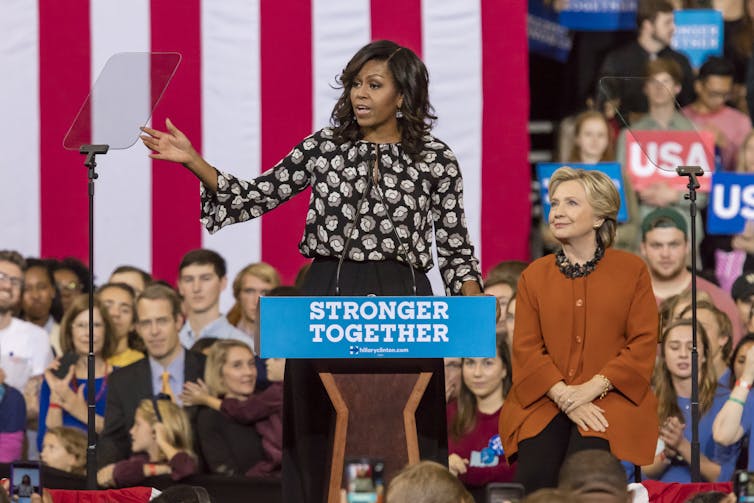
Like Clinton, Michelle Obama was a visible policy advocate. She used media and popular culture strategically, promoting causes such as support for military families, healthy eating or higher education through social media challenges and television appearances. Obama also spoke candidly about race and identity, framing her position as an active platform for social change and to inspire future first ladies globally.
She looked to position young people – especially girls – as agents of change through her Reach Higher and Let Girls Learn education initiatives. And Obama’s 2020 documentary, Becoming, offered the American public an expanded insight into what a former first lady’s political influence can look like after the White House.
Joseph Sohm / Shutterstock

While holding no formal authority, the US first lady occupies one of the most visible platforms in American public life. This makes the role especially revealing of what Americans expect from women and leadership. First ladies have historically been expected to embody the nation’s moral tone, demonstrate unity above partisanship and act as ceremonial “mother” to the nation.
However, since initially becoming first lady in 2016, Melania Trump has largely maintained distance both from the role and traditional advocacy. Her public image has instead leaned heavily on visual symbolism such as fashion, posture and reserve. She has also been widely seen as partisan. In 2018, for example, she wore a jacket emblazoned with “I really don’t care, do you?” during a trip to a migrant child detention centre on the US-Mexico border.
The behind-the-scenes Amazon documentary, which coincides with two West End plays about former first lady Mary Todd Lincoln, comes at a moment of active cultural engagement with how female figures in political spheres are perceived and narrated. It offers the current first lady a chance to shape her own public narrative rather than being defined by the press.
Melania Trump’s editorial control of the documentary suggests she wants the public to see her as a distinct entity from the president, with her own agenda and vision. In the documentary itself, she also hints at having ambitions that extend beyond the traditional ceremonial aspects of the first ladyship.
From references to reinventing the office of first lady to thinking about how lawmakers could do their jobs better, it appears Trump is aiming to cultivate a narrative in which she is seen both as independent and influential enough to shape political culture. Whether she evolves the first lady role in any meaningful way will become clear in the years ahead.
You must be logged in to post a comment Login