





In the early 1970s, the idea of an ordinary person owning a computer sounded absurd. Computers back then were more like aircraft carriers or nuclear power plants than household appliances – vast machines housed in data centres operated by teams of specialists, serving governments, universities and large corporations.
Then came Apple.
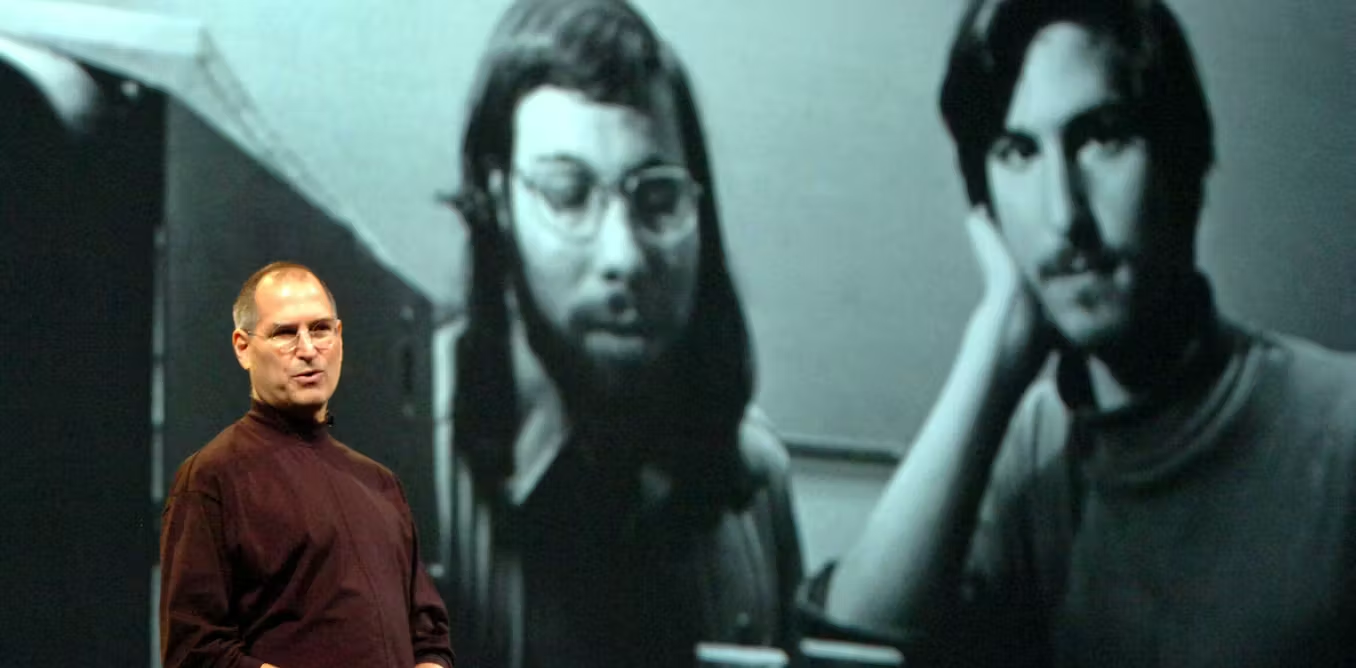
Founded on April 1 1976 by “college dropouts” Steve Jobs and Steve Wozniak, the Silicon Valley startup did not invent computing. What it did was arguably more important: it helped turn computing into a personal technology.
Before Apple, computers were largely sold in kit form. Jobs saw that people wanted them pre-assembled and ready to run. The earliest Apple I units, featuring handmade koa wooden cases, now sell for hundreds of thousands of dollars.
As an early Apple adopter and app developer, here’s my selection of the company’s (and Jobs’s) most significant technological achievements over the last 50 years.
Apple II – beige yet distinctive
Early personal computers were more curiosities than practical tools. The Apple II, launched in June 1977, introduced something new: style. Even its colour – beige! – was distinctive, contrasting with the black metal boxes common at that time.
The use of colour graphics was both new and exciting, and the keyboard felt satisfying to use. A simple speaker, with only a single-bit output, was ingeniously coaxed into producing tones and even speech-like sounds. The design revolution stretched as far as the packaging: Jerry Manock, Apple’s first in-house designer, placed the machine in a moulded plastic case which looked sleek and professional.
The mouse – a whole new way of interacting
By 1979, the 24-year-old Jobs – sensing that tech giant IBM was catching up with Apple – went looking for the next big thing. The photocopier company Xerox, wanting pre-IPO shares in Apple, offered a visit to its nearby research labs as an inducement. Jobs realised that researchers such as Alan Kay at Xerox’s Palo Alto research centre were creating the next generation of computing interfaces.
Central to this was a device invented by Kay’s mentor, Douglas Engelbart, at Stanford University in the mid-1960s and nicknamed “the mouse”. Engelbart’s vision of computers as machines to augment the human mind inspired Kay and colleagues to create graphical displays in which users interacted with scrollbars, buttons, menus and windows.
Macintosh – dawn of the modern product launch
Jobs thought anyone should be able to use a computer. In January 1984, the first Apple Mac pushed this idea to new extremes. The traditional need for obscure computer commands (and manuals) vanished. Early adopters such as myself felt we just knew how to do everything.
But the Mac’s launch was not just another technological leap for Apple. It also inspired the now-familiar cultural moment of the modern product launch. Following a teasing Super Bowl advert directed by Ridley Scott, Jobs used a 1,500-seat theatre on January 24 to create a stage performance centred on a single charismatic presenter. Jobs let a small, square and still-beige computer (then known as Macintosh) out of its bag – and it began speaking for itself, to rapturous applause.
Pixar – Jobs’s side hustle
In its first decade, Apple grew at an exceptional rate – but it also came close to financial collapse on several occasions. This led to one of the most dramatic moments in Apple’s history when, in May 1985, the company forced Jobs out.
A year later and now in charge of the startup NeXT Inc, Jobs bought a division of George Lucas’s film company which was soon rebranded as Pixar. Its RenderMan software generated images by distributing processing across multiple machines simultaneously.
Pixar, jokingly referred to as Jobs’s “side hustle”, would become one of the world’s most influential (and valuable) animation production companies, having released the first fully computer-animated feature film in Toy Story (1995).
iMac – a meeting of minds
After a failed attempt to develop a new operating system with IBM, Apple eventually bought Jobs’s company NeXT. In September 1997, he returned to Apple as interim CEO with the company “two months from bankruptcy”. The move, though welcomed by many Apple users, terrified some of its employees. Jobs quickly began firing staff and shutting down failed products.
During this restructuring, he visited Apple’s design studio and immediately hit it off with young British designer Jony Ive. Their meeting of minds led to the 1998 candy-coloured translucent iMac. Essentially smaller, cheaper NeXT machines, iMac (the i stood for internet) also kicked off another Apple habit: abandoning ageing technology. The floppy disk drive was ditched in favour of a CD drive – a move heavily criticised at the time, but later widely copied.
iPod – 1,000 songs in your pocket
For Apple, computing was always about more than, well, computing. In 2001, the company began focusing on processing sound and video, not just text and pictures. By November that year, it had released the iPod – a personal music player capable of storing “1,000 songs in your pocket”, compared with a maximum of 20-30 on each cassette tape in a Sony Walkman.
The iPod used an elegant “click wheel” to operate the screen. Music was synced through a new application called iTunes. By 2005, people were using iTunes to manage audio downloaded automatically from the internet using a process called RSS. This in turn put the pod in podcasting.
iPhone – a computer in everyone’s hands
By 2007, many mobile phone companies had approached Apple about merging the iPod with their phones. Instead, on January 9, Jobs unveiled Apple’s most ambitious product yet: a combined phone, music player and Mac computer – all at the size of a handset with no physical keyboard and huge screen.
Most media “experts”, from TechCrunch to the Guardian, predicted the iPhone would bomb. Steve Ballmer, then CEO of Microsoft, mocked the US$500 price tag, saying nobody would buy it. In fact, 1.4 million iPhones were sold by the end of the year – and over 3 billion more since then. This truly put a computer into everyone’s hands – and opened the door to social media as we know it today.
App Store’s software revolution
By mid-2008, the iPhone enabled third-party developers the chance to to create a dizzying range of new applications. At the same time, the App Store – launched on July 10 2008 – addressed one of the most complex problems: how to distribute and commercialise these “apps”. Historically, they were often copied and distributed freely. The App Store changed this, using strong encryption to ensure the copy sold could only be used by that specific user, thus eliminating software piracy.
By establishing the first (eponymous) App Store, Apple changed the way people discover and purchase software. This led to an explosion of apps and a simple but powerful idea: whatever you wanted to do, someone, somewhere, had already built it. Apple captured this shift in a slogan that became part of everyday language: “There’s an app for that”.
Time and again, this extraordinary company has anticipated the value of opening up computing to everyone. Happy birthday, Apple.













































You must be logged in to post a comment Login