Naomi began exploring polyamory after her son was born (Picture: S4C)
On Valentine’s morning last year, Naomi Aldwyn-Allsworth woke beside her partner, Matt, shared bubbles in bed over a breakfast of novelty chocolate boobs, then returned to her London home to spend the day with her son.
And her other partner, Christopher.
As a practising polyamorist – someone who has multiple partners at once – the survival and outdoor expedition specialist tells Metro that the idea of having a traditional desk job, marriage, and retiring at state pension age is her absolute ‘worst nightmare’.
Speaking over Zoom, a few days before heading to Norway to train in minus-30-degree conditions for an expedition to the South Pole, 30-year-old Naomi offers some insight into how she manages to juggle motherhood with her complex love life.
Advertisement
‘Non-monogamy was the primary way of navigating relationships until a few thousand years ago, so it’s surreal to me that it blows people away as this modern, crazy concept,’ she says.
Naomi’s journey into polyamory began when she started dating Christopher at the age of 20. Going to school together in Pembrokeshire, the pair had been friends since they were 11, and have since gone on to have a son together, who is now seven.
‘When I started dating Christopher, I realised quite quickly he wasn’t someone you date casually,’ Naomi explains. He was someone you might marry and have a family with. That scared me because I felt too young for it to be my final relationship. So we decided we could write our own rules.’
Christopher, who comes from a religious background, is happy to be monogamous, but Naomi, who is also attracted to women, began dating other people a year after she gave birth to their son, who is now seven.
Advertisement
Life as a throuple isn’t always straightforward, admits Naomi (Picture: S4C)
‘He loved me deeply and didn’t want me to close off who I was,’ Naomi explains. ‘And I love him for that.’
Since then, she has dated other men and women, as well as married couples – at one point juggling four partners at once. However, the mum insists, she’s only interested in relationships, not flings.
As you might imagine, life in a throuple (or more) has not always been straightforward, and it’s important to Naomi that she is open and honest with everyone involved.
‘If I was ever wanting to take someone’s number or kiss someone, I would confirm it with a partner first so I wouldn’t cross any lines without discussing it,’ she says.
‘That first moment of becoming intimate with someone is really important. Everyone should be aware that it’s happening.’
Advertisement
Naomi – who has appeared on Channel 4’s Alone and worked with Bear Grylls – frequently travels internationally for work, which means she has to be ruthlessly organised to maintain her relationships.
She uses an app where all her partners – and even work colleagues – can see where she is at any given time.
Naomi has to be ruthlessley organised to maintain her relationships (Picture: S4C)
However, Naomi is clear that her son is her number one priority.
‘Managing a relationship is difficult for the average person with a normal job. Then you add my life into the mix… it is difficult,’ she says.
‘You need to be really organised with your time.
Advertisement
‘My son will always come first, and my career – which is very demanding – is really important to me too. So when I’m back from trips I prioritise family time. A partner has to be aware and understanding of that, and if they can’t be, then I’m probably not the right person for them.’
Holidays can also be particularly tricky, Naomi admits.
‘At Christmas you want to do all the festive things together. But when a new relationship begins and you have those exciting butterfly feelings, you want to spend all your time together, and you can’t,’ she says.
‘So naturally you pull back in those moments when most people would jump straight in.’
Advertisement
Naomi is clear that her son is her number one priority. (Picture: S4C)
In the documentary Naomi admits that there are ‘many challenges’ raising a child in a polyamorous ‘network’.
‘At themoment it’s ok. He’s too young to understand every aspect of my relationship, and there’s no need for him to -don’t understand every aspect of my parents’ relationship,’ she explains. ‘Some things stay between us and that’s also important.’
While her unconventional lifestyle may have brought many hurdles, it is something Naomi says she’s simply not prepared to compromise on.
‘[Polyamory] is going to cause rows. Naturally there will be moments of discomfort,’ she adds.
‘But there’s so much care, openness and transparency in this kind of relationship that you learn to talk through everything. You end up having conversations that many monogamous couples wouldn’t dare to enter into.’
Advertisement
When Naomi told friends and family about her relationship status, they were at first taken aback, with some being judgmental.
‘I think it was mainly because we have a son, the concerns were around the impact on him. But over the years, they have seen how my partners and I put him first,’ she says.
Naomi has decided to share her polyamory story as part of a documentary (Picture: Getty Images/iStockphoto)
Naomi is sharing her story in the documentary Love Without Limits: Polyamory and Me, which follows the rocky path of her relationships as she divides her time between Christopher, Matt – a partner who moved from America to be with her – and married couple Mollie and Connor, whose own family are unaware of the arrangement.
Christopher tells the film that their relationship has not always been simple.
‘It’s easier to say there are different partners and there’s more love… The reality is, logistically it can be horrific,’ he admits.
Advertisement
The dad explains that before any partner meets Barnaby, he must meet them several times first – befriend them, almost.
‘With us, you can see that a new partner gives Naomi something very different to what I can give her,’ he says, explaining why he is open to her having different experiences with different people.
‘The fact we can go through that and still be happy for each other is beautiful. You’re giving your partner something that you can’t give them yourself.
‘I’m not jealous. There’s another side to loving someone. I’m just happy to be part of Naomi’s life and see how she chooses to live it. There’s sacrifice for both of us. It’s a juggling act,’ he says.
Advertisement
In the documentary, Naomi explains that being raped at the age of 15, is the reason she is reluctant to clip her own wings in her personal life.
‘I wanted to show myself that I was okay and that I could love and be intimate with people while still feeling safe,’ she says. ‘I never wanted something like [the assault] to stop me from having a full life.’
‘Every partner I’m with brings a different kind of energy,’ says Naomi (Picture: S4C)
The film also captures difficult moments within Naomi’s relationships, including discussions about when Barnaby should first stay at Matt’s home with her, and a tense argument between the couple about Naomi not having enough time for him.
During the documentary, the pair have ended their relationship, and Naomi was seen talking about meeting someone new.
Viewers also learn that she and Christopher also ended their romantic ties as their relationship became more ‘platonic’. Currently, they continue to live together so they can co-parent their son, moving from their two-bed into a three so they can date other people.
Advertisement
‘Nothing terrible happened in our relationship for us to stop being together romantically,’ Naomi insists. ‘It just shifted and adjusted. We still have a lot of love for one another and want to maintain a happy, healthy home.’
She admits that introducing new partners can bring tension.
‘If someone goes on a new date it can add a little bit of spikiness to our conversations that day,’ she says. ‘But you just work your way through it.’
For now, Naomi says she is enjoying the balance. She and Christopher remain close, and Barnaby is growing up in a happy and supportive home.
Advertisement
His school is aware of their family arrangement and has been understanding.
‘With Barnaby, we focus on love, honesty and family, and explain how a number of families look different and it’s okay for your family structure not to be the traditional mum, dad and children,’ she says. ‘This is just another way, and that it’s more people to love and to love him in return.
‘Every partner I’m with brings a different kind of energy,’ Naomi adds. ‘For me, it’s not about one person ticking every box. That’s an impossible pressure to put on one partner.
‘But if you spread that load a little bit, I think that’s really healthy.’
Advertisement
Cariad Heb Ffiniau: Poliamoir a Fi (Love Without Limits: Polyamory and Me) airs on 24 March at 9pm on S4C and iPlayer.
Apple is urging users to update their iPhones after the discovery of new spyware that can take over phones running older versions of the iOS operating system.
The powerful software exploit can steal information from potentially hundreds of millions of users, said cybersecurity researchers at Lookout, iVerify, and Alphabet’s Google.
It is unclear how many iPhones are vulnerable to the spyware known as Darksword, a type of malware designed to secretly steal information from mobile devices.
Advertisement
It affects users running an older version of the iOS operating system, released between March and August 2025 (versions 18.4 to 18.6.2).
An estimated 220 to 270 million iPhones still run on older iOS versions, according to researchers.
Analysis from the three companies shows the iPhone hacking tools have been focused on several groups: Ukrainians targeted by Russian intelligence; Chinese cryptocurrency users; and people in Saudi Arabia, Turkey and Malaysia.
On 3 March, Google and iVerify revealed details of a separate powerful iPhone spyware tool called Coruna, which was linked to Russian intelligence groups and Chinese cybercriminals.
Advertisement
Darksword was found on the same servers that suspected Russian operators of Coruna have used.
Researchers said the two hacking tools indicate a flourishing market for malware. Darksword can steal data, including emails, usernames, passwords, photos, and even cryptocurrency wallets.
Lookout described it as “highly sophisticated” malware, which “appears to be a professionally designed platform”.
An Apple spokesperson, Sarah O’Rourke, said the two tools only work against devices running older versions of Apple’s operating system, reinforcing the need for people to apply updates regularly.
Advertisement
“Keeping software up to date remains the single most important thing users can do to maintain the high security of their Apple devices,” she said.
John Scott-Railton, a senior researcher at Citizen Lab, a University of Toronto-sponsored cybersecurity lab, told NBC News: “The barrier to entry for widespread, devastating mobile attacks has been decisively lowered… it’s clear this problem is only going to grow.”
“The scary takeaway for regular users is they can’t spot this attack,” he added.
Advertisement
Apple’s latest operating system, iOS 26, was released in September and protects users against both hacking campaigns, according to the company.
Last week, Apple made the unusual move of releasing a special update for iPhone users with older devices that cannot handle a full upgrade to iOS 26, specifically to block hackers from using the hacking tools.
But Dilip Jajodia, the company’s owner, has warned that they have encountered issues in transiting their balls, which are stitched in south Asia before being distributed from his factory in Walthamstow.
“We’ve got a major crisis right now with this bloody Gulf war nonsense,” Jajodia told the Daily Mail. “We’ve got to ration clubs by giving them 50 per cent of their balls at the start of the season, and then manage the problem.
Advertisement
“We’ve got plenty of stuff in the factories in the subcontinent ready to go, but the airlines are not taking the freight, because there’s a logjam.
“The rates have gone up, too. A box of 120 cricket balls would be charged normally by airlines at about $5 (£3.76) a kilo. The last quote I got was $15 a kilo. Most of the stuff goes through the Middle East, but if you’ve suddenly got rockets flying around, you’ve got a major problem.
Dukes have warned of a shortage of balls (Getty Images)
“I heard the other day somebody flew something from Pakistan to Sri Lanka, which is another route out. Human beings will find ways. It might well be very expensive, but you’ve got to find a way to do it. Eventually, the couriers might have to charter flights.”
The new County Championship season is due to begin on 3 April, with preseason fixtures already underway.
Dukes will produce the only ball used in English red-ball cricket this summer after the ditching of an experiment that saw a Kookaburra ball employed in a number of rounds.
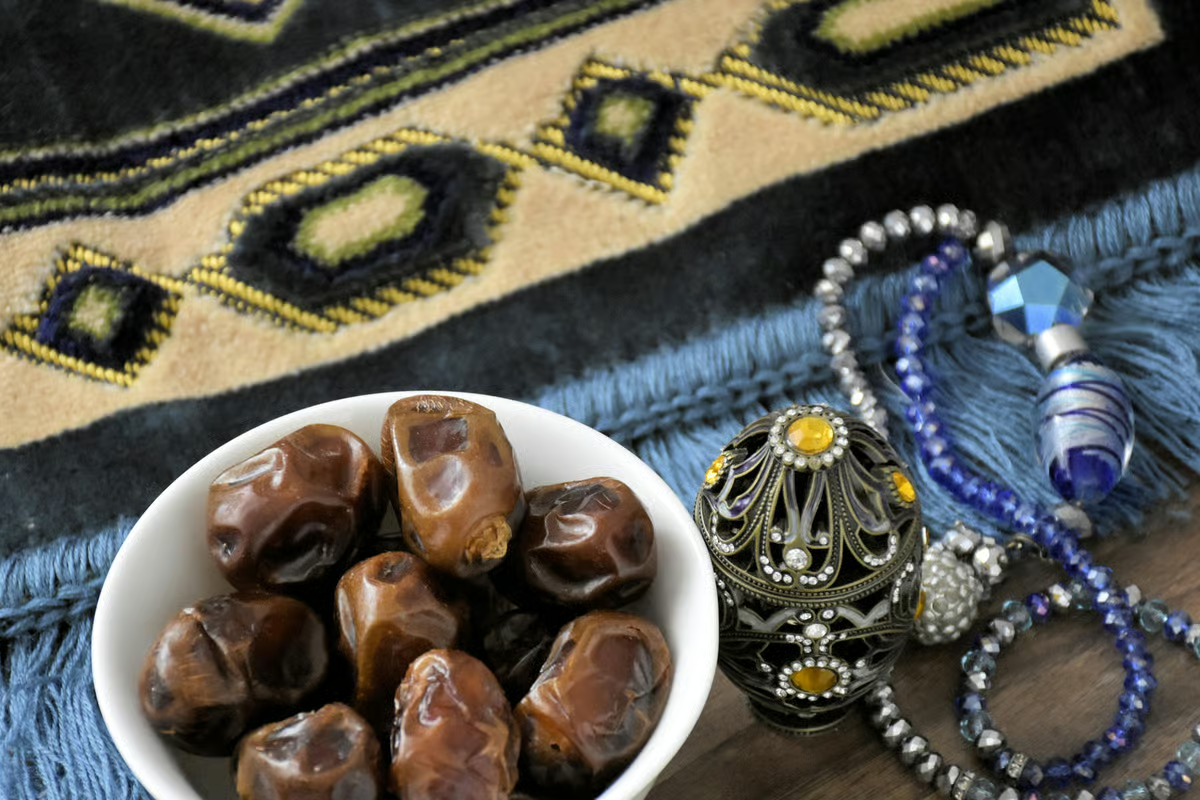
Ramadan, the annual month-long stint of fasting practised by Muslims before Eid, is drawing to an end.
Those practising have fasted from sunrise to sunset, allowing no food or drink to pass their lips until the evening meal of iftar. This year, Ramadan is poised to wrap up on March 19, so Eid al-Fitr 2026 will fall on March 20.
Why do Muslims fast for Ramadan?
The ritual occurs on the ninth month of the Islamic calendar and is done to bring believers closer to God. Fasting for the month highlights the preciousness of things that are usually taken for granted — like food and drink (yes, even water).
Advertisement
How will London’s Muslim community celebrate Eid?
Following the traditional period of abstention, Eid is celebrated with huge parties across London and beyond, with lots of feasting, dancing, and of course, gift-giving.
While cash presented in decorated envelopes is the usual offering for children and teens (sparing you the headache of sourcing the latest toy that’s sparking joy in the playground), if you’re looking for a more considered present to spoil friends and family, I have rounded up the best gifts to give right now.
From luxe hampers and beauty treats to deluxe boxes of dried dates, fruit and chocolate that the whole family can chomp through, there’s something for everyone in my Eid gift guide. I’ve found options galore, whether you’re celebrating in person or you’re planning to send a delivery to their door.
Advertisement
A warm Eid Mubarak to our readers who are celebrating.
Alton Towers is set to open the world’s first Bluey themed ride for families later this month – here’s everything we know so far about the new attraction at CBeebies Land
Visit Bluey’s first coaster at CBeebies Land(Image: Stoke Sentinel)
If the Bluey theme tune has become background music in your home, then you may want to plan a trip to Alton Towers, as the resort is set to open a brand new ride celebrating the Heeler family later this month.
The new rollercoaster in CBeebies Land will open on March 28, and although the theme park has remained tight-lipped about exactly what’s on offer, they have revealed it will be inspired by the show’s beloved ‘Grannies’ episode.
In fact, designers watched Bluey for 180 hours; to bring the world’s most famous blue puppy’s world to life, the creative team involved in the project watched more than a full week’s worth of Bluey episodes back-to-back.
Advertisement
Now, Alton Towers has shared 7 key facts you need to know about what they are promising will be a “giggle-filled adventure”…
Bluey the Ride: Here Come the Grannies! is inspired on one of the show’s most popular storylines, in which Bluey and his sister Bingo morph into mischievous alter-egos Janet and Rita.
The ride opens on March 28 in CBeebies Land, and families can book stays at the Bluey themed hotel rooms too if they want a fully immersed break.
You can play games while you wait: the ride’s queues are full of interactive zones and games like Keepy Uppy and fairy ring dancing to keep the whole family entertained while you wait to go on the coaster.
There are Easter Eggs… or Easter dogs: Attentive riders can also pass time by looking for the mysterious Long Dog character, who is hidden in different parts of the attraction.
You can visit Bluey’s home: before the ride begins, guests are welcome to take pictures inside Blue’s house, as the Heeler family home was recreated inside the park.
The design team watched episodes over ten times: designers watched 154 episodes in total to get a full grasp of the show, but certain moments needed revisiting – over 10 times – to make sure every detail was captures.
The ride offers light-hearted fun, but its structure is made of 550 cubic metres of concrete and 55 tonnes of steel, all there to keep everything safe and in place.
To pay a visit, book a short break at the Alton Towers Hotel and enjoy a stay that includes the ultimate Bluey sleepover in the UK’s only Bluey-themed rooms, at the CBeebies Land Hotel.
Follow mirror:
The decision to strip Senegal of the 2025 Africa Cup of Nations title is “abject” and “we have to denounce it” a senior figure at African football’s governing body has said.
Senegal beat Morocco 1-0 in January’s final but the Confederation of African Football (Caf) overturned the result on Tuesday because Senegal’s players walked off the pitch in protest when hosts Morocco were awarded a stoppage-time penalty.
Play resumed after a 17-minute delay, and Brahim Diaz’s penalty for Morocco was saved and the game went to extra time, where Senegal’s Pape Gueye scored the winner.
Following an appeal by the Moroccan Football Association (FRMF), Caf ruled that by walking off the pitch Senegal had forfeited the match, with the “result being recorded as 3-0 in favour” of Morocco.
Advertisement
Augustin Senghor, a Caf executive committee member and former head of the Senegalese Football Federation, told BBC World Service’s Newsday: “In a situation like this, we have to fight against injustice.
“Football is fair play, football is played is on the field, not in offices.
“What happened with Caf was unacceptable.
“When you see a committee taking such a decision in violation of our rules, in violation of the Fifa laws of the game, to take the trophy and give it to Morocco, I think it is something very abject.
Advertisement
“We have to denounce it.”
The FRMF said in a statement on Wednesday that the Caf verdict “upholds respect for rules that are necessary for the proper functioning of international competition”.
It added: “This decision helps to clarify the framework applicable to similar situations in the future and contributes to the consistency and credibility of international competitions, particularly African football.”
But Senghor believes that the decision was made after pressure from the FRMF.
Advertisement
“Senegal will fight because what happened is happening for the first time in the story of African football, in world football,” he added.
“I am sure that if we [appeal to the Court of Arbitration for Sport] then we will win and the trophy will never leave Senegal. It is clear in my mind.”
This is because the government has announced an increase to passport fees which, if approved, will come into effect from Wednesday, April 8.
Here’s what we know about the price increase, including how much adult and child passports will cost under the new plans.
Passport fees to increase for Brits from April
Currently, the new fees are waiting for approval from Parliament but the government has shared a first look at what the prices could increase to.
Advertisement
Here are what are thought to be the new prices:
Standard online application:
For adults – £102 (up from £94.50)
For children – £66.50 (up from £61.50)
Standard postal application:
For adults – £115.50 (up from £107)
For children – £80 (up from £74)
A Premium Service (one day) application made from the UK could cost £239.50, up from £222.
A standard online application that’s applied for from overseas could cost £116.50 for adults (increased from £108) and £75.50 for children (up from £70).
— His Majesty’s Passport Office (@HM_Passport) March 13, 2026
Advertisement
If you apply from overseas for a new standard passport by post, you can expect the price to jump from £120.50 to £130 for adults and from £82.50 to £89 for children.
Why are passport fees going up?
The government said: “The new fees will help the Home Office to continue to move towards a system that meets its costs through those who use it, reducing reliance on funding from general taxation.
“The government does not make any profit from the cost of passport applications.
“The fees contribute to the cost of processing passport applications, consular support overseas, including for lost or stolen passports, and the cost of processing British citizens at UK borders.”
Advertisement
Recommended reading:
How long does it take to get a new passport?
The government asks Brits to apply for a passport “in good time before travelling”.
It added: “In 2025, where no further information was required, 99.7% of standard applications from the UK were processed within three weeks.”
What do you think of the proposed new passport fees? Let us know in our poll above or in the comments below.
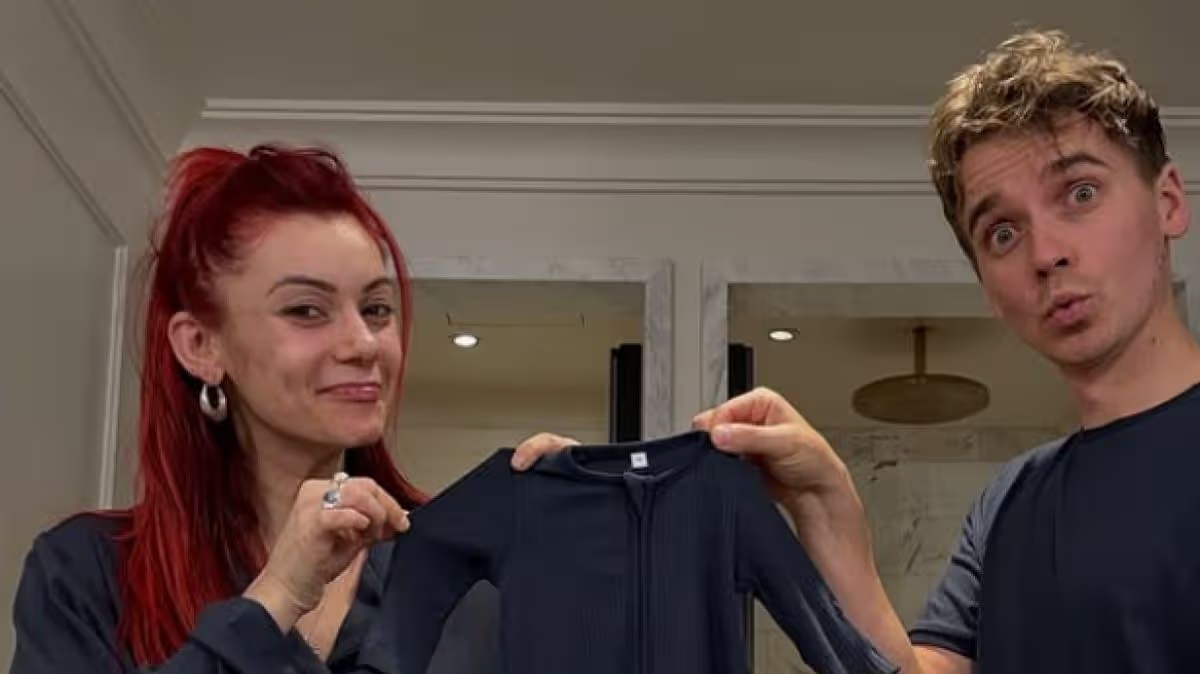
Joe Sugg and Dianne Buswell have shared a little explanation of their son’s name after they revealed they had become first-time parents.
The Strictly Come Dancing stars have delighted their friends and fans by announcing the birth of their first child. It was in September last year that Joe and Dianne revealed they were expecting a baby boy.
The couple, who met and fell in love while taking part in the BBC One dance contest in 2018, shared an adorable announcement video on Instagram, which was set to the iconic Elton John track, Tiny Dancer, and told their loyal following: “Our little baby boy [heart emoji]. We cannot wait to meet you.”
It was then on Wednesday (March 18) after keeping their fans and followers updated throughout their journey to becoming mum and dad that Dianne and Joe confirmed the arrival of their baby boy.
Advertisement
Taking to Instagram, Joe led the announcement by sharing the first pictures of their son, one of him swaddled in a cot and wearing a knitted blue hat, alongside another of him bonding with his mum and a third in which Joe could be seen carrying him out of the hospital in his car seat.
Joe captioned the post, which was also reshared by Dianne: “Never felt a love like it,” before adding: “Baby Bowden Mark Richard Sugg,” with the date 16/03/26, confirming he was born on Tuesday.
The congratulatory messages soon came flooded in from Dianne’s Strictly co-stars, their famous pals and their fans. But Joe and Dianne were quick to address one detail about their new bundle of joy.
Taking to their Instagram Stories, the pair shared another photo of baby Bowden, in which they could be seen taking his tiny hand into theirs. It was alongside the snap that Joe wrote an explanation about their son’s name, as he shared: “Bowden Sugg (pronounced Bow like How not Bow like Row… Hopefully that makes sense [crying laughing emoji]).”
And fans have been sharing their reaction to Dianne and Joe’s chosen name, and spotted the significance of both his middle names and his birth dates. @scdjoanne said: “I am just now learning that joe grew up in a cottage at 1 bowden hill lacock and i have a little tear actually because that’s really beautiful to name their child after his childhood.” @ultimatesugg replied: “Also Richard after grandad chippy and of course Mark.”
@strictlylmx commented: “What is life joe and Dianne have a baby that was born on the 16th,” to which @Edensmith1122 replied: “I also don’t know what the 16th means,” and the original poster said: “Joe and Dianne announced they were together on the 16th and it kinda became a big deal.”
Advertisement
As mentioned, the congratulatory messages to come flooding in, especially from Dianne’s Strictly co-stars. Gorka Marquez replied: “OMG!! Congrats to you both !!!” Vito Coppola gushed: “Oh Finally. Bello di zio.I am so so happy. Crying for joy and happiness. Uncle Vito cannot wait to meet you. Love love love. Bellissimo a zio.”
Katya Jones replied: “He’s just perfect!!!! Congratulations to the pair of you.” Alexis Warr shared: “So precious! Congratulations!!” Anton Du Beke posted: “Congratulations my loves.” Neil Jones penned: “Honestly congratulations. He’s so cute and I can’t wait to meet little baby Bowden.” Nikita Kuzmin wrote: “Congratulations that’s so so amazing. That’s the best and most special thing in the world. Love love love to you!!! Karen Hauer added: “Congratulations !! So beautiful.”
Meanwhile, some also shared the special news with their own followers. Resharing Dianne and Joe’s post to her Instagram Story, Amy Dowden said: “So happy for you both! Isn’t baby Bowden perfect! Can’t wait for cwtches @diannebuswell @joe_sugg.” Alexis also shared: “So very precious! Congratulations @diannebuswell @joe_sugg.” Carlo Gu posted: “My heart is melting!!!” while Strictly 2025 contestant George Clarke also shared the post with a string of heart emojis.
With the Senedd (Welsh parliament) election due in May, Wales faces a test of whether long-term thinking can survive short-term political pressure.
In 2015, Wales made a bold move. Through the Well-being of Future Generations Act prevention was written into Welsh law, requiring public bodies to consider how today’s decisions shape the wellbeing of future generations.
It requires them to set wellbeing objectives, work across organisational boundaries and prioritise prevention over short-term reaction. Success is measured not only through economic growth but through health, equality, environmental resilience and strong communities.
Take Sian, aged 41, who lives in Swansea and was one of the participants in our recent study. She works full time, has two children, doesn’t sleep enough and had stopped exercising. After rising blood pressure and a health scare, she was introduced to a local community coordinator.
Advertisement
They met for coffee, then walked to a small Sunday sea swim. The first time, the coordinator went into the water with her. Sian was hooked. Through the group she met other women. She now helps organise the swims, and her children go to the beach in all weathers. What began as a referral became part of her life and community.
What shifted was not just her blood pressure, but her connection to movement, people and place. Our research on local area coordination suggests this relationship-centred support can strengthen wellbeing, confidence and social ties before problems escalate into crises.
If this type of preventive work is scaled back, crises may become more frequent and costs may rise, leading to further pressure on hospitals and social care. Health and social care already consume more than half of the Welsh government’s budget. With services stretched and more people living longer with complex needs, that path is not sustainable.
Politically fragile
Passing a law is one thing. Changing how an entire system behaves is another. Politics naturally pulls towards the immediate. Election cycles are short and budgets are set year by year. Members of the Senedd must respond to urgent concerns from voters. Visible problems demand visible progress.
Advertisement
Prevention, by contrast, produces quieter results that often emerge slowly and may not appear within a single parliamentary term. Implementation is also hard. Frontline services and staff are stretched. Legislation can set direction, but embedding change in strained organisations requires sustained backing, culture change and investment.
Public attention follows the same pattern. When uncertainty rises, attention narrows. Waiting lists, rising living costs and visible migration are immediate and emotionally charged. Policies designed to reduce future risk can feel abstract by comparison.
Psychological research helps explain this. Studies suggest that when people feel under threat, they look for stories that explain what is happening and who is responsible. These narratives can restore a sense of control, but they may also simplify complex problems into clear lines of blame.
For a policy built around prevention, this creates a difficult political environment. Polarised debate tends to reward immediate fixes and simple villains rather than the slower work of building the conditions that allow people to stay well.
The wellbeing approach takes a broader view of health. Rather than seeing health solely as an individual responsibility, it recognises that wellbeing is shaped by social and environmental conditions. In other words, safe neighbourhoods, strong communities and access to nature.
International evidence suggests that investing earlier in community support can reduce pressure on crisis services. Wales is now exploring a similar redesign, but it will require leadership support and investment.
Research published in 2023 that had followed Welsh communities over a decade found better mental health in greener neighbourhoods, particularly in more deprived areas. Access to nature improves wellbeing directly and can also strengthen people’s sense of connection to the environment, which in turn encourages more sustainable behaviour.
These insights are already influencing local initiatives. Our work has embedded neurorehabilitation – support for people recovering from brain injury or neurological illness – into everyday community life through partnerships between health services and local organisations.
Advertisement
Ecotherapy programmes have been developed through relationships with locally valued initiatives, including community farms and a surfing charity that works with the coastline as part of recovery.
The aim is a shift from simply fixing what is “wrong” to rebuilding agency, purpose and connection. These are all factors linked to resilience and reduced demand on services over time.
Our work also incorporates “biophilic” design – architecture that integrates greenery, natural light and outdoor spaces into buildings – into social housing developments. This work is re-imagining preventive health by bringing nature into our cities, offering residents an opportunity to reconnect to nature, tend to community gardens and grow their own food.
Advertisement
The goal is what we refer to as “sustainable wellbeing”, which means improving health while also nurturing the skills and mindsets needed for a more sustainable future.
Wales is making decisions amid overlapping crises, including widening inequality, rising chronic illness and the accelerating effects of climate change. In this context, the Well-being of Future Generations Act is either a framework for building more resilient systems, or a piece of legislation that is often praised but rarely followed.
Governments ultimately decide whether prevention is protected when finances tighten. But voters shape those choices too. A question facing this Senedd election is whether the Act continues to guide party manifestos, budgets and service design, or slips behind the pressure for immediate solutions.
On May 7, Wales will not only choose its representatives. It will also decide whether the wellbeing of people – and the planet they depend on – remains at the heart of public decision-making.
More than a million people in Lebanon have been displaced and over 900 killed as Israel intensifies its offensive against the militant group Hezbollah.
Israel says those displaced from southern Lebanon will not be allowed back to their homes until the IDF has dismantled Hezbollah’s infrastructure in the region.
The latest round of violence erupted on 2 March when the group launched missiles into northern Israel in support of its ally, Iran, which had come under US-Israeli attack four days earlier.
Israel responded with full force, launching hundreds of strikes across Lebanon, mostly concentrated in southern Lebanon.
Advertisement
But there have also been many strikes on the Lebanese capital, Beirut, including the southern suburb of Dahiya – a Hezbollah stronghold, but also densely packed with civilian residents.
These strikes have coincided with a sweeping evacuation order covering almost half of the capital.
Datawrapper
This content is provided by Datawrapper, which may be using cookies and other technologies.
To show you this content, we need your permission to use cookies.
You can use the buttons below to amend your preferences to enable Datawrapper cookies or to allow those cookies just once.
You can change your settings at any time via the Privacy Options.
Unfortunately we have been unable to verify if you have consented to Datawrapper cookies.
To view this content you can use the button below to allow Datawrapper cookies for this session only.
And in southern Lebanon, the IDF has ordered the evacuation of everyone living south of the Zahrani river – the largest evacuation order issued by the Israeli military in recent history.
Datawrapper
This content is provided by Datawrapper, which may be using cookies and other technologies.
To show you this content, we need your permission to use cookies.
You can use the buttons below to amend your preferences to enable Datawrapper cookies or to allow those cookies just once.
You can change your settings at any time via the Privacy Options.
Unfortunately we have been unable to verify if you have consented to Datawrapper cookies.
To view this content you can use the button below to allow Datawrapper cookies for this session only.
Sky News estimates that the area covered by the evacuation orders was previously home to two million people – or a third of Lebanon’s population.
Advertisement
At least two bridges across the Litani river have been destroyed in recent weeks, despite the need for civilians to cross it to comply with the IDF’s evacuation orders.
On 18 March, the IDF announced that it would begin striking the remaining bridges, which it alleged were being used by Hezbollah to transport soldiers and combat equipment.
“The orders have come with terrifying force, and there is panic,” says international human rights lawyer Geoffrey Nice KC.
“The panic is your responsibility if you’re the one that’s ordering them to leave.”
Advertisement
“It seems to me there’s quite a lot of evidence to say this is unlawful,” he adds.
“We are following international law and doing everything we can to avoid harm to civilians,” an IDF official told Sky News.
Israel may be planning to stay
Israeli defence secretary Israel Katz said on 18 March that those fleeing southern Lebanon will not be allowed to return to the area south of the Litani river “until the safety of the residents of the north [of Israel] is guaranteed”.
Advertisement
Under a 2006 UN resolution, the only armed groups allowed to operate south of the Litani river are the Lebanese armed forces and UN peacekeepers.
Datawrapper
This content is provided by Datawrapper, which may be using cookies and other technologies.
To show you this content, we need your permission to use cookies.
You can use the buttons below to amend your preferences to enable Datawrapper cookies or to allow those cookies just once.
You can change your settings at any time via the Privacy Options.
Unfortunately we have been unable to verify if you have consented to Datawrapper cookies.
To view this content you can use the button below to allow Datawrapper cookies for this session only.
Israel says that by removing Hezbollah from this region, it is seeking to enforce the UN resolution.
Advertisement
Last year, Mr Katz said Israel would also maintain a “security zone” inside Lebanon for the foreseeable future.
Since 2024, the IDF has maintained at least five bases on the Lebanese territory.
Candice Ardiel, spokesperson for the UN’s peacekeeping mission in Lebanon (UNIFIL), told Sky News that the existence of these bases is a “clear violation” of the 2006 resolution.
An IDF official told Sky News that “Israel kept to that agreement until Hezbollah started attacking our civilians”.
Advertisement
Satellite imagery shared with Sky News by the London-based Centre for Information Resilience suggests three additional bases may have been constructed in recent months.
Datawrapper
This content is provided by Datawrapper, which may be using cookies and other technologies.
To show you this content, we need your permission to use cookies.
You can use the buttons below to amend your preferences to enable Datawrapper cookies or to allow those cookies just once.
You can change your settings at any time via the Privacy Options.
Unfortunately we have been unable to verify if you have consented to Datawrapper cookies.
To view this content you can use the button below to allow Datawrapper cookies for this session only.
Mr Katz has said that the IDF’s goal in the current war is to “take control of additional strategic positions in Lebanon”.
Advertisement
In early March, the country’s opposition leader, Yair Lapid, called for this expanded security zone to be “an area with no Lebanese villages in it”.
“It might be unaesthetic perhaps, or unpleasant, to scrape away two or three Lebanese villages, but they brought it upon themselves,” he told i24 News.
Many are experiencing displacement for the second time
When Sky News visited Beirut on 12 March, our team found people sleeping in tents and cars near the port.
Advertisement
Advertisement
Beachfront hit as Israel bombards Beirut
“People are leaving very fast when evacuation orders are announced,” says Carolina Lindholm Billing, Lebanon representative for the UN’s refugee agency (UNHCR).
“They just get in their car without even collecting some extra clothes or belongings, out of fear of being there when aerial strikes begin. And one reason, many say, is that they experienced the same in 2024.”
Before the latest round of hostilities, more than 64,000 people were still displaced from the last major escalation in 2024, according to the International Migration Observatory.
Advertisement
Despite a ceasefire signed in November 2024, many have been unable to return to their homes due to frequent Israeli strikes.
Others have had no homes to return to, with some border towns like Aita Al Chaab almost destroyed.
The video below, shared on 17 March, shows the IDF demolishing several houses in the town, much of which is already in ruins.
Satellite imagery taken in November shows that 91% of buildings in the town centre had already been destroyed by that point.
An Israeli military official acknowledged to Sky News that the IDF was responsible for widespread destruction in the area, but insisted it only targeted buildings used by Hezbollah.
When Sky visited Aita Al Chaab in December, the few remaining residents told us they wanted to rebuild – but IDF strikes on construction equipment made it impossible.
Human Rights Watch, a US-based international rights group, described the strikes on reconstruction equipment as “systematic”.
Advertisement
“They don’t allow anyone who’s building or wants to settle back in Aita Al Chaab,” said cafe owner Nehmeh Mahmoud Al Zein.
“If you have a problem with Hezbollah, go sort it with Hezbollah. It’s not our problem – we’re civilians here and we’ve got nothing to hide.”
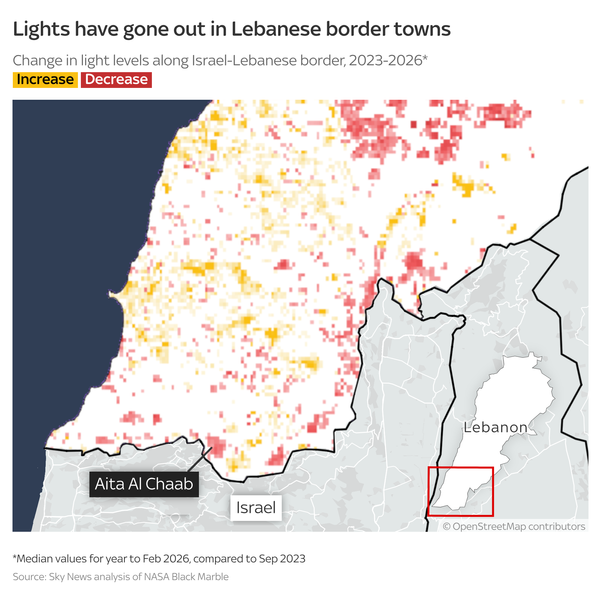
The scale of the depopulation along the border can be seen from space, with a marked decrease in light levels visible in night-time satellite imagery.
The map below shows the change, with decreases highlighted in red. Right along the border with Israel, the lights in Lebanese towns have dimmed.
Advertisement
Concerns about the use of white phosphorus
Since October 2023, Sky News has interviewed dozens of residents of southern Lebanon who say they have seen white phosphorus being sprayed on their crops, farmland and houses.
The video below, first shared on 15 March and verified by Sky News, shows an IDF operation in southern Lebanon.
Amael Kotlarsk, a weapons expert at defence intelligence company Janes, told Sky News that the substance is white phosphorus.
The chemical is used by militaries to create smokescreens or for illumination, as above, but can also start fires, damage crops and cause severe burns.
Its indiscriminate use in populated areas is illegal under international law.
Advertisement
The photograph below, verified by Sky News, shows a white cloud enveloping buildings in the town of Yohmor on 3 March. Human Rights Watch says it has confirmed that the substance is white phosphorus.
Image: A white cloud rising over the town of Yohmor, Lebanon on 3 March, 2026. Human Rights Watch says the substance is white phosphorus. Pic: Islamic Health Committee
Human Rights Watch previously documented widespread use of white phosphorus by the IDF in Lebanese border towns in late 2023 and early 2024.
When asked by Sky News, the IDF did not deny using white phosphorus during recent operations in Lebanon but said it always does so in a way that “complies with and exceeds the requirements of international law”.
Ramzi Kaiss, Lebanon researcher at Human Rights Watch, tells Sky News the use of white phosphorus in populated areas risks damage to homes and agricultural lands.
“I think the use of white phosphorus now is another tactic that is pushing people out of those towns or making it much harder for them to return,” he says.
Advertisement
The Data and Forensics team is a multi-skilled unit dedicated to providing transparent journalism from Sky News. We gather, analyse and visualise data to tell data-driven stories. We combine traditional reporting skills with advanced analysis of satellite images, social media and other open source information. Through multimedia storytelling we aim to better explain the world while also showing how our journalism is done.
These agents, Microsoft’s national security officer Jo Miller tells Metro, are common on personal and work phones and laptops alike.
‘We might choose to download some tools beyond Copilot, for example,’ she says of Microsoft’s AI model.
Advertisement
‘Some might be developed by Western companies, others elsewhere that have a different lens on how AI should be used and data protected.
‘If I choose to download three more, maybe an image generator or a research agent, I can’t have the same confidence in where these tools come from – they could be harvesting my data, selling it, misusing it and playing it back as misinformation or disinformation.’
What can shadow AI agents do?
The computer giant found that many bosses are confident in tackling shadow AI threats (Picture: Cheng Xin/Getty Images)
Microsoft’s survey of 1,000 major public and private sector bosses, conducted in January, shows that bosses are quickly trying to get their heads around new-fangled tech like AI agents.
At least 62% of organisations are already deploying autonomous AI agents, almost tripling from 22% last year.
As much as shadowy AI agents are in the back of their minds, 68% expect agents to be fully integrated across their organisation within a year.
Advertisement
Microsoft says that as employees rush to embrace AI agents, they are creating security blind spots that bosses are addressing.
Most mainstream AI agents, Miller explains, have a level of autonomy held back by corporate guardrails – they won’t go off the rails, in other words.
But these agentic tools can be exploited by cyber criminals or ‘hostile nation states’ to conduct cyber attacks, ransomware attacks, data theft and IP theft, actions typically described as ‘adversarial’.
What do companies itching to use AI agents need to do to keep us safe?
Microsoft found that 86% of leaders are employing AI agents for security challenges, though 80% worry about managing agents at a large scale.
Advertisement
As the race is on to embrace these futuristic-sounding machines, 85% believe deployment is progressing faster than oversight approaches were built to support.
Nevertheless, 87% told Microsoft they’re confident they can prevent shift AI tools from being created or used.
Security experts told Microsoft that they should have three priorities:
Maintain visibility over where AI agents are operating (50%)
Integrate agents safely into existing systems and processes (50%)
Meet compliance, risk and audit requirements as autonomous activity expands (49%).
By ‘hostile nation states’, also called nation-state threats, Miller means groups tied to countries with not the best intentions.
Advertisement
Think pro-Russia groups amid Moscow’s war against Ukraine, with Miller saying there has been a rise in cyber attacks over the last four years.
AI agents used at work can sometimes be fully integrated – embedded in email services, slideshow software and other apps.
‘If I bring in another tool that will sit just outside our platform, I don’t know what back doors there might be to exfiltrate data,’ Miller says.
She adds: ‘We really need to be really deliberate and clear about what tools we’re downloading and using.
Advertisement
‘We don’t truly know where data might be going if we don’t understand the security parameters around a particular tool.’
AI-powered cyber threats have risen during the Russia-Ukraine war (Picture: REUTERS)
What should you do about shadow AI?
The main thing, according to Miller, is to only use AI tools you can trust.
‘Like by a known vendor or supplier,’ she adds, ‘that’s well-established and has published information around how secure they are.’
‘There’s an element of faith or trust we place in AI, but we need to remember these tools are designed around the human brain.
‘So, in the same way a human brain misremembers, the same way the brain is not always factually correct, these models will not always be correct.
Advertisement
‘Humans in the loop adds a level of accountability and an assurance of output.’




















































You must be logged in to post a comment Login