Connect with us
DAPA Banner
DAPA Coin
DAPA
COIN PAYMENT ASSET
PRIVACY · BLOCKDAG · HOMOMORPHIC ENCRYPTION · RUST
ElGamal Encrypted MINE DAPA
🚫 GENESIS SOLD OUT
DAPAPAY COMING

NewsBeat

Incredible phenomenon that sees dementia patients suddenly regain their memory and personality shortly before they die

Published

on

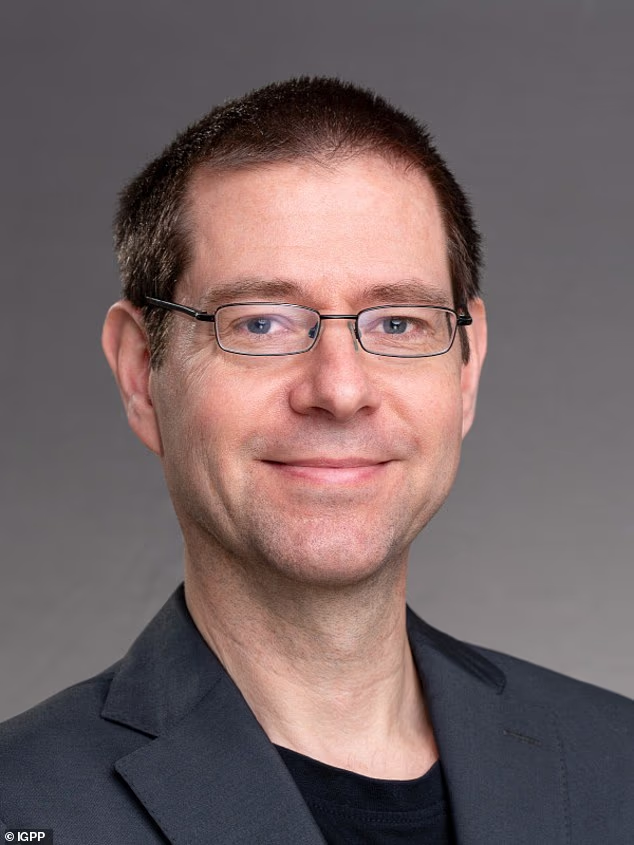
German biologist Dr. Michael Nahm helped introduce the scientific term 'terminal lucidity' in 2009 after uncovering decades of historical medical reports describing similar end-of-life experiences

For nearly five years, an elderly woman with advanced Alzheimer’s disease hadn’t spoken.

Then, one afternoon, while lying in bed surrounded by her two daughters and granddaughter, she suddenly became lucid.

For almost two hours, she carried on what witnesses described as a perfectly ordinary conversation. She spoke openly about her fear of dying, discussed disagreements she had with the church and asked after relatives she hadn’t recognized in years.

Later that evening, she died.

Advertisement

Her story was extraordinary. But it was far from unique.

For generations, caregivers, doctors and hospice workers have described similarly bewildering moments: people who appeared lost to dementia suddenly recognizing loved ones, recalling long–forgotten memories and speaking with remarkable clarity in the final hours or days of life.

The episodes were deeply meaningful to the families who witnessed them, yet they occupied an unusual place in medicine. Physicians occasionally documented them. Hospice nurses recognized them. Caregivers quietly shared stories with one another.

Despite appearing in medical literature for more than a century, however, the phenomenon had no agreed–upon name, no standardized definition and almost no scientific research devoted to understanding why it happened.

Advertisement

That changed in 2009, when German biologist Dr Michael Nahm and psychiatrist Dr. Bruce Greyson introduced the scientific term terminal lucidity, giving researchers a common language to investigate one of the most mysterious experiences reported at the end of life.

More than 15 years later, researchers are still trying to understand how people who appear lost to advanced dementia can suddenly recognize loved ones, recall long–forgotten memories and hold coherent conversations shortly before death. 

German biologist Dr. Michael Nahm helped introduce the scientific term ‘terminal lucidity’ in 2009 after uncovering decades of historical medical reports describing similar end–of–life experiences

Advertisement
People with advanced Alzheimer's disease have occasionally been reported to suddenly recognize loved ones, recall long-forgotten memories and hold coherent conversations shortly before death in a phenomenon known as terminal lucidity

People with advanced Alzheimer’s disease have occasionally been reported to suddenly recognize loved ones, recall long–forgotten memories and hold coherent conversations shortly before death in a phenomenon known as terminal lucidity

Searching for rare exceptions 

For Nahm, the journey into terminal lucidity didn’t begin in medicine.

Trained as a biologist, his work has long centered on life’s biggest unanswered questions: how consciousness arises, how life began and what happens at the boundaries of human experience.

‘It’s not the conventional stuff that teaches you the most important issues,’ Nahm said. ‘It’s those rare exceptions from the rule where you may find some windows opening into previously under–researched areas.’

Advertisement

That fascination with life’s outliers eventually led him to nineteenth–century medical journals, where he kept encountering the same puzzling accounts.

Again and again, physicians described dying patients who unexpectedly regained mental clarity shortly before death. Some recognized loved ones they had long forgotten. Others carried on coherent conversations after months or even years of silence.

The reports stretched across decades and countries, yet no one had attempted to study them systematically.

‘People report about this amazing phenomenon,’ Nahm said. ‘But there’s no name and no research on it.’

Advertisement

That realization prompted Nahm and Greyson to coin the term terminal lucidity, giving researchers a shared language to investigate a phenomenon that had long existed only in scattered case reports.

Researchers hope studying terminal lucidity could reveal new clues about memory, consciousness and future dementia treatments

Researchers hope studying terminal lucidity could reveal new clues about memory, consciousness and future dementia treatments

A distinction that matters 

As interest in the phenomenon has grown, one misconception has continued to frustrate Nahm.

Researchers often use the terms terminal lucidity and paradoxical lucidity interchangeably.

Advertisement

He argues they are not the same.

Terminal lucidity refers to when an episode occurs: an unexpected return of mental clarity shortly before death.

Paradoxical lucidity refers to who experiences it: someone whose brain has been so severely damaged that coherent thought should, according to current medical understanding, be impossible.

‘Terminal lucidity is terminal because it’s always related to dying,’ Nahm explained. ‘Paradoxical lucidity is called paradoxical because it always occurs in people with a severely damaged brain.’

Advertisement

The distinction may sound technical, but Nahm said he believes it is essential if researchers hope to understand what is actually happening.

The two sometimes overlap. Someone with advanced Alzheimer’s disease who suddenly becomes lucid in the final hours of life may experience both terminal and paradoxical lucidity.

But they are not synonymous.

A patient with severe dementia who becomes lucid months before death would be experiencing paradoxical lucidity, not terminal lucidity.

Advertisement

Conversely, someone dying of cancer without structural brain damage who suddenly becomes mentally clear shortly before death would experience terminal lucidity, but not paradoxical lucidity.

Nahm later formalized that distinction in a 2022 paper, arguing that researchers should reserve the terms for separate concepts to avoid confusion as the field grows.

‘It’s really important to distinguish,’ he said.

The phenomenon remained largely unexplained for more than a century before researchers began formally studying it in 2009

The phenomenon remained largely unexplained for more than a century before researchers began formally studying it in 2009

Advertisement

More than just a ‘good day’ 

One question families often ask is whether terminal lucidity is simply a particularly good day.

Nahm says the difference is usually unmistakable.

Unlike the natural fluctuations often seen in Alzheimer’s disease, terminal lucidity is sudden, dramatic and unexpected.

‘It’s really pronounced,’ he said. ‘People are really going, ‘What’s happening now? This is unusual.”

Advertisement

Some families are so astonished that they instinctively begin recording the moment on their phones.

Even so, defining exactly what separates an ordinary cognitive fluctuation from a genuine episode of terminal lucidity remains one of the field’s biggest challenges.

There is still no universally accepted medical definition or diagnostic criteria.

Instead, Nahm said he believes researchers need something similar to the standardized scales used to study near–death experiences: a scoring system that could objectively evaluate the characteristics of each episode and help distinguish true terminal lucidity from routine cognitive fluctuations.

Advertisement

‘Scientists always like to have these boxes,’ he said. ‘But that’s often not how real life works.’

Could terminal lucidity unlock new treatments? 

For Nahm, the scientific importance of terminal lucidity extends far beyond satisfying curiosity.

If researchers can determine what briefly restores cognition at the end of life, they may uncover entirely new ways of treating dementia.

One possibility, he said, is that the memories aren’t actually gone.

Advertisement

‘They may still be there,’ Nahm said, ‘even though they’re usually not accessible.’

If scientists can identify what temporarily restores access to those memories, whether through changes in brain activity, electrical signaling or another neurological process, they may one day be able to replicate it.

‘If we could find this new kind of therapy,’ he said, ‘this would be very, very important.’

Not all neurologists, however, are convinced terminal lucidity points toward an entirely new understanding of dementia.

Advertisement

Such a breakthrough could transform dementia care.

But before scientists can develop new treatments, they first have to answer a more fundamental question: what is happening inside the brain during these extraordinary moments? 

Researchers say the phenomenon is prompting doctors and caregivers to rethink how they treat people with advanced dementia

Researchers say the phenomenon is prompting doctors and caregivers to rethink how they treat people with advanced dementia

A possible explanation inside the brain 

Dr. Ronald Petersen, a Mayo Clinic neurologist who served as director of the Mayo Clinic Alzheimer’s Disease Research Center from 2009 to 2025 and now leads the Mayo Clinic Study of Aging, said he believes the answer may lie not in reversing Alzheimer’s disease but in the brain’s arousal systems – the networks responsible for alertness, attention and consciousness. 

Advertisement

‘Do I have an explanation? No. Do I have the answer? No,’ Petersen said.

Rather than viewing the episodes as entirely separate from known brain function, Petersen said he believes they may be linked to the same brain mechanisms behind the cognitive fluctuations seen in some forms of dementia.

Petersen explained that people with dementia with Lewy bodies – a type of dementia that causes dramatic swings in alertness, attention and thinking – can appear profoundly confused one day and much more mentally present the next.

‘Somebody [with Lewy bodies] will be quite confused one day… and then the next day look pretty normal. I think, from a physiologic anatomic perspective, it pertains to those arousal mechanisms in the brain that are up and down. When they get fired up, then the person’s brain can function relatively normally.’

Advertisement

That theory may also explain why some patients appear able to recall long–forgotten memories.

Petersen said memories are not stored in a single location but across vast networks throughout the brain.

‘They’re not like a book in a library on a shelf,’ he said.

Instead, memories formed decades before Alzheimer’s damaged the brain may still exist but become difficult to retrieve.

Advertisement

‘Something 20 or 30 years ago, when your brain was working well, those may very well be accessible,’ Petersen said. ‘If those arousal mechanisms are reactivated, they may be able to access some of these memory networks that are still in place.’

Petersen cautioned that the most dramatic reports remain rare and said families’ interpretations may not always match a physician’s assessment.

‘With all due respect, there’s some subjective interpretation of these events by the observers too,’ he said.

Dr Ronald Petersen said he believes terminal lucidity may be linked to temporary changes in the brain's arousal systems rather than a reversal of Alzheimer's disease

Dr Ronald Petersen said he believes terminal lucidity may be linked to temporary changes in the brain’s arousal systems rather than a reversal of Alzheimer’s disease

Advertisement

The Case He Never Forgot 

Among the hundreds of cases Nahm has studied, one has remained particularly vivid.

It involved the grandmother of a physician friend who had advanced Alzheimer’s disease and had not spoken for nearly five years.

Then, one afternoon, while lying in bed surrounded by her two daughters and granddaughter, she suddenly became lucid.

For nearly two hours, she carried on what Nahm described as a perfectly ordinary conversation. She spoke about her fear of dying, discussed disagreements she had with the church and asked after relatives she had not recognized in years.

Advertisement

The sudden transformation was so startling that one of her granddaughters ran from the room in fear.

Later that evening, the woman quietly died.

Nahm says stories like hers illustrate why families should know terminal lucidity exists.

Without that knowledge, many interpret the sudden improvement as recovery.

Advertisement

‘They have the false hope,’ he said. ‘Now everything is getting better.’

New research suggests lucid episodes don't always signal death and can sometimes occur months before a patient dies (Pictured: Mayo Clinic)

New research suggests lucid episodes don’t always signal death and can sometimes occur months before a patient dies (Pictured: Mayo Clinic)

Not always a sign of imminent death 

Whether these episodes are actually signs that death is imminent, however, has become one of the biggest questions facing researchers.

Dr Joan Griffin, a social and behavioral scientist at the Mayo Clinic, has spent years interviewing caregivers who witnessed lucid episodes in loved ones with Alzheimer’s disease.

Advertisement

While Nahm helped define terminal lucidity, Griffin has focused on understanding how often these episodes occur, what they look like and what they mean for the families who experience them.

Her findings have challenged one of the field’s longest–held assumptions.

‘I don’t think that they are necessarily harbingers for death,’ Griffin said. ‘Our data is pretty robust now to show that they’re happening months, sometimes six months, sometimes two years before they actually die.’

Rather than one single phenomenon, Griffin found that lucid episodes appear in many different forms.

Advertisement

Some occur shortly before death.

Others happen long beforehand.

Some last only a few minutes.

Others continue for hours, and in rare cases even days.

Advertisement

‘What surprised me is that creating these different types of episodes—it’s not just one,’ she said. ‘It’s not sort of a universal one type of experience. It’s pretty heterogeneous.’

Her team also found that many episodes coincided with family visits, holidays or familiar music.

Griffin is careful not to call those moments triggers.

Relatives may simply have been paying closer attention.

Advertisement

Researchers still cannot predict when a lucid episode will occur, why one patient experiences one while another never does, or what biological process causes it.

Mayo Clinic researcher Dr Joan Griffin studies lucid episodes in Alzheimer's patients and their lasting impact on caregivers and families

Mayo Clinic researcher Dr Joan Griffin studies lucid episodes in Alzheimer’s patients and their lasting impact on caregivers and families

When the researcher became the witness 

For Griffin, the work eventually became deeply personal.

Her father–in–law had lived with Alzheimer’s disease for roughly a decade.

Advertisement

Although he could still speak, he had not recognized family members by name for years and relied on a wheelchair to move around.

Then, during a summer visit from Griffin’s brother–in–law, something remarkable happened.

The 97–year–old stood up, grabbed his walker and walked inside the house.

‘He looked at my brother–in–law and said, ‘Oh, hey Bob, what are you doing here?” Griffin recalled.

Advertisement

The family managed to capture the moment on video.

‘I couldn’t believe it,’ she said. ‘I was in the middle of my research, and I remember thinking, ‘I can’t believe I’m witnessing what I study.” 

For many caregivers, Griffin said, those moments become some of their most treasured memories.

‘They’re like, ‘I got them back. They told me they loved me. They expressed joy,” she said. ‘For the most part, they are extremely beautiful stories and very indelible.’

Advertisement

But they can also raise painful questions.

If someone who appeared unable to communicate suddenly recognizes family and expresses coherent thoughts, relatives often wonder whether the person they loved had somehow remained present throughout the disease.

Some feel guilty that they did not spend more time talking to them.

Others wonder whether they should have played more music or recreated whatever circumstances surrounded the episode.

Advertisement

The moments rarely last.

‘They typically return to their baseline state that they were before the episode started,’ Griffin said, ‘and sometimes a little worse because it’s exhausting.’

Her team is now studying whether those experiences make grief easier or more complicated after a loved one dies.

The answer, she suspects, depends on the family.

Advertisement
For many families, these brief moments of clarity provide one last opportunity to reconnect, express love and say goodbye before a loved one dies

For many families, these brief moments of clarity provide one last opportunity to reconnect, express love and say goodbye before a loved one dies

Changing how patients are treated 

Even without understanding why lucid episodes occur, Griffin said she believes the research has already changed the way caregivers and healthcare professionals should think about people living with advanced dementia.

‘If these episodes can happen, how would you actually treat people differently?’ she said. ‘We have to be able to maintain the dignity and humanity of people throughout their entire illness.’

That means resisting the temptation to talk over patients, ignore them or assume they cannot understand what is happening around them.

Advertisement

‘Don’t forget they’re in the room,’ Griffin said. ‘Because you just don’t know what’s going on.’

Nahm hopes the expanding field will eventually answer the scientific questions that first drew him to the phenomenon.

Although terminal lucidity first came to prominence through Alzheimer’s disease, researchers have since documented similar episodes in people with strokes, brain tumors, psychiatric illnesses and other neurological conditions.

More recent reports have also described cases in children, suggesting the phenomenon may be far broader than originally believed.

Advertisement

‘What I appreciate a lot,’ Nahm said, ‘is the dimension of how broad the phenomenon is.’

When Nahm helped introduce the term terminal lucidity in 2009, he never imagined the subject would become an international area of research.

Today, neurologists, dementia specialists, hospice researchers and caregivers are all contributing to a field that barely existed two decades ago.

The reaction he hears most often remains remarkably simple.

Advertisement

‘They say, ‘I didn’t know there’s a name for it,” Nahm said. ”I didn’t know there’s research on this.”

Source link

Continue Reading
Click to comment

You must be logged in to post a comment Login

Leave a Reply

NewsBeat

Up to 180 homes could be built on outskirts of Cambridgeshire city

Published

on

Cambridgeshire Live

The proposed housing development will be designed to be ‘in-keeping with the local area’, developers said

An applicant is seeking permission to build up to 180 homes in an area on the outskirts of a Cambridgeshire city. Stantec UK Limited has submitted an EIA screening opinion request on behalf of O&H Properties Limited to build the housing development.

Advertisement

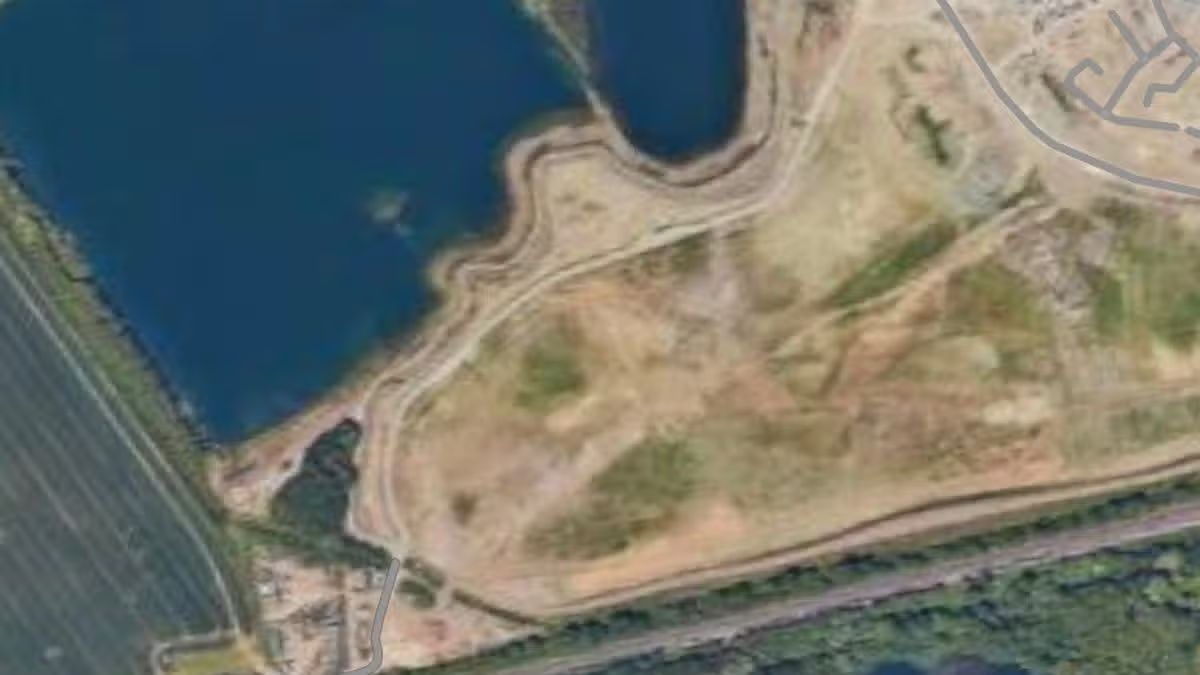
The housing development is proposed on land at Hampton East, near Broadway Business Park in Peterborough. If approved, O&H Properties Limited would deliver up to 180 homes alongside open space and infrastructure.

During a pre-application meeting in June 2025, Peterborough City Council confirmed to the applicant that the development would unlikely be an EIA development, but that a formal request should be submitted. An EIA development is one likely to have significant effects on the environment by factors such as its nature, size, or location.

It is anticipated that the homes would be accessed from the B1091 to the south or the north. However, it is being determined based on traffic surveys.

The housing development will be designed to be “in-keeping with the local area” and the layout will also be designed to maintain connections to the wider green infrastructure network. It aims to provide a “high-quality relationship between built development and adjacent open spaces”, according to the planning document.

Advertisement

The request has been submitted prior to its outline planning application to approve the development. The site falls within flood zone one land, meaning it is unlikely to flood.

Planned working hours to deliver the homes would be from 8am until 6pm between Monday and Friday and between 8am to 1pm on Saturdays. However, work outside of these hours may be required for construction.

Source link

Advertisement
Continue Reading

NewsBeat

Bitter Argentina players turn their backs to Spain’s World Cup trophy lift after violence marred winners’ celebrations – as lip-reader reveals what furious star said to winning captain Rodri during brawl

Published

on

Argentina players decided to turn their backs to Spain's World Cup trophy lift on Sunday

Argentina’s sulking stars turned their backs on World Cup winners Spain yesterday as the newly crowned champions lifted the trophy. 

The South Americans were outplayed by Luis De La Fuente’s side in a drab encounter at the MetLife Stadium in New Jersey, with Lionel Messi and his team-mates unable to disrupt their rivals with the same aggressive, physical tactics that unsettled England in the semi-final.

Barcelona star Ferran Torres bagged the winning goal in extra time to seal Spain’s second World Cup triumph – after first winning the trophy in 2010 – leaving Messi, 39, in tears at the final whistle.

The 2022 champions collected their silver medals from FIFA boss Gianni Infantino and US President Donald Trump on the stage but opted not to watch as Spain lifted the trophy – despite it being customary in finals of major tournaments.

Advertisement

Instead, the Argentina players, coaching team and staff walked over to the end where the majority of their fans were sat and turned their backs as their rivals celebrated.

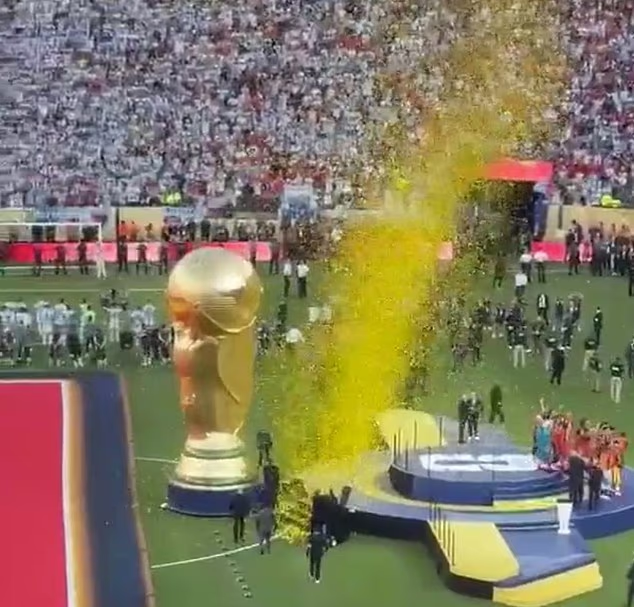
Footage shows Spain players holding the World Cup trophy aloft as gold confetti explodes behind them, with the Argentina team facing the other way.

Argentina’s snub came came after the final descended into violence at full time, with a brawl breaking out between the two sides. 

Advertisement

Argentina players decided to turn their backs to Spain’s World Cup trophy lift on Sunday

The move came after ugly scenes at the end of the game which Spain won 1-0 after extra time

The move came after ugly scenes at the end of the game which Spain won 1-0 after extra time 

Some of Argentina’s players lost their heads as Spain’s substitutes and staff ran on to the pitch to celebrate their victory.

Torres’s 106th-minute winner came after Chelsea midfielder Enzo Fernandez was sent off in the 93rd minute following a reckless challenge on Pau Cubarsi – which summed up the South Americans’ deplorable approach to the game.

Advertisement

At full time, Argentina midfielder Leandro Paredes was sent off for punching Eric Garcia and pushing Gavi to the ground.

Argentina’s Nahuel Molina also hit Rodri in the torso as he was running by, while Thiago Almada was also involved.

In the aftermath of the ugly brawl, DAZN Spain claimed Argentina defender Nicolas Otamendi complained to Rodri about Las Rojas’ pre-match comments alluding to officiating concerns ahead of the final.

The South Americans had benefitted from a series of questionable decisions heading into the showpiece event, with the Manchester City midfielder raising concerns before the final.

Advertisement

‘You and [Spain team-mate Aymeric] Laporte. Both of you,’ he said to Rodri. 

Spain shared fears of roughhouse tactics from Argentina, and their concerns came to fruition with Enzo Fernandez sent off for a shocking challenge on Pau Cubarsi

Spain shared fears of roughhouse tactics from Argentina, and their concerns came to fruition with Enzo Fernandez sent off for a shocking challenge on Pau Cubarsi

‘You spent the time crying and complaining about the referees, my friend. But you shouldn’t have spoken before the match, you know that? Didn’t you see what he said this week?’

Argentina were thuggish throughout the World Cup final, just as they had been when they beat England in the semis.

Advertisement

Astonishingly, Fernandez complained against his dismissal for a second yellow, despite it being a clear foul, before attempting to get Chelsea team-mate Marc Cucurella sent off for covering his face while talking to Messi.

New laws state that footballers who cover their mouths when speaking to a player from the opposing team must be sent off, but replays showed Cucurella was simply scratching his nose as he spoke to Argentina’s captain.

Paredes was also fortunate to not be sent off for a second bookable offence in regular time for a foul on the edge of the box which presented Lamine Yamal with a last-gasp free-kick before extra-time.

Argentina only had two shots in the entire match, with the first of coming in the 117th minute.

Advertisement
Donald Trump took centre stage as Spain lifted the World Cup trophy on Sunday afternoon

Donald Trump took centre stage as Spain lifted the World Cup trophy on Sunday afternoon

It appeared as though Infantino attempted to usher Trump away – but the President remained where he was

It appeared as though Infantino attempted to usher Trump away – but the President remained where he was

There were an estimated 1.5 to 1.8billion viewers tuning in to watch the summer tournament’s showpiece finale, which saw Trump take centre stage during the trophy lift.

The US President refused to step aside to allow the victorious Spaniards to have their moment in the spotlight. 

Advertisement

Trump and Infantino handed out various awards to match officials and players, before officially welcoming Spain’s players up to the stage to lift the World Cup trophy.

The President presented the prestigious title to Spain captain Rodri, who took great pleasure in raising it aloft.

Much like when he presented the Club World Cup title last summer, Trump stood awkwardly alongside the Spain squad as they lifted the trophy and celebrated wildly.

It seemed as though, when Spain were about to perform the trophy lift, Infantino had attempted to usher Trump away from the players – though the President remained where he was.

Advertisement

He stood to the side of the team as the confetti cannons went off at MetLife Stadium, clapping and grinning while Infantino laughed off Trump’s awkward cameo.

Loud boos had come from the stands when Infantino and Trump made their way onto the pitch, as fans made their feelings on the pair undoubtedly clear.

Fans noted that one Argentina star – Tottenham defender Cristian Romero – completely ignored the President as he collected his medal from Infantino.

In a video which swiftly went viral on social media, the Argentinian could be seen receiving his silverware from Infantino before waltzing past Trump on stage.

Advertisement

Meanwhile, the President also presented a trio of awards to Spain’s stars; including the Young Player of the Tournament, the Golden Glove and the Golden Ball – which were claimed by Pau Cubarsi, Unai Simon and Rodri respectively.

There was a degree of irony in regards to Trump presenting Spain with the World Cup trophy, after previously launching a stinging attack on the country at a UN summit earlier in July for not contributing enough money to NATO.

‘Spain is a terrible partner in NATO. They don’t participate. They don’t pay. I don’t want anything to do with Spain. Cut off all trade with Spain, please, including visits,’ he said. ‘Don’t even talk to them. They’re hopeless, bad people.’

Then, on his way back to the United States on Air Force One, Trump said Spain had tried to improve their standings with him.

Advertisement

‘I did have issues, and ​I still do. But Spain, they came back all the way today. Spain was very generous today,’ he said.

Wayne Rooney savaged the 2026 World Cup final halftime show as he described the performance as 'c**p' and said the 'best part was when it ended' live on BBC

Wayne Rooney savaged the 2026 World Cup final halftime show as he described the performance as ‘c**p’ and said the ‘best part was when it ended’ live on BBC  

The show delivered a spectacular mix of music, nostalgia and global star power, with the likes of Madonna, Justin Bieber, Shakira and the Muppets all performing under one roof

The show delivered a spectacular mix of music, nostalgia and global star power, with the likes of Madonna, Justin Bieber, Shakira and the Muppets all performing under one roof

‘They honoured a request for lots of payments, and if they didn’t, we wouldn’t have even ⁠talked to them.’

Advertisement

Earlier in the day, Trump and his wife Melania were seen taking in the action inside a packed MetLife Stadium suite – alongside FIFA president Infantino, Canada’s prime minister Mark Carney and Mexico’s president Claudia Sheinbaum.

Trump also shook hands with Spain’s Prime Minister Pedro Sanchez as Infantino stood beside them.

Spain’s Queen Letizia and King Felipe VI also greeted the president. Javier Milei, the president of Argentina, reportedly watched the game from home due to ‘superstition,’ The New York Times reported.

Trump also waved at the crowd from behind the glass.

Advertisement

Inside the private suite, Infantino posed for pictures with the President’s son, Eric Trump, his wife, Lara, and their children. Barron Trump also showed up for the big game.

The World Cup final also saw a bizarre half-time show, with Madonna, Coldplay, Justin Bieber, The Muppets and Shakira performing during the 27-minute interval, which was described by Wayne Rooney as ‘c**p’. 

‘To be honest, mine was when it finished I like a lot of those artists but to be honest I thought it was c**p’, he fumed. 

‘I did honestly. It just didn’t get me going, I wanted the football to be back on. It was a bit flat. I like Burna Boy I like Shakira I like Bieber but that was too flat.’ 

Advertisement

Source link

Continue Reading

NewsBeat

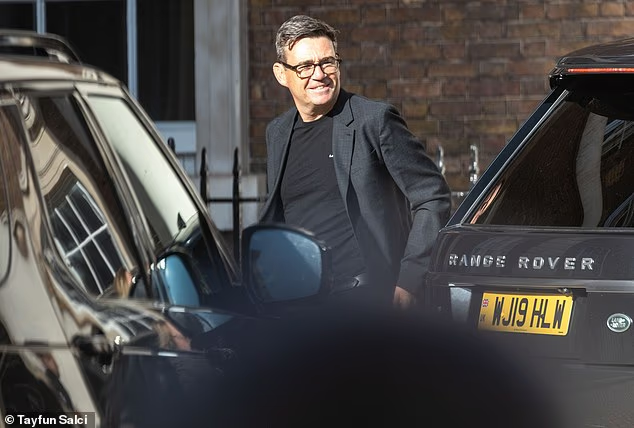
Andy Burnham says his dad doesn’t know he is new UK Prime Minister as he opens up on Alzheimer’s heartbreak

Published

on

Manchester Evening News

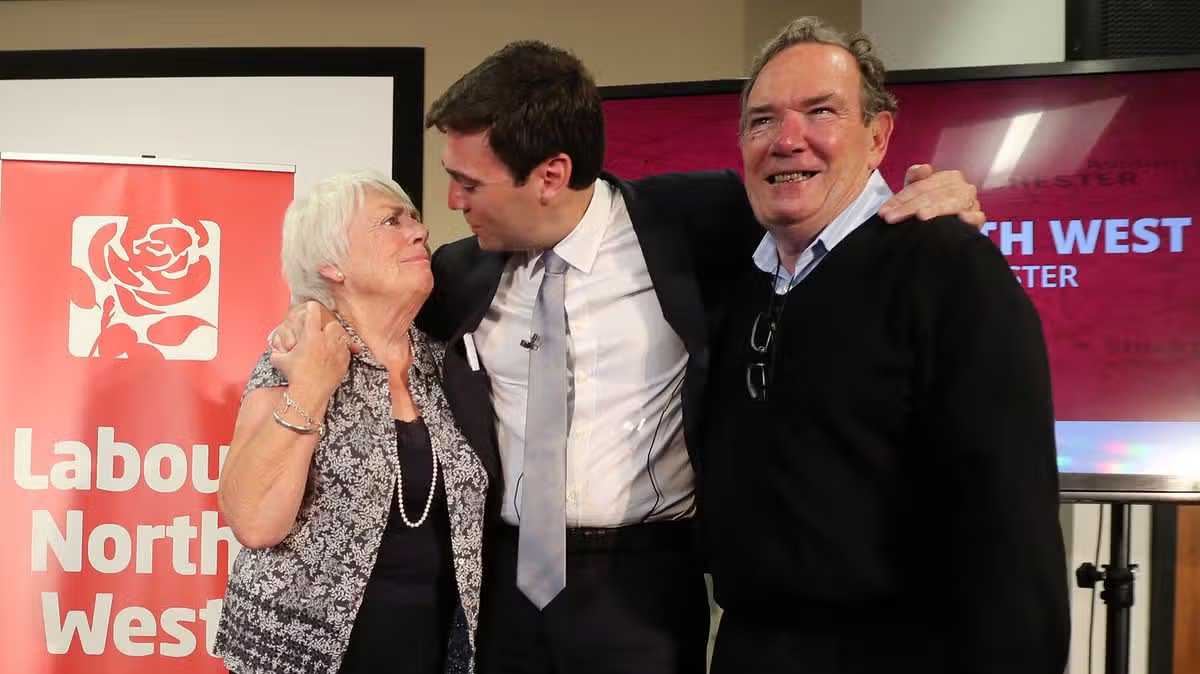
Incoming Prime Minister Andy Burnham plans to reform adult social care system as he opened up on his father’s Alzheimer’s

Andy Burnham has revealed that his father does not know he will be the next prime minister because of his Alzheimer’s, a matter which fuels his ambition to reform the adult social care system.

Advertisement

The incoming prime minister, who is set to make his first speech on Monday, has promised to “grasp the nettle” of reforming the system, drawing on his father Roy’s experience. He told The Times that his father was unaware that he is on the brink of power.

“That’s a sadness because he would be (proud),” Mr Burnham said. And attributing his success to his family, he added: “The way I look at it, it’s his achievement as well. A whole family achievement although he doesn’t know it.”

Click here for the latest on Greater Manchester’s politics in our newsletter

He added that his father remains unaware that his son had come around to the idea of proportional representation – which was one of his political passions. He said: “I don’t think he’s ever realised, because of his condition, that I’ve come round to PR, which is one of his missions – to get me to accept that.”

Advertisement

Mr Burnham revealed that the family, including his youngest daughter, visited his father last Sunday. “We were at his care home. My two brothers were there, my mum was there. So, all five of us together, which was a nice thing.”

Reform of the social care system is unfinished business for Mr Burnham, who set out plans for change while he was health secretary in Gordon Brown’s administration.

Mr Burnham described the “broken social care system” in England as “the worst of all worlds” and insisted it is a “massive” priority for the public.

Advertisement

The PM-in-waiting, who will take up his role in Number 10 on Monday (July 20), acknowledged reform will “require something difficult”, after his efforts to do so more than a decade ago failed.

His plans in 2010 to overhaul social care for the elderly with the creation of a national care service for England were turned against Labour by the Conservatives, who claimed they would levy a “death tax” to pay for it.

“The minute that poster landed with the gravestones, that was it. My reforms were dead,” Mr Burnham later admitted.

Now he has pledged to “expend political capital” during his premiership on what he said has been a long-neglected sector – accusing Westminster of having “flinched” from such big decisions for too long.

Advertisement

Addressing the issue in his first speech after formally replacing Sir Keir Starmer as Labour leader, he told a special conference in London on Friday: “Let’s take a problem-solving rather than a point-scoring approach.

“Let’s have the courage to fix the big things that politics has neglected, like social care, and have the conviction to go out there together and argue for our plans.”

How adult social care works and is funded in England has been a thorny issue for many governments over the years. Unlike NHS care, social care is not free at the point of use and high costs sometimes mean people are forced to sell their homes to pay for what they need.

Advertisement

People with savings worth more than £23,250 are not entitled to help with the cost of care from their local council.

Baroness Louise Casey, who is leading an independent review into the sector and is expected to publish her first report later this year, noted in a speech earlier this month that there have been no fewer than 22 attempts since 1997 at reforming the sector – none of which she said had “fixed the foundations”.

In 2019, in his first speech as prime minister, Boris Johnson said the Conservatives would “fix the crisis in social care once and for all”, something that failed to come to fruition.

Advertisement

Labour faced criticism after the party was elected in 2024 for scrapping plans for an £86,000 cap on the amount anyone in England would need to spend on their personal care over their lifetime, having argued the proposals were not “deliverable” in the time frame.

After becoming Labour leader on Friday, Mr Burnham referred to his family’s own experience of the system due to his father living with Alzheimer’s.

“I think it’s about being prepared to grasp the nettle,” he said. “I’ve got personal experience of the system. My dad has Alzheimer’s and you see what the staff have to put up with. It’s not their fault. The system’s broken. You can’t leave social care like this.”

He said that while reform “will require something difficult” he believes the public want a better system.

Advertisement

He added: “The NHS won’t get back to where it needs to be when you have a broken social care system that can’t keep people out of hospital.

“So this is massive when it comes to the things that people care about. And I’m not going to do what Westminster has traditionally done, which is to kick the can down the road on this important issue.

“I will expend political capital on bringing forward a plan to fix social care, and I’m not going to waste time because every time that we waste another year, thousands and thousands more people don’t get the care that they need.”

He said that with the system as it is people are “paying for care in the most unfair way possible”, likening it to “the American healthcare system”.

Advertisement

Mr Burnham said: “The more vulnerable you are, the more you end up paying, so that’s the worst of all worlds and people lose everything that they’ve worked for.

“So you start from there and then you look at the options as to how you make a universal social care system, because that’s what I believe, a national care service, how do you fund that? And we’ll come to those options in due course.”

Speaking in May, before he became an MP, Mr Burnham said he did not “resile” from previous comments he had made about abolishing inheritance tax in favour of a care levy.

Source link

Advertisement
Continue Reading

NewsBeat

Harry Kane insists England team-mates must stop talking about winning major silverware and focus on finally finishing the job after latest World Cup heartbreak

Published

on

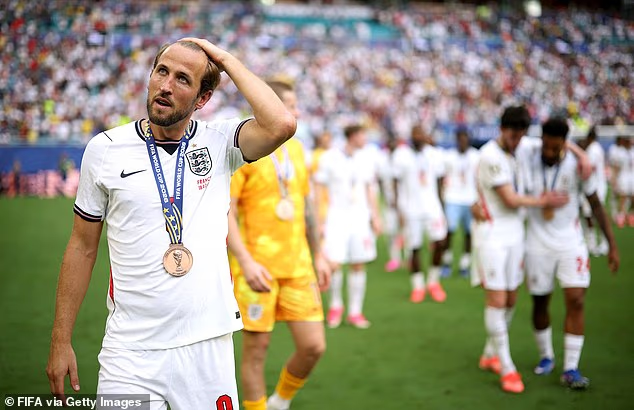
Harry Kane has urged his England team-mates to prove they can go on and win a major tournament such as the World Cup

Advertisement

Harry Kane has told his England team-mates that the talking about taking the final step on the road to silverware must stop and the time has come to just finish the job.

Thomas Tuchel’s squad still appeared in a state of shock as they left Miami following Saturday’s absurd 6-4 victory over France, which clinched third place at this World Cup.

The win secured a best-ever finish on foreign soil but the scars of their painful late semi-final defeat by Argentina are still evident.

Kane believes the manner of that defeat will linger for weeks and revealed that the group had been theorising over how best to deal with specific scenarios against the best opposition since losing the European Championship final to Spain in 2024.

Advertisement

‘The last 30 minutes of Argentina is not the team we want to be,’ Kane said. ‘We spent a lot of time over the last two years talking about that situation, to attack those moments. The bottom line is we lost anyway.

‘It’s easy to go away and talk about it. We need to get better at actually being in those situations.

Harry Kane has urged his England team-mates to prove they can go on and win a major tournament such as the World Cup

Advertisement

‘We have to learn, improve. The coach will have improved from these learnings. I can talk as much as I want but ultimately it’s about showing it next time we’re in that situation.’

Kane insisted that the Nations League campaign, which pits them against Spain, Croatia and Czechia from September, should better equipe England ahead of the home Euros.

And he has thrown his backing behind Tuchel amid fierce criticism from supporters and pundits for the way in which a one-goal lead against Argentina was managed.

‘It’s the enthusiasm he has, the emotion he brings, the tactical experience he has,’ Kane added. ‘It doesn’t mean you’re going to get it right every time. We want to get it right on the biggest occasions and he expects that from himself as well. He’s a fantastic coach.

Advertisement

‘It was his first major tournament. He’ll learn a lot from the players, the situations, the pressures, the travel. And the players will learn a lot from the other night.’

That the players had been discussing their inability to close out the biggest games before Tuchel’s arrival suggests that internally they will shoulder a portion of the blame.

Tuchel had appeared hurt by widespread condemnation, claiming that his first media conference since Argentina had felt as if England had been knocked out of the group stage without picking up a win.

England suffered a heart-breaking World Cup semi-final defeat to Argentina

England suffered a heart-breaking World Cup semi-final defeat to Argentina

Advertisement

‘He not only gave the players belief but he gave the country belief that it was our year,’ the England captain said. ‘That is why it hurts even more than other years because everyone believed we were going all the way. Everyone has to process it. He has to process it himself.

‘We’re still in that grieving stage, the emotional stage, and we’ll be in that for the next few weeks.

‘It’s so hard. I think the fans are behind the team and are behind the manager. When something like this happens it’s very emotional – and rightly so. We’ve all been England fans when we wished we’d done this or that and it didn’t quite happen. That will die down naturally.

‘We had a lot of good things, a lot of tough situations we overcame. The group is incredible, the best England group I’ve been a part of in terms of togetherness. The boss was a big part of creating that as well.’

Advertisement

Advertisement

Source link

Continue Reading

NewsBeat

Long-time broadcaster Edward Stourton who presented BBC Radio 4 dies aged 68

Published

on

Long-time broadcaster Edward Stourton who presented BBC Radio 4 dies aged 68
Edward Stourton was diagnosed with prostate cancer in 2014 (Picture: Mike Lawn)

Veteran broadcaster Edward Stourton has died at the age of 68 after living with incurable prostate cancer.

The acclaimed journalist, whose career spanned more than four decades, died on Saturday surrounded by his family, the BBC confirmed.

Stourton – who spent 10 years presenting Radio 4’s Today programme – revealed in his 2023 memoir Confessions that he had been diagnosed with prostate cancer back in 2014.

After initially undergoing treatment, he was later told that the disease had spread and become incurable. Despite his diagnosis, he continued working until very recently.

Advertisement

Paying tribute to Stourton, his friend and former Today co-host James Naughtie praised his ‘warm intelligence and wit’, describing him as ‘one of the best colleagues’.

Radio 4 controller Mohit Bakaya also called him ‘an absolutely outstanding broadcaster’.

Mandatory Credit: Photo by Brenda Monks/Daily Mail/Shutterstock (862953a) Bbc Newsreader Edward Stourton Who Decided To Diet After He Was Mistaken For His Father. Bbc Newsreader Edward Stourton Who Decided To Diet After He Was Mistaken For His Father.
Stourton’s career in journalism spanned more than four decades (Picture: Monks/Daily Mail/Shutterstock)

Meanwhile, the BBC’s interim news chief Jonathan Munro said it was ‘far too soon to lose Ed’.

Advertisement

Got a story? Get in touch with our news team by emailing us at webnews@metro.co.uk. Or you can submit your videos and pictures here.

For more stories like this, check our news page.

Follow Metro.co.uk on Twitter and Facebook for the latest news updates. You can now also get Metro.co.uk articles sent straight to your device. Sign up for our daily push alerts here.

Advertisement

Advertisement

Source link

Continue Reading

NewsBeat

Next please! Andy Burnham will become Britain’s seventh PM in a decade TODAY – as jittery markets wait to see if ‘Red’ Ed Miliband gets No11

Published

on

Next please! Andy Burnham will become Britain's seventh PM in a decade TODAY - as jittery markets wait to see if 'Red' Ed Miliband gets No11

Keir Starmer will officially exit Downing Street today – as Britain braces to find out what an Andy Burnham premiership means. 

Sir Keir is departing just two years after winning an extraordinary election landslide, leaving Mr Burnham to become the country’s seventh PM in a decade.

The politicians will parade in and out of Buckingham Palace to see the King as traditional processes play out. 

But the former Greater Manchester Mayor is already facing a crucial moment as he names his Cabinet this afternoon.

Advertisement

The Labour Left is still clamouring for Ed Miliband to be made Chancellor, despite alarm from businesses and moderates. Markets have been calmer amid mounting speculation that Shabana Mahmood will get the role instead, but any surprises could prompt a panicky response.

Meanwhile, the fates of big beasts such as Angela Rayner, Wes Streeting and Yvette Cooper are due to be decided.

On another momentous day in UK politics:

  • Mr Burnham has revealed his Alzheimer’s-hit father does not know he is going to be PM, as he vows to overhaul social care;
  • The new PM has hinted at an earlier end to the freeze on the basic rate tax threshold, without saying how it would be funded; 
  • Mr Burnham will become the first openly Catholic PM in around 500 years, with work-arounds put in place to protect the Church of England; 
  • Loudspeakers have been banned near Downing Street today after protesters blighted Sir Keir’s speech announcing his resignation.

Keir Starmer will officially exit Downing Street today – as Britain braces to find out what an Andy Burnham premiership means

Advertisement
Sir Keir is departing just two years after winning an extraordinary election landslide, leaving Mr Burnham to become the country's seventh PM in a decade

Sir Keir is departing just two years after winning an extraordinary election landslide, leaving Mr Burnham to become the country’s seventh PM in a decade

The famous black door of No10 is given a buff up as the big moment looms

The famous black door of No10 is given a buff up as the big moment looms 

The handover comes barely a month after Mr Burnham returned to Westminster following his victory in the Makerfield by-election.

He has been installed by Labour MPs in a ‘coronation’, without a formal vote by activists – or having to spell out any policies.

Advertisement

Among the vague commitments laid out by the incoming PM so far are devolving power away from Westminster.

He has announced he will scrap Sir Keir’s flagship digital ID programme to focus money and attention on the cost of living.

In an interview with The Times, Mr Burnham said he had already spoken to the Treasury about his planned announcements and stressed the importance of making people ‘feel better’.

Adding that complaints about frozen tax thresholds had been ‘lodged in his mind’ since the Makerfield contest, he said: ‘So when people, they’re just characterising me as a tax raiser, well again, it’s never that simplistic is it? The breathing space point is a really serious one.’

Advertisement

The comments raise more questions about how Mr Burnham will pay for giveaways, after he backed a ‘land tax’ and harked back to the 1970s condemning Thatcherite reforms.  

But the weekend was dominated by bungled briefing over whether the new Government will allow new oil and gas drilling in the North Sea.

The leader’s team has now confirmed he will stick to Labour’s 2024 manifesto, which promised not to issue new licences.

Instead he could merely allow expanded drilling at the Rosebank and Jackdaw sites – something that was being considered by Sir Keir’s administration.

Advertisement

That could bode ill for Mr Burnham’s relations with Donald Trump, who yesterday jubilantly hailed more drilling as a way of stopping Britain being a ‘poverty stricken disaster’.  

Mr Burnham also faces a decision on whether to temporarily nationalise Thames Water as the firm struggles with a £20billion debt pile.

He has already expressed support for greater public control of essential services, and Thames Water’s main creditors have said they are willing to discuss the issue with his new ministers in an effort to agree a rescue deal and avoid the business falling into a so-called ‘special administration regime’.

Another priority is likely to be reforming social care, which he has said is something he wishes to ‘expend political capital’ on.

Advertisement
The Labour Left is still clamouring for Ed Miliband to be made Chancellor, despite alarm from businesses and moderates

The Labour Left is still clamouring for Ed Miliband to be made Chancellor, despite alarm from businesses and moderates

Liberal Democrat leader Sir Ed Davey has urged Mr Burnham to engage other parties to solve the ‘social care crisis’, calling for guaranteed rights for family carers, a universal safety net and protection against ‘catastrophic costs’.

Kemi Badenoch has also written to Mr Burnham, saying her party will work with him to cut the welfare bill and calling for him to rule out tax rises and back new oil and gas drilling.

Mrs Badenoch told Mr Burnham she would ‘never shirk’ from holding him to account, adding: ‘You will enter office without having set out a clear plan on any of the issues facing our country.

Advertisement

‘You have refused calls to come to Parliament for questions from MPs, and you have not submitted yourself to serious media scrutiny. This is not a promising start.’

Source link

Continue Reading

NewsBeat

Spanish boy, 13, is crushed to death by a collapsing fountain in World Cup celebration tragedy – as millions take to the streets after victory over Argentina

Published

on

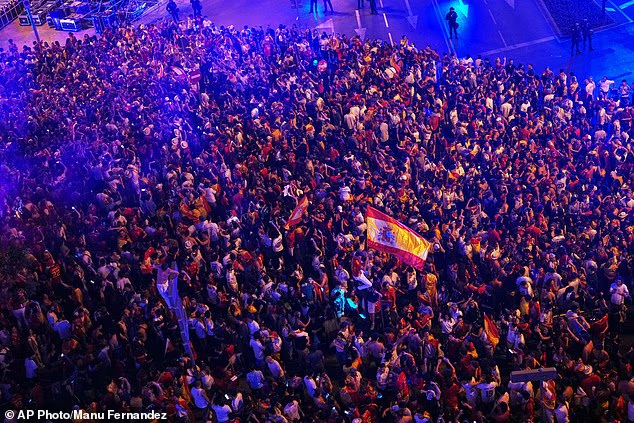
Spanish fans celebrate in central Madrid after Spain defeated Argentina in the World Cup final soccer match in East Rutherford, N.J., near New York, Sunday, July 19

A 13-year-old boy has died after a fountain he was celebrating Spain’s World Cup victory on collapsed.

Two other people were injured in the drama, which occurred just after 12.30am this morning as fans were partying in the historic walled city of Ciudad Rodrigo in the province of Salamanca near the Spanish border.

The teenager was inside the fountain with other youngsters when the upper part of the structure collapsed and fell on top of revellers who were inside it.

Police removed the debris on top of him to free him and rushed him to a nearby health centre but he was pronounced dead shortly after arrival.

Advertisement

The local council said it was declaring three days of mourning overnight.

It said in a statement: ‘The City Council of Ciudad Rodrigo expresses its sorrow and condolences over the death of the 13-year-old child.

‘The entire city of Ciudad Rodrigo mourns this loss and stands with the child’s family and friends in their grief.

‘What should have been a celebration of the Spanish national team’s victory in the World Cup has turned into a tragedy for the entire community of Ciudad Rodrigo.

Advertisement

‘The City Council also wishes a speedy recovery to the other people who were affected by the incident.

Spanish fans celebrate in central Madrid after Spain defeated Argentina in the World Cup final soccer match in East Rutherford, N.J., near New York, Sunday, July 19

The triumph has sparked an outpouring of national pride in football-mad Spain, where many younger supporters had never witnessed the men's team lift the World Cup since their only previous title came in South Africa in 2010

The triumph has sparked an outpouring of national pride in football-mad Spain, where many younger supporters had never witnessed the men’s team lift the World Cup since their only previous title came in South Africa in 2010

Advertisement
Spanish national football team supporters wave flags and ignite flares as they celebrate their team's 1-0 extra-time victory over Argentina in the 2026 FIFA World Cup final at the Fan Zone in Plaza Colon, Madrid, Spain, on July 20

Spanish national football team supporters wave flags and ignite flares as they celebrate their team’s 1-0 extra-time victory over Argentina in the 2026 FIFA World Cup final at the Fan Zone in Plaza Colon, Madrid, Spain, on July 20

‘As a sign of mourning for this loss, the City Council’s flags will fly at half-mast from July 20 to July 22.’

The fountain where the tragedy occurred is in a spot known locally as the Fat Tree Roundabout in English.

It owes its name to a century-old elm tree that stood there until it had to be removed due to Dutch elm disease.

Advertisement

One traumatised local wrote online: ‘How unfair life is when tears of joy turn into pain. It’s very hard. Strength to the family. Rest in peace.’

Another said: ‘What a great tragedy. Sending hugs and strength to the family. Ciudad Rodrigo is in mourning. Rest in peace, little angel.’

Spain’s World Cup winners were due home on Monday to a heroes’ welcome in Madrid where a million fans are expected to greet them after a night of raucous celebrations across the country.

The triumph has sparked an outpouring of national pride in football-mad Spain, where many younger supporters had never witnessed the men’s team lift the World Cup since their only previous title came in South Africa in 2010.

Advertisement

Fresh from their 1-0 victory over Argentina in Sunday’s final in East Rutherford, United States, coach Luis de la Fuente’s squad is due to land in Madrid at 12.50 pm (10.50am GMT) with the golden trophy.

The players are then expected to be received by King Felipe VI and Prime Minister Pedro Sanchez before climbing aboard an open-top bus for a parade through central Madrid beginning at around 4.30pm.

They will travel from near the Moncloa Palace, the prime minister’s official residence, to Cibeles Square, the central government’s representative in Madrid, Francisco Martin, told Spanish public television.

A ceremony involving the players will then be held at the square, the traditional gathering point for celebrations by the Spanish national team and its supporters.

Advertisement

Around one million people are expected to line the parade route, with additional security and transport measures planned to handle the crowds, Martin said.

A total of 2,050 police officers and 400 Civil Guard personnel will be deployed, he added.

The precise timetable for the festivities had not been fully confirmed on Monday morning, however, with Sanchez scheduled to make a brief visit to Algeria before returning to Spain in the afternoon.

The royal household had also yet to confirm whether the king would attend the celebrations.

Advertisement

The scenes are expected to echo the celebrations that followed Spain’s first World Cup title in 2010, when hundreds of thousands of supporters flooded Madrid’s streets to welcome the team home after their victory in South Africa.

Pictured: The fountain where a 13-year-old boy died after he was celebrating Spain’s World victory

Pictured: The fountain where a 13-year-old boy died after he was celebrating Spain’s World victory

Spanish fans celebrate in central Madrid after Spain defeated Argentina in the World Cup final soccer match in East Rutherford, NJ, near New York, Sunday, July 19

Spanish fans celebrate in central Madrid after Spain defeated Argentina in the World Cup final soccer match in East Rutherford, NJ, near New York, Sunday, July 19

Fans of the Spanish national football team celebrate their team's victory at the Fan Zone in Plaza Colon, Madrid on July 19

Fans of the Spanish national football team celebrate their team’s victory at the Fan Zone in Plaza Colon, Madrid on July 19

Advertisement
Spain defeated reigning World Cup champions Argentina 1-0, with the lone goal coming from Ferran Torres #7 in the 106th minute of extra time

Spain defeated reigning World Cup champions Argentina 1-0, with the lone goal coming from Ferran Torres #7 in the 106th minute of extra time

Spain's supporters on a motorcycle waves Spain's flag celebrating victory after the 2026 World Cup final match between Spain and Argentina at Neptuno square in Madrid, on July 19

Spain’s supporters on a motorcycle waves Spain’s flag celebrating victory after the 2026 World Cup final match between Spain and Argentina at Neptuno square in Madrid, on July 19 

The capital was already buzzing with activity after the final, where thousands of supporters who gathered in bars and three fan zones had poured out into the streets in celebration

The capital was already buzzing with activity after the final, where thousands of supporters who gathered in bars and three fan zones had poured out into the streets in celebration

While the country waited for the team’s arrival, celebrations continued overnight from Madrid to Spain’s smallest villages on Sunday night.

Advertisement

The capital was already buzzing with activity after the final, where thousands of supporters who gathered in bars and three fan zones had poured out into the streets in celebration.

Car horns blared, fireworks lit the sky and supporters poured into streets and squares moments after the final whistle, despite a tense final in which Spain struggled for long periods to break down the Argentine defence.

At Madrid’s Colon Square, where a fan zone had been set up for the match, supporters wrapped in Spain’s red-and-yellow flag sang and danced long into the balmy summer night, while others set off flares and fireworks, an AFP journalist observed.

‘Campeones, campeones! (Champions, champions!)’ chanted jubilant fans.

Advertisement

Others shouted ‘Que viva Espana! (long live Spain)’ as they celebrated a triumph that came just two years after Spain’s Euro 2024 victory and with the women’s national team already holding the world title won in 2023.

‘You have faced each challenge with the conviction of a great team and have carried the name of Spain to the very top,’ the Spanish Royal Household said on social media platform X, hailing a ‘reward’ stemming in particular from ‘exemplary commitment in every match’.

‘Today, we celebrate a title. Tomorrow we will remember a legend,’ it added.

Source link

Advertisement
Continue Reading

NewsBeat

‘Envy’ tax to clobber 1million drivers who buy an average car this year

Published

on

The envy tax is an annual £425 levy paid for five years on a car costing more than £40,000. Everyday vehicles such as a Volkswagen Golf M may be affected by the tax

Advertisement

Almost a million drivers will be hit by a ‘luxury’ vehicle tax this year after a new car’s average price topped £40,000.

The ‘expensive vehicle supplement’ is an annual £425 levy paid for five years on a car costing more than £40,000.

But with everyday vehicles such as a Volkswagen Golf, Ford Kuga and Skoda Kodiaq now priced at that much, thousands more families are sucked into paying the ‘envy’ tax.

Ian Taylor, of the Alliance of British Drivers, said: ‘Ordinary families are being priced out. For most people the car is an essential thing more than it is a luxury. The Government needs to rethink this tax.’

Advertisement

The levy is paid for five consecutive years after the second year of registration, costing buyers £2,125.

About 926,000 new cars costing above £40,000 were registered last year, data from automotive analysis firm Jato shows. That figure is set to rise again in 2026, it says, with sales from the first six months suggesting registrations could top 973,000 by the end of the year.

The envy tax is an annual £425 levy paid for five years on a car costing more than £40,000. Everyday vehicles such as a Volkswagen Golf M may be affected by the tax

Advertisement

The Government raised the tax threshold for electric cars to £50,000 in April to reflect their higher price, but the threshold for petrol and diesel cars has been frozen since 2017 when the average cost was £26,000.

Sue Robinson, of the National Franchised Dealers Association, said: ‘Everyday family cars are increasingly being classed as luxury vehicles rather than the exception the tax was designed to capture.’

The luxury tax, which also applies to hybrid cars, is based on the manufacturer’s price listing, meaning any dealer discounts at the point of sale are ignored even if the final purchase price drops below £40,000.

The levy must also be paid on second-hand cars if bought within the applied period. Engineer Jeremy Stern, 50, of Southam, Warwickshire, paid £48,000 for a second-hand Tesla saloon in 2024, less than half the £98,000 it cost new.

Advertisement

He told the Sunday Times: ‘Freezing thresholds on car tax is a stealthy way of making more people pay. It seems like another envy tax.’

The Society of Motor Manufacturers and Traders said 70 per cent of new cars now cost £40,000 or more.

Since 2017, the price of a VW Golf GTI has risen from £27,865 to £44,175. The price of a Vauxhall Grandland Ultimate, a family SUV, has increased from £33,995 to £40,745. 

The ST Line of the Ford Kuga, another SUV, cost £25,845 in 2017, compared to £40,485 today.

Advertisement

Jato said buyers are turning to cheaper Chinese brands, such as Jaecoo, BYD and Chery. Over the past year, sales of Jaecoo vehicles, which cost £32,000 on average, increased from 8,399 to 34,084.

A Treasury spokesman said revenue from motoring taxes helped to ‘fund the public services and infrastructure we all rely on’.

He added: ‘The expensive car supplement ensures those buying the most expensive vehicles make a fair contribution. We have raised the threshold for new electric cars to £50,000 and are protecting motorists by extending the 5p cut to fuel duty.’

Advertisement

Advertisement

Source link

Continue Reading

NewsBeat

‘Joke’ Argentina v England match torn apart and Dan Biggar asks Wales question

Published

on

Wales Online

These are your headlines on the morning of Monday, July 20.

Argentina v England ‘a joke’

Former England international Will Greenwood launched a scathing assessment of England’s dramatic defeat to Argentina, describing the contest as “everything I hate about rugby” after a match dominated by lengthy stoppages, yellow cards and controversial officiating decisions.

The ex-centre did not hold back in his verdict on the encounter, which lasted around two and a half hours and was repeatedly interrupted by TMO interventions, disciplinary reviews and lengthy discussions between the match officials.

There were ugly scenes after the match as referee Angus Gardner was targeted by the crowd, with an object appearing to be thrown at him.

Advertisement

Writing in the Telegraph after the game, Greenwood said: “What an absolute joke of a game that was between Argentina and England. It was everything I hate about rugby. A 2½-hour match with total confusion, misinterpretation, disagreements between officials, players getting on at each other, England brilliant then collapsing then brilliant then collapsing. It ruined my night.”

The Test had already become an increasingly fractious affair, with a succession of yellow cards disrupting the flow and leaving both teams repeatedly forced to adapt with reduced numbers. Several incidents were referred upstairs for review, contributing to the stop-start nature of the contest and prompting fresh debate over rugby’s disciplinary process and the impact of lengthy TMO interventions on the spectacle.

The controversy reached its peak in the closing stages when Argentina thought they had snatched a dramatic late try, only for it to be ruled out following another review.

Greenwood questioned the decision, adding: “Bedlam at the end – and I am often England’s most hyperbolic cheerleader – but that was clear and obvious my backside! There was nothing clear and obvious about that last try for Argentina being taken away. It goes a long way to putting people off rugby.”

Advertisement

Biggar flips 10 question on head

Wales rugby legend Dan Biggar says the answer of who should play at No10 for the national team should be influenced by who starts at inside centre.

Steve Tandy has chopped and changed at fly-half during the latest Nations Championship campaign, having plumped for Dan Edwards during the Six Nations, with Scarlets man Sam Costelow injured.

Both 10s bring something different to the role, with Edwards enjoying more time in the jersey under Tandy’s stewardship to date. But with Costelow now fit again, the head coach has a decision to make over who should be the long-term incumbent.

Biggar, though, feels the pick at 12 is almost more important when trying to figure out who should be the number one at No. 10.

Advertisement

Biggar said on ITV: “It’s a little bit like the Irish 10 debate, there is no real standout candidate.

“Dan Edwards and Sam Costelow are the two in the running and played the majority of the games.

Advertisement

“Dan Edwards is very much more of a moment player so he’s going to give you real big moments and he’s going to be on the end of things whereas Costelow is a little bit more keep it in structure.

“I think the biggest question in answering that is who do Wales play at 12 and how do they play at 12?

“Do they continue with a ball player, a second ball player at 12 or do they use an Eddie James and use him as a little bit of a Jamie Roberts-type player to get them over the gainline?”

Pushed by his co-pundit Ronan O’Gara over who he would pick, Biggar added: “Who has got more credit in the bank, probably Dan Edwards, seeing as Mr O’Gara is putting me on the spot!”

Advertisement

All Black’s son wins Open

By Carl Markham, Press Association

New Zealander Ryan Fox kept his head while all around him were losing theirs to make his major breakthrough at the age of 39 with a brilliant birdie at the last for a one-shot victory at the Open.

Fox, son of former All Blacks fly-half Grant, was one of only three players in the final 12 groups to shoot under par on a chaotic final day when Royal Birkdale finally showed its teeth after two days of back-to-back record-equalling rounds of 62.

After Cameron Young posted the nine-under target after a best-of-the-day 64 a couple of hours earlier, double figures was the aim for those out on the course.

Advertisement

Fox headed down the last – Birkdale’s most difficult hole – needing a birdie to overtake the American, for so long the PGA Tour’s perennial runner-up, and hit his approach inside 12 feet.

He held his nerve, as he had done all day and punched the air as he became New Zealand’s second Open champion after Sir Bob Charles in 1963.

Fox comes from rich sporting stock; father Grant won rugby’s first World Cup in 1987, while his his grandfather Merv Wallace captained New Zealand at Test cricket.

Townsend happy with form

By Gavin McCafferty, Press Association

Advertisement

Gregor Townsend reflected on the strides his Scotland side have made since their collapse against Argentina last autumn as they rounded off a long season with a comeback win over Fiji.

Scotland somehow let a 21-0 half-time lead slip when they lost to the Pumas at Murrayfield in November.

They soon lost in Italy in their Guinness Six Nations opener to leave Townsend facing criticism but they bounced back in impressive fashion and have now won five of their seven games since.

That included victories over Wales, England, France, Argentina and now a spirited Fiji team, who led by 10 points at half-time at Murrayfield on Saturday.

Advertisement

Townsend and his players showed they could turn the momentum in their favour with a more direct second-half display.

Three replacements grabbed four tries – Jamie Dobie (two), Pierre Schoeman and Scott Cummings – to seal a 33-17 Nations Championship win.

Looking back over the season, Townsend said: “I still feel the Rome game was beneficial in terms of, we didn’t start well, but we came back. The weather was a factor.

“But I did feel that since Argentina, we’ve been able to show that we’re able to come back in games. South Africa, for example, last week, Italy and Wales being the clear ones.

Advertisement

“But also being able to ride momentum as well. When we started well against France, we kept that going, same as England.

“That’s the part that I’ve been most impressed with and pleased that the players are able to handle momentum and notice it and make sure that we get it back quickly.

“Also, I feel that there’s a real alignment with the game. I think our supporters know what our identity is and our players do too and they know what is working for us.

“That’s not just playing an attack and moving the ball, it’s a certain way that they can shape a defence. And the kicking game too. We came on in huge strides there and that was something we had to go to.

Advertisement

“From a coaching point of view, I’m really pleased with how we’ve responded to Argentina and what that’s done to us and made us a better team.

“Also, the leadership has been excellent. Sione (Tuipulotu) has been outstanding as a captain, but that leadership group has really grown this year.

“They prepared the team really well this week. The players that didn’t get a chance to play, like Sione and Rory Darge, even though he wasn’t training, he really led this week.

“It’s been a positive season and there’s still a lot of growth in us.

Advertisement

“Little areas last week that we learned off South Africa and why they’re the world champs, we need to add those to our game and be a better team next season.”

Wales vs Japan VIP and hospitality tickets

This article contains affiliate links, we will receive a commission on any sales we generate from it. Learn more
Content Image

Prices vary

Seat Unique

Book tickets here

Seat Unique is offering VIP hospitality tickets for Wales’ Nations Championship matches against New Zealand and Japan in November.

Advertisement

Slade nails his man

By Duncan Bech, Press Association Rugby Union Correspondent, Santiago del Estero

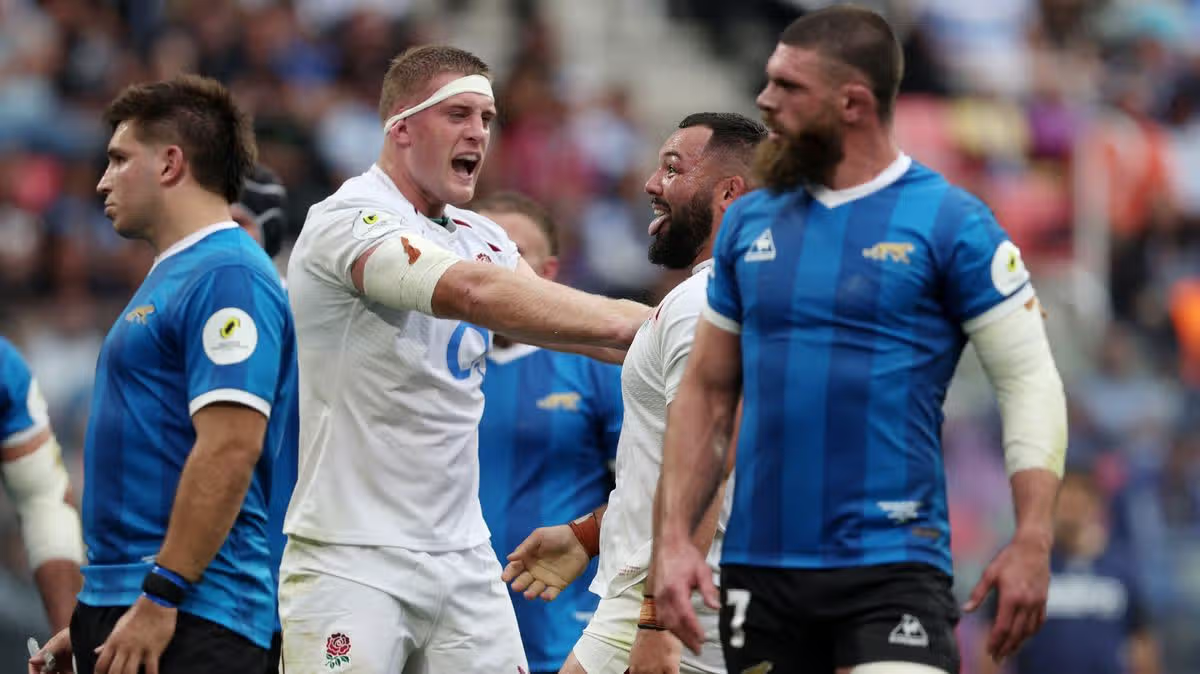
Henry Slade insists he was determined to nail his man as he emerged as England’s saviour against Argentina with a remarkable try-saving tackle at the death of a 31-24 victory in Santiago del Estero.

Slade raced to his team’s rescue three minutes into overtime with a “just get him out, any means necessary” challenge that edged Bautista Delguy’s finish in the right corner out of play.

Referee Angus Gardner awarded a try but it was overruled by video referee Brett Cronan in a lengthy and dramatic climax to an exhausting tour that has taken England to three continents.

Advertisement

Had Delguy scored and the conversion been added, Argentina would have snatched a draw.

Slade said: “Just get him out, any means necessary. Thankfully I was able to do it.

“It was pretty close in the end, but it wasn’t as close as they made it out to be. Touch is touch, I guess.

“It’s a nerve-wracking situation. You don’t know what the refs and the TMOs are going to do.

Advertisement

“From our perspective, all we could do was force him as wide as possible and keep scrapping right to the end.

“If we did that and they scored it, they’d have had to take a tough kick right from the touchline and we’d then put pressure on the kicker. That’s all we could do really.”

England finished their 25,000-mile Nations Championship expedition with two wins in three matches, a solid return given their brutal itinerary and their spirit is beyond dispute.

But their victory over Argentina was made far harder than it should have been following their customary disciplinary implosion, on this occasion losing four players to the sin bin to leave them playing nine minutes with 13 men.

Advertisement

Injury meant they actually finished the game with just 12 on the field and twice they were forced to repel Pumas fightbacks, initially having raced 19-3 ahead.

It was total chaos at times with players streaming on and off the pitch and England have now been shown 14 yellow cards and one red in eight Tests in 2026.

Slade said: “I didn’t actually know what position I was in at the end. I was changing from 10, to 12, 13, 15 – I don’t know!

“The desire and the intent from the boys and the never-say-die attitude is unquestionable. It’s just that we have to couple that with better discipline.

Advertisement

“Our discipline has been a thing we’re trying to work on because when we’ve got 15 on the pitch, we were a really, really top side.

“I can’t fault the effort and desire and intent of the boys, we’ve just got to find a way to keep everyone on the pitch. No one’s trying to get sin-binned, no one’s trying to get sent off.”

* Follow all of our channels to ensure you stay up to date with the latest Welsh rugby news. Sign up to our free daily newsletter here and our WhatsApp channel here for all the breaking news.

Source link

Advertisement
Continue Reading

NewsBeat

Swansea City close in on third signing as they agree deal to break club’s record

Published

on

Wales Online

Swansea City are close to signing their third new addition of the summer

Swansea City are closing in on the signing of New Zealand winger Elijah Just.

Advertisement

The Motherwell man played in all three games of the All Whites’ World Cup campaign this summer and would become the Swans’ third signing of the summer after Stephen Welsh and Moussa Yeo.

Our colleagues at the Daily Record report that Motherwell have agreed a club-record fee for the attacker, who will now head south to join Vitor Matos’ side.

They report a “multi-million deal”, with add-ons, has been rubber-stamped, which is said to eclipse Scotland international Lennon Miller’s sale to Udinese last summer.

That deal was said to eventually be worth £5million, but this will potentially eclipse that, according to the Record.

Advertisement

In terms of timescale, matters could be wrapped up within the next 24-48 hours, with permission give to Just to travel to south Wales to thrash out details.

Just had been on Celtic’s radar this summer but it appears he has chosen to test himself in the Championship.

He only joined Motherwell last year, having spent the majority of his career playing in Denmark.

The 26-year-old was shortlisted for the PFA Scotland’s player of the year award and was a standout for the Steelmen last season.

Advertisement

Just will arrived in SA1 to be greeted by familiar faces, having played with Marko Stamenic at international level and Welsh, who was on loan at Fir Park last term.

Matos has seen Ethan Galbraith leave the club for Stoke City this summer, while Goncalo Franco is now facing three months on the sidelines through injury.

Swansea are currently in Austria on pre-season tour.

Matos said he has been impressed with both of his new arrivals so far.

Advertisement

“I’m really impressed with both, and they both played really well. It’s also good now that the team will also start to understand them as well,” he said after their draw with Bundesliga 2 side Holstein Kiel.

“And to understand their strengths and how we can use that in our game.

“It was also good to see players from the academy, a lot of new faces which allows us to know them better.”

*Follow all of our social channels to ensure you stay up to date with the latest Swans news. Sign up to our daily newsletter here and our WhatsApp channel here. Our Swansea City correspondent Tom Coleman is also on social media. He can be found on his X account here, on Instagram, on TikTok and on Facebook.

Advertisement

Source link

Continue Reading

Trending

Copyright © 2025