We may receive a commission on purchases made from links.
For many car owners, the garage is the most important area of the home, whether it’s used to keep classic cars safe from the elements, work on project cars, or even store a collection of handy car repair tools. That’s why something like mold can feel like a living nightmare. Unfortunately, dark, damp spaces with little ventilation attract mold quite easily, which is why garages are particularly susceptible.
If you spot mold, you should tackle it with a mold removal product like 30 Seconds’ Pro Mold and Mildew Stain Remover before it spreads. You can also make your own mixture by mixing warm water with distilled white vinegar, detergent, or bleach.
Advertisement
Before you start working, make sure the garage is well-ventilated. Put on gloves, goggles, and a face mask. Spray the area with your solution of choice and let it sit for a while. Then scrub the area with a stiff-bristled brush. Repeat this process until the mold is gone. Then, rinse it and leave the area to dry completely.
Advertisement
How to stop mold from coming back
Damian Pawlos/Shutterstock
Once the mold is gone, you will want to ensure it stays away for good. Get rid of junk in the garage, like old cardboard boxes or furniture, as mold can grow on these surfaces or hide behind them. Ideally, you should keep your tools organized to reduce clutter. Don’t put anything wet or perishable inside your toolboxes, and make sure nothing leaks. If there is any moisture in the garage, you should address it as well.
If you sense that your garage is on the humid side, you may want to bring in a dehumidifier. Uncertain about spending the money? Aluminum foil can help you check if you need one. A fan could also be useful, as improving the garage’s airflow will help greatly. Better ventilation will be beneficial, as will proper floor drainage. Finally, you can also add more natural light so the garage is less dark and damp — think large windows or a garage door with window panels.
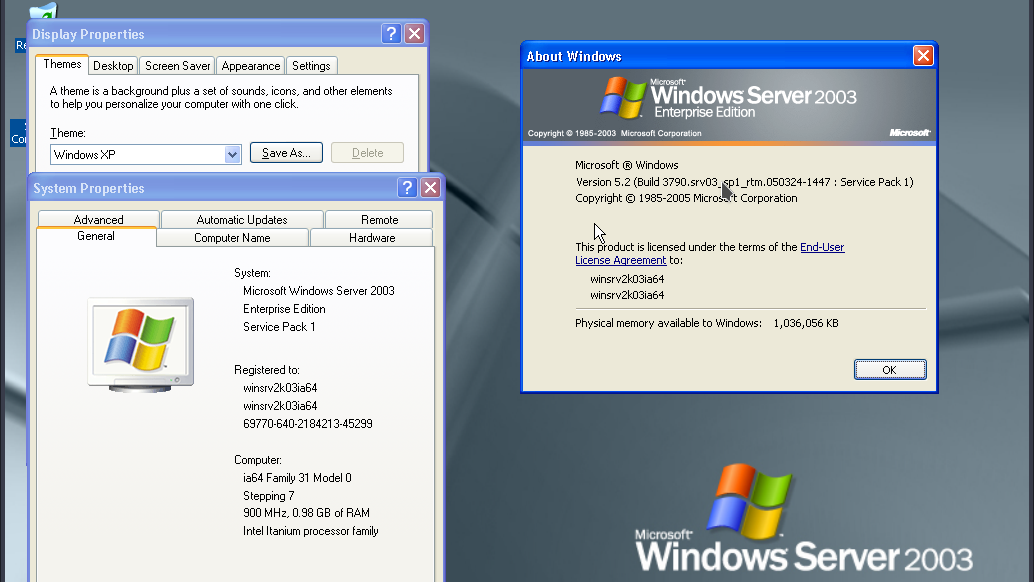
Intel’s Itanium architecture was an interesting experiment, but it has gone down in history as one of the chip giant’s bigger flops, so much so that it earned the name “Itanic” in the tech press. This is perhaps unfair, considering it did limp on until a quiet EOL in 2020. We didn’t know anyone missed it, but perhaps it was more the technical challenge than nostalgia for obsolete server hardware that led [Yufeng Gao] and [gdwnldsKSC] to spin up an instruction-set translator for the late, lamented, IA-64 architecture.
Note that it’s very much in alpha, version 0.1, so don’t expect all the things. Neither HP-UX and OpenVMS will boot, which is a pity since Itanium’s great success was arguably winning those OSes and thereby killing the bespoke architectures HP and DEC had at the time. Gentoo can get to a shell, as long as you use Kernel 6.6 or older, and Windows Server 2003 and XP-64 both apparently boot.
It’s not incredibly performant, with 486-level speeds when running on Ryzen 5000 series hardware, but then, it is a 64-bit hardware being emulated here, and pretty weird hardware at that. Itanium’s Very Long Word Instruction architecture was notoriously hard to program well. Specifically, it was hard to compile optimized programs for, so we expect optimizing an emulator is going to be similarly difficult. That’s why this is so impressive, even at this early stage.
An expired card, overzealous spam filter, and broken authenticator create havoc with a very clear moral
Nothing can ruin the end of a week like finding out that all of the websites and hosted email you’re responsible for are offline, which is exactly what happened to Christopher Bradbury and his web design and development firm, Digital Takumi last week. AWS has since resolved the situation, but Bradbury’s mistakes can serve as a useful lesson to others of what not to do.
As Bradbury explained to The Register in an email, he noticed last Thursday, July 16, that all the websites and Google Workspace email accounts connected to domains he manages were offline. All of those sites are hosted through Route 53, AWS’ combined DNS/hosting service, and none of them were resolving.
Advertisement
Bradbury went digging through his emails to figure out if there was anything to point to the failures, and sure enough: In his spam folder were numerous messages from AWS telling him a payment card on file had expired, and warning him that the account used to host all those customer websites through Route 53 was going to be suspended unless he took action. He didn’t obviously, because he didn’t realize there was an issue.
“AWS had been sending billing notifications, but unfortunately they had been filtered into a spam folder and, in some cases, were being delivered to an employee who had since left the business,” Bradbury told us.
“I accept responsibility for missing those notifications,” he added, but that didn’t help his customers’ websites get back online.
The situation could have been resolved sooner, but Bradbury had made some other mistakes as well:
Advertisement
“The root account had MFA enabled using a software authenticator that had been stored on an older laptop which has since suffered a motherboard failure,” Bradbury explained. Without access to that authentication code generator, he was unable to get into the account. Rather than getting the dead-laptop-with-a-critical-authenticator-on-it problem resolved, he was just relying on MFA emails instead – not the best idea.
“I’ve been bypassing the device key for quite a while by just using the recovery MFA via my email,” Bradbury told us. “It works, I get access. However if I just had my Passkey up to date it would have let me right in and I could have solved this.”
And then there was the email address where those MFA codes were going:
“The AWS recovery process required email verification using the registered root email address,” Bradbury told us. “That email address belonged to one of the domains whose DNS was hosted in the suspended AWS account, meaning I couldn’t receive the verification email.”
Advertisement
The account recovery tango
Bradbury’s next option was contacting AWS from a different email address, which didn’t go anywhere. He created another AWS account and purchased business support access on someone’s recommendation, but the support engineers he spoke to using that method wouldn’t discuss the other account until he verified he owned the one in question.
“Over the following days I spoke with several AWS teams, including Billing and Account Recovery. I was transferred between teams multiple times, but nobody was able to complete the ownership verification or restore access to the account,” Bradbury told us.
He wanted to pay AWS, Bradbury told us, but it took a while for them to be able to take his money. “The practical consequence is that I cannot log into the AWS account, cannot receive email at the registered root address, cannot access the MFA device, cannot update the expired payment method, and therefore cannot pay the outstanding invoices from inside the account.”
While we were working on this story, after speaking to both Amazon and Bradbury, he contacted us to say that access to the sites had been restored, and that he had logged in, paid the back invoices, updated his payment method, reset his MFA keys, and generally taken care of all the stuff he had been putting off until all this happened.
Advertisement
It’s unfortunate that someone has to go through AWS billing hell to serve as an example to others, so let this be a warning to anyone else managing client websites through AWS.
“Firstly pay your AWS bills,” Bradbury said in an email, adding that anyone running an AWS hosting account also makes sure their emergency recovery email isn’t on the same domain as one of the sites they manage through that profile. That, and “stop using shortcuts” when it comes to MFA.
“This isn’t a big infrastructure account, we run a single company marketing website and some domains through Route 53,” Bradbury explained. “It just shows that even the most modest instances of AWS can be absolutely business critical and you need to use proper practices and processes.” ®
Anthropic can finally start cutting checks to a group of authors and book publishers that sued the AI lab over copyright infringement. A federal judge gave final approval Monday of Anthropic’s landmark $1.5 billion settlement of a class action copyright lawsuit, Reuters reported.
Judge William Alsup of the U.S. District Court for the Northern District of California issued a preliminary approval of the settlement last year, after ruling that Anthropic had illegally downloaded and stored millions of copyrighted books.
Alsup has since retired and Judge Araceli Martinez-Olguin signed off on the settlement on Monday.
The payout will deliver $3,000 per work across an estimated 500,000 works, shared among the authors and publishers who hold rights to them. While the settlement is believed to be the largest in the history of U.S. copyright law, many authors and creators still don’t view it as a win.
Advertisement
That’s because of how the legal question was resolved. Alsup sided with Anthropic on the core issue. He ruled that training an AI model on copyrighted text counts as fair use — a decision widely seen as a turning point for the AI industry. But the ruling didn’t excuse how Anthropic obtained the books in the first place. Anthropic had built its training library from two sources: books it purchased and scanned (fine), and books it downloaded from pirate sites like Library Genesis and Pirate Library Mirror. Alsup found the second method illegal on its own terms and said that piracy question could go to trial; Anthropic agreed to a settlement soon after to avoid a trial and whatever damages a jury might have awarded.
While the final approval closes out this case, it doesn’t settle the legal question industry-wide because Alsup’s ruling was a single district court decision, and Anthropic’s decision to settle means the case will never reach an appeals court to become binding precedent.
Other judges are still free to reach their own conclusions on their own facts, which is exactly what’s playing out elsewhere. There is still a string of copyright lawsuits against companies such as Google, Meta, Midjourney, and OpenAI over whether it’s legal to train AI models on copyrighted works. Just last week, a group of publishers and authors, including Hachette, Cengage, Elsevier, author Scott Turow, and S.C.R.I.B.E. filed a class action lawsuit against Google over accusations that the company used their copyrighted works to train its AI platform, Gemini.
When you purchase through links in our articles, we may earn a small commission. This doesn’t affect our editorial independence.
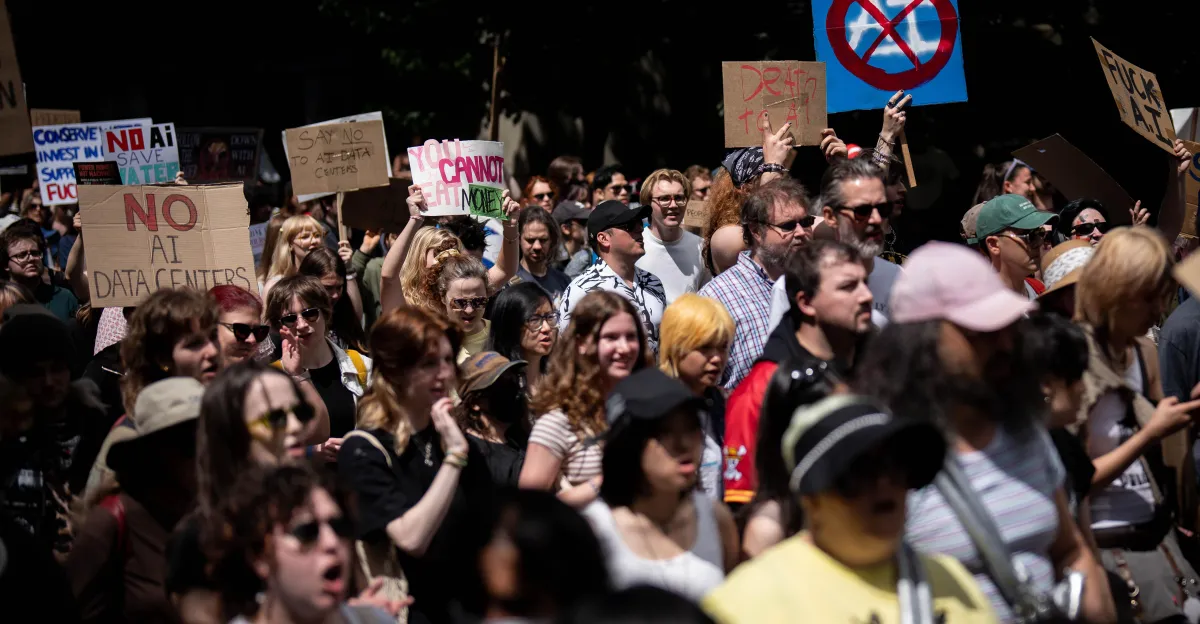
AI was supposed to make our lives better. Instead, it’s made many of us scared and angry. Communities are protesting against the building of new data centers — the warehouses of IT equipment powering the AI buildout — across the country, and increasingly they’re winning. And polling shows most Americans think AI is moving too fast.
So how did public opinion on AI curdle so quickly? Jasmine Sun, who reports on the industry from San Francisco, argues that the backlash treats AI less as a technology and more as a political project. “The debate was not about like, is ChatGPT useful to me?” Sun told me during a taping of Vox’s The Gray Area. “The debate was actually something more like, there are these big corporations and unaccountable billionaires…coming into my city, coming into my life and changing it without having any sort of democratic input?”
Filling in for Sean Illing, I talked to Sun about the rise of “AI populism,” the parallels with the Industrial Revolution, and how the backlash could crash into the 2028 presidential election.
As always, there’s much more in the full podcast, which drops every Monday, so listen to and follow us on Apple Podcasts, Spotify, Pandora, or wherever you find podcasts.
Advertisement
You’ve been writing about a phenomenon you call AI populism. How would you define that? What is AI populism?
I define AI populism as a worldview where AI is not seen as an ordinary technology, but specifically as an elite political project to be resisted. I came to the term while thinking about the AI backlash and the reasons people are increasingly anti-AI — whether that’s LLM slop, whether that’s Waymos in their city, whether that’s a new data center project. One thing that occurred to me was that a lot of times the debate wasn’t about whether ChatGPT is useful to me, or whether Waymos are safer than a human driver. The debate was actually something more like: There are these big corporations and unaccountable billionaires who are coming into my city, coming into my life, and changing it without any democratic input.
When I talk to people who are opposing AI in various ways, they seem more concerned with this concentration-of-power, anti-elite dimension — which is where I take the word “populism” — rather than classic AI safety concerns, which are more about the technical characteristics that might introduce risk.
You wrote a piece that touched on some of this but went to a darker place — “AI populism’s warning shots” — and you wrote about actual shots. Sam Altman, the CEO of OpenAI, was targeted by a Molotov cocktail and a shooting within the span of a couple of days. There was an Indiana councilman who voted for a data center and woke up to gunshots at his home and a note reading “no data centers.” Why do you think of those incidents of violence as warning shots of something to come?
Advertisement
It was pretty scary. I’m no Sam Altman fanboy, but it’s terrifying that assassination attempts are showing up in response to people’s worries about AI. One factor is that we’ve been seeing a rising wave of political violence and support for political violence in the US, especially among young people, over the past few years — the UnitedHealthcare CEO shooting, the Charlie Kirk shooting. Increasingly, a lot of disaffected, maybe nihilistic young people are turning toward political violence as a way to express political beliefs they don’t feel they have other channels for. Or maybe that person is just unwell. But I do expect to see more of it, because my theory of political discontent is that if people feel they have institutional channels to bargain for their rights — if they feel the democratic process is working, or they’re part of a union and believe their union leader will go bargain about how automation shows up in the workplace — they’ll most likely go through those channels.
When it feels like the official channels aren’t working, opposition becomes much more diffuse and volatile. That’s part of why, in creative communities, you’ll see people witch-hunting each other over AI use. I think we’ll see more political violence against people seen as AI leaders, or as supporting AI leaders.
Yeah, I’m quite worried about it. But again, my sense is that it comes from a feeling of — what else is there to be done, when you have this level of concentration of wealth and power, and there’s no democratic input right now into how AI is regulated or built?
It’s like a jump straight from complaining at your community meeting about the data center to an act of violence.
Advertisement
I was talking to some friends about this. During the 20th century in the US, there was a wave of factory mechanization and automation, but unions were really strong — often when a company said, “We’re going to bring in these machines,” they’d sit down with the factory union leader and say, “Okay, you can bring in the machines, but we’re going to couple that with a wage increase,” or a 35-hour workweek, or earlier retirement. There was a channel to make a deal about how automation would show up in your workplace. That meant people were more likely to accept it as something lifting all boats. I don’t think that’s happening now — most of the industries affected by AI aren’t organized in labor unions, and the democratic channels are questionable at best.
It’s like when people have agency to be part of the transition, the process goes a lot smoother. Is there a historical analogy for a technological change that didn’t allow for input from the people involved? I’m thinking of the Luddites.
The Luddites are a good example. When the automated looms were introduced, there was a lot of violence against the looms. The book I’d really recommend here is Carl Benedikt Frey’s The Technology Trap. He’s an Oxford economist who studied a ton of historical examples — in Europe, in China, all over the world — including the Luddites and 20th-century automation. His central question was: In what contexts do workers successfully stop automation, and in what contexts do they allow it to be introduced? How does the political environment, or the balance of power between people and their leaders, change the outcome? He found that when automation was introduced alongside social welfare policies — a higher minimum wage, some form of redistribution — people were much more willing to accept it, which is fairly rational.
I want to talk about Silicon Valley’s understanding of this backlash more generally. You’re painting a pretty dark picture, and you’re right in the belly of the beast in San Francisco — I’m sure you talk to people involved with AI every day. Is there a moment when it clicked for them that this backlash is real and something they have to take seriously? Or has that happened yet?
Advertisement
I’ve definitely noticed a huge difference, over the past six months, in how seriously people in Silicon Valley take the AI backlash.
People just talk about it more. I’d bring up AI populism to people last year, and they’d normally say, “It doesn’t matter — technology always introduces some discontent, people get annoyed but they get used to it, like the internet.” That was the standard reaction last year. Not anymore. I think part of the reason OpenAI and Anthropic have felt pressure to introduce economic policy proposals around job automation is that they’re seeing how worried people are. The data center moratoriums and the broader data center backlash have been surprising and meaningful in getting AI leaders to recognize they have both a messaging problem and an actual problem with the product and the technology they’re introducing.
A lot of the increasing opposition to AI in Washington has caused people to see this too. At first, Trump — as you mentioned — was very pro-AI. He and David Sacks were accelerationists; they wanted AI to go faster and to block attempts at regulation.
“The moratoriums, the regulation fights, even the booing at graduations, the literal assassination attempts — people in Silicon Valley have become much more worried.”
Advertisement
He was the AI czar — he’s no longer the AI czar. But it turned out a lot of other constituencies, both on the left and the right, were pretty opposed. For example, Trump and David Sacks tried to introduce a big federal bill that would preempt all state-level AI regulation — no state could regulate AI for 10 years. They tried to sneak it into a big omnibus bill so no one would notice. But members of Congress realized it was happening, and — whether for kid-safety reasons or frontier-safety reasons — people said, Wait a second, the idea of preventing any state from regulating AI for ten years is crazy. A lot of people organized in Washington to successfully stop that preemption. I think that showed the scale and bipartisanship of a coalition that was very keen to make sure it stayed possible to regulate AI was underestimated. As a result of all this — the moratoriums, the regulation fights, even the booing at graduations, the literal assassination attempts — people in Silicon Valley have become much more worried.
China is our big competitor in the AI race, and it certainly has all the conditions for a populist pushback to AI — youth unemployment is really high, and AI technology is in some ways more advanced at taking over real-world jobs. I was watching a video about fully automated factories and a robot pharmacist. You’re one of the rare American tech reporters who gets to spend time in China, and you wrote a piece that surprised me — you found there wasn’t really a populist backlash to AI there. Why not?
I was really interested in this question, and I was finishing my New York Times piece while in China for a few weeks, talking to both AI people and non-AI people. The main reason there’s not a big populist backlash in China is that there isn’t a lot of social unrest or populist backlash against anything — the entire MO of the Chinese government, the No. 1 priority, is domestic social stability. Any whisper of protest gets shut down; that’s why they have such strong speech controls. So one factor is that China doesn’t have much of a culture of resistance in general, whether in workplaces or politically. I’m not saying no one dissents — but it has a cultural effect too, because people don’t see it as useful or as an option. When I ask family members of mine in China about AI, sometimes they’re annoyed about specific things, but fundamentally, the idea of opposing AI is seen as almost unimaginable.
The other thing about China is that if you’re middle-aged there, you’ve lived through so many political, economic, and technological revolutions in your lifetime. When I was a little kid visiting Shanghai in the mid-2000s, there were no high-speed trains — now China has some of the best high-speed rail systems in the world. Technology has always gone hand in hand with dramatic economic advancement, with being lifted out of poverty. The modernization process has been aggressive and disruptive, but it’s not something the party has offered opportunities to resist, and it’s something most Chinese people still see as an inevitability that was mostly good for most people — because incomes did increase by dramatic amounts alongside the technological change. So I think people have a similar attitude toward AI: It’s much less about “Can I stop the AI wave?” and more “How can I take advantage of the AI wave to get ahead economically?”
Advertisement
We were just talking about this deep pessimism about what technology can bring us here in the US. I think a lot of people look around and think: We don’t have a cure for cancer yet, but we’ve sure seen our lives get worse in a lot of ways because of technology, social media, whatever. That pessimism probably fuels the backlash to AI, the skepticism about whether it can ever deliver on its promises. And that experience just isn’t the same in China, or probably much of the rest of the world, where technological progress has been faster and more concrete in people’s lives.
My 90-year-old grandfather said he’d love an elder-care robot to help him do tasks around the house so he doesn’t have to rely on his kids — he wants more freedom and mobility. It’s seen more as a tool to help individual goals. Even with the robot factories or pharmacies — one thing that struck me visiting a robot pharmacy was that the PR people happily said, “Yep, we’re doing these robots because human workers take too many smoke breaks and bathroom breaks and take too long.”
You’d never say that in the US, but they’re probably thinking the same thing — they just don’t say it. The other thing they mentioned is that this lets the pharmacy operate 24/7, because a lot of people need medications in the middle of the night and want to order via the DoorDash equivalent. There was actually a labor shortage before — Chinese workers weren’t willing to work night shifts — so these pharmacies are offering real consumer surplus. A significant percentage of orders come in overnight, when no other pharmacy is open. And with the factories, part of the issue is that Chinese workers, especially young people, don’t want to do factory work anymore.
“I think the 2028 presidential primary and election is really where I expect AI to become a centerpiece of the conversation.”
Advertisement
That anecdote gets at the promise and peril of AI, and the role of the backlash movement — which I’m still wrestling with how I feel about. On the one hand, I want to live in a world where cancer gets cured, where we live in an era of abundance, where things are cheap and easy to make because factories can run all the time with machine workers who don’t require anything — I want the future we were promised, of flying cars and everything working well.
But I also don’t want to lose my job, or see humanity wiped out by an angry machine god. Because we don’t really know what’s going to happen yet, it’s hard to work out my own feelings about the pushback here in the States — what’s appropriate, and what’s holding us back from real advances in our lives.
Totally, I agree. I like Waymos — I think they’re safer, and I’d prefer a safer robot car driv[ing] me around instead of me driving. I’m not a good driver; no one should let me drive. So I wrestle with some of the same things.
To close out the conversation — let’s come back to the United States. AI populism is brewing as a political force. We’ve seen it show up in a couple of races so far, but it’s early. We’ve got the midterms, then the presidential election. How do you think it’s going to affect American politics this November, and in 2028?
Advertisement
My sense is that this November, it’s going to be more about state and local races where AI really shows up. I’m going to spend some time in Michigan and Wisconsin this summer touring some of the data center sites facing the most opposition — those states also have contested governor and Senate races where AI and data centers have become a core issue, so I’m interested to learn more there. I think the 2028 presidential primary and election is really where I expect AI to become a centerpiece of the conversation — especially if we start to see some of the employment impacts people are expecting. As soon as we see something like a 2 percent rise in unemployment, if that happens, I think people will be very upset, and we should expect a ton of focus on the issue.
The other thing I’ll note is political opportunism — you’re already seeing a bit of this, where politicians are likely to raise the salience of AI above where people might ordinarily care about it, because it’s become a convenient boogeyman. It polls so poorly, people are so anti-AI and anti-data-center, AI billionaires are so unsympathetic, that no matter what your policy program is, AI is a great reason to push it. I think a lot of politicians who are being clever about this are going to move AI to the center of the conversation, raising its salience to manufacture urgency for proposals they’re already excited about. That’s definitely something I’m watching for 2028.
Global consumer spending on recorded music increased 8.6% to $47.1 billion in 2025, with streaming accounting for 86% of the total, according to Futuresource Consulting’s latest industry outlook.
The number of paid music subscriptions worldwide reached 865 million, an increase of 71.5 million from the previous year. Those figures make the direction of the business difficult to misunderstand: streaming is no longer merely the largest part of the recorded music market. It has become the market’s central economic engine, with physical sales and downloads operating around it.
Futuresource expects global music spending to surpass $50 billion in 2026 and reach $60.2 billion by 2030, when subscription streaming could account for almost nine out of every ten dollars spent on recorded music.
That does not mean physical music is disappearing. Consumer spending on physical formats increased 7% during 2025, while global vinyl retail value rose 10% to $3.77 billion. Streaming may have taken over the largest bedroom and changed the Wi-Fi password, but records and CDs have not moved into the garage quite yet.
Advertisement
Subscriber Growth Is Moving Beyond Mature Markets
Source: Futuresource Consulting
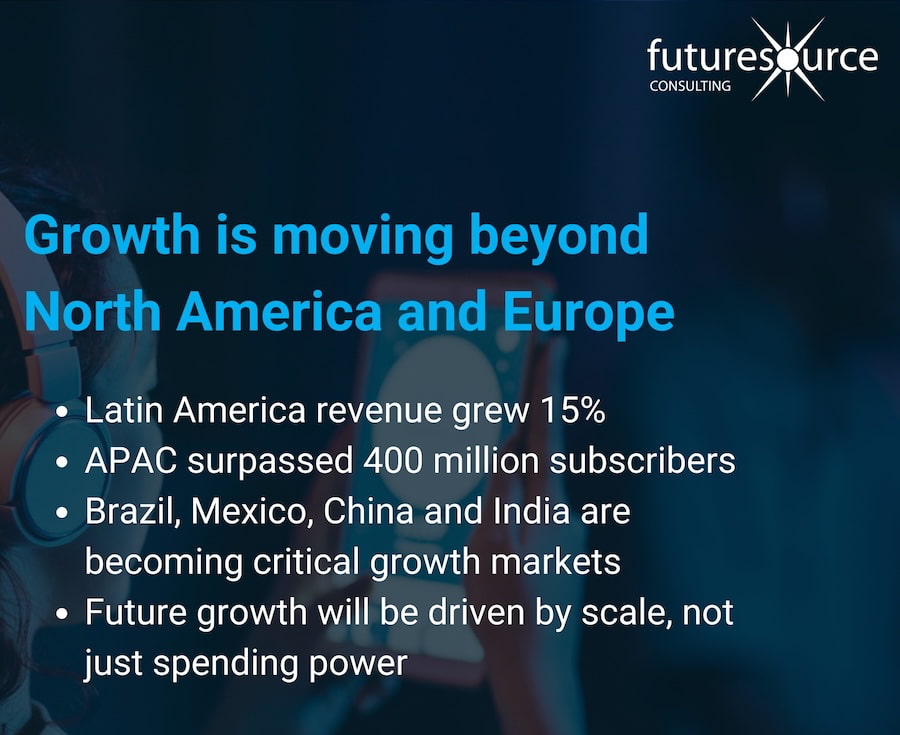
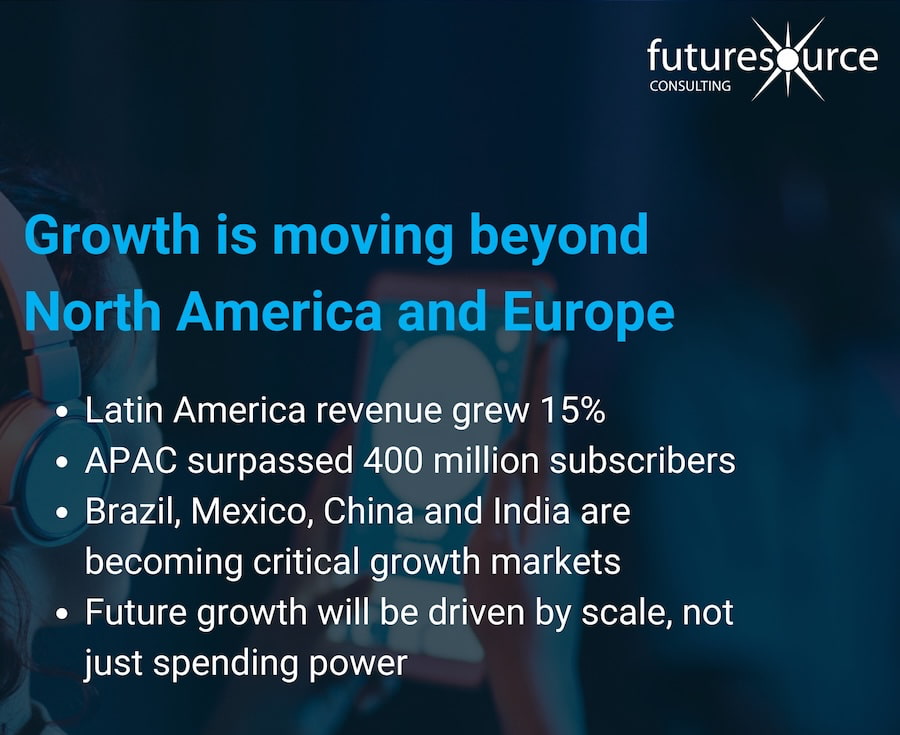
The addition of 71.5 million paid subscriptions during 2025 reflects continued growth in regions where streaming adoption still has considerable room to expand.
Latin American recorded music revenue increased 15%, while the Asia-Pacific region surpassed 400 million paid music subscriptions. China, India, Brazil and Mexico are expected to play increasingly important roles as subscription growth slows across North America and Western Europe.
That slowdown is one reason streaming services are focusing more heavily on higher-priced plans, bundled content, premium features and regular price increases. Most consumers in mature markets who are willing to pay for music streaming already subscribe to at least one service, which means future growth depends increasingly on charging existing users more rather than simply finding new ones.
Spotify, Apple Music, TIDAL, Qobuz, Amazon Music and other platforms have responded with higher monthly prices, additional subscription tiers, audiobooks, music videos, artificial-intelligence features and other additions designed to make the increases appear less like increases.
Some of those changes have created real value. Others have mostly improved the number printed on the credit-card statement.
Advertisement
Vinyl Remains the Physical Market’s Economic Engine
Source: Futuresource Consulting
Vinyl continues to generate the largest share of physical music revenue, with global retail spending reaching $3.77 billion in 2025.
That figure is consistent with the broader trend eCoustics has followed throughout 2026. The RIAA reported that U.S. vinyl generated $1.043 billion in wholesale revenue during 2025, with 46.8 million records sold. Revenue increased 9.3%, while unit sales grew 7.9%.
Advertisement. Scroll to continue reading.
It was the format’s 19th consecutive year of growth in the United States, which makes it increasingly difficult to dismiss vinyl as a short-lived revival driven entirely by aging collectors and Record Store Day releases. Fads generally do not survive four presidential administrations, multiple economic downturns, a pandemic and the arrival of $50 single-LP reissues bought by people who already own five other copies.
Vinyl now supports a substantial network of independent retailers, pressing plants, equipment manufacturers, distributors, labels and reissue companies. It has also evolved into something broader than an audio format, combining music ownership with collectibility, artwork, limited editions and physical merchandise.
Advertisement
That explains why buyers continue to spend money on colored vinyl, numbered editions, alternate covers and deluxe box sets, even when the same music is available instantly through a streaming subscription.
CDs Are Showing More Life Than Expected
Source: Luminate
Compact discs remain considerably smaller than vinyl in both revenue and cultural visibility, but the format has shown unexpected momentum during 2026.
Luminate reported that U.S. CD sales increased 16% to 16.3 million units during the first half of the year, while vinyl unit sales grew by only 2.4%. That gave CDs a growth rate almost seven times higher during the period.
K-pop releases contributed significantly through elaborate packaging, photo cards, alternate editions and fans purchasing multiple versions of the same album. However, Luminate found that CD sales would still have increased 6.7% after K-pop titles were removed from the data, suggesting that the improvement was not dependent on one unusually committed group of collectors.
Target, Walmart and other mass-market retailers now account for almost 30% of U.S. physical music sales, another indication that records and CDs are no longer confined to independent stores and specialist websites.
Advertisement
The figures do require some context. Futuresource measures global consumer spending, while the RIAA reports U.S. wholesale revenue net of returns and Luminate tracks retail consumption and unit activity. The numbers describe related trends, but they are not directly interchangeable.
The RIAA still reported that U.S. CD sales declined to 29.5 million units in 2025, with wholesale revenue falling to $312.4 million. Luminate’s stronger first-half results therefore suggest a possible change in direction rather than proof that compact discs have suddenly returned to their late-1990s commercial peak.
Nobody should start rebuilding Tower Records just yet.
Physical formats will remain much smaller than streaming, but the evidence does not support the idea that they are disappearing. Vinyl is a multibillion-dollar global business with nearly two decades of sustained U.S. growth, CD sales are showing renewed momentum in 2026, and manufacturers at both ends of the market continue introducing new players and transports.
Advertisement
Esoteric and Luxman still serve buyers who want disc playback treated as a precision instrument, while Denon, Yamaha, NAD, Audiolab, Mission, Quad, Topping and FiiO continue to develop products at more accessible prices. This is not an industry maintaining a format on life support; it is one still investing in it.
Advertisement. Scroll to continue reading.
The turntable market is even more remarkable. There have not been this many new models available in at least 30 years, with hundreds of options from Rega, Pro-Ject, Thorens, Kuzma, VPI, Vertere, Linn, Luxman and far too many others to list without turning this article into a dealer catalog. Entry-level decks, premium belt-drive designs, direct-drive models, automatic turntables and statement products all continue to arrive because demand remains real.
Interest in physical music has not been this strong in a very long time. Listeners understand that well-mastered records and CDs can sound better than compressed or compromised streams, but sound quality is only part of the appeal. Physical media provides ownership, permanence and a sense of community among listeners, collectors, retailers and artists that no monthly subscription can reproduce.
Advertisement
There will never be a Streaming Store Day. Nobody is lining up outside at 6 a.m. to celebrate a licensing agreement that can disappear before lunch.
The music business often treats streaming and physical media as opposing formats, but consumers increasingly use them for different reasons.
Streaming provides access, convenience and discovery. It allows listeners to explore enormous catalogs, move between devices and hear new releases immediately without committing to a purchase.
Physical media provides ownership and permanence. A record or CD cannot disappear because a licensing agreement expired, an artist changed distributors or a streaming platform removed a specific version from a regional catalog.
Advertisement
CDs also provide an inexpensive route to creating lossless local files, while vinyl offers artwork, presentation and a physical connection to an album that streaming cannot reproduce. For many listeners, the most practical approach is to stream broadly and purchase selectively.
That is not a contradiction. It may be the most rational way to consume music in 2026: use streaming to discover, buy the albums that matter, rip the CDs and retain a library that does not depend on a monthly subscription or somebody else’s licensing agreement.
The cloud is convenient. It is not ownership.
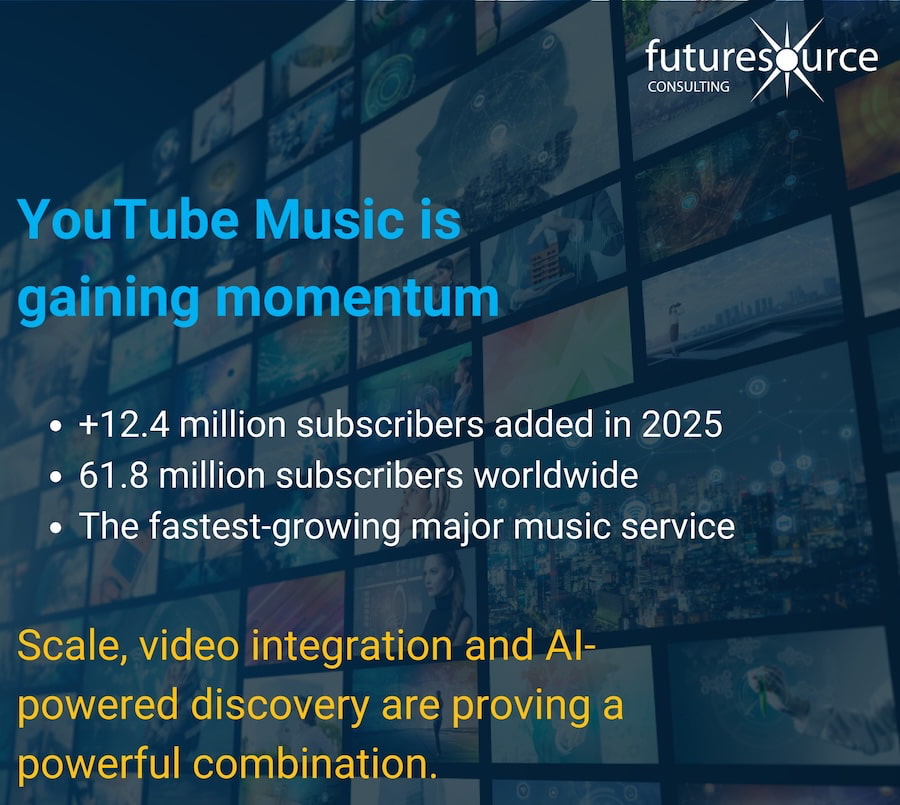
AI Will Influence Where the Next Billions Go
Source: Futuresource Consulting
Futuresource also identifies artificial intelligence as one of the major forces shaping the music business.
Streaming platforms are using AI for recommendations, playlists, search and engagement, while labels and rights holders explore licensing and content-management agreements. Services are also being forced to address the rapid growth of fully synthetic music and determine whether AI-generated recordings should compete directly with human artists for recommendations and royalty payments.
Advertisement
Deezer has taken one of the clearest positions by identifying fully AI-generated tracks and removing them from algorithmic recommendations. Other services are still developing their policies, even as synthetic content continues to increase.
Advertisement. Scroll to continue reading.
The issue will become more significant as streaming controls a larger share of global music spending. Platforms do not merely deliver music; they influence what listeners discover, which artists receive exposure and how revenue is distributed.
There is a great deal of money attached to those decisions, which usually means the ethical discussion will continue immediately after the commercial agreements have been signed.
Advertisement
The Bottom Line
Global paid music subscriptions reached 865 million in 2025, while streaming captured 86% of recorded music spending and pushed the market to $47.1 billion. By 2030, that share could approach 90%, driven by higher prices, premium tiers, expansion in developing markets and the increasingly unavoidable arrival of AI inside every service.
Those numbers confirm that streaming has won the battle for access. It is fast, convenient and almost impossible to avoid. What it does not provide is ownership, permanence or any guarantee that the version of an album you love will still be available next year, in the same country, under the same licensing agreement.
Physical media remains much smaller, but it offers something streaming cannot: control. A record or CD belongs to the buyer, can be played without permission from a platform and often sounds better when the mastering is superior.
That combination of sound quality, ownership and community is why records and CDs continue to matter, even as streaming absorbs most of the money. The industry may prefer recurring monthly payments, but listeners still understand the difference between having access to music and actually owning it.
Advertisement
The industry appears perfectly willing to charge people for both, and a growing number of listeners appear willing to pay.
IC3 says any account claiming to represent it is fake
Real FBI agents won’t slide into your DMs and offer to help you recover stolen funds. The bureau’s Internet Crime Complaint Center (IC3) updated an earlier warning on Monday about scammers impersonating the agency online, saying fraudsters continue to use the scheme “to deceive and revictimize individuals.”
According to IC3, there are two different schemes being used to target cybercrime victims, both directly and by soliciting them to report incidents.
Advertisement
In the first scheme, IC3 said scammers create fraudulent social media profiles and pages impersonating FBI personnel or IC3. They may also infiltrate online groups for fraud victims or contact victims directly while claiming to represent the FBI or the complaint center.
In other cases, victims are being contacted by someone claiming to be an FBI agent after realizing they were approached by someone trying to scam them and saying they intended to report the incident to the FBI or file an IC3 complaint. The FBI said the impersonator then directs victims to a fake IC3 update page or continues communicating through messaging apps.
In the other instance, scammers are creating AI-generated videos on social media depicting senior FBI officials and directing users to a spoofed IC3 website to report cybercrimes they may have fallen victim to, with the scammers then collecting the information and using it to contact victims for further fraud. AI-generated depictions of public figures are similarly being used to make such scams appear legitimate.
“Some individuals received an email or a phone call, while others were approached, or observed an advertisement via social media or forums,” the IC3 said. “Almost all complainants indicated the scammers claimed to have recovered the victim’s lost funds or offered to assist in recovering funds.”
Advertisement
Regardless of how legitimate social media profiles look, or how realistic those AI-generated videos may be, the IC3 is warning that none of them should be believed for a simple reason: The IC3 doesn’t have a social media presence of any kind, and it doesn’t investigate crimes or offer to recover lost funds through social media.
“Any social media profiles or pages claiming to represent IC3 or offering to recover lost money are fraudulent and are actively attempting to steal your personal or financial information,” the IC3 warned. “IC3 will never directly communicate with individuals via phone, email, social media, phone apps, online chat, or public forums.”
The IC3 said that any contact made with a cybercrime victim who reports an incident via its actual website will be made by an FBI employee from a local field office or other law enforcement official.
Here’s another hot tip: If you fall victim to a cybercrime or online scam, don’t post about it on social media – that’s only going to invite someone with bad intentions to seek you out. ®
A new NYT Strands puzzle appears at midnight each day for your time zone – which means that some people are always playing ‘today’s game’ while others are playing ‘yesterday’s’. If you’re looking for Monday’s puzzle instead then click here: NYT Strands hints and answers for Monday, July 20 (game #869).
Strands is the NYT’s latest word game after the likes of Wordle, Spelling Bee and Connections – and it’s great fun. It can be difficult, though, so read on for my Strands hints.
Want more word-based fun? Then check out my NYT Connections today and Quordle today pages for hints and answers for those games, and Marc’s Wordle today page for the original viral word game.
Advertisement
SPOILER WARNING: Information about NYT Strands today is below, so don’t read on if you don’t want to know the answers.
Latest Videos From
NYT Strands today (game #870) – hint #1 – today’s theme
What is the theme of today’s NYT Strands?
• Today’s NYT Strands theme is… Write there
Advertisement
NYT Strands today (game #870) – hint #2 – clue words
Play any of these words to unlock the in-game hints system.
SLAY
HEEL
TRADE
LIFT
SHARD
CASHED
NYT Strands today (game #870) – hint #3 – spangram letters
How many letters are in today’s spangram?
• Spangram has 10 letters
NYT Strands today (game #870) – hint #4 – spangram position
What are two sides of the board that today’s spangram touches?
• First side: left, 4th row
Advertisement
• Last side: right, 5th row
Right, the answers are below, so DO NOT SCROLL ANY FURTHER IF YOU DON’T WANT TO SEE THEM.
Advertisement
NYT Strands today (game #870) – the answers
(Image credit: New York Times)
The answers to today’s Strands, game #870, are…
ENVELOPE
LETTERHEAD
SHEET
CARD
FILE
NOTEPAD
SPANGRAM: STATIONERY
My rating: Easy
My score: Perfect
The act of writing a letter and sending it to someone in the post has become not just a form of communication from a former time, but also an expensive one.
Sign up for breaking news, reviews, opinion, top tech deals, and more.
Advertisement
Organized postal networks date back to Ancient Egypt, while in the UK King Henry VIII founded the Royal Mail in 1516. Today, though, they are not so interested in delivering simple letters and have rebranded their business to compete with parcel delivery companies.
It was with nostalgia, then, that I collected ENVELOPE and LETTERHEAD as I pondered the last time I had used some actual STATIONERY.
Advertisement
Yesterday’s NYT Strands answers (Monday, July 20, game #869)
TINY
LITTLE
MICROSCOPIC
MINIATURE
MINUSCULE
SPANGRAM: ITSYBITSY
What is NYT Strands?
Strands is the NYT’s not-so-new-any-more word game, following Wordle and Connections. It’s now a fully fledged member of the NYT’s games stable that has been running for a year and which can be played on the NYT Games site on desktop or mobile.
I’ve got a full guide to how to play NYT Strands, complete with tips for solving it, so check that out if you’re struggling to beat it each day.
If you use WordPress, patch now. Just hours after fixes came out, attackers have begun exploiting two bugs that, when chained together, allow pre-authentication remote code execution (RCE). And security researchers tell us there’s a very good chance the miscreants had an AI assist.
“Once the vulnerabilities were publicly disclosed, reproducing them with the help of frontier AI models was only a matter of time and tokens,” Jake Knott, watchTowr principal security researcher, told The Register. “WatchTowr was able to trivially reproduce CVE-2026-63030 within minutes of disclosure, and the second CVE-2026-60137 with some additional effort.”
Advertisement
WordPress released patches for both CVEs late Friday, but by Saturday it was game over.
“By the early hours of Saturday morning, successful exploitation was already well underway, initially using public exploit code to exfiltrate hashed credentials, with remote code execution following once additional details were made public,” Knott said. “From our vantage point across a global client base, we are seeing widespread impact of this vulnerability across organizations of every size and every vertical.”
Here are the details about both security holes, and what went down since WordPress revealed and fixed them on Friday.
CVE-2026-60137 is a moderate-severity SQL injection issue, and CVE-2026-63030 is a critical REST API batch-route confusion bug.
Advertisement
“A route confusion flaw causes the arrays containing the sub-requests, validation results, and matched handlers to become misaligned,” Hacktron researchers explained. This causes WordPress to become confused about which requests have been properly validated and thus treat all requests as trusted, including those that it should block.
Individually, the bugs are difficult to exploit. But when chained together, they can wreak havoc on any organization using a vulnerable WordPress version because they allow unauthenticated RCE.
WordPress 6.9 is affected by both vulnerabilities, and version 6.9.5 contains fixes for both, while WordPress 6.8 is only affected by the SQL injection flaw, and version 6.8.6 fixes it.
Additionally, WordPress 7.1 Beta 1 is also vulnerable. Version 7.1 Beta 2 fixes both CVEs.
Advertisement
Versions of WordPress prior to 6.8 are not affected.
John Blackbourn, one of the WordPress core developers, recommended affected users “update your sites immediately.” Because of the flaws’ severity, the WordPress security team “enabled forced updates via the auto-update system for sites running affected versions,” he added.
The content management system credited Searchlight Cyber researcher Adam Kues with finding and reporting CVE-2026-63030, and in a subsequent Friday advisory, Kues dubbed the bug wp2shell.
“The attack has no preconditions and can be exploited by an anonymous user in a stock install of WordPress with no plugins,” Kues said, adding that his security shop released a free wp2shell checker to determine if your instance is vulnerable.
Advertisement
Security firm PatchStack reported exploitation of both CVEs as of Friday night, but didn’t provide details about the attacks.
“After public exploit code was released, attackers began spraying the internet indiscriminately, hitting anything reachable and trying to get lucky,” Knott told us. “Our honeypots recorded tens of thousands of exploitation attempts, and more than 100 backdoor accounts created by different threat actors using variations of public tooling.”
After creating these backdoor admin accounts, watchTowr observed attackers deploying fake WordPress plugins to achieve RCE, exfiltrate credentials or secrets, or download additional tooling to further compromise the system, he added. “In one case, we watched a threat actor repeatedly attempt to pull down Overlord RAT, a Golang-based remote access trojan.”
Advertisement
Any orgs that waited until Monday to patch are likely already compromised, Knott warned. “Defenders need to inspect their WordPress instances for new administrator accounts, malicious plugins, or other suspicious files, regardless of whether they’ve patched,” he said.®
Apple users are becoming even less likely to switch away from the iPhone. According to new research, the company’s customer loyalty has reached its highest level in years.
This is up from 84% during the same period last year. At the same time, the number of Android users moving to Apple’s platform has continued to shrink.
According to CIRP’s survey, just 12% of new iPhone buyers switched from Android during the March quarter. This is down from 14% a year earlier. The remaining 1% came from feature phones, other smartphone platforms or were buying their first smartphone.
Advertisement
The figures suggest that the battle between iPhone and Android is more about keeping existing ones. CIRP notes that Android switchers have consistently accounted for between 11% and 15% of new iPhone buyers in recent years. This is a much narrower range than during the iPhone’s early growth. At that time, Apple was expanding to more carriers and attracting first-time converts in larger numbers.
Advertisement
That trend also reflects a maturing smartphone market. Most buyers have already settled into one ecosystem and are less inclined to change platforms when upgrading.
One product that could help is the long-rumoured foldable iPhone. Apple is widely expected to enter the foldable market in the near future. This could potentially appeal to buyers who have already embraced foldable devices from Samsung, Google and other Android manufacturers.
Advertisement
Smartphone owners appear increasingly loyal to the platform they’ve already chosen, with relatively few switching sides each year. As new AI features and fresh hardware arrive, the competition may become less about converting users and more about giving them fewer reasons to leave.
“Cards are basically a commodity at the end of the day; how you differentiate them is really what makes the difference,” Riley says. “That’s really the big deal here—how you use your card.” Riley has a card for grocery shopping and one for Amazon transactions; all of these steps help him earn the most points.
“One of the big challenges here on rewards is that quite often, you go in well-intentioned and you don’t get the full benefit of the rewards because you start revolving on the product,” Riley says, meaning cardmembers start accumulating interest on the unpaid balance, with interest charges wiping out the value earned by the rewards.
Riley points to one of the failings of the Apple Card: Apple oversold it. It’s slick, yes, but it never became a mainstream challenger to the credit card industry because the average consumer typically has three or four cards per household: one for all of their purchases, one for emergencies, and one that might focus on travel.
Sara Rathner, a credit card expert at NerdWallet, echoed that sentiment. “The Apple Card is far from the iPhone in terms of changing the world,” Rathner says. “It’s fine; it’s a cash-back card.” All of these cards exist to create brand loyalty, she says. If you have a lot of points with Hyatt, you’re more likely to book a stay at a Hyatt property on your next trip. If you make many purchases with Samsung Wallet, that might incentivize you to get the Galaxy Card.
Advertisement
Rathner says the 3 percent cash reward for purchases using the Samsung Wallet app is a really good rate. If you tap-to-pay at New York City’s subway turnstile with Samsung Wallet on your phone, for example, that’s 3 percent on every commute, and “that would be compelling.”
While Rathner finds the Apple Card underwhelming, she does credit Apple with innovating on certain features. For example, Apple allows you to see the interest rate and credit rate you would qualify for before a credit pull, something other credit cards are increasingly offering. The app (and card) have a beautiful design, the physical card is easy to activate with just a tap on the iPhone, and cash rewards are posted daily rather than waiting for a billing cycle.
“I think if other cards want to compete in that way and also follow suit with those features, I think that just makes credit cards in general better products for consumers,” Rathner says. “We’ll see how this resonates with people who have Samsung phones.”



























































You must be logged in to post a comment Login