NewsBeat
Iran-US war latest: Yemen’s Tehran-backed Houthi rebels launch first missile attack on Israel since war began

Yemen’s Iran-aligned Houthis have launched missiles at Israel in their first attack since the current Middle East conflict broke out.
The Houthis, whose involvement on Saturday risks broadening and prolonging a war that has entered its fifth week, warned their operations would continue until the “aggression” on all fronts ended. Israel said it had intercepted a missile from Yemen.
Experts have warned the rebel group may attempt to block the Bab al-Mandab Strait south of Yemen, further disrupting shipping lanes around the Red Sea.
The escalation comes after US Secretary of State Marco Rubio’s latest update on the war suggested the conflict would last “weeks, not months” and Iran had indicated a willingness to talk about “certain things”.
Meanwhile, the Islamic Revolutionary Guard Corps has closed the Strait of Hormuz,adding that any transit through the waterway will face “harsh measures”, according to state media.
Rubio raised concerns that Iran could operate the strait using a tolling system if their control over the waterway persisted.
He also said that he believed the US could achieve its goals in Iran without ground troops, despite reports from theDonald Trump is considering sending another 10,000 troops to the Middle East.
In Photos: In Pictures: Israel hits Beirut’s southern suburbs

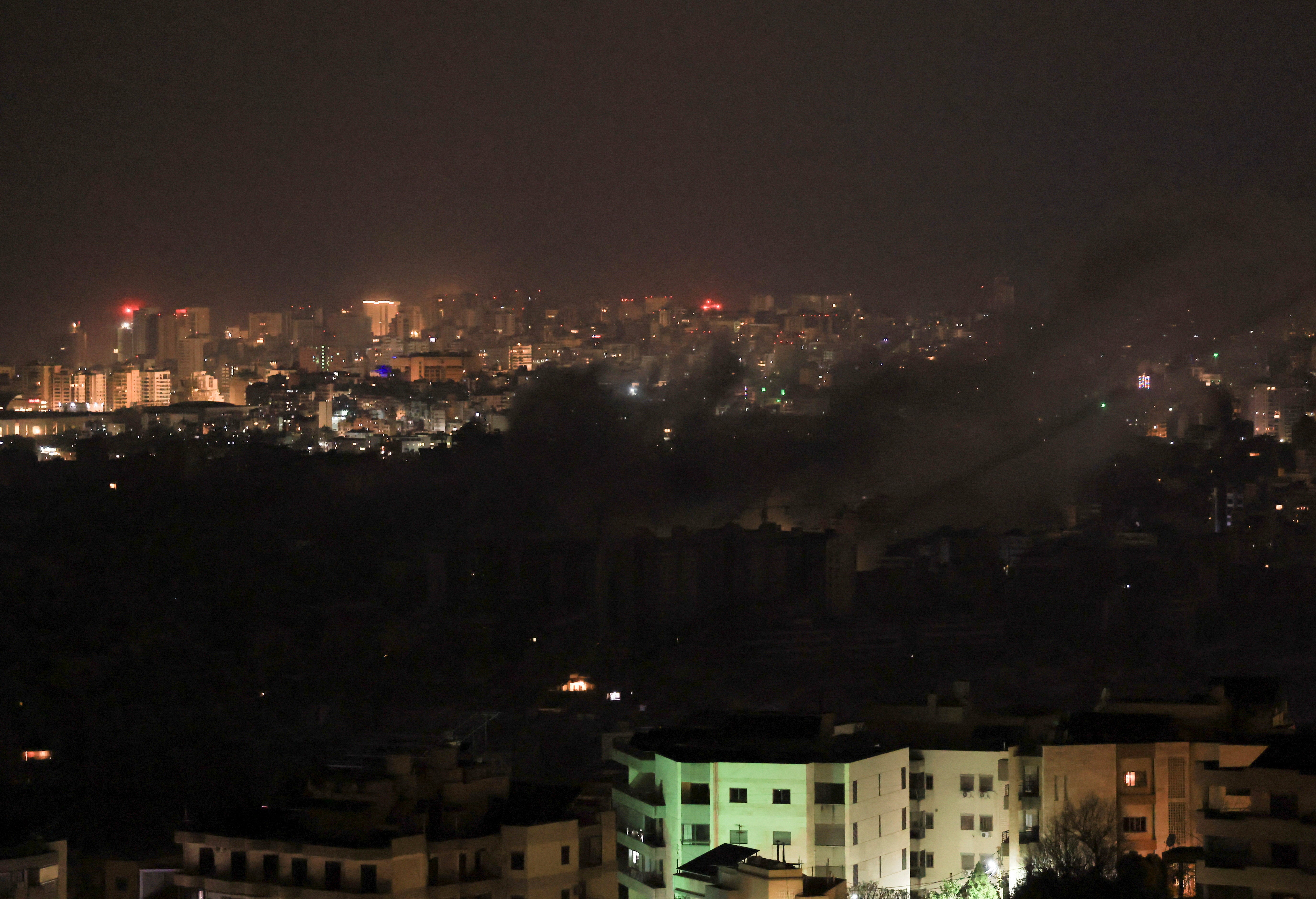




Vishwam Sankaran28 March 2026 10:15
Tehran threatens to retaliate with ‘decisive and crushing’ response if infrastructure targeted
Iran’s president Masoud Pezeshkian has threatened to deliver a “decisive and crushing response” if Tehran’s key infrastructure and economic centres are targeted by the US and Israel.
“We have repeatedly stated that Iran does not carry out preemptive attacks, but in response to attacks on infrastructure and economic centers, we will deliver a decisive and crushing response to the aggressor enemy,” Pezeshkian wrote on X on Saturday.
“To the countries of the region, I say: if you seek development and security, do not allow our common enemies to orchestrate the war from your territories.”


Maira Butt28 March 2026 10:02
Who are the Houthi rebels? And why experts are worried their involvement will be worse for shipping chaos
The Houthis, formed in the late 1990s, developed as political-religious Shia movement and launched a series of guerrilla wars against Yemen’s national army upon conception.
The rebels have developed an arsenal including ballistic missiles and armed drones capable of hitting Israel more than 1,000 miles from Sana’a.
In 2024, the rebel group launched its first sustained attacks on ships passing through the Red Sea claiming it was in retaliation for Israel’s attacks on Gaza. The onslaught disrupted global trade by striking the Bab al-Mandeb Strait, which is a narrow strip of sea between Yemen and east Africa that is a key international trade route.
Experts say the Houthis, along with Gaza’s Hamas and Lebanon’s Hezbollah, form part of Iran’s “axis of resistance” – a military alliance built over four decades to oppose Israeli and American power in the Middle East.
Maira Butt28 March 2026 09:45
Explosions and sirens heard across Israel as Houthis enter the fray
Israel’s military said it intercepted a missile launched from Yemen toward Israel early Saturday and the Iranian-backed Houthi rebels later claimed responsibility for the attack, their first since the war in the Mideast started.
Brigadier General Yahya Saree, a military spokesperson for the Houthis, claimed responsibility in a statement aired Saturday morning on the rebels’ Al-Masirah satellite television.
The possible entry to the war of the Houthis calls into question whether the group will again target commercial shipping traveling through the Red Sea corridor.
Sirens went off around Beer Sheba and the area near Israel’s main nuclear research center for the third time overnight Friday into Saturday as Iran and Hezbollah continued to fire on Israel overnight.
Loud explosions also filled the air in Tel Aviv and Israel’s Fire and Rescue Service said it was responding to 11 different impact sites across the metro area.


Maira Butt28 March 2026 09:31
FBI confirms Kash Patel photos were leaked by Iran-linked hackers
An FBI spokesperson confirmed that the agency chief Kash Patel’s email was hacked by the Iran-linked Handala Hack Team.
The group published dozens of emails and photographs on Friday that they said were taken from a personal inbox belonging to Patel.
“We have taken all necessary steps to mitigate potential risks associated with this activity,” FBI spokesperson Ben Williamson said today.
The data accessed by the hackers were “historical in nature and involves no government information”, Williamson said.
Vishwam Sankaran28 March 2026 09:10
How war disrupts semiconductor production
Iranain strikes have forced the shutdown of Qatar’s production of helium, which is critical to semiconductor manufacture.
“The shutdown of Qatar helium production due to the US-Iran military conflict has removed roughly a third of global helium supply and shifted the market from oversupplied to undersupplied,” Deutsche Bank analysts said earlier this month.
Experts warn that a drawn-out war could forced chip makers to seek alternate sources and supply routes.
Russia, which is the world’s third largest helium supplier could gain from this disruption.
“If Qatari disruptions persist, Russia is well placed to further expand its role in China’s helium supply mix,” Center on Global Energy Policy researcher Erica Downs wrote in a blog post.
Vishwam Sankaran28 March 2026 08:51
Kuwait international airport suffers ‘significant’ radar system damage after drone attacks
Kuwait International Airport was targeted by multiple drone attacks that caused significant damage to its radar system but resulted in no casualties, state news agency KUNA said on Saturday, citing the country’s Civil Aviation Authority.
Tara Cobham28 March 2026 08:45
India prepares for internet disruptions as war threatens key subsea cables
India’s telecom department convened a meeting yesterday to draw up contingency plans as the Iran war threatens critical subsea cable routes which could put India–Europe connectivity at risk.
Telecom companies have reportedly sought the Indian government support to engage with Iran to safeguard subsea cable infrastructure.
Experts warn that the Red Sea and Strait of Hormuz are key risk zones for international data flows via undersea cables where disruptions could take months to repair.
“While a complete internet blackout is unlikely, India remains exposed to congestion and performance issues due to its reliance on limited routes and landing points,” Amajit Gupta, chief of cloud connectivity services provider Lightstorm, told Moneycontrol.
“Strengthening resilience will require diversifying cable landings, expanding eastward connectivity, and building domestic repair capabilities with policy support,” Gupta said.
Vishwam Sankaran28 March 2026 08:30
FAO chief economist warns of severe global food security risks
The chief economist of the Food and Agriculture Organization warned that the disruption to the Strait of Hormuz due to the ongoing war in the middle east is a “systematic shock affecting agrifood systems globally”.
The region accounts for nearly half of the global sulphur trade, necessary to produce fertilisers for crops.
FAO chief economist Máximo Torero warned that disruptions to Sulphur supply are already translating into higher costs for farmers worldwide.
“Farmers are facing a dual cost shock: they have more expensive fertilizers alongside rising fuel costs affecting the entire agricultural value chain, including irrigation and transport,” Torero said.
Vishwam Sankaran28 March 2026 08:10
You must be logged in to post a comment Login