




Connect with us
DAPA Banner

NewsBeat

Iran-US war latest: Yemen’s Tehran-backed Houthi rebels launch first missile attack on Israel since war began

Published

on

Iran-US war latest: Yemen’s Tehran-backed Houthi rebels launch first missile attack on Israel since war began
‘Iran is talking’: Trump, claims ‘defeated’ regime facing internal ‘disaster’

Yemen’s Iran-aligned Houthis have launched missiles at Israel in their first attack since the current Middle East conflict broke out.

The Houthis, whose involvement on Saturday risks broadening and prolonging a war that has entered its fifth week, warned their operations would continue until the “aggression” on all fronts ended. Israel said it had ⁠intercepted a missile from Yemen.

Experts have warned the rebel group may attempt to block the Bab al-Mandab Strait south of Yemen, further disrupting shipping lanes around the Red Sea.

The escalation comes after US Secretary of State Marco Rubio’s latest update on the war suggested the conflict would last “weeks, not months” and Iran had indicated a willingness to talk about “certain things”.

Advertisement

Meanwhile, the Islamic Revolutionary Guard Corps has closed the Strait of Hormuz,adding that any transit through the waterway will face “harsh measures”, according to state media.

Rubio raised concerns that Iran could operate the strait using a tolling system if their control over the waterway persisted.

He also said that he believed the US could achieve its goals in Iran without ground troops, despite reports from theDonald Trump is considering sending another 10,000 troops to the Middle East.

Advertisement

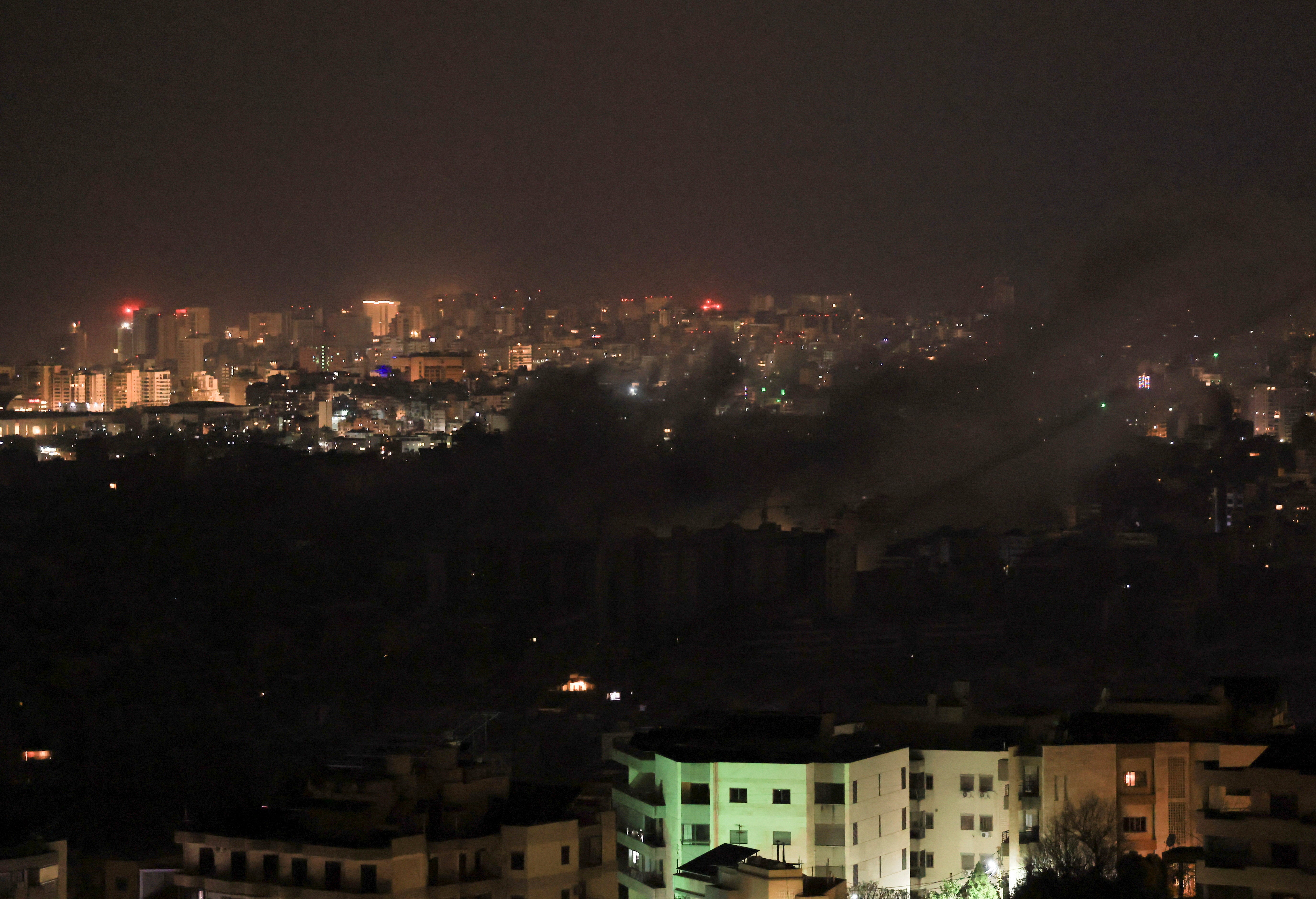
In Photos: In Pictures: Israel hits Beirut’s southern suburbs

Smoke rises after a reported Israeli airstrike, amid escalating hostilities between Israel and Hezbollah, as the US-Israeli conflict with Iran continues, in the southern suburbs of Beirut
Smoke rises after a reported Israeli airstrike, amid escalating hostilities between Israel and Hezbollah, as the US-Israeli conflict with Iran continues, in the southern suburbs of Beirut (REUTERS)
The moon illuminates the sky above Beirut's southern suburbs, amid escalating hostilities between Israel and Hezbollah, as the US-Israeli conflict with Iran continues, in Lebanon
The moon illuminates the sky above Beirut’s southern suburbs, amid escalating hostilities between Israel and Hezbollah, as the US-Israeli conflict with Iran continues, in Lebanon (REUTERS)
Smoke and fog after reported Israeli airstrikes, amid escalating hostilities between Israel and Hezbollah, as the US-Israeli conflict with Iran continues, in the southern suburbs of Beirut
Smoke and fog after reported Israeli airstrikes, amid escalating hostilities between Israel and Hezbollah, as the US-Israeli conflict with Iran continues, in the southern suburbs of Beirut (REUTERS)

Vishwam Sankaran28 March 2026 10:15

Tehran threatens to retaliate with ‘decisive and crushing’ response if infrastructure targeted

Iran’s president Masoud Pezeshkian has threatened to deliver a “decisive and crushing response” if Tehran’s key infrastructure and economic centres are targeted by the US and Israel.

“We have repeatedly stated that Iran does not carry out preemptive attacks, but in response to attacks on infrastructure and economic centers, we will deliver a decisive and crushing response to the aggressor enemy,” Pezeshkian wrote on X on Saturday.

“To the countries of the region, I say: if you seek development and security, do not allow our common enemies to orchestrate the war from your territories.”

Advertisement
China SCO Parade Guests

Maira Butt28 March 2026 10:02

Who are the Houthi rebels? And why experts are worried their involvement will be worse for shipping chaos

The Houthis, formed in the late 1990s, developed as political-religious Shia movement and launched a series of guerrilla wars against Yemen’s national army upon conception.

The rebels have developed an arsenal including ballistic missiles and armed drones capable of hitting Israel more than 1,000 miles from Sana’a.

In 2024, the rebel group launched its first sustained attacks on ships passing through the Red Sea claiming it was in retaliation for Israel’s attacks on Gaza. The onslaught disrupted global trade by striking the Bab al-Mandeb Strait, which is a narrow strip of sea between Yemen and east Africa that is a key international trade route.

Advertisement

Experts say the Houthis, along with Gaza’s Hamas and Lebanon’s Hezbollah, form part of Iran’s “axis of resistance” – a military alliance built over four decades to oppose Israeli and American power in the Middle East.

Maira Butt28 March 2026 09:45

Explosions and sirens heard across Israel as Houthis enter the fray

Israel’s military said it intercepted a missile launched from Yemen toward Israel early Saturday and the Iranian-backed Houthi rebels later claimed responsibility for the attack, their first since the war in the Mideast started.

Advertisement

Brigadier General Yahya Saree, a military spokesperson for the Houthis, claimed responsibility in a statement aired Saturday morning on the rebels’ Al-Masirah satellite television.

The possible entry to the war of the Houthis calls into question whether the group will again target commercial shipping traveling through the Red Sea corridor.

Sirens went off around Beer Sheba and the area near Israel’s main nuclear research center for the third time overnight Friday into Saturday as Iran and Hezbollah continued to fire on Israel overnight.

Loud explosions also filled the air in Tel Aviv and Israel’s Fire and Rescue Service said it was responding to 11 different impact sites across the metro area.

Advertisement
(Houthi Media Wing)

Maira Butt28 March 2026 09:31

FBI confirms Kash Patel photos were leaked by Iran-linked hackers

An FBI spokesperson confirmed that the agency chief Kash Patel’s email was hacked by the Iran-linked Handala Hack Team.

The group published dozens of emails and photographs on Friday that they said were taken from a personal inbox belonging to Patel.

“We have taken all necessary steps to mitigate potential risks associated with this activity,” FBI spokesperson Ben Williamson said today.

Advertisement

The data accessed by the hackers were “historical in nature and involves no government information”, Williamson said.

Vishwam Sankaran28 March 2026 09:10

How war disrupts semiconductor production

Iranain strikes have forced the shutdown of Qatar’s production of helium, which is critical to semiconductor manufacture.

Advertisement

“The shutdown of Qatar helium production due to the US-Iran military conflict has removed roughly a third of global helium supply and shifted the market from oversupplied to undersupplied,” Deutsche Bank analysts said earlier this month.

Experts warn that a drawn-out war could forced chip makers to seek alternate sources and supply routes.

Russia, which is the world’s third largest helium supplier could gain from this disruption.

“If Qatari disruptions persist, Russia is well placed to further expand its role in China’s helium supply mix,” Center on Global Energy Policy researcher Erica Downs wrote in a blog post.

Advertisement

Vishwam Sankaran28 March 2026 08:51

Kuwait international airport suffers ‘significant’ radar system damage after drone attacks

Kuwait International Airport was targeted ⁠by multiple drone attacks ⁠that ​caused ⁠significant damage ⁠to its ​radar ⁠system ‌but resulted in no ‌casualties, state news ‌agency KUNA ⁠said on Saturday, citing the country’s Civil Aviation ‌Authority.

Tara Cobham28 March 2026 08:45

Advertisement

India prepares for internet disruptions as war threatens key subsea cables

India’s telecom department convened a meeting yesterday to draw up contingency plans as the Iran war threatens critical subsea cable routes which could put India–Europe connectivity at risk.

Telecom companies have reportedly sought the Indian government support to engage with Iran to safeguard subsea cable infrastructure.

Experts warn that the Red Sea and Strait of Hormuz are key risk zones for international data flows via undersea cables where disruptions could take months to repair.

Advertisement

“While a complete internet blackout is unlikely, India remains exposed to congestion and performance issues due to its reliance on limited routes and landing points,” Amajit Gupta, chief of cloud connectivity services provider Lightstorm, told Moneycontrol.

“Strengthening resilience will require diversifying cable landings, expanding eastward connectivity, and building domestic repair capabilities with policy support,” Gupta said.

Vishwam Sankaran28 March 2026 08:30

Advertisement

FAO chief economist warns of severe global food security risks

The chief economist of the Food and Agriculture Organization warned that the disruption to the Strait of Hormuz due to the ongoing war in the middle east is a “systematic shock affecting agrifood systems globally”.

The region accounts for nearly half of the global sulphur trade, necessary to produce fertilisers for crops.

FAO chief economist Máximo Torero warned that disruptions to Sulphur supply are already translating into higher costs for farmers worldwide.

“Farmers are facing a dual cost shock: they have more expensive fertilizers alongside rising fuel costs affecting the entire agricultural value chain, including irrigation and transport,” Torero said.

Advertisement

Vishwam Sankaran28 March 2026 08:10

Video: UN warns Somalia ‘on the edge’ as war deepens aid crisis

UNICEF warn Somali children are ‘on the edge’ as Iran war worsens aid crisis

Vishwam Sankaran28 March 2026 07:50

Source link

Advertisement
Continue Reading
Click to comment

You must be logged in to post a comment Login

Leave a Reply

NewsBeat

UK government recommends maximum one hour of screen time for younger children: what the evidence says

Published

on

UK government recommends maximum one hour of screen time for younger children: what the evidence says

New UK government guidance recommends that screen time for children under two should be avoided, except for shared activities such as video calls. For children aged two to five, a maximum of an hour a day is suggested. The guidance also outlines that watching screens together is better than children viewing alone.

This echoes guidance from the World Health Organization recommending no screen time for infants under two, and no more than one hour per day for older children aged four and under.

The early years, especially from birth to age six, are a critical period for developing social and communication skills. This is when children are learning how to connect with others, communicate their needs and understand the signals people give them. Given the increasing presence of touchscreen technologies in young children’s environments, understanding how these tools influence early developmental trajectories is essential.

Touchscreen technology offers new opportunities for learning and play. But there are also questions about its impact on children’s social development, communication and school readiness. Researchers and health organisations have been working to consider how digital media interacts with children’s development and shapes their early experiences.

Advertisement

Excessive touchscreen use has been associated with delays in expressive language, reduced attention spans, and poorer interactions between parents and children.

Yet the picture is not one-sided. My research with colleagues highlights that early exposure to multi-modal technologies – tools that combine sound, images, touch and movement – can shape children’s social development in both positive and negative ways.

Language skills and collaboration

On the positive side, interactive and engaging uses of technology can foster language development. Studies show that digital platforms encouraging storytelling, role play and collaborative activities can enhance children’s competence in communication.

Touchscreens can also help children to work together on shared tasks. Multi-touch interfaces promote joint problem-solving, turn-taking and dialogue. This can strengthen cooperation and peer relationships.

Advertisement

In classrooms, tablets often become focal points for group activities. Children share knowledge, assist one another and collaborate on projects, which can enhance social interaction skills and confidence.

Touchscreens also create opportunities for social play and communication across distance. Video-communication apps such as Skype and FaceTime allow children to maintain relationships with family and friends, supporting emotional bonds and social connection.

Children can collaborate using screens.
Mkosi Omkhulu/Shutterstock

Creative expression is another area where digital tools can shine. Drawing, animation, and storytelling apps encourage children to share ideas and collaborate. This can promote cooperation and social bonding.

Passive use

However, these benefits coexist with significant challenges. Excessive screen time can reduce opportunities for face-to-face interaction, limiting children’s practice of conversational skills and emotional understanding. When children use screens passively or in isolation, they may become less engaged in socialising with others.

Advertisement

Parents’s use of screens is another concern. When parents are absorbed in their own devices, they talk less with their children. This reduces opportunities for educationally meaningful conversations.

Touchscreen use can also affect communication more directly. Studies show that electronic books may shift parents’ attention toward the device rather than the story, displacing meaningful conversation and reducing the quality of shared reading experiences. Some research suggests that heavy touchscreen use may make it harder for children to pick up social and emotional cues. This may affect their ability to decode social situations.

Importantly, the impact of touchscreen use is shaped by several mediating factors. Children learn more effectively when adults or their classmates model how to use touchscreen devices. As the government guidance states, it’s also better if adults watch screens together with their child, rather than their child watching alone.

Parents’ views and wider culture matter too. In research I carried out with colleagues, we found that cultural perceptions about what makes a good childhood shaped parents’ choices. In Portugal and Norway, strong cultural emphasis on outdoor play, social interaction, and connection with nature led parents to prioritise these activities over touchscreen use.

Advertisement

These cultural expectations influence how parents interpret and regulate young children’s digital practices, showing that attitudes toward technology are closely tied to wider national discourses about childhood. Educational settings further influence this. The way technology is integrated into classrooms can reinforce social behaviour.

These findings have important implications for school readiness. Social communication skills, such as turn-taking, listening, expressing ideas, and understanding others, are foundational for success in early education. Touchscreens can support these skills when used interactively and collaboratively. But when screen use replaces conversation, imaginative play or peer interaction, it may hinder the development of the very abilities children need for school and their social lives.

The evidence suggests that the question is not whether children should use touchscreens, but how. High-quality, interactive, and socially supported digital experiences can enrich development. Passive or excessive use can undermine it.

However, it’s vital to recognise that not all digital content is created equal. The quality and context of technology use can have a significant impact. As digital technologies continue to evolve, ensuring that young children’s screen experiences are balanced, meaningful, and socially engaging will be essential.


Advertisement

Source link

Continue Reading

NewsBeat

Scotland v Japan LIVE: Team news as hosts face tough pre-World Cup friendly at Hampden

Published

on

Scotland v Japan LIVE: Team news as hosts face tough pre-World Cup friendly at Hampden

Scotland v Japan live

Scotland resume their preparations for this summer’s World Cup – and play their first game since qualifying for the tournament – as they host Japan at Hampden in the first of two friendlies this week.

Now Clarke will oversee his final camp before naming his final World Cup squad, with Scotland arranging games against Japan at Hampden and the Ivory Coast at Everton’s Hill Dickinson Stadium on Tuesday.

Advertisement

Scotland have stuck with a settled squad as the countdown to that crucial opening game against Haiti on 14 June begins.

Chris Wilson28 March 2026 14:32

Good afternoon

Hello and welcome to The Independent’s live blog coverage of Scotland’s friendly against Japan this evening.

Advertisement

Steve Clarke’s side play their first game since dramatically sealing World Cup qualification against Denmark in November, and this friendly comes against a talented Japanese side that includes the likes of Take Kubo, Ao Tanaka, Daizen Maeda and Karou Mitoma.

This means it will be a suitable test as Scotland begin to intensify their preparations for the World Cup, and we’ll have all the latest build-up, teams news and updates from Hampden right here.

Chris Wilson28 March 2026 14:28

Source link

Advertisement
Continue Reading

NewsBeat

How to watch Liverpool legends v Dortmund charity match on TV for free?

Published

on

Wales Online
How to watch Liverpool legends v Dortmund charity match on TV for free? | Wales Online