Senior clerics are pushing for Iran’s new supreme leader to be selected within 24 hours (Picture: AFP)
Iran’s temporary leadership council is facing pressure to swiftly appoint a new supreme leader, according to reports.
The nation’s Assembly of Experts could meet within a day to choose the next leader, after former Ayatollah Ali Khamenei, 86 was killed by US-Israeli strikes on Tehran.
One assembly member, Ayatollah Hossein Mozafari, suggested that the clerics would shortly convene.
It is unclear whether the 88-member council would meet in person or online, with some consultations having been conducted remotely.
Advertisement
Since Khamenei’s assassination, Iran has been led by a three-person council comprising of President Masoud Pezeshkian, Chief Justice Gholam-Hossein Mohseni-Eje’i and Ayatollah Alireza Arafi.
It comes as state media quoted Grand Ayatollah Naser Makarem Shirazi saying a new supreme leader would help ‘better organise the country’s affairs’.
Ayatollah Ali Khamenei was supreme leader of Iran since 1989 (Picture: Shutterstock)
Another grand ayatollah, Hossein Nouri Hamedan, urged for the process of selecting a new leader to be accelerated.
Among frontrunners for the top job is the late supreme leader’s son Mojtaba Khamenei.
Advertisement
The younger Khamenei, 56, has a background in Islamic theology and ties to the Islamic Revolutionary Guard Corps (IRGC).
Both his mother, Mansoureh Khojasteh Bagherzadeh and his wife Zahra Adel were reportedly killed in the airstrikes.
His views are considered to be hardline conservative and, despite having never held a formal office, he is thought to be the most influential of Khamenei Sr’s children.
Under the rules of Iran’s constitution, a new supreme leader must be chosen within three months.
Advertisement
A protester holds a photo of the former supreme leader during the ‘Stop The War’ rally against the strikes in central London on Saturday (Picture: Getty Images)
Donald Trump reiterated his demand on Saturday to be involved in the selection of Khamenei’s successor.
However Iran’sUN ambassador Amir-Saeid Iravani insisted the process would be concluded ‘without any foreign interference’.
Pictures of the late Khamenei were held up by protesters at a ‘Stop The War’ march against the strikes on Iran in central London on Saturday.
As the conflict entered its second week, Iran apologised to Gulf neighbours, insisting that no further strikes would be targeted at those countries unless an attack originated from them, while vowing to continue attacks on US and Israeli assets.
While Craig Pawson added 11 minutes on at the London Stadium, allowing the hosts to come from 2-0 down in that period to force extra time and a penalty shootout, Michael Oliver did not add on a single second in the tie at Etihad Stadium.
Social media was awash with supporters asking how Oliver could just ignore the laws of the game and choose to play no added time.
But it is far from unusual in cup games where a match is effectively over.
A couple of years ago Pierluigi Collina, Fifa’s head of referees, was talking about added time and when it might be acceptable to cut it short.
The Italian made a good point. He said in cup ties that have no likelihood whatsoever of the outcome changing, blowing up early can be OK.
But Collina also pointed out that should never be the case in a league game, because goal difference can always be crucial.
Advertisement
Zero added time is not seen very often in England, but Uefa referees are told they can end a match bang on time if there is nothing to be gained by playing on. Oliver is, of course, a Fifa and Uefa referee.
Take a look at a couple of Champions League games last month.
Chelsea‘s tie with Paris St-Germain and Barcelona against Newcastle both had no added time, with the English sides losing by aggregate scores of 8-2 and 8-3 respectively.
Once you look at the stoppages in the West Ham game, you can see the 11 minutes was justifiable.
Advertisement
Three minutes for treatment to Adama Traore and Joe Rodon
Two minutes while the physios came on for Pablo and Jaka Bijol
Three minutes for the penalty after a video assistant referee (VAR) check
One minute while Noah Okafor was checked out for an injury
Plus two substitutes, a couple of VAR checks and other delays.
So while it might have appeared excessive, it was explainable.
“When we are ever in the lead it feels like a crazy amount of time on it,” said Leeds boss Daniel Farke afterwards. “When we are chasing a game it feels like it is only three minutes.
“You have to deal with it and it is up to the officials to decide. I’m used to accepting the officials decisions and I try to not complain about it. It is what it is.”
Despite the SNP having lost the four election campaigns fought while Mr Swinney has been leader – for Westminster in 2001, Holyrood in 2003, the European Parliament in 2004 and the 2024 general election – the First Minister stressed that “obviously I want to go into this election with the objective of winning it”, adding that his party is “in a very strong position to do so”.
Statutory sick pay and parental rules changes are now in place
Alan Jones and Beth Abbit Mancunian Way newsletter editor
00:01, 06 Apr 2026
More than a million workers will get access to statutory sick pay for the first time thanks to new employment rights. New rules on sick pay and parental leave come into force today (April 6).
The TUC said 1.2 million workers – mostly low-paid women – are set to get access to statutory sick pay for the first time. While 8.4 million people will benefit from sick pay paid from the first day of illness.
Previously, workers who earned below a threshold of £125 a week were not eligible for statutory sick pay. The TUC said that before today’s changes, workers had been left with no choice but to go into work when they were ill.
Advertisement
Get MEN Premium now for just £1 HERE – or get involved in our WhatsApp group by clicking HERE. And don’t miss out on our brilliant selection of newsletters HERE.
Tens of thousands of workers will also get access to day one paternity leave under measures in the Employment Rights Act. It means that as well as stronger sick pay, fathers and partners will now have a day-one right to paternity leave – and all parents will gain the day-one right to unpaid parental leave.
The TUC said this first tranche of rights being delivered through the act represented a “landmark day” for workers. Business Secretary Peter Kyle said: “Day-one rights mean exactly that: rights that are there for you from the moment you start a job, and from the moment you get sick.
“Whether you’re a low-paid employee who’s been forced to work while unwell, or a new parent who wants to be there for their family, these changes are for you. We’re delivering the most significant upgrade to workers’ rights in a generation.”
Advertisement
TUC general secretary Paul Nowak said: “After years of campaigning from unions and workers, the first individual rights from the Employment Rights Act are coming into force – and they will change lives up and down the country. Sick pay for all, paid from day one of illness is a huge step forward.
“For too long, low-paid workers – especially women – have missed out on any form of sick pay. Even those who were eligible for statutory sick pay had to wait four days before they could claim it.
“That left many with no choice but to go into work when ill – risking spreading and prolonging their illness. That’s why today’s changes are much needed.”
Advertisement
Abby Jitendra, principal policy adviser at the Joseph Rowntree Foundation, said: “Good jobs give us security and stability. The new rights introduced today extend the security many of us in good jobs enjoy to millions of low-paid workers.
“Workers will no longer pay a penalty for being on a low income and falling sick, with sick pay for all workers from day one. New dads will also have a right to time off to look after their partner and bond with their newborn from their first day at work.
“The changes in the Employment Rights Act bring more workers closer to jobs that they can be proud of, where they truly get out what they put in.”
Petra Wilton, the Chartered Management Institute’s policy director, said: “Managers are not being given the tools they need to fully understand how the rules of the workplace are changing, some of them quite dramatically. This creates a real risk for both employers and employees and could lead to preventable workplace tensions.”
When last seen she was wearing light and dark blue bottoms, a black puffer coat and light coloured trainers
Police in the Newry area are currently searching for a 17-year-old who has been reported as missing.
Advertisement
Officers say Layla Rose Smith has not been seen since 15.30 on Saturday, April 4 2026. When last seen she was wearing light and dark blue bottoms, a black puffer coat and light coloured trainers.
Layla is approximately 5 foot 4 in height with brown shoulder length hair.
Issuing the missing person appeal on Sunday, a PSNI spokesperson said: “If anyone knows where Layla currently is or has any information to pass onto ourselves please contact us on 101 quoting the police reference CC1660 of 4/4/26.”
We are back after Saturday’s goalfest in the FA Cup quarter-finals and this afternoon West Ham take on Leeds United at the London Stadium. It is a draw which raises the question of whether both teams can put their Premier League predicament aside in the hope of a Wembley trip for their fans.
Nuno Espirito Santo’s side come into the match having drawn six of their last eight games in 90 minutes across all competitions. Despite this new-found consistency, a lacklustre performance in their last outing against Aston Villa cost them crucial ground in the relegation battle, with Nottingham Forest moving three points clear with their win at Spurs. At home, West Ham have not lost a game at in the last three months.
Posing as a tricky side to defeat in front of their home crowd, they strive to keep this cup run alive and reach their first FA Cup semi-final since they finished runners-up in 2006. Twenty years on, this competition has been something to savour for the London side this year, despite relegation hanging over them.
Advertisement
Has this relentless cup form reignited West Ham’s optimism and given the squad new belief heading into their final eight games of the season? With a two-week gap following the international break, there’s been plenty of time to park the relegation doubts and focus on today. Nuno has always excelled in the FA Cup reaching the semi-finals twice before with both Nottingham Forest and Wolverhampton Wanderers. You would expect him to utilise this experience in today’s fixture in hopes of continuing West Ham’s unlikely run through the competition.
Meanwhile, Leeds find themselves in a similar sticky situation. Despite having only lost twice in their last nine games, they still face a daunting run with the relegation zone just over their shoulder, four points clear of the drop. Leeds have drawn a blank in their last two games, but they will have 9,000 fans in the away end in east London.
In the Premier League against West Ham, Leeds proved to be the dominant side, victorious in their last encounter. A deeper FA Cup run would do wonders for their campaign and hopefully ease the ever mounting pressure in the league. History looms over them having lost their last three FA Cup quarter-finals, it will demand a mammoth effort to reach their first semi-final in the competition since 1986-87.
Kick-off is at 4.30pm, with line-ups on the way shortly.
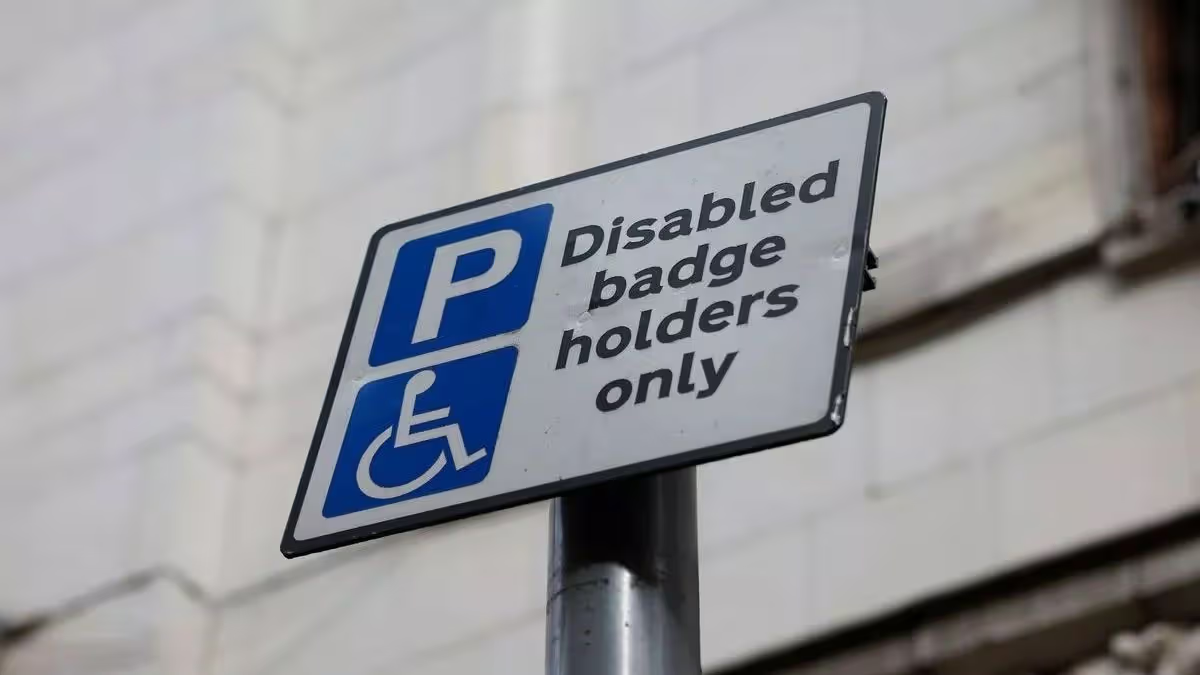
The AA says up to one in five badges may be used by someone other than the holder
A record surge in Blue Badge ownership has sparked urgent calls from motoring experts for a nationwide crackdown on parking permit fraud.
Advertisement
New analysis of Department for Transport data reveals that one in 20 people in England now hold a permit, marking an all-time high of 3.07 million users. While these badges provide a vital lifeline for people with disabilities, the AA warns that as many as one in five permits may be used illegally by people who are not the authorised holders.
The sharp 8% increase in badge holders over the last year is largely driven by a 2019 policy change that expanded eligibility to include non-visible conditions such as dementia, Parkinson’s, and epilepsy.
Get MEN Premium now for just £1 HERE – or get involved in our WhatsApp group by clicking HERE. And don’t miss out on our brilliant selection of newsletters HERE.
Consequently, more than two-fifths of badges issued in the most recent cycle were granted without a formal medical assessment.
Advertisement
Usage varies significantly across the country, with the North East recording the highest proportion of holders at 6.1%, while London maintains the lowest at 3.5%.
Permit holders enjoy significant benefits, including the ability to park for up to three hours on yellow lines and exemptions from the capital’s £18 daily congestion charge.
However, AA President Edmund King expressed deep concern over the rising levels of abuse, citing instances of counterfeit badges, the use of permits belonging to deceased relatives, and the resale of stolen badges.
He said: “The blue badge scheme is a mobility lifeline for millions of legitimate users and their families. Our concern is not the absolute number of badges issued but the estimates that up to one in five badges may be used by someone other than the holder or authorised user.”
Advertisement
Mr King added: “Fraud is an issue which can include family misuse, use after death, counterfeit badges and theft and resale of badges. We would welcome a crackdown on illegitimate use of badges to safeguard the deserving users.”
Local authorities have already begun escalating their enforcement efforts to combat these crimes.
Recent prosecutions in Croydon resulted in offenders paying nearly £6,000 in fines and costs, while councils in Oxfordshire and Gateshead have successfully convicted drivers for using permits belonging to others.
Advertisement
The Local Government Association has urged the public to report suspected misuse, noting that even though some disabilities are not immediately visible, the act of “lazy” or “fraudulent” parking is a criminal offense that deprives those with genuine needs of essential access.
Large plumes of black smoke could be seen billowing from a unit at the height of the fire on the estate in the Tyne Dock area of South Tyneside.
It is understood that the fire broke out at about 4.15pm today.
The fire on Mitre Place, South Shields. (Image: NORTHERN ECHO)
Two engines were seen battling the fire on Mitre Place, South Shields.
In a post on X, the Tyne and Wear Fire and Rescue Service advised residents to keep windows and doors locked and urged people to avoid the area, if possible, while they tackled the fire.
Advertisement
It is understood the fire is being brought under control, but fire personnel are expected to be at the scene for some time.
Trump’s comments over the weekend stand in contrast to several he made last week, including a televised address on 1 April, in which he suggested that the US had already created the conditions necessary for other countries to engage in the Strait. “Take it, protect it, use it for yourselves,” he told allies.
Taylor Little became so badly addicted to her smartphone that she felt she had lost many of her teenage years. “I was literally trapped by addiction at age 12 and lost my teenage years because of it,” she said. Her addiction was to social media, which led to suicide attempts and prolonged depression.
Molly Russell, at just 14, took her own life. Her parents blame the apps on her phone for exposing her to graphic and disturbing content that took control of her mindset.
The proposed response – in Australia, now proposed in the UK and elsewhere – is to ban social media for under-16s. It is an understandable impulse. But there are good reasons to think it won’t work – despite politicians claiming a successful start to the ban.
Advertisement
Teenagers have always found ways around rules. Getting an older sibling to buy alcohol is a time-honoured tradition. When it comes to social media, teenagers are more tech-savvy than the adults trying to restrict them, and evidence is emerging that many are working around the age verification systems put in place to enforce bans, such as by using VPNs (virtual private networks).
Rules will exist, but compliance will be patchy and hard to enforce. Those most determined to access social media may also be the most resourceful in getting around restrictions. This means that the teenagers most at risk may also be the least affected by a ban. Evidence from other areas shows that when certain activities are driven underground, they often become more harmful.
Social media is one component of a broader “smartphone ecosystem”, and targeting one app while leaving the ecosystem intact is unlikely to solve much.
If social media is blocked, teenagers are not going to put their phones down. They will migrate to mobile games, group chats and endless web browsing – activities that rely on the same design features driving their social media use: notifications, streaks (features that track consecutive days of use and reward consistency), infinite scroll. The problem is not any single app but a pattern of behaviour that will find new outlets.
Nor is this only a problem for teenagers. Adults struggle with excessive smartphone use too. Heavy use is associated with poorer sleep, reduced attention and higher stress – and in some respects the adult consequences are more severe. Distracted driving, often fuelled by phone use, kills thousands of people every year.
Distracted driving kills thousands each year. Noody/Shutterstock.com
This matters for teenagers because behaviour is learned by watching others. Children who see parents, teachers and other adults checking their phones absorb that as the norm. A policy that targets only young people does nothing to change the culture they are growing up inside.
Advertisement
And opting out is becoming harder for everyone. Primary school children are expected to use smartphones for homework – on apps that share more than a passing resemblance to addictive games. Online banking has become more difficult without one. Workplaces assume employees are reachable via multiple WhatsApp groups at all hours.
When opting out means opting out of modern life, restricting access to one category of app starts to look less like a solution and more like a gesture.
If the goal is to reduce harm, the focus needs to widen. The deeper issue is the central role smartphones now play in everyday life – for all of us, not just teenagers. That points towards different kinds of intervention: delaying smartphone adoption among younger children, encouraging simpler devices, redesigning compulsive features across all apps, and ensuring that essential services such as banking, education and travel stop assuming everyone is glued to a screen.
Banning social media for teenagers may feel like decisive action. But until the broader dependency is addressed, it will not deliver the change its advocates are hoping for.
A man took on the grand but derelict Craig y Don mansion which had been left to decay for years
02:02, 06 Apr 2026
Advertisement
A huge and historic mansion by the sea stood empty, unloved and alone for many years, shrouded by trees and unruly foliage, hidden from view; alone, silent and slowly beginning to fall into dereliction.
Sadly there are many houses across Wales that replicate this scenario, some remain hidden and hoping for rescue, some are found and illegally entered by trespasses and end up on social media, but very few actually find a historic house hero who will take on such a substantial project to save it, revive it and secure its future for generations to come.
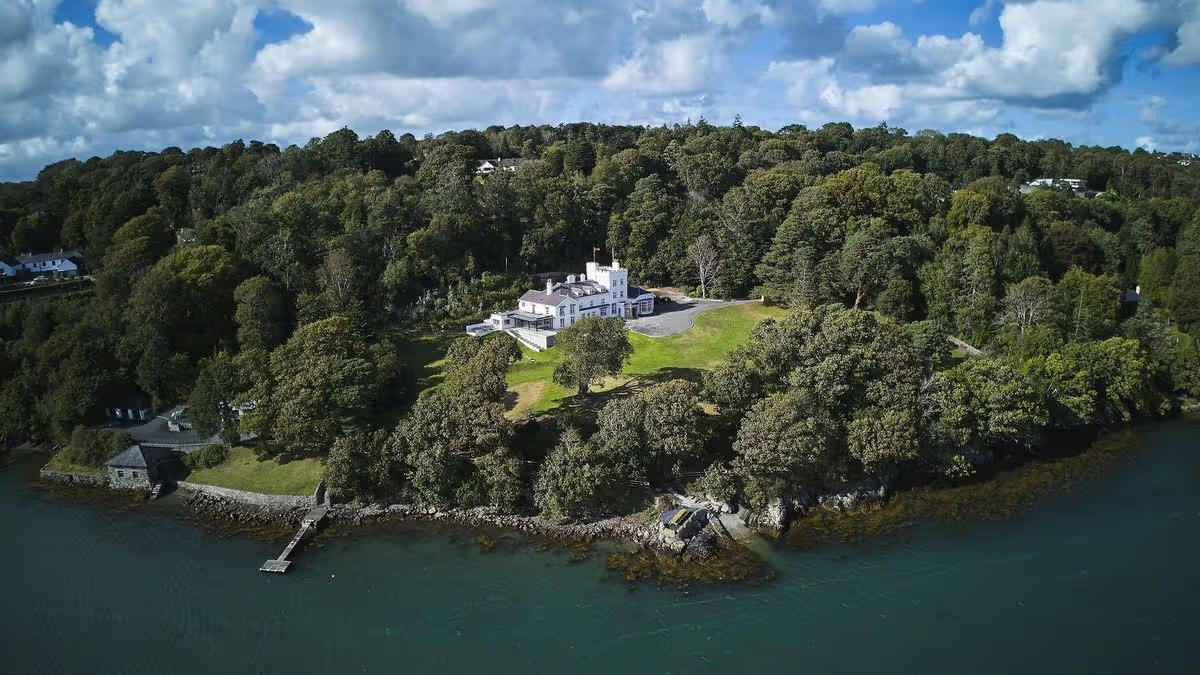
Craig y Don, a striking white-washed mansion sitting high above the Menai Strait within acres of private land, is one of the lucky ones because Mark Ellis found it, fell in love with it, and has spent years and too much budget to even say out loud, renovating and transforming it. For more property stories sent to your inbox twice a week sign up to the property newsletter here.
It was 2021 and Mark, who comes from the area and visits the Isle of Anglesey frequently, says: “I saw this place come up and knew of it, but I thought it looked pretty amazing. Actually I remember going down and climbing over the gate and having a look and initially, just thinking ‘Oh gosh, it looks like a really big project’- I was a bit scared by the size of it.
“But I sort of reflected on it and, foolishly, an idea started to form. I was thinking ‘this is a pretty good spot and they don’t make land like this anymore’. I ended up looking around it and yeah, fell in love with it, and just couldn’t stop imagining what it might be like.”
Advertisement
The idea that started to gain momentum came from Mark’s challenging experience of trying to find somewhere amazing as a place to rent and stay for a large family celebration.
Mark says: “I think there were 16 of us and I was struggling to find somewhere that was lovely, that was five-star luxury where the whole family could sit around the same fireplace or at the same dining room table. I thought ‘if I’m struggling to find somewhere then surely other people are too’.”
He found there was a ‘surprising lack’ of top-end family places to rent in stunning locations, and that is where Craig y Don started to weave its way into Mark’s future.
Advertisement
After building up a solicitor business and then selling it in his fifties, Mark was not ready to retire just yet and having already done a restoration on a house in Chester, he had been bitten by the renovation bug – all good news for Craig y Don, maybe a bright and lasting future was on the horizon?
But this renovation project was going to be epic. Mark remembers: “It was in a very poor state. It hadn’t been lived on for nearly 20 years but at least the roof was solid. However, there was a lot of damp, black mould, peeling paper, and there was plaster that was starting to fall off.
“And there was no kitchen, just a tiny space with an Aga, but nothing else, not even kitchen units. There was no running water and wires hanging everywhere. Then there were seagulls that had fallen through chimneys and ash that had fallen onto the floors.”
But nothing that Mark saw that day, and on subsequent visits, dampened his enthusiasm, even the ambience of sadness that wafted through the rooms did not persuade him to change his mind and his ambition.
He says: “It felt cold. It felt unloved. It felt damp. But, and this sounds a bit deep, it had a good spirit. It felt like the energy was positive, it just needed some love. And it felt like it had once been a happy place, although it certainly wasn’t now.”
Advertisement
Being from the area and loving the island Mark was keen to use local trades people on the project where possible and now that the renovation is finished he has teamed up with companies in the area to promote local outdoor activities, pubs and restaurants, and places for guests to visit – he is keen that the local economy and employment opportunities benefit from the house being alive again after 20 years of emptiness.
His company Daisy Joy also annually supports three local charities in their endeavours, as Mark is keen to support the community as much as possible. He says: “It comes from a love of Wales and a love of the island.”
But the core driver that ploughed through all the challenges Craig y Don threw at Mark was saving the house so it would survive forever and making it a place to create lifelong memories.
Advertisement
Mark says: “It’s a forever investment. This is not a business for me. I mean, if it was a business, I would be out of business because I’ve done it from the heart and spent more than it’s now worth, but I’ve done it to keep it alive forever.
“I think that if we can be successful and fill it with family gatherings, you know, people celebrating important birthdays and celebrations, fill the house with laughter and happiness again, then I hope that’s a good thing.
“We’re not doing commercial events, we’re not doing weddings, this is about family and friends spending time together and making sure that the grandparents will have as much fun as the grandkids and vice versa. This is a family home, where we want to have family gatherings.”
Advertisement
Craig y Don had been empty for 20 years and on the market many times; no-one was interested, and at some points Mark wished he hadn’t been interested either.
He says: “There have been many nights when I have lain awake and thought, ‘what have I done, I must be bonkers’, and then when I started putting the work out to tender, the quotes were coming back so high because I knew I wanted this to be done well.”
Enter the next house saving hero – a team called Birch Stays who came up with an interesting proposition that benefitted all parties and the house.
Advertisement
The company specialise in offering property owners a complete package to create and run high-end holiday homes from the renovation stage right through to booking and marketing, maintenance and guest services.
Mike Walsh, one of the directors at Birch Stays, says: “We’d been steadily building a reputation for transforming character properties into standout holiday homes, and this was an opportunity to take on something truly special and so we agreed to renovate Craig y Don after just a single tour of the home.
“It had incredible bones, an amazing history dating back centuries and a Grade II listing, but it needed a huge amount of work. Like many heritage properties, it had seen years of piecemeal changes that didn’t really do it justice.”
Advertisement
Mark adds: “I said ‘I’ll pay you a fixed fee for project managing and then I’ll use local trades and pay them directly’ and this was a way I tried to find a more cost-effective way of doing it with them.”
Once the project work was agreed, Mike and business partner Jonathon Leyland and the team at Birch Stays were keen to get started, and emotions were high.
Mike says: “We felt equal parts excitement and respect, to be honest. Projects like this don’t come along often, and you feel a real responsibility to get it right. It’s not just about creating something beautiful, it’s about honouring the history while making it relevant for modern guests. We knew it would be a challenge, but that’s exactly what makes it worthwhile.”
Advertisement
The house was given a Grade II listing by Cadw in 1988 for being ‘a mainly early 19th century small country house with good later interiors and group value with the coach house, the boathouse and the lodge’. The earliest recorded occupant was Colonel Thomas Peers Williams MP in 1845, grandson of Thomas Williams Commander of the Anglesey Light Infantry.
The listing goes on to state that in the mid 19th century Mrs Peer Williams supported ‘a private charity school at the house, founded in 1845, for 12 girl scholars, none of whom had to pay fees’.
The core of the house is said to date back to 1540 but according to the listing the earliest surviving evidence of a previous abode is an 18th century red brick chimney stack visible in the attic.
Since then the property had early to mid 19th century rebuilding, remodelling and extensions with subsequent modern alterations, and Mike says these added to the drama as well as the need to respect and work within the Grade II listed status.
There were many challenges, from peeling back all the work done to the house over the decades, structural issues, and drainage that needed an extensive amount of groundwork.
Inside, the original features have been preserved and restored and the interior design has been spearheaded in a partnership between Mark and company Horton & Co who work extensively on Anglesey and across the area to create an absolutely stunning house.
Mark says: “We had a vast space that was completely empty. It didn’t have any furniture, any wallpaper, anything at all, so we started from scratch. We didn’t want to go out and buy new furniture, obviously we bought lovely new luxury beds and mattresses and it’s been completely redecorated, but we’ve sourced antiques and artwork. And I think the interior design is something worth celebrating in itself.”
The house provided some of the interior inspiration with the Prince Edward bedroom suite and the Lillie Langtry suite, both located in the tower, were created as a recognition of the rumour that Albert Edward, Prince of Wales (the future King Edward VII) and the Victorian socialite and actress Langtry stayed at the house during their affair.
Advertisement
The Prince Edward suite has been designed with a masculine energy, including time spent finding a fabulous four-poster bed of the right age, while the Lillie room is more delicate and feminine and the views from both are outstanding.
A new glass extension has been added at one side of the house to create a social kitchen diner hub with more exceptional views to enjoy and it’s this contrast between old and new that excites Mark the most regarding the home’s new interior.
He says: “We’ve got modern wood and contemporary as well as antiques and old, I think we have achieved that lovely mix of contemporary with tradition.
Advertisement
“Standing in the new kitchen dining space, you feel like you’re on top of the Menai Strait and the water’s below, you can see for miles including all the activity on the water looking over towards the mountains; it is wonderful.”
Another interior space that Mark finds himself drawn to and that guests, now that the house is open for bookings, are enjoying is the visually breathtaking lounge bar found in the former ballroom that Mark describes as ‘extravagant and opulent’.
There is so much to explore at the house even before stepping inside, including acres of private land that includes a boat house and steps down to the water, two hot tubs, and a sun-drenched terrace outside. Climb the distinctive tower to the roof deck at the top and the views are truly panoramic and immersive.
Advertisement
Inside the nine gorgeous bedrooms can sleep up to 20 people in total and each has been lavished with their own unique interior design, and six have their own ensuite.
Time is easily spent and enjoyed in the cinema room, the tranquil drawing room, the library and, of course, the lounge bar in the ballroom. Maybe the games room is the standout play space, offering table tennis, air hockey, and table football plus a space also suited for yoga and pilates.
The mini spa includes a sauna, gym and treatment room and Mark’s company Daisy Joy can even arrange staff to visit for treatments and massages.
Advertisement
It’s taken six years and a secret seven-figure sum to get to this point. Mark says: “At times it has been stressful, it’s just been so much more work to do and the job being much bigger than we expected but I’ve had to just hold my nerve. I now feel a great sense of relief and pride, I suppose, of what we’ve done.”
Mark is still clearly in love with Craig y Don, he finds joy in every space and every element of design and now he is hoping that guests feel enchanted too. He says: “Hopefully I can get some good feedback from people staying there and that’ll be the most satisfying time, when somebody writes to me and says, ‘We’ve had such a lovely time. We all loved it’, and I think that’ll be when I think ‘okay, it was worth it’.
“Because in thedaylight hours, looking at the beauty of the location, looking across towards the mountains of Eryri and just visualising how it would be when we finished the project kept me going. But then you go to those dark periods in the night and you’re thinking ‘goodness me, I’ve bitten off more than I can chew here!’.
Advertisement
“But I’m a positive person so I’d stop myself and say, ‘no, actually, this is a really lovely spot, it’s great, and I can do this and I mustn’t give up’ because I actually couldn’t give up, that wasn’t an option.
“All of my family and friends thought I was absolutely mad, and I still do too sometimes because it makes absolutely no sense financially. But you know, it is a legacy because it’s definitely not a business, it’s something that my family owns now and into the future, we will never sell it.”



















































You must be logged in to post a comment Login