When Joe Wicks and I sit down for a Teams meeting, we’re both fighting off one of the many winter illnesses that have been doing the rounds of late.
We’re here to chat about why kids should sign up for the TCS Mini London Marathon in schools – but it’s another type of marathon that swiftly crops up in conversation, and that’s the momentous feat that is getting children into bed at the end of the day.
Joe, who is founder of The Body Coach (and also earned another title as the “nation’s PE teacher” during the pandemic), lives with his wife Rosie, and their four children: Indie, 7, Marley, 6, Leni, 3, and Dusty, 1.
Asked how he makes bedtime work, he lets me in on “one of the most incredible lightbulb moments” he had after someone he worked with asked him what his goals were, and he admitted he wanted to be more present around his kids.
Advertisement
Now, he has an alarm on his phone that goes off every day at 6pm, which he’s named “I am a phone-free dad”. At this point, he puts his phone away to focus on his kids.
“It’s changed my life because rather than be distracted and running to my phone and thinking about Instagram and checking DMs and memes, I see that time as their [my kids’] time and I’m not as stressed, and I’m more patient,” he says.
While the younger children fall asleep more quickly (and long may that continue!), Joe and Rosie aim to get their two older children in their bedrooms – that means pyjamas on, teeth brushed, stories read – between 7pm and 7.30pm.
As for when they actually fall asleep, well, that can take a while.
Advertisement
“I think, ‘yes I’ve read books with you two and everything’s good’ and I’ll go down to the kitchen for an hour and come back up and they’re still awake,” he admits. “And I’m like: ‘how are you still awake?’” (As someone whose eldest is still awake at 9pm most nights – despite all of the calming bedtime rituals – this is music to my ears.)
The couple started homeschooling their eldest child, Indie, in 2023, and now they also homeschool Marley. The older children also attend a forest school twice a week.
“It’s a challenge, it’s not as easy as it looks,” says Joe of homeschooling. “You can imagine trying to get two kids to sit and focus, while the other two babies are running around and kicking off, screaming and hungry and stuff.
“You’ve got to be flexible with it, but it brings a certain independence and freedom to learn what you want and have days out.”
Advertisement
That said, he notes this is “really stressful” and “takes so much patience” as the children “want to resist and do anything but learning”.
“I think sometimes 20 minutes of focused learning is the same as, like, an hour in the classroom with 30 kids, so you don’t need to be doing hours and hours of focused concentration for them to be learning,” he says, adding they’ll do everything from playing instruments to reading to cooking and having a kick about in the garden or heading to a skate park.
“It really isn’t easy, but I’m blessed we can do it,” he continues. “But it’s also the most challenging thing as you’re with them all the time and there’s no let-up.”
On the topic of no let-up, any parent will know that staying calm and regulated when your kids aren’t playing ball can be tricky at the best of times, but when you’re with them 24/7 – and you’ve asked them seven times to do one task, only to be ignored – it can be even more intense.
Advertisement
Discussing how he manages the trickier parenting moments, Joe admits he’s still learning: ”I’ve read books on this and I’m trying to change my natural instinct to be ‘fight or flight’ and [instead] be calm.
“But take my situation: there’s four kids in a house and it’s constantly messy, you’re trying to homeschool and run a business.”
He finds exercise helps keep him on an even keel – if he does a morning workout, he notices he feels he can “interact better” and is more patient.
“I hate how I feel when I lose control a little bit.”
“I feel really bad when I shout at my kids, but then I have to remind myself I am with them an un-normal amount of time,” he says.
Advertisement
“So, I just apologise, I say ‘I’m sorry I shouted, I’m really trying to stay calm’. And I keep reminding them: ‘when you’re calm, I’m calm. Let’s work together and keep the house nice and level.’
“But they’re still kids and toddlers, so they’re irrational sometimes. I think communicating after is really important.”
“I hate how I feel when I lose control a little bit,” he adds. “But we are humans and kids can be the most annoying people on earth, so you have to be understanding I suppose, and a little bit more compassionate towards yourself.”
Advertisement
Social media seems to spawn a new parenting style (gentle parenting, FAFO parenting, air traffic control parenting) on a weekly basis. When I ask what his own approach to parenting is, Joe says: “I’m trying to always be the calm, wise owl – that’s my dream, that I’m respectful and I don’t swear and shout and get irritated and slam doors and run out of the house when it gets difficult.
“So, I suppose that’s my aim and my dream. And I’d say 60-70% of the time I am that guy. But then it’s the 40% of the time, it amplifies doesn’t it? Where you feel like: ′ahh I shout and I’ve lost it and I thought I was a really patient dad but underneath I’m not’. And it’s because my childhood was like that – I was shouted at all the time, it wasn’t a calm environment.
“I think we are a product of our childhood and our environment. I’m having to really refocus and remodel my default setting. My default is probably to shout and scream, but I’m trying my hardest to take a breath and take a moment. And it is exhausting. To be a calm parent is way more exhausting, because your brain is constantly being tensed and stressed and trying to resolve things.”
Exercise, sleep, a balanced diet – these are all important factors that can determine how Joe finds his stride each day as a parent. So, it’s perhaps no surprise that he’s on a mission to encourage more children to get moving after a long winter spent largely indoors.
“It breaks my heart when I see articles around inactivity levels increasing and schools getting budgets cut,” he says. “It feels so obvious that the answer to this problem is to get our kids moving more and really prioritise physical activity as opposed to cutting it out and reducing it.”
Joe Wicks and a team of school children
For his part, Joe is hoping to get thousands of kids moving this spring by encouraging them to take part in the TCS Mini London Marathon in schools.
The TCS Mini London Marathon is the biggest, free one-day children’s event in the UK. This year, it takes place on Saturday 25 April, with entries already sold out, and around 22,000 children aged 4-17 expected to take part in either the one mile or 2.6km distance around St James’s Park.
Advertisement
In 2022, the event was expanded to include all school children – the idea being they can take part in the two-mile event at their school or education setting.
The 2026 event runs from today until Friday 1 May, with schools able to sign-up here. The two miles can be done in one day or split over a number of days, per class or as a whole school.
“It’s such an easy win because most schools have a little bit of a field or an outdoor playground so they can do little loops and things,” says Joe.
Since 2020, more than one million children from across the UK have taken part and a record 2,039 schools registered to complete their own two-mile distance in 2025.
Advertisement
If your child’s on the fence about taking part, Joe has a special message for them: “Run, walk or wheel – it’s not about being this elite little runner and smashing it in five minutes, it’s just like the ‘daily mile’ in schools: it’s fun, it’s sociable, it’s a challenge, but you can cheer each other on and you can do it in your own time.
“You’ll feel so proud of yourself when you’ve finished it,” he adds. “You’ll feel energised, you’ll feel more focused, you’ll feel calmer. It’s not this competitive thing, it’s about doing something that day or week to boost your physical and mental health.”
Franck Queudrue spent nine years in English football, featuring for Middlesbrough, Fulham, Birmingham and Colchester, but it was months prior to leaving boyhood club Lens in 2001 that he produced one of the most iconic own goals of all time.
In a Ligue 1 match against Bastia, the left-back attempted a volleyed clearance 30 yards out from his own goal.
Queudrue connected with the ball superbly, but in completely the wrong direction to loop it high into the air and over his own goalkeeper.
For a defender who only scored only 28 league goals in his entire career, it is probably a contender for one of his best-ever strikes, albeit into the wrong net.
Police have charged a 40-year-old man following reports of a male with a machete close to Belfast City Centre.
Advertisement
Officers were called to the scene at Peter’s Hill, close to the Shankill Road on Thursday afternoon.
The man has been charged with a number of offences, including possessing a blade in a public place and a “simple drunk” charge.
A PSNI spokesperson said: “Police investigating a report of a man with a machete in the Peter’s Hill area of north Belfast yesterday afternoon, Thursday 9th April, have charged a man to court.
“The man, aged 40, has been charged with possessing an article with a blade or point in a public place, and simple drunk.
Advertisement
“He is expected to appear before Belfast Magistrates Court on May 8th, 2026.
“As is usual procedure, all charges will be reviewed by the Public Prosecution Service.”
“At previous events linked to this group we have seen coordinated attempts to disrupt police activity, including obstructing officers and, at times, verbal or physical abuse. Our officers are trained to deal with these situations proportionately and effectively, and we are confident we have the plans and resources in place to respond appropriately, including making arrests where necessary.”
There’ll be some crafters as well and the house bar will be selling G&Ts and fizz!
Meanwhile, Scottish singing sensation Connor Fyfe will again rock the festival stage this summer.
Advertisement
The 19-year-old had the main stage rocking last year with a foot-stomping set that kept spirits up as the weather tried to dampen them.
A home gig for Connor, he packed out the large tent at George Allan Park and had hundreds of revellers chanting along to perfectly performed cover versions.
And the event will again be a perfect opportunity for him to showcase his new music.
Covers band Underdog are also returning, with the event again headlined by DJ, Let’s Get Eclectic, who can regularly be heard holding Glasgow pub audiences captive.
Advertisement
As well as unveiling the live music line-up for the event, organisers have announced some of the breweries pouring on the day, with beer lovers in for a treat.
That includes Strathaven’s very own, Up Front Brewing, who will be joined by a host of other top beer makers, such as Dookit, Outlandish, Simple Things Fermentation and Two Towns Down.
For non-beer lovers, Angels Dare Cocktails, The Dispensary Bar and Netherfield Whisky will be on hand to quench thirsts.
The fun-filled community event will have plenty for all the family, including specialist kids entertainment.
Gold Dancer had to be put down after suffering a broken back when winning the Mildmay Novices’ Chase on day two of the Grand National Meeting at Aintree.
The horse dragged his back legs through the final fence when leading Regent’s Stroll and was ridden out to win by four lengths under Paul Townend for trainer Willie Mullins.
Gold Dancer was immediately pulled up after crossing the finish line, with Townend dismounting and screens erected for veterinary experts to assess and treat the horse but the seven-year-old was put down.
Owners Gigginstown said: “He’s been put down. He broke his back. It’s terribly sad for the horse.
Advertisement
“What could Paul Townend do? He felt fine, it was just when he pulled up that something was wrong.”
Emma Slawinski, chief executive at the League Against Cruel Sports, said: “Year after year we see horses dying at Aintree for people’s entertainment and a cheap bet. Sadly, Gold Dancer is the latest victim of this heartless spectacle, which flies in the face of animal welfare.
“The public and businesses should boycott the Aintree Festival, refuse to bet on the racing, and stop watching the ITV coverage and advertising which glosses over the animal cruelty.
“The government needs to act as the British Horseracing Authority and Jockey Club is prioritising gambling profits over the lives of the horses.”
Advertisement
Two horses, Willy De Houelle and Celebre D’Allen, died at last year’s Aintree Festival.
Gold Dancer has tragically lost his life after suffering a catastrophic injury while winning the William Hill Mildmay Novices’ Chase at Aintree. The seven year old had produced an almost perfect round and was cruising towards a dominant win before faltering at the last fence.
Despite the setback, the Willie Mullins-trained runner still managed to claim victory by nearly five lengths, but harrowing scenes unfolded at Aintree afterwards. The horse limped past the winning post before jockey Paul Townend swiftly dismounted. Veterinary teams immediately attended as barriers were put in place, before the heartbreaking announcement was made.
Eddie O’Leary, racing manager for the Gigginstown stable, said: “He’s been put down. He broke his back,” adding “It’s terribly sad for the horse. What could Paul Townend do? He felt fine, it was just when he pulled up that something was wrong.”
Advertisement
Earlier in the race, Miami Magic and Jordans Cross both suffered falls, although ITV confirmed that both horses were able to walk back to the stables afterwards.
Aintree Racecourse issued a statement addressing the tragic incident, saying: “The winner of our second race of the day, Gold Dancer, was pulled up after the line and dismounted,” reports the Mirror, reports the Irish Mirror.
“He was immediately attended to by our expert veterinary team but sadly he could not be saved. Our heartfelt condolences are with his connections.” ITV’s Ed Chamberlin confirmed: “The winner was immediately attended by veterinary team but sadly could not be saved.” The Jockey Club, which operates 15 racecourses nationwide and runs both the Cheltenham and Aintree Festivals, is continuing its work to minimise dangers in the sport.
Emma Slawinski, chief executive at the League Against Cruel Sports, said: “Year after year we see horses dying at Aintree for people’s entertainment and a cheap bet. Sadly, Gold Dancer is the latest victim of this heartless spectacle which flies in the face of animal welfare.”
Advertisement
Gold Dancer had finished runner-up in the Jack Richards Novices’ Limited Handicap Chase at the Cheltenham Festival in March. The horse had previously won at Tipperary and Galway in Ireland while trained by Mullins, after beginning his racing journey in France.
Regent’s Stroll finished second in the 2:20 at Aintree, with Salver claiming third position.
Put 90g smooth peanut butter, 2 tbsp lime juice, 2 tbsp rice vinegar, 2 tbsp soy sauce, 2 tbsp honey, 2 tsp sesame oil, ½ finely chopped red chilli (deseeded), 1 grated garlic clove, 1½cm square piece of fresh root ginger (peeled and grated to a purée) in a food processor or blender with 2 tbsp hot water and blitz, or mix everything together with a fork, beating vigorously. You should have quite a smooth mixture. Cover and set aside.
As a researcher investigating how electric brain stimulation can improve people’s powers of recollection, I’m often asked how memory works – and what we can do to use it more effectively. Happily, decades of research have given us some clear answers to both questions.
Sensory memory, which can last only milliseconds, registers raw information such as sights, sounds and smells. These are first processed by the brain’s five primary sensory cortices (visual cortex for sights, auditory cortex for sounds and so on).
Working (short-term) memory holds and manipulates a small amount of information over several seconds or more. Think of this as your brain’s mental workspace: the system that lets you do mental arithmetic, follow instructions and comprehend what you’re reading. So it mainly involves the prefrontal cortex – the front part of your brain that supports attention, decision-making and reasoning.
Advertisement
Finally, long-term memory stores information more permanently, from minutes to a lifetime. This includes both “explicit” memories (facts and life events) and “implicit” ones (skills, habits and emotional associations).
For long-term memories, the hippocampus and temporal lobes – located deep within the brain, around the sides of your head near your temples – contribute largely to memories involving facts or life events, while the amygdala (near the hippocampus), cerebellum (at the back of the brain) and basal ganglia (deep in the brain) process emotional or procedural memories.
Anshuman Rath/Shutterstock
Working memory often acts as a conscious gateway to long-term memory – but it has its limits. In 1956, the American psychologist George Miller proposed that we can only hold about seven “chunks” of information in our working memory at any time.
Advertisement
While the exact number is debated to this day, the principle holds: working memory is limited. And that limitation can shape how effectively we learn and remember things.
But you can also get your memory working more effectively. Here are five easy steps for improving both your working and long-term memory.
1. Put your phone away
Smartphones reduce your working memory capacity. Even just having a phone nearby – no matter if it’s face down and on silent – can reduce performance on memory and reasoning tasks.
The reason is that part of your brain is still subtly monitoring it. Even resisting the urge to check notifications consumes mental resources – which is why researchers sometimes call smartphones a “brain drain”. The solution is simple: put your phone in another room when you need to focus. Out of sight really does free up mental capacity.
Advertisement
2. Stop your mind racing
Stress and anxiety can take up valuable mental space. When you’re worrying about something or are distracted by racing thoughts, part of your working memory is already in use.
Relaxation training and mindfulness practices can improve both working memory and academic performance, probably by reducing stress levels. And if meditation feels intimidating, try breathing techniques such as “cyclic sighing”. Inhale deeply through your nose, take a second shorter inhale, then slowly exhale through your mouth. Repeating this for five minutes can calm the nervous system and create better conditions for learning.
3. Get chunking
Everyone can expand their working memory using the technique of chunking – grouping information into meaningful units. In fact, you probably already do it to remember some phone numbers or lists of words – breaking long sequences into bite-size chunks that your brain can recall as a mini-group.
Advertisement
Video: National Geographic.
The same principles apply if you’re delivering a presentation, to help your audience remember your key points more effectively. Chunking would involve grouping ten case studies, say, into three or four themes, each with a short headline and single key takeaway.
Repeat this structure on each slide: one idea, a few supporting details, then move on. By organising information into meaningful patterns, you reduce cognitive load and make it more memorable.
4. Become a retriever
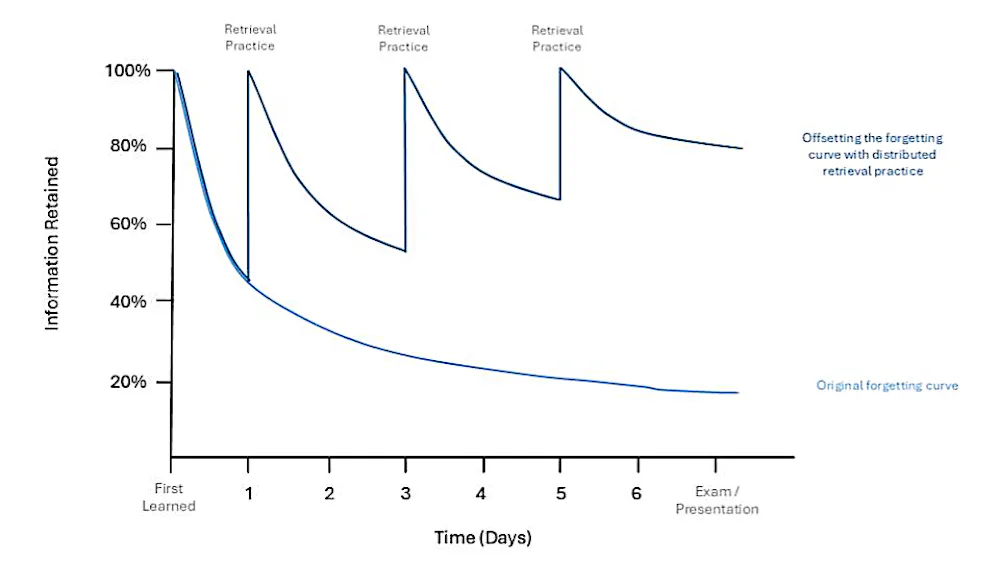
In the 19th century, German psychologist Hermann Ebbinghaus demonstrated how quickly we forget information after learning it. Within about 30 minutes, we lose roughly half of what we have learned, with much more fading over the next day. Ebbinghaus called this the forgetting curve. The light blue line on the chart below illustrates this.
However, there is a way of ensuring that more sinks in when you are trying to learn a lot of information in a short period of time: retrieval practice.
When preparing to give a talk or studying for an exam, rather than simply rereading your notes, keep testing how much you remember. Use flash cards, answer practice questions, or try explaining the material out loud without notes.
Memory works through associations. Each time you successfully retrieve information, you link the material to new prompts, examples and contexts. This builds more cues to accessing the information, and strengthens each memory pathway. Often when we “forget”, the memory isn’t gone – we just lack the right retrieval cue.
5. Give yourself a break
Research shows that memory is more effective when study or practice sessions are spread out, rather than massed together. If you are studying for an exam, build solid blocks of downtime into your revision schedule. The dark blue line on the chart above illustrates how spacing out your practice sessions can help you remember more information over time, by adjusting Ebbinghaus’s forgetting curve.
Advertisement
One study suggests leaving gaps between each revision session that equate to 10-20% of the time left until your exam or presentation. So, if your deadline is five days away and you do hours of revision a day, you should still take between a half and full day off in between sessions. In other words, don’t overdo it – you probably won’t see the rewards!
If you only remember one thing from this article about improving memory, make it this. Memory isn’t just about intelligence, it’s about strategy. Small changes in how you study or work can make a real difference in how well, and how long, you remember crucial information.
Chelsea midfielder Enzo Fernandez will remain unavailable for the upcoming home match against Manchester City despite apologising for recent comments about Madrid, head coach Liam Rosenior says.
Fernandez was handed a two-match internal ban by the club last week after he gave an interview during the international break in which he expressed his admiration for the city of Madrid.
The Argentine has repeatedly been linked with a move to La Liga club Real Madrid.
His agent, Javier Pastore, said this week that “we cleared the air” with Chelsea after Fernandez missed last Saturday’s 7-0 FA Cup victory against Port Vale, and had hoped that the ban would be reduced to one match.
Advertisement
However, Rosenior says Fernandez will miss Sunday’s Premier League fixture against Manchester City as Chelsea have decided to stick to their original punishment, despite the Argentine apologising for his comments.
“I had three or four [conversations] with Enzo,” said Rosenior.
“He’s apologised to me, he’s apologised to the club, and we’ll deal with that after a massive game on Sunday.
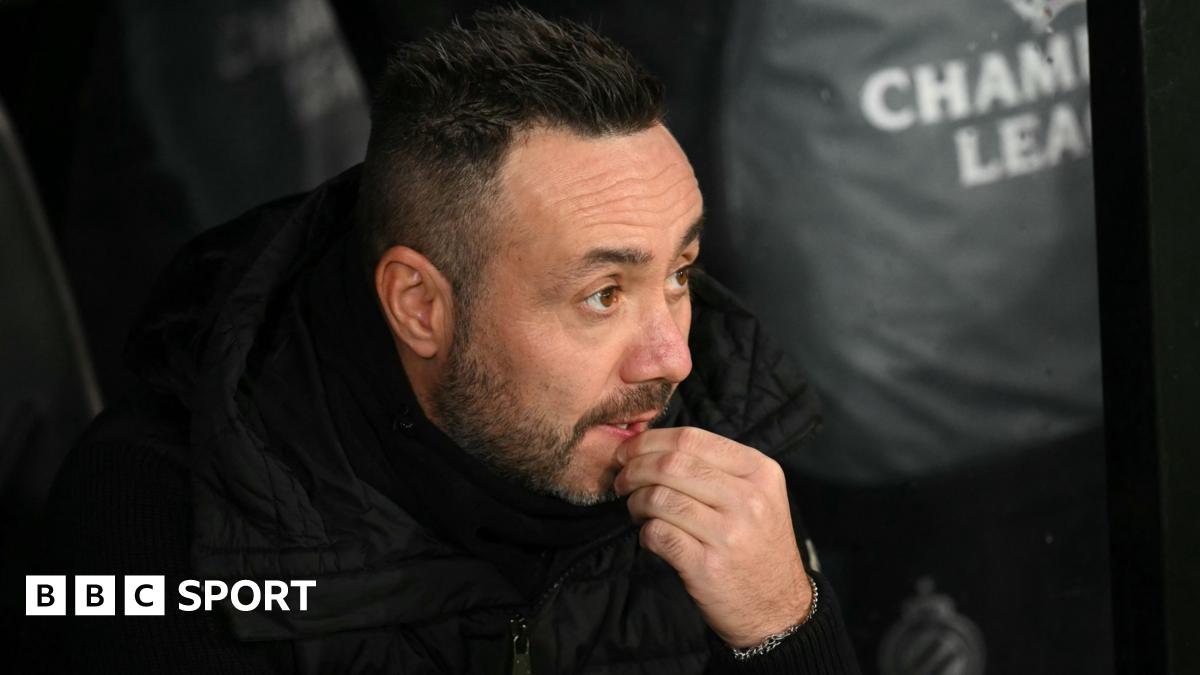
Tottenham manager Roberto de Zerbi says he is “not better” than predecessors Thomas Frank or Igor Tudor as he prepares to take charge of his first game at the Premier League strugglers.
Sunderland will be Spurs’ first opponents under the Italian, who was appointed on 31 March with the club one point outside the relegation zone with seven games remaining.
De Zerbi is Tottenham‘s third manager of the season after Frank and Tudor – the latter only lasting 44 days and seven matches in the role.
“I am proud and happy to be here and I have to say thank you to Vinai [Venkatesham] and Johan [Lange] because they showed me a big, big confidence,” said De Zerbi on Friday.
Advertisement
“I’m sure about the level of the players because I was very, very close to bringing many of these players to my former teams in the past.
“I think I am not better than Frank or Tudor because I consider them very good coaches.
“I try to bring my style, my character, my personality and my strengths to achieve our target, which is the most important part now.”
Tottenham have not won a domestic league game in 2026 and only two since 26 October 2025.
Advertisement
They were also knocked out of the Champions League in the last 16 by Atletico Madrid 7-5 on aggregate.
Since 1950, Spurs have only spent one season outside the top flight, which was back in 1977-78.
“For me, it was a big opportunity because Tottenham are a very important club in the Premier League and the Premier League is the best league in the world,” said De Zerbi, who previously managed Brighton between 2022 and 2024.
“I love the qualities of the players and the crucial part that there was 12 days before the first game and for me it was important to have more than one week. I thought it would be important to understand the problems.
Advertisement
“The message for my staff and players is that we have to deserve the support because the fans are suffering like us. But for the fans, there is just one club. The players can change but for the fans, their club is unique.
“We have to make them happy with the right spirit and the right behaviour on the pitch. Then it’s easier to make points.”
Tottenham travel to the Stadium of Light to face 11th-placed Sunderland on Sunday (14:00 BST kick-off).





















































You must be logged in to post a comment Login