

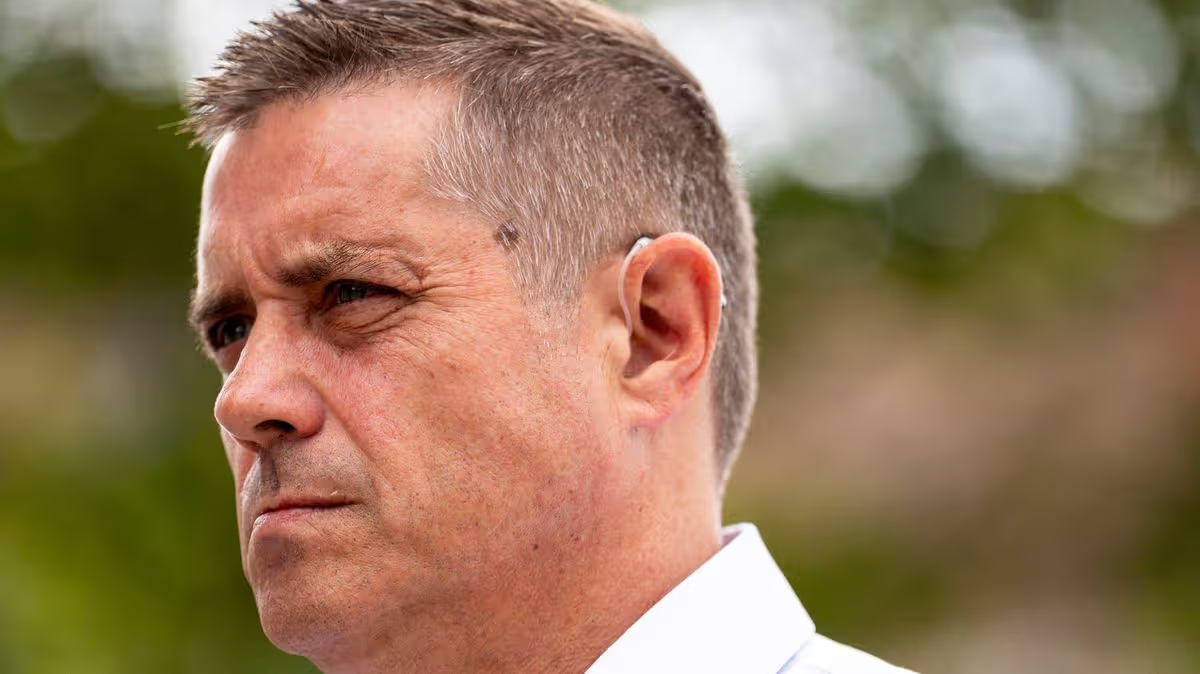
Former 90s TV star John Alford, known for his roles in Grange Hill and London’s Burning, has died at the age of 54 after being convicted in January of sexually abusing two underage girls
What started as a seemingly harmless sleepover descended into horror for two teenage girls following their encounter with John Alford. The former TV pin-up, aged 54, has died in jail just weeks after being handed an eight-and-a-half-year jail term for child sex offences after abusing two adolescent girls at his mate’s property.
The ex-actor, recognised for his parts in Grange Hill and London’s Burning, gave the youngsters, aged 14 and 15, alcohol, the court was told, following a 4.30am trip to a petrol station where he splashed out £250 on cigarettes, snacks and booze – including rum, beer and flavoured vodka.
Alford, convicted under his birth name John Shannon, showed no remorse during sentencing after being found guilty of four counts of sexual activity with a child, plus two further counts of sexual assault and assault by penetration involving a second victim at St Albans Crown Court on September 5. The assaults occurred at his friend’s residence in April 2022, following an evening at the pub.
The teenagers had been having an unplanned sleepover during their Easter school holidays at the home of a third girl, whose father was friends with Alford – of Hartham Road, Islington. Apart from Alford, all other adults in the house eventually retired to bed.
The court heard that due to the nature of conversations the disgraced actor had with the teenagers during the night, he was aware of their ages. After a trip to the shop, he provided the underage girls with Ciroc flavoured vodka, whilst he himself drank a bottle of beer.
The father-of-four proceeded to have sexual intercourse with the 14 year old girl in the garden of the property and later in a downstairs toilet. He also inappropriately touched the 15 year old girl as she lay semi-conscious on the living room sofa.
In heart-wrenching testimony, the 14 year old victim disclosed that she was a virgin and had pleaded with Alford to stop “three or four times”.
She further testified that “I told him to stop because I didn’t want to have sex with an old man”. The court also heard Alford ask her “do you want this babe?” to which she replied “no”.
The other victim testified that “We were all just like dozing off. That was when John started to touch me.”
The teenager also told the court that she felt “absolutely sick” after the assault, and once she had reached the safety of the other victim’s home she showered, and the two teenagers “spoke about everything that happened” in a bathroom together.
In deeply distressing victim impact statements, the teenage survivors laid bare the horrific injuries inflicted by Alford and the devastating long-term consequences of the attack. For the 15 year old victim, this included attempting suicide and self-harming.
“This man destroyed my mental wellbeing. When I was 16 I tried to take my own life with sleeping tablets,” she described. “I was in so much physical and emotional pain I cut myself deeply. I used my mum’s lighter to burn the inside of my thighs as well.
“I felt so suicidal and depressed, words cannot describe how I felt.”
She went on to detail the daily struggles she now endures following the assault, including travelling on public transport, going to the toilet alone at night, and confessed: “I struggle with men. I don’t want to think of every man as evil, but I do. I will never forget his face, his scent, his voice or him.”
The 14 year old victim revealed in her statement that even embracing her own father had become difficult after the attack. “I’m the victim of penetrative sexual assault. Being sexually assaulted has affected my family in every way,” she wrote.
The court was told that the sexual health examination she underwent following the assault proved traumatic and had to be halted due to the severe pain it caused. She was required to take emergency contraception and received injections to prevent HIV and other infections, which left visible bruising.
“I was scared people were going to notice and wonder why I had them,” she said. The 14 year old victim also shared, “It has affected me severely with school. I didn’t care about my GCSEs as this was the only thing that mattered. I wasn’t bothered about my personal hygiene or appearance. I was just existing.”
She went on to say, “I was getting flashbacks. I’ve been getting dreams. I’m convinced he’s going to come through my door. I also find it hard being intimate with my boyfriend because of this.
“The assault by John has completely changed my perspective on life. It has made me look very differently at the world and I now have worries for my life and my future children. I will not let this assault define me, but it has been constantly in my mind.”
Tina Chummun, a member of the Counselling Directory, told the Mirror that the type of traumatic injury these teenage survivors have endured fundamentally changes how a “survivor experiences the world” and psychologically, there is no “normal” to return to.
Tina, who specialises in trauma therapy for victims of domestic violence and sexual abuse and has worked for The Women’s Trust, explained: “Recovery after sexual assault is not about ‘going back to normal’, because trauma changes how a survivor experiences the world. The survivor will experience their world through their trauma lens for some time that their body and mind needs for recovery – however long that takes, and it is dependent on the survivor.”
Alford’s appalling attack need not “define” his young victims, “but it will shape [their lives] in profound ways,” the trauma specialist explains. This occurs “because [the] nervous system is still living in survival mode. When someone experiences an intimate violation, their brain’s threat system becomes hyper-alert and struggles to tell the difference between what is safe and what is dangerous.
“Everyday stress, memories, smells, touch or even moments of closeness can trigger the same fight, flight, freeze or fawn responses as the original trauma. This is why survivors often live with flashbacks, fear, shame, self-blame, frequent triggers from daily experiences and difficulties with trust and intimacy long after the event.”
Ms Chummun said simply allowing time to pass is insufficient for recovery. “Healing involves more than time passing. It requires trauma-informed support in a safe, empathic, supportive, boundaried and non-judgemental space where the experience can be processed rather than pushed away. It’s the awareness, acceptance and then the acknowledgement to want to work towards changing thoughts and behaviours related to the trauma that will mean the survivor has processed it. The awareness and acceptance part of the recovery process are the most challenging. Without this, the body continues to carry the trauma as if it is still happening.
“Psychological pain is experienced in the same brain regions as physical pain, so survivors are not being dramatic when they say it hurts. It truly does. Recovery looks like slowly rebuilding a sense of safety in their body, restoring confidence, reclaiming their power and choices, having a personal safety plan in place, can be worked on together with a therapist, and learning that life can be lived again without ‘fear’ being in their driving seat.”














![BITCOIN IS ABOUT TO DROP !!! [Bear Flag Confirmed]](https://wordupnews.com/wp-content/uploads/2026/04/1775318607_maxresdefault-80x80.jpg)





































You must be logged in to post a comment Login