

Connect with us

NewsBeat

Khan convicted in car tax ‘scam’ for vehicle he denies owning

Published

on

Close-up of orangutan's eyes

Court records show Khan was prosecuted by the DVLA after the annual tax on the blue Nissan Micra, which was first registered in 2002, ran out in September last year.

The DVLA said the vehicle was spotted untaxed on 24 January and told the court that his name and date of birth appeared against the car on official records held by the government.

The agency said a letter asking for confirmation of the identity of the car owner, which was sent to the wrong address, went unanswered in January, leading to a criminal prosecution on 18 August after no plea was entered to the charge.

The court also sent a record of conviction to the Gordon Ramsay restaurant, ordering Khan to pay the £340.84 court bill within 28 days or face the prospect of increased fines, bailiffs, or even “a warrant for your arrest to bring you to court”.

Advertisement

The DVLA said it was reviewing the case and investigating the circumstances of the prosecution.

Defendants who believe they have been wrongly convicted of a crime in their absence can apply for the case to be reopened, typically by appearing in person in front of a judge to make a statutory declaration.

Khan could argue that he did not know about the criminal case because the letters were addressed to the wrong building.

Once reopened, he could petition the DVLA to withdraw the prosecution if it can be shown that he was wrongly accused, or enter a not guilty plea.

Advertisement

Alternatively, the DVLA could apply to the court for the case to be reopened.

Listen to the best of BBC Radio London on Sounds and follow BBC London on Facebook, external, X, external and Instagram, external. Send your story ideas to hello.bbclondon@bbc.co.uk, external

Source link

Advertisement
Continue Reading
Click to comment

You must be logged in to post a comment Login

Leave a Reply

NewsBeat

USS Abraham Lincoln docks in Thailand after gruelling 250-day stint at sea, as resort town issues rules for sailors

Published

on

The USS Abraham Lincoln aircraft carrier is pictured arriving at Laem Chabang Port on Wednesday following its extended deployment to the Middle East

The USS Abraham Lincoln has docked at a Thailand resort town following an extended deployment of more than 250 days in which they faced grueling conditions.

The US Navy aircraft carrier stopped in the resort city of Pattaya on Wednesday, where the 5,000 sailors and Marines on board will have the chance to unwind before heading back to the United States, the Navy announced.

‘Our arrival in Laem Chabang provides a well-deserved opportunity for our Sailors and Marines to rest and recharge,’ Rear Admiral Robert Loughran, commander of Carrier Strike Group 3, said in a statement.

‘It also underscores the strong and enduring partnership and alliance between the United States and Thailand.’ 

Advertisement

Officials in the city are now hoping it will become an ‘important vacation spot’ for US service members in the future, Newsweek reports. 

‘We welcome more visits of the troops in the future, whether for a drill or a vacation, before they go back to the US,’ Mayor Poramet Ngampichet is said to have told American military officials. 

The trip marks a much-needed break for the American servicemembers, who had been at sea since November 21 amid the war in Iran.

Its deployment included a record-setting uninterrupted time at sea of more than 250 days. 

Advertisement

But city officials have also implemented a series of rules for the sailors after speaking with American military officials. 

The USS Abraham Lincoln aircraft carrier is pictured arriving at Laem Chabang Port on Wednesday following its extended deployment to the Middle East

Pattaya had started off as a fishing village, but became a tourism center during the Vietnam War, when US servicemembers were stationed nearby

Pattaya had started off as a fishing village, but became a tourism center during the Vietnam War, when US servicemembers were stationed nearby

Advertisement

Pattaya started off as a fishing village but became a tourism center during the Vietnam War, when US servicemembers were stationed nearby.

It has since developed a reputation for sex tourism but, ahead of the ship’s arrival on Wednesday, authorities in the city launched a crackdown on prostitution. 

Police raids over the weekend saw 40 to 50 people detained with additional patrols in place for the main beachfront and nightlife district, The Independent reports. 

The mayor has denied the crackdown on sex work was related to the arrival of US servicemembers.

Advertisement

But under an agreement with the US, service members docked at Pattaya are barred from engaging in certain recreational activities such as parasailing and cannabis use, which was legalized in Thailand in 2022, according to the Guardian. 

And while famed nightlife area Walking Street will be opened to sailors, they must leave by 2am. 

Any US service member found violating Thai law will be prosecuted accordingly, City Police Chief Anek Srathongyoo vowed.

Officials in the city are now hoping it will become an 'important vacation spot' for US service members in the future

Officials in the city are now hoping it will become an ‘important vacation spot’ for US service members in the future

Advertisement
Business owners in Pattaya eagerly awaited the arrival of the US sailors

Business owners in Pattaya eagerly awaited the arrival of the US sailors

Unlike in the United States, vapes and e-cigarettes are illegal in Thailand, and anyone caught possessing one can face up to five years in prison. 

The country also has strict laws against insulting the country’s monarchy – which could see violators sentenced to 15 years in prison. 

In preparation for the deluge of US servicemembers, authorities in Pattaya have stepped up security, adding more police officers in popular areas along the beach and in the bustling downtown area. 

Advertisement

Meanwhile, business owners across the city eagerly awaited the arrival of the sailors, with some businesses displaying banners reading: ‘Welcome all US military personnel. Thank you for your service’ and ‘All Welcome’ next to a silhouette of the aircraft carrier.

The ship’s arrival in Thailand comes just weeks after the USS George Washington was forced to abandon its post in the Pacific Ocean to relieve the strained sailors of the USS Abraham Lincoln.

The sailors onboard the Lincoln had reportedly experienced horrific conditions that led some service members to experience suicidal ideation due to dwindling morale.

The wife of one of the sailors even described the ship as a ‘floating metal prison’ with appalling conditions as she slammed President Donald Trump for downplaying family members’ concerns.

Advertisement

The unidentified woman said her husband described the experience aboard the aircraft carrier stationed in the Middle East as ‘the worst deployment he’s ever been on.’

‘This is not his first deployment. This is not his first time being out there, and he is saying that it is the worst deployment that he’s ever been on. And he also says that his shipmates say the same,’ she told CNN‘s Jake Tapper.

Sailors have complained about the meager portions they were receiving onboard the ship

Sailors have complained about the meager portions they were receiving onboard the ship

Since the beginning of the war in Iran, reports have surfaced of food shortages and rationing aboard the Lincoln, accompanied by photographs of sailors’ meals.

Advertisement

‘It’s not just the quality; it’s the quantity,’ the sailor’s wife told the outlet. ‘It’s the rationing. The portions are awful, so it’s really not good.’ 

Remaining anonymous out of fear of retaliation against her husband, the woman added her spouse, who she said is typically unaffected by work stressors, ‘feels himself being angrier and more frustrated.’

‘You’re stuck in a floating metal prison essentially, in the middle of the water, eating prison-like food with the same people in the same bunk beds in the same small quarters for 200 days, 250 days, you start to go a little insane working 12 hours, getting four or five hours of sleep,’ she continued.

Sailors aboard the Lincoln are said to have endured moldy showers, broken toilets, laundry outages, food shortages and long stretches without hot water. 

Advertisement

Some sailors even reportedly tried to jump ship amid the extended deployment, with one 19-year-old father-of-two now facing non-judicial punishment from the Trump administration for hurling himself overboard in an apparent attempt to drown.

Navy documents accuse the servicemember of ‘intentionally faking an illness or hurting themselves to avoid work, duty or service,’ while a separate charge claims he failed to report to his required place of duty during the mental-health crisis. 

‘I think they’re insane for doing this to people who need mental help,’ the sailor’s wife told MS NOW. ‘Instead of giving them help, this is just another huge stressor.’

Crew members are pictured standing on the flight deck as the USS Abraham Lincoln approached Thailand on Wednesday

Crew members are pictured standing on the flight deck as the USS Abraham Lincoln approached Thailand on Wednesday

Advertisement
The USS Abraham Lincoln aircraft carrier is pictured in April carrying out blockade operations in the Arabian Sea

The USS Abraham Lincoln aircraft carrier is pictured in April carrying out blockade operations in the Arabian Sea

His wife said he repeatedly requested paternity leave to meet his newborn daughter for the first time but was denied each time. His fate will be decided at a ‘captain’s mast,’ where his commanding officer could dock as much as half his pay, according to the charging documents.

The sailor was rescued after going overboard on August 3 and medically evacuated before returning to San Diego ten days later, according to his wife.

He then spent five days at Naval Medical Center San Diego, known locally as Balboa, where staff monitored his vital signs but never had him evaluated by a psychiatrist or therapist, she said.

Advertisement

He was ordered back to work immediately after his release and did not receive his first therapy session until this Wednesday, nearly two weeks after arriving home.

The Navy is pursuing the case through non-judicial punishment, an internal disciplinary process generally used for lower-level misconduct that avoids a formal court-martial and criminal conviction.

Meanwhile, a bipartisan group of Congressional lawmakers has demanded greater oversight and transparency over living conditions aboard the carrier. 

Source link

Advertisement
Continue Reading

NewsBeat

Four members of family died after ‘getting into trouble’ in sea | News UK

Published

on

Four members of family died after 'getting into trouble' in sea | News UK
Zeina Alayn, left, pictured alongside her daughter, Sarah, middle, and husband Hossam Al-Khawas, right

Four family members died after being pulled from the sea off the Sussex coast, an inquest has heard.

Hussam El-Khawas, 55, his wife Zeina Alayan, 37, older daughter Sara El-Khawas, 14, and youngest daughter Saja El-Khawas, six, died after members of the public reported them ‘getting into trouble in the sea’.

Saja was rescued from the water at Shoreham-by-Sea and resuscitated, but died on August 21 in hospital after showing signs of a brain injury throughout treatment.

An inquest into the deaths of all four family members opened at Horsham on Tuesday.

Advertisement

The hearing heard that the RNLI was called after reports of ‘members of the public getting into trouble in the sea’.

Sign up for all of the latest stories

Start your day informed with Metro’s News Updates newsletter or get Breaking News alerts the moment it happens.

Mr El-Khawas, Ms Alayan and Sara were brought ashore by lifeboat crews at Kingston Beach before being pronounced dead at the RNLI lifeboat station.

A dog running in the sea at Shoreham-by-Sea, West Sussex, near the RNLI station. Three members of the same family, including a man, a woman and a teenage girl, have died after getting into trouble in the water off Shoreham-by-Sea, while a younger girl from the same family is in a critical condition, Sussex Police have said. Picture date: Wednesday August 19, 2026. PA Photo. Photo credit should read: Yui Mok/PA Wire
Four family members were pulled from the sea at Shoreham-by-Sea, pictured (Picture: Yui Mok/PA Wire)
A safety sign at Shoreham Port in Shoreham-by-Sea, West Sussex. A father who died alongside a woman and a teenage girl after entering the sea off the Sussex coast was a Palestinian refugee called Hossam Al-Khawas, the Palestinian embassy has said. Mr Al-Khawas is thought to have gone into the water to swim with three other family members near Shoreham Fort in Shoreham-by-Sea, West Sussex, on Tuesday afternoon. Picture date: Wednesday August 19, 2026. PA Photo. Photo credit should read: Yui Mok/PA Wire
An inquest into the deaths of all four family members opened on Tuesday (Picture: Yui Mok/PA Wire)

Saja was taken to the Royal Alexandra Children’s Hospital in Brighton in a critical condition before being transferred to Evelina London Children’s Hospital at St Thomas’ Hospital.

Coroner’s officer Kelly Truss told the hearing that Saja showed signs of a brain injury throughout her time in hospital.

Advertisement

‘All clinical signs throughout her admission showed evidence of a hypoxic brain injury,’ she said.

Saja was pronounced dead on August 21, with a provisional cause of death given as hypoxic ischaemic encephalopathy and drowning.

The cause of death for the other three family members has not yet been established.

Source link

Advertisement
Continue Reading

NewsBeat

Bank job returned my confidence after Centerpoint support

Published

on

Bank job returned my confidence after Centerpoint support

Michael, spent most of his life in care. However, after he returned home from university his relationship broke down with his foster parents – forcing him into sofa surfing and eventually on to the streets.

After a few months, he got in contact with Centrepoint, who were able to place him into accommodation and help him find a job. It was here that Michael started working at The Co-operative Bank, through it’s Brick by Brick scheme, and he hasn’t looked back since.

He said: “Over two years I applied for 400 jobs. It was demoralising because I really wanted to work but couldn’t as employers would either say I was too experienced or not experienced enough.

“Thankfully, Centrepoint and The Co-operative Bank were able to support me into this job now and I love it. Everyone’s friendly and supportive and it’s given me a purpose, as opposed to just existing.”

Advertisement

Brick by Brick, launched earlier this year, is a pioneering early careers programme, designed to support young people into sustainable work and move on from homelessness for good.

It provides a steady, structured journey starting with employability workshops, and then progressing to the Get Set Go Programme which provides six days classroom learning, mock interviews, professional behaviour guidance, and an introduction to the Bank’s values.

After this, a young person will then complete work experience at the Bank which, if successful, is followed by an employment offer, removing the pressure of formal interviews. The program ends with an optional apprenticeship and keep in touch days, designed to improve preparedness between a job offer and start date.

The initiative has had 35 young people participating in various steps so far with several securing permanent employment in the Bank’s Contact Centre.

Advertisement

Michael is one of these, and discussing the skills it has given him, he said: “Communication, multitasking, timekeeping, but most importantly, confidence.

“I’ve gone from thinking ‘Why would a company want me’ to now thinking ‘Why wouldn’t they’.”

With over one million young people currently not in education or employment, Brick by Brick is reshaping conversations about homelessness by refusing to define young people by their experiences, instead investing in their potential and honouring their needs.

“By meeting young people where they’re at, we can close the opportunity gap that holds too many back from reaching their potential,” said Anna Cuskin, the Bank’s Social Impact Lead. “Everyone deserves the chance to succeed. With the right support, young people can gain confidence, find meaningful employment and build a future beyond homelessness.”

Advertisement

HMO has given me ‘sense of purpose’ says man at risk of homelessness

A man who was at risk of homelessness has told us how a new home gave him a ‘sense of purpose.’

Kai, 22, was living with his dad before overcrowding at home forced him to find somewhere else to live, he said: “It was a really worrying time. I didn’t know where to go or who to turn to.”

Fortunately, Kai was able to get in contact with Centrepoint where through the Rent Deposits Scheme, funded by Nationwide Building Society, he was able to find a place in a House In Multiple Occupation (HMO). 

“It’s given me the stability to rebuild my life and slowly I’m getting back on track.

Advertisement

“One day I’d like to live in a house of my own, by a river, on my own plot of land, and do what I want with it.

“That’s my dream and I feel like if I keep sticking at it, I’ll be able to eventually achieve it.”

However, young people in Kai’s situation may not be so fortunate – research by Centrepoint has found there has been a 10% fall in HMOs since 2019, with 458,000 in 24/25 compared to 510, 776 in 19/20.

When asked if he had any advice for young people going through something similar, Kai said: “Don’t give up. It might be hard, but right now, your best bet is to keep pushing forward and look for any form of help where you possibly can. Just keep going.”

Advertisement

PM’s pledge to end rough sleeping gets early boost

Centrepoint (Image: Centrepoint)

The Prime Minister’s pledge to end rough sleeping has been given an early boost after the number of young people sleeping rough in London dropped by almost half.

Between April and June 2026, 202 18–25-year-olds in London were recorded as sleeping rough. This was a 45% decrease from the same quarter last year when 368 young people were reported.

The youth homelessness charity Centrepoint said this was cause for celebration and called the number proof that the Prime Minister’s pledge could be achieved.

Lisa Doyle, the charity’s Head of Policy and Public Affairs, said: “London is providing the blueprint for what can be achieved when political leaders has the vision and intent to end street homelessness.

Advertisement

“These figures are a real cause for celebration, but the job is not done. The Mayor of London and the Government must continue these efforts until rough sleeping is reduced to as close to zero as possible, and anyone forced onto the streets is helped off them quickly.

However, the charity warned that ending street sleeping alone is not enough. “We must also remember that homelessness does not begin and end with rough sleeping.” Lisa said, “For every person on the streets, many thousands more are living in insecure or unsafe situations. To avoid reversing this positive trend, the Government must now also address the causes and consequences of those experiences too, and step up efforts to prevent homelessness.”

Months of heat ‘life threatening’ for homeless people says charity

A charity has warned that homeless people’s lives are ‘at risk’ due to the past few months of high temperatures.

It comes after August saw another flurry of heatwaves – regularly rising over 30 degrees across the country. The UK’s leading youth homelessness charity, Centrepoint, believes council should do more to protect those sleeping rough when it’s this hot.

Advertisement

Lisa Doyle, Head of Policy and Public Affairs, said: “This weather is life threatening for those forced to sleep on the streets.

“And while many councils do activate protocols to protect those sleeping rough, there is no legal requirement for local authorities to provide shelter for everyone during severe weather. This must change.”

“Ultimately, street homelessness is just the tip of the iceberg – the best way to keep people safe is to reduce homelessness however it is experienced.”

Advertisement

Source link

Continue Reading

NewsBeat

Deaths in Congo’s fast-moving Ebola outbreak top 3,000

Published

on

Deaths in Congo’s fast-moving Ebola outbreak top 3,000

BUNIA, Congo (AP) — Congo’s Ebola outbreak has killed more than 3,000 people out of over 6,100 confirmed cases, the latest government data showed Wednesday, as the disease is spreading at an unprecedented speed, faster than efforts to track and slow it.

Data from Congo’s Ministry of Health showed the outbreak has recorded 6,186 confirmed cases, including 3,007 deaths since it was declared in mid-May. It remains the fastest-growing outbreak of Ebola ever.

The disease has continued to spread rapidly for several reasons, including conflict in the eastern region of the country where the outbreak is concentrated, attacks on health workers, miners constantly on the move, and inadequate health infrastructure.

The resumption of school in the middle of the outbreak has also raised concerns about transmission in classrooms.

Advertisement

The World Health Organization said the outbreak is on track to exceed the deadliest on record, West Africa’s regional outbreak between 2014 and 2016, which killed 11,000 people.

There is no vaccine or approved treatment for the rare Bundibugyo virus that has sparked the current outbreak. The government is distributing the Ervebo vaccine, which has helped combat previous Ebola disease outbreaks and which the WHO said could offer some protection. The virus has spread to six provinces.

Advertisement

Source link

Continue Reading

NewsBeat

Pensioners face ‘retirement stealth tax’ trap next year: Here’s how to tell how much YOU may lose

Published

on

In April next year the headline state pension is expected to rise from the current £241.30 a week to £251.20 a week, amounting to a £500-a-year increase

Millions of pensioners could be hit with a £100 ‘retirement stealth tax’ on their state pension from next spring.

Unless the full state pension is your only income, or you are living on less than that anyway, you will see some of it clawed back by the taxman.

That is because the full-rate state pension is on course to top £13,000 a year, busting the basic-rate income tax threshold of £12,570 a year.

While the bump in income is welcome, news that the taxman is going to take a chunk of it straight back again will infuriate many pensioners.

Advertisement

Older Money Mail readers have in the past told us in no uncertain terms that they don’t believe any tax should be levied on a state pension which they earned by stumping up National Insurance contributions throughout their working lives.

The Government is alive to the widespread discontent and has promised to lift those whose sole income is the full state pension ‘without any increments’ out of income tax.

But the vast majority of pensioners won’t qualify for this waiver – and leading pension experts warn that the Government’s ‘grossly unfair’ solution will lumber retirees with a two-tier tax system.

Here, we explain the looming state pension stealth tax trap, how much you can expect to lose, whom exactly the Government plans to let off a tax bill – and whom it won’t.

Advertisement

In April next year the headline state pension is expected to rise from the current £241.30 a week to £251.20 a week, amounting to a £500-a-year increase 

Why will state pension be taxed?

In April next year the headline state pension is expected to rise from the current £241.30 a week to £251.20 a week, amounting to a £500-a-year increase.

This is thanks to the triple-lock pledge that promises to raise the state pension by the highest of three figures – inflation, average wage growth or 2.5 per cent.

Advertisement

If the state pension increases as expected, worked out as a 52-week annual income, it will be £13,062 from April 2027. This is more than the £12,570 tax-free personal allowance, which has been frozen since 2021.

Taxing the headline state pension after it breaches the personal allowance next spring represents a step-change. And it is a step-change that’s not likely to be corrected any time soon.

This is because the initial freeze on every tax bracket, which was originally due to run to 2026, was extended to 2028 by Jeremy Hunt as chancellor, then until 2031 by Rachel Reeves when she was chancellor in her November 2025 budget.

Meanwhile, the state pension triple lock has been guaranteed until at least the next election.

Advertisement

The latest wage growth figure published a couple of weeks ago was 4.1 per cent, while the most recent inflation figure – using the consumer price index measure – was 2.6 per cent.

The benchmark average earnings growth figure due out on September 15 is now practically certain to decide the spring state pension rise, as it will be higher than inflation.

If there is a 4.1 per cent increase, the full-rate new state pension for those retiring after 2016 should rise to £251.20 from April 2027.

People who retired before April 2016 on the old basic state pension would see a rise from the current £184.90 a week to £192.50, or just shy of £400 a year to about £10,000, still well below the tax threshold if that is their only income.

Advertisement

These people get less basic state pension than those who retired after 2016 because they either paid reduced National Insurance, which went into their work pension instead, or are paid generous top-ups known as the State Earnings-Related Pension Scheme (Serps) or the State Second Pension (S2P).

Derence Lee, chief finance officer at the mutual society and life insurer Shepherds Friendly, says that the triple lock is designed to protect pensioners from rising living costs.

However, as the state pension rises they could see a growing proportion of their income exposed to income tax through ‘fiscal drag’ – this is when frozen thresholds push people into higher tax brackets.

‘More pensioners could find themselves paying income tax as their total taxable income rises above the threshold – and particularly those with private pensions or other taxable income,’ says Mr Lee.

Advertisement
Derence Lee: More pensioners could find themselves paying income tax as their total taxable income rises above the threshold

Derence Lee: More pensioners could find themselves paying income tax as their total taxable income rises above the threshold

Pensioners’ tax bills will grow

Plenty of pensioners who have built up any private work or personal pensions, or have other income that pushes them above this level are already taxpayers.

So are state pensioners who retired before 2016 and earned sizeable top-ups through Serps or S2P during their working lives.

Altogether, more than ten million pensioners are now paying income tax, setting a new record since thresholds were frozen five years ago, according to official figures that were released in July. 

Advertisement

A new breakdown by tax bracket shows the number of pensioners paying 20 per cent basic-rate tax has risen by a third to 8.48 million over the past five years.

The HM Revenue & Customs figures, obtained under a freedom of information request by pension consultant LCP, also show that the number liable for 40 per cent higher-rate tax has doubled to 977,000. Meanwhile, the number paying the 45 per cent additional rate has trebled to 115,000.

The triple lock has protected pensioners’ incomes over the past decade, but a contradiction in the system is now being exposed, according to Aaron Bright, investment analyst at online trading provider IG Group.

Mr Bright, who has crunched the numbers on future state pension tax bills, says: ‘As the state pension rises, more of those increases risk being pulled into the income tax net. That creates what is effectively a retirement stealth tax.

Advertisement

‘Pensioners are promised inflation-linked increases to help protect their standard of living, only for a growing share of those increases to be eroded through taxation.’

Aaron Bright: The Government faces a choice – accept more state pension income becomes taxable, continue making ad hoc changes to prevent that, or review the triple lock

Aaron Bright: The Government faces a choice – accept more state pension income becomes taxable, continue making ad hoc changes to prevent that, or review the triple lock

Your future state pension tax bill

Older people could face a £98-a-year tax bill on their state pension if the full rate rises by 4.1 per cent in 2027-28, according to IG’s calculations.

They would be paying basic-rate tax on a £492 slice of their £13,062 annual state pension in this scenario.

Advertisement

IG also looked ahead at how the state pension tax bill could soar in future years.

It assumed future state pension rises of 2.5 per cent, the lowest rate at which it could increase under the triple lock.

And it anticipated that once the £12,570 personal allowance was unfrozen in 2031 it would resume rising broadly in line with its typical pace of about £300 every two years.

This would mean a £310 tax bill on a £1,549 portion of a £14,419 state pension in 2031-32. Five years later, the bill could jump to £509 on a £2,543 chunk of a state pension worth £16,313 in 2036-37.

Advertisement

Still further ahead, you could expect to pay £817 on £4,087 of a state pension that could have risen to £18,457 by 2041-42.

And you could be looking at a £1,122 tax bill levied on £5,612 of your £20,882 state pension in 2046-47.

Two-tier plan for state pension tax

The Government says it will let older people off paying income tax if their ‘only income is the full new or basic state pension without any increments’.

But the measure promised for the rest of this parliament will benefit just one in 18 pensioners, according to a study by LCP conducted earlier this year. 

Advertisement

This creates a two-tier solution, where some are let off tax but others pay it.

No one on the old state pension is likely to be excused. While the basic rate is less than the personal allowance, if you earned the generous Serps or S2P top-ups they count as an ‘increment’.

Meanwhile, earning just one pound of other taxable income in retirement could see you disqualified.

Details are still pending, but people who delayed taking the state pension and so get higher payments are also among those set to be excluded.

Advertisement
The full-rate state pension is on course to top £13,000 a year, busting the basic-rate income tax threshold of £12,570 a year

The full-rate state pension is on course to top £13,000 a year, busting the basic-rate income tax threshold of £12,570 a year

You currently get an extra 5.8 per cent added to your state pension for each year you defer.

People who reached state pension age before April 2016 get a more generous bump of 10.4 per cent for each year they defer, or can choose a lump sum plus interest instead.

The plan could drive a wedge between those pensioners who are exempt and those who are still expected to pay tax and get increasingly larger bills.

Advertisement

It could also encourage counter-productive behaviour to qualify for the waiver, such as not deferring your state pension when that could save you tax if you still earn a salary.

Former pensions minister Steve Webb, who is a partner at LCP, says: ‘The plan to exempt a small group of pensioners from income tax for the next three years is riddled with problems.

‘It will be seen as grossly unfair by older pensioners on the old state pension system, whose income could tip over the tax threshold but who will not qualify. It will penalise those who have simply deferred taking their state pension.

‘It will penalise those with small amounts of private pension compared with those who have not saved at all.’

Advertisement

Mr Webb also questioned what would happen if the exemption ended at the end of this parliament – in about three years’ time unless an election is called sooner.

Pensioners could suddenly go back to facing tax bills running to hundreds of pounds a year.

He is calling for a systematic review of the way pensioners are taxed, rather than what he dubs a ‘sticking-plaster solution’.

Jenny Holt, customer savings and investment director at life insurer Standard Life, says: ‘Protecting people whose only income is the state pension from small tax bills and unnecessary administration makes sense, but the practical detail will be important.

Advertisement

‘Any solution needs to be simple, avoid unexpected bills or cliff edges, and ensure that people don’t feel penalised for having made additional provision for retirement.’

Jenny Holt: It's understandable that some pensioners may feel frustrated at the prospect of paying tax on the state pension

Jenny Holt: It’s understandable that some pensioners may feel frustrated at the prospect of paying tax on the state pension

Is it fair to tax the state pension?

Taxing the state pension is arguably a way to help offset the mounting cost of maintaining the triple lock guarantee – which is popular but often decried as unsustainable in the long run – by raking in more cash from richer pensioners.

Another option to defray the cost is raising the state pension age, which is currently under review, but seen as penalising older pensioners in poorer health.

Advertisement

Meanwhile, the state pension has only become high enough to be taxed because of a series of above-inflation increases in recent years.

But many older people will see it as unfair when state pensions have been paid for through National Insurance contributions, or qualified for in some other way such as family caring duties, or illness or disability.

There is also the practical anomaly (some would call it a nonsense) of the Department for Work and Pensions paying out state pensions, while the Treasury then takes some of the cash straight back off pensioners again.

‘It’s understandable that some pensioners may feel frustrated at the prospect of paying tax on the state pension, particularly when many see it as something they have built up through a lifetime of national insurance contributions,’ says Ms Holt.

Advertisement

‘That feeling is likely to be particularly strong among those relying on the state pension alone.’

Ms Holt notes that if the personal allowance had kept pace with inflation, it would be £16,072 this year.

Mr Bright at IG Group says: ‘The Government will now increasingly face a choice – accept that more state pension income becomes taxable, continue making ad hoc changes to prevent that happening, or review how the triple lock operates over the longer term.’

A Treasury spokesman said: ‘Pensioners whose only income is the full new or basic state pension without any increments will not pay income tax and we are committed to that over this parliament.

Advertisement

‘By keeping the triple lock, 12 million pensioners will see their income rise by up to £470 this year, and they continue to benefit from one of the most generous personal allowances in the G7.’

Pension calculator: When can you afford to retire? 

When can you afford to retire and how much do you need to get the lifestyle you want? 

This is Money’s pension calculator, powered by Jarvis, uses benchmark Pensions UK Retirement Living Standards amounts to help you work out what your retirement could look like – and what you need to save. 

> Pension calculator: Work out whether you are on track

Advertisement

<!- – ad: https://mads.dailymail.co.uk/v8/de/money/moneypensions/article/other/mpu_factbox.html?id=mpu_factbox_1 – ->

Source link

Advertisement
Continue Reading

NewsBeat

Inside Amanda Owen’s Anty John’s Yorkshire farmhouse

Published

on

Inside Amanda Owen's Anty John's Yorkshire farmhouse

The building, known as Anty John’s, sits close to the Owen family’s famous Ravenseat Farm in Upper Swaledale.

It has become the main focus of Our Farm Next Door: Amanda, Clive and Kids, which follows the family as they restore the centuries-old property.

After years of major structural work, attention has now moved inside.

What is Anty John’s?

Anty John’s is the name commonly used for High Smithy Holme.

Advertisement

The Grade II-listed farmhouse dates from the early 18th century and is in the parish of Muker.

The landscape around Ravenseat and Anty John’s (Image: CHANNEL 4)

It was in poor condition when the Owen family began restoring it.

The project has involved work on the roof, walls, floors and other parts of the building.

Why are Amanda and Clive restoring it?

The family bought the neighbouring property with plans to bring it back into use.

Advertisement

Our Farm Next Door has followed the restoration from the early stages.

The long-term aim is to turn the building into a four-bedroom family home.

The work has taken several years because of the condition of the property and its remote location.

What work has already been done?

Much of the early work focused on making the building safe and weatherproof.

Advertisement

That included rebuilding the roof and carrying out major repairs to the stonework.

Floors were also installed and work began on electricity, heating and other utilities.

The exterior has now largely been completed.

That has allowed the family and builders to concentrate on the inside.

What is happening inside now?

Recent episodes have shown plastering, heating and work on the layout of the rooms.

Advertisement

New doors have also been fitted, while Amanda has been choosing features for the interior.

The family has also been working on plumbing and bringing running water into the property.

Those jobs are important because the farmhouse is being turned into a fully usable home rather than simply being preserved.

Why is it called Anty John’s?

The farmhouse is believed to have links to Anthony Clarkson, a 19th-century surveyor and mapmaker.

Advertisement

Historic England says the property is thought to have been his home.

Amanda has been looking into his story as part of the programme.

The history of the building has become another part of the series alongside the physical restoration.

What happens next?

Further episodes of Our Farm Next Door, expected in October, are due to continue the project.

Advertisement

Viewers will see more work on the interior as the building moves closer to becoming a finished home.

Ravenseat remains the farm which made Amanda Owen famous.

But Anty John’s is now becoming just as important to the family’s television story.

Advertisement

Source link

Continue Reading

NewsBeat

Gary Glitter pleads not guilty to sexual abuse charges against eight-year-old girl

Published

on

Boy, 15, arrested for attempted murder after armed attack on school teacher

Ex-pop star Gary Glitter, real name Paul Gadd, has pleaded not guilty at Southwark Crown Court to eight allegations of sexual abuse against a girl in the 70s and 80s when she was aged between eight and 11.

Source link

Continue Reading

NewsBeat

London mayor Lord Sadiq Khan is convicted and fined for ‘failing to tax Nissan Micra that doesn’t belong to him’

Published

on

Lord Sadiq Khan, pictured at Downing Street in July, has been fined for failing to pay tax on a Nissan Micra which he claims he doesn't own

Labour’s Mayor of London Sadiq Khan has been convicted and fined for allegedly failing to tax a vehicle, despite officials saying it does not belonging to him.

Lord Khan was convicted via the controversial single justice procedure (SJP) over neglecting to tax a 24-year-old Nissan Micra.

However, City Hall officials say it is a ‘scam’ and the car does not belong to either the Mayor or Transport for London (TfL).

SJPs were brought on in 2015 as a cheaper method of dealing with low-level criminal cases, allowing magistrates to sit alone and in private to hand out convictions rather than sitting in open court. 

Advertisement

The mayor, 55, was found guilty by a magistrate last month of keeping an unlicensed vehicle in a criminal prosecution brought by the DVLA.

The magistrate, sitting in Herefordshire, convicted Lord Khan in his absence and ordered that he pay a £220 fine, £85 in costs and settle the £35.84 bill for unpaid tax on the Micra.

Court documents show that DVLA letters addressed to the Mayor about the unpaid tax bill were sent to Gordon Ramsay‘s east London restaurant, instead of the nearby TfL offices.

Officers at the DVLA are now reviewing the case and investigating the circumstances of the prosecution. 

Advertisement

The Mayor, who became Baron Khan of Tooting after he was appointed to the House of Lords in July, now faces the possibility of having to appear in court in person to try to overturn the conviction. 

A spokesman for the Mayor of London said: ‘This is a scam, which is a crime. It’s not the first time the Mayor has been victim of a scam involving people falsely stating that Sadiq is the owner of a vehicle. Such behaviour is illegal, and the DVLA are aware.’ 

It comes after a host of furious motorists pledged to register their vehicles in Lord Khan’s name in a protest against the expansion of the Ultra Low Emission Zone (ULEZ) to cover the whole of London.

The protesters hoped to make him liable for the £12.50 daily charge for entering the zone.

Advertisement

The mayor was widely accused of waging war on motorists by Londoners after he expanded ULEZ and hiked the congestion zone charge.

Lord Sadiq Khan, pictured at Downing Street in July, has been fined for failing to pay tax on a Nissan Micra which he claims he doesn’t own

He is also considering introducing new charges for SUV drivers, it was reported earlier this year. 

Advertisement

Critics have dubbed the SJP ‘conveyor belt justice’, with magistrates deciding on hundreds of cases a day and sometimes spending less than a minute making each decision.

The system, which is currently under Government review, was criticised in 2024 when around 59,000 train fare evasion convictions had to be overturned for being unlawful and it emerged that children had been wrongly convicted in the secretive courts.

It has also been the focus of intensifying scrutiny thanks to regular incidents of sick and incapacitated people being harshly convicted of not paying their household bills.

In Lord Khan’s case, court records seen by the Press Association show he was prosecuted by the DVLA after the annual tax on the blue Nissan Micra, which was first registered in 2002, ran out in September last year.

Advertisement

The DVLA accused Lord Khan of being the keeper of the vehicle when it was spotted as being untaxed on January 24, telling the court that his name and date of birth appear against the car on official records held by the Government.

The agency said a letter asking for confirmation of the identity of the car owner went unanswered in January, leading to a criminal prosecution.

Lord Khan serves as the chair of TfL as part of his mayoral role, and the organisation has its offices on the ninth floor of 5 Endeavour Square in Stratford.

But court papers show the DVLA sent its letters to 9 Endeavour Square, a two-minute walk away from the TfL base, in a building where Gordon Ramsay’s Bread Street Kitchen, Bar & Rooftop occupies the top floor.

Advertisement

Magistrate Surinder Gidda, sitting at Herefordshire Magistrates’ Court, convicted Lord Khan on August 18 after no plea had been entered to the charge.

The court has also sent a record of conviction to the Gordon Ramsay restaurant, ordering Lord Khan to pay the £340.84 court bill within 28 days or face the prospect of increased fines, bailiffs, or even ‘a warrant for your arrest to bring you to court’.

Defendants who believe they have been wrongly convicted of a crime in their absence can apply for the case to be re-opened, typically by appearing in person in front of a judge to make a statutory declaration.

Lord Khan could argue that he did not know about the criminal case because the letters were addressed to the wrong building.

Advertisement

Once reopened, he could petition the DVLA to withdraw the prosecution if it can be shown that he has been wrongly accused, or enter a not guilty plea.

Alternatively, the DVLA could apply to the court itself for the case to be reopened.

Source link

Advertisement
Continue Reading

NewsBeat

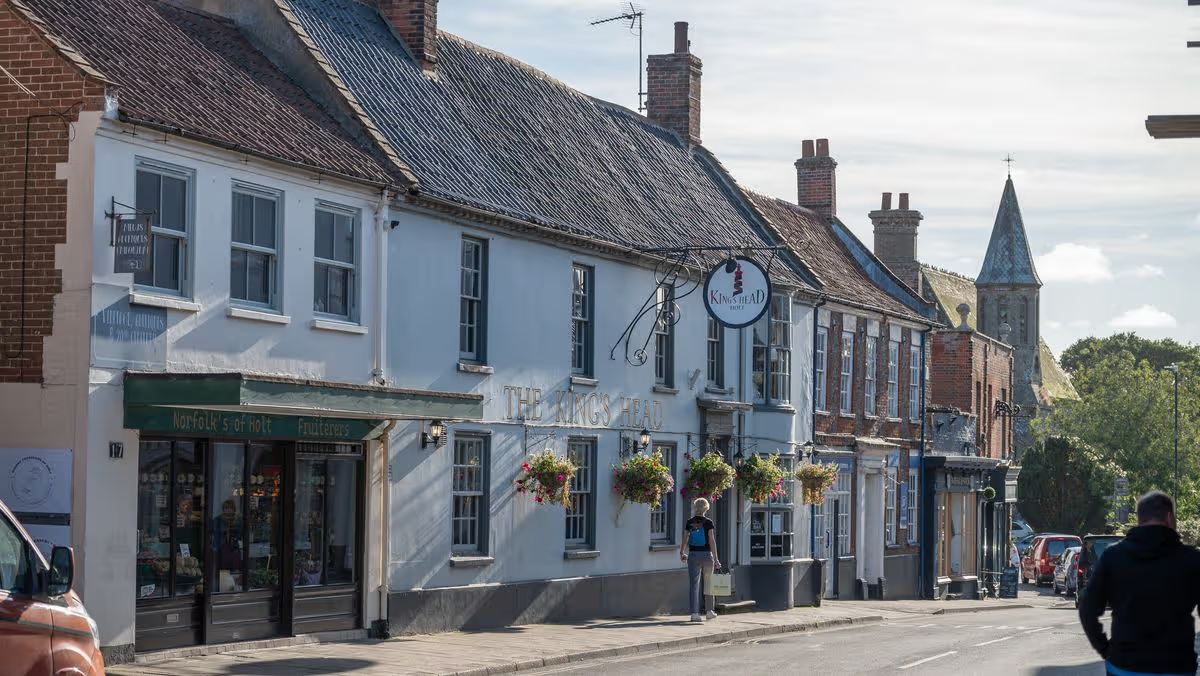
‘I went to the prettiest town in all of England that’s just 2hrs from Cambridge’

Published

on

Cambridgeshire Live

A town near Cambridge has been named one of the prettiest in all of England, and it boasts gorgeous nature, historic architecture, and has over 200 independent stores to explore

While Cambridge is full of gorgeous architecture and various parks to explore, it can sometimes be nice to leave the city to explore somewhere new, as the surrounding area is brimming with stunning places just waiting to be discovered. Most people might find it more appealing to go on day trips and staycations in the summer months, when the weather is warmer, but the colder months can also be a great way to explore new places, as there tend to be less crowds around.

And to share his top recommendations, one avid UK-based traveller named Alexander McHale often shares his top recommendations of places he thinks is worth a visit. In a recent video published onto his social media platforms, Alexander went on to boast about a smaller town that’s near Cambridge, which he argued is one of the prettiest towns in all of England.

Advertisement

“One of England’s prettiest towns,” he wrote in the overlay text of the video, as he shared snippets from his visit.

Content cannot be displayed without consent

The town in question is Holt, a historic Georgian market town in north Norfolk, located 79 miles northeast of Cambridge and close to the coast.

The town is home to many art galleries, antique and book shops and places to eat located along the high street and tucked away in hidden, charming courtyards and alleyways. And with over 200 independent shops, there are also plenty of shopping opportunities.

If you’re looking to enjoy nature, there are also several landmark spots, as the town is bordered by Holt Country Park and close to the Norfolk Coast.

Advertisement

In his video, Alexander was seen walking around the various shops on the high street, enjoying a sweet treat from one of the many cafes and coffee shops in the town, and taking in the gorgeous architecture.

After a major fire ruined most buildings in the town in 1708, the town was rebuilt using strict rules of proportion, symmetrical facades, and mathematical precision. It now still features gorgeous 18th-century Georgian buildings, courtyards, and alleyways that are waiting to be explored.

But some historic artifacts managed to survive the fire, including various 18th-century fire insurance plaques affixed to brick facades.

Advertisement

The town also boasts the Poppy Line steam train from the local train station, where visitors can enjoy scenic rides toward Weybourne and Sheringham.

To get to Holt from Cambridge, you can either do a two hour drive to get there, or take a train to Norwich before taking a second train to Holt.

Several people were quickly amazed by the town, as viewers took to the comment section to share their thoughts.

Source link

Advertisement
Continue Reading

NewsBeat

what families want staff to understand

Published

on

what families want staff to understand

A mother discovered her son was restrained 33 times in six weeks. Another was told her distressed daughter is “aggressive” as six staff pin her to the floor and inject her with medication. Through tears, families describe images they cannot forget: bruises, broken bones, loved ones left sitting in urine-soaked clothes, isolated and afraid.

These are recent experiences shared by family carers supporting relatives with learning disabilities, autism and mental health conditions in mental health hospitals.

My colleagues and I spoke to 27 family carers about their experiences. Again and again, they described the fear that something might happen to the person they loved, alongside the frustration of knowing how to help but being unable to make that knowledge count.

Families told us that they had spent years learning how their relatives communicated fear, pain, distress and safety. They could often distinguish sensory overload from physical pain or anger. They recognised subtle signs that someone was becoming overwhelmed and knew which routines helped them feel secure and which situations could trigger panic.

Advertisement

This kind of knowledge is built through years of daily care and close attention. Yet many carers felt that their expertise lost its value as soon as their relative entered hospital.

Participants told us they were consulted during assessments but then excluded from decisions about care. Concerns raised after an incident were not always reflected in plans designed to prevent the same thing happening again. Some carers said they were labelled “difficult” or “disruptive” when they challenged the treatment their relative received.

Many described becoming reluctant advocates because they feared what might happen if they remained silent. Similar concerns about families struggling to obtain answers after serious incidents and deaths involving autistic people have been identified in previous research.

This led families to question how distress itself was being understood.

Advertisement

What professionals sometimes described as “challenging behaviour”, families recognised as fear, sensory overload, frustration, pain, confusion or an attempt to communicate an unmet need.

If distress is understood mainly as a risk that needs to be controlled, restrictive responses such as physical restraint become increasingly likely. Restraint means using physical force to limit someone’s movement and is generally intended as a last resort when there is an immediate risk of harm. Research has shown that the use of restrictive practices, including restraint and seclusion, can itself cause physical and psychological trauma.

Families described alternatives that could help. They valued communication passports, short personalised documents explaining how someone communicates and what staff need to know about their needs, alongside care plans setting out their fears, preferences and sensory needs. When staff used these well, carers felt signs of distress could be recognised earlier and some crises avoided altogether.

Families often knew the subtle signs that a relative was in pain or becoming overwhelmed, and what helped them feel safe.
PeopleImages/Shutterstock

The problem described by families went beyond individual communication failures. They spoke about wider problems in how services were organised, how decisions were made, by whom and how concerns were handled.

Advertisement

Several described the trauma of seeking help for someone they loved and then believing that the care itself had caused harm. One participant expressed their anger by calling the system “the most corrupt, barbaric system going in the world”.

Carers also questioned what happened after things went wrong. Although healthcare policies emphasise openness and learning from mistakes, participants described accountability as “a hollow word”. Some struggled to obtain clear explanations and felt that complaints did not lead to meaningful change.

Their accounts echo concerns raised by the Care Quality Commission, the independent regulator of health and social care in England. Its Out of Sight review (published in 2020) documented longstanding concerns about restrictive practices and the treatment of autistic people and people with learning disabilities in hospital settings.

These concerns extend beyond the UK. The World Health Organization has highlighted efforts to move mental health services away from coercion, meaning practices that restrict a person’s freedom or compel treatment, towards approaches based on human rights, participation and relationships. The United Nations has also raised concerns about coercive practices and the rights of disabled people.

Advertisement

There is evidence that involving families may form part of the solution. A review of 53 studies examining ways to reduce restrictive practices found that family involvement was associated with lower use of restraint and other forms of coercion.

That finding reflects a central question raised by our research: whose knowledge is treated as valuable?

Family carers may hold thousands of small pieces of information about a person: how they show fear, what causes sensory distress, which routines provide reassurance and what apparently aggressive behaviour may be communicating.

Yet many participants described being pushed to the margins of decision-making or forced to fight to have that knowledge taken seriously. They believed this exclusion could increase the likelihood of distress escalating, deepen trauma and damage trust between families and services.

Advertisement

Efforts to reduce restraint increasingly recognise that coercion is shaped by relationships, institutional cultures and the way services are organised. Family knowledge may therefore be an important and underused resource for recognising distress before it becomes a crisis.

For the carers we spoke to, being listened to was ultimately about the safety and wellbeing of the person they loved.

If mental health services want to reduce the use of restraint, they need reliable ways of using the detailed knowledge families have accumulated over years of caring. That knowledge can help staff understand what a person is trying to communicate before distress reaches the point at which force is considered necessary.

Advertisement

Source link

Continue Reading

Trending

Copyright © 2025