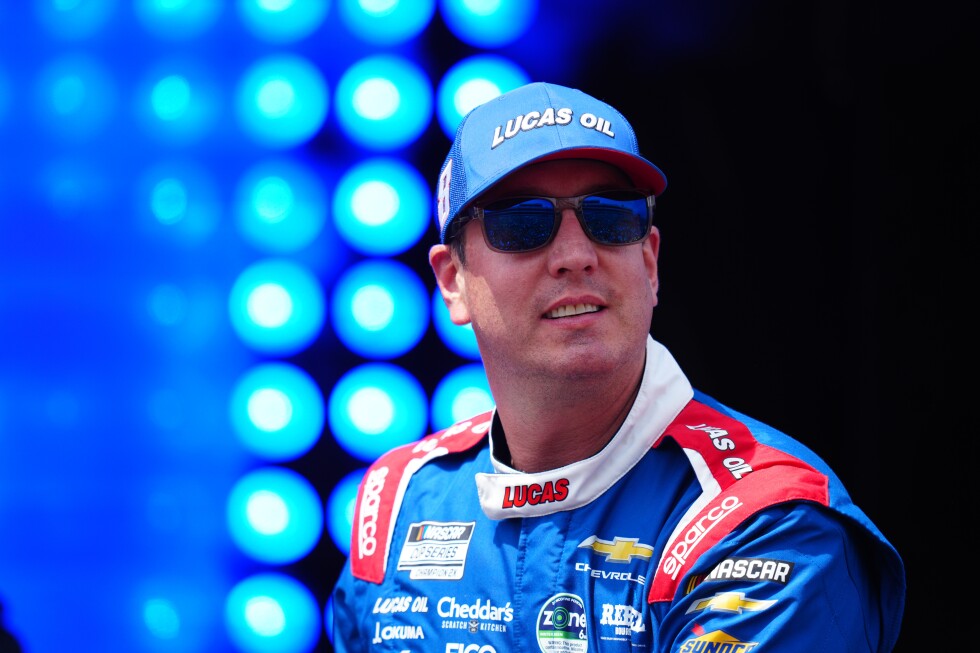
CONCORD, N.C. (AP) — Kyle Busch died after severe pneumonia progressed into sepsis, resulting in rapid and overwhelming complications, according to a statement released by his family.
Dakota Hunter, vice president of Kyle Busch Companies, said in a news release the family received the medical evaluation on Saturday.
Busch, a two-time NASCAR champion, died at 41 on Thursday, a day after passing out in a Chevrolet simulator.
Sepsis is considered a life-threatening medical emergency that occurs when the body has an extreme, overactive response to an infection, causing the immune system to damage its own tissues and organs, according to the Centers for Disease Control and Prevention.
Advertisement
Typically the immune system releases chemicals to fight off pathogens like bacteria, viruses or fungi, but with sepsis the response goes into overdrive. The results can cause widespread inflammation, form microscopic blood clots and make blood vessels leak.
Busch was thought to have had a sinus cold while racing at Watkins Glen on May 10 and radioed in to his team saying that he needed a “shot” from a doctor after the race. However, he bounced back to win the Trucks Series race at Dover last weekend, and then he finished 17th in the All-Star race on Sunday.
Busch, who was preparing to race Sunday at the Coca-Cola 600 at Charlotte Motor Speedway, was testing in the Chevrolet racing simulator in Concord on Wednesday when he became unresponsive and was transported to a hospital in Charlotte, several people familiar with the situation told The Associated Press.
During the emergency call placed late that afternoon, an unidentified caller calmly told the dispatch: “I’ve got an individual that’s (got) shortness of breath, very hot, thinks he’s going to pass out, and is producing a little bit of blood, coughing up some blood.”
Advertisement
The caller said Busch was lying on the bathroom floor inside the complex and told dispatch “he is awake,” according to audio provided by the Cabarrus County Sheriff’s Office. The man then gave directions on where emergency responders should go and asked that they turn off any sirens upon arrival.
NASCAR driver Brad Keselowski said he knew Busch wasn’t feeling well recently.
“Yes, but I won’t go into any specifics,” Keselowski said. “But then when he ran the Trucks race last week, those (thoughts) were honestly kind of erased in my mind.”
Keselowski said running multiple races on the same weekend can be difficult on a driver’s health — but most don’t want to miss a race for fear of being replaced.
Advertisement
“There’s no shortage of drivers that would love to take my seat or anybody else’s seat if we weren’t feeling well, and I think every driver feels that pressure,” Keselowski said. “All athletes do. It’s not unique to NASCAR in that sense. We’re all thinking to ourselves, ‘I don’t wanna be replaced.’ … So you try to power through it the best you can.”
Keselowski said Busch’s unexpected death has forced him to pay attention to his own health moving forward.
Chase Briscoe said Busch’s health issues served as a “wake-up call” for him and other drivers, who often put aside dealing with potential issues because they are so busy traveling around the country and competing on a weekly basis.
He said if something feels off, “you need to get checked out.”
Advertisement
Busch’s Richard Childress Racing teammate Austin Dillon was not made available for comment.
Austin Hill will replace Busch on Sunday and drive the No. 33 car. RCR is temporarily retiring Busch’s No. 8 until his 11-year-old son Brexton is old enough to race.
All 39 cars in the field for Sunday’s race will include a small black No. 8 decal to honor Busch.
Drivers spoke at length on Saturday about his accomplishments, praising his toughness, competitive spirit and penchant for speaking his mind — all of which led to him earning a reputation as NASCAR’s villain.
“He was a polarizing figure that no matter if you like him or disliked him as a racer, he was always talked about,” Ryan Blaney said. “Just this guy that was always there and won too much, which is why people didn’t like him. And he always spoke his mind. I think people came to respect that about him, that he was true to who he was and that never changed.”
Blaney added that Busch’s personality outside of the car and his competitiveness behind the wheel made him “a larger-than-life person in racing.”
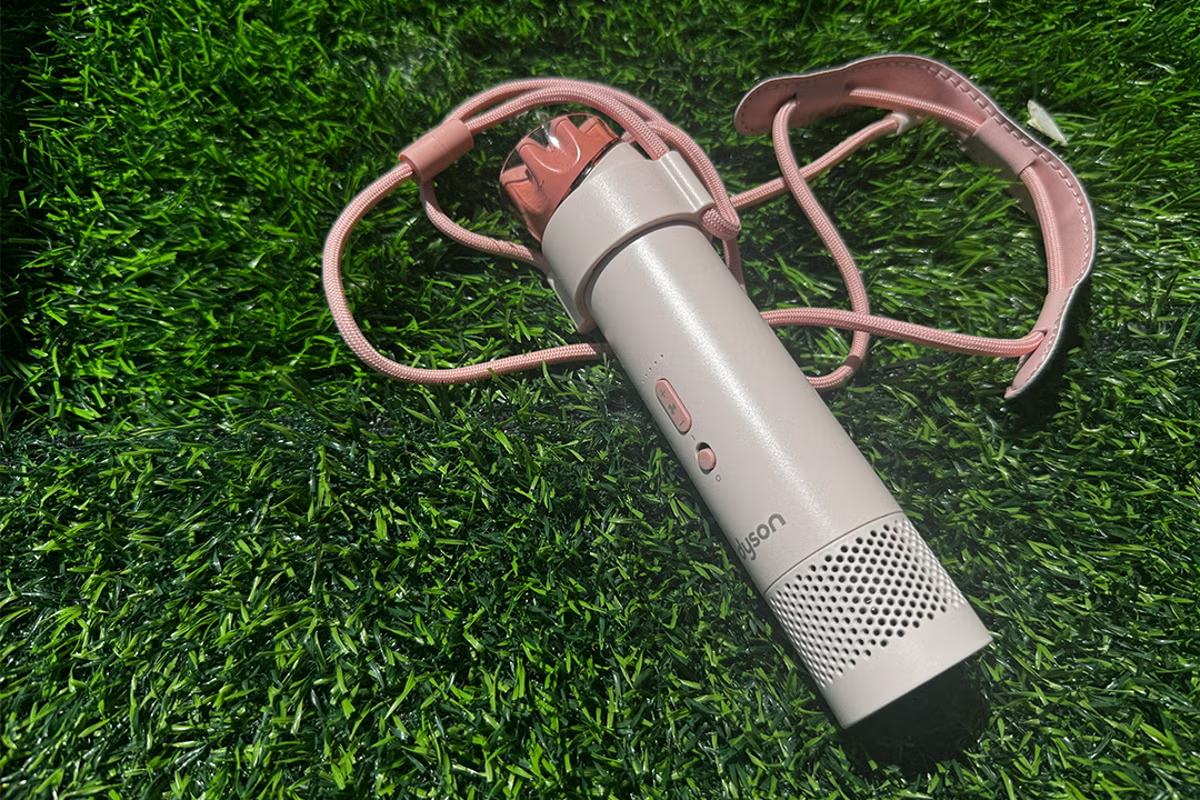
Dyson’s handheld fan doesn’t look like a regular bladed model. Tall and cylindrical, it doesn’t have spinning blades but a precision nozzle with a honeycomb mesh liner that can be rotated 360 degrees so you can point it whichever direction you like.
You can place it on your desk or attach the included lanyard and wear it around your neck – and it’s probably the best wearable implementation I’ve seen on a handheld fan so far.
You can hang it around your neck using the included lanyard (Alex Lee/The Independent )
Coming in ink/cobalt, carnelian/sky and stone/blush – I’ve been testing the latter, a delicate pink colour that matches Dyson’s other vibrantly-coloured gear. A doddle to set up, it charges via USB-C at the base of the fan. Flick the switch up to turn it on and out comes a nice, strong airflow.
What’s special about Dyson’s handheld fan compared to most is the sheer power it delivers – not a surprise, given Dyson’s cooling heritage and its range of fans for the home. There are six different fan speeds. The sixth (boost mode) can only be activated by holding down the plus button. Dyson obviously doesn’t want you to use it all the time.
Advertisement
Inside the fan is a brushless DC motor that Dyson says spins up to 65,000RPM, and on boost mode, that delivers wind speeds of 55mph. It’s really impressive. Boost mode is so intense and actually gives me a little shiver whenever I used it. Most of the time, level five has been sufficient enough to keep me adequately cool.
It does get quite loud on level five and boost mode, but I’ve tested a lot of handheld fans for The Independent, and the hushjet mini cool is one of the quietest I’ve tested at its high airflow speeds.
You get six hours on a single charge when using the lowest fan speed – a setting I barely touched in the heatwave. On the higher settings, it’ll only last an hour. You can charge the fan and use it at the same time, but annoyingly, it won’t let you use it beyond level one. It takes roughly three hours to charge to full once depleted. It’s an impressive bit of machinery, but worth the price?
At £99, I’m not too sure. My favourite handheld fan (the Commem turbo fan) costs a tenner and delivers what feels to me like a similar amount of airflow on the highest setting. Although it’s significantly louder than the Dyson hushjet mini cool, I don’t really mind the noise. If you do, then the Dyson might be the better choice, but it’s just as powerful and doesn’t cost nearly as much.
Advertisement
When comparing the Dyson hushjet mini cool to Shark’s £130 three-in-one chillpill, I found that, while it isn’t as powerful as the Dyson in terms of raw fan speed, it actually made me feel cooler. That’s largely down to the misting feature, which sprays a fine mist of water at your face. The Dyson hushjet mini cool is more of a traditional handheld fan – the airflow is incredibly strong, but when the air itself is hot, it sometimes feels as though I was simply having warm air blown back at me.
That doesn’t make the hushjet mini cool bad – far from it. It has excellent build quality, powerful airflow and quiet operation at higher speeds. But it’s very expensive for what it is. If you just want something to keep you cool, cheaper options will do the same job, making the Dyson a tricky handheld fan to recommend.
Key specifications
Speed settings: 6
Battery life: 5 hours on lowest speed, 1 hour on highest speed
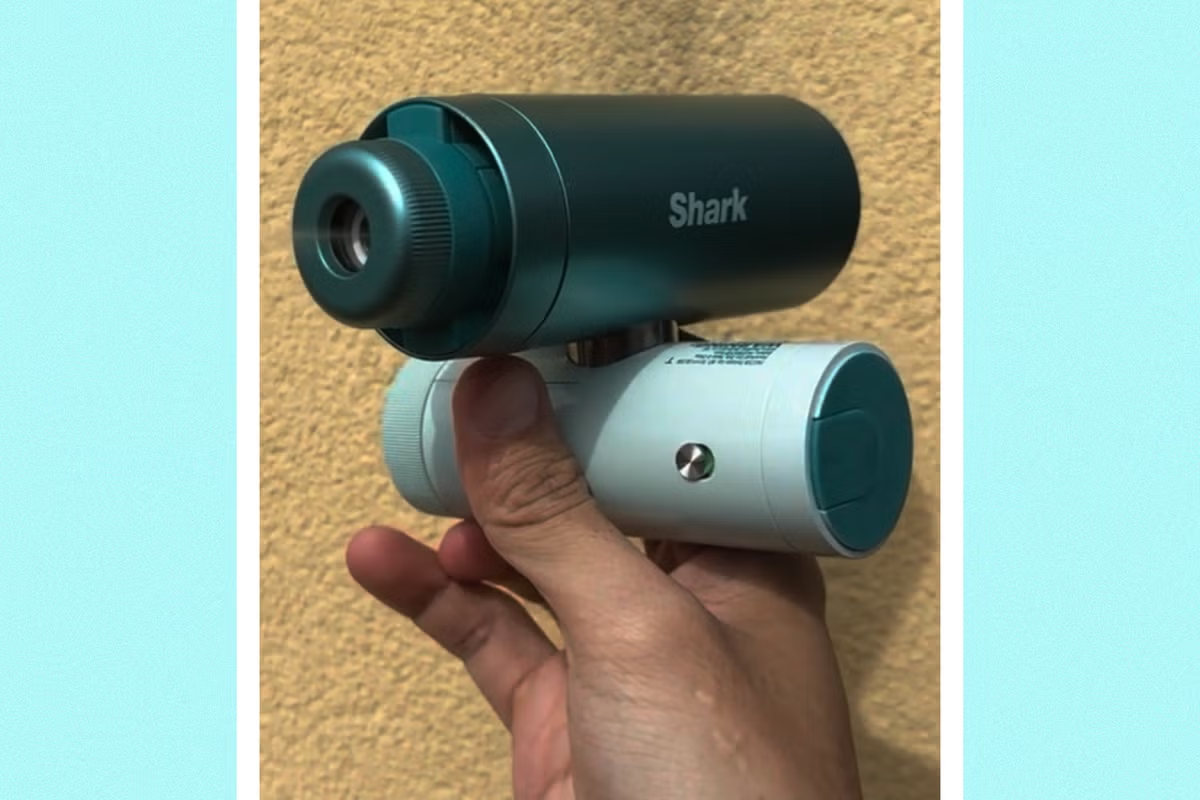
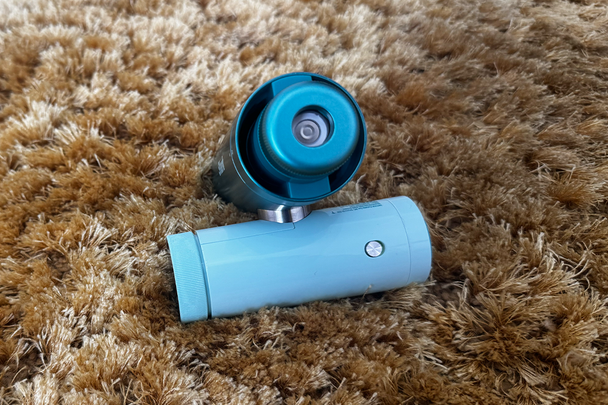
The chillpill has, let’s say, a rather unique design – it looks a bit like a compact pair of binoculars, with two rounded barrels sitting side by side and connected by a hinge. The smaller barrel houses the controls and charging port, while the larger one contains the motor and interchangeable attachments. There’s a dial around the LED display on the smaller barrel too, letting you crank the fan speed up from one to 10.
You can angle the fan exactly where you want it, or twist it into a right angle and sit it on a desk, using the smaller barrel as a base. Shark also sells accessories, like a crossbody strap (£9.99, Sharkclean.co.uk), so you don’t have to constantly hold it in your hand.
While it’s kind of awkward to hold at first, the tech is actually pretty neat. Unlike most handheld fans, which just blow a nice breeze in your direction, the chillpill uses a modular attachment system – yes, exactly like you’d get with a Shark vacuum.
It ships with the standard fan head attached, but you also get a misting attachment and a cooling plate in the box, so you can swap between them depending on how you want to cool down. The cooling plate is the most power-hungry of the three, lasting around an hour and a half per charge, which makes sense given it’s actively generating a cooling effect. With the fan and misting attachments, you can get up to 11 hours of battery, depending on the speed setting.
Advertisement
You get a standard fan head, misting attachment and cooling plate included (Alex Lee/The Independent )
With Shark’s experience in airflow, it’s no surprise the fan is seriously powerful – far more so than the cheap handheld ones you’d buy off someone on Oxford Street in July. It does get loud at higher speeds, but that’s the trade-off for that extra punch.
I think the most interesting attachment is the misting spray. You open the lid, fill it up with cold water, then screw it onto the barrel. Turn it on and you get a fine spray of water, along with the airflow. It feels like a cold shower just for your face. Having used it in 23C heat, it’s easily the device’s best feature. The airflow and mist deliver a really refreshing cooling effect, and it makes a noticeable difference compared to a standard handheld fan. That said, while you can turn down the fan speed, it still releases the same amount of water, so it’s easy to get bathed in water if you leave it running continuously.
The misting attachment releases a fine spray of water, along with airflow (Alex Lee/The Independent )
Thankfully, you can switch between a constant spray and an intermittent mode, which helps rein it in a bit (and saves battery too).
I was most excited about the cooling plate, which is one of the interchangeable attachments designed for direct, contact-based cooling rather than airflow. Once you screw it on, you can choose between two cooling settings, and the metal plate gets noticeably cold to the touch.
It’s great for targeted relief – press it against your neck or wrist and you get an instant cooling effect, but unlike Sony’s reon pocket pro, you have to hold it in place. That makes it less effective for longer, hands-free cooling, even if the sensation itself already feels nice.
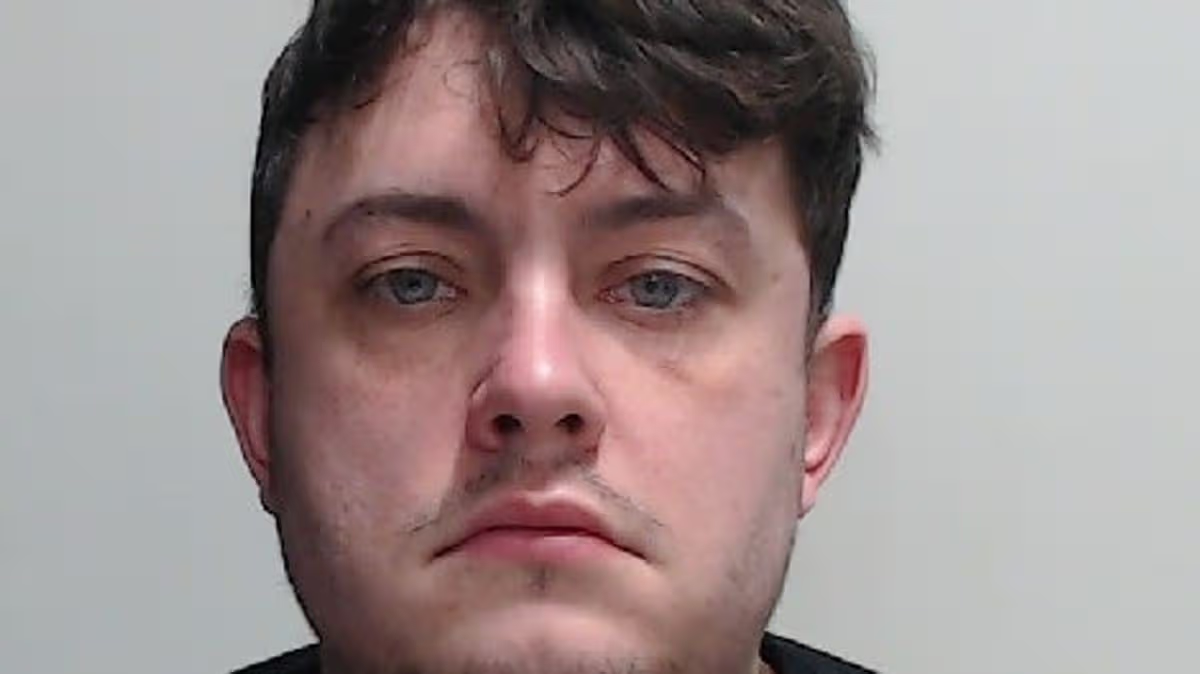
Lewis Burns pleaded guilty after deliberately driving his car towards his victim in Edinburgh in February.
A man has been jailed after using “his car as a weapon” in an attempt to murder a man in Edinburgh. Lewis Burns, 31, pleaded guilty to a number of charges in May following the murder bid in February.
Advertisement
Emergency services were called to Lochend Drive in the city’s Lochend area shortly before 10pm on Tuesday, February 3 after Burns deliberately drove his car at a 36-year-old man twice.
Burns made off from the scene and the victim was taken to hospital for treatment.
Nine days after the attack, Burns was one of two men arrested by police. The second man, a 35-year-old arrested in connection with attempting to pervert the course of justice, was later released.
In May, Burns pleaded guilty to assault to severe injury, permanent disfigurement and attempted murder. At sentencing today, Burns was jailed for six years for the murder bid and banned from driving for eight years.
Detective Inspector Gavin Howat said: “Burns deliberately drove at his victim not once but twice. He used his car as a weapon that day and he is now facing the consequences of his actions. I hope today’s outcome affords the victim a degree of justice as they continue to move forward with their life.”
A spokesperson for Police Scotland said: “A 31-year-old man has been sentenced to more than six years for attempted murder and other offences at the High Court in Edinburgh.
“Lewis Burns pleaded guilty in May this year to assault to severe injury, permanent disfigurement and attempted murder.
Advertisement
“It follows an investigation into an incident which occurred on Tuesday, February 3, when police were called to a report of a collision involving a pedestrian and a vehicle on Lochend Drive.
“Burns was also banned from driving for more than eight years.”
Get Daily Record Premium for just £1 per month in exclusive offer to celebrate the world cup. Click HERE.
A man has been arrested on suspicion of attempted murder after the incident
21:22, 18 Jun 2026Updated 21:28, 18 Jun 2026
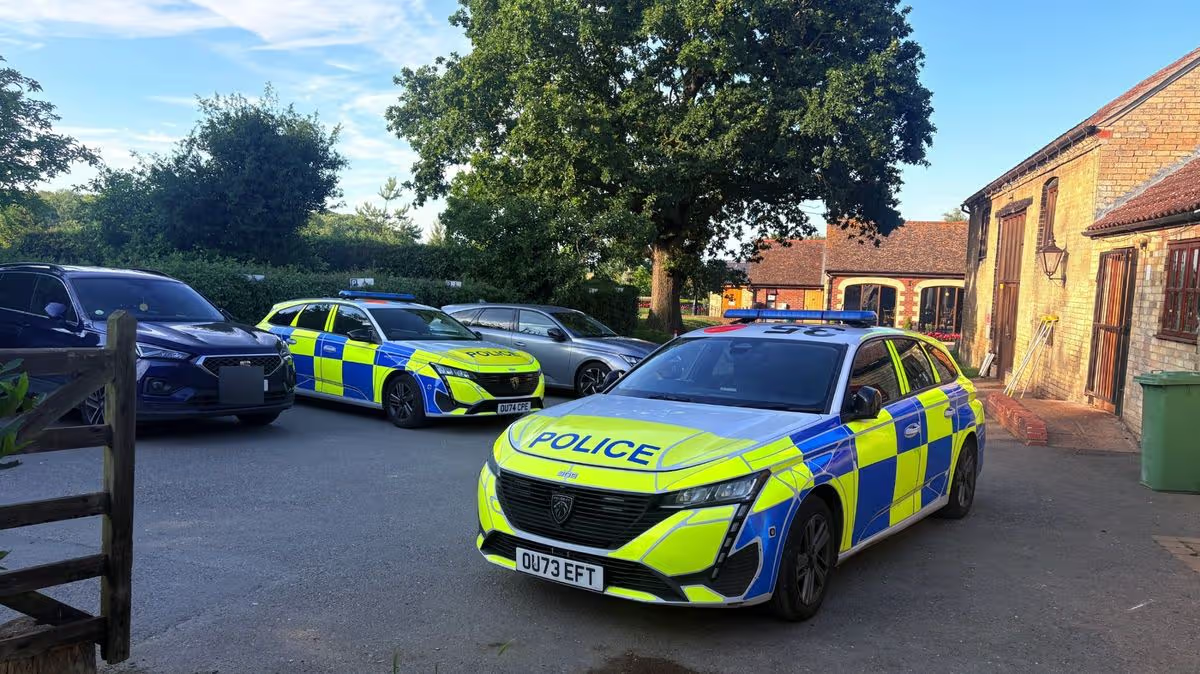
A councillor said she hopes the family of a three-year-old boy in critical condition gets “some closure” after an incident involving a zoo’s crocodile enclosure. An investigation has been launched after police were called to the zoo at 1.24pm on Thursday, June 18, to reports of an incident involving a three-year-old boy.
A force spokesperson said the boy “ended up” in the crocodile enclosure. It is not yet clear exactly how this is believed to have happened.
The boy has been taken to Addenbrooke’s Hospital with serious injuries and is critical but stable. Specially trained officers are at the hospital supporting the boy’s family.
Advertisement
A 30-year-old man from Norfolk has been arrested on suspicion of attempted murder. Detectives from the Major Crime Unit are investigating. The force does not believe the man arrested and the child are known to each other.
Councillor Charlotte Lowe, who represents the Warboys Ward on Huntingdonshire District Council, spoke to CambridgeshireLive at the scene. She said her “stomach just dropped” as she heard the news.
The councillor said she “just couldn’t believe it”. She said “I just thought, it can’t be here, it can’t be Johnson’s”. Cllr Lowe, who became aware of the incident at around 5pm, said her thoughts automatically questioned “how on earth has this happened?”
Advertisement
The moment she was told, Cllr Lowe said she “just had to show her support” even if “it was to give somebody a hug”. Cllr Lowe added: “I couldn’t not come with something like this. It will affect everybody, the locals, the villages especially, and all the villages around.
“Everybody that comes here is going to think ‘Oh my, how could this happen?’ It is like all other incidents that have happened in Cambridgeshire; you remember it.”
Cllr Lowe described the incident as “unbelievable”. She said she hopes that the investigation will give the family “some sort of result, and some closure” by answering the questions of what has happened and why it has happened?
Explaining her thoughts, the councillor added that “with the health and safety, you can’t possibly think that something like this would happen”.
Advertisement
Just days before the incident, on Tuesday, June 16, Johnsons won an award for ‘Best Family Experience’ across Cambridgeshire and Suffolk. Cllr Lowe said she “just can’t imagine” what everyone involved is feeling, adding “not just the family” but the “workers here and the owners”.
Det Insp Verity McCann said: “At this stage we are speaking to people who were at the zoo at the time of this distressing incident to understand more about the circumstances.
“We do not believe the man arrested and the child are known to each other. Officers are supporting the boy’s family at hospital, and our thoughts remain with them.”
Advertisement
A local resident, who asked not to be named, described the incident as “horrendous”. They said there are dangerous animals at the zoo but “I don’t think anyone could have predicted it”, the resident added. They feel as though this will “not be good” for Johnson’s.
Johnsons has confirmed that the Tropical House part of the site will be closed until further notice. A spokesperson said: “Our thoughts and prayers are with the boy and his family following the incident that occurred today.
“Out of respect to the family, our Tropical House will remain closed until further notice. If you have any questions about the incident, please direct enquiries to Cambridgeshire Police Constabulary. The rest of the site will remain open as normal.”
Officers found a man in his 20s with injuries ‘consistent with a knife’, Greater Manchester Police (GMP) said.
Click here to get the biggest stories straight to your inbox in our Daily Newsletter
He was taken to hospital for treatment. His injuries are not believed to be life-threatening or life-changing.
Advertisement
A 22-year-old man has been arrested on suspicion of possession of an offensive weapon.
A 24-year-old woman has also been arrested on suspicion of affray. They are both currently in custody for questioning.
Tony Farrell, 55, who lives in the Northern Quarter, was passing the Gardens earlier this evening and said he suddenly heard ‘sirens coming from all directions.’
Advertisement
He said: “I saw a man on the floor. I didn’t think much of it at first but then I saw police officers around him, tending to him and giving him first aid.
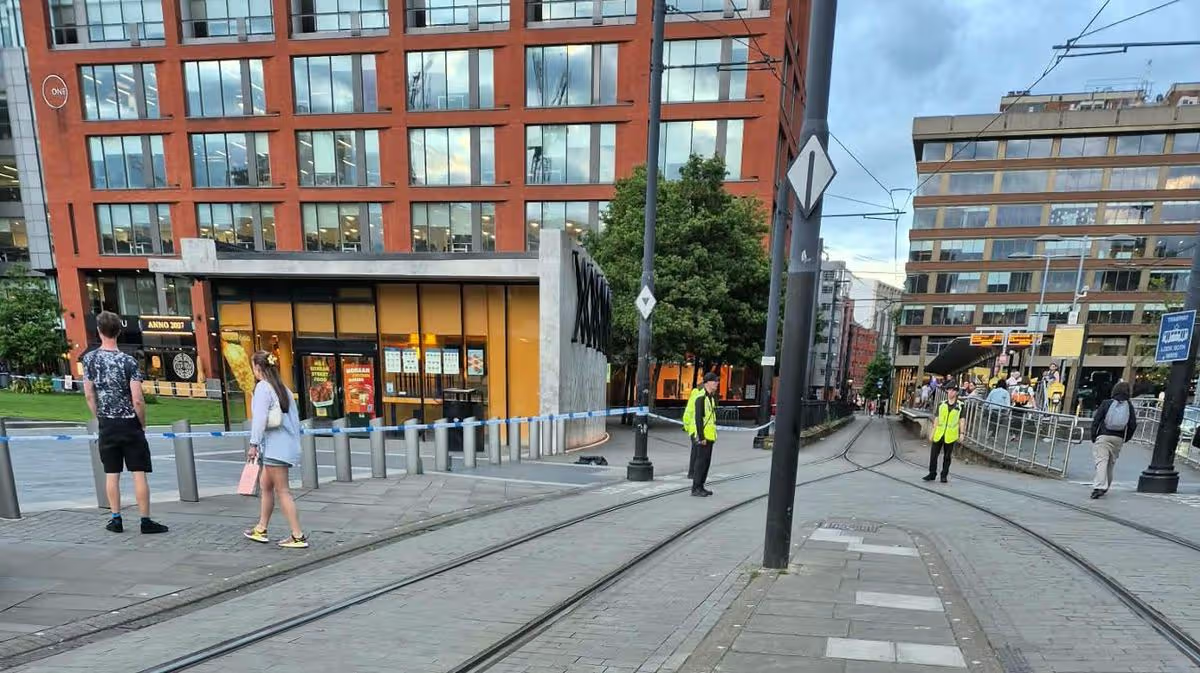
“He looked like he was holding his back. Paramedics attended as well and police taped off a big section of the Gardens, near the tram stop. There were detectives there as well.”
“It was just shocking” he said. “But it’s no surprise. It looks like there’s no end to it.”
A dispersal order has been authorised for Piccadilly Gardens and the surrounding area following the incident.
Advertisement
It will be in force until 8.40am tomorrow morning (Friday) and it covers Princess Street, Miller Street, Great Ancoats Street, the Mancunian Way, Fairfield Street and Whitworth Street as well as the Gardens.
Initially a large section of the Gardens including the track next to Piccadilly Gardens tram stop was taped off.
That led to Metrolink services being disrupted. The cordon has now been scaled down with services running again.
The Bee Network website says however: “Due to an earlier police incident, we are experiencing a minor delay on the Altrincham, Bury, Ashton, and Eccles Line.”
Two key players have been included in the Kingdom’s match-day 26 for Saturday’s huge Round Three clash with Ulster champions Armagh in Killarney
Kerry have been handed a major boost ahead of Saturday’s showdown with Armagh with two key players returning to their match-day squad.
Advertisement
All-Star goalkeeper Shane Ryan and fellow All-Star Sean O’Shea have been named in Jack O’Connor’s 26 while the Kingdom have one change in their starting team from last weekend’s victory over Kildare with Paul Murphy replacing Evan Looney.
Skipper Paul Geaney was a late replacement for Tony Brosnan the last day and retains his place.
O’Shea has been sidelined with a foot injury since the League final loss to Donegalwhile Ryan hasn’t played in 2026 so far with a quad injury.
Dublin, meanwhile, have made two changes for Sunday’s clash with Donegal in Croke Park with Eoin Kennedy and Sean Bugler favoured in place of Lee Gannon and Peadar Ó Cofaigh Byrne.
Advertisement
Elsewhere, Monaghan boss Gabriel Bannigan has named an unchanged team for Saturday’s clash with Leinster champions Westmeath in Clones.
The Farney return to St Tiernach’s Park one week on from beating Connacht champions Roscommon and Bannigan has kept the faith with the same starting 15 with Stephen Mooney and Stephen O’Hanlon retaining their places after being drafted in prior to throw-in against the Rossies.
There are three changes to the Dublin hurling team for their All-Ireland quarter-final meeting with Clare in Thurles on Saturday with Eoghan O’Donnell, Sean Currie and Ronan Hayes replacing Liam Rushe, Darragh Power and Brendan Kenny.
Kerry (v Armagh): S Murphy; P Murphy, J Foley, D Casey; B Ó Beaglaoich, M Breen, G O’Sullivan; M O’Shea, S O’Brien; J O’Connor, P Clifford, D O’Connor; D Clifford, P. Geaney , D Geaney. Subs: S Ryan, E Healy, E Looney, K Evans, T Brosnan, C Trant, A Heinrich, G White, K Spillane, T Morley, S O’Shea, T Kennedy.
Advertisement
Dublin (v Donegal): E Comerford; G McEneaney; N Doran, D Byrne; S MacMahon, C McMorrow; E Kennedy; T Clancy, B Howard; S Bugler, C O’Callaghan, N Scully; P Small, C Kilkenny, C Costello.
Monaghan (v Westmeath): R Beggan; R Wylie, K Lavelle, D Byrne; D Ward, R O’Toole, C McCarthy; M McCarville, K Gallagher; S O’Hanlon, M Bannigan, O McGorman; J McCarron, A Woods, S Mooney
Dublin (v Clare): E Gibbons; C McHugh, P Smyth, E O’Donnell; C Crummey, P Doyle, C Burke; B Hayes, C Donohoe; F Whitely, D Burke, S Currie; R Hayes, J Hetherton, C Ó Riain.
Want to see more of the stories you love from Belfast Live?Making us your preferred source on Googlemeans you’ll get more of our exclusives, top stories and must-read content straight away. To add Belfast Live as a preferred source, simplyclick here.
After dining lavishly on lobster, caviar and truffles in the opulent surrounds of the Palace of Versailles last night, Donald Trump affixed his signature to the much-anticipated memorandum of understanding that will, all being well, begin a 60-day ceasefire between the US, Israel and Iran.
The document was subsequently signed in Tehran by the Iranian president, Masoud Pezeshkian.
“This was not easy,” the US president reportedly remarked as he wielded his trademark Sharpie marker pen – a statement that may go down as a huge understatement. The text of the deal reveals the Iranian negotiators drove a very hard bargain in return for opening the Strait of Hormuz, which the world now hopes will enable the global economy to recover from the considerable disruption of the past three and a half months.
This war has been an utter disaster for the US and Israel, writes Arshin Adib-Moghaddam of SOAS, University of London, who has been researching and writing about Iranian affairs for many years. Trump and his ally, Israeli prime minister Benjamin Netanyahu, have failed to secure any of the outcomes they set out to achieve when they attacked Iran on February 28. In fact it has arguably left Iran, while battered, stronger strategically than it was before the war.
Advertisement
It’s not as if Iran-watchers haven’t warned of the danger of using blunt force against Iran. As Adib-Moghaddam notes here, he and fellow scholars and analysts have been stressing for years that the Islamic Republic was well prepared for the sort of asymmetrical conflict we have now seen it wage. And now, of course, it has demonstrated to itself – and the rest of the world – what a potent deterrent it has in its ability to shut down the strategically vital Strait of Hormuz.
The state banquet at Versailles followed the 2026 summit of the Group of Seven (G7), which has been taking place this week in the French spa town of Évian-les-Bains. As Natasha Lindstaedt of the University of Essex notes, this was a clever move dreamed up by the French president, Emmanuel Macron, who was desperate to avoid a repeat of last year’s summit in Alberta, Canada, when the US president walked out a day early.
On that occasion he refused to sign the usual unified G7 statement, complaining that he didn’t like the language on Ukraine. There was no such reticence this year. Macron was cock-a-hoop at what he called a “very deep change in the US approach”. It was, he said, “re-synchronisation” for the G7 on the war in Ukraine, which released a statement pledging unwavering support for Ukraine in defending its territorial integrity, which Trump also signed after what the US president said was a “very good” meeting with Ukrainian president, Volodymyr Zelensky on the summit’s sidelines.
Advertisement
Key to achieving this unity, says Lindstaedt, was the approach of the other G7 leaders towards the US president: flattery. As we know, this is something that has proved highly effective in the past.
If Trump’s dining companions at Versailles were effusive in their congratulations for the US president’s deal, the reaction from many prominent Republicans in the US has been less than positive. “Reagan is rolling over in his grave,” commented Senator Bill Cassidy, who added that the war had been “the worst foreign policy blunder in decades”. It’s a view shared by much of the party’s old guard, who see the deal as a capitulation.
Quite how Iran managed to gain the upper hand in a conflict against two of the world’s best-armed militaries will make for an important case study for students of war. Jim Lamson and Matthew Moran of King’s College London explain how Iran managed to turn the tables and emerge not only undefeated, but arguably stronger.
Meanwhile, if the US president’s critics in the US are unimpressed, Israelis – friend and foe alike – are positively livid. David Horovitz, the editor of The Times of Israel, called it “a catastrophic capitulation”. Others have been less polite.
Benjamin Netanyahu has made no public comment since the deal was signed. It has been reported that he wasn’t shown the finalised agreement before it was signed (Trump commented this week of their alliance that: “We are the big partner and he is the very small partner”, which will give him an idea of where he stands).
The fact is, writes Simon Mabon, a Middle East specialist at Lancaster University, that despite being close allies, the US and Israel – but particularly Trump and Netanyahu – are at loggerheads over what they want from the war from any peace agreement that ends it. Most Israelis see any bid by Iran to develop a nuclear weapon as an existential issue, for which there can be no compromise. The war, meanwhile, is deeply unpopular in the US, where rising fuel prices and inflation are really beginning to hit home.
Advertisement
The war has also hurt Trump’s popularity which is at a new low, just months before November’s midterm elections, at which the Republicans are likely to lose control of at least one chamber of Congress, if not both. Netanyahu also faces an election in October. So the idea of a ceasefire with no resolution of the nuclear issue is anathema.
To further complicate the situation, the deal stipulates an end to the conflict being waged in southern Lebanon and makes the US responsible for guaranteeing that country’s territorial integrity. This would require Israel to withdraw, something the Israeli prime minister has firmly ruled out, setting the scene for some serious discord between the two leaders.
All of which means we may well be hearing some more fairly ripe language from Donald Trump, who has recently told the Israeli prime minister he is “fucking crazy” and that he has “no fucking judgement”.
Advertisement
Strong words. But not without precedent. As Andrew Gawthorpe, an expert in US politics at Leiden University notes here, Netanyahu has a long track record of moving US presidents to profanity.
The red coloured vehicle, a 2010 Nissan Qashqai Diesel, is sitting in a prominent position within the street.
21:41, 18 Jun 2026Updated 21:54, 18 Jun 2026
Motorists in Ayr are being driven round the bend by a seemingly abandoned car that is causing an obstruction in Parkhouse Street.
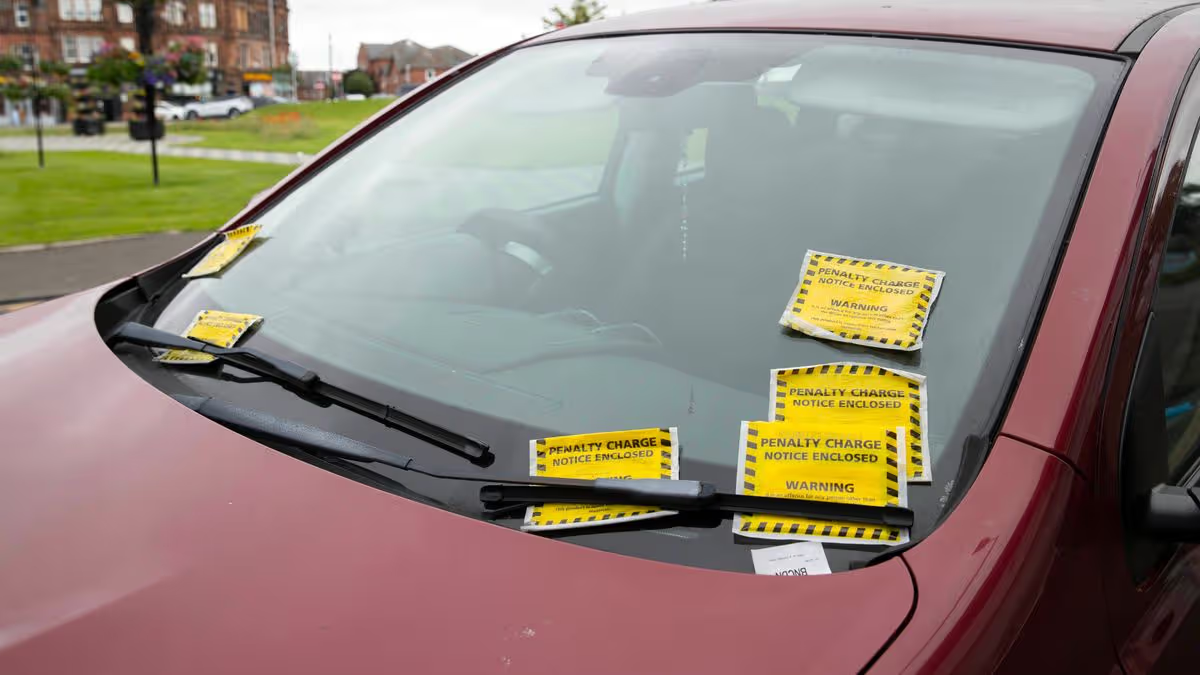
The red coloured vehicle, a 2010 Nissan Qashqai Diesel, is sitting in a precarious position within the town centre.
And motorists are having to dodge past the vehicle as they enter the one-way street because the car is jutting out at an angle and onto the roadway.
Advertisement
It is believed that the vehicle has been sitting there for around three weeks. Traffic wardens have placed at least six tickets on the front windscreen.
And questions are being asked as to why action hasn’t been taken to remove the vehicle from situ.
One prominent Facebook page, ‘C**p Parking in Ayrshire,’ which flags up poor parking in the region, has already picked up on the rogue vehicle.
One man posted this message: “This car has been here for three weeks now. The back end that is sticking out over the parking bay into the carriageway has been clipped.
Advertisement
“Instead of plastering it in parking tickets, shouldn’t the traffic wardens be contacting the appropriate body to get it lifted before somebody else clips it?”
Another message read: “We questioned this this morning thinking maybe owner in hospital or something. Why can they not trace owner’s address and do a wellness check?”
Another contributor said: “Traffic wardens need an education! You can’t just put ticket on. Only the first ticket is valid.”
Advertisement
Another poster said: “Phone the police. They will come and get the registration details and contact the owner to move it. My parents had a car that sat outside for four weeks. Police were called by a couple of the neighbours and the car was moved within a day.”
Ayrshire Live contacted Ayrshire Roads Alliance and was told that the vehicle has been reported to the police for uplift. ARA don’t have the powers to remove it.
Mayor Wu signed a letter of intent and a formal agreement will follow next April during Tartan Week.
21:43, 18 Jun 2026Updated 21:44, 18 Jun 2026
Boston’s mayor admitted she placed on traffic cone on a statue of Bill Russell outside the city halls amid the Tartan Army’s antics.
Mayor Michelle Wu laughed when asked about the trend after she officially made Boston and Glasgow sister cities.
“I think we may see some lingering traditions from their visit, and I have to admit I also put a cone on Bill Russell’s head outside today,” Mayor Wu said.
Advertisement
“It’s been fun. I mean, the cones are pretty fun.”
She added: “I think that it’s such a sense of playful, joyful surprise when you can see that happening.
“We do need cones that need to be in the right place to stay in the right place, so we need to find additional cones for that, but it’s just a sense of joy everywhere.”
The traffic cone tradition is most associated with the statue of the Duke of Wellington outside the Gallery of Modern Art in Glasgow.
Since the late 1980s, a cone has been atop the statue’s head and it has been persistently replaced whenever it is removed.
Mayor Wu also praised the Tartan Army for bringing positive energy to the city and for cleaning up after themselves along the way.
“No Scotland, no party’ has been absolutely been stuck in my head all the time,” she said.
Advertisement
“I think one other bit of incredible feedback that I’ve gotten is that in space after space, where the Tartan Army has has occupied, whether it is the fan march or other spaces, they’re cleaning up after themselves completely.”
Mayor Wu added: “They’re gathering all the litter, putting it away when the trash cans are overflowed, putting it in a little pile next to the trash cans.
“It’s a mayor’s dream, really.”
Mayor Wu signed a letter of intent at The Haven, Boston’s only dedicated Scottish bar, which has served as the unofficial Tartan Army headquarters throughout the tournament, on Thursday.
Advertisement
A formal agreement will follow next April during Tartan Week.
Speaking to journalists on Thursday, Mayor Wu said the sister city agreement is “an enduring partnership from there on out”.
She called First Minister John Swinney a “lovely leader” and said it was an “honour” to welcome him into Boston’s City Hall.
She said they had a conversation about the shared history and heritage that Boston and Scotland communities have.
Advertisement
They also discussed how devoted they are to tackling hunger and poverty, especially for children.
“There were a lot of shared values there, and a lot of places where we’ll look to work together,” Mayor Wu said.
Get more Daily Record exclusives by signing up for free to Google’s preferred sources. Click HERE.
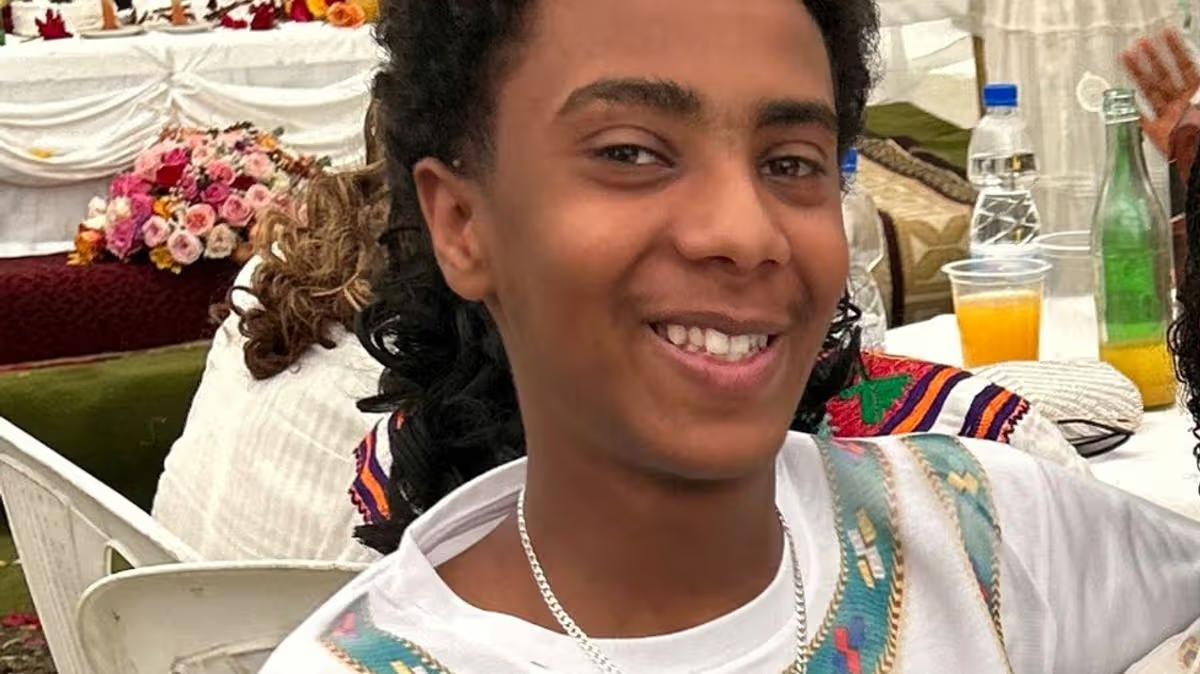
Amen Teklay, 15, died after being found seriously injured on Clarendon Street in Maryhill last March.
22:09, 18 Jun 2026Updated 22:09, 18 Jun 2026
A trial was shown CCTV and footage of a teenager being chased down a street in Glasgow with a weapon just days before he was allegedly murdered.
Amen Teklay was found seriously injured on Clarendon Street, Maryhill, on the evening of March 5 last year and died at the scene.
Two teenagers aged 16 and 17 have gone on trial accused of murdering the 15-year-old in a sword attack in Glasgow.
Advertisement
The trial began at the High Court in Glasgow on Thursday and jurors were shown CCTV and mobile phone footage leading up to the day of Amen’s death.
Footage filmed on a phone on February 12, 2025 – nearly a month before Amen was murdered – showed Amen being assaulted by a group of three boys on Great Western Road.
Prosecutor Adrian Stalker said the altercation was “three against one”.
The jury was also shown footage from March 2, 2025 – three days before Amen’s death.
Advertisement
At approximately 8.45pm, a group of three young males, apparently including one of the accused, was seen on CCTV footage outside the Lismore pub in Partick.
Detective Sergeant Jennifer Piggot, the first witness in the case, told the court that Amen could be seen approaching the group before a stand-off took place.
Mr Stalker said: “It looks like there’s been some kind of confrontation.”
He added that the group of three could be seen “circling Teklay around the bus stop” by the pub.
Advertisement
“It appears both [the accused and Amen] have weapons at some point.”
Ms Piggot confirmed to the jury that it looked like both teenagers possessed “large knives or machetes”.
One of the accused teenagers could then be seen on mobile phone footage, apparently chasing Amen down the street.
The video ends with an image of the accused holding a large knife that Mr Stalker said “widens then tapers on the end”.
Advertisement
The murder charge alleges that the two teenage boys, with their faces masked, assaulted Amen and brandished a frying pan and a sword or similar instrument at him at Glenfarg Street and Clarendon Street on March 5 last year.
It is alleged that the pair, who cannot be named due to their age, chased Amen and struck him on the body with the sword, leaving him so severely injured that he died.
The two boys deny the charge and the 16-year-old has lodged a special defence of self-defence.
The 16-year-old boy is also charged with attempting to defeat the ends of justice on March 5, 2025 by hiding a blood-stained top and disposing of a sword or similar instrument, by means unknown to the prosecutor.
Advertisement
It is also alleged the 16-year-old, while acting with another person, behaved in a threatening or abusive manner on March 2 last year in that they brandished a sword and metal barrier or similar instruments at Amen and chased him.
The 16-year-old is also charged with unlawful possession of a blade, namely a sword or similar instrument, at a number of locations in Glasgow between March 2 and 5, 2025.
It is also alleged that, while acting with two other people, he assaulted Amen on February 12 last year on Great Western Road, Glasgow.
The two teenagers have both pleaded not guilty to the charges.
Advertisement
Jurors were sworn in on Thursday at the trial which is taking place before Lord Colbeck at the High Court in Glasgow.
Addressing the jurors, he told them: “You must reach your verdicts based on the evidence.”
Get more Daily Record exclusives by signing up for free to Google’s preferred sources. Click HERE.



































You must be logged in to post a comment Login