

Connect with us

NewsBeat

Lindsay Clancy trial tensions flare as judge declines to remove holdout juror

Published

on

Mocha wears a fushia pink off-the-shoulder dress with matching pink gloves and has a large brunette wig on. She has dramatic eye makeup. She is standing in front of a poster board which has her face on it.

A judge has again told the deadlocked jury in Lindsay Clancy’s murder trial to keep trying to reach a verdict after a dramatic sixth day of deliberations in a case that has gripped America.

Tensions flared in court after the jury forewoman sent the judge a note saying one juror would not follow the court’s instructions on reasonable doubt.

The defence team asked for the holdout to be removed, a request that was denied by the judge.

Clancy, 36, is charged with three counts of first-degree murder in the deaths of her three children – Cora, five, Dawson, three, and eight-month-old Callan – at her Massachusetts family home on 24 January 2023.

Advertisement

Warning: This article contains distressing details

The former labour and delivery nurse does not deny strangling her two sons and daughter in the basement of their house.

But her lawyer argues she was suffering from postpartum psychosis at the time, and could not distinguish right from wrong.

The jury of nine women and three men in Plymouth has deliberated for some 35 hours without a verdict.

Advertisement

The panel has twice previously sent the judge notes saying it could not come to a unanimous decision, but Thursday was the first hint of rancour in the deliberation room.

Clancy’s lawyer, Kevin Reddington, said in court that the jury forewoman had sent another note, this one complaining to Judge William Sullivan that a juror was refusing to listen to the law on reasonable doubt.

Reddington and prosecutor Jennifer Sprague had an animated discussion with the judge in court.

Reporters in the room could not hear the exchange, but the BBC saw exasperated facial expressions and gestures from Clancy’s attorney.

Advertisement

Then Judge Sullivan brought in each juror individually and questioned them.

He reminded the panel they must unanimously believe beyond a reasonable doubt that the defendant is guilty in order to convict her of a crime.

Source link

Advertisement
Continue Reading
Click to comment

You must be logged in to post a comment Login

Leave a Reply

NewsBeat

‘Loving’ mum and teacher dies of ovarian cancer after being told it was perimenopause

Published

on

Daily Record

Kelly Hashemi was told she was suffering from perimenopause symptoms but a private scan showed she had stage three ovarian cancer

A “loving” mum died from ovarian cancer after being told her symptoms were caused by perimenopause, her devastated husband has revealed.

Advertisement

Kelly Hashemi began suffering from mid-cycle bleeding, bloating and anxiety in her late thirties and repeatedly sought help from medical professionals. But it was only after she paid for a private scan that she discovered she had stage three ovarian cancer.

The popular primary school teacher underwent two gruelling operations in a desperate fight against the disease. Tragically, she died in July last year aged just 41, Chronicle Live reports.

Now her husband Arya, 42, is taking on this month’s Great North Run to honour her memory and raise funds for St Bede’s Hospice in Gateshead, where Kelly spent her final months. His fundraiser has already attracted more than £5,500 in donations, which you can also donate to via this link.

The father-of-one explained: “If you catch ovarian cancer early it’s treatable but if you catch it late it’s a death sentence. It’s a really difficult cancer to deal with once it gets hold.

“Kelly was always extremely community-minded. She would have done her job for free. She had so much passion for teaching and gave every bit of her for the children she taught.

“She was a huge environmentalist, a vegetarian and she took her health really seriously. She was the most patient and loving mother. She just had endless love and energy and patience.

“We attempted to live near her primary school and when we were walking around you’d hear ‘Mrs Hashemi we love you”. I felt like I was walking around with a rock star. I was so proud of her. I was so proud that I was her husband. She was really special.”

Advertisement

Kelly and Arya, parents to 13-year-old Tabitha, shared their family home in the Low Fell area of Gateshead. Kelly received her ovarian cancer diagnosis in July 2022 following a privately-funded scan.

Arya, a practising lawyer, recalled: “Things didn’t feel right. She kept saying this is something else. When she received her diagnosis the doctor said ‘We have caught this at a late stage, you are going to die from this’.

“It was something that she never came to terms with. A simple blood test or simple scans would have picked this up earlier and there was a refusal to do that.”

Arya revealed that Kelly underwent extensive surgery and spent a fortnight in intensive care, followed by several months of rehabilitation before beginning chemotherapy.

He said: “The surgery was enormous. They operated from her throat to the top of her pubic bone. She had to have a full hysterectomy and part of her liver, bladder and diaphragm removed. It was really, really painful rehabilitation. It was a really bleak time.”

In September 2024, Kelly was asked to work in early years at Newcastle High School for Girls, where she spent roughly seven weeks before a scan confirmed her cancer had returned. She was told that with further surgery she could have a year to live and without it she would have a few months.

“She decided to have the surgery again to have some more time with Tabitha and she had that surgery early November”, Arya recalled. “She lost her bowel and it made no difference, the cancer just kept growing.”

Advertisement

Kelly was admitted to St Bede’s Hospice, based within the Queen Elizabeth Hospital grounds. After spending three months receiving care there, she died in July 2025.

Arya, who now lives in Fenham, Newcastle, with Tabitha, explained: “Her biggest worry was not seeing her daughter grow. Kelly was super prepared and she wrote me lists of things I must do.

“I would say to her ‘I don’t know how I’m going to do this without you’. She would say ‘You just have to put one foot in front of the other’. I wake up every morning and say ‘One foot in front of the other’.

“Our daughter is such a special kid. She’s incredibly resilient and determined. She uses school and sport as her form or recovery from this. She represents the region in hockey and netball. I just drive her across the country for the sports. We sit in the car next to each other for hours and we talk about her mum a lot.”

Advertisement

On September 13, Arya will participate in the Great North Run as a tribute to his late wife. His online fundraising campaign for the hospice has already raised more than £5,500 in contributions. Arya said: “She had such fear about going into the hospice and losing her dignity and independence. Every single one of their team went over and above, showering her with love, and all of her fears just disappeared.

“They were so kind and compassionate to her. It was an absolute lifeline to me and my family.

I have stuck religiously to my training plan. I’m scared but I’m very excited about doing it. I know it’s going to be really emotional. It was something Kelly did. She always talked about it as being one of the greatest things she’d ever done. It’s a really nice tribute to Kelly.”

Advertisement

Arya said Tabitha has been supportive of his fundraising efforts. He said: “She thinks I’m mad getting up at five in the morning to do my practice runs but she keeps telling me she’s really proud of me which is all the motivation I need.”

Arya has urged anybody who is concerned about their health to push for help. He said: “I think the only person who really knows if something is wrong if yourself. If something feels wrong fight your corner. No one is going to advocate for you, you have to advocate for yourself.”

Ensure our latest stories always appear at the top of your Google Search by making us a Preferred Source. Click here to activate or add us as your Preferred Source in your Google search settings.


Source link

Advertisement
Continue Reading

NewsBeat

Body found in woods amid urgent search for missing 16-year-old girl

Published

on

Daily Record

Jasmine Ferguson has been missing since Tuesday.

A body has been found in a wooded area near a Stenhousemuir street following the desperate search for a missing 16-year-old girl.

Advertisement

Police Scotland were called at around 4.15pm on Thursday, September 3, following the discovery of a body in woodland near McLachlan Street.

Formal identification has yet to take place but officers have confirmed that the family of Jasmine Ferguson, who had been reported missing from the town two days ago, are aware of the discovery.

The youngster was last seen at around 2.30pm on Tuesday, September 1, in the Lamond View area of Stenhousemuir.

Officers from Police Scotland have stated that the death is not believed to be suspicious and a report will be sent to the Procurator Fiscal in due course.

Get more Daily Record exclusives by signing up for free to Google’s preferred sources. Click HERE.

Source link

Continue Reading

NewsBeat

How AI could make us work even harder

Published

on

How AI could make us work even harder

Technological progress has taken more than its fair share of the workload from humans over the years. Washing machines clean our clothes, tractors plough the fields and computers sort out the admin.

Meanwhile, economic growth and redistribution of wealth means most workers in industrialised countries do not need to spend most of their waking hours on gainful employment. The 12 hour working day that was common during the 19th century has been largely reduced.

So will developments in AI help us gain even more free time?

Not necessarily. In fact, AI might actually cause working hours to increase.

Advertisement

One reason for this has to do with the effects of AI on people’s bargaining power in the workplace. If workers are fearful that their jobs might be lost to automation, research shows they may be inclined to increase their efforts as a way of signalling to employers that their labour is still valuable.

My research on the rat race suggests that this kind of response is to be expected.

Employers must continuously decide whom to hire, promote or dismiss. In making such decisions, employers seek to reward productivity. But productivity is often hard to measure, so employers rely on alternatives metrics such as the amount of time spent working.

Checking whether a work station is still occupied after everyone else has gone home is much easier than assessing the accuracy of a complex project. And from a worker’s point of view, increasing the time they spend at work seems like an effective way of setting themselves apart from other (apparently less motivated) workers.

Advertisement

But when everyone pursues this strategy, it becomes self-defeating. No one gains a positional advantage, while everyone works more.

The introduction of AI to workplaces can turbocharge this dynamic. Existing AI tools have already automated some tasks, like data entry, creating an expectation that entire roles will be redundant soon.

Against this backdrop, the rat race becomes more cut throat. Workers reasonably expect large scale restructurings of their companies and seek to make sure that they will retain their jobs in the process. Researchers recently found evidence for this, noting that workers in AI exposed industries like financial services and IT are literally switching off their office lights later than those in less exposed industries.

Another problem is that employers can overestimate the extent to which AI boosts workers’ productivity. The availability of AI tools to improve efficiency creates an expectation among employers that workers can do more than they could before in the same amount of time. However, when these expectations are overblown, they can lead to additional work intensification or longer work hours.

Advertisement

Working nine ‘til…?

Finally, the adoption of AI causes significant frictions. Established routines are overhauled, existing roles change and new roles are created. Workers must be trained in the use of AI tools and must learn to work alongside them.

But what makes this particularly challenging is that existing AI tools are continuously being improved and new tools developed at a rapid pace. All of this places additional demands on workers’ time.

Dark times.
Gorodenkoff/Shutterstock

It may be sobering to contemplate that AI might not improve our lives by relieving us from toil. Overwork and burnout might even increase over the coming years.

But that situation is by no means inevitable or unavoidable – especially if future control over AI’s design and implementation is not left to employers and large AI firms.

Advertisement

It is possible in theory to design and implement AI in ways that improve workers’ skills, enhancing their areas of expertise, making their work more valuable and thereby enhancing their bargaining power with employers. An empowered workforce would be able to bargain for favourable working conditions, including working time patterns that fit with people’s lives and preferences.

And if developers were to prioritise augmentation and empowerment, AI could be the ultimate tool that helps to tackle widespread resentment and disenchantment with our working lives.

Source link

Advertisement
Continue Reading

NewsBeat

Scientists make ‘unavoidable’ microplastic discovery in lung cancer patients

Published

on

Manchester Evening News

We still know “remarkably little” about what happens when microplastics enter our body

New research reveals that patients diagnosed with lung cancer are found to have more microplastic in their body than other people.

Microplastics are plastic pieces less than five millimetres long that are produced as a result of the breakdown of larger plastic items. They are produced by single-use food packaging, plastic water bottles, vehicle tires, fibres from our carpets and even our clothing.

Once created, plastic never breaks down in the way that natural materials do and, instead, it slowly breaks down into smaller and smaller pieces. As a result, these pervasive pollutants have made their way into the most unexpected of places.

Advertisement

Click here to get the biggest stories straight to your inbox in our Daily Newsletter

Scientists have now discovered that patients with lung cancer are more likely to have microplastics in their lungs and to have larger quantities of the tiny plastic particles in their lungs than other people.

Their findings add to growing evidence that microplastics are entering our bodies via the air we breathe and suggests that there could be a link between microplastics and lung disease.

Study leader Dr Ilias Dimeas said: “Microplastics have become an unavoidable part of our environment, but we still know remarkably little about what happens once they enter the human body. We don’t yet know what the background levels of microplastics in the lungs are, how much they vary from person to person, or whether they contribute to disease.

“If we are breathing these particles in every day, we need to understand where they end up and whether they could be linked to disease.”

The study looked at 100 people who were having a bronchoscopy to investigate lung symptoms at University Hospital of Larissa in Thessaly, Greece. The procedure involves a thin, flexible bronchoscope being fed into the lungs, which allows a doctor to see inside the lungs and take samples as needed.

Each patient provided a lung-wash sample, where saline solution is used to “wash out” a section of the lung, collecting cells and other material. In half of patients, researchers also took a small sample of lung tissue.

Advertisement

Each sample was analysed for the presence of microplastics and a selection were tested to see which types of plastics were present. Of the 100 patients, 50 were subsequently diagnosed with lung cancer while 50 were not.

Across all samples, the researchers identified a total of 232 microplastic particles. Overall, 70% of patients had detectable microplastics in at least one sample – either the lung wash, tissue or both.

When the lung wash and tissue samples from each patient were analysed together, patients with lung cancer were more likely to have detectable microplastics and had a higher overall microplastic burden than those without cancer.

Patients with lung cancer were also more likely to have detectable microplastics in their lung wash samples – 66% compared to 46% – and had a higher microplastic burden than patients without lung cancer.

Advertisement

Analysis of the microplastics showed that polypropylene and polyethylene were the most common types of plastic. They are widely used in everyday products such as packaging, textiles, household materials and consumer goods.

Dr Dimeas said: “Our results suggest that inhaled microplastics can be found in the human lung more frequently than many people may realise. This adds to the growing evidence that reducing environmental plastic pollution may have benefits that extend beyond ecosystems and into human health.

“This type of study doesn’t tell us why we found more microplastics in the samples from lung cancer patients. Microplastics could contribute to inflammation or other biological processes that may contribute to diseases like cancer, but it is also possible that diseased lungs simply retain particles differently than healthy lungs.

“What it does show is that microplastics were found more often and in greater numbers in patients with lung cancer, which raises important questions for future research.”

Advertisement

He added: “We have already begun more laboratory experiments to better understand the types of plastics involved and how they may interact with lung cells.”

Professor Barbara Hoffmann, chair of the ERS Advocacy Council, said the findings show that microplastics are “infiltrating” many parts of the human body.

Prof Hoffmann, who is based at the University of Düsseldorf, Germany, said: “Lung cancer is the most common type of cancer worldwide. It’s also the leading cause of cancer deaths, with around 2.5 million cases and 1.8 million deaths annually.

“Smoking remains by far the biggest cause of lung cancer. Air pollution is now also known to cause lung cancer and contribute to many other lung diseases, such as asthma and COPD.”

Advertisement

She added: “Research on the health effects of microplastics is still at a very early stage, but we are starting to realise that these tiny pieces of plastic are infiltrating many parts of the body.

“This study adds to evidence that we are breathing microplastics in via the air and they are lodging in our lungs. We need more research to fully understand their potential role in lung diseases, including cancer.

“In the meantime, we advocate for the fundamental human right to breathe clean air, and this includes air that is not polluted with microplastics.”

Source link

Advertisement
Continue Reading

NewsBeat

RICHARD EDEN: Paramount buys Meghan and Harry’s ‘Cookie’ film

Published

on

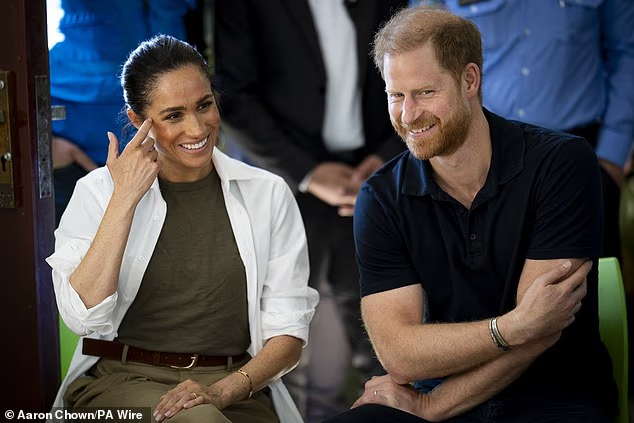
Meghan and Harry's film about US girl scouts has been purchased by the film industry giant

There was widespread bemusement when the Duke and Duchess of Sussex turned up in Jamaica in 2024 to attend a film premiere honouring reggae legend Bob Marley.

Not only did Prince Harry and Meghan have nothing to do with the film but they were photographed on the night with the Jamaican prime minister, Andrew Holness, who had vowed to push ahead with plans to ditch King Charles as head of state.

To add insult to injury, the King was preparing for hospital treatment for an enlarged prostate at the time.

The couple were there as guests of the film’s producer, Paramount Pictures chief executive Brian Robbins, and it appears that the courtship may have paid dividends.

Advertisement

For I can disclose that Robbins’s streaming channel, Paramount+, has bought the rights to Cookie Queens, a documentary of which Harry and Meghan are executive producers.

Paramount+ is a major rival to Netflix, to which the couple were signed when they flew to Jamaica.

Meghan and Harry’s film about US girl scouts has been purchased by the film industry giant

Advertisement

Their five-year deal with Netflix, which was said to be worth about $100 million (£75 million), ended in 2025. At that point, the Sussexes announced that they had signed a ‘multi-year, first-look deal’ with Netflix, which would give the US streaming giant a first option on proposals from their Archewell production company.

They said it disproved claims that they were going to part company completely with Netflix.

Cookie Queens, which follows ambitious young Girl Scouts competing to sell the most biscuits, was given its premiere at the Sundance Film Festival in January. Meghan, herself a former Girl Scout, said she was drawn to the project after seeing early footage.

However, it fared so badly on its opening weekend in US cinemas that it was beaten by a compilation of cat videos.

Advertisement

Ex-son-in-law of ‘City Superwoman’ reveals new love

Mercury Prize-winning singer Benjamin Clementine with Hollywood actress Lana Parrilla

Mercury Prize-winning singer Benjamin Clementine with Hollywood actress Lana Parrilla 

Following the collapse of his marriage to ‘City Superwoman’ Dame Helena Morrissey’s musician daughter Flo earlier this year, Benjamin Clementine has found love again.

I can reveal that the Mercury Prize-winning singer, 37, is going out with Hollywood actress Lana Parrilla, 49, who stars in the hit US fantasy series Once Upon A Time with Jamie Dornan and Robert Carlyle.

The couple made their red-carpet debut this week at the series two premiere of The Gentlemen, in which Benjamin plays a former soldier.

Advertisement

‘They started seeing each other earlier this year,’ confirms a source close to the couple. ‘Benjamin is serious about her and he’s already introduced her to his children. He’s very happy.’

I reported the musician’s split from Flo, 31 – the mother of his two children – in January, when she confirmed that they had divorced after seven years of marriage.

How The Gentlemen has given Maya a taste for gangster roles

Maya Jama seemed keen to prove her mettle at the premiere of The Gentlemen this week

Maya Jama seemed keen to prove her mettle at the premiere of The Gentlemen this week

Maya Jama hopes that her debut acting role as tweed-wearing criminal associate Aisha in Guy Ritchie’s Netflix hit series The Gentlemen will be the start of a beautiful new career.

Advertisement

‘I really hope to do more gangster films and TV,’ the Love Island host tells me at the party after the premiere at Guildhall in the City of London.

Maya, 31, who recently split up with Manchester City footballer Ruben Dias, seemed keen to prove her mettle at the party, where she could be seen walloping a punch bag that was on display for guests who included fellow stars Joely Richardson, Theo James, Ray Winstone and Kaya Scodelario.

Baby joy for Matt and Eilidh 

Former Reform candidate Matt Goodwin and his girlfriend Eilidh Hargreaves, who is pregnant

Former Reform candidate Matt Goodwin and his girlfriend Eilidh Hargreaves, who is pregnant

He didn’t manage to capture Gorton and Denton for Reform UK earlier this year, but Matt Goodwin has cause to celebrate.

Advertisement

The best-selling author’s girlfriend, Eilidh Hargreaves, is expecting a baby. ‘It’s wonderful news,’ says Eilidh, who admits the timing was, however, ‘comically bad’ because she had just resigned from her role as features director at Tatler magazine.

‘I just quit my dream job and have given up my salary,’ she says. ‘I do not have a trust fund.’

Eilidh has launched an online newsletter, High Society Diary. Surely not a rival to Eden Confidential?

If it wasn’t for 6ft 8in Greg Davies, Stephen Merchant would be the tallest comedian in Britain.

Advertisement

There is no doubt, however, that he’s one of the richest.

Merchant, who’s 6ft 7in, made more than £10 million last year. Newly published accounts for television production company, SJJM Ltd, disclose that it has amassed more than £41million.

Merchant, 51, created The Office, Extras, and Life’s Too Short with Ricky Gervais.

The Bayeux Tapestry, which was viewed at the British Museum this week by King Charles and French President Emmanuel Macron, shouldn’t have that name, claims television historian Janina Ramirez. ‘It is not a tapestry but rather an embroidery, and it was made in England, most probably by nuns at Barking Abbey.

Advertisement

‘It should be known as a “mistresspiece” rather than a “masterpiece”, as every stitch we see was made by women.’

Harry Potter star Miriam Margolyes has written four books, which have all failed to arouse any interest at home. 

‘My partner Heather [Sutherland] doesn’t read my books,’ the 85-year-old actress says of the Australian historian, 83. ‘She hasn’t read any of them. She’s an international scholar, and highly intelligent. My books are not for highly intelligent people, so they wouldn’t be part of her reading material.’ 

Source link

Advertisement
Continue Reading

NewsBeat

Final Fantasy Resonance preview – HD-2D reveals its final form

Published

on

Final Fantasy Resonance preview - HD-2D reveals its final form
Final Fantasy Resonance – 2D beauty (Square Enix)

The first HD-2D Final Fantasy game may be retro-inspired but it’s very far from being shallow nostalgia bait, even if Cloud Strife is in it.

For fans of classic – that is, old school – Japanese role-players, Square Enix’s creation and application of its HD-2D technology has been very welcome. It allows the company to take venerable 2D games and breathe new graphical life into them, keeping the original isometric viewpoints and 2D characters but dropping them into lush-looking 3D worlds.

Until now, the technology has been applied to the Octopath Traveler and Dragon Quest franchises (as well as the recent The Adventures Of Elliott) but Final Fantasy fans have long wondered what it would be like if some of the early games from that franchise received the HD-2D treatment. Well, they need wonder no more, because Final Fantasy Resonance, the first HD-2D Final Fantasy game, is due to be released on October 22 for Nintendo Switch, PlayStation 5, Xbox Series X/S, Nintendo Switch 2, and PC.

It may sound like an original Final Fantasy game – and it feels like one in gameplay terms – but Resonance is loosely based on one of the more obscure elements of the franchise, the free-to-play 2015 mobile game Final Fantasy Brave Exvius. It’s a strange connection, that you don’t need to know anything about to place Resonance, but if that’s what’s given Square Enix the confidence to experiment then so be it.

Advertisement

Despite the complications inherent in its origins, Resonance is coherent, distinctive, and polished. We managed to play it for the best part of an hour at Gamescom, on Switch 2, a console that has always felt a particularly well-suited platform on which to play HD-2D games.

Our play-through consisted of about 10 minutes of random overworld exploration, followed by the whole of a dungeon, including its final boss battle. We had been given a fair bit of help, in the form of a decent stock of typical Final Fantasy potions and restorative items, plus a full battle group consisting of four characters.

Expert, exclusive gaming analysis

Sign up to the GameCentral newsletter for a unique take on the week in gaming, alongside the latest reviews and more. Delivered to your inbox every Saturday morning.

That wouldn’t necessarily have been a given at that point in the game, since Resonance features two main playable characters, Rain and Lasswell, but has a feature called Visions, which allows you to add other characters from the franchise to your battle party. Which explains why our party included Cloud Strife himself, who proved useful since he has the ability to automatically sense enemies’ elemental weaknesses (although the traditional Assess ability is also present in the game).

Advertisement

In a brief potter around the overworld, which looked superb in the distinctive HD-2D style, the first element of Resonance which stood out was its turn-based battle system. That’s old school turn-based as well, with no sign of the ATB (Active Time Battle) mechanism from the more modern games, which means you know exactly when team members are able to make their moves.

Despite that retro element you’re still able to do pretty much anything that you can in any other mainline Final Fantasy game: select abilities or items, cast spells, summon when allowed, and even launch resonances. These are attacks that are unique to characters and depend on their pre-defined character class. Resonances can only be triggered later on, in longer battles, so they were somewhat akin to limit breaks, although limit breaks are also present – and indeed proved quite decisive in some of the more epic battles.

Having had a taste of the overworld, we descended into a dungeon named the Wind Shrine. Instantly, Resonance demonstrated the range of its visuals, with some highly polished cut scenes, cleverly mixing 2D and 3D animations.

Advertisement

The Wind Shrine itself proved to be a classic Final Fantasy dungeon, involving a certain amount of environmental puzzling: a pretty labyrinthine built on many levels, with lifts and horizontally-moving blocks to trigger. As is customary in Final Fantasy dungeons, it was dotted with random enemies and contained plenty of obscure corners and cul-de-sacs in which chests could be found, yielding mainly crystals and the odd weapon.

Final Fantasy Resonance screenshot of dungeon
Dungeon crawling in 2D-HD (Square Enix)

According to Square Enix, Resonance’s storyline contains plenty of Final Fantasy staples, including the likes of crystals, airships, espers (which can be summoned in battles) and moogles.

Having negotiated our way through the Wind Shrine’s labyrinth (a process which took about 35 minutes, including the odd exploratory deviation) and equipped a couple of our characters with superior weapons which we found, it was time to take on the boss, a pretty fearsome Wind Demon. Even after we discovered his weaknesses we had to rely on the use of the odd phoenix down and curative spell (we also had some group-curing mist potions in our inventory).

Eventually, through judicious use of limit breaks and resonance attacks, along with making hay when we managed to stagger him and the minions he regularly summoned, we prevailed after a good 10 or so minutes, triggering another lavish cut scene.

Advertisement

Despite its retro undercurrent, with the HD-2D visuals and turn-based battling, Final Fantasy Resonance fells surprisingly modern in terms of its gameplay. Its battle system offers more or less the full range of options to which we have become accustomed in the 3D Final Fantasy games, and is certainly way more sophisticated than the battle systems in other HD-2D games, like the Octopath Traveler games and Dragon Quest remakes.

Plus, it looks superb, with a typically vibrant colour palette, as seen in other HD-2D games, and some pretty lush cut scenes. Naturally, a short demo left question marks concerning how big its world might be and how long it might take to finish, and we got very little insight into what the story is about.

But what we played left us feeling confident that it will be a worthy addition to the Final Fantasy catalogue, and one which is especially suited for playing on the go on the Switch or Switch 2. We’ll bring you a definitive verdict when it arrives in October.

Final Fantasy Resonance screenshot of overworld
The overworld is especially old school (Square Enix)

Email gamecentral@metro.co.uk, leave a comment below, follow us on Twitter.

To submit Inbox letters and Reader’s Features more easily, without the need to send an email, just use our Submit Stuff page here.

Advertisement

For more stories like this, check our Gaming page.

Advertisement
Advertisement

Source link

Continue Reading

NewsBeat

Amal Clooney needs a helping hand to exit her boat as she swaps red carpet gowns for a sparkly fringed mini dress during a night out with husband George in Venice

Published

on

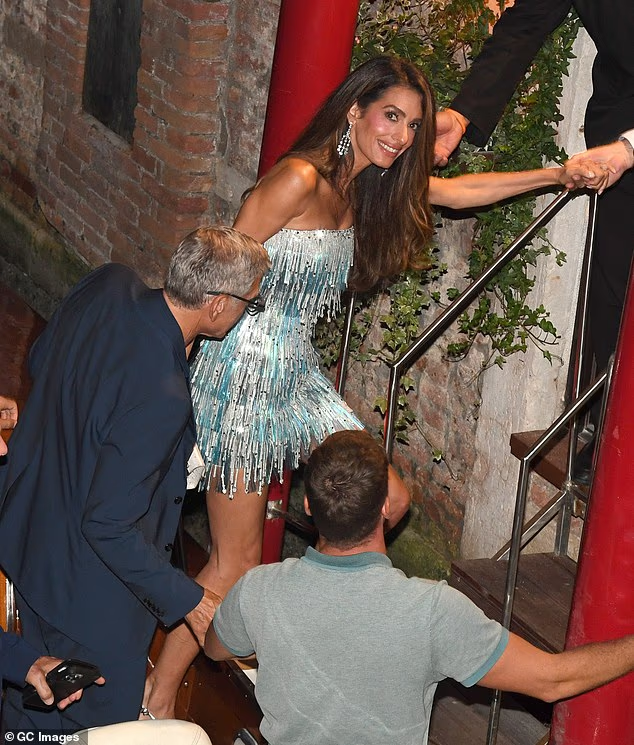
Amal Clooney needed a helping hand as she exited her private boat to enjoy a night out with her husband George on the second night of the Venice Film Festival

With her penchant for showstopping outfits, it’s no surprise that Amal Clooney had another stunning look for her second night in Venice.

But the human rights lawyer needed a helping hand as she exited her private boat to enjoy a night out with her husband George at the glitzy film festival.

Amal, 48, opted for a dramatic turquoise dress adorned with fringed sequins as she arrived in a private boat before being helped to shore.

George cut a dapper figure in a smart navy blue suit as he and Amal headed out for the evening, hours after he’d paid tribute to her during a powerful speech.

Advertisement

The 65-year-old Hollywood actor, who picked up the Golden Lion for Lifetime Achievement on Wednesday, made sure to praise his ‘badass’ lawyer wife Amal.

Amal, a British-Lebanese human rights lawyer, has represented Yazidi survivors and helped secure historic legal victories holding ISIS members accountable for genocide.

Amal Clooney needed a helping hand as she exited her private boat to enjoy a night out with her husband George on the second night of the Venice Film Festival

Advertisement
Amal, 48, opted for a dramatic turquoise dress adorned with fringed sequins as she arrived in a private boat before being helped to shore

Amal, 48, opted for a dramatic turquoise dress adorned with fringed sequins as she arrived in a private boat before being helped to shore

‘By the way, my wife’s the only person to have ever put ISIS on trial and won,’ he lauded. ‘She’s a badass, and she gets the job done. We do it for our families. We do it for our friends.’ 

He added: ‘Amal’s taken some very difficult stands over the years, and we’ve had to face some pretty heavy criticism based on that. I wrote an op-ed about President Joe Biden. I got some s***.

‘We have really interesting conversations around the table. But you know, we also have two nine-year-old kids, and we have a normal family life, and there’s a lot of laughing and a lot of love, and we’re very lucky, and we’re really aware of that.’

Advertisement

Clooney also added that he braces against people telling actors to ‘shut up’ about human rights and political issues.

‘I didn’t give away my freedom of speech the minute I became an actor,’ he defiantly said. ‘It also means that people can get mad at you and not like you anymore. Fair enough. That’s how this works. 

‘You can’t demand freedom of speech and then say, “But don’t say bad s*** about me”. Right? That’s the deal.’ 

Taking a swipe at President Trump, Clooney added: ‘I get mean tweets from the President of the United States. That’s okay. I can handle it. I’ll do all right. I’ll be fine. But that’s part of life.’ 

Advertisement

Clooney and Trump have taken plenty of swipes at each other over the years. 

George cut a dapper figure in a smart navy blue suit as he and Amal headed out for the evening, hours after he'd paid tribute to her during a powerful speech

George cut a dapper figure in a smart navy blue suit as he and Amal headed out for the evening, hours after he’d paid tribute to her during a powerful speech

The 65-year-old Hollywood actor, who picked up the Golden Lion for Lifetime Achievement on Wednesday, made sure to praise his 'badass' lawyer wife Amal

The 65-year-old Hollywood actor, who picked up the Golden Lion for Lifetime Achievement on Wednesday, made sure to praise his ‘badass’ lawyer wife Amal

On Wednesday, Clooney launched a scathing attack on the US administration, branding those in charge ‘the least qualified people’ and slamming what he said was a complete absence of ‘decency’.

Advertisement

‘We’ve had some other difficult times but this is one of them,’ he said. ‘There is a great word, kakistocracy, which is a country run by the least qualified people. I think maybe we have a kakistocracy right now but we will get through it.

‘We will have an election in November that should be a check and balance and then in 2028, with any luck, we will have some restoration.’

The Oscar-winning star went on to denounce Trump’s administration as ‘cruel’, arguing that basic standards of decency had disappeared from public life.

‘The idea that cruelty is the base, that being cruel and unkind is part of the fun of all this,’ Clooney told press, in the latest of a string of attacks the actor has made against the running of the US.

Advertisement

‘You see what the secretary of defense just tweeted out a picture about women in the military in Canada and you’re going, “What is wrong with you?”

‘”Where is the sense of decency in all this?” I’m ashamed of all of that but we will get through it and we will come out better on the other side.’

Clooney drew on a tweet by US Defense Secretary Pete Hegseth appearing to mock the physical appearance of an overweight female Canadian soldier presenting a medal at a youth camp.

On Monday night, Hegseth posted the image from a cadet training center in British Columbia with the caption: ‘This is real’.

Advertisement

Calling himself an optimist, Clooney said he remembered living through dark times in the country’s history – which he likened to today.

‘I’m old enough to have been through 1968 in the States when every city in the United States was set on fire and we lost Martin Luther King and Bobby Kennedy in the same year,’ he said.

‘There was tons of violence. The Capitol was surrounded with tanks. We’ve had some other difficult times, but this is one of them.’

Source link

Advertisement
Continue Reading

NewsBeat

Two arrested over ‘human trafficking offences’ in Glasgow retail crime ring probe

Published

on

Daily Record

Police allegedly uncovered the exploitation of vulnerable young people across the west of Scotland.

Two people have been arrested in connection with alleged human trafficking offences as part of a police operation targeting retail crime across the west of Scotland.

Advertisement

A 62-year-old man and a 61-year-old woman were arrested and charged on Thursday, September 3, following enquiries under Operation Dynos, part of the Retail Crime Taskforce.

Police believe vulnerable young people are being targeted and exploited to steal alcohol from shops across the west of Scotland.

Officers say the operation is also focused on protecting children and young people from being coerced into criminal activity.

Constable Paul Steell said: “We remain committed to tackling retail crime, while continuing to safeguard young people from harm and coercion into criminal behaviour. We will continue to gather evidence and use all resources at our disposal to tackle this type of crime.”

Advertisement

The pair are due to appear at Glasgow Sheriff Court on Friday, September 4.

The latest arrests bring the total number of adults arrested in connection with the alleged criminal exploitation of children and young people under Operation Dynos to nine since the operation began in April 2025.

Get more Daily Record exclusives by signing up for free to Google’s preferred sources. Click HERE.

Source link

Advertisement
Continue Reading

NewsBeat

Onions will keep fresh for up to six months if stored in one common kitchen area

Published

on

Wales Online

You’re likely storing your onions in the wrong place

Tips for storing food are always handy to know – not only for bananas and potatoes, but also for prolonging the freshness of your onions. Onions, a kitchen essential across the UK, are often kept in the fridge alongside other vegetables, but this is far from the ideal environment for them.

Advertisement

If you notice your onions beginning to sprout, soften, or develop mould, they are likely not being stored properly.

YouTube content creator Jerry James Stone has shared his top guidance for keeping onions in prime condition “without them rotting or going mushy”, offering his expertise in one of his videos.

He advised: “I’m going to talk to you about how you properly store onions – if you do it correctly, you can actually store them for up to six months.”

He continued: “Onions hate being in the fridge, that’s the first thing – never put them in the fridge. If you do, they actually rot and go mushy.”

Jerry stressed that the cold and damp environment of a fridge is entirely unsuitable for whole onions, as they require the complete opposite conditions.

Given their tendency to absorb moisture, refrigerating them can cause onions to become soft and deteriorate far more quickly — though this does not apply to peeled or pre-cut varieties.

“The other thing about onions is they prefer to be in a dry place, that’s cool, and has good ventilation,” Jerry continued.

Advertisement

“Avoid storing them in a cramped drawer; instead, aim for a pantry where there’s plenty of air movement. That’s [ventilation] super crucial as they emit quite a bit of moisture.

“One thing you definitely don’t want to do is store onions anywhere next to potatoes. Because of the moisture and ethylene gas onions put out, they cause potatoes to sprout. The food you can store onions next to is garlic – they prefer the same environment.”

If you have bought onions from a supermarket in a plastic bag, it’s recommended to remove them from the packaging before storing them. The plastic can trap moisture, which may result in mould developing.

Advertisement

To stay fresh, onions require enough ventilation, so it’s worth considering storing them in a net or mesh bag, which promotes better air circulation and helps to control moisture levels.

For short-term storage, if you intend to use the onions within a couple of days, leaving them in a bowl on the kitchen worktop or inside a cupboard will do.

For longer-term storage, however, onions should be kept in a cool, dry and dark space, away from direct light, such as a cellar or garage.

Source link

Advertisement
Continue Reading

NewsBeat

Himalayan hazards are becoming more complex. Our warning systems need to catch up

Published

on

Himalayan hazards are becoming more complex. Our warning systems need to catch up

The exact timeline of the recent Nepal flooding disaster is becoming clearer. At 8:37am, instruments recorded what was initially interpreted as an earthquake near Nepal’s border with China. Seven minutes later, CCTV recorded the Gyirong Port border post being destroyed by a massive debris flow and flood.

Nepal’s flood authorities learned about the incident at about 9:00am and sent out an emergency SMS alert at about 9:15am. But by that time, Nepal was already deep into a major disaster.

The 38 minute gap between the tremor being detected and the emergency alert is striking. But it would be wrong to assume Nepal’s authorities could simply have acted on the initial signal: at the time, it appeared to be a small earthquake, rather than a much rarer mountain collapse. The flood also arrived too swiftly for water-level sensors: they went almost immediately from recording normal levels to being destroyed.

The more interesting question is what a better-integrated warning system might have made possible. Could seismic readings, satellite images and other observations have been combined quickly enough to recognise what was happening and alert people further downstream?

Advertisement

Existing early-warning systems have often been designed around particular hazards such as regular rain-caused floods or glacial lake outburst floods (Glofs). But this disaster was neither a Glof nor a regular flood. Instead it appears to have involved a rare, large-scale collapse of rock and ice, which turned into a devastating debris flow and flood.

As a recent study of a strikingly similar flood in India last year argued, this type of hazard is largely absent from existing warning frameworks. As warming destabilises glaciers and thaws permafrost, such events are likely to happen more often.

Cascading mountain hazards that cross borders

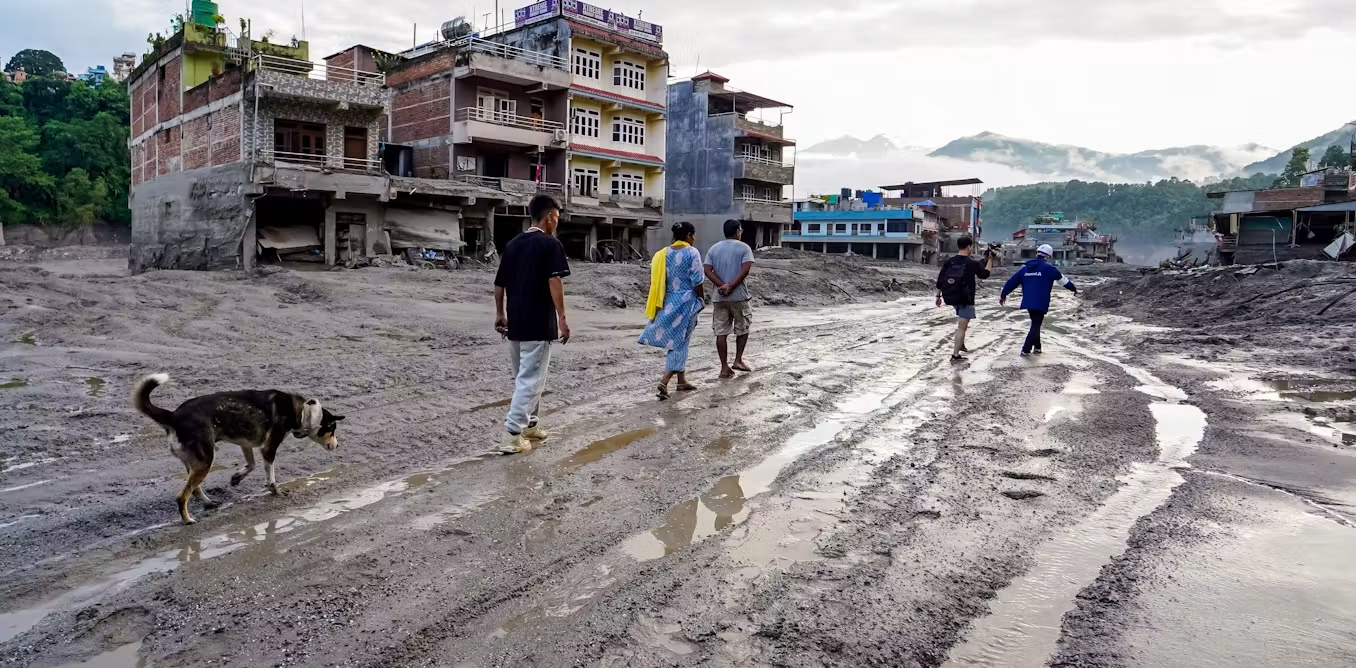
In July 2025, a glacial lake in Tibet burst and swept down this very same stretch of river into Nepal, killing at least nine people and leaving around 20 missing in Nepal. Eleven people were also officially reported missing on the Chinese side.

Advertisement

Aftermath of flooding on the Nepal-China border, July 2025. These same buildings were entirely destroyed in the August 2026 flood.
Zuma / Alamy

After the flood, Nepal and China agreed in principle to share real-time information about floods, landslides and glacial lakes. However, despite Nepal’s foreign minister raising the issue during a visit to China in May 2026, no formal agreement has been signed.

Across the Himalayas and Hindu Kush mountain ranges, rivers, weather systems and infrastructure frequently span national boundaries. Our ongoing research shows a hazard that begins in one place can have lethal consequences – and create new warning requirements – far downstream.

A warming climate is increasing these risks by thinning glaciers, thawing permafrost and destabilising slopes, even if climate change isn’t the sole explanation for every disaster. Meanwhile roads and hydropower projects are putting more people and infrastructure in threatened valleys.

Cooperation has to come before the disaster

Some cross-border early-warning arrangements already exist between Nepal and its neighbours, particularly for recurring floods. But sudden, cascading events such as the recent disaster pose a different challenge. A warning has value only if it travels the whole distance – from a sensor in the mountains, through scientific agencies, national and local authorities, to households in the valleys and plains below, in the minutes that matter.

Advertisement

Community-based flood warning already works in parts of Nepal’s Koshi basin, where upstream gauges and trained local volunteers buy downstream villages precious time. A regional early warning system would have to link these community-level systems with national and cross-border monitoring, so that information can move from the source of a hazard to the people at risk. That means agreeing in advance what should be shared, how warnings should be passed between countries and agencies, and what action they should trigger.

That requires institutional changes and political commitment, as much as new technology. The region’s existing water treaties were written to divide flows and manage dams and barrages, not to govern cascading hazards in the high mountains. Governments could establish permanent bodies responsible for Himalayan rivers and their associated hazards. Featuring both scientists and policymakers, and linked to counterparts in neighbouring countries, these public bodies would be mandated to share data, jointly monitor glaciers, lakes and slopes, and coordinate warnings across borders.

The aim would be to make cooperation routine and sustained between disasters, rather than improvised in a crisis when events may unfold too quickly for international debate. None of this requires neighbours to resolve their wider disputes; it asks only that disaster warning be ring-fenced as shared humanitarian infrastructure that keeps working unabated.

The technologies for predicting and monitoring high-mountain hazards are improving fast. We now need more international scientific and policy cooperation, and warning systems capable of turning these observations into rapid action.

Advertisement

Source link

Continue Reading

Trending

Copyright © 2025