Part of the A470 in Powys is blocked in both directions due to a fire. According to traffic service Inrix the incident has been ongoing since 8.14pm from the A4059 to Llwyn Onn Guest House, Merthyr Tydfil.
A social media report suggests affects a mountainside of Bannau Brycheiniog (Brecon Beacons National Park). Stay informed on everything Merthyr Tydfil by signing up to our newsletter here
The post states: “The smoke was pretty intense on the A470 as I had been coming through… Especially on me passing the junction for Garwnant.” According to Inrix the fire is “serious”.
‘Anything we can do to better safeguard victims and children who are impacted by domestic abuse, will be a priority’
There has been “positive” progress on raising awareness of domestic abuse as an offence, the PSNI said as a major inspection report was published.
Advertisement
The third Criminal Justice Inspection (CJI) review of the implementation of Part 1 of the Domestic Abuse and Civil Proceedings Act (NI) 2021 was published on Thursday.
It found there was “positive” progress in raising awareness across the criminal justice system about domestic abuse as an offence.
It also recognised that police officers face a number of “difficult challenges” on a regular basis when dealing with domestic abuse cases.
Detective Chief Superintendent Zoe McKee said they welcomed the findings and the recommendations of the report.
Advertisement
“We continue to work with our partner agencies in the criminal justice system to ensure that we deliver a service that meets the needs and expectations of all victims and witnesses,” she said.
“As an organisation, we have already commenced a body of work to ensure the voices of children who are impacted by domestic abuse cases are clearly heard and feature in investigations.
“This is year three of our delivery of Part 1 of the Domestic Abuse and Civil Proceedings Act (NI) 2021, which saw us equipped with new legislative tools to target those who perpetrate domestic abuse and protect the most vulnerable.
“Anything we can do to better safeguard victims and children who are impacted by domestic abuse, will be a priority.”
Advertisement
Ms McKee continued: “We have delivered specialised training in partnership with Women’s Aid – which has a focus on children as victims of domestic abuse cases and the new legislation that holds perpetrators to account.
“Officers from across different departments within the police service have attended a series of awareness sessions to ensure they have the required awareness and confidence that they need when dealing with such cases.
“We’re also working with our IT systems internally to help develop and implement a technical solution that assists officers in seamlessly adding child aggravators to case files.
“Training programmes for our custody sergeants have also been developed to ensure child aggravator awareness is captured on our internal systems prior to their disposal.
Advertisement
“We also continue to work with colleagues in the Public Prosecution Service to review and improve processes relating to victims, including developing a robust quality assurance process to monitor the appropriate use of aggravators.
“Domestic abuse remains a service priority and we are fully committed to delivering for victims and bringing offenders to justice.”
The plans include a cinema room and communal areas
Darren Calpin, Local Democracy Reporter
17:00, 29 Apr 2026
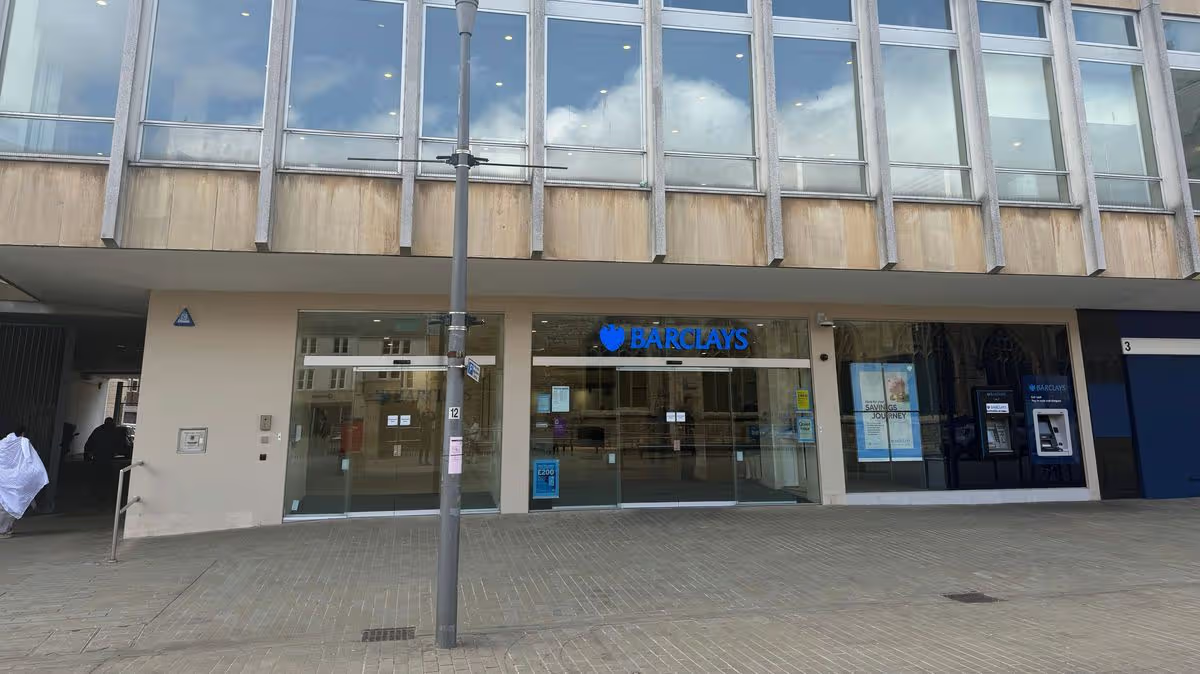
Barclays Bank on Church Street is set to be transformed into a block of more than 100 flats, according to plans. Application documents submitted to Peterborough City Council reveal plans to extend and infill the brutalist-style building to create 104 “high-quality co-living units”.
The ground floor and basement will still be retained for commercial use. Barclays Bank also recently submitted a planning application to take over the former Sports Direct unit on Long Causeway so that it can open a new, larger branch within the city centre.
Advertisement
The company is on a push to re-open high street branches so that it can once again offer an “all-important in-person experience,” rolling back on a wave of closures which has left them with just over 200 branches across the UK.
According to documents labelled “former Barclays Bank” prepared by the FRONT architectural office, the new bedsit-style co-living units will be “affordable housing for professional individuals” within the city centre.
“All residential units have access to communal facilities including kitchens, social spaces, library/reading areas and laundry benefits,” FRONT states. A cinema room and large communal areas are also included in the plans.
While all of the small, single aspect units are designed for single occupancy, they will meet or exceed the minimum HMO (house in multiple occupation) size standards set by Peterborough City Council of 11sq/m for a bedroom and 13 sq/m for a studio (excluding en-suite facilities).
Advertisement
There will be no car parking available, although the revamped basement will offer secure cycle storage capable of accommodating around 120 bikes. The application will now be considered by Peterborough City Council and can be viewed on its planning portal, using reference 26/002223/FUL.
We’ve had two nights of handball controversy, first involving Bayern Munich and now Arsenal.
In both cases, the ball took a deflection off the body before hitting the arm, and fans have been conditioned into thinking this means there cannot be a penalty.
What referees actually look for is a clear change of trajectory. Why is that? Because it means the arm position would not create a barrier to the natural direction of the ball.
If the ball stays on roughly its intended path, then the ball touching the arm takes precedent.
Advertisement
The penalty given against Alphonso Davies on Tuesday would not have been awarded in the Premier League as the arm was too close to the body.
For Uefa, the fact that the arm moves out from the body before the ball hits it would trump the small deflection.
But Ben White’s handball against Atletico was a very clear penalty under Uefa’s definition. The arm was a long way out from the body and came in to make contact with the ball.
There is some discretion if the arm is being brought in to make the body smaller, but in White’s case it started from so far out, a penalty would be expected.
Advertisement
The Premier League is more relaxed than Europe even when it comes to deflections before a handball. That said, Arsenal defender Gabriel should have really conceded a penalty at Newcastle earlier this season as his arm, when sliding, was raised very high and the deflection off the body was negligible.
Would the ball deflecting off White’s shin have caused VAR to stay out of this in the Premier League? Possibly, but the movement of the arm was very clear.
A definite spot-kick in Europe, borderline for the Premier League.
Other members of the public, alongside nightclub security, were forced to step in and Kerr was restrained on the ground until police arrived.
22:26, 29 Apr 2026Updated 22:27, 29 Apr 2026
A drunk Scot had to be restrained after threatening to “take a man’s face off” outside a popular nightclub.
Liam Kerr, 44, from Edinburgh, was ‘heavily intoxicated’ outside The Liquid Rooms on Victoria Street during the early hours of September 12, 2025.
Kerr was trying to engage with other people outside the club at around 2am, Edinburgh Sheriff Court heard on Wednesday, reports Edinburgh Live.
Advertisement
Kerr and another man then had some sort of disagreement which saw him push the man on the body and act aggressively. He then uttered threats, including telling the man “I will take your face off.”
Other members of the public, alongside nightclub security, were forced to step in and Kerr was restrained on the ground until police arrived. He was taken to St Leonard’s Police Station.
Kerr, who has several previous convictions, pleaded guilty to threatening or abusive behaviour by shouting, swearing, uttering threats of violence and pushing the victim on the body.
He had pleas of not guilty accepted for an assault charge and a separate charge of threatening or abusive behaviour.
Advertisement
Sheriff Stirling imposed a fine of £150 on Kerr, discounted from £200 due to his early plea.
Get more Daily Record exclusives by signing up for free to Google’s preferred sources. Click HERE
Anusuyabai Pandekar and her daughter-in-law Mandabai sit facing each other beside a stone grindmill. The mill is still. No grain rests between its stones. No flour gathers at the edges. Instead it sits between them like an object from another time.
One of the women begins to sing. The other joins. The melody carries the rhythm of a labour no longer being done, cyclical and without clear beginning or end:
It is raining heavily, let the soil become wet.
Women go to the fields, carrying baskets of bhakri (bread).
The pre-monsoon rain is beating down on the fields.
Advertisement
Under the jasmine tree, the ploughman is working with the drill-plough.
Scenes like the one this song describes, once common across rural western India, now belong increasingly to the archive. Hand-grinding has given way to electric mills. The work that once informed these songs has thinned out, leaving behind recordings, fragments and memory.
Accounts of drought and environmental change rarely include such voices. In official records and news reports, what is measured often overshadows what is lived. Climate change is typically explained through numbers, including emissions targets, temperature thresholds and rainfall variability. This data is necessary. But it cannot capture how change is inhabited: how it settles into bodies, reshapes routines and presses into everyday life.
Long before climate science named the crisis, women were registering these shifts in another language – song.
Advertisement
Anusuyabai Pandekar and her daughter-in-law Manda singing in May 2017 for the Grindmill Songs Project archive.
Climate, labour and everyday life
Across the world, women’s work songs function as informal archives of environmental change. Emerging from repetitive labour – including grinding, pounding, planting and carrying – they register shifts in seasons, resources and survival long before these enter formal records.
I began to understand this during my doctoral work in 2020 and 2021. I was researching labour arrangements within the sugar industry in drought-affected regions of western India. Policy reports described rainfall deficits, groundwater depletion and crop loss. But women spoke instead of work – walking further for water, delaying planting and stretching food across uncertain seasons.
Their voices extended beyond conversation into an unexpected archive – The Grindmill Songs Project. First documented in the 1990s and now hosted by the People’s Archive of Rural India, the project brings together around 100,000 songs organised by people, places and themes. I used this archive alongside ethnographic interviews to trace labour, marriage and drought in the sugarcane industry, where women’s voices were largely absent from official records.
Advertisement
Here, labour and environmental strain were articulated with a precision often absent from formal accounts. Climate was not abstract; it was embedded in the rhythms of work.
The climate crisis has a communications problem. How do we tell stories that move people – not just to fear the future, but to imagine and build a better one? This article is part of Climate Storytelling, a series exploring how arts and science can join forces to spark understanding, hope and action.
The water-guzzling sugarcane crop, around which the region’s economy turns, surfaced repeatedly in both speech and song. It appeared as a metaphor for happiness, for domestic violence, even for dowry; a substance moving between fields and households, binding labour, desire and coercion. Environmental stress did not stand apart from these concerns, but moved through them. As one song goes:
Advertisement
A daughter’s existence is like a sack of sugar
Father got his daughter married, he became a merchant
Another describes married life through the language of extraction:
Father says, daughter, how are you treated by your in-laws
Like a 12-year-old sugarcane crushed in the sugar-mill
A broader pattern emerges from this context. Across regions, environmental change is first encountered through its effects on labour, and only later abstracted into data. Comparable dynamics appear elsewhere. In west African farming communities, songs synchronise collective labour while expressing shared experience of seasonal uncertainty. In Malawi, during famine, women sang:
Advertisement
Koke kolole … pull, pull hard, pull the clouds –
why does the rain not come?
Our dead fathers, what have we done?
Forgive us … do you want us to die?
Send us rain.
Advertisement
Here, ecological crisis is framed as a breakdown within a moral and social order. Such songs interpret environmental failure through relationships between the living and the dead and between obligation and neglect.
On the Swahili coast, fishing songs similarly accompany sailing and net-making, embedding weather knowledge, labour discipline and social commentary within everyday maritime life. These songs accompany work, but they also organise it, giving rhythm to collective effort while encoding knowledge about seasons, risk and survival.
A Gaelic waulking song that helps women beat cloth to a specific rhythm, sung in the Outer Hebrides.
This relationship between labour and environment extends across very different histories. In the Caribbean, work songs bear the imprint of plantation economies shaped by extraction and environmental vulnerability. In Latin America, women’s traditions carry histories of colonial labour within their rhythms.
Advertisement
In Colombia’s San Basilio de Palenque, women still sing as they coax peanuts from rain-softened soil, gathering food, language and memory in the same gesture. Elsewhere, songs track movement itself: young men leaving with the dry-season wind, rivers in flood separating families.
Along cold North Sea coasts, herring workers, known as the “gutters”, sang Gaelic work songs in the 19th century while gutting fish at speed, their rhythms coordinating labour under harsh conditions. Beyond work, women also composed laments that dwelt on separation from men at sea.
Listening to climate differently
These songs describe hardship. But they also make it perceptible, situating environmental stress within labour, social relations and obligation. Climate change follows existing inequalities. In many contexts, its earliest effects are absorbed through women’s work, through longer hours, shifting responsibilities and increased strain.
Importantly, these songs were not intentionally composed as records of environmental change. They emerge from labour, relationships and survival. Yet because women’s work is so closely tied to land, water and season, environmental shifts are registered within them, often indirectly, as part of their lived experience.
Advertisement
Women working at the grindstone. The Grindmill Songs Project / People’s Archive of Rural India
Work songs therefore offer a distinct kind of record. Against archives that have historically privileged elite and male voices, they preserve forms of knowledge grounded in everyday labour.
But the conditions that sustained such singing are fading. Mechanisation and the decline of collective work have reduced the spaces in which these songs were produced and shared, with many now confined to ritual settings such as weddings and childbirth gatherings. As these practices decline, so too do the forms of knowledge embedded within them.
Listening to these songs does not replace data-driven, scientific knowledge about climate change. It complements it by making visible dimensions of change that are otherwise difficult to capture, including the reorganisation of labour, the strain on relationships and the uncertainty of survival.
Viktor Gyokeres puts Arsenal ahead from the spot before an equalising penalty from Atletico Madrid’s Julian Alvarez in the second half. A third penalty call for the Gunners is overturned by VAR which ensures the first leg of their Champions League semi-final ends in a 1-1 draw.
The easy hack, which takes just a few clicks, has been doing the rounds on social media this week.
And bargain hunters are loving it, as reported by creatorzine.com.
Many reckon it’s one of the quickest loyalty wins out there right now, with points landing almost instantly.
UK supermarket rankings in 2026
The trick was shared on Reddit, where a post on the r/UKFrugal thread revealed how one savvy user bagged 500 Nectar points with barely any effort.
Advertisement
The post, from MovieMore4352, read: “Check your emails from Nectar.
“I’ve just been given 500 Nectar points for simply registering with Marriott Bonvoy. Easy and took seconds.”
The deal is part of Nectar’s tie-up with Marriott Bonvoy, letting members link accounts, swap points and unlock bonus rewards across both schemes.
Through the partnership, shoppers can trade points for hotel stays, experiences and travel perks while also earning extras just for signing up or staying at participating hotels.
Advertisement
New Marriott Bonvoy members who sign up via Nectar can pocket a 500-point bonus – worth about £2.50 – simply by linking their account, with even more points up for grabs on hotel stays.
Some shoppers initially thought they had to book a trip to qualify but later realised the sign-up alone could trigger the bonus.
(Image: Jam Press/Reddit)
Others rushed to try it, with many saying it worked straight away.
One user wrote: “Thank you, this worked for me just now!”
Advertisement
Another user said: “Thank you! Just did it and got points immediately.”
A third of person added: “That was surprisingly painless. Thanks a lot for sharing.”
Others shared tips for those who didn’t get the email – pointing out the offer can also be found in the Nectar app.
One user wrote: “I didn’t get the email… but it was also listed under ‘Partner Offers’ in the Nectar app with a link that takes you straight there.”
A new petition wants to ‘ensure that welfare money is being spent on essentials’ amid concerns over welfare spending
Linda Howard Money and Consumer Writer and Ashlea Hickin Content editor
20:30, 29 Apr 2026
A fresh online petition is calling on the UK Government to “ensure that welfare money is being spent on essentials to help those in need” by abolishing cash payments for benefit recipients and introducing an alternative support mechanism.
Petition organiser Dewald Meiring is proposing the introduction of a ‘payment card’ which can “only be used for things like food, clothes, school supplies etc”. He stated: “We are concerned that the taxpayer could be funding non-essential items for those who rely on the state for support.”
The ‘Introduce a benefits payment card that can be used for essentials only’ petition has been published on the Petitions Parliament website. Upon reaching 10,000 signatures it will receive a written response from the UK Government, and at 100,000 signatures, the Petitions Committee would consider it for parliamentary debate.
Advertisement
Throughout the 2025/26 financial year, the UK Government is projected to allocate £323.1 billion towards the social security system in Great Britain. Overall welfare expenditure is projected to represent 10.6 per cent of GDP and 23.6 per cent of total government spending in 2025 to 2026.
Approximately 55 per cent of social security expenditure is directed towards pensioners; in 2025 to 2026 the government will allocate £177.8 billion on benefits for pensioners in Great Britain. This encompasses State Pension spending, which is projected to reach £146.1 billion in 2025/26. The Labour Government will also allocate £145.3 billion towards working age and child welfare. This encompasses expenditure on Universal Credit and its predecessors, alongside non-DWP welfare spending, reports the Daily Record.
In the current financial year, which ends on April 5, it will additionally allocate £76.9 billion on benefits supporting disabled people and those with health conditions, plus £37.8 billion on housing benefits.
Over 24 million people throughout Great Britain receive at least one benefit. This includes:
Advertisement
8.4 million people on Universal Credit
13 million older people in receipt of the State Pension – classed as a contributory benefit
3.9 million people on Personal Independence Payment (PIP)
While in office, the Conservatives put forward proposals to replace PIP cash payments – valued at up to £749.80 per month – with vouchers, which sparked considerable opposition from charities, campaigners and rival political parties.
The Labour Government is presently reviewing PIP eligibility and has confirmed it will not substitute cash payments with vouchers, meaning a shift towards a ‘payment card’ would be extremely improbable.
Universal Credit is a means-tested benefit designed to assist people in low-paid employment and those without work, covering everyday living expenses. A ‘payment card’ with restricted spending options would create its own difficulties, as everyone’s requirements differ. The State Pension is a contributory benefit, with the amount received dependent upon the National Insurance Contributions made throughout an individual’s working life. Restricting pensioners to a payment card appears impractical, given that their daily requirements may well differ from those of working-age individuals — and by all accounts, they have spent their lives as taxpayers, effectively funding their own retirement.
PIP is a tax-free, non-means-tested benefit available to those living with a disability, long-term illness, or physical or mental health condition. The payment can assist recipients with the additional costs of daily living and/or mobility requirements.
Port Talbot fire and everything we know so far | Wales Online
Need to know
The fire involves 200 tonnes of commercial waste
22:50, 29 Apr 2026Updated 22:50, 29 Apr 2026
The fire began at an industrial site(Image: @SkyCymru / Finley Ready)
Advertisement
Huge fire breaks out in Port Talbot
Fire broke out at an industrial estate in Port Talbot Firefighters from Mid and West Wales Fire and Rescue Service received multiple reports of an incident at Dock Road from 3.30pm on Wednesday, April 29. Local residents were asked to keep their windows and doors closed and visitors were advised to avoid the area.
Thick smoke filled the skyThe incident could be seen as far away as Mumbles due to the huge size of the plumes. The sky turned black in parts of Port Talbot as smoke billowed high above the town.
Traffic disruptionAs of 10.30pm on Wednesday the A4241 Dock Road remains closed from the Industrial Park turn off to North Bank Road. Earlier on Wednesday afternoon the M4 was also affected, with slow traffic reported on the M4 in both directions from J41 A48 Pentyla-Baglan Road (Baglan / Pentyla) to J40 A4107 Tanygroes Street, due to smoke blowing across the road. Drivers were urged to take care.
What the fire service has said In an official update, the service confirmed the type of fire crews are dealing with. It reads: “At 3.36pm on Wednesday, April 29, the Mid and West Wales Fire and Rescue Service crews from Port Talbot, Neath, Morriston, Ammanford, Tumble, Carmarthen, Pontarddulais and Glynneath Fire Stations were called to an incident at Dock Road in Port Talbot. This incident is currently ongoing. With support by crews from South Wales Fire and Rescue Service, crews are dealing with a fire involving approximately 200 tonnes of commercial waste. The area should be avoided while the incident is ongoing to allow access for emergency services and local residents are advised to keep windows and doors closed if there is thick smoke in the area. Please only call 999 if lives or property are in immediate danger to allow our Control Room Operators to manage resources effectively.”
Volunteers support crews According to the Rapid Relief Team UK, volunteers are supporting firefighters at the scene. A post shared on X reads: “A major fire is currently ongoing at a recycling centre in Swansea, with around 150,000 tonnes of material alight. Emergency services are continuing to work in challenging conditions, with around 70 firefighters and responders on site, maintaining a sustained response to the incident. RRT Swansea are on scene now, having deployed just over an hour after call‑out. Our volunteers are providing welfare support for those crews as they continue their vital work.”
As of 10.30pm on Wednesday, April 29 the incident is ongoing and you can follow our live coverage here.
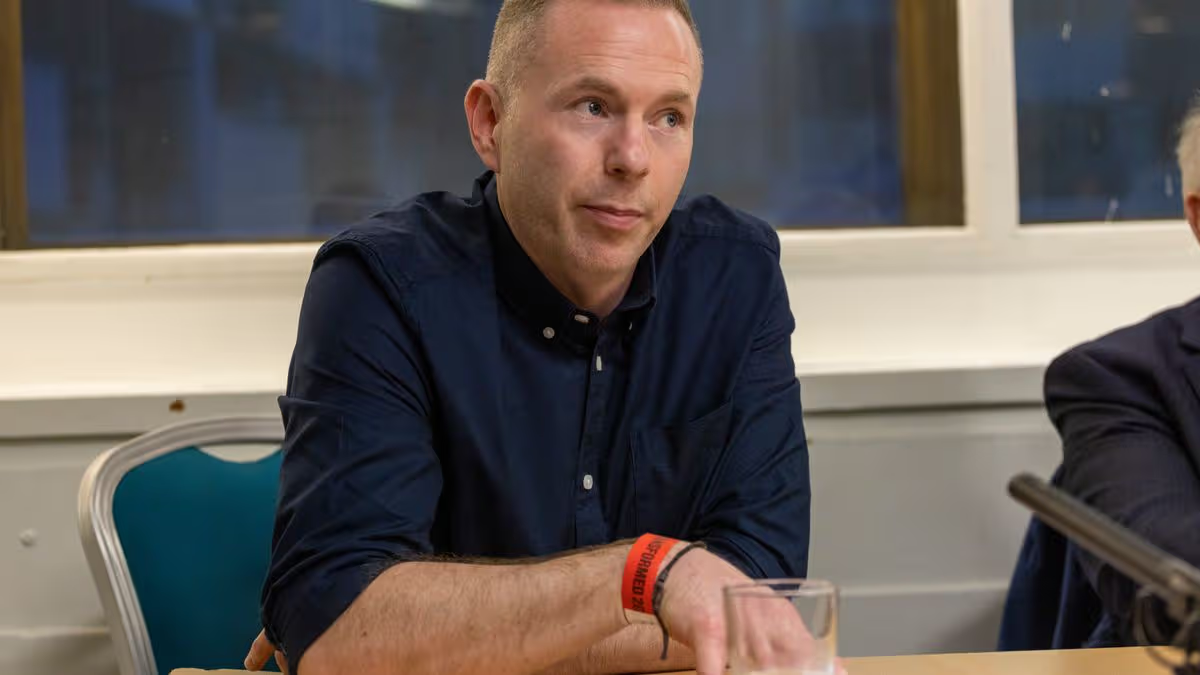
Writing for Belfast Live, South Down MP Chris Hazzard argues that Stormont is being asked to manage decline while an insulated Whitehall watches from the sidelines.
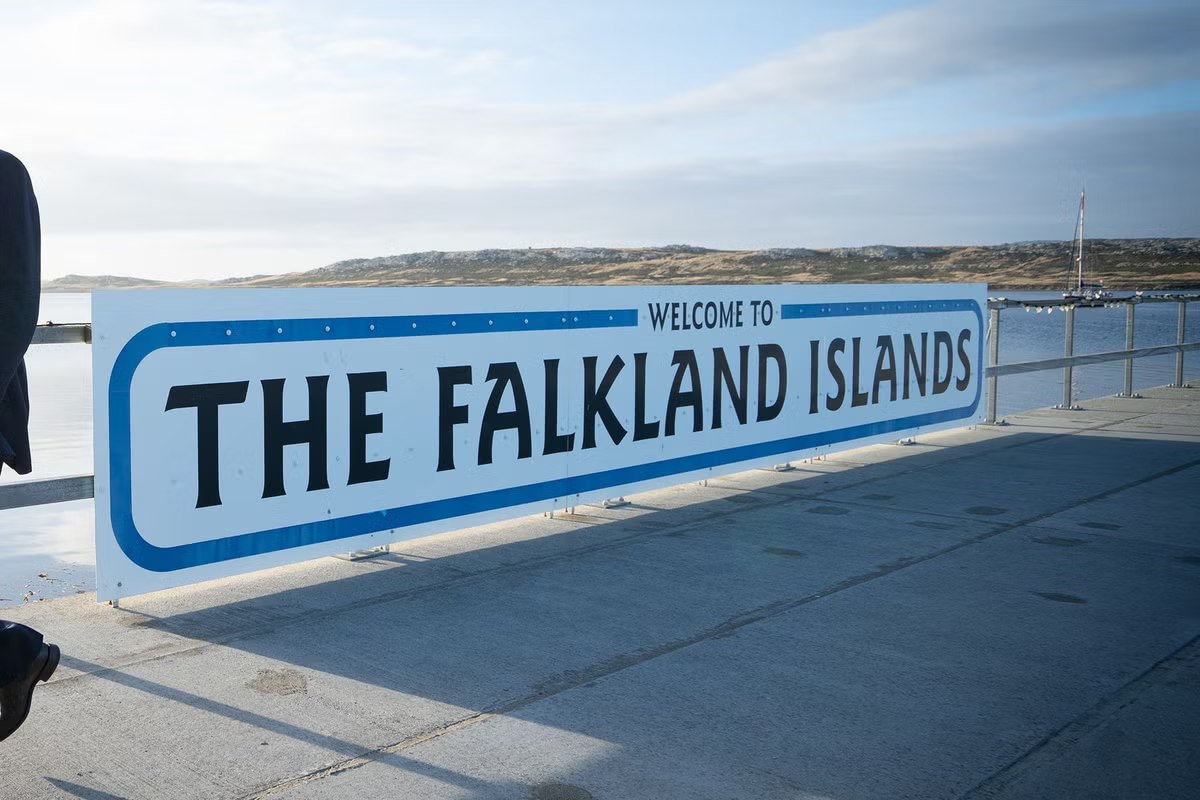
Earlier this month, the British Secretary of State Hilary Benn arrived in Kilkeel Harbour to meet a fishing industry in crisis. He heard of soaring fuel costs and a crewing shortage that threatens to dry‑dock a generational way of life. While he acknowledged their difficulties, his message remained fixed to a familiar Treasury script: the Stormont Executive has received a “record settlement,” and it is now up to local ministers to manage it. To repeat this line to people watching their livelihoods slip away is to expose a profound disconnect between Whitehall mathematics and the reality on the ground. It is a fiscal illusion that depends on the public not looking past the headline figure to see a British Treasury-controlled system being slowly strangled by real‑terms cuts, a decaying spending baseline, and a decade‑long refusal to invest in the basic infrastructure of a modern state.
Advertisement
The Treasury’s preferred trick is to speak only in cash terms. An £18.2 billion block grant sounds like a windfall until inflation is accounted for. The NI Fiscal Council has shown that while the settlement is 2.6 per cent larger in cash, it amounts to just 0.2 per cent growth in real terms. And even that microscopic increase is fragile. If the Executive is required to repay previous overspends, the budget would actually shrink by 3 per cent in real terms. The deeper problem lies in the benchmark used to judge “fairness.” Funding here is tied to public spending in England through the Barnett Formula, and the Treasury insists that because Stormont receives 124 per cent of English spending, it is somehow overfunded. But that logic only holds if spending levels in England are themselves adequate. They are not. Across the water, the English baseline for public services is in a state of managed decline. That is a direct result of political choices. The British government has chosen military spending and weapons of war over the health and well-being of their own people. As a result, NHS England is grappling with a £13.8 billion maintenance backlog, while schools face a further £13 billion in essential repairs. Only last month, the Annual Local Authority Road Maintenance survey revealed that local roads in England are now resurfaced just once every 97 years. Britain sits at the bottom of the G7 for total investment, and even the quality of its bathing waters – rated five times worse than the European average – reflects decades of capital neglect that have earned it the label of “the dirty man of Europe.” This decay is no longer an abstract policy debate; it is a live political crisis. It is one reason why parties such as the SNP, Plaid Cymru and the Greens are tipped for major breakthroughs in next month’s elections. Voters across the water are on the verge of revolting against a system that prioritises fiscal optics over functional infrastructure. When the British Government tells Belfast to “live within its means,” it is benchmarking local services against an English system that is itself on starvation rations. Brexit has only sharpened the squeeze. Imposed without a mandate in the north, it has stripped away EU structural funds that once underpinned community development and peace‑building initiatives. Replacement schemes designed in Whitehall have failed to match either the scale or the certainty of what was lost. Fishing and coastal communities in Co Down who once received 10 per cent of Britian’s share of Europe’s Maritime & Fisheries Fund, are now to receive less than 3 per cent of Westminster’s new replacement scheme. The British Government has placed a ceiling on economic growth while simultaneously tightening the purse strings. Perhaps the most frustrating aspect of this fiscal theatre is the role played by some within the local media and political establishment. Rather than scrutinising the systemic underfunding that is choking public services, a chorus of voices – including the Leader of the Opposition at Stormont – merely echoes the Treasury’s “record funding” line. Indeed, for a Leader of the Opposition who previously served as a Downing Street press officer, it often feels as though old habits die hard. Acting as a regional megaphone for Westminster talking points does not inform the public; it validates a false narrative of local incompetence and shields the British Government from accountability. Meanwhile, the Northern Ireland Office continues to urge MLAs to make “tough decisions” – a euphemism for cuts or imposing charges. This framing ignores a basic constitutional reality: local representatives are not accountants. They are elected with a duty of care to protect the health and wellbeing of their citizens. MLAs are right to resist decisions that would lengthen waiting lists, introduce water charges, increase tuition fees or strip support from vulnerable children simply to satisfy a Treasury spreadsheet. Closing a facility without the capital to provide a better alternative is not leadership. It is a dereliction of duty. Stormont is being asked to manage decline while an insulated Whitehall watches from the sidelines. As Britain continues its retreat from public investment, it is clear that more people in the north of Ireland are looking south. The Shared Island Fund has already stepped in to support projects the Treasury has neglected – from the Narrow Water Bridge to cross‑border environmental and educational schemes. This is not just tactical financial support; it reflects a growing recognition that the current fiscal framework is fundamentally broken. On an island where one jurisdiction is navigating multi‑billion‑euro surpluses while the other is lectured on “tough decisions” by a neighbour in visible decline, it is no surprise that the economic argument for constitutional change is increasingly being framed as a matter of basic survival. The “record settlement” narrative may be a masterpiece of political framing, but it fails the test of economic honesty. It ignores the soaring costs of modern governance, the inadequacy of the Treasury’s spending baseline, the fallout of Brexit, and the British state’s chronic refusal to invest in the future. Whether it is fishermen in Kilkeel or families waiting for life-changing surgery, people deserve a conversation based on need, not on misleading historical comparisons. It is time to stop talking about “record settlements” and start talking about the actual cost of a functioning society. One is a headline; the other is a necessity.












































You must be logged in to post a comment Login