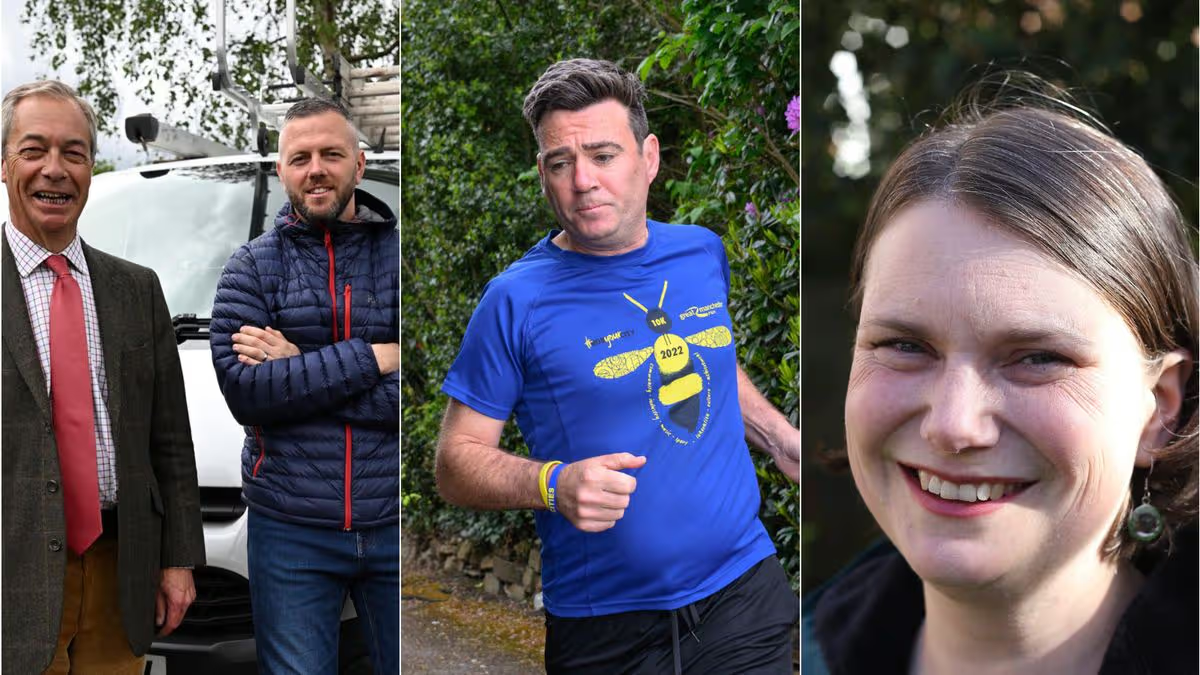

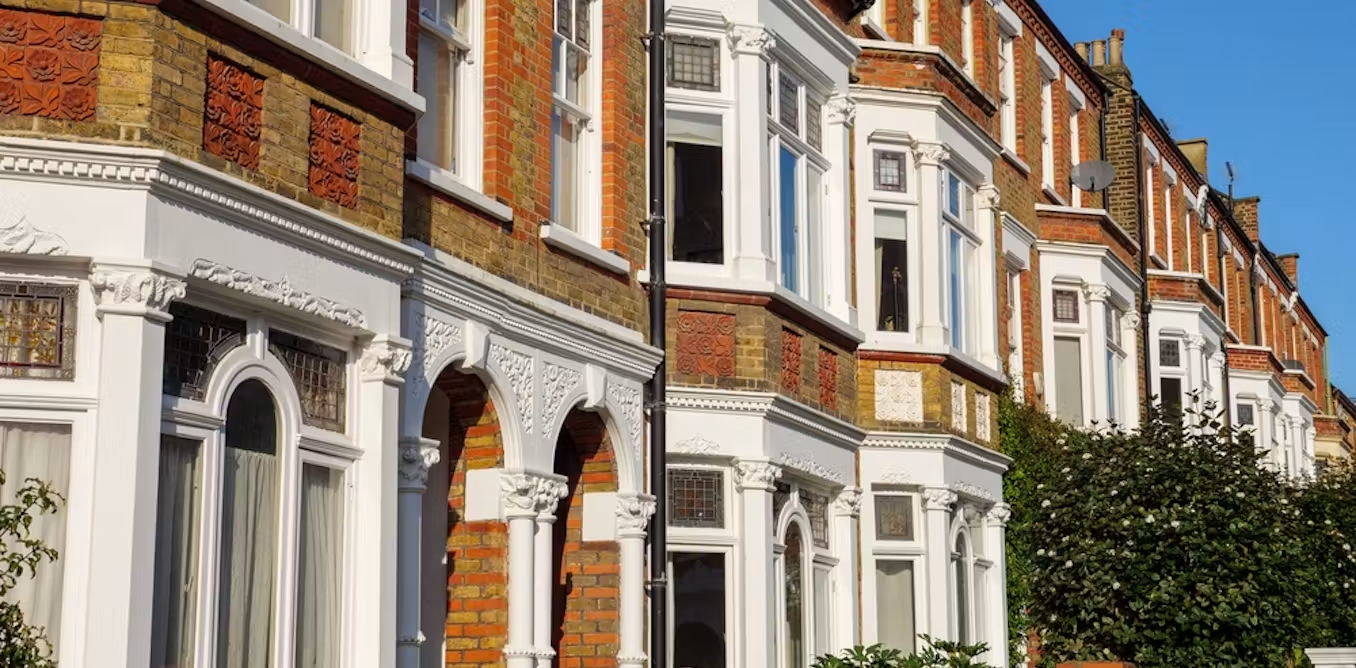
Makerfield canddate Robert Kenyon has come under fire over social media posts. It was reported he used a now-deleted X account to support an offensive post about Welsh broadcaster Carol Vorderman.
Messages published by campaign group Hope Not Hate showed that Mr Kenyon responded on Christmas Eve 2021 to another person’s post including graphic sexual language about the presenter who made her name as the maths expert on Channel 4’s Countdown.
Alongside a thumbs up and a laughing emoji, the plumber wrote: “He’s only saying what we’re all thinking.”
Advertisement
When asked about the message, Reform MP Danny Kruger told BBC Radio 4’s Today programme on Monday: “The great challenge for social media for private people is that they use it as if they are chatting to their friends in the park. Clearly an inappropriate thing to say publicly.
“I’m not going to judge people for their what are essentially regarded at the time and intended as private conversations.”
Responding Labour Party chairwoman Anna Turley said: “Danny Kruger’s interview tells voters everything they need to know about Reform’s judgment.
“He admitted Robert Kenyon’s comments were ‘unacceptable’, but then said he would not ‘police the previous remarks’ of their candidate. That is not leadership. It is a party making excuses for vile misogyny, violent rhetoric and conspiracy politics.
Advertisement
“Reform are trying to dress up chaos and extremism as straight-talking. Makerfield deserves better.
“Andy Burnham is the only candidate with the experience, values and determination to stand up for local people and deliver the fresh start this area needs.”
Memories of those qualifiers – which both ended 1-1 – are still fresh, but a score will be settled on neutral ground this evening as one team has to emerge victorious. The winners will progress to Saturday’s final to face the winners of the second semi-final between India and Jamaica, while the losing side has to settle for a place in the third-place play-off. Follow the game LIVE below with our dedicated match blog!
In a review of Cabinet meetings, the New York Times found that, on average, one in every six sentences spoken by current members offers Trump some sort of flattery. It ranges from direct compliments and giving Trump credit to bashing his enemies.
Secretary of State Marco Rubio, who spoke the most often during Cabinet meetings, was found to have flattered the president the most, according to the analysis. Rubio credited Trump with helping bring an end to multiple world conflicts – a claim the president also consistently makes.
Meanwhile, Vice President JD Vance criticized Trump’s opponents most often, with one of every six sentences being an insult towards them, the analysis determined.
Advertisement
White House Spokesperson Allison Schuster said in a statement that Trump “has opened nearly all of his Cabinet meetings to the press, allowing his talented team to highlight the exhaustive list of accomplishments they have delivered on behalf of the American people to Make America Great Again.”
Open press cabinet meetings often include hours of officials flattering President Trump, insisting he deserves credit for a policy or bashing the president’s political opponents, according to an analysis (AFP/Getty)
White House officials have often highlighted how the president has made his administration more transparent to the public by televising Cabinet meetings.
Cabinet meetings are historically closed-door to allow the president and his inner circle to discuss sensitive issues. But Trump has chosen to allow TV cameras and the press in the room to give Cabinet members an opportunity to explain what they’re doing and take questions from reporters.
During a January 29, 2026, Cabinet meeting, Small Business Administrator Kelly Loeffler credited Trump with helping Americans affected by natural disasters, criticized California Governor Gavin Newsom and former President Joe Biden, parroted Trump’s claim that he ended eight wars and insisted Americans had lined up to thank Trump.
Secretary of State Marco Rubio speaks the most at Cabinet meetings, according to the analysis, and thus offers the president the most amount of praise (Getty)
At a December 2025 Cabinet meeting, EPA Administrator Lee Zeldin told the president his team was “crushing it,” said he was grateful for Trump during the holiday season and insisted the president was “willing to take a bullet for this country.”
Many Cabinet members credit Trump’s leadership with accomplishments in their respective departments or agencies, often using the phrase “under your leadership” during sentences.
On April 30 last year, now departed Attorney General Pam Bondi raised eyebrows by claiming Trump had saved the lives of 258 million Americans – about 75 percent of the population of the United States – through the seizure by law enforcement agents of 22 million fentanyl pills.
Another former Cabinet member, ex-Homeland Security Secretary Kristi Noem, told the president in December: “Sir, you made it through hurricane season without a hurricane. You kept the hurricanes away.”
Advertisement
The New York Times analysis found that Rubio often asserted Trump deserved more credit for his foreign policy agenda and that no other leader would have been able to intervene in conflicts to make peace.
Treasury Secretary Scott Bessent insisted Trump’s decision to bomb Iran would have a positive long-term outcome for the U.S. economy and criticized Democrats for underestimating the president during a March 26, 2026, Cabinet meeting.
Cabinet members use the public meetings to give updates on what they are doing and compare it to Democrats, a White House official said (AFP/Getty)
Vance bashed Democrats during a December 2, 2025, Cabinet meeting, repeating various claims Trump had made about his predecessor, including that Biden had created an affordability problem.

Trump’s messaging often includes vilifying his predecessor. Despite winning the 2024 presidential election, Trump continues to compare his administration to Biden’s during Cabinet meetings, press conferences or rallies.
Members of the Cabinet often do the same.
Advertisement
During an April 30, 2025, Cabinet meeting, Defense Secretary Pete Hegseth blamed Biden for the disastrous withdrawal in Afghanistan, Transportation Secretary Sean Duffy blamed Biden for adding overhead costs to infrastructure, Housing and Urban Development Director Scott Turner blamed Biden for prioritizing migrants over Americans, and Director of the Office and Management and Budget Russell Vought blamed Biden for raising prices for families and more.
WASHINGTON (AP) — The Supreme Court on Tuesday refused to intervene in a discrimination lawsuit led by former Miami Dolphins head coach Brian Flores against the NFL, allowing the case to proceed toward trial.
The justices rebuffed an appeal from the league, which wanted the case handled through its arbitration process rather than open court in New York. Justice Brett Kavanaugh dissented from the decision not to hear the case.
Advertisement
The Supreme Court is seen in Washington, Monday, May 18, 2026. (AP Photo/J. Scott Applewhite)
Advertisement
The Supreme Court is seen in Washington, Monday, May 18, 2026. (AP Photo/J. Scott Applewhite)
Advertisement
Advertisement
Flores, who’s Black, sued the league and three teams in February 2022, alleging the league was “rife with racism” regarding its hiring practices when it comes to Black coaches. He was later joined in the lawsuit by fellow Black coaches Steve Wilks and Ray Horton.
Flores, who was fired by the Dolphins shortly before the suit was filed, is now the Minnesota Vikings’ defensive coordinator.
Advertisement
Minnesota Vikings defensive coordinator Brian Flores stands on the sideline during the first half of an NFL football game against the Chicago Bears, Sunday, Nov. 16, 2025, in Minneapolis. (AP Photo/Matt Krohn, File)
Advertisement
Minnesota Vikings defensive coordinator Brian Flores stands on the sideline during the first half of an NFL football game against the Chicago Bears, Sunday, Nov. 16, 2025, in Minneapolis. (AP Photo/Matt Krohn, File)
Advertisement
Advertisement
Advertisement
The NFL has argued Flores should go through arbitration rather than the legal system, but lower courts have sided with the plaintiffs. The league said it respected the Supreme Court decision, which allows lower-court rulings to stay in place, but is “fully prepared to defend ourselves as this matter proceeds.”
Advertisement
David Gottlieb and Douglas Wigdor, attorneys for the plaintiffs, said they were pleased with the decision. “The NFL must now accept that its commissioner cannot be the arbitrator over discrimination claims against the league and its teams. We look forward to litigating these claims in court,” they said in a statement.
Flores was fired after posting a 24-25 record over three years without a playoff appearance. The Dolphins did have back-to-back winning seasons before Flores was dismissed.
Flores sued the NFL as well as the Denver Broncos, the New York Giants and the Houston Texans. He interviewed with the Broncos in 2019 and the Giants and Texans in 2022.
Wilks, who was fired as the New York Jets’ defensive coordinator in December, joined the lawsuit by claiming the Arizona Cardinals in 2018 hired him as a “bridge coach” — promoting him to interim coach after they fired another coach but then passing over him for the full-time role. He said the Cardinals didn’t provide him with a realistic chance to succeed.
Advertisement
Cleveland Browns defensive coordinator Steve Wilks walks on the sideline during an NFL football game against the Cincinnati Bengals, Sunday, Dec. 8, 2019, in Cleveland. (AP Photo/David Richard)
Advertisement
Cleveland Browns defensive coordinator Steve Wilks walks on the sideline during an NFL football game against the Cincinnati Bengals, Sunday, Dec. 8, 2019, in Cleveland. (AP Photo/David Richard)
Advertisement
Advertisement
Advertisement
Horton, who last coached in the NFL in 2019, alleged the Tennessee Titans didn’t offer him a genuine interview for the head coaching position in 2016.
Advertisement
Tennessee Titans defensive coordinator Ray Horton, during an organized team activity at the team’s NFL football training facility, June 10, 2015, in Nashville, Tenn. (AP Photo/Mark Humphrey, File)
Advertisement
Tennessee Titans defensive coordinator Ray Horton, during an organized team activity at the team’s NFL football training facility, June 10, 2015, in Nashville, Tenn. (AP Photo/Mark Humphrey, File)
Advertisement
Advertisement
Advertisement
___
Advertisement
Associated Press writer Michael R. Sisak in New York contributed to this story.
Barnard Castle – known locally as “Barney” – sits on the north bank of the River Tees in south‑west County Durham, about 21 miles from Durham city and an easy run up from Darlington.
It’s the main town in Teesdale, acting as a gateway to the dales, waterfalls and moorland that make this part of the North Pennines an Area of Outstanding Natural Beauty.
A Norman fortress town
Advertisement
The town grew up around the Norman stronghold that still dominates the skyline on a rocky outcrop above the Tees.
Barnard Castle was begun in the 12th century by Bernard de Balliol and later passed through powerful families, including the Beauchamps and Richard III, who used it as one of his northern bases.
Today the ruined walls, towers and views over the river are managed as a visitor attraction, with the site typically taking a couple of hours to explore.
Cobbled streets and markets
Advertisement
Step away from the castle and you’re in a tight maze of cobbled streets, ginnels and squares lined with Georgian and Victorian buildings.
The main route, Galgate, runs into Horse Market and the cobbled Market Place, where a traditional Wednesday market and monthly farmers’ markets still bring stalls and producers into the town centre.
At the top of the cobbles stands the octagonal Market Cross, an 18th‑century landmark that anchors the high street.
Independent shops are one of Barney’s big draws: antiques and collectables, butchers, bookshops, galleries and cafés sit alongside everyday services and a supermarket.
Advertisement
For visitors, it’s the kind of place where you can park once and spend the day wandering between castle, museum, river and shops without needing the car again.
(Image: SARAH CALDECOTT)
The Bowes Museum
On the eastern side of town, set in parkland, the Bowes Museum is Barnard Castle’s other flagship attraction.
Alongside the permanent collection, it runs a programme of exhibitions, family activities and events throughout the year.
(Image: STUART BOULTON)
Walks and the River Tees
Part of Barnard Castle’s appeal is how close town and countryside sit together. Riverside paths drop down from the centre to the Tees, where you can follow waymarked routes to the medieval bridge, through Flatts Wood or out towards Egglestone Abbey.
The town is also a natural base for exploring further up Teesdale to High Force, Low Force, Bowlees and the high moors, all within an easy drive.
Advertisement
Practical details for a visit
Most of Barnard Castle’s centre offers short‑stay free parking, backed up by car parks close to the shops, castle, riverside and Bowes Museum.
Buses connect the town with Bishop Auckland and Darlington, and there is a visitor information point in the town centre with maps, leaflets and local advice.
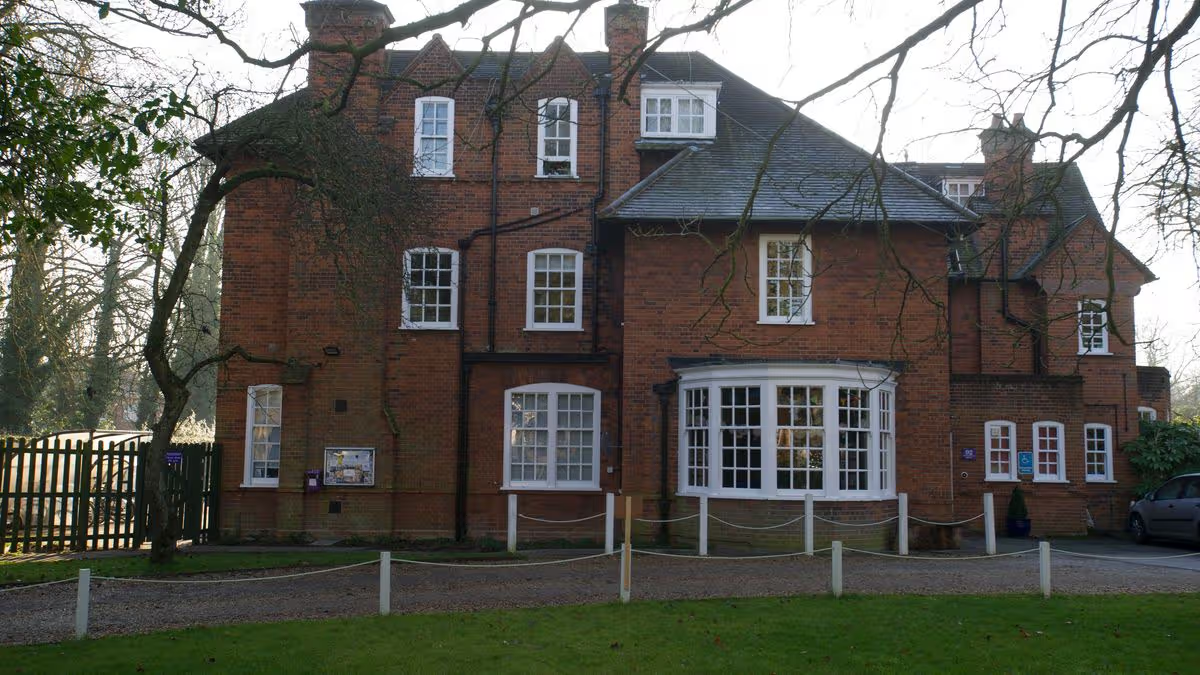
Between the history, the Bowes Museum and the simple pleasure of a wander around the cobbles, it works just as well for a quick stop off the A66 as it does for a full weekend in Teesdale.
Trump arrived at the Bethesda, Maryland facility at 8:52 am on Tuesday for what the White House described as “his annual dental and medical evaluations” as well as visits with military personnel while there.
He left for the return drive to the White House after roughly three and a half hours of what he described as a “six-month physical” in a Truth Social post in which he declared that “everything” had “checked out PERFECTLY” during the checkup.
The medical exam was Trump’s third publicly disclosed checkup with his U.S. Navy physician, Dr. Sean Barbabella, since October 2025 — and his fourth since returning to the White House last January.
Advertisement
He previously visited Walter Reed for the first time in his second term for an annual physical in April 2025, after which the White House claimed he was in “excellent health” and weighing in at 224 pounds — a fully 20 pounds lighter than what he weighed five years earlier.
President Donald Trump leaves the White House to travel to Walter Reed National Military Medical Center for his third checkup since November (AP)
Trump then underwent an evaluation by Dr. Barbabella in July 2025 after photographs of his swollen ankles raised health concerns, followed by what the White House called a “semi-annual physical” in October after which the White House disclosed that he’d had a CT scan to rule out cardiovascular issues.
His latest examination comes amid rising scrutiny over his mental and physical condition as he nears the start of his ninth decade and as Americans express increasing doubts over his fitness to serve as president after regular episodes of falling asleep during public events, bizarre and often erratic behavior and evidence of physical decline.
Since the start of his second term, photographers have routinely spotted visible bruising on both of his hands that he attempts — unsuccessfully — to conceal with makeup.
The White House has repeatedly claimed that the bruising is the result of frequent and constant handshaking while carrying out official duties combined with the side effects of a high daily dose of aspirin, with White House Press Secretary Karoline Leavitt telling The Independent last year that the Oval Office under Trump is “like Grand Central station” since Trump returned to the presidency.
Advertisement
Yet no explanation has been offered for the similar bruising on the back of Trump’s left hand, which is not generally used for shaking hands.
A bruise was visible on the back of President Donald Trump’s left hand during a signing ceremony for the “Board of Peace” at the World Economic Forum on Jan. 22 and has been spotted multiple times this year and last. (Getty)
After photographs of the president revealed visibly swollen ankles last July, Dr. Barbabella penned a memorandum stating that Trump was suffering from Chronic Veinous Insufficiency, which he described as a “common” vein condition that was benign and not evidence of more serious disease.
Barbabella separately acknowledged that Trump was using “a preventative skin treatment” to address a dermatological issue he did not describe further after photographs emerged of a blotchy red rash around Trump’s neck during an event earlier this year.
The U.S. Navy Captain has described the president’s “cardiac age” — a metric used by physicians to describe cardiovascular vitality as approximately 14 years younger than his chronological age. And Leavitt said the CT scan of Trump taken during his exam last October indicated that he is “exceptional physical health.”
Yet Trump’s condition is increasingly being questioned after he has appeared to fall asleep during several meetings, including a during a cabinet meeting late last year.
Advertisement
A Reuters/Ipsos poll in April found that 51 percent of Americans believe that Trump’s mental faculties declined over 2025 and early 2026. That same poll found that only a quarter of Americans believe he is “even-tempered.”
The same month, a Washington Post/Ipsos poll found that just four in ten Americans now believe that Trump has the mental sharpness required for the presidency, a drop of seven points in that category from several months ago. That poll also found that worries about Trump’s physical health were increasing as well.
Yet Trump frequently boasts about his cognitive condition — including his ability to pass a routine screening used to detect dementia.
During an Oval Office event in late March, he claimed to be the “only president that ever took a cognitive test.”
Advertisement
“I took it three times. It’s actually a very hard test for a lot of people. It wasn’t hard for me. But it’s a cognitive test,” he said.
“It starts off with an easy question. And by the time you get to the middle, it gets tougher. By the time you get to the end, very few people can answer those questions. They get very tough mathematical equations and things.”
Local councillors in the town told on Tuesday that a Sheriff had signed papers to serve notice.
Travellers occupying land at the Xcite campus in Linlithgow are set to be moved on.
Advertisement
Local councillors in the town told on Tuesday that a Sheriff had signed papers to serve notice.
It comes almost a week after travellers set up an authorised encampment at the site in McGinlay Way in the town- one of several set up across the county in recent weeks.
There have already been reports of nuisance and vandalism at the site including playing pitches torn up by vehicles with reports of cars “ donutting” on playing fields destroying playing surfaces.
The travellers moved onto the site last Wednesday- the day after the council agreed its new policy framework into how to deal with an issue which hit communities across the county last summer and left the council with a clean up bill running into tens of thousands of pounds.
An unauthorised camp at the Linlithgow site last summer took contractors weeks to access and clear up because of soggy ground conditions.
The decree against the latest encampment was issued on Tuesday morning with immediate effect. The council’s legal officers arranged for Sheriff Officers to serve notice in the travelling families.
Should the travellers fail to vacate the site Police Scotland and an external contractor low loaders will attend to assist Safer Neighbourhood Team officers.
Chairing a meeting of the Linlithgow Local Area Committee this morning, Councillor Sally Pattle thanked council officers for providing daily updates on the Xcite encampment, given the interest from local people and the question she and other members had faced over the latest arrival.
Last week the Local Democracy Reporting Service highlighted the difficulties that the council will continue to face under existing legislation. West Lothian, along with other local authorities has to seek written permission fro a Sheriff before it can act to move travellers on.
There were doubts expressed last week, as the LDRS highlighted that without a change of legislation there will be no improvement.
A woman at the heart of a murder probe in Rochdale has been identified. Keeley Aspinall, affectionately known as Kiki amongst mates, was discovered deceased at a flat on the Freehold estate on Monday afternoon (May 25).
Police responded to a welfare concern at the property near Tweedale Street at approximately 4pm. Greater Manchester Police confirmed a woman was located at the flat. Tragically, she was declared dead at the scene.
Keeley, 44, has now been formally identified and named by relatives, who are receiving support from specialist officers at GMP.
Her family paid tribute, saying: “Gone too soon.. we can’t believe you are gone. We will always love you and miss you, love all your family xx.”
Advertisement
One friend, speaking to the Manchester Evening News in remembrance of Keeley, described her as ‘like a sister’, stating: “She was the best friend anyone could ask for. I’m going to miss her so much, she will always be in my heart.”
A man in his 30s has been detained on suspicion of murder. He continues to be held in custody for questioning on Tuesday (May 26).
Advertisement
Police maintained their presence on the estate throughout the afternoon. A flat at the Hartlebury block was sealed off, with officers positioned outside.
Detectives were observed conducting door-to-door inquiries, while forensic specialists were also present at the scene. GMP confirmed there would be an increased police presence in the vicinity as investigations progress.
Temporary Detective Chief Superintendent Jamie Daniels, from GMP’s Major Incident Team, stated on Monday: “We appreciate this incident is likely to cause some distress amongst the public and local community. I would like to reassure you that we believe this to be an isolated incident, which does not pose any further risk to the wider public.”
He continued: “We understand the severity of events such as this, and whilst we are in very early stages, our officers will work tirelessly to establish the full details of this tragic death.
Advertisement
“A scene will remain in place at this time, and there will be an increased police presence in the area over the coming days. Thank you for your patience as our investigations continue.”
Social media has been inundated with tributes for Keeley. Naomi Parkinson wrote: “Oh this is heartbreaking I knew Keeley from my younger days x condolences to all her family xx.”
Anna Feeney commented: “When meeting you in Rochdale u was Such a lovely girl sending so much love and condolences to your family. rip Kiki a beautiful girl.”
Advertisement
Paul Ashi shared: “Lovely girl full of fun never a dull moment with her around.” Eleanor Smith remarked: “She was so lovely r.i.p keeley. so sad she was such a beautiful person to get to know condolences to her family xxx.”
Ensure our latest stories always appear at the top of your Google Search by making us a Preferred Source. Click here to activate or add us as your Preferred Source in your Google search settings.
Cole Palmer could potentially be sold by Chelsea in the summer transfer window, with his asking price and Champions League comments putting interested parties on red alert
Chelsea star Cole Palmer would reportedly cost at least £80million for either Manchester United or Manchester City to tempt Xabi Alonso’s side into negotiating a sale this summer. The Blues talisman, after being left out of England’s World Cup squad, looks set for months of uncertainty surrounding his future after his side failed to qualify for any form of European football next season.
Advertisement
In the midst of a turbulent campaign, links over a move to Old Trafford emerged with Palmer a boyhood United fan. However, those rumours died down somewhat with Michael Carrick and Co focusing on additions in other positions.
Interest from United could be reignited though with his asking price coming to light and some telling comments resurfacing that suggest he could leave. According to The Sun, £80m would be the starting point for any negotiations.
Get MEN Premium now for just £1 HERE – or get involved in our United WhatsApp group by clicking HERE. You can also join our United Facebook page by clicking HERE and don’t miss out on our brilliant selection of newsletters HERE.
Chelsea are not exactly in a strong position for any potential talks however, with defeat to Sunderland last weekend seeing them finish 10th and outside of any European qualification spots. Palmer made quite the Champions League claim prior to Chelsea’s run of one league win in five games.
Advertisement
He told TNT Sports: “Hopefully [I can achieve my ambitions at Chelsea]. I believe in the club, they spoke to us as players. Hopefully I, and we, can win a lot at Chelsea. If we’re not in the Champions League, everything changes. We need to finish in the Champions League.”
Having finished third, United are back in Europe’s top club competition but could face competition from another Champions League side in Manchester City. Reports in Spain have gone as far as stating an £86million offer is on the table.
The latter took charge of his final game as City boss last weekend and he is expected to be replaced by former Chelsea head coach Maresca, who had a stint as Guardiola’s No2.
He was sacked just a few months into his tenure with Xabi Alonso, who was strongly linked to City, confirmed as their manager for the 2026/27 season.
Advertisement
United also looked set to be in the managerial market this summer but made the decision to stick with Michael Carrick permanently after he guided the club to a third-placed finish.
Midfielders are the priority for United but Palmer could be considered a unique market opportunity given Chelsea’s failings.
You unlock your phone with your face, your fingerprint sends your laptop whirring into action, you pass airport security by glancing at a camera. Biometric technology has become so woven into the daily routine that for many people, it barely registers any more.
That invisibility is part of the point. These systems are usually fast, convenient and feel secure. Unlike a password, you can’t forget your face. But that doesn’t mean they are without risk.
Biometrics fall into two broad families: physiological (fingerprints, faces, irises, even nailbed patterns) and behavioural (how you walk or type, the rhythm of your speech, the angle you hold your phone).
Both forms are already being widely used – you just may not realise it. Many banks and retailers now monitor how you interact with your device – from swipes, taps and scrolls to the angle you hold your phone, the rhythm of how you move between fields, and the pressure of your touch. If someone else picks up your unlocked phone and tries to access your banking app, this can automatically trigger a fraud alert.
Advertisement
My research with colleagues even shows it’s possible to infer a user’s name and native language from the timing patterns of their keystrokes.
The graphic below shows the full extent of biometric technologies. Those marked dark green are in widespread commercial and government use today – including less-familiar examples such as the veins in your hand and other bodily vein patterns.
Biometric technology colour-coded by use status, from active to still in research. Oli Buckley, CC BY
Gait analysis – reading how you walk – is already used for security and surveillance purposes, from venue access to detecting potentially suspicious behaviour. You can wear a mask, pull up a hood, avoid looking at a camera – but you can’t easily change how you walk.
A number of other biometric technologies (marked light green), ranging from skin texture and ear shape to micro-expressions and hand-grip patterns, are being actively researched for use in the near future. A further group (marked red) have so far only been demonstrated in the laboratory. But even body odour and breath signatures are further along than their novelty might suggest.
What once felt like science fiction is now embedded in our everyday lives. You can’t always see this technology, and you can’t always opt out. But knowing it exists is the first step to understanding how much of yourself you’re already sharing.
Advertisement
V is for vulnerability
In April 2026, financial security expert Li Chang showed Chinese TV viewers how AI tools could extract a celebrity’s fingerprints from a single selfie. The culprit? The classic V-sign, finger pads pointed straight at the lens.
This built on work by Japan’s National Institute of Informatics which in 2017 showed that usable fingerprints could be lifted from photos taken up to three metres away. And phone camera technology has only got better since then.
In the UK, police have made at least two arrests based on fingerprints lifted from photos: one from a WhatsApp image of a hand holding ecstasy pills, the other when a drug dealer was identified from a photo of him holding a block of Stilton cheese.
This technology can work in the other direction too. In the Chinese city of Hangzhou in July 2025, criminals reportedly tried to unlock a smart door using a photo the homeowner had posted online with his fingers visible. The attempt failed but the intent was clear.
Advertisement
While this kind of targeted, technically demanding attack is still unusual, there are some precautions I would advise taking as the use of biometric technology grows.
China’s use of biometric surveillance technology explained. Video: The New York Times.
How to protect yourself
First, be selective about when you agree to share biometric data – fingerprints, face, iris, voice, all of it.
Most modern smartphones store biometric templates in a secure chip that never leaves the device. But third-party apps and workplace systems rarely offer the same guarantee.
Advertisement
In July 2024, US tech giant Meta paid the state of Texas US$1.4 billion (£1.1bn) after running facial recognition on users without consent. This followed a class-action settlement with TikTok’s parent company ByteDance in Illinois for US$92 million over similar allegations.
So, try to keep track of which apps have access to your camera and microphone. On both iOS and Android, this takes about two minutes. And don’t use biometrics as the only layer of security – make sure there’s a second step.
Three potential biometric weakpoints
Voice: This is probably the most casually surrendered biometric. AI voice cloning requires only seconds of audio to produce a convincing replica, and it’s being used in fraud calls impersonating family members. This is a far more realistic – and terrifying – version of the virtual kidnapping scam that’s been around for years. Establishing a safe word with the people closest to you for any unexpected financial request is a simple and underrated defence.
Eyes: Iris recognition is considered robust because this coloured eye muscle has around 250 measurable features – far more than a fingerprint – and remains stable throughout your life. But the quiet expansion of eye-tracking data collected through VR headsets, for example, is going unnoticed. Check the privacy settings on any VR device you use, and be aware that gaze data is increasingly treated as a commercial asset by platforms that collect it.
Advertisement
Fingerprints: Beyond being careful what you point at the camera, know where you’ve enrolled your fingerprint. Workplace access systems and payment terminals vary widely in how they store and protect data – and unlike your phone, they’re not legally required to tell you.
None of this means biometric systems are broken. For most purposes, they are more secure than the passwords they are replacing. The question is not whether to engage with these systems – they’re already too embedded to avoid. It’s whether we’re engaging with our eyes open – eyes that are, of course, already regularly being scanned.
The Westminster Hall debate, due to take place on Thursday, June 4, will focus on concerns surrounding recent changes to school transport eligibility, accessibility and affordability introduced by North Yorkshire Council.
The policy means the council will only provide free school transport to a child’s nearest school, meaning transport is not offered to catchment schools which are not the closest.
Tom Gordon, the Liberal Democrat MP for Harrogate and Knaresborough, said he secured the debate because too many families were being negatively affected by the changes.
Advertisement
He said: “I have already been contacted by a significant number of constituents who have outlined how these changes are affecting their children’s ability to get to school safely and on time, and the strain it is placing on family budgets.
“These experiences matter, and they deserve to be heard at the highest level.”
The MP is encouraging affected families to share their experiences ahead of the debate to help highlight the impact of the policy changes.
A spokesperson for the group said: “We are incredibly grateful to Tom Gordon for the support he has shown rural families on this issue from the very beginning.
“He has worked closely with campaigners, helped ensure our petition reached the Department for Education and, crucially, he has refused to give up on families being left stranded by these policies.”
The group also criticised current national guidance around home-to-school transport, arguing that it leaves rural communities vulnerable to service reductions.
North Yorkshire Council has previously defended the changes, saying the revised policy was designed to create a fairer and more sustainable transport system while helping address rising costs and increasing demand for school transport services.
Advertisement
Council leaders have argued that the authority faces significant financial pressures and that the updated arrangements bring North Yorkshire more closely in line with statutory requirements followed by many other councils.
The authority has also said support remains in place for eligible pupils and that it continues to meet its legal responsibilities for home-to-school transport provision.
You must be logged in to post a comment Login