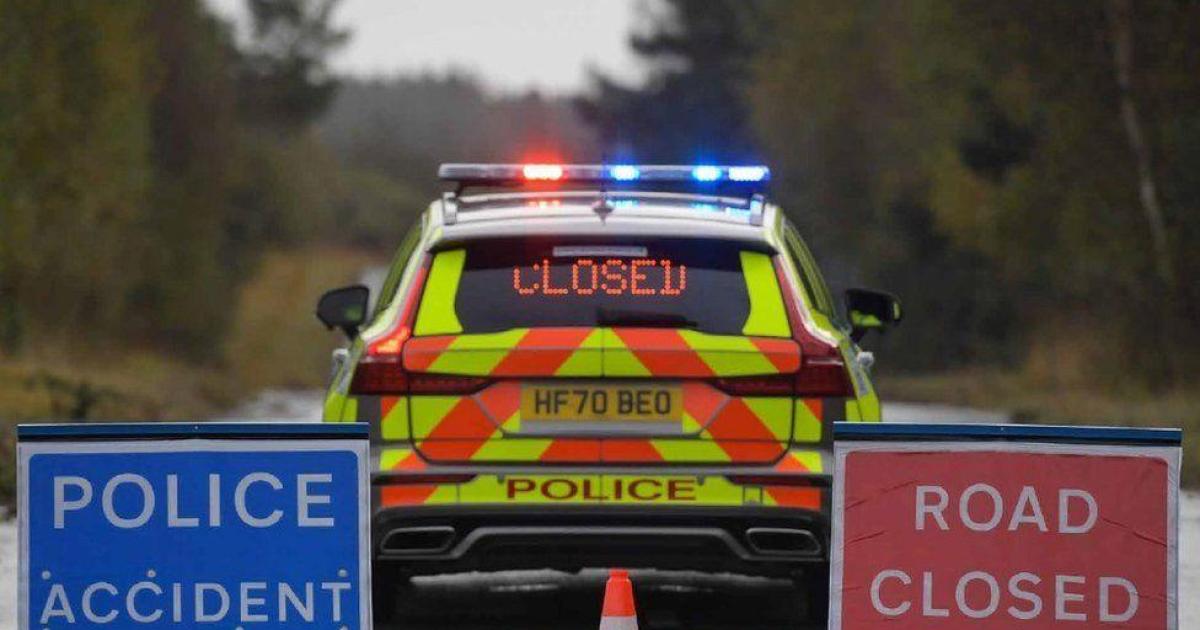


Benjamin James Swift, now 21, could only think about his beloved sports car and not about the family he had injured when he crashed into their Land Rover Defender as they drove to a picnic at Castle Howard, York Crown Court heard.
Several drivers told the jury how Swift had been “driving like an idiot”, narrowly missed a vehicle coming the other way with one overtaking manoeuvre and became airborne and lost control when he tried a second.
The front seat passenger in the Land Rover, Jacqueline Bell, said she believed she was about to die as the Porsche zigzagged towards them across the road immediately before crashing into her vehicle.
His back seat passenger had severe abdominal pains following the crash, the jury heard.
After an hour in retirement, the jury convicted Swift of seriously injuring Mr Thompson by dangerous driving close to Welburn crossroads on the Castle Howard approach road.
Approaching Welburn crossroads from the south, heading towards Castle Howard (Image: Google Street View)
Swift, of Holly Tree Lane, Haxby, had denied the charge and showed no reaction as the jury returned their unanimous verdict. He had been 19 at the time of the crash on July 7, 2024.
Advertisement
“You told the jury you consider yourself to be a polite young man: you may like to add ‘arrogant’,” Recorder Geraldine Kelly told him.
“I saw an arrogant young man in the witness box, not having a hint of remorse about the harm you caused to the victims.
“All you seemed to care about was your beloved Porsche and the damage you caused to it.”
Despite having appeared to be sorry at the scene of the crash, he had decided to have his trial and thereby forced those injured in the crash to relive their experiences in the witness box.
Advertisement
She said the evidence against him had been “overwhelming”.
The judge disqualified Swift from driving and warned him that he could not drive any vehicle from that moment. He will learn the full length of his ban when he is sentenced on August 7.
Barristers for the prosecution and defence agreed sentencing guidelines state he should receive a jail term of between two and four years.
Swift was given bail while probation officers prepare a report on him.
Advertisement
He will have to take an extended driving test at the end of his ban before being allowed to drive unsupervised again. His Porsche was written off by the crash.
He told the jury he was an apprentice field services engineer.
Antonee Robinson is said to be open to a move to Old Trafford as he remains one of many transfer targets linked with Manchester United
Antonee Robinson has admitted he could leave Fulham if a club matched his asking price. The defender has impressed for the United States at the World Cup, leading to reports linking him with Manchester United.
Advertisement
Michael Carrick is looking to reinforce the left-back position – Robinson’s primary area of cover – with Luke Shaw standing out as the only senior option next season. Tyrell Malacia is departing United as a free agent this summer, while Patrick Dorgu is expected to continue on a more attacking front under the new manager.
Get MEN Premium now for just £1 HERE – or get involved in our United WhatsApp group by clicking HERE. You can also join our United Facebook page by clicking HERE and don’t miss out on our brilliant selection of newsletters HERE.
Robinson admitted that while he is content at Craven Cottage, the idea of a transfer is tempting. Speaking to Marca in 2024, the 28-year-old said: “I’m very happy here. The fact that there is interest from other teams is great.
Advertisement
“Obviously, it all comes down to whether someone wants me enough to pay what Fulham would ask. So, if the club sees it as a good idea, I would leave.”
Former Fulham manager Marco Silva was full of praise for the defender during his time in south-west London, highlighting his defensive abilities, which greatly improved the squad. He said: “He never stops going up and down, and, on top of that, in attack, he is decisive.
“He is a great athlete, but I would highlight, above all, the way in which he has been improving in our defensive process. He had to defend many one-on-one situations with Salah and, despite having a yellow card since the 27th minute, he was brave and aggressive, in a good way.”
Advertisement
Robinson has been a reliable performer for Fulham since joining from Wigan Athletic in 2020. The defender has provided four goals and 22 assists in 215 appearances for the Cottagers and has stood out in the Premier League.
While United have other options, including Hall, Robinson is considered the more affordable choice. Reports have suggested that Fulham may accept a fee of around £28million.
The 28-year-old looks to be open to a move, but his current club are in a moment of change, with Silva departing as boss and Alvaro Arbeloa in advanced talks to take over. This could prove to be a wrench in United’s plans, and they would likely have to act fast if Robinson continues to perform at the World Cup.
Sky is knocking 20% off its entire range of Glass TVs to mark the start of the 2026 FIFA World Cup. Until June 17, shoppers can upgrade to the Sky smart TV that’s ‘designed for football’ from £4.50 per month when taken alongside a Sky TV and Netflix package.
Jordan Everington, 23, was pronounced dead in November 2025, nine days after leaving HMP Holme House on licence, according to a report by the Prisons and Probation Ombudsman.
The report found he died from cocaine toxicity after being discovered unresponsive in a field in Redcar.
At the time of his disappearance, Cleveland Police issued a missing person appeal following concerns for his welfare. Officers said they wanted to speak to him in connection with alleged offences and were treating him as a high-risk missing person.
Advertisement
In the early hours of November 8, police responded to reports of a man in a field behind Staintondale Avenue.

Following his death, a Cleveland Police spokesperson said: “In the early hours of Saturday, November 8, a man was found unconscious in a field behind Staintondale Avenue in Redcar, and sadly the man later passed away.
“The family of 23-year-old Jordan Everington, who was previously circulated as missing, has been informed and our thoughts remain with them at this extremely difficult time.
“The death is not being treated as suspicious, and a file has been prepared for the Coroner.”
Advertisement
Jordan had been released from HMP Holme House on October 30 after being recalled to custody earlier that month for breaching his licence conditions.
The Ombudsman’s investigation said prison staff warned him about the risks associated with drug use after release, referred him to community drug services and provided harm reduction advice before he left custody.
He failed to attend appointments with both probation and community drug support services after his release.
His community offender manager made repeated attempts to contact him and had begun recall proceedings before his death.
Advertisement
The report concluded: “We are satisfied that Mr Everington had appropriate pre-release planning and post-release supervision. We make no recommendations.”
An inquest held on June 16, 2026, concluded that Mr Everington’s death was drug related.
Following the announcement on Friday, Chris enthused: “I’m thrilled to be joining Strictly Come Dancing and coming home to the UK for this incredible experience.
“I’ve always believed that the best things happen when you take a chance and try something new. I may know my way around a salon floor, but the dance floor is a whole different story – and I can’t wait to get started.”
He was also briefly a tabloid staple thanks to his whirlwind relationship with the White Lotus actor Lukas Gage, to whom he was married for around eight months in 2023.
Dani was originally booked to compete on Strictly last year, but had to pull out days before the first live show due to injury.
Advertisement
While Lacey, Dani and Delta were unveiled for the line-up within days of each other, Chris’ participation was confirmed a full week after the last casting announcement.
In a press release, the BBC said that “further news about Strictly Come Dancing 2026 will be revealed throughout the summer ahead of the brand-new series” which is due to begin airing in September.
Here’s what the stars have in store for your day (Picture: Metro.co.uk)
Uranus has arrived in Gemini and it’s bringing a whole new energy. The pace of change will certainly require adaptability.
Taurus, Gemini and Aries, there could be a challenge that tests your flexibility in the day ahead. Don’t be tempted to act on impulse.
Keep things fluid today, and you will reap the rewards. Stay set in your ways, and it could be detrimental.
Ahead, you’ll find all star signs’ horoscopes for today: Saturday June 20, 2026.
Advertisement
Like checking your horoscope every morning? You can now sign up to our free daily newsletter to get a personalised reading for your star sign delivered straight to your inbox.
To order your unique personal horoscope based on your time, date and place of birth, visit patrickarundell.com.
Aries
March 21 to April 20
The electric and futuristic energies of Uranus are set to have an enormous impact on us all in the changeable sign of Gemini, where it recently arrived. Technological advances may be brilliant, but the pace of change will require us all to flex and rapidly adapt. Today, balancing this with the routines you feel comfortable with and the instincts you trust, may be a push
Now it wouldn’t be like you, Taurus, to get an impulsive desire to suddenly splash the cash on something desirable, would it? Umm, well, perhaps it would. And today, your usual earthy pragmatism can be challenged by this very yearning. Then again, you could be extremely generous towards someone you are close to, or someone you are finding hard to ignore.
Whether it is your home or worldly situation, today’s powerful planetary clash between the truth seeker, Uranus in your sign, and two important celestial points, known as the nodal axis, can give you a hard-to-ignore desire to challenge the status quo of these two areas. You might not even know why you feel compelled to do so, but it’s because one or both isn’t fulfilling you.
Whether we like a person or not, when we interact, we exchange energy. Some can lift us, others drain us. It doesn’t define their worth; it just defines their impact on us. A conversation or email exchange today can emphasise this dynamic precisely. If you know certain people can tend to deflect or demand more than you have to offer, look to create more personal space.
Managing the ins and outs of our finances is something we all regularly do. However, today’s acute angle between the planet of higher purpose, Uranus, and the powerful nodal points can see you not just looking to balance the books but also understanding the motives behind certain spending decisions. Shared finances can also be something you scrutinise mindfully.
There have Eclipses in the last eighteen months between your sign, earthy and practical, and the watery Pisces, more emotional. This has been pushing to get a clear balance between what you need as an individual and what you need from others. This will have had an impact at work, as much as personally. Today, if this equation is out of kilter, it can show up powerfully.
Cosmic messages for Cosmic messages for Virgo today
Libra
September 24 to October 23
Freedom can be psychological as much as physical. So, a state of mind, as well as the amount of personal space or time we have. The conundrum for you today, Libra, could be if you feel locked into any scenario where you feel obligated but unseen. If so, you could feel a very strong desire to do something about it. Don’t over-analyse this too much, just take firm action.
You may be finding someone’s magnetic presence hard to ignore. But do they feel the same? One thing you should do today is to listen to your instincts. They rarely fail you – as long as you don’t apply too much logic and trust the process. Conversely, if you’re in an involvement that tends to run on the dramatic side, with intense scenes, you may welcome some you time.
The dramatic energies of Uranus are set to bring a spark of excitement to your relationships. And yet the more anyone you meet is hard to predict, the more they can intrigue you. Involved? Here, the need can be to liven things up. Break out of stale routines; find ways to recreate that original sense of attraction. The trick today is just not to make any hasty moves.
There is going to be a lot of nervous energy pulsating around the heavens today. Being the conscientious sign that you are, you are often task-oriented but may find yourself conflicted about what to attend to first. Try not to do everything on your wish list. Instead, note the essential things to attend to in order of importance, and work steadily through them.
As much as we know it’s better to live in the moment, it’s not always easy to do. Competing demands, outstanding jobs, or unresolved issues create a melting pot that can make zen-like acceptance challenging. Today, if you contemplate doing something on impulse, like booking a meal, a special day with friends or partner, or snaffling a yummy treat, why not just do it?
You know the old saying, we can’t please all the people all the time. Now you can become more aware of this maxim – if you find yourself pulled around by competing demands, people, or situations. How do you react? It’s all about boundaries. Don’t feel that you don’t have any choices or any rights to assert them. Sure, this may cause a stir, but a point will have been made.
Your daily Metro.co.uk horoscope is here every morning, seven days a week (yes, including weekends!). To check your forecast, head to our dedicated horoscopes page.
As a loyal Metro reader, we want to make sure you never miss our stories when searching for your news. Whether it is the latest politics news explained, live football coverage or a showbiz scoop.
Click the button below and tick Metro.co.uk to ensure you see stories from us first in Google Search.
Here are some fundamental architectural reasons why this is.
1. Shutters
Many Victorian homes featured external wooden shutters to block the sun’s heat before it entered the building. The Victorians knew that blocking the sun’s heat before it enters the building is among the best ways to reduce overheating. Few homes built in the 20th century in the UK have external shutters on windows, partly because modern homes use outward-opening hinged casement windows which cannot be used with external shutters.
Advertisement
Homes in southern and central Europe have tended to keep their external shutters, because they have historically faced hotter summers than the UK. With a changing climate, parts of the UK are expected to have a climate similar to the Mediterranean by the middle of this century.
Victorian homes were also equipped with internal shutters. These are less effective than external ones at reducing overheating because the sun’s heat has already passed into the building. Yet, they are still more effective than a completely unshaded window, particularly if the shutters are painted a light colour which reflects some of the heat back out.
Their main benefit, however, is keeping the heat in during winter. Many Victorian internal shutters survive today as they are less likely to have been damaged due to weather exposure or have been removed when sliding sash windows were replaced with other alternatives.
Awnings like these were often put over windows in Victorian homes to help keep the house cool. Barlow Blinds Ltd (BBSA Member), Author provided (no reuse)
2. Canopies and awnings
Conjure up an image of a Victorian high street, and no doubt a row of striped canopies and awnings above the shops and cafes will come to mind. These have a similar effect to external shutters by blocking the sun’s heat before it enters the building.
Canopies and awnings have several other benefits: they can be used alongside outward opening windows, so they don’t block ventilation; they allow a view out of the building; and they provide a pleasant shady place to sit.
Although it’s not entirely clear why canopies were removed, there may be fewer barriers to their return than we think. The Royal Borough of Kensington and Chelsea in London has spotted that many of the awning boxes, which stored the rolled up awning or retracted canopy, survive today as they are integrated into the building’s facade. With increasing pressure to keep our homes cool in summer, these could easily, and relatively cheaply, be brought back into use.
Ventilation can bring in cooler outdoor air (usually at night) and reduce overheating. The Victorians used sliding sash windows which could be operated even with the external shutters closed.
Sash windows are particularly effective because they have a separate operable upper and lower portion which allows for hot air to leave the home at the top and cooler air to enter at the bottom. With hinging casement windows on modern homes the air coming in is often blocked by the air going out, so they don’t keep homes as cool.
It is not just sash windows that makes Victorian homes better ventilated. With open fires burning in winter, the Victorians designed their homes to bring in lots of outdoor air for combustion and several open chimneys to carry the smoke away.
Advertisement
These types of homes, with open chimneys, suspended timber floors, and uninsulated solid brick walls, are the leakiest and least airtight homes in the British housing stock.
This allows more air to enter the building, even when windows are closed, which can cool the home in summer if it is cooler outside than inside. The suspended timber floors also store cool air under the building during the day to provide a cooling effect.
Modern homes do not have these features – there is no need for open chimneys when central heating is used. To help reduce winter energy bills, suspended timber floors have been replaced by insulated slab-on-grade or beam-and-block, and modern building regulations are requiring more airtight homes to reduce heat loss in the colder months.
Queen Victoria Market shopfronts in Melbourne, Australia, built in the Victorian period and featuring canopies at the front. Jacqui Szyrpallo/Wikimedia, CC BY
5. Solid brick
Walk into an ancient church on a hot day and you may mistakenly think they’ve installed air-conditioning. The real reason for the instant cool feeling is in the huge amounts of thermal mass – the ability of the building to store heat within the building fabric.
There has been a fundamental shift in the way houses are constructed in the UK. Victorian homes had solid brick or stone external and internal partition walls – so high thermal mass.
Modern homes are constructed of lightweight timber frame and plasterboard (lower thermal mass) because they are cheaper and quicker to build. These walls are less able to absorb heat during the day, but they do have the benefit of cooling down faster at night.
What goes wrong?
So why are some Victorian properties not particularly cool during summer heatwaves today? Often the way they have been adapted introduced an overheating problem. When wooden sash windows reach the end of their life, they are often replaced with cheaper outward-opening casement windows. This prevents them from being used with external shutters or ventilating as efficiently.
Conversion of Victorian single homes into multiple flats can further cause problems as the once free cross-ventilation may now be blocked and those in converted loft spaces are exposed to high internal roof surface temperatures.
Victorian building design has lessons for today. If sash windows are removed, inward opening windows can be combined with external shutters or blinds instead. Victorian-style awnings and canopies are compatible with outward opening windows, so these could help too.
Most homes standing today will still be around in decades to come, so they must be planned or adapted to cope with whatever the future climate has to throw at them.
Water unites everyone on the planet, and as well as keeping us alive, it has thousands of other uses, yet we undervalue it, take it for granted and often waste it.
Tap water is clean, safe to drink and delivered directly to our homes. A lot of work has gone into getting it there and testing it to ensure it’s safe; we should think of this as gold-plated water. In some cases we need this, but when we come to water the plants or flush the toilet, we don’t really need to use this gold-plated water.
We can follow the principle of reduce, reuse and recycle to use less of this water and to make the most of the water we do use this summer.
Advertisement
Reducing water use
Thinking of water as a valuable resource helps us recognise when we’re wasting it. A simple example is leaving the tap running while brushing our teeth. A tap in the UK can deliver 10-15 litres of water per minute, so leaving the tap running for a minute each time we brush our teeth could waste 9,000 litres per year. On a street of 70 family homes, that’s enough water to fill an Olympic swimming pool each year.
We can also use water (and energy) more efficiently by always filling the dishwasher, rather than running it half empty, and only putting as much water as we need in the kettle.
Toilets are the elephant in the (bath)room: Every flush uses at least four litres of water, and sometimes as much as 13 litres. It’s not for everyone, but depending on your household, it may not be necessary to flush every time. Keeping the lid closed and adopting the “If it’s yellow, let it mellow” principle just once a day could save the average home over 3000 litres of water each year.
If you are renovating a bathroom, you can save water by using a toilet-sink combination unit, which reuses water to flush. Many water companies provide testing strips or instructions on how to check whether your toilet is leaking water. If your toilet is older, you can reduce the amount of water used each flush by installing a water-saving device in the cistern. You can buy one or even make your own quite easily.
Advertisement
Using leftovers
Some tasks need that gold-plated clean water, but some don’t. For example if we use water for cooking, such as boiling vegetables or washing salad, the leftover water is perfectly suitable for watering plants. Water from a reusable water bottle you didn’t drink can go in the kettle, the birdbath, or anywhere but down the sink.
Speaking of the sink, keeping a jug here is a great way to reduce water use. It means you can capture water that would otherwise be wasted and reuse it. Every time we turn on the hot tap and wait for it to warm up, we waste litres of water. Capturing this in a jug and using it for something else is a good idea.
Using greywater
Greywater is water that’s already been used, such as from a bath, shower or basin. We all produce a lot of it, and while we can’t use it for everything, there are opportunities to reuse it if we’re willing to put in a little effort.
A shower uses less water than a bath, but if you do have a bath, use a bathroom bucket or jug to reuse this water to flush the toilet later. Either throw the water down the pan or flush then use it to refill the cistern. You could also use greywater on non-edible plants, or to wash your bike.
Advertisement
I previously built a system to refill our toilet automatically from a greywater tank. This can save thousands of litres of water. The challenge was getting the greywater back up to the height of the toilet cistern without using lots of energy, as this could cancel out the environmental benefit of the water saving. I used a siphon and a solar-powered pump. If you’re looking for a project there are examples online.
Fitting a water butt is relatively easy.
Using rainwater
In the UK, for a large part of the year we are blessed by an abundance of free water from the sky. Unfortunately it doesn’t always arrive when we need it, so storing rainwater is really important.
Water butts are fantastic. If you have a downpipe, you should install a water butt. They are relatively easy to fit and fairly cheap, starting around £30. It’s surprising how quickly they fill up, and even small roofs like sheds often deserve their own. If you don’t have a downpipe or gutters, there are other ways to collect water.
Advertisement
Leaving a bucket outside is simple but very effective. More complex methods include large trays which drain into water butts, hanging sheets (hang a plastic sheet with a slight sag in it, angled so water runs down into a bucket), or even upturned umbrellas, which you can pop outside when it starts to rain and then empty.
Making the area you capture water from as large as possible is the key. Place buckets under any drips from roof corners or areas where you see puddles. Sinking a small pot into a larger pot can also help retain rainwater and keep a plant container moist over a few days.
The bigger the surface area rained on, the more water you will catch. Stuart Walker, CC BY
Catching rainwater also has wider benefits if you live in a flood-risk area. In a storm, if some of the water fills water butts, this reduces the amount entering drains and watercourses and can help reduce flooding.
As climate change starts to really take hold in the UK, we will see more heatwaves, more water shortages, and more pressure on our water systems. By recognising how valuable water is and doing our best to preserve it, we can help reduce the environmental impact, save money, and help make sure there’s enough for everyone.
-7 W Clark (US); -3 M Fitzpatrick (Eng), T Kim (Kor), X Schauffele (US), S Stevens (US)
Selected: -2 C Morikawa (US); -1 J Thomas (US); Level A Fitzpatrick (Eng), R McIlroy (NI), S Scheffler (US); +1 A Rai (Eng), J Rose (Eng), L Aberg (Swe), T Fleetwood (Eng); +2 T Hatton (Eng); +4 R MacIntyre (Sco)
Once again the weather took top billing at Shinnecock Hills as Wyndham Clark built a healthy four-shot halfway lead at the US Open.
Advertisement
Scottie Scheffler called the gusting wind “the biggest challenge”, while Rory McIlroy pointed out their “side of the draw played in the windiest conditions and the scores show that” after the world’s top two finished the second round on level par for the championship, seven adrift of Clark.
It is, of course, one of the hazards of playing an outdoor sport with start times spread across a day. The scoring average shifted from 73.87 on Thursday morning to 71.97 for Friday’s early starters.
Clark, the 2023 champion, was one of those who took advantage of playing in the more benign conditions late on Thursday and early on Friday, and followed his opening six-under 64 with a 69.
England’s Matt Fitzpatrick, the 2022 US Open winner, was also on that side of the draw and is among Clark’s nearest challengers on three under after posting a 70. He was joined on that number by two-time major champion Xander Schauffele.
Advertisement
But the wind was not solely to blame given two players on McIlroy and Scheffler’s side of the draw are also four back and joint second – South Korea’s Tom Kim and American Sam Stevens.
McIlroy also reached three under after picking up two birdies in his opening eight holes and looked the most likely player to eat into Clark’s lead, before he was derailed by a combination of poorly executed shots and the strengthening wind on his second nine holes.
The blustery conditions were not as extreme as Thursday’s when 40mph gusts of wind buffeted the Long Island course in New York state.
But it was clearly penal enough to trouble Scheffler, particularly on the putting surfaces.
Advertisement
“With the amount of pitch you have on the greens, playing in the wind is extremely difficult, and judging speed on putts when the wind is blowing that hard can be challenging as well,” he said.
Aerial footage of the aftermath shows the two damaged East Midlands Railway (EMR) trains with most carriages on the tracks but at least one shunted off.
Footage shows a long line of emergency vehicles on a rural road as emergency crews and passengers of the two southbound trains gathered in the neighbouring field.
The two East Midlands Railway services involved were the 4.40pm from Corby to London St Pancras and the 3.50pm Nottingham to London St Pancras, the rail operator said.
Air ambulance helicopters are on the ground after the collision happened just south of the Elstow interchange between the A421 and the A6.
Advertisement
Serious injuries have reportedly been sustained by on-board staff and passengers, a Rail, Maritime and Transport (RMT) union spokesperson said.
A team of RAIB (Rail Accident Investigation Branch) inspectors is on site at the scene of a collision between two trains near Elstow, to start gathering evidence.
Passenger Pete Knapp described people “crying, screaming” and said some seemed to have major injuries.
He told the Press Association: “There was a moment of being flung into the chair in front, and then I saw smoke. People were crying, screaming, people were so scared and confused.
Advertisement
“I got up and I saw a lot of people who were unable to speak, had broken legs, and then I managed to get out of the train and because I’m quite thin I was able to squeeze out through the gap in the doors.”
The 40-year-old added: “My first thought was I needed to get out of the train just in case it was a terrorist explosion, I thought it was safer to get off the train.”
He said he had not felt the train slow down before the crash but other passengers told him they had.
Dr Knapp told PA he saw people with “life-threatening, major injuries, minor injuries” as well as “people with bandages, people who couldn’t see straight”, while others like him were still able to walk.
Advertisement
Police close a road in Bedford, after the 4.40pm East Midlands Railway service from Corby to London St Pancras and the 3.50pm Nottingham to London St Pancras service, were involved in a collision just south of the Elstow interchange between the A421 and (Image: Jordan Reynolds/PA Wire)
He said: “I’ve got blood all over my trousers and my back hurts like hell but I’m alright.”
The crash occurred at 5.12pm leaving the “front of train OK, third carriage off rails”, he said earlier on Bluesky.
“Sudden crash, no slowing down or horns. No warning.
“No explosion, just stopped instantly,” he said.
Advertisement
Dr Knapp added: “No horns, warnings, explosions, just sudden impact. No terrorism signs.”
Bedford Hospital and Luton and Dunstable University Hospital have both asked people to avoid attending their emergency departments “unless they have a genuine medical emergency” as they respond to the “active incident”.
Meanwhile British Transport Police warned concerned relatives or friends of people who may have been on the trains not to travel to the scene.
EMR trains are “unable to run in or out of” London St Pancras for the rest of the day and it advised customers: “DO NOT TRAVEL this evening”.
Advertisement
Transport Secretary Heidi Alexander said she was “deeply concerned” by the reports.
In a post on X, she said: “I’m grateful to emergency services who are on the scene, attending to those affected.
“We’re working quickly with the rail industry and local partners to support passengers.”
Health Secretary James Murray is being kept updated on the events, he posted on X.
Advertisement
The crash appears to have been a “relatively slow speed collision” and the damage to the trains looked “fairly minimal”, a rail expert told Sky News.
Tony Miles said: “Obviously it’s a rear end collision, they were going in the same direction, so one of them, the rear one was going faster than the one it’s caught up with, for some reason. That’s not a complicated assumption.
“So, the question has to be how has that train that’s in the rear got in to contact with the train that it was following, and obviously it’s either gone past the signal that was telling it it should stop, or the signal was faulty, or the driver’s made a mistake in some way, or didn’t read the signal, or something.”
He added: “Even if you’re going 40 miles an hour and you come to a halt in a few metres, you’ve got the energy of a 40-mile-an-hour body in you, and you’re going to move until you hit something, unfortunately. So, even relatively low-speed collisions can be dangerous for people that are on board.”
Advertisement
Bedford and Kempston MP Mohammad Yasin said he was “very sorry” to hear of the incident and would share more information “soon”.
Transport Salaried Staffs Association general secretary, Maryam Eslamdoust, said it is “devastating to hear of the collision” and “safety on our railways is always our number one priority”.
East of England Ambulance Service sent air ambulance and a Hazardous Area Response Team encouraged people to avoid the area.
You must be logged in to post a comment Login