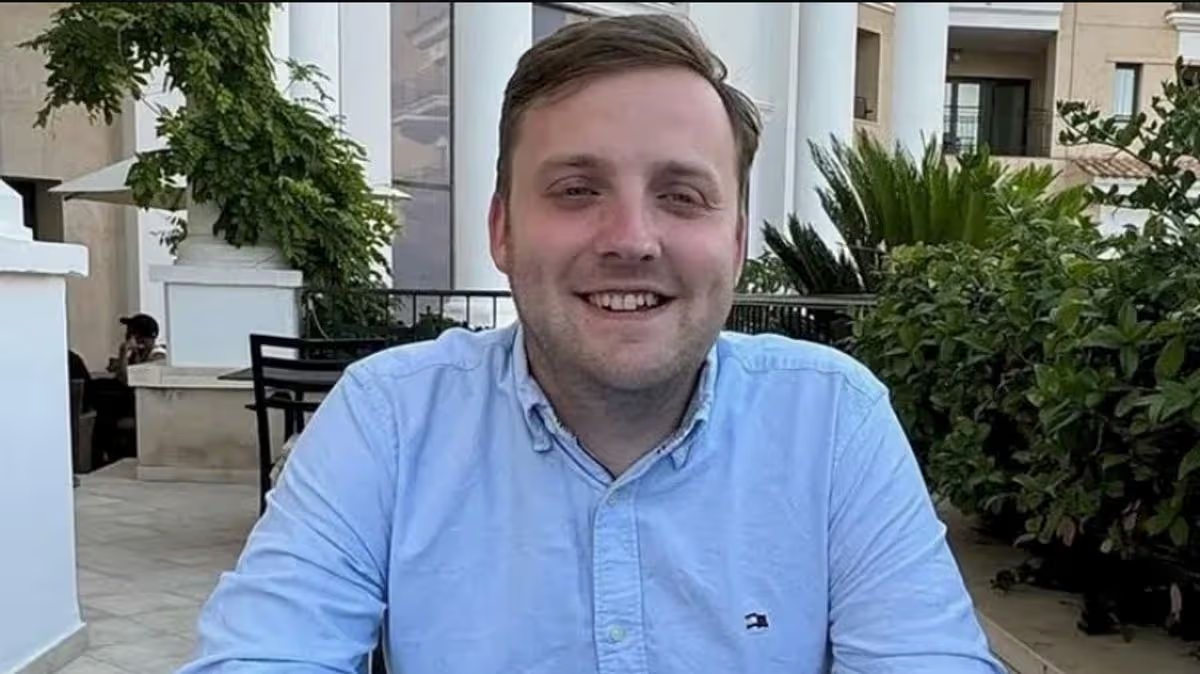
Joshua Haines, 30, was found dead at his home in Leeds three days after calling a GP three times to raise concerns he could be suffering from a form of diabetes
02:19, 23 Apr 2026Updated 02:23, 23 Apr 2026
A man who repeatedly told a doctor he feared he had life-threatening diabetes died just days later from the condition after failing to get urgent medical treatment, an inquest heard.
Joshua Haines, 30, was found dead at his home in Leeds, West Yorks., three days after calling a GP three times on March 16, 2025. He had raised concerns about worsening symptoms and suggested he could be suffering from a form of diabetes, although he had no history of the illness.
But despite reporting severe dehydration, vomiting and slurred speech, the GP advised him to contact the non-emergency NHS number 111 rather than being seen in person. An inquest at Wakefield Coroner’s Court heard Mr Haines died from diabetic ketoacidosis – a life-threatening complication linked to undiagnosed type 1 diabetes.
Assistant coroner Naomi McLoughlin said there had been “missed opportunities” to get him “urgent medical help”, though she could not confirm these led to his death.
Speaking after the hearing, his sister Jessica Parker said: “We’re deeply disappointed and devastated. All we want from this is for no family to go through what we’ve had to go through.”
Advertisement
The inquest heard evidence from the Claire Lindsey of the Yorkshire Ambulance Service. She said that had Mr Haines’ symptoms been reported by the GP or himself, he would likely have been classed as a category two emergency. This would have meant an ambulance should have aimed to reach him within 40 minutes.
Senior paramedic Daniel Lawton said crews attending would likely have identified the condition, begun rehydration and taken him to hospital as an emergency. In further evidence, an investigating doctor said “red flags were missed” by the Extended Access service Mr Haines contacted.
Dr Saleh Majid, who spoke to Mr Haines on three occasions, said he initially believed the symptoms pointed to a stomach bug due to persistent vomiting. He said diabetes had been considered and agreed it could develop “out of the blue”, but added he could not assess “how far down the line he was” and did not “envisage it being at a life-threatening stage”.
Advertisement
Asked if he made mistakes, Dr Majid said: “I could have done things differently on reflection. I have had time to learn and reflect on this tragic case. Things will be done differently.”
Mr Haines, a surveyor, had been fast-tracked into management and was seen as a “rising star” with “exceptional ability”, his sister said. She previously told the inquest his death was preventable, adding: “His death has torn a hole through my heart. We cannot understand how he could die so suddenly.”
Peter Skelton, representing the family, urged the coroner to record a narrative verdict linking the missed opportunities to Mr Haines’ death and to consider a prevention of future deaths report.
Advertisement
He said: “The family are very serious that there have been some very serious failures of care with the most extreme of consequences: the needless death of a young patient. They are concerned that Dr Majid didn’t understand the full consequences and they question his competency.”
In her conclusion, Ms McLoughlin said she could identify missed opportunities – including the lack of a face-to-face appointment and no 999 call being made – but could not say whether they directly caused his death. She recorded that Mr Haines died between March 16 and 19 from diabetic ketoacidosis.
WARNING: DISTRESSING CONTENT – Wendy Duffy, 56, a former care worker from the West Midlands, has paid £10,000 to end her life at Pegasos, a Swiss assisted dying clinic, after losing her son Marcus, 23, four years ago
Michael D. Carroll and Peter Hennessy UK & World News Editor
05:58, 23 Apr 2026
A British woman with no terminal illness is travelling to Switzerland to end her life at an assisted dying clinic following the death of her only son – making her the first person to speak openly about making the trip before it takes place.
Wendy Duffy, 56, a former care worker from the West Midlands, has paid £10,000 to end her life at Pegasos, a Swiss assisted dying clinic, after losing her son Marcus, 23, four years ago. Despite years of therapy and antidepressants, she has been unable to come to terms with his passing, reports the Express.
Advertisement
Speaking just days before her death, Wendy said: “I won’t change my mind. I know it’s hard for you, sweetheart. It will be hard for everyone. But I want to die, and that’s what I’m going to do. And I’ll have a smile on my face when I do, so please be happy for me. My life; my choice.”
She added: “I can’t wait.”
Why is Wendy choosing to end her life?
In an interview with Daily Mail journalist Jenny Johnson, Wendy recounted the devastating circumstances surrounding Marcus’s death four years ago. He had nodded off on the sofa while eating a sandwich, hungover after a heavy night out. Wendy had been preparing her own lunch at the time – cheese and onion – when Marcus asked her to make him one too.
“Throw a couple of those cherry tomatoes on mine,” he said.
Advertisement
She obliged, halving them as she always did. When she walked back into the living room, she was confronted with every parent’s worst nightmare.
“He was purple,” she said. “I thought, ‘It’s his heart.’” Wendy, who has medical training, immediately got Marcus onto the floor and started CPR, crying out desperately for assistance. Paramedics arrived and raced him to hospital, where the devastating news emerged: half a cherry tomato had been discovered blocking his windpipe. Specialist equipment had been required to extract it.
“They think he must have fallen asleep when he still had food in his mouth. That’s the only comfort, that there was no struggle,” she said.
Advertisement
Deprived of oxygen for an extended period, Marcus was brain dead. Wendy remained by his side for five days before his life support was turned off. His organs were donated for transplant.
“Afterwards, I got a letter from the man who got his heart. He said that thanks to Marcus he was able to play with his kids again,” she said. Another recipient was a four year old child. “That was a comfort, but it also ripped at me.”
She visited the funeral home daily to be with her son, listening to his Spotify playlist.
“In the funeral home, I went in every day, and just sat with him, playing through his Spotify list. I broke when I saw him in there. My boy, on a metal table. You can’t come back from that, you know.
Advertisement
“That’s when I died too, inside,” she said. “I’m not the same person now as I was. I used to feel things. I don’t care about anything any more. I exist. I don’t live.”
Who was Marcus?
Marcus had been the centre of Wendy’s world from the moment she learnt she was expecting. Born into a large Irish family, Wendy never wed and spent a decade trying to conceive. Following years of fertility tests that showed damage to her fallopian tubes, she turned to specialist treatment.
“I told the consultant that I wasn’t greedy. If I could have one child, I would be the happiest woman in the world,” she said.
In 1998, she got her miracle. “The day I discovered I was pregnant with Marcus was the happiest of my life.”
Advertisement
After parting ways with Marcus’s father when the lad was about four, mother and son became inseparable. Wendy grafted hard and put money aside for his future. Marcus developed a love for music – hip-hop and grime – and was pursuing a career in recording.
“I’d give anything to be shouting at him to turn the music down today,” she said.
Did Wendy try to get help?
After Marcus’s death, Wendy received extensive NHS and private counselling and was given antidepressants. Nine months after his loss, she tried to take her own life with an overdose, planning it meticulously – “like a wedding” – getting her affairs in order. A friend sounded the alarm after she didn’t reply to messages.
Officers forced entry into her property to discover a note carefully fixed to the bedroom door. She endured a fortnight on a ventilator, temporarily lost function in her right arm, and continues to have no sensation in her little finger. She was told she risked locked-in syndrome – left dangerously close, in her own words, to being “a cabbage in a persistent vegetative state.
Advertisement
“I remember coming round and thinking, ‘I’ve f***ed this up’, and I don’t want to go through that again. That’s why I’ve gone for Pegasos,” she said.
Following her hospital discharge, she voluntarily admitted herself to a psychiatric ward but departed after a single night, likening the environment to a prison – a bed, a wardrobe minus its door, no toothbrush, a grimy beaker of tea.
“I did try to get better,” she said. “But you can take all the pills, you can go to all the counselling in the world – and I did. Ultimately, they can’t help you. They don’t have to live your life, and my life is agony. Even though I’ve got family, I’ve got friends, I’ve got my routines. I go to the park. I’m not lonely, but I still sit at night and I talk to Marcus, and I kiss the box I had made for his ashes and I say ‘goodnight, sunshine’ and I think ‘I don’t want to be in this world without you, Markie’. And I don’t. It’s as simple as that.”
Advertisement
What is Pegasos and how does it work?
Pegasos is a Swiss assisted dying facility that accepts cases based solely on psychiatric conditions – where no physical illness is present – as long as they satisfy stringent requirements. The condition must be serious, enduring and resistant to treatment. Numerous Swiss clinics, including the more well-known Dignitas, turn away such cases altogether.
Wendy first learned about Pegasos in 2024 when it was featured in an ITV investigation into the death of Alastair Hamilton, whose mother publicly branded the clinic a “cowboy clinic.” Despite the scathing coverage, Wendy’s response was instant.
“Wow. This is what I need,” she thought. She fired off an email requesting information and lodged a formal application in early 2025.
The procedure involved more than a year of correspondence – interviews, paperwork and the submission of her complete medical records and therapy history – carried out almost exclusively remotely via email and WhatsApp. A panel of specialists including psychiatrists examined her case and gave it the green light.
Advertisement
Under Swiss law, Wendy must administer the fatal medication herself.
“They put the line in but you’ve got to turn the doobra yourself to get it flowing. Then – ding, ding, ding – within a minute, you are in a coma, and a minute after that, you are gone,” she explained.
She opted to go out listening to Lady Gaga and Bruno Mars singing Die With A Smile.
“You’ll never be able to hear that song now without thinking of me, will you?” she said. Wendy refused to end her own life in a manner that would leave others traumatised.
Advertisement
“I could step off a motorway bridge or a tower block but that would leave anyone finding me dealing with that for the rest of their lives,” she said. “I don’t want to put anyone through that.”
She held off until her two dogs had passed away from old age before booking a date at Pegasos. When the journalist suggested buying her a dog and leaving it on her doorstep to give her something to live for, she remained resolute.
“You could give me a house full of dogs. I’m doing this,” she said.
Her background working in the care sector, she explained, has given her a comfort around death that others might lack.
Advertisement
“Oh, I’ve seen death a million times. I’ve sat with so many people as they’ve gone. I’ve seen nice deaths, horrible deaths. I want a nice, gentle one.”
What does the clinic say?
Pegasos founder Ruedi Habegger confirmed Wendy had cleared her final psychiatric assessment, conducted earlier this week.
“Wendy is very decided. I saw her at her hotel today, I had a long talk with her and with the psychiatrist that is going to see her a second time before the VAD [voluntary assisted death]. He is very confident that we are doing the right thing letting her go, that we should not stand in her way. She is absolutely not in a depressive state. I’m very experienced in this field. There are no worries with Wendy, none at all,” he said.
He confirmed four of her siblings had been notified and given their approval. “Her family knew this was coming at one point or another. She is happy that she has their blessing. She feels content now, like a weight has been lifted,” Habegger said.
Advertisement
Wendy said: “I have told them all and they support me. They are sad, but they know what this has done to me.”
What has Wendy planned for her death?
Wendy has organised every single aspect. She has penned letters to those closest to her, picked out what she’ll wear and decided on the music to be played. She’ll be dressed in a t-shirt that belonged to Marcus – “it still smells of him” – and has requested the clinic’s large windows remain open so her spirit can escape freely. Her possessions, including her suitcase, will be given to an animal charity.
She’s unable to donate her organs and will be cremated in Switzerland. Her ashes will be sent back to relatives in the UK and scattered next to Marcus’s at a park bench dedicated to him.
“I hate funerals anyway and don’t want one. It’s all planned,” she said.
Advertisement
Wendy’s siblings – four sisters and two brothers – reportedly understood she’d applied to Pegasos but weren’t informed of the precise timing of her appointment, to shield them from potential legal consequences. Under UK law, anyone who helped her – even something as simple as giving her a lift to the airport – could face scrutiny or criminal charges.
Pegasos reached out to her family themselves. Wendy intends to ring them from Switzerland to say her final farewell.
“They will get it. They know. Honestly, 100 per cent, they know that I’m not happy, that I don’t want to be here,” she said.
Why is she speaking out? Journalist Jenny Johnson spent time with Wendy in the days leading up to her departure, finding a warm and funny woman who spoke about her approaching death with the calm composure of someone preparing for a holiday – bags packed, house vacuumed, already at peace.
Advertisement
Wendy said she chose to go public to contribute to the assisted dying debate, the latest stage of which is due to take place in the House of Lords imminently.
“I’m not breaking the law. I don’t feel I’m doing anything wrong. Yet for them, it’s a mess,” she said of her family’s position.
She is fully aware that her story will serve as “a grenade lobbed into the assisted dying debate” – yet remains utterly steadfast.
“My life; my choice,” she repeated. “I wish this was available in the UK, then I wouldn’t have to go to Switzerland at all.”
Advertisement
Her voluntary assisted death procedure is scheduled to take place on Friday.
If you are affected by issues discussed within this article, you may contact Samaritans on 116 123 or visit samaritans.org
Chelsea have lost five consecutive league games without scoring a goal for the first time since 1912, the year the Titanic sank, to leave Rosenior with that sinking feeling.
Rosenior was hoping to avoid the sack until at least Sunday, when Chelsea face off with Leeds at Wembley in the FA Cup semi-finals, but he will not take charge at Wembley having been relieved of his duties.
But two former Chelsea stars are first and second favourites in the queue to take over.
Filipe Luis spent one season at Stamford Bridge, having been signed during Jose Mourinho’s second spell in charge, and won the Premier League and League Cup before returning to Atletico Madrid.
Advertisement
He took his first steps into management with Flamengo’s Under-17s side in January 2024 but come September of the same year was in charge of the first team, where he has enjoyed plenty of success in less than 20 months, including winning the league and Copa Libertadores.
Cesc Fabregas, another Mourinho signing, is similarly turning heads in his first managerial role with Serie A side Como, who finished 10th last season and is pushing for Champions League qualification during the tail end of the current campaign. Como were playing second-division football just two years ago.
Whether either would be convinced to return to the Bridge remains unclear, while Frank Lampard, who guided Coventry to the Championship title, is considered an outsider for a third managerial spell with the Blues.
Chelsea manager for start of 2026/27 Premier League season
Aoun said preserving Lebanese sovereignty over all of its territory was his top priority, and that Lebanese negotiators would seek an end to Israeli attacks, the withdrawal of Israeli troops from Lebanon, release of Lebanese prisoners in Israel, deployment of Lebanese troops along the Israeli border, and the beginning of reconstruction process, according to a statement from his office.
*Astro line horoscopes are updated every Thursday. Calls cost 65p per minute plus your telephone company’s network access charge and will last approximately five minutes. You must be over 18 and have the bill payer’s permission. Service provided by Spoke. Customer service: 0333 202 3390
We analysed dozens of recent local news reports as part of our ongoing investigation into criminal activity on UK High Streets. From Bideford in Devon, to Great Yarmouth in Norfolk, to Belfast in Northern Ireland – we found that drugs, including crystal meth and heroin, had been found in more than 70 shops and linked premises.
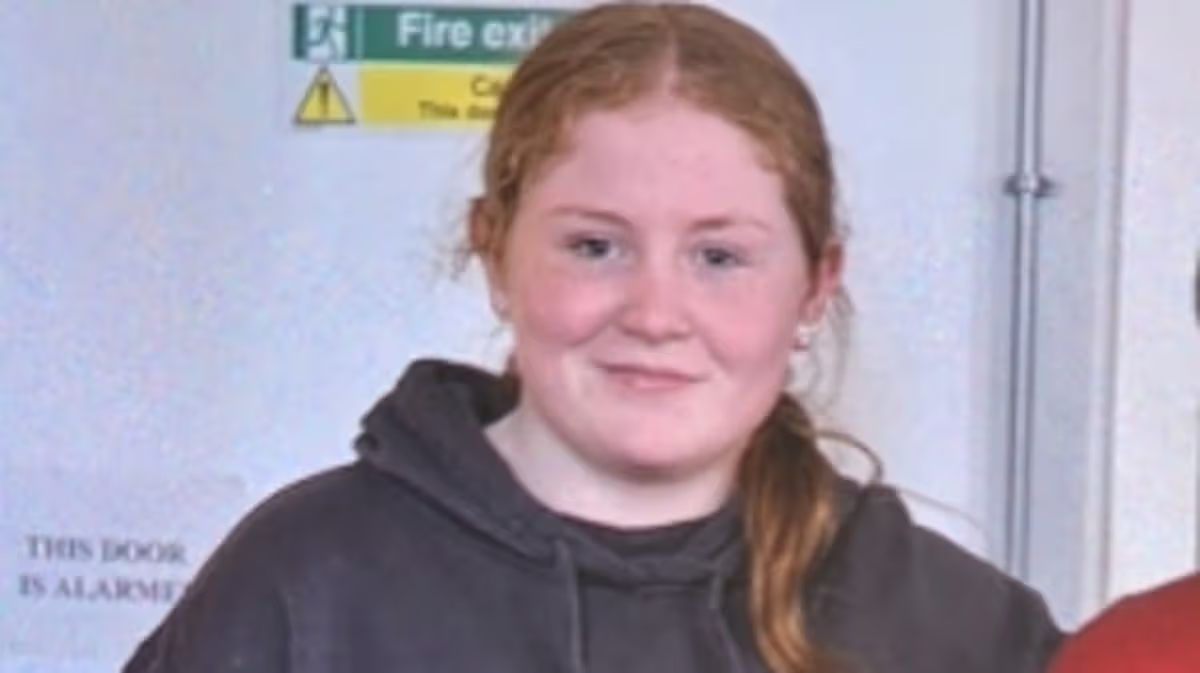
She was last seen wearing school PE kit in the Moira area
Police are seeking the public’s assistance in trying to locate a missing person last seen in the Moira area.
Advertisement
Police believe Aimee-Rose Temple could be in the general Moira/Lisburn area, or could potentially have travelled further.
She is approximately 5ft 3’’, with long strawberry-blonde hair and blue eyes. She is wearing a school PE kit, consisting of blue jogging bottoms and a blue top, along with a green and black Nike bag.
Through the early hours of Thursday, temperatures hover around 3 to 4C across Darlington under patches of low cloud, mist and fog as light winds continue, leaving it feeling distinctly cold before dawn.
By breakfast time, any lingering fog patches and low cloud are expected to clear quite quickly, with a dry start and temperatures edging up to around 4C at 7am and 6C by 8am.
Winds remain on the light side at this stage, generally a gentle breeze at around 3 to 4mph, so although it is chilly, conditions are calm with very little chance of any rain.
Advertisement
As the morning wears on, sunshine becomes more widespread, and by mid-morning Darlington should be enjoying long sunny spells with temperatures climbing through 7C and 9C to around 10C or so by late morning.
The chance of precipitation stays very low through the day, pointing to a fine, settled picture rather than anything showery.
Humidity, initially on the higher side after the misty start, steadily eases back as the air warms, helping it to feel more pleasantly springlike by late morning despite the modest numbers on the thermometer.
Into the early afternoon, the day peaks, with a maximum temperature of about 12C expected for Thursday, reached as we head from lunchtime into mid-afternoon.
Advertisement
Hour-by-hour figures show temperatures stepping up from 11C at midday through 12C and 13C to around 14C at about 3pm before easing back slightly later in the day.
Winds remain light, mostly in the 5 to 7mph range, so there is little wind chill to speak of and, under unbroken or long sunny intervals, it will feel a touch warmer than the air temperature suggests, with “feels like” values running close behind.
UV levels rise to moderate around the middle of the day, so there is some strength in the sunshine during the early afternoon.
Later in the afternoon and into the early evening, the fine, dry theme continues, with temperatures slipping back through the low teens into single figures by early nightfall.
Advertisement
By 5pm, Darlington is on around 13C, fading to about 10C by 7pm as the sun lowers, but with the chance of any rain still very low.
Light breezes continue, and visibility remains generally good to very good, making for a clear, cool evening if you are out and about after work.
Overnight into Friday, skies stay predominantly dry and winds fall very light again, allowing temperatures to dip away to around 4C, with humidity creeping back up and the potential for some mist or fog patches to reform towards dawn.
Across the wider North East, Thursday fits into a settled spell, bringing another fine and dry day with long sunny spells and light winds once any early low cloud, mist and fog have cleared.
Plans were approved in January to introduce a 20mph speed limit in the village
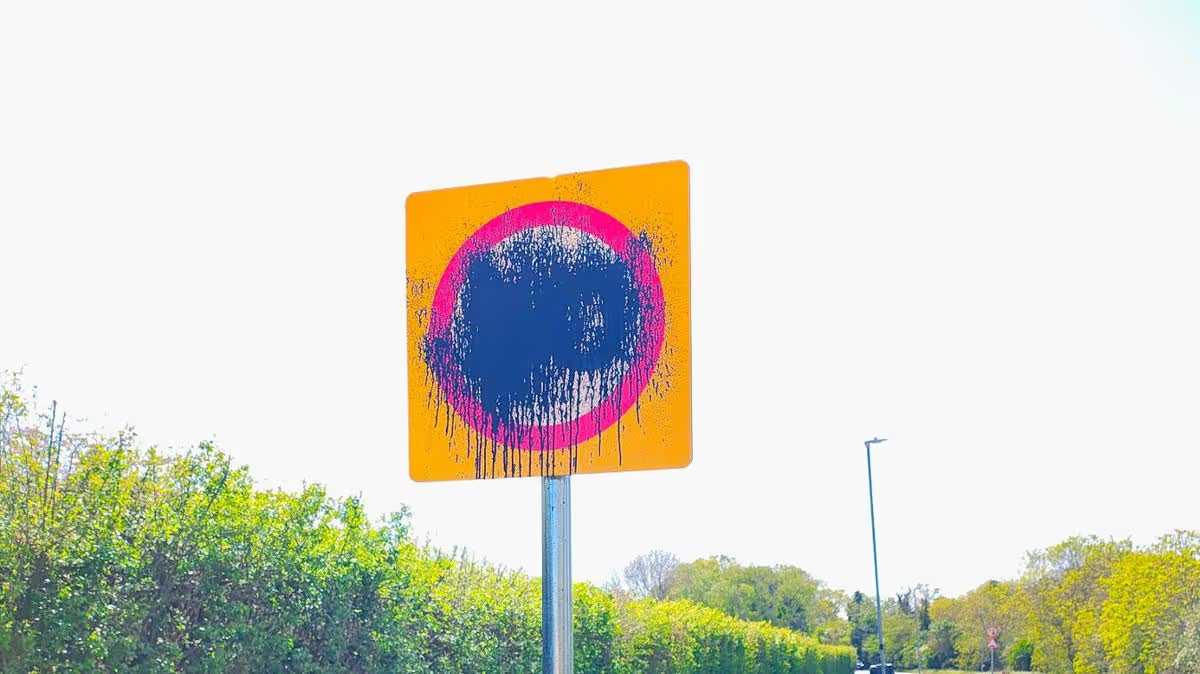
New speed limit signs in a Cambridgeshire village have been vandalised “within a matter of hours” of being installed. The new 20mph signs are being put up in Cottenham.
Advertisement
Plans to introduce the lower speed limit throughout the village were approved by Cambridgeshire County Council back in January, despite over 150 objections to the plans. The speed limit was introduced to “create a safer environment for all road users”.
The signs have only just been installed, and some have already been vandalised with black paint. Resident James Prestidge said he spotted a vandalised sign while driving home from work on Tuesday (April 21).
He said: “I noticed, contractors had started installing the new 20mph signs in Cottenham. So far only the entrance from Twenty Pence Road has been done, and a few little ones up to the high street.
“On the way home from work, I was quite amazed to see them plastered and dripping in black spray paint! It seems within a matter of hours they’ve already been vandalised!”
Advertisement
A Cambridgeshire County Council spokesperson said: “We are disappointed to confirm that one pair of the newly installed 20mph signs in Cottenham has been vandalised. Our highways team is on-site, and it will be cleaned as soon as possible.
“The 20mph speed limit is being introduced in Cottenham following a successful application to our funding programme, and a consultation where the local community were invited to share their views and help shape this project.
“We’re committed to improving road safety, and 20mph schemes are one part of this. Reducing speed limits from 30mph to 20mph can cut pollution by up to 30 per cent and reduce the likelihood of a severe or fatal injury in the event of a collision by as much as 60 percent.”
The warning comes as airlines face operational challenges and potential fuel supply issues. Travellers are being urged to prepare for possible delays and familiarise themselves with their rights.
Tom Vaughan, travel insurance expert at Confused.com, said: “For Brits planning to travel this summer, it’s worth being aware that flight cancellations and delays could happen as airlines respond to operational pressures.
“Disruptions like this can leave travellers unsure about their rights and what steps to take next if they are affected.
Advertisement
“The good news is that UK passengers have rights if their flight is cancelled.
“Airlines should offer a refund or an alternative flight, even if your ticket was non-refundable.”
Mr Vaughan also urged travellers to obtain travel insurance before departure.
He said: “It’s always sensible to take out travel insurance before going away.
Advertisement
“Even if you are able to claim directly via the airline, an insurer can guide you on how to make a claim.
“With the right policy in place, you may also be able to claim back for other parts of your holiday that were affected as a result.”
He advised passengers to contact their airline as soon as possible if affected and to keep receipts for essential expenses, such as food, accommodation or transport, as these may be reimbursed.
Travellers were also encouraged to review their travel insurance policies and speak to their insurer to understand what extra costs could be claimed back.
Several UK airlines may have to cancel flights or hike prices ahead of summer with travel experts warning passengers to ensure insurance is in check with ‘refund’ update
05:20, 23 Apr 2026Updated 05:20, 23 Apr 2026
As summer holidays are approaching and UK airlines are facing some disruptions due to the Middle East conflict, passengers have been urged to be aware of their refund rights.
Travel experts are warning holidaymakers to be aware of how to protect your plans before summer commences.
Advertisement
Fuel prices have nearly doubled since the war began, with the International Energy Agency describing the situation as potentially the largest energy crisis the world has faced.
A document has been submitted to ministers and the Civil Aviation Authority warning that if disruption “worsens” airlines in the UK will be forced to increase fares and cut flights.
Airlines UK, which represents a number of carriers, including EasyJet, Jet2, British Airways and Ryanair, say in the document that “the doubling of jet fuel costs (with fuel accounting for around one-third of airline costs) represents a major additional price shock”.
Advertisement
The letter is an attempt to get the government to step in to secure fuel supplies and give airlines more flexibility to cope with soaring costs.
One of the asks is to allow the temporary import and use of Jet A – a grade of jet fuel produced in the US, according to ITV.
The emergency document illustrates the financial fears of airlines, adding to the concern that flights may be cut or prices escalated.
A travel expert has warned that British travellers should ensure “travel insurance is in order” and “check booking terms” ahead of summer.
Advertisement
Airlines will still be required to offer full refunds, should flights be cancelled, or provide an alternative route.
The spokesperson for Ski Vertigo said: “This is a situation every traveller with a summer booking should be watching closely. Prices are already moving and the risk of cancellations is real, particularly on shorter intra-European routes where the economics are tightest.
“Our advice is to make sure your travel insurance is in order, check your booking terms, and keep a close eye on any communications from your airline.” They added: “If your flight is cancelled, airlines are still required to offer you a full refund or an alternative route, and their duty of care — covering meals, accommodation where needed, and rebooking — remains in place regardless of the reason for the disruption.
“However, because this crisis stems from a geopolitical conflict outside the airline’s control, it is likely to be treated as an extraordinary circumstance, which means financial compensation beyond a refund is unlikely in most cases.”
















































You must be logged in to post a comment Login