Connect with us

NewsBeat

Man in hospital after Valentine’s Day ‘stabbing’ on Airdrie street as man charged

Published

on

Daily Record

Emergency services raced to the incident at 12.05pm on Valentine’s Day.

A man is in hospital after an alleged stabbing in Airdrie.

Advertisement

Emergency services raced to the North Lanarkshire town’s South Bridge Street after receiving reports of a serious assault at 12.05pm on Valentine’s Day. Crews attended and a man was found injured.

He was taken to hospital for treatment, where his current condition is unknown. Police confirmed a 35-year-old man was arrested and charged in connection.

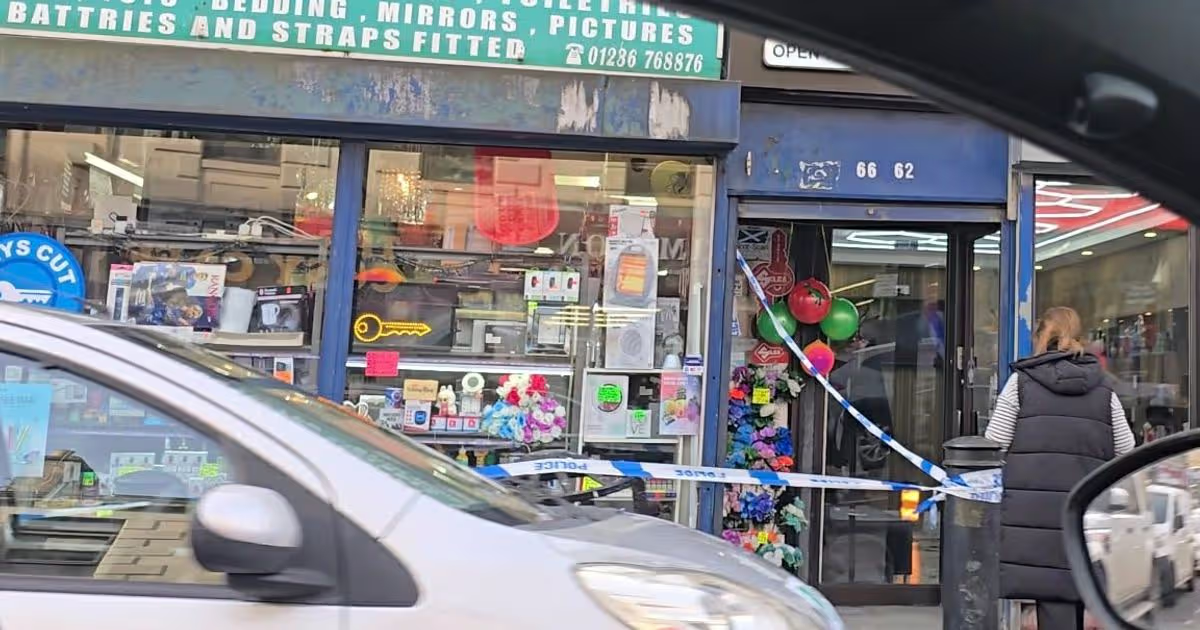
He is due to appear at Airdrie Sheriff Court on Monday, February 16. Images taken from the scene show the area taped off following the alleged street attack.

Advertisement

The cordon stretched around a barber’s shop as uniformed officers stood guard. Multiple cop vehicles were pictured in attendance.

A Police Scotland spokesperson said: “Around 12.05pm on Saturday, 14 February, 2026, we were called to a report of a serious assault on a man in the South Bridge Street area of Airdrie.

“Emergency services attended and he was taken to hospital for treatment.

“A 35-year-old man has been arrested and charged in connection. He is due to appear at Airdrie Sheriff Court on Monday, 16 February, 2026.”

Advertisement

Get more Daily Record exclusives by signing up for free to Google’s preferred sources. Click HERE.

Source link

Continue Reading
Click to comment

Leave a Reply

Your email address will not be published. Required fields are marked *

NewsBeat

Two teens to appear in court after woman ‘raped’ in Glasgow city centre

Published

on

Daily Record

Police were called to Clyde Street shortly after 3am on Saturday after a report that a woman had been seriously sexually assaulted.

Two teenagers have been charged after a woman was allegedly raped in Glasgow city centre.

Advertisement

Officers from Police Scotland were called to Clyde Street shortly after 3am on Saturday, February 14, after a report that a woman had been seriously sexually assaulted.

The woman was taken to hospital. Two men aged 18 and 19 are due to appear in court on Monday in connection with the alleged attack.

A Police Scotland spokesperson said: “Around 3.05am on Saturday, February 14, 2026, we were called to a report of a serious sexual assault in the Clyde Street area of Glasgow. The woman attended hospital.

“Two men, aged 19 and 18, have been arrested and charged in connection. They are due to appear at Glasgow Sheriff Court on Monday, February 16, 2026.”

Advertisement

Police said in an earlier statement that they had received a report of “concern for a woman”.

The area, close to the River Clyde, was taped off yesterday as investigations were carried out.

Get more Daily Record exclusives by signing up for free to Google’s preferred sources. Click HERE

Source link

Advertisement
Continue Reading

NewsBeat

just some of the injuries risked by Winter Olympians

Published

on

just some of the injuries risked by Winter Olympians

The sports featured at the Winter Olympics defy gravity and physics. Many competitors move at breakneck speeds down steep, snowy inclines or careen across icy surfaces in a bid to set world records and earn their place on the podium.

But as exciting as these events are for spectators, they also place competitors at serious risk of injury. This is something we have been reminded of after US alpine ski racer Lindsey Vonn fractured her leg during a horror crash just seconds into her downhill run in the Milan Cortina games.

Of course, this isn’t the first time a Winter Olympian has suffered injury at the Games. Four athletes have died during Winter Olympic events or in preparation for them – most recently, Georgian luge athlete Nodar Kumaritashvili, who died after colliding with a wall during a training run at the 2010 Winter Olympics in Vancouver, Canada.

But of the 15 sports disciplines featured at this year’s Winter Olympics, a few stand out in terms of their riskiness to competitors:

Advertisement

Skiing and snowboarding

Of the snow-based events, skiing and snowboarding appear to be the most risky.

In alpine (downhill) skiing, there’s a 75% risk of professional athletes suffering at least one injury per season. And the majority of these are trauma injuries from a fall or collision. Male alpine skiers are at greater risk of overall injury and upper-body injuries, while women are a greater risk of knee injuries.

Video analysis of alpine skiing injuries shows that almost all occur when the skier is turning or landing from a jump. When you consider Olympic athletes are on the edge of doing what is possible, this is hardly surprising.

Turning and landing also put the knees into a particularly vulnerable position. The forces placed on them can be the equivalent of bearing up to three times a skier’s bodyweight.

Advertisement

This is one of the reasons why knee ligament injuries are common in skiing. Male skiers are at greater risk of medial collateral ligament injuries – a ligament that plays a key role in stabilising the knee. The same study showed that female skiers are almost three times more likely to suffer an anterior cruciate ligament (ACL) injury. This ligament plays a key role in standing and bending the knee.

If you were to look at 100 skiers in a single season, around eight female skiers will experience a severe ACL injury. Vonn had ruptured her ACL just days before competing in these Winter Olympics, illustrating just how harsh the sport can be.

Finger, hand and wrist injuries are common too. These typically happen during falls – either from crashing into an object or while trying to break a fall. Falling with a ski-pole in hand can cause a specific injury known as “skier’s thumb”. This causes damage to the ligament that helps stabilise the thumb.

While finger injuries are an inconvenience, they certainly don’t mean that athletes can’t continue to compete. The Italian skier Sofia Goggia proved this in 2022 when she broke multiple fingers during an event, had surgery overnight, then returned to the slopes the next day.

Advertisement


À lire aussi :
Three common injuries skiers should watch out for this season


Snowboarding also accounts for a large number of injuries – including from falling on outstretched arms, as well as spinal and head injuries. As snowboarding events become more extreme, with athletes performing death-defying tricks and pushing the boundaries of what is possible, this could result in even more injuries per season.

Sledding

Of all the risky winter events performed on ice, bobsleigh, luge and skeleton all rank near the top in terms of injury risk.

“Sled head” is the aptly named condition used to describe the catalogue of symptoms affecting athletes competing in these sports. These include headaches, dizziness and brain fog arising from the multiple small impacts the head receives as athletes rattle down a track.

Advertisement

Approximately 13–15% of athletes in sledding sports also report experiencing concussion at a high-level competition such as the Olympics.

‘Sled head’ can be a common problem for sledding athletes.
Associated Press

Due to the explosive start needed in sled events, particularly bobsleigh, muscle and tendon tears and ruptures can be common. This creates a problem for bobsledders because the event requires an explosive start, placing the legs’ large hamstring and quadriceps muscles under a lot of pressure. Similar injuries are also seen in sprinters.

Cross-country skiing

Cross-country skiing is far less extreme that its downhill counterparts, but still results in plenty of injuries.

The most common are repetitive strain and overuse injuries, such as shin splints, damaged knee ligaments and stress fractures in the feet. It’s estimated that for every 1,000 hours of cross-country skiing an athlete does, they will sustain an average of around four injuries.

Advertisement

Then there’s also the risk of frostbite, even on the most intimate parts of an athlete’s anatomy – as the Finn Remi Lindholm found out in Beijing in 2022.

Curling

When we think of extreme winter sports, we certainly don’t think of curling. Predictably, curlers suffer far fewer serious injuries than most other winter sport competitors.

But injuries from overuse are common. These are particularly caused by being in the “tuck” position used to deliver the curling stone, since the knee has to flex beyond 90 degrees.

Similar issues arise in the spine and the shoulder from the frantic sweeping of the ice – with team sweepers typically covering over 1km per match. Interestingly, men are more likely to get injured in curling than women, although the reason isn’t clear.

Advertisement

Physical injuries aren’t the only risk to athletes. Over 42% of athletes competing at the Winter Olympics report suffering from a respiratory illness. This can affect their balance, which may increase the risk of falls and sustaining injury.

So, as you watch the athletes doing their thing, it’s worth remembering they may be hiding all sorts of aches and pains – and may be one slip or fall from a season- or career-halting injury.

Source link

Advertisement
Continue Reading

NewsBeat

Paul Anka, 84, teases possible retirement

Published

on

Paul Anka, 84, teases possible retirement

Paul Anka, 84, says that after 70 years in show business, he’ll know when it is time for him to retire.

The iconic “Put Your Head on My Shoulder” singer reflected on his career in an interview with CBS News.

“When it’s time for my body to say enough, I’ll know,” he said on the outlet’s Sunday morning program. “I’m playing with the house’s money now. I’m one lucky guy!”

Anka has stayed on Billboard ‘s Top 100 chart for nearly his entire career. He wrote Frank Sinatra’s classic “My Way,” along his own hit songs like “Diana” and “Lonely Boy.”

Advertisement

The songwriter told the outlet that he started in the music business when he was just 10 years old, growing up in Ottawa, Canada.

Paul Anka, 84, is considering retirement after seven decades in show business
Paul Anka, 84, is considering retirement after seven decades in show business (Getty Images for the Songwriters)

“It was very difficult to go from a modest background in a small town, to everybody’s all over you and you’re famous and you’re a celebrity,” Anka said.

More to follow…

Source link

Advertisement
Continue Reading

NewsBeat

The science behind the trend for showering in the dark before bed

Published

on

The science behind the trend for showering in the dark before bed

The latest wellness trend and “sleep hack” involves switching off the bathroom light before stepping into the shower. In the dimness, the water feels louder, the day’s visual clutter fades and the hope is that sleep will come more easily. This practice, often called “dark showering”, has spread on social media, with people claiming that washing before bed in near darkness leads to deeper and faster sleep.

There is little research on dark showering as a standalone sleep technique. However, sleep science is clear about two key factors this ritual changes: light and heat. Both can nudge the body toward sleep or keep it alert.

Light is not only for seeing. Bright light in the evening signals to the brain’s internal body clock that it is still daytime. This delays the release of melatonin, a hormone that helps regulate sleep and is often described as the body’s “darkness signal”.

In a laboratory study of 116 adults, typical room lighting between dusk and bedtime reduced early night melatonin levels by about 70% compared with very dim light. Exposure to room light before bed also shortened the total duration of melatonin release by about 90 minutes. Participants reported feeling more alert.

Advertisement


À lire aussi :
Light at night can disrupt circadian rhythms in children – are there long-term risks?


Bathrooms are often the brightest rooms in a home. Overhead lighting and illuminated mirrors are designed for precision tasks that are useful in the morning but less helpful late at night. Turning these lights off, or dimming them, removes a strong signal that it is still daytime.

One experiment exposed volunteers to standard bathroom lighting for just 30 minutes at bedtime. Melatonin levels dropped and self reported alertness increased, even though participants remained in the bathroom.

Advertisement

More recent research supports this. A 2025 crossover trial compared exposure before bed to cool white LED lighting with softer fluorescent lighting at the same brightness. The LED lighting delayed the time it took participants to fall asleep by about ten minutes and left them feeling less sleepy.

Another study of adolescents found that a burst of bright light in the early evening reduced melatonin levels three hours later and delayed the normal rise in sleepiness.

The same pattern appears in studies of screens. A controlled experiment comparing reading on a light emitting e-reader with reading a printed book found that the glowing device delayed the body clock, reduced melatonin and made it take longer to fall asleep.

A 2023 laboratory study that adjusted the “blue weighted” impact of screens, meaning the part of light most likely to affect the body clock, found that reducing this blue component lessened melatonin suppression and shortened the time needed to fall asleep.

Advertisement

If dark showering replaces time spent under bright bathroom lights or scrolling on a phone, it may help simply by reducing evening light exposure. The benefit will be smaller if the shower is followed by time under full lighting to dry hair, choose clothes for the next day and tidy up.

Darkness also works gradually. Melatonin does not switch on instantly when the lights go out, and a brief shower will not reset a body clock that has been running late for weeks.

Shower water may provide a second benefit. Research on passive body heating, which means warming the body without exercise, has shown that a warm shower or bath taken at the right time can help people fall asleep more quickly.

A 2019 meta analysis of 13 trials concluded that about ten minutes in warm water one to two hours before bedtime shortened the time it took to fall asleep by roughly nine minutes and improved sleep efficiency, the proportion of time in bed actually spent asleep. Warm water widens blood vessels in the hands and feet, helping core body temperature drop afterwards, a key signal for drowsiness.

Advertisement


À lire aussi :
Want better sleep? Try a warm bath or shower 1-2 hours before bedtime, study suggests


Dark showering may also help prepare the nervous system for sleep. Low light reduces the brain’s alerting signals and makes it easier to shift from a state of vigilance, often called the “fight or flight” response, into a calmer “rest and digest” state.

One lab study asked volunteers to lie in a bath while sensors monitored their heartbeat. When the water was close to normal body temperature, about 37 to 38 degrees Celsius, the parasympathetic nervous system became more active. This is the part of the nervous system that slows the heart and supports relaxation. Heart rate slowed slightly and heart rate variability increased, a sign the body is adapting and settling.

A simpler experiment found a similar effect using only warm foot baths. Young women who soaked their feet in warm water for ten minutes showed an increase in vagal tone within 15 minutes.

Advertisement

Vagal tone refers to signals carried by the vagus nerve, which helps regulate heart rate, breathing and relaxation. Higher vagal tone is linked to steadier breathing, lower stress hormone levels and an easier transition into sleep.

Darkness supports the same process from another angle. Bright, blue rich LED lighting can raise heart rate and reduce vagal tone within minutes. A 2025 systematic review found that dimmer, warmer lighting allows heart rate variability to increase, signalling a calmer nervous system.


À lire aussi :
LED face masks are popular on social media for glowing skin – but they could disrupt your sleep


Another factor is the sound of running water. A 2024 analysis found that natural sounds such as rainfall or flowing rivers can lower cortisol, a stress hormone, and stabilise heart rate more effectively than silence. Heat, darkness and soft background noise may therefore combine to signal that it is safe to relax.

Advertisement

There are important caveats. No large trial has directly compared dark showers with brightly lit showers while measuring objective sleep outcomes, so the idea is based on combining related findings rather than direct evidence.

People with mobility difficulties may need some light to reduce the risk of slips, and those who experience night-time anxiety may feel uneasy in complete darkness. As with most sleep advice, no single habit is a cure for chronic insomnia. Daytime light exposure, caffeine timing and stress management all play an important role.

Source link

Advertisement
Continue Reading

NewsBeat

The strange Cambridgeshire cemetery that forbade church rectors from entering

Published

on

Cambridgeshire Live

The cemetery was founded in 1845 and rectors were banned from it for nearly 100 years.

While many people associate cemeteries with churches, men of the cloth were once forbidden to enter a Victorian cemetery in Cambridgeshire. Cemeteries across the UK go back hundreds of years.

Advertisement

One in Cambridgeshire – the Cottenham Dissenters’ Cemetery – goes back to Victorian times. Founded in 1845, this cemetery was established as a burial ground for non-conformists. Also known as dissenters, these are members of a non-established church.

In the 1700s, there were two dissenting groups in Cottenham. The original dissenters’ group met in a barn in Broad Lane, Cottenham. The group grew over the years that followed, and in 1783, it opened the Old Baptist Chapel.

It was enlarged in 1798, then rebuilt in 1856. There was another chapel, known as Ebenezer Chapel, that opened in 1813, and the Wesleyan Chapel was built in 1865.

In 1839, there was a confrontation with Reverend John Frere when he became rector of All Saints Church. The Revd Frere was a member of the aristocracy, and people believed he didn’t fit in Cottenham.

Advertisement

For over 250 years, Cottenham had been a self-governing village, and many of those who made orders were well-educated farmers. When the church wardens had to collect a church rate from the villagers, who were dissenters, the wardens went on strike.

After the strike, the rector claimed he paid for the upkeep of the church and also the ropes for the bell ringing. In retaliation, the rector refused to bury the bodies or ring the bells.

The Revd Frere shared his concerns with the Bishop of Ely in a letter on May 27, 1843. Still in confrontation, Joseph Green, a minister at the Old Baptist Church, gave the dissenters an idea.

Mr Green suggested that the dissenters have their own burial ground – where church rectors were not allowed to set foot. So in 1845, an acre of ground in Lanes Lane was bought from a farmer for £280.

Advertisement

This money was raised from public subscription. The new cemetery officially opened in 1845. The first person reported to be buried there was three-year-old Ann Norman. Only five years after it opened, 137 bodies were buried there.

The cemetery nearly went 100 years without the rector being allowed onto the grounds. An entry from the diary of Horace Gautrey in 1937 said: “Until four or five years ago the church rector [was] not allowed to pass through the cemetery gates.” This is according to the Cambridgeshire Community Archive Network.

The cemetery is still in operation today. More than 4,000 people have been laid to rest there.

Source link

Advertisement
Continue Reading

NewsBeat

IOC under fire for selling replica 1936 Olympics t-shirt used to promote Nazi Germany

Published

on

IOC under fire for selling replica 1936 Olympics t-shirt used to promote Nazi Germany

The International Olympics Committee is under fire over the sale of a T-shirt that features artwork from the 1936 Berlin Olympic Games, which Adolf Hitler used to promote Nazi Germany.

The Olympics’ official online shop has sold out of the controversial T-shirt, which replicates designs from the propaganda used 90 years ago: a man wearing a laurel crown, the Olympic rings and the Brandenburg Gate.

Introduced as part of the Olympic Heritage Collection, the limited-edition shirt immediately sparked backlash for commemorating the dark time in Germany’s history.

“History should be taught, not merchandised,” one X user wrote on social media. Another said: “Shocking sell-out—Olympics merch team really thought Nazi-era Berlin art was a good vibe? History lesson needed ASAP.”

Advertisement

One person criticized on Reddit, “IOC is rotten to the core. Have always been.”

The International Olympics Committee is under fire for selling shirts with artwork that was used at the 1936 Berlin Olympic Games, which Adolf Hitler famously used to promote Nazi Germany

The International Olympics Committee is under fire for selling shirts with artwork that was used at the 1936 Berlin Olympic Games, which Adolf Hitler famously used to promote Nazi Germany (Olympic Shop)
The International Olympics Committee defended its sale of a controversial T-shirt by saying that it was a part of its Heritage Collection

The International Olympics Committee defended its sale of a controversial T-shirt by saying that it was a part of its Heritage Collection (Getty Images)

“Selling Berlin 1936 merch is tone-deaf; it risks normalizing Nazi propaganda rather than critically acknowledging that dark chapter in Olympic history,” another said on X.

Advertisement

Taking place three years after Hitler’s regime rose to power, the 1936 Olympics are remembered by historians for the way that Hitler used the event to push his ideals of racial supremacy and antisemitism. The Nazis blocked German-Jewish athletes from competing in the games and openly referred to Black athletes as “non-humans.”

“The 1936 Olympic Games were a central propaganda tool of the Nazi regime,” German politician Klara Schedlich said in a statement. She accused the IOC of “clearly not reflecting sufficiently on its own history,” adding that, without context: “the choice of image is problematic and unsuitable for a T-shirt.”

In response to the criticism, the IOC has defended the shirt — which reproduces the original 1936 poster by German artist Franz Würbel — as part of its Heritage Collection, which features artwork from every Olympic Games.

“Of course, we recognize the profound historical context surrounding the Berlin 1936 Olympic Games,” the IOC said in a statement to the New York Post. “The 1936 Games also brought together 4,483 athletes from 49 countries competing in 149 events and included remarkable sporting achievements.

Advertisement

“Many of them stunned the world with their athletic achievements, including Jesse Owens,” the IOC added.

Owens, a American track-and-field American Olympian, directly challenged Hitler’s racist ideology with his record-shattering victories at the 1936 Games. He won four gold medals in the 100m, 200m, 4x100m relay and long jump.

The IOC did not immediately return The Independent’s request for comment.

This is not the first time that the Olympics has sparked backlash over its reference to the 1936 games. In 2020, the IOC posted a Throwback Thursday picture commemorating the controversial year.

Advertisement

Source link

Continue Reading

NewsBeat

Barnsley and Wakefield men – hare coursing near Goole

Published

on

Barnsley and Wakefield men - hare coursing near Goole

Elijah Boswell, 38, of Smithy’s Lane in Barnsley, and Shaun Price, 54, of Dunningly Lane in Wakefield, were both fined for hare coursing offences, after a trial held at Beverley Magistrates’ Court last week.

Boswell was ordered to pay £1,061, while Price, was fined £1,339.


RECOMMENDED READING:

Advertisement

The incident took place in December 2023 in Faxfleet, Goole, and after receiving reports, officers stopped a vehicle near the scene and found lurcher-type dogs and a thermal scope.

Both men gave no explanation for the items during police interviews.

PC Rich Fussey of the Rural Task Force said: “Illegal hare coursing is not only a priority for our Rural Task Force, but also for the UK Wildlife Crime partnership.

“This kind of criminality involved is serious, and perpetrators are organised and sophisticated in their planning, often involving cross-border offending.”

Advertisement

“Not only does it involve barbaric acts against protected wildlife species, but it causes harassment, alarm, distress and annoyance to the rural communities.

“Poachers do not care about trespassing across farmland, intimidation to farmers and landowners, and the damage they cause. However, they do care about the zero-tolerance response that we have towards their illegal activities.

“I hope this case and the seizure of the thermal scope used in the commission of hare coursing offences sends out a strong message.”

The public are urged to report suspected hare coursing by calling 101 and quoting Op Galileo.

Advertisement

Source link

Continue Reading

NewsBeat

Five reasons Trump’s plan for Ukrainian elections and a peace referendum will only prolong the war

Published

on

Five reasons Trump’s plan for Ukrainian elections and a peace referendum will only prolong the war

In a surprise announcement on February 10, Ukraine’s president, Volodymyr Zelensky, said that his administration was preparing to hold presidential elections before the middle of May. Alongside these elections, he is reported to be planning to hold a referendum on a peace deal with Russia.

This is a dramatic shift in Zelensky’s stance: the president has long resisted elections under conditions of war, despite the fact his mandate ran out in 2024. One possible explanation for the turnaround is that US pressure on Ukraine is having some real effects. A few days ago, Zelensky indicated as much, saying that his US counterpart, Donald Trump, was pushing for a negotiated end to the war by June.

Trump’s timeline – probably with an eye towards the US mid-term elections, when the White House would like to present a Ukraine deal as another major foreign policy success – is one thing. The feasibility of elections and, even more so, a peace deal between Russia and Ukraine is quite another.

1. Organising a free and fair vote in wartime

The first problem is logistics. Who will be eligible to vote? Where and who could monitor the elections to ensure they are free and fair? Apart from the hundreds of thousands serving in the trenches defending Ukraine against Russia’s aggression, there are also 3.7 million internally displaced Ukrainians and almost 6 million refugees abroad – plus approximately 5 million Ukrainians currently living under Russian occupation.

Advertisement

There is also the uncertainty of a Russian ceasefire – needed to facilitate not only the conduct of the elections but the preceding election campaign – and the near certainty of large-scale Russian election interference.

We can expect something similar to what Moldova experienced during its presidential elections, European integration referendum in 2024 and parliamentary elections in 2025, when voters were flooded with disinformation. Moscow even recruited Orthodox priests to try to sway the electorate. Russia’s attempts to influence the outcomes of these votes were shown to have clear limitations. But this will not deter it from trying again, and harder, in Ukraine.

Given all this, the prospects of organising any vote – let alone one of such consequence for the country and its people – look worse than daunting.

2. There’s no realistic peace deal yet

A second problem is the feasibility of any peace deal between Russia and Ukraine. At present, it is hard to imagine the gaps between Russia and Ukraine can be bridged in a meaningful way that does not cross either side’s red lines – especially on territory and security guarantees.

Advertisement

Even if it were possible to find a form of words to which the Russian and Ukrainian presidents could both sign up, the approval of any such deal in a referendum in Ukraine looks remote. Likely to be held on the same day as the presidential elections, a referendum would face all the same logistical and eligibility pressures.

3. Ukrainians might say no to peace

It is not clear what would happen if a majority of Ukrainians rejected the settlement put to them in the referendum. Would this mean a return to negotiations, or to war? The latter is the more likely scenario.

A third option would be the continuation of a shaky ceasefire and the implementation of parts of any settlement beneficial to both sides, such as prisoner exchanges.

But as was the case with the ill-fated Minsk agreements of 2014 and 2015, a return to all-out war would remain firmly on the cards.

Advertisement
Uncertain future: Ukrainians in Mariupol vote in a sham referendum on the annexation of their illegally occupied region by Russia, September 2022.
EPA/stringer

4. Europe must play a part

So far, Ukraine’s European partners have mostly been on the sidelines of the peace negotiations. They may not be a direct party to the war, but they clearly have a stake in the peace terms that might now be hammered out between Moscow, Kyiv and Washington. The mostly European coalition of the willing is expected to play a key role in the implementation of US-backed security guarantees, and to do the heavy lifting on Ukraine’s post-war reconstruction.

But after more than 12 months of hostility from Washington towards Brussels, there is little trust left in the dependability of US backing for Ukraine. The fourth problem, therefore, is that European acquiescence with a US-imposed peace deal cannot anymore be taken for granted either.

This does not necessarily mean a peace deal is impossible – but it will almost certainly be unless Europe has played a part in its negotiation.

The French president, Emmanuel Macron, recently dispatched his most senior diplomat, Emmanuel Bonne, to Moscow for talks in the Kremlin. And the country’s former permanent representative on the UN security council, Nicolas de Rivière, has been appointed as the new French ambassador to Moscow, signalling the importance that Paris assigns to direct contacts with Russia.

Advertisement

The EU, according to its foreign policy chief, Kaja Kallas, might also appoint a special representative for contacts with Moscow – after the bloc has agreed on the messages it wants to send.

However, despite the fact that Brussels holds some powerful cards – including frozen Russian assets and a wide range of sanctions – there is no indication for now that either Washington or Moscow are willing to grant Brussels a seat at the negotiating table.

5. Russia can’t be trusted

The final problem is whether Russia will accept even the best possible terms in a peace agreement, and then stick to it. The US push to seal a deal in the coming months suggests there is some confidence in the White House that a deal acceptable to the Kremlin can be forged, and that Ukraine and its allies can be coerced to go along with it.

US president Donald Trump walks and talks with Russian president, Vladimir Putin. In the background is Air Force One.
Donald Trump hostng the Russian president, Vladimir Putin, for talks in Alaska in August 2025.
EPA/Gavril Grigorov/Sputnik/Kremlin pool

There is a lot in what has transpired in recent days that will be to Russia’s liking: presidential elections in Ukraine; the US using its support for security guarantees as leverage to push Kyiv towards accepting more and more compromises; and the parallel US-Russia negotiations on an economic deal.

Russia’s president, Vladimir Putin, has got to this situation without making any concessions. He has played the US president perfectly so far, and there is no indication that he is done playing him. Trump is almost certain to continue to do Putin’s bidding – and to walk away as and when his grandiose plan unravels.

Advertisement

Is there a backup plan?

It is not clear what the backup plan is for Zelensky and his European allies. Given there is little to suggest the current US plan and timeline for a deal will lead to a happy ending, they need to come up with credible contingencies very quickly.

Offering logistically almost-impossible elections and a referendum with a highly uncertain outcome would be a smart way for the Ukrainian president and his European allies to buy themselves the time they need for a new strategy.

Putin may think he has successfully tricked Trump into doing his bidding. But on this occasion, Zelensky may have outsmarted them both – albeit at the price of the war against his country continuing.

Advertisement

Source link

Continue Reading

NewsBeat

Kidnapper ‘removed woman’s teeth and lips’ in sick experiment, leaving gaping hole

Published

on

Małgorzata

WARNING: DISTRESSING CONTENT. A young woman by the name of Małgorzata reportedly sustained horrific facial mutilations during her four years spent at the mercy of Mateusz J, the depraved kidnapper dubbed ‘Poland’s Josef Fritzl’ who has this month faced sentencing

A young woman went to meet a man she’d connected with on a dating app, only to enter a four-year living nightmare. Now the monster who subjected her to such cruelties has finally faced justice.

Advertisement

The survivor, known only by her first name, Małgorzata, was taken prisoner by village “weirdo” Mateusz J, who brought her back to the farm he lived on with his parents. It was here that he locked her away in a disused animal barn used as an outdoor utility room, subjecting her to unimaginable torture. The makeshift cell in which Małgorzata was kept, in the sleepy village of Gaiki, near Glogow, Poland, had no electricity, running water or heating. She also allegedly had no access to a toilet or even the comfort of sunlight, with the window blocked off with a false window and a curtain.

Earlier this month, J. was sentenced to life imprisonment in a therapeutic setting after Judge Michał Misiak found him guilty of abuse and deprivation of liberty, as per Polish publication Onet. The perpetrator must now also pay the survivor PLN 500,000 (approximately £100,000) in compensation, and has also been banned from contacting her or coming within 100 meters of her for the next 15 years.

This ordeal finally came to light in September 2024, when Małgorzata was taken to the hospital with a dislocated shoulder. It was here that she told other patients that she’d been repeatedly raped and tortured while locked inside an outbuilding, and that she’d even become pregnant with and given birth to her abductor’s baby. Doctors observed that Małgorzata, who was in her twenties at the time of her 2019 kidnapping, had suffered extensive facial damage and that her body was covered in various abrasions and scars. Horrifyingly, Małgorzata reportedly suffered extreme mutilation during her time in captivity, with her kidnapper having allegedly removed her lips and teeth.

READ MORE: Man who violently shook baby to death before scrolling Facebook jailed for life

Advertisement

A source close to the investigation told the Mail Online: “From what we heard, the girl does not have lips now because of everything he had done to her. Her face is covered in bruises, and she just has an open hole [where her mouth is] without the lips. The woman said he [J]was doing some kind of trial on her. He was experimenting on her. He was trying out different things on her.” During her four years of imprisonment, Małgorzata was allowed out of her cell a few times for hospital treatment… However, she was too afraid of her captor to tell medics what was really going on.

Małgorzata, from Leszno, told Polish publication MyGlogow.pl: “I couldn’t tell the doctors the truth, I was afraid, he threatened me that if I complained, it would get even worse.” She also revealed how, during journeys to the hospital, J. made sure she wore a balaclava so that she couldn’t figure out whereabouts she was being kept. This same precaution was adhered to when J. took her out to wash at night, sometimes just using a hose to spray her. If she obeyed his commands, Małgorzata was permitted hot water.

Recalling how she sustained the shoulder dislocation which led to her final hospitalisation, Małgorzata shared: “I didn’t meet his sexual expectations. And that had been happening very often lately. Back then, I was beaten and not fed. He only fed me better when I had no strength left, when my chest hurt. He was probably afraid I would die…”

Advertisement

A statement released by the prosecutor’s office details the torment Małgorzata endured: “He kicked her, choked her, pushed her, pulled her, twisted her arms, pulled her hair, and isolated her from other people, humiliated her, called her vulgar names, took her outside with a balaclava forcibly put on, maliciously shaved her hair, constantly monitored all of her behaviour. And moreover, during this period of time, repeatedly, at his own discretion and against the will of the injured party, by violence and unlawful threats of beating, bodily harm and deprivation of life, he led the injured party to sexual intercourse, and also forced her to submit and perform other sexual acts and he recorded this at least twice using a mobile phone.”

Chillingly, Małgorzata’s makeshift cell was situated close to neighbours, who were left shocked by the torture allegedly occurring so close by. Meanwhile, his parents have also denied having any prior knowledge of the terrible situation. As per Polish media outlet Onet, J’s father wept as he insisted, “This is a shock for us. It’s impossible. My wife and I really didn’t see any girl here. It’s a shock for us. It’s impossible. It couldn’t have lasted years, maybe a few months, but not that long, because it would have been revealed sooner.”

TVP 3 reports that, throughout his trial, which began in June 2025, Mateusz J. maintained that his relationship with Małgorzata had been consensual, and it was noted that he showed no remorse for his actions. Psychiatric and psychological experts also concluded that the rapist had been fully sane at the time of his crimes. The court heard, “I have never met a man who committed so much evil.”

In his justification for the verdict on February 3, Judge Misiak told The District Court in Legnica that it was “impossible to disagree” with the prosecutor’s claim that “this case defies all convention.” He also remarked that this case “exceeded the professional experience” of officers and experts from a variety of fields.

Advertisement

If you’ve been the victim of sexual assault, you can access help and resources via www.rapecrisis.org.uk or calling the national telephone helpline on 0808 802 9999

READ MORE: Child sex offender Paul Tyler jailed for further 18 years for historic abuse

Source link

Continue Reading

NewsBeat

Man dies after being pulled from flooded Derbyshire brook following police chase | UK News

Published

on

Formal identification of the deceased man has not yet taken place. Pic: PA

A man has died after being pulled from a flooded brook following a police chase.

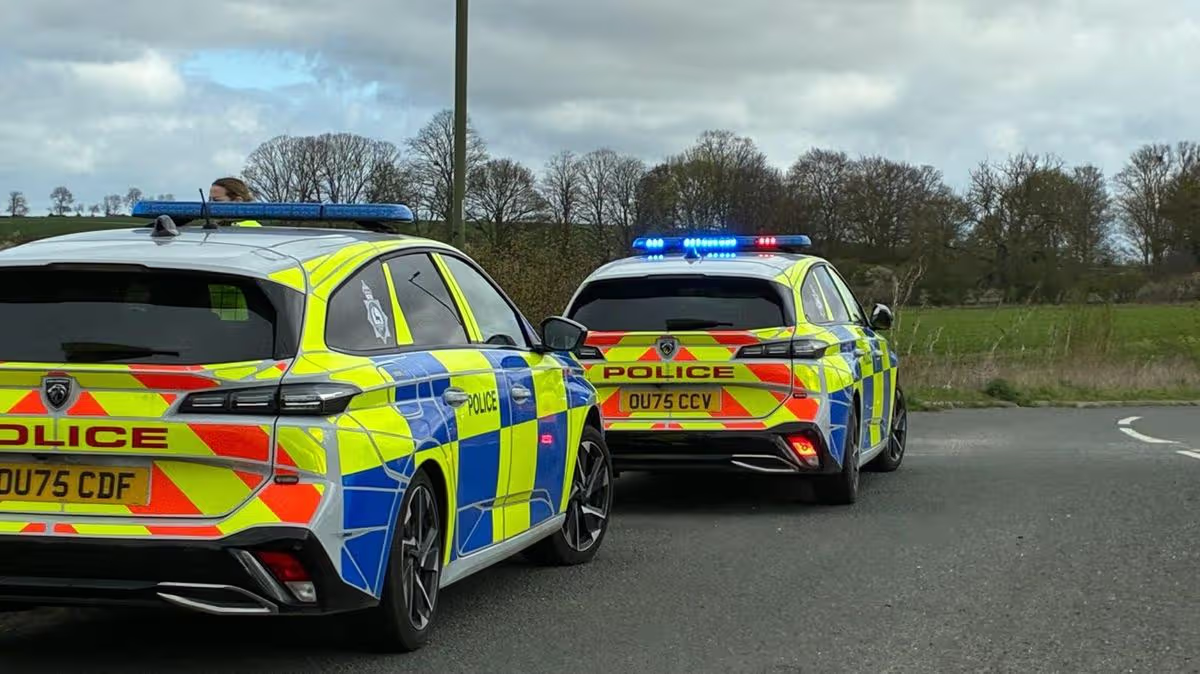
Police had been chasing a stolen caravan in Oakerthorpe, Derbyshire, in the early hours of Saturday.

Two men in the vehicle towing the caravan rammed into the police cars before coming to a stop and fleeing on foot.

Advertisement

One man was arrested shortly afterwards, while a second was described by police as having “entered the flooded Egginton Brook”.

Several hours later the man was recovered from the water and treated by ambulance crews at the scene before being taken to Royal Derby Hospital, where he was pronounced dead, police said.

Advertisement

Because the death happened after police contact, the force has referred itself to the Independent Office for Police Conduct (IOPC).

Formal identification of the man has not yet taken place, and efforts are ongoing to trace his next of kin, the force added.

Read more from Sky News:
Van camps are growing in numbers – here’s why
Man fatally stabbed in London

Adrian Osiecki, 34, of Harnall Lane West, Coventry, has been charged with dangerous driving, including failing to stop for police, and criminal damage to police vehicles; driving without insurance; driving while disqualified and theft of a caravan.

Advertisement

He is due to appear at Southern Derbyshire Magistrates’ Court on Monday.

Source link

Advertisement
Continue Reading

Trending

Copyright © 2025