Connect with us

NewsBeat

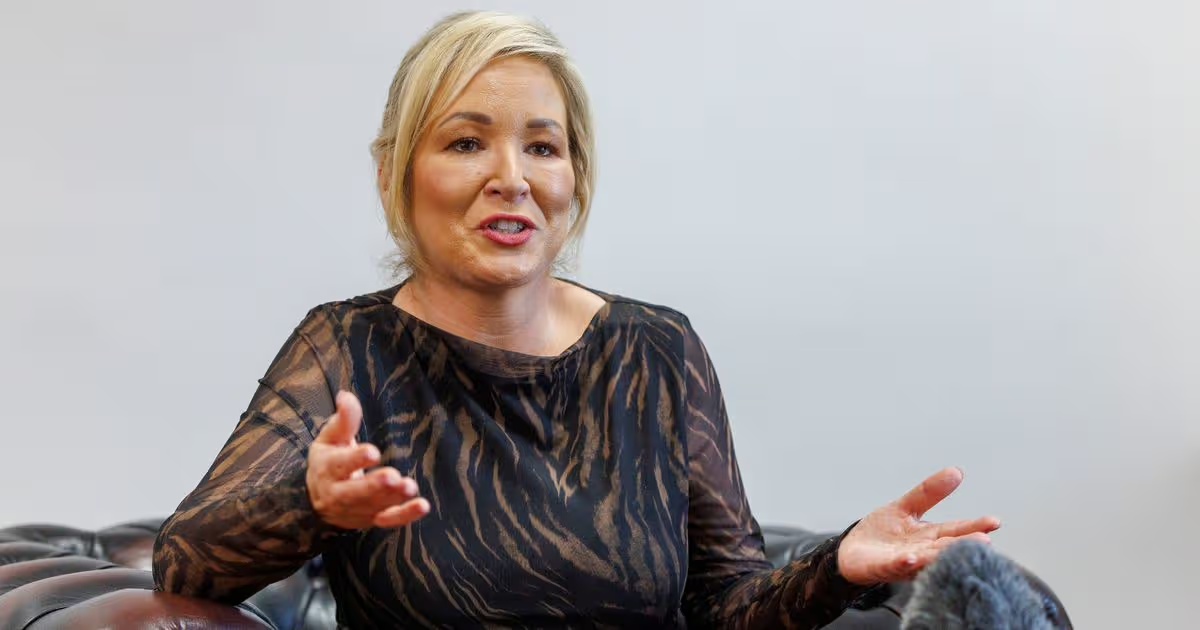
Michelle O’Neill: ‘Gendered lens’ applied to her and Emma Little-Pengelly

Published

on

Belfast Live

Speaking ahead of International Women’s Day on Sunday, Michelle O’Neill praised the uplift in women “stepping into the political world”, but said too many still face online abuse ranging from comments on their appearance to threats of physical or sexual violence

Stormont’s First Minister has described the “gendered lens” through which her and deputy First Minister Emma Little-Pengelly are criticised.

Advertisement

Speaking ahead of International Women’s Day on Sunday, Michelle O’Neill praised the uplift in women “stepping into the political world”, but said too many still face online abuse ranging from comments on their appearance to threats of physical or sexual violence.

She served as the first female mayor of Dungannon and South Tyrone council from 2010 to 2011 and was the first woman to become deputy first minister in 2020, serving alongside Baroness Arlene Foster, the first female first minister.

Ms O’Neill said her more than 20 years in politics is a “significant time to witness an awful lot of change” and comparing the political world in 2026 to her time in Dungannon council is “day and night actually”.

Of Sinn Fein’s 27 MLAs in the Northern Ireland Assembly, 16 are women, a fact Ms O’Neill said she was proud of, but that there is still a “journey to be travelled”.

“I think that there’s a very ugly climate, and we could describe it at times for women in politics, I think people in politics in general, but women in particular, face an awful lot of misogyny, and it’s not just online,” she told the Press Association.

“We talk a lot about what we receive online, but I, even this week in preparation for International Women’s Day, was speaking to my own team of female MLAs, and you see some of the stories that they have told me of their experience of being a female elected representative – it is scary.

“These are young mothers, in some cases, who have been accosted by people on the street. They regularly feel the pressure from the online abuse… people who think it’s fine to attack them with threats of sexual violence, with physical threats, and it makes a real chilling factor, I think, for women coming forward into politics.”

Advertisement

She added: “As First Minister, I see, even in the Assembly chamber here, a real creeping, real negative commentary and quite an aggressive tone being demonstrated by some of the male elected Assembly members.

“I don’t think that’s a nice space. Let’s disagree where we disagree. Let’s agree where we can also, but don’t be introducing an atmosphere where it becomes a real chill factor, where someone thinks ‘I don’t want to be a part of that’.”

Ms O’Neill is currently serving as First Minister alongside Ms Little-Pengelly, DUP MLA for Lagan Valley, and she said there is “more of a gendered lens to the questions we get asked at times”.

“I don’t recall even whenever Martin McGuinness and Peter Robinson were first and deputy first minister, I don’t recall people focusing on the nature of their relationship,” she said.

Advertisement

She acknowledged herself and her partner in the Executive Office “come from two very different backgrounds, two very different outlooks on life, and two very different outlooks where we think we should be in the future in terms of the constitutional question”.

“But the job for us to do here is actually to work together politically, to lead in the Executive, to try to deliver positive things and make a difference to people’s lives,” she said.

“And that’s where we should be questioned in terms of the policy choices, in terms of what we’ve been able to achieve here and what we’re able to deliver for people, as opposed to, ‘are you mates?’, ‘Do you get on?’, ‘Do you text each other?’ which sometimes, often becomes the starting point for a lot of the questions that women in politics get asked.”

According to Women’s Aid since 2020, 28 women in Northern Ireland have been killed by men and the region is consistently flagged as having one of the highest rates of femicide in Europe.

Advertisement

Legal proceedings are currently ongoing into the murders of 21-year-old Chloe Mitchell and 32-year-old Natalie McNally, who was 15 weeks pregnant when she was killed.

The Executive’s Violence Against Women and Girls Strategy, introduced in 2024, aims to tackle this culture through prevention programmes in schools, stronger protections and support services for victims, and co-ordinated multi‑agency action to reduce gender‑based violence.

Ms O’Neill pledged that strategy would be a priority for her on the return of devolved government and she said she has “lived up to that commitment”.

“I actually feel really, really proud of the work that we have started around ending violence against women and girls,” she said.

Advertisement

“The reality is, unfortunately, that we’re not going to turn this over overnight, but we are making progress and even I’ve just come from an International Women’s Day event, and a lot of the groups were talking to me about the positive work that they’re doing on the ground, speaking to young people.

“We have to change that attitude in society and that’s not just down to us as women. That’s down to everybody in society. Everybody has a part to play.

“I think in terms of the Natalie McNally trial, a beautiful young woman, when you think about Chloe Mitchell and her family, young women are looking at that and thinking, ‘how horrendous is that and that happened in our place, this is our home’.

“And that would make some women, young women, feel naturally unsafe, but I would say to everybody, we’re entitled to be safe, to feel safe and to be safe.”

Advertisement

Want to see more of the stories you love from Belfast Live? Making us your preferred source on Google means you’ll get more of our exclusives, top stories and must-read content straight away. To add Belfast Live as a preferred source, simply click here.


Source link

Continue Reading
Click to comment

Leave a Reply

Your email address will not be published. Required fields are marked *

NewsBeat

Anti-immigration protestors gather outside Edinburgh block of flats after ‘knife incident’

Published

on

Anti-immigration protestors gather outside Edinburgh block of flats after 'knife incident'

Protestors have gathered at a block of flats where an alleged knife incident took place in Edinburgh on Monday.

Anti-immigration protesters gathered at a block of flats where a man was arrested after two people were injured on Monday.

The protesters, who said they were demonstrating against illegal immigration, decried Police Scotland and both the Scottish and UK Governments outside Cobbinshaw House in the Calder area of Edinburgh on Friday.

Firearms officers were called to the Calder Gardens area following reports of a man with a bladed weapon at around 8.25am on Monday, March 2.

Advertisement

An armed police stand-off unfolded with residents warned to stay indoors during the incident. Two people were injured during the disturbance.

A man was stabbed and suffered “non-life-threatening injuries” and a woman had a laceration to her head that is “not believed to be caused by a bladed weapon”.

Mustafa Kokoneh, 23, appeared at Edinburgh Sheriff Court on Wednesday, March 4. He was charged on eight counts, two involving attempted murder and four involving danger to life.

Footage from the scene tonight shows a large crowd of people swarming the area amid a heavy police presence. Officers can be seen forming a human wall while several blue-lit riot vans are parked up at the scene.

Advertisement

Some of the protestors are waving Saltires and Union Flags. One man shouts “cowards” while beeps and sirens sounds in the street.

Other clips being circulated online also show music being blasted through speakers and some attendees addressing those who have turned up through a megaphone. It is not yet known if any arrests have been made.

Edinburgh Napier University took the decision to close its Sighthill campus and the ENGAGE sports centre ahead of the protest.

Prior to the protest police said they would attend to “mitigate disruption” to residents in the area.

Advertisement

Chief superintendent David Robertson said: “We are aware of a planned gathering due to take place in the Calders area of Edinburgh on the evening of Friday, March 6, 2026.

“Should it be required, officers will be on hand to ensure the safety of those in attendance and mitigate disruption to the wider community.”

Police Scotland confirmed that what happened on Monday is not being treated as terror related. Chilling Snapchat footage appeared to show a man walking around in the housing estate holding two large knives.

Advertisement

A second clip showed a local convenience store trashed, with smashed bottles lying across the floor.

Kokoneh was also charged with assault to severe injury and permanent impairment, breach of the peace, possession of a blade, carrying an offensive weapon, and vandalism.

He entered no plea and was committed for further examination. He was remanded in custody and will appear again in the next eight days.

Police officers in full riot gear swarmed the Cobbinshaw House tower block during the disturbance. Police dog handlers were also spotted on the scene, while professionals used drone cameras to monitor events.

Advertisement

A cordon was erected around the impacted area, and Scottish Ambulance Service sent three ambulances to the site. The nearby Sighthill Primary School at Calder Park was closed while the situation went on.

On Tuesday, Police Scotland warned the public about sharing misinformation following the “frightening” incident and clarified some speculation that had been circulating online.

Chief Inspector Scott Kennedy said: “I’m aware misinformation continues to be shared online about this incident which could cause further distress in the local community. I’d like to be clear: we did not receive any reports of a man attempting to enter a nursery or any educational establishment and this was not a hostage situation.

Advertisement

“While we understand what happened was frightening, I’d ask people to avoid speculating about the details and be mindful that false information could affect any future court proceedings.”

Get more Daily Record exclusives by signing up for free to Google’s preferred sources. Click HERE.

Source link

Advertisement
Continue Reading

NewsBeat

Experts say Iran school blast likely targeted airstrike

Published

on

Experts say Iran school blast likely targeted airstrike

JERUSALEM (AP) — Satellite images, expert analysis, a U.S. official and public information released by the U.S. and Israeli militaries suggest an explosion that killed scores of Iranian students at a school was likely caused by U.S. airstrikes that also hit an adjacent compound associated with the regime’s Revolutionary Guard.

The Feb. 28 strike, which had the highest reported civilian death toll since the war began, has come under staunch criticism from the United Nations and human rights monitors. More than 165 people were killed, most of them of children, in the blast during school hours at Shajareh Tayyebeh Elementary School, according to Iranian state media.

Satellite images taken Wednesday and reviewed by the The Associated Press show most of the school in the city of Minab, some 1,100 kilometers (680 miles) southeast of Tehran, reduced to rubble, a crescent shape punched into its roof. Experts say the tight pattern of the damage visible on the satellite photos is consistent with a targeted airstrike.

Iran has blamed Israel and the United States for the blast. Neither country has accepted responsibility. Asked about the strike at the school at a Pentagon press briefing Wednesday, Defense Secretary Pete Hegseth said, “All I can say is that we’re investigating that. We, of course, never target civilian targets. But we’re taking a look and investigating that.”

Several factors point to a U.S. strike.

Advertisement

One is the launching of an assessment of the incident by the U.S. military. According to the Pentagon’s instructions on processes for mitigating civilian harm, an assessment is launched after a group of investigators make an initial determination that the U.S. military may bear culpability. A U.S. official told the AP that the strike was likely U.S. The official spoke anonymously because they were not authorized to comment publicly on the sensitive matter.

Another is the location of the school — next to a base of the Revolutionary Guard in Hormozgan Province and close to a barracks for its naval brigade. The U.S. military has focused on naval targets and acknowledged strikes in the province, including one in the vicinity of the school.

Israel, which has denied conducting the strike, has focused on areas of Iran closer to Israel and hasn’t reported conducting any strikes south of Isfahan, 800 kilometers (500 miles) away. The U.S. is operating warships in the Arabian Sea, including the USS Abraham Lincoln aircraft carrier, within range of the school.

When asked by the AP about its findings, U.S. military Central Command spokesperson Capt. Tim Hawkins said, “It would be inappropriate to comment given the incident is under investigation.”

Advertisement

White House press secretary Karoline Leavitt told reporters Friday that she had no updates on the investigation and did not directly answer a question about whether Trump was satisfied with the pace of the probe.

“My assumption is that probably there were some activities recently there and they detected and tracked them, but … they weren’t aware or didn’t have an up-to-date database that a girls’ school was there and they bombed it,” said Farzin Nadimi, a senior fellow at the Washington Institute for Near East Policy who studies Iran’s military.

Satellite images show damage

The school is adjacent to a walled compound labeled on maps as the Seyyed Al-Shohada Cultural Complex of the Guard, which included a pharmacy, gym and sports field.

In addition to the school, satellite photos show that blasts struck at least five buildings in the Guard compound, leaving the area pocked with craters, charred holes in roofs and piles of rubble.

Advertisement

Iranian online map applications show a living quarters for the Assef Brigades about 150 meters (165 yards) from the school, inside the Revolutionary Guard compound. The 16th Assef Coastal Missile Group is part of the Guard’s navy, Nadimi said. The 1st Naval District, which the Assef Brigades belong to, is responsible for the Strait of Hormuz, the narrow mouth of the Persian Gulf through which a fifth of all oil and natural gas traded passes. The strait has been a particular point of conflict in the war.

In the aftermath of the strike, video from Iran’s state broadcaster verified by the AP using satellite imagery showed dozens of fresh graves dug at a nearby cemetery. Nadimi said it is likely the school taught daughters of Guard personnel.

The strike has drawn wide condemnation from the secretary-general of the United Nations and international human rights groups. The criticism comes amid reports that airstrikes have also hit other schools in Iran.

Targeting schools would be a clear violation of international laws governing armed conflict, said Elise Baker, a senior staff lawyer at the Atlantic Council, a Washington-based nonprofit think tank.

Advertisement

“Strikes can only legally target military objectives and combatants, but the school was a civilian object and the students and teachers were civilians,” Baker said. “The school’s proximity to (Guard) facilities and the attendance of children of (Guard) members at the school does not change that conclusion: It was a civilian object.”

Pattern of damage suggests targeted strike

Three experts told the AP the satellite imagery and videos from the scene strongly suggested multiple munitions hit the compound. Complicating any assessment is the lack of images of bomb fragments from the blast. No independent agency has reached the site during the war to investigate.

There are no craters or evidence of bombs hitting in the surrounding neighborhood, suggesting a great degree of accuracy, said Corey Scher, a researcher who uses satellite imagery and radar data to study landscape changes in armed conflict zones.

“All the strikes are clustered within the walled-off compound,” Scher said. “That’s one level of precision at the block level. And then most of the strikes are basically leading to direct hits on buildings. That’s another level of precision.”

Advertisement

Scher said the school and the other buildings struck in the compound showed damage consistent with the use of air-to-surface munitions.

“They didn’t explode in the air above the building,” he said. “It looks like the explosion happened at the time they hit the surface, whether it was the building or the ground.”

Sean Moorhouse, a former British Army officer and explosive ordnance disposal expert, said the available satellite imagery was insufficient to determine exactly what type of munitions were used in the strike, but he said the visible damage was consistent with what would be expected with impacts from multiple 2,000-pound (900-kilogram) high-explosive warheads. He said the multiple precise impacts would undercut any suggestion that a malfunctioning Iranian missile hit the school.

N.R. Jenzen-Jones, the director of Armament Research Services, said the school and Guard compound were targeted with “multiple simultaneous or near-simultaneous strikes.” He said in videos of the school taken immediately after the strike, smoke can be seen rising from the Guard compound. There were also impacts on multiple buildings visible in satellite images and media reports citing witnesses who said they heard multiple explosions.

Advertisement

“If indeed it is confirmed that an American or Israeli strike hit the school, there are several potential points of failure in the targeting cycle,” Jenzen-Jones said. “We might be seeing an intelligence failure, likely rather early in the process, which misidentified the target or failed to update a targeting list following the building’s change in use.”

___

Biesecker reported from Washington. Associated Press writers Jon Gambrell in Dubai, United Arab Emirates, Konstantin Toropin and Michelle Price in Washington, and Aamer Madhani in Doral, Florida, contributed to this report.

Advertisement

Source link

Continue Reading

NewsBeat

Manchester mum told police 10 men raped her – but it was all a wicked pack of lies

Published

on

Manchester mum told police 10 men raped her - but it was all a wicked pack of lies

Stacy Sharples lied to police with some of the men spending hours in custody. None of the men were charged

A mum faces prison for falsely accusing 10 men of rape after telling police a ‘wicked pack of lies,’ Bolton Crown Court heard. Some of the men spent hours in police custody, while others spent months on bail or being released under investigation after Stacy Sharples made false allegations to the police. None of the men were charged.

Some of them had consensual sex with her, others had no sexual contact whatsoever. One of the men bumped into Sharples in the street after he was cleared. She ran into a nearby chip shop and called 999, claiming the man was threatening to kill her, the court heard.

Advertisement

When he made a comment that police were actually investigating her, Sharples said: “They’re not pressing charges. I’ve got away with it. Yet again.” But she now faces a prison sentence after admitting charges of perverting the course of justice. Her false allegations cost the public purse about £120,000, the court heard, MEN reports.

She initially faced 19 counts of the charge, but ultimately only 10 proceeded to court. Judge Nicholas Clarke KC said that because Sharples had admitted a ‘sufficient number of counts to reflect the overall criminality’ that it would not have been in the public interest to pursue more.

Four of Sharples’ victims were in court for the sentencing hearing. The judge said: “I want to make it clear to anybody that reads anything about their names anywhere, that these men’s lives have been blighted by unfortunate allegations which have been made involving some sort of sexual offending, none of which are true at all.

“Only belatedly by her pleas has she now acknowledged that it was all a wicked pack of lies.” Her lawyer said that he could offer ‘no satisfactory explanation’ for her crimes, but said there had been ‘concerns about her mental health and intellect for a significant period’.

Advertisement

Sharples, from Farnworth, Bolton, will be sentenced on Wednesday, March 11. Prosecuting, Mark Monaghan told the court that Sharples’ first victim was Kaylum Davies. He had been messaging Sharples for a few days, after being put in touch by a friend.

Sharples attended Mr Davies’ friend’s house on Boxing Day in 2013, where other people were also present. Mr Davies said Sharples was quiet and spent most of the time looking at her phone. She left after about an hour without saying anything, the court heard. Sharples then called her brother, falsely claiming to be in danger. She told her brother and father that Mr Davies and other men had forced her to perform a sex act on him.

She further claimed to have been attacked by nine men and threatened with a knife. Mr Monaghan said her claims were a ‘complete fabrication’, and that he’d had no sexual contact with her at all. Mr Davies was arrested and interviewed. Sharples refused to attend an appointment at a sexual assault referral centre. He was not charged, but spent 18 months on bail. Police were concerned about inconsistencies in her claims.

A second victim, James Blundell, met up with Sharples after they had met via the dating website Plenty of Fish. She invited him to a hostel where she was living in Burnage, on February 4, 2018. He said that they had consensual sex, but decided to leave after she made comments which made him feel uneasy. Mr Blundell told her that he was going for a cigarette, but he left.

Advertisement

She messaged him, asking why he had left and why he was not responding. Sharples then told hostel staff that someone had done something to her ‘which she did not want’. They called police and handed her the phone, and she claimed to have been raped. Mr Blundell was arrested and spent 17 hours in police custody before being interviewed. He was released under investigation for six months.

Months later, a third victim, Astron Inman, met Sharples via Facebook after she ‘randomly’ added him. They met on August 11, 2018, after Sharples sent him a topless picture of herself and saying she wanted to join him in the shower.

He picked her up in his car, they had consensual sex and later he dropped her home. There, she called the police and claimed that her ‘partner’ had raped her, but that she didn’t know his surname or where the ‘rape’ happened.

She gave police an account of a violent and forceful rape. She also claimed that Mr Inman had added her on Facebook. Mr Inman was arrested and spent eight hours in police custody awaiting interview. He provided his Facebook messages and police discovered the true picture.

Advertisement

Sharples contacted Andrew Dearden on Plenty of Fish in February 2019. They had consensual sex and after, Sharples asked him if they were now a couple. When they parted ways, Mr Dearden was ‘bombarded’ with messages from her, asking where he was, what he was doing and if he loved her. She also asked to meet again.

They met at a Cash Generator shop near her home to help her sell a TV. She told Mr Dearden to wait outside. When she went inside, she called police and alleged that she’d been raped by Mr Sharples the night before. Police arrived and arrested him there. He spent eight-and-a-half hours in police custody before being interviewed.

He provided police with the messages Sharples had sent. She refused to attend an appointment for an interview with police. Reece Lockett and Conor Austin were also victims of Sharples. Mr Lockett met her through Plenty of Fish in late 2018. Mr Monaghan said there was some sexual contact between the pair but that he did not pursue it further because he thought she was ‘weird’.

Sharples asked to meet him again in April 2019. She said she would be with a friend, and Mr Lockett asked his cousin Mr Austin if he also wanted to attend. They went for a walk at a reservoir, but Mr Lockett had changed his mind about being interested in Sharples. After, Mr Lockett declined to drive Sharples home but said he’d drop her off nearby.

Advertisement

Mr Monaghan said Sharples was ‘annoyed’ and told him ‘watch what happens now’. She called 999 and accused both men of rape. Mr Lockett spent three hours in police custody, and Mr Austin two-and-a-half hours. Mr Lockett bumped into Sharples in the street a couple of months later.

They had a row and Sharples ran into a chip shop and called 999, claiming ‘there’s a guy I got done for rape a while ago threatening to kill me’. Mr Lockett made a comment about the police taking an interest in her.

She said: “I’ve been let go. They’re not pressing charges. I’ve got away with it. Yet again.” Anthony Green received multiple messages from Sharples before they were met at his flat in June 2019. They engaged in sexual contact, but did not actually have sex, until she asked him to stop, and he did.

“All of this was done consensually,” said Mr Monaghan. Mr Green offered to get her a taxi, which he did, and she left. Mr Green then received a text saying he’d hurt her, bitten and strangled her. “None of that was true”, Mr Monaghan said.

Advertisement

She later called police and 999 to say that she’d been sexually attacked, that Mr Green had strangled and bitten her before penetrating her. She told police she ‘couldn’t get him off her and that he wouldn’t let her leave’.

Mr Green was arrested in 2019 and spent 12 hours in custody. The defendant then changed her allegation, saying he hadn’t done much of what she’d claimed. The case was dropped against him in 2019. Two further victims of Sharples were Andrew Jackson and Jack Byrne. She made a single false allegation about them both.

They lived together at the time in a house, and in August 2019 received a Facebook message from Sharples saying she ‘wanted something to do’, along with a friend of hers. The two men invited the defendant and her pal to their house, and the women arrived with two bottles of vodka. They spend the next few hours drinking and taking some drugs. “There was no sexual contact’”, Mr Monaghan said.

Sharples’ facial piercing was hurting and started to bleed towards the end of the evening, and she asked her dad to come and collect her. She then sent messages to Mr Byrne, who said ‘she was pestering me on Facebook and texting me loads all night’. Eventually, Mr Byrne said: “Will you f*** off? Don’t ever ring me at eight o’clock in the morning again.”

Advertisement

Mr Monaghan said: “It might not have been the kindest response, but it does not in any way justify calling the police.” Sharples alleged that the two men got her drunk to the point she ‘didn’t know what was happening’, pinned her down, threatened her and sexually assaulted her by penetrating her. She claimed the two men said they would attack her, and called her a ‘sket’ and a ‘b****’. Sharples claimed they’d punched her, but there were no bruises to her face.

Both men denied any rape. Sharples refused to be medically examined, and tests on her underwear found no presence of semen. Sharples’ final victim was Lee Dixon, who met her through the dating app Badu. They exchanged ‘flirty’ messages, four days after Sharples had called the police on Mr Byrne and Mr Jackson.

Mr Dixon invited her to his home on August 17, 2019. Mr Monaghan said that Sharples ‘suggested they go upstairs and made it clear she wanted sexual contact’. They had consensual sex, which was proved by a video recording which was taken, prosecutors said.

More sexual messages were exchanged that day. Mr Monaghan said: “‘Mr Dickinson’s first knowledge of any complaint was later that day when he was told the defendant had contact police and accused him of rape’.

Advertisement

Sharples deleted her side of their WhatsApp chat, but the messages showed that they had been discussing how they’d enjoyed their sexual encounter. In his victim impact statement, Mr Dickinson said his experience with the defendant and her false claims led him to have a ‘mental breakdown’.

After Sharples was arrested, she told police: “You need to look into my mental health. That’s all I need to say. You’ll never understand, I had a s*** upbringing.” She also said she had emotionally unstable personality disorder.

She added: “I’m a ticking timebomb, you flip me off and I’ll flip back.” Mr Monaghan said it was a ‘conservative estimate’ that the defendant had cost the police, criminal justice, and sexual assault health services £120,000 as a result of her false allegations, due to the investigations they instigated, and all of the police, legal and medical time they required.

One victim in an impact statement told of how he’d ’moved to Sweden to reevaluate my life and I wasn’t part of my children’s life for a few years’. He said he now struggles to approach women, adding: “I have a lot of hate for that girl, I hope she gets what she deserves, it makes me sick to my core.”

Advertisement

A number of men told in their victim impact statements that they were prevented from seeing their children after the allegations, were excommunicated from their families and friends, struggled to form any romantic relationships, and have been left with PTSD. One man said the false allegations about him took him to such a dark place he thought about ending his life. Another called the defendant a ‘wolf in sheep’s clothing’.

Judge Clarke said: “I take the view that she was a sexual predator. This has taken resources away from genuine crime and genuine victims.” Defending Sharples, Hunter Gray said the victims in the case would be questioning why the defendants had made the false allegations. Mr Gray said: “In reality there is no satisfactory explanation that can be given.

“It’s not just the harm to these victims, but genuine victims of rape are damaged, as is the wider administration of the criminal justice system.” He said of the defendant: “It is correct that there have been concerns about her mental health and intellect for a significant period of time.”

Mr Gray said that Sharples ‘still struggles to accept full responsibility’ but has shown ‘some remorse’ and ‘some insight’. He conceded that a custodial sentence was inevitable in her case.

Advertisement

Sharples, of Lucas Road, Farnworth, pleaded guilty to 10 counts of perverting the course of justice. She was remanded in custody.

Source link

Continue Reading

NewsBeat

Harry Styles shares sweet message to fans ahead of Co-op Live show

Published

on

Harry Styles shares sweet message to fans ahead of Co-op Live show

The Sign of the Times singer is performing in Manchester tonight for ‘one night only’

Global superstar Harry Styles is performing in Manchester this evening on the day of his latest album launch – and he has issued a heartfelt message to his fans.

Advertisement

The former One Direction star broke his performing hiatus last week at the Brit Awards, which took place at the Co-op Live, where he played Aperture – a track from his new album Kiss All The Time, Disco Occasionally.

Kiss All The Time, Disco Occasionally was released in full today (March 6), and his special Manchester gig is expected to include every song from the new album. Fans were treated to affordable £20 tickets as well as a ticket request system rather than a standard first come first serve ticket sale.

Get MEN Premium now for just £1 HERE – or get involved in our WhatsApp group by clicking HERE. And don’t miss out on our brilliant selection of newsletters HERE.

For Harry’s ‘one night only’ Co-op Live gig, organisers have issued a rare no phones policy, meaning that nobody inside the venue is allowed to take pictures or videos for the duration of the night.

Advertisement

In a message shared on the Co-op Live website, it warns: “Phones will be secured in a recyclable bag, kept on your person upon entry to the event, and will still be able to be used in a normal way including all communication functions but without the camera.”

It continues: “All other recording devices will not be permitted in the building. At the end of the night your phone will be removed from the bag and the bag will be recycled. Please note that anyone using a digital recording device during the performance will be asked to stop and if they do not, they may be asked to leave.

“We hope you will take this opportunity to enjoy the show fully and allow yourself to be fully immersed in the experience.

Advertisement

“Each pair of tickets sold will receive a disposable camera on the night so you can still capture your own special moments and share them after the show.”

One fan has shared an image on X, formerly Twitter, of their disposable camera alongside a note which reads: “It’s really great to be home. Thank you for really being here with me. Dance with all your friends.”

Content cannot be displayed without consent

See our live coverage of Harry Styles’ Manchester gig here.

Source link

Advertisement
Continue Reading

NewsBeat

Queen Camilla leaves The One Show viewers saying same thing after ‘inspiring’ speech

Published

on

Queen Camilla leaves The One Show viewers saying same thing after 'inspiring' speech

The Queen delivered a moving message about children’s literacy as the BBC 500 Words writing competition winners were announced at Windsor Castle

The One Show viewers were touched as Queen Camilla delivered a heartfelt message.

The Royal was present to announce the winners of the children’s writing competition, 500 Words, on the BBC show on Friday evening (March 6). The special episode was hosted by Alex Jones and Roman Kemp at Windsor Castle, reports Wales Online.

Camilla attended the ceremony, where she shared with the audience: “I hope you have enjoyed taking part in the 500 Words, but in doing so you have discovered a secret. A secret that reading and writing are the best fun ever. And don’t just take my word for it.”

Advertisement

She continued: “Many years ago, a famous author said this, ‘In the main, writing is just the thrill. The thrill of exploring.’ Now the man who found writing so thrilling was AA Milne, who exactly a hundred years ago published the first book that introduced us to his beloved bear, Winnie the Pooh. Pooh like all of us here, had firm views about storytelling. He didn’t much like long, difficult words. But rather short or easy words. Like, ‘What about lunch?’”

When it was time to reveal the winners, the Queen stated: “Let me leave you with one more quote from our author of the day AA Milne. ‘Always remember, you are braver than you believe, stronger than you seem and and smarter than you think.’ Which makes you all winners.”

She then told Alex and Roman: “I think to get children reading and writing stories, especially nowadays, is so important. And also, it gives them time to get away from some of their phones!”

Advertisement

The speech resonated deeply with audiences, prompting one viewer to post on X, formerly Twitter: “I’m not crying.”

Another gushed on Instagram: “What a nice clever and inspiring speech!!” A fellow viewer described it as “marvellous”. One fan remarked: “How thoroughly lovely,” whilst numerous others flooded the platform with heart emojis.

One audience member declared the initiative “brilliant” whilst another commented: “Her Majesty is just an extraordinary woman. Truly inspiring.”

Advertisement

The BBC Bitesize-supported competition attracted over 46,500 submissions from throughout the UK. Six young writers were honoured as champions during the finale.

Famous faces including Jodie Whittaker, Joanna Page, Sara Cox, Bradley and Barney Walsh, Big Zuu and Paterson Joseph participated in the ceremony, whilst Paddington made a special appearance to perform The Explorer and The Bear from Paddington The Musical and West End sensation Marisha Wallace delivered a rendition of A Million Dreams from The Greatest Showman.

For the latest showbiz, TV, movie and streaming news, go to the new **Everything Gossip** website

The One Show airs at 7pm on BBC One on weekdays

Advertisement

Source link

Continue Reading

NewsBeat

Emergency services responding to ongoing incident in Bolton

Published

on

Emergency services responding to ongoing incident in Bolton

As a subscriber, you are shown 80% less display advertising when reading our
articles.

Those ads you do see are predominantly from local businesses promoting local
services
.

These adverts enable local businesses to get in front of their target audience – the local
community
.

It is important that we continue to promote these adverts as our local businesses need
as much support as possible during these challenging times.

Advertisement

Source link

Advertisement
Continue Reading

NewsBeat

refugee status was never ‘permanent from day one’

Published

on

refugee status was never ‘permanent from day one’

The UK’s asylum system is being overhauled. The home secretary, Shabana Mahmood, has laid out a series of reforms that will affect refugees seeking safety in Britain. Mahmood argues that these changes – which include removing financial and housing support for asylum seekers who break the law, and offering incentive payments for asylum seekers whose claims have been rejected to return home – will remove “incentives” drawing people to Britain. She says they are necessary as part of a “firm but fair approach” to asylum.

One of the headline announcements is to make refugee status temporary, subject to review every 30 months. “Those whose country has now become safe, and therefore no longer require protection, will be expected to return home,” according to the home secretary.

Under the current rules, asylum seekers who have been granted refugee status are permitted to stay for five years, after which they can apply for indefinite leave to remain in the UK. Mahmood claims that “this means refugee status is, in effect, permanent from day one”.

But this is not true. Refugee status was always intended to be temporary. Most refugees have never wanted to be refugees forever, and states have never been expected to host them indefinitely.

Advertisement

Since the creation of the UN refugee convention, states have had the right to end refugee status. The convention itself, as the home secretary even noted, says that its protections no longer apply if “the circumstances in [connection] with which [someone] has been recognised as a refugee have ceased to exist”.

If someone is no longer in need of international protection, they must either return to their country of origin or find another legal way to stay where they are. The UN refugee agency has always been clear though that the onus of proving this falls on states. Refugees should neither be required to continuously justify their right to international protection nor “be subject to constant review in the light of temporary changes” in the country that they came from. This puts the UK government’s position at odds with a key principle designed to protect refugees, by requiring them to apply for further permission to stay.


À lire aussi :
What Labour’s migration reforms mean for LGBTQ+ asylum seekers


Technically, the UK government already had the right to remove refugee status and, if individuals had no other legal claim to stay in the UK, send people back to countries it deemed “safe”. For several reasons, however, this has been difficult to implement in practice.

Advertisement

To end a person’s refugee status, states must prove that a refugee is no longer at risk of persecution, and that if they must return to their country of origin, they will not face a threat to their life and fundamental liberties. States must hence demonstrate that there has been a “fundamental, stable and durable” change in the country of origin. This should be related to the specific reason for the refugee’s asylum claim.

Looking at major recent refugee-producing countries, such as Syria, Ukraine and Afghanistan, conflict and violence still rage. It seems implausible that any government would be able to prove that significant numbers of citizens from these countries no longer have valid claims to protection.

Denmark – the country whose asylum system has inspired Mahmood – has been attempting to reject Syrians’ applications to renew their refugee status, on the grounds that parts of Syria are safe for them to return to. These efforts have been criticised by international groups including the UN refugee agency, and are so far only applicable to a small number of people.

The home secretary says changes to the asylum system will remove the ‘incentives’ that draw people to seek safety in the UK.
Sean Aidan Calderbank/Shutterstock

Determining safety

Refugees can become pawns in domestic and international politics, regardless of their ongoing need for protection.

Advertisement

Who, for example, gets to decide what is an acceptable standard of human rights? Or whether a change is actually “fundamental, stable and durable”? Countries of asylum have pushed to end refugees’ statuses to reduce their responsibilities to host them. This appears to be Mahmood’s plan.

Countries of origin can also manipulate this process. They have pushed for refugees to be returned to them, in order to silence legitimate political opposition in exile, and in the hope of restoring their images as peaceful countries. This happened during the protracted application of the cessation clause to Rwandan refugees, leaving many in a vulnerable position.

Practically too, in stating that the status of refugees will be reviewed every 30 months, Mahmood is introducing another costly and time-intensive bureaucratic process when the asylum system is already chronically backlogged. The government has already trialled using artificial intelligence in asylum decision making, so it’s possible that this is on the horizon here. But this comes with its own risks to due process, fairness and privacy.

I would argue that the government is dressing up a legal option that they have always had as a “new policy”, while downplaying the safeguards that have prevented them from turning this option into reality.

Advertisement

It is unlikely that this reform will make the asylum process either more efficient or humane, or that it was ever intended to do so. Mahmood insists that it will make the system “fair … to those seeking a new and better future in this country” – but requiring refugees to relive and defend their trauma every two and a half years will only heighten the suspicious, hostile and punitive nature of the asylum system.

Source link

Advertisement
Continue Reading

NewsBeat

Huge US bomber nickmamed ‘the Bone’ that can hit 900mph lands in UK | News UK

Published

on

Huge US bomber nickmamed 'the Bone' that can hit 900mph lands in UK | News UK
A Rockwell B-1 Lancer, a supersonic variable-sweep wing, heavy bomber used by the United States Air Force arrives at RAF Fairford in Gloucestershire (Picture: PA)

One of the US’s most fearsome bombers has landed in the UK ahead of possible deployment to Iran, after the war secretary warned that strikes are ‘about to surge dramatically’.

The 146ft B-1 Lancer has a wingspan of 137ft, weighs 86 tonnes and is the fastest bomber in the US Air Force, according to Boeing, hitting speeds of more than 900mph with 24 cruise missiles on board.

Piloted by a crew of four, ‘the Bone’ has advanced radar and GPS systems to help hit targets, and electronic jammers, radar warnings and a decoy system to protect it from enemies.

The B‑1, which has been used in Syria, Libya, Afghanistan and Iraq, can carry up to 34 tonnes of weapons and equipment.

Advertisement

The US Air Force says on its website: ‘Carrying the largest conventional payload of both guided and unguided weapons in the Air Force inventory, the multi-mission B-1 is the backbone of America’s long-range bomber force.

Sign up for all of the latest stories

Start your day informed with Metro’s News Updates newsletter or get Breaking News alerts the moment it happens.

Advertisement

‘It can rapidly deliver massive quantities of precision and non-precision weapons against any adversary, anywhere in the world, at any time.’

A bomber was pictured arriving at RAF Fairford in Gloucestershire on Friday after Sir Keir Starmer granted the US permission to strike defensively against Iran’s missile facilities from British bases.

To view this video please enable JavaScript, and consider upgrading to a web
browser that
supports HTML5
video

Advertisement

Western officials confirmed on Wednesday that US aircraft were expected at the base in the coming days and Britain was ready to accept them.

US defence secretary Pete Hegseth said on Thursday that strikes on Iran are ‘about to surge dramatically’.

He said: ‘It’s more fighter squadrons, it’s more capabilities, it’s more defensive capabilities. And it’s more bomber pulses more frequently.’

Advertisement

Protests are expected at RAF Fairford on Saturday afternoon to oppose any use of the base by US bombers.

epa12799628 Smoke and flames rise following an Israeli airstrike on Dahieh, a predominantly Shia Muslim suburb in the south of Beirut, Lebanon, 06 March 2026. The Israeli military stated it is conducting strikes across the country targeting Hezbollah infrastructure and personnel. According to the Lebanese Ministry of Public Health, at least 123 people were killed and 683 others injured in airstrikes across Beirut's southern suburbs and villages in southern Lebanon. EPA/WAEL HAMZEH
Smoke and flames rise following an Israeli airstrike on Dahieh, a predominantly Shia Muslim suburb in the south of Beirut, Lebanon (Picture: EPA)
A man walks past heavily damaged buildings at the site of overnight Israeli airstrikes in the southern suburbs of Beirut on March 6, 2026. Heavy attacks were reported in Tehran on March 6 after Israel said it was hitting
A man walks past heavily damaged buildings at the site of overnight Israeli airstrikes in the southern suburbs of Beirut (Picture: AFP via Getty)

In an update on Friday, White House press secretary Karoline Leavitt revealed the US military campaign against Iran may take as long as four to six weeks.

President Donald Trump has previously suggested the conflict could take around five weeks before warning it could go ‘far longer’.

Hegseth has similarly insisted the US would ‘take all the time we need to make sure that we succeed’.

The president appeared to rule out negotiations with Iran to end the conflict in the Middle East, saying in a social media post Friday that there will be no deal absent ‘unconditional surrender’.

Advertisement

‘After that, and the selection of a GREAT & ACCEPTABLE Leader(s), we, and many of our wonderful and very brave allies and partners, will work tirelessly to bring Iran back from the brink of destruction, making it economically bigger, better, and stronger than ever before,’ Trump said.

He has said multiple times that whoever takes over leadership of Iran must be to the US’s liking.

Trump signed off the social media post with ‘MAKE IRAN GREAT AGAIN (MIGA!)’, a riff on his longtime campaign slogan, ‘Make America Great Again’.

Get in touch with our news team by emailing us at webnews@metro.co.uk.

Advertisement

For more stories like this, check our news page.

Advertisement
Advertisement

Source link

Continue Reading

NewsBeat

Former Michigan football coach Sherrone Moore pleads no contest to 2 misdemeanors

Published

on

Former Michigan football coach Sherrone Moore pleads no contest to 2 misdemeanors

ANN ARBOR, Mich. (AP) — Former Michigan football coach Sherrone Moore pleaded no contest Friday to two misdemeanors in a criminal case that arose immediately after he was fired for having an inappropriate relationship with his executive assistant.

The deal was struck on the same day that a judge planned to hear a challenge to Moore’s arrest in December on three charges, including felony home invasion. Those charges were dropped in exchange for Moore pleading no contest to misdemeanor trespassing and misdemeanor malicious use of a telecom device.

“Things have changed,” Judge J. Cedric Simpson said.

Moore had confronted the woman with whom he had been having an affair and blamed her for his dismissal, even threatening to kill himself with butter knives in her apartment, authorities said.

Advertisement

___ EDITOR’S NOTE — This story includes discussion of suicide. If you or someone you know needs help, the national suicide and crisis lifeline in the U.S. is available by calling or texting 988. There is also an online chat at 988lifeline.org

___

“All the charges against Mr. Moore were not supported by facts and law,” said attorney Ellen Michaels, standing alongside Moore and his wife, outside the courtroom. “The dismissal of those charges validates the concerns we raised about the investigation from the very beginning. Mr. Moore is pleased to put this behind him and move forward.”

Moore did not respond to a reporter asking him for comment. Assistant prosecutor Katie Rezmierski, on her way out of the courthouse, declined an interview request..

Advertisement

Sentencing is scheduled for April 14 on charges that have a potential maximum of six months and 30 days in prison.

He was fired on Dec. 10 after two seasons as the successor to Jim Harbaugh, who won a national championship before leaving to lead the NFL’s Los Angeles Chargers.

Moore arrived at the courthouse with his wife, Kelli, and they walked toward the courtroom holding hands, interlacing fingers.

In dismissing Moore, the university cited an inappropriate relationship with a staff member. Rezmierski has said the woman ended the affair a few days before Moore’s firing and cooperated with the school’s investigation.

Advertisement

The AP isn’t identifying the woman, who has accused Moore of domestic violence and stalking. She did not answer a dozen calls or respond to some text messages from him before his dismissal, police said.

“It’s not stalking if the communication has a legitimate purpose,” Michaels has said.

A message seeking comment was left with attorney Heidi Sharp, who is representing Moore’s former executive assistant.

Michaels has accused the woman’s personal lawyer of giving information to police to “villainize Mr. Moore and maximize the chances of obtaining a large settlement from the deep pockets of the University of Michigan.”

Advertisement

___

Associated Press writer Ed White in Detroit contributed to this report.

Advertisement

Source link

Continue Reading

NewsBeat

WASPI compensation update as DWP rejects payout for second time

Published

on

WASPI compensation update as DWP rejects payout for second time

The WASPI campaign has provided an update on next steps after the DWP rejected compensation for the second time, with legal teams reviewing whether to launch another judicial review challenge

The WASPI campaign (Women Against State Pension Inequality) has provided a fresh update on their fight for DWP compensation. The group suffered a significant blow recently when the DWP confirmed it would not be offering compensation.

Advertisement

This marked the second time the Labour Government has issued a statement on the matter. Ministers initially announced in December 2024 that no compensation would be forthcoming, but the WASPI campaign successfully secured a judicial review of that decision.

The campaigners were due to appear in court in December 2025, but ministers withdrew the decision at the last minute, stating they would reconsider it based on new evidence. Legal representatives for the DWP then agreed to an out-of-court settlement, paying out £120,000 to cover WASPI’s legal costs.

This raises questions about whether WASPI will mount another judicial review challenge against the latest decision. In an update, WASPI said: “Since our last update, WASPI’s legal team have undertaken a careful line by line scrutiny of the Government’s new decision and the barrister team has been fully briefed; we will meet with them in the coming days. We will update you on our next steps once we have received their advice.”

The WASPI campaign is amongst several organisations representing women born in the 1950s who were affected when the state pension age for women increased from 60 to 65 and later to 66, reports the Mirror.

Advertisement

Campaigners maintain the women weren’t properly informed about the changes, and the DWP should have communicated the alterations sooner.

An earlier investigation by the Parliamentary and Health Service Ombudsman found there was ‘maladministration’ by the DWP, as they ought to have sent letters to the affected women far earlier. The watchdog recommended compensation payments to the women ranging between £1,000 and £2,950.

Labour has accepted this finding of maladministration, but opted against providing financial compensation. In delivering the second decision, Work and Pensions Secretary Pat McFadden told MPs: “The evidence shows that the vast majority of 1950s-born women already knew the state pension age was increasing thanks to a wide range of public information, including through leaflets, education campaigns, information in GP surgeries, on TV, radio, cinema and online.

“To specifically compensate only those women who suffered injustice would require a scheme that could reliably verify the individual circumstances of millions of women.”

Advertisement

Grace Hardy, tax accountant at Hardy Accounting, highlighted several crucial takeaways from the WASPI situation. She said: “The overarching lesson is that the UK tax and benefits system is genuinely complex, changes frequently, and does not reliably notify those affected by changes.

“Treating your own financial position as something to actively and periodically review rather than something that will look after itself is probably the most valuable single habit anyone can develop.”

She urged individuals not to assume that current regulations will stay the same going forward. She said: “Pension ages, tax thresholds, allowances and benefit rules are all subject to change. Any plan that depends entirely on current rules holding indefinitely is fragile.”

This advice is particularly timely, as the state pension age will soon be rising again. The qualifying age currently sits at 66 for both men and women and will rise progressively from April 2026, reaching 67 by April 2028.

Advertisement

Ms Hardy pointed out some other financial matters worth keeping an eye on. She said: “Know what applies to you specifically. General media coverage tells you the average or headline rules.

“But your state pension age, your National Insurance record, your specific tax position, your pension entitlements these are individual. Use the Government Gateway to check your state pension forecast and National Insurance record.”

She also advised seeking independent financial guidance on significant decisions, including consolidating pensions, drawing down from defined benefit schemes, and inheritance planning. Ms Hardy stated: “These are areas where mistakes are costly and often irreversible.”

Source link

Advertisement
Continue Reading

Trending

Copyright © 2025