


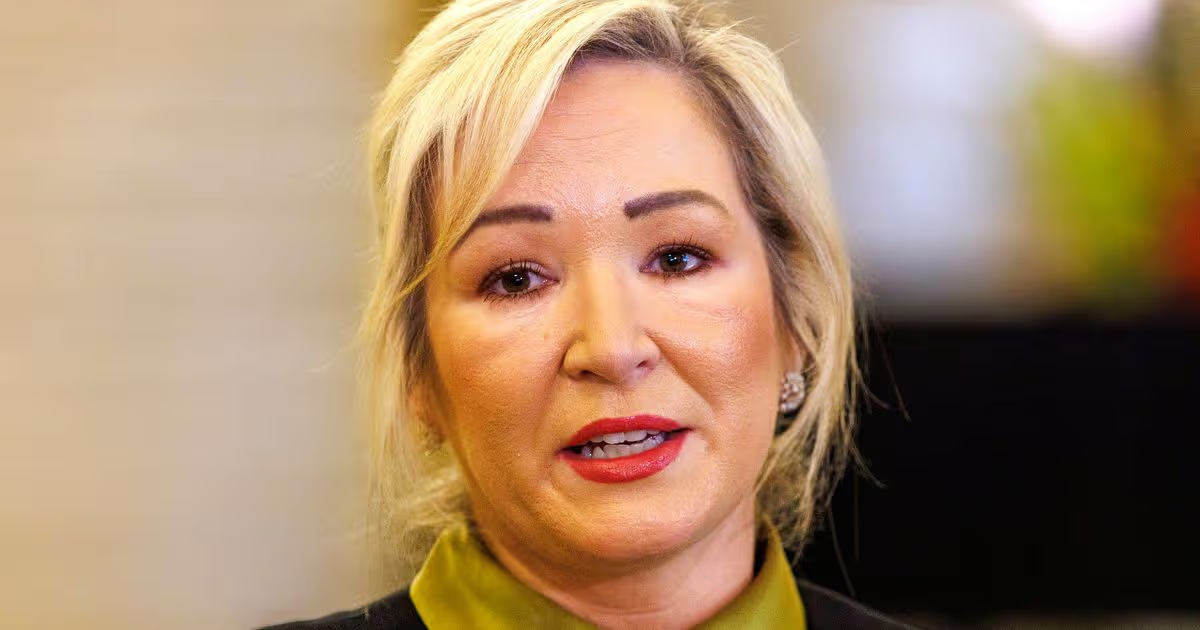
By choosing not to attend, Michelle O’Neill allowed the focus of the story to shift away from her argument about the war and towards the optics of her absence
Stormont rarely has much direct influence over foreign policy, but that has never stopped international events spilling quickly into the politics of this place.
The escalating conflict involving Iran is the latest example. While decisions about military intervention are being taken in London, Washington and elsewhere, the consequences are already being felt much closer to home. Families across Northern Ireland are watching developments anxiously as the situation in the Middle East deteriorates, aware that friends and relatives are among the large number of British nationals currently in countries that could become increasingly dangerous in the days and weeks ahead.
UK officials believe hundreds of thousands of Britons are in countries targeted by Iran, with more than 140,000 registered for Foreign Office updates. If the situation continues to escalate, the prospect of evacuations on a scale rarely attempted by the UK is now openly being discussed.
It was against that backdrop that the UK Government convened a series of briefings for devolved administrations last week, and First Minister Michelle O’Neill chose not to attend.
The First Minister’s explanation has been clear enough. She has said she remains in contact with both the British and Irish governments, and that her priority is to ensure that anyone from Northern Ireland who needs assistance leaving the region can do so safely. Her objection, she says, is to taking part in a briefing by the British Government on military operations when she fundamentally disagrees with the decision to join the conflict.
That position sits squarely within Sinn Féin’s long-established approach to international affairs. The party has consistently opposed British military intervention overseas, and Michelle O’Neill has framed the current conflict in similar terms, warning that the situation is spiralling and questioning where the escalation will end. She has also been careful to stress that the Iranian regime itself is brutal and repressive, while arguing that war will not deliver a peaceful outcome.
Taken in isolation, none of that is especially surprising. But the politics of the situation is not only about the substance of her argument. It is also about the moment in which the decision was taken and how it has been interpreted.
The briefings offered by London were not about seeking the endorsement of devolved ministers for military action. Stormont was hardly being invited to weigh in on strategic decisions about missile strikes. Their purpose, according to those who attended, was to ensure devolved administrations were updated on developments in the region and on the potential implications for citizens from their jurisdictions. In other words, they were about information rather than endorsement.
That distinction has allowed deputy First Minister Emma Little-Pengelly to frame the situation in a way that is politically advantageous for her. By attending both briefings and speaking afterwards about the scale of the challenge involved in any potential evacuation, the deputy First Minister has been able to emphasise a more practical focus on the immediate consequences of the conflict for people here.
Her criticism of Michelle O’Neill was measured but pointed. It was, she said, “genuinely disappointing” that the First Minister had chosen not to attend a meeting designed to update local leaders on events that could affect thousands of people connected to Northern Ireland. In Stormont terms, the exchange quickly settled into a familiar dynamic.
Emma Little-Pengelly’s argument was not really about foreign policy at all. Instead, it presented a contrast of one side attending briefings and focusing on practical contingencies, while the other is standing back on the grounds of principle.
The deputy First Minister used an opportunity to launch a broader attack on what she described as Sinn Féin’s historical relationship with Iran, while DUP leader Gavin Robinson went further, arguing the UK should have been involved earlier.
None of that necessarily changes the substance of the First Minister’s critique of the war itself. Across Europe and beyond, there are serious questions being asked about the legality of military action and the risk that the current escalation could pull more countries into a widening conflict.
But politics, particularly in Northern Ireland, rarely unfolds in a purely substantive way. At a time when families here are worried about loved ones in the region, participation in a briefing designed to provide information about their safety carries a certain symbolic weight, regardless of the technical purpose of the meeting itself.
It is worth saying that had the First Minister attended the briefings, I don’t believe anyone would have batted an eyelid. By choosing not to attend, Michelle O’Neill allowed the focus of the story to shift away from her argument about the war and towards the optics of her absence, which has given Emma Little-Pengelly an opportunity to present herself as the steadier voice in the room.
For all the latest news, visit the Belfast Live homepage here and sign up to our daily newsletter here.





![Ripple CTO Made an ENCRYPTED Message... "DO NOT SELL XRP EARLY" GET READY XRP HOLDERS! [MUST SEE]](https://wordupnews.com/wp-content/uploads/2026/03/1772957034_maxresdefault-80x80.jpg)