Forget footballers and popstars – today’s celebrity children want to be influencers.
And Rochelle and Marvin Humes’ 13-year-old daughter is the latest young nepo baby planning a career as a ‘content creator’ despite an upcoming social media ban for under-16s.
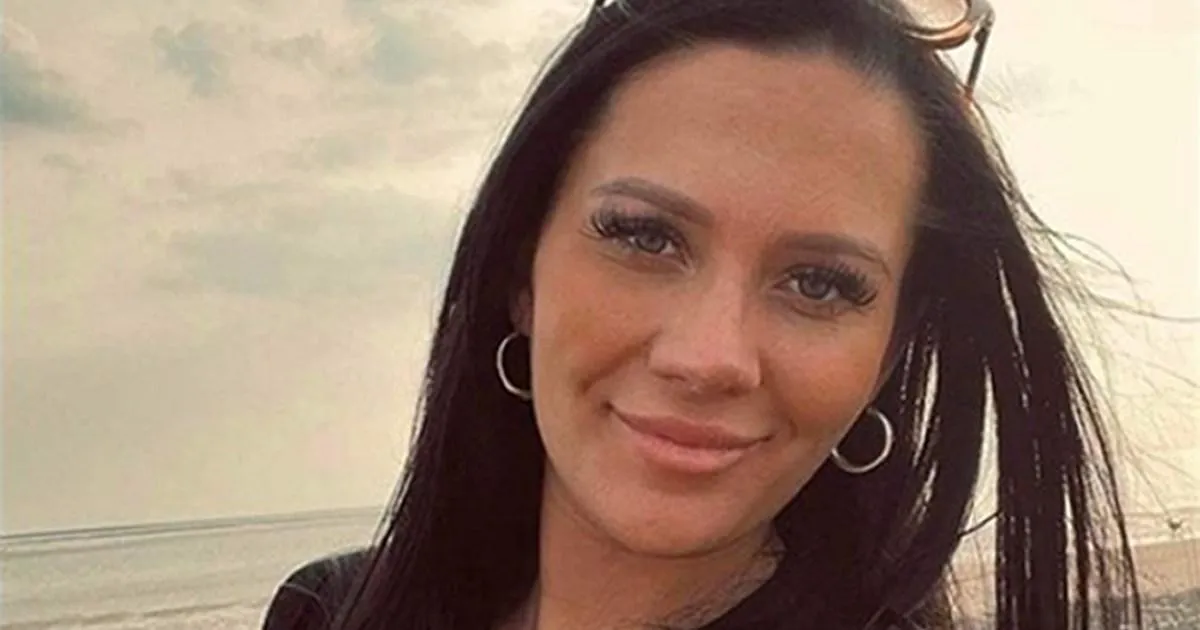
Rochelle, who rose to fame as a singer in The Saturdays and is now in a presenting duo with her JLS star husband, told how their daughter Alaia-Mai wants to be a social media creator when she’s older and next week will be doing work experience on her mother’s account.
Speaking at Vodafone’s The Opportunity Hub in Covent Garden on Thursday morning, she said: ‘Next week, Alaia-Mai is doing a week of work experience with me early. She wants to be a content creator, the girl who isn’t allowed any social media, which is ironic.
Advertisement
‘But she loves Shannon [Rochelle’s personal content creator]. She thinks she is so cool, and Shannon is off on holiday, and Alaia-Mai was like, “Can I do Shannon’s job?” And I was like, “ok the team will write you a brief”, so she has been reading the brief while on a caravan holiday with my mum. They are currently on a 10-day caravan holiday; I’m actually really jealous.
She added: ‘I want to be a nepo mum! I’m like, go do your thing!’
Rochelle and Marvin Humes ’ 13-year-old daughter is the latest young nepo baby planning a career as a ‘content creator’ despite an upcoming social media ban for under-16s
Advertisement
Rochelle, who rose to fame as a singer in The Saturdays, told how their daughter Alaia-Mai wants to be a social media creator when she’s older and next week will be doing work experience on her mother’s account
Alaia-Mai will be following in the footsteps of Harper Beckham, 15, Venezuela Fury, 16, Scarlett Thomas, 17, and Princess Andre, 19, who all intend to make a name for themselves on social media.
It comes as the UK government has announced plans to ban social media for under–16s in the spring of next year.
The change will mean youngsters won’t be able to access popular apps such as Instagram, YouTube, TikTok, Snapchat, Facebook and X.
Advertisement
The Government also confirmed that 16- and 17–year–olds will face curfews.
As part of the new measures, their access to popular social media will be switched off from midnight to 6am every night.
Features that are designed to keep teens scrolling for longer will also be disabled by default for older teenagers. This includes videos that automatically play one after another and feeds that continually serve up personalised content.
Alaia-Mai is no stranger to a camera, as she and her siblings, Valentino, nine, and Blake, five, appear on their famous parents’ social media.
Advertisement
They also participate in content for Rochelle’s successful family skincare and lifestyle brand, My Little Coco, which launched in February 2020.
Rochelle and Marvin pictured with their children Valentino, nine, Blake, five, and Alaia-Mai
For Rochelle, 37, balancing a successful career with motherhood is something she thinks about every day.
She admits there is a constant push and pull between work and family.
Advertisement
Reflecting on the balance she strives to maintain, Rochelle said: ‘By being here, I’m not with my kids, but by being at home I wouldn’t be working; there is always that push and pull element.’
Despite the demands of her career, the presenter insisted that her priorities have never changed, adding: ‘My children and my family are my number one priority.’
Rochelle explained that she and Marvin, 41, made a conscious decision to adapt their working lives after becoming parents.
‘I don’t travel half as much as I used to, and me and Marvin knew by starting a family our lives would look different. If he’s travelling, I won’t,’ she said, revealing how the couple coordinates their schedules to ensure one parent is always at home with their children.
Advertisement
‘We do one TV show together [BBC’s The Hit List], and we break our backs and do it in five days; we film three episodes a day.
‘I love how our kids get to see how ambitious we are as a family,’ she added.
The presenter was speaking at Vodafone’s The Opportunity Hub in Covent Garden
Vodafone offered practical support, expert advice, and inspiring talks from entrepreneur and broadcaster Rochelle (in conversation with Roman Kemp)
Advertisement
Rochelle added she has found that what she is good at is being an entrepreneur, jokingly adding: ‘I was never very good at singing or dancing anyway!’
The presenter was speaking at Vodafone’s The Opportunity Hub in Covent Garden.
On stage, she admitted that she had been a Vodafone customer longer than she has been with Marvin – which is 16 years.
To help people turn ambition into action, Vodafone opened the UK’s first Opportunity Hub, offering practical support, expert advice, and inspiring talks from entrepreneur and broadcaster Rochelle (in conversation with Roman Kemp) plus writer and campaigner Anna Whitehouse and executive coach and psychotherapist, David Waters.
Advertisement
The event, hosted by content creator and entrepreneur Jade Beason, provided visitors with the tools, tech, advice and connections needed to help unlock opportunity and builds on Vodafone Three’s commitment to create the UK’s best network, backed by a fully funded £11bn investment to grow coverage, boost reliability and strengthen the digital future for the nation.
The summer window is entering its final weeks as Arsenal, Chelsea, Manchester United, Liverpool and Tottenham all step up their push for new signings. Arsenal will announce the arrival of Bruno Guimaraes today, while they are said to have made a shock enquiry over Cristian Romero and agreed personal terms with Julian Alvarez after Vinicius Jr signed a new contract at Real Madrid.
Citric acid has long been a favourite for descaling kettles and coffee machines, but its uses extend far beyond banishing limescale.
After Sarah-Jane Hoadley shared her top cleaning jobs for citric acid, readers flooded the comments with their own tips. They revealed just how versatile this inexpensive household staple can be, whether that’s using the powdered form, or lemons, in which it occurs naturally.
From removing rust from tools to unblocking sinks and even making homemade elderflower cordial, here’s what our readers had to say.
Advertisement
A cleaner barbecue
With barbecue season well underway, reader Tom Spencer tells us about his top tip.
“Cleaning with lemons is all over the internet nowadays,” he says. “I use cut lemons or limes to clean the barbecue grates after scraping with the wire scraper once at a high temperature. It is as simple as rubbing the halved lemon onto the bars. The acid does the rest, and gets any little bits off. Then put olive oil onto some kitchen roll and rub the bars so the food doesn’t stick.”
Summer drinks
Speaking of summer, citric acid can also be used in various cocktail, cordial and wine recipes, as detailed by Janet Adams, 74, from Scotland.
“I bought the citric acid last year to make elderflower wine. I was somewhat nervous about putting it in, acid after all,” she says. Janet has a host of self-seeded elder trees on the land where she lives. “Last year was the first time I put them to any use.”
Advertisement
When making cordial, the flower heads have to be picked on a hot day when the perfume is strong. They do get soaked overnight, but “be careful to allow anything crawly to escape before that”, Janet adds.
The US has recorded another sharp fall in its murder rate, with homicides down 18% in the first six months of the year compared to the same period in 2025.
That’s according to analysis from the Council on Criminal Justice (CCJ), which said that the US homicide rate has likely reached a “historic low”.
It’s not just the murder rate that’s falling. The CCJ said that four types of crime have fallen by more than half in recent years: homicide (51% lower than 2022), carjacking (73% lower than 2023), residential burglary (56% lower than 2018), and vehicle theft (down 51% compared to 2023).
Advertisement
While the White House has framed the data as a triumph for the Trump administration, crime rates in the US have been falling for years, albeit with some exceptions, notably shop-lifting and drug offences.
“Murder and other crime rates are falling across the map, in cities with different political leadership, housing and economic conditions, policing and prosecution strategies, violence reduction models, and levels of federal enforcement activity,” said Adam Gelb, the CCJ’s president.
“Local policies and programmes surely matter, but the striking consistency of the decline suggests that macro-level forces are exerting enormous influence as well.”
Amid family feuds, damaging headlines and questions about its future role, Britain’s royal family has spent much of the past decade managing its public image. But the importance of good royal PR dates back centuries.
Long before communications teams and media advisers became fixtures of royal life, Queen Caroline (1683-1737) attempted a remarkable piece of image management. Faced with the challenge of making a German royal dynasty seem unmistakably British, she turned to one of Britain’s most powerful national stories: the legends of King Arthur and Merlin.
As the wife of the king of Great Britain and Ireland, George II (1683-1760), Caroline belonged to the House of Hanover. The German dynasty had inherited the British throne only two decades earlier and was still viewed with suspicion by many of their subjects. At the same time, an increasingly public feud between the king and his heir, Frederick, Prince of Wales, threatened to undermine the image of stability that a country recently torn apart by civil war, religious schisms and political revolution so desperately needed.
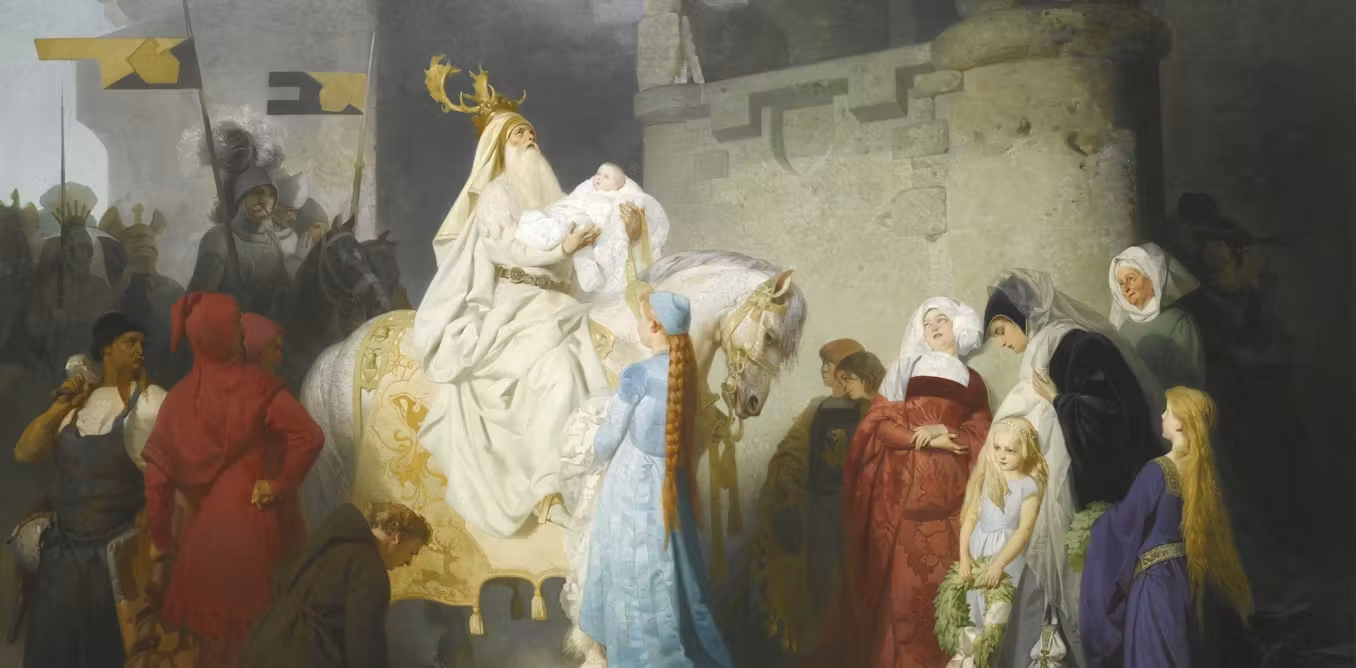
Caroline’s solution to this problem was unexpected. In 1735, she commissioned a curious attraction in the gardens of her palace at Richmond. Known as Merlin’s Cave, it looked like something from a fairy tale: a gothic thatched building filled with wax figures of Merlin, legendary prophets and other figures from Britain’s distant past. Many contemporaries thought it bizarre, with one critic dismissing its inhabitants as “a great many strange puppets”.
Advertisement
Portrait of Caroline of Ansbach in Manner of Michael Dahl (1730). Shire Hall
Yet Merlin’s Cave was far more than an eccentric garden folly. Although an unlikely tool of statecraft, Caroline’s use of Arthurian iconography sought not only to strengthen the Hanovarian claim but also to promote a shared British identity at a time of political uncertainty.
Myth as messaging
Although the House of Hanover had inherited the British throne in 1714, it did not yet possess a deep-rooted place in the nation’s imagination. George I (who reigned 1714-1727) preferred his native Hanover to his new dominion and had relied heavily on interpreters and intermediaries throughout his reign. This exposed the dynasty to accusations that they were foreign rulers.
Supporters of the exiled Stuart dynasty, known as Jacobites, continued to regard James II’s son, the “Old Pretender” James Francis Edward Stuart, as Britain’s legitimate king. They had attempted ill-fated but bloody uprisings in 1715 and 1719. On his accession to the throne in 1727, George II therefore faced a challenge that was both political and cultural: he needed to not only rule Britain, but to persuade his people that he belonged there.
Arthurian legend offered a solution to this problem. Unlike the Jacobite claim, which emphasised hereditary right, it provided access to something broader and potentially more powerful: the idea of a shared British past. Arthur and Merlin were useful precisely because they belonged to no single dynasty. They could be appropriated to cultivate a different kind of legitimacy – one founded on patriotism, national identity and Britain’s historical traditions.
Advertisement
Queen Caroline was well placed to appreciate Arthur’s political usefulness. Unlike her husband, who famously cared little for the arts, Caroline was an enthusiastic reader who understood the political value of culture. Raised in the intellectually vibrant courts of Berlin and Hanover, she had access to extensive libraries that exposed her not only to Arthurian myth but to traditions linking the House of Guelph – the Hanoverian dynasty – with medieval English royalty.
While earlier monarchs such as Henry II and Edward I had often appropriated Arthur directly as a model of kingship, Caroline shifted attention towards Merlin. Throughout Arthurian tradition, Merlin acts as an adviser, genealogist and interpreter of Britain’s future. He guides Arthur while also foretelling the destiny of the realm. By placing Merlin at the centre of her cave, Caroline was employing these associations to connect the past, present and future in ways that linked the Hanoverians both to Britain’s ancient heritage and its future success.
Merlin’s Cave from John Rocque’s Plan of the Royal Gardens (1754). British Library
This symbolism became even more pointed because the royal family itself was divided. George II and Caroline had a strained relationship with their son, Frederick, and contemporary supporters interpreted Merlin’s inclusion as a call for reconciliation. In a 1735 poem inspired by Merlin’s Cave, the Anglo-Welsh writer Jane Brereton has Merlin urge Frederick to fulfil his filial duty and “perpetuate Brunswick’s Race”, suggesting that at least some observers understood the Cave’s symbolism as a plea for dynastic harmony as well as political stability.
Not everyone was convinced, however. Caleb D’Anvers – a pseudonym for Nicholas D’Anvers, editor of the satirical journal The Craftsman – mocked Merlin’s Cave as an eccentric curiosity. Opposition writers, meanwhile, turned Merlin into a vehicle for attacks on both Caroline and her ally Sir Robert Walpole. Yet the very nature of these responses suggests that Caroline’s critics understood the political message she was trying to convey. Their objections stemmed not from confusion, but disagreement.
In the deeply divided political culture of the 1730s, Whig celebrations of Britain’s legendary past could easily become targets for Tory and Jacobite satire. The negative responses to the cave demonstrate that Caroline’s political opponents recognised her intentions well enough to parody them.
Advertisement
Merlin’s Cave therefore offers a revealing glimpse into the political uses of myth in 18th-century Britain. In turning to Arthurian legend to promote the image of a stable, legitimate and distinctly British monarchy, Caroline understood a lesson that monarchies continue to grapple with today: legitimacy depends not on inheritance, but on the stories people tell about who belongs to the nation and who should shape its future.
The figures also reveal the safest place to live in Northern Ireland
Richard Ault
06:00, 07 Aug 2026
People in South Belfast are more likely to witness crime than residents of any other part of Northern Ireland.
The latest PSNI recorded crime figures show that there has been a rise in some serious types of offending, including rape and all sexual offences (by 4%), stalking and harassment (1%), robbery (19%), drug offences (5%), and possession of weapons (14%).
However, the general trend of falling crime over the past decade has continued. In the year ending March 2026, 93,601 offences were recorded, a 2% drop on the previous 12 months.
Advertisement
The figures also reveal that some parts of the country are far more dangerous places to live than others. The highest volume of offences last year were recorded in Belfast, a total of 30,994 offences.
That means a third of all recorded crime in Northern Ireland last year took place in Belfast.
Crime rates, which account for population size, are generally considered the fairest way to compare crime across areas of wildly different sizes.
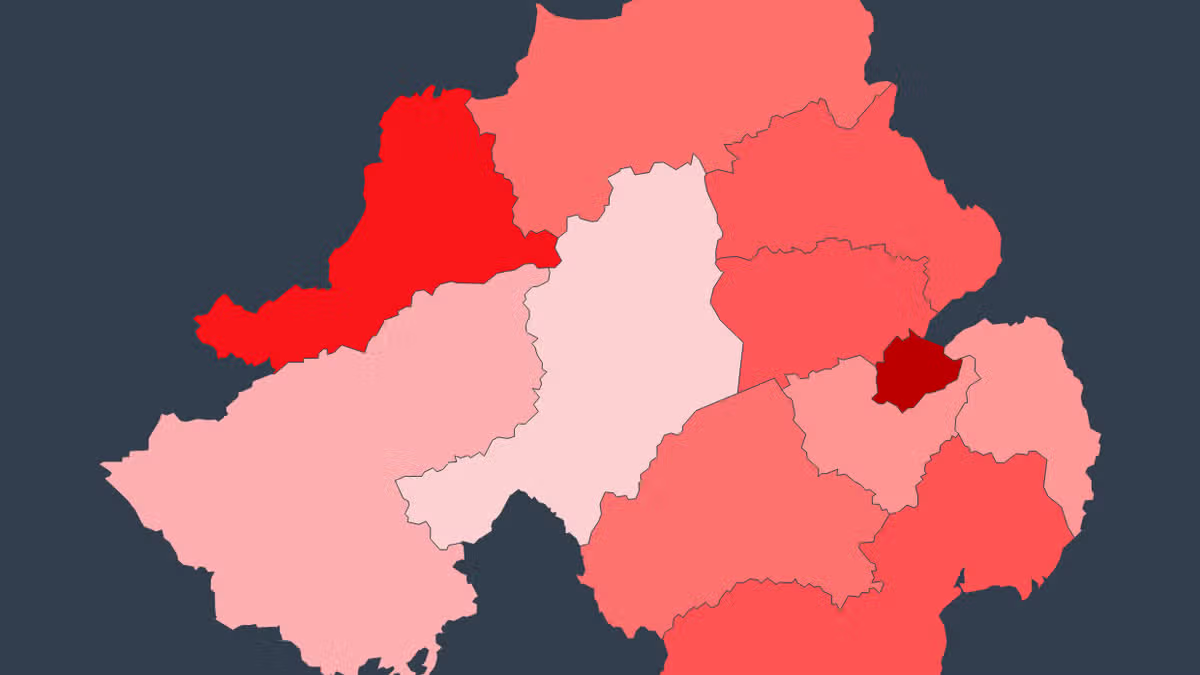
You can see how it compares where you live using our interactive map:
Advertisement
They show that Belfast also has the highest crime rate in Northern Ireland, of 88 crimes per 1,000 residents.
Population figures are not readily available for the four policing districts within Belfast – North, South, East, and West – so the crime rate is for the city as a whole. However, estimates based on census population ward figures show that residents in South Belfast are most likely to witness crime.
Last year, South Belfast, covered by the local policing team based on Lisburn Road, experienced the highest volume of crime, with 10,117 recorded offences. South Belfast also had the highest crime rate, followed by North, West, and then East Belfast.
However, higher crime rates in South Belfast may be driven by visitors to the district for its nightlife or shopping.
Advertisement
Outside of Belfast, residents of Derry City and Strabane were most likely to experience crime with a crime rate of 61 crimes per 1,000 residents, significantly lower than Belfast.
Meanwhile, Mid Ulster was the safest place to live in Northern Ireland, with the nation’s lowest crime rate of 29 crimes per 1,000 residents.
BUNIA, Congo (AP) — Wiza Bondele goes to work every day at a hospital in Congo with one goal in mind: to slow the fastest-growing Ebola outbreak on record.
At an Ebola treatment hospital in the eastern Ituri province, the epicenter of Congo’s ongoing outbreak, Bondele disinfects contaminated areas, checks visitors’ temperatures and enforces handwashing protocols — work that puts him at risk of getting infected.
But like hundreds of other front-line health workers, including burial teams and drivers, Bondele says he has been working without pay since the outbreak was declared in mid-May in one of Congo’s most remote and conflict-hit regions.
Poor welfare for front-line workers has been a key source of concern in the outbreak. The payment issues and attacks on health teams and facilities have forced some health workers to walk off the job, disrupting critical care in the outbreak that authorities say continues to spread at an alarming rate and faster than efforts to track it.
Advertisement
Ebola spreads through direct contact with the bodily fluids of infected people or contaminated materials, a risk Bondele is well aware of.
“Sometimes patients are bleeding or vomiting blood. We clean and disinfect those places,” the 29-year-old infection control worker told The Associated Press while on duty. “With risks like that, we deserve salaries.”
Confirmed cases in the outbreak have exceeded 4,000, including over 1,800 deaths, according to the latest government data. It is the second-largest Ebola outbreak on record, behind the 2014-2016 West Africa outbreak that recorded more than 28,000 cases, including over 11,000 deaths. Another from 2018-2020 killed at least 2,200.
Instead, he found himself among many workers who have continued reporting for duty without receiving the monthly salary of $510 that Bondele said they were promised.
Officials have told them that the outstanding payments will be made, he said. Workers have registered their numbers to get paid through mobile money transactions, signed attendance sheets and waited for payment notifications, but only some were eventually paid.
Bondele said even colleagues who were paid have told him they have not received the full amount.
Advertisement
Sign up for Morning Wire:
Our flagship newsletter breaks down the biggest headlines of the day.
Advertisement
Congolese authorities did not immediately respond to a request for comment on Thursday. Officials in the past have blamed logistical issues for the payment delays.
Without his salary, paying rent, buying food, phone credit, covering transport costs and paying water bills have all become daily struggles. He also supports his wife, child and other relatives, responsibilities he says have become increasingly difficult to meet.
Advertisement
One morning, the hardship became painfully visible.
Setting off for work on his motorcycle, Bondele said he ran out of fuel along the way. With no money to refill the tank, he left the bike with neighbors and walked the remaining 13 kilometers (8 miles) to the hospital. By the time he arrived, he said his shoes had fallen apart.
Despite the unpaid wages and hardship, Bondele and hundreds of workers continue to show up to the hospital seven days a week. He said his work is too important to abandon.
“I hope their conscience tells them that I deserve to be paid,” Bondele said, referring to officials.
Advertisement
Strikes and protests have led to disruptions
Bondele was among hundreds of Ebola response workers in Bunia who staged strikes and protests over unpaid wages in recent weeks, at times abandoning health facilities and disrupting parts of the response as the outbreak continued to spread.
“We realized they (the authorities) weren’t doing anything, and that’s when we went on strike,” he said.
They warned that unpaid wages were undermining morale and affecting patient care. In a statement, staff at one treatment center said they would remain on strike until “concrete solutions” were found to resolve months of unpaid wages and bonuses.
Dr. Adelard Lufungula, operations manager for the government’s Ebola response, said last month that the payment problem was being resolved, with workers now paid through mobile money instead of cash and the backlog expected to be cleared soon.
Advertisement
For Bondele, the explanations have done little to ease the uncertainty.
“I wonder whether it is injustice or whether there simply isn’t enough money,” he said.
Insecurity and residents’ mistrust complicate the response
The strikes come as the Ebola response is already battling armed conflict, widespread misinformation and deep public mistrust, all of which have made it harder for health workers to contain the outbreak.
“It is very difficult to get people to understand,” Bondele said. “Sometimes while raising awareness I can be threatened or beaten, and I have to run away.”
Advertisement
Some communities continue resisting basic prevention measures such as regular handwashing, he said.
Restrictions on traditional burials, where families are prevented from touching the highly contagious bodies of loved ones, have fueled resentment in some communities. Rumors claim that the virus is a hoax, that health workers are profiting from the outbreak or that hospitals are withholding lifesaving treatments.
The misinformation has repeatedly turned violent. Angry crowds have torched Ebola treatment centers, stormed hospitals to retrieve relatives’ bodies and attacked teams carrying out safe burials. Health officials say the mistrust has also made contact tracing and early treatment more difficult, particularly in remote communities affected by rebel violence.
As visitors line up for temperature checks and disinfectant is sprayed to keep the virus at bay, Bondele continues the work he says he joined out of passion.
Advertisement
“Working this job takes a lot of courage,” he said. “But today, I am discouraged.”
The Associated Press receives financial support for global health and development coverage in Africa from the Gates Foundation. The AP is solely responsible for all content. Find AP’s standards for working with philanthropies, a list of supporters and funded coverage areas at AP.org.
Manchester United boss Michael Carrick has not yet followed transfer instructions previously laid out by Paul Scholes
Michael Carrick has not sanctioned any major sales so far this summer at Manchester United. This is despite United hero Paul Scholes recommending eight stars be sold.
However, there has yet to be a major exit from the club, aside from Casemiro’s departure. In April, Scholes was asked for a series of United stars who were surplus to requirements and of the eight players he listed, only one appears set to leave as things stand.
Scholes and Carrick spent seven seasons together in United’s midfield during their playing days. However, whilst the pundit’s suggestion to move on Zirkzee may materialise, the other seven stars Scholes mentioned could all remain part of United’s squad next term, with Carrick’s response clear.
The 51-year-old stressed the importance of United revamping their defence. Speaking on The Good, The Bad and The Football podcast, Scholes said of Leny Yoro: “I think he’s struggled, me. I think there’s something in there, I think he needs a bit of time, but if you had to make a choice now, I’d probably sell him.”
Countdown to Kickoff: The Ultimate 26/27 Sky Sports Bundle
This article contains affiliate links, we will receive a commission on any sales we generate from it. Learn more
Sky’s Ultimate TV and Sky Sports bundle includes at least 215 live Premier League clashes across the 2026/27 season with more than 1,400 live games across the EFL and beyond, plus F1, golf and darts.
Every subscription now comes with 135 channels alongside free subscriptions to HBO Max, Netflix, Disney+, discovery+ and Hayu.
Turning to midfield, Scholes felt Manuel Ugarte would depart and the Uruguayan was linked with a move before picking up an injury at the World Cup. Mason Mount also featured on Scholes’ eight-man list, though the England international has caught the eye during pre-season.
Advertisement
Additionally, Scholes felt the moment had arrived to say goodbye to Harry Maguire, who continues to have a key role at United. He said: “I’m thinking about a Manchester United team you want to win the league and the Champions League and that’s where United should be aiming. I’m not sure you’d do that with Maguire.”
Elsewhere, United have held an interest in Newcastle United full-back Lewis Hall in the transfer window. Focusing on the left-back position, Scholes previously urged the club to offload long-serving Luke Shaw due to doubts about his reliability, despite him having featured in every Premier League fixture last season. He was equally prepared to let Patrick Dorgu leave.
Scholes said on Dorgu: “They brought him in as a wing-back and he’s not really played much there. I’d probably sell. I’m not sure what position he is. Again, if you keep him then he’s just a squad player.”
Advertisement
Overall, of the eight players Scholes recommended be sold, only Zirkzee appears set for an imminent exit. There has been little speculation regarding the remaining seven of Yoro, Mazraoui, Shaw, Dorgu, Mount, Ugarte and Maguire.
Join our new MAN UTD WhatsApp community and receive your daily dose of Manchester United content from Mirror Football. We also treat our community members to special offers, promotions, and adverts from us and our partners. If you don’t like our community, you can check out any time you like. If you’re curious, you can read our Privacy Notice.
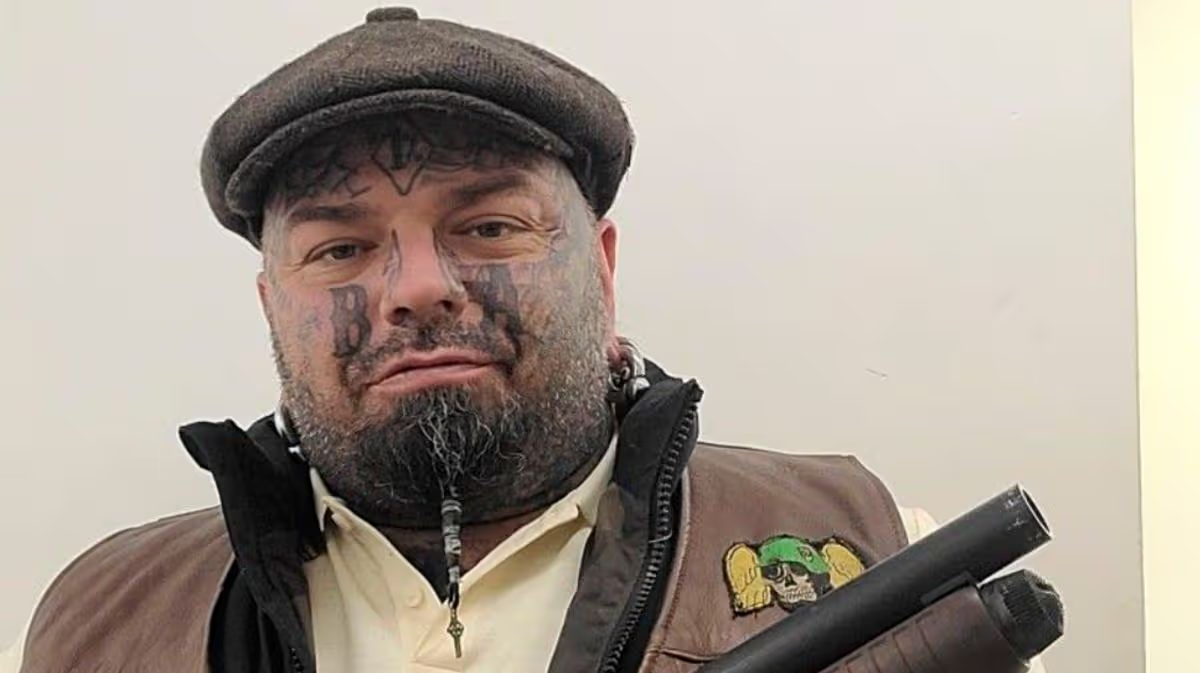
From a small YouTube channel with barely 50 subscribers to a cushy jail cell curtesy of pipe bomb plot, Dan Laponder has had an unusual rise to infamy. A founder and former president of the the Mad Dogs Motorcycle Club, Laponder is well known among bikers.
He was one of the lead figures when the gang broke away from Blue Angels – Scotland’s oldest motorbike outlaw gang – in 2023. That move sparked conflict between the two tribes who have remained at war ever since.
Violent confrontations have seen several bikers injured – including former Mad Dogs president Mark “Bruni” Brown who has been forced to step away from gang. Two years ago, Laponder planted a pipe bomb under a rival’s father’s van amid the feud and he was subsequently jailed for nine years.
As the gang war between the two groups wages on, just who is Dan Laponder? Daniel McMillan Laponder, now 45, was originally a member of the Blue Angels and he rose to become a leading figure within the gang.
Advertisement
He was always destined to be a key figure in the biker gangs of Britain – his younger brother David followed as he became a member of the Sons of Hell biker gang in Tameside. In November 2020, David was sentenced to nine years behind bars after striking Daniel Gibbons – the president of the Warrington branch of the gang – over the head with a meat cleaver eight times during a ‘frenzied attack’.
In February 2023, he opened a YouTube channel – easy entry locksmith – which he used as “a record of my locksmith training”. The videos, which include “drilling a yale lock”, “snapping a lock” and “practice opening a car with non destructive entry kit” show Laponder testing his skills.
Advertisement
He barely speaks in the videos which show different locksmith techniques and were published between April and November 2023. It was around this time that he led the split from the Blue Angels.
The exact reason for the unceremonious break is unknown but Laponder took a bunch of bikers with him to found Mad Dogs Motorcycle Club. Two further videos entitled “digger driver vibes” and “digger v dumper driver race” and published on his YouTube channel in 2024 show Laponder driving construction vehicles.
All told, his 24 videos have racked up 22,200 views and he has drawn a whopping 51 subscribers. In May 2024, Laponder thanked killer John Bingham for “a very generous financial contribution” to the club.
Bingham, who had been cleared of murder after admitting stabbing love rival Alister Milroy to death in 2013, leapt from a car before threatening a female motorcyclist in a road rage incident. With the two gangs separated, they began a brutal war which has led to serious injuries, fire attacks and even a pipe bomb plot.
Advertisement
Laponder’s part in the feud has landed him a cushy life in jail after he was sentenced in November 2024. The then 43-year-old targeted David Rollo senior’s work van outside his home in Lennoxtown on June 8 that year.
Mr Rollo’s son is a member of the Blue Angels and Laponder chose the vehicle as his target during the gang feud. An off duty firefighter was alerted after the van was spotted on fire.
He attended to assess the situation and, underneath the van, he observed a device – a pipe bomb – made up from bottles, a copper pipe and RF receiver with an antenna. The bomb squad was quickly alerted and the area locked down as experts worked to defuse the device and make it safe.
Advertisement
Laponder was linked to the pipe bomb after DNA and fingerprints were recovered from the bottles and tape. A forensic investigation on the device found that it comprised of petrol and ball bearings with a remote activation attached to it.
At the time, he was living on a barge in Kirkintilloch and police attended his home on July 3 where he was found with a loaded side-by-side, double barrel, break action shotgun. When quizzed by officers, Laponder stated: “I’m not a Blue Angel anymore, I retired a year ago.”
Laponder was asked about the bomb and replied: “Link the dots, we’ve been getting attacked all the time. What is a remote detonator? It goes off with a remote, perhaps it was a shot across the bow.”
A garage linked to the Mad Dogs Motorcycle Club was raided and two remote firing systems similar to the one used in the bomb attack were recovered. Laponder pleaded guilty on October 15, 2024, to a charge of wilful fire raising and a charge under the Firearms Act 1968.
Advertisement
He was sentenced to nine years behind bars the following month and his since been incarcerated at HMP Greenock. Despite his convictions, Laponder last month claimed his “window” for a low-security transfer is just months away. If so, he would be moved to HMP Castle Huntly near Dundee.
The low-supervision facility, set on a 15th-century castle estate, allows inmates deemed low-risk more freedom to go into the community to prepare them for release. In a social media post from his cell, Laponder boasted about his easy life behind bars, revealing he has penned a tell-all book about his crimes to set the record straight, recorded an acoustic album, and been handed a plum job mentoring new inmates.
He said: “My window to go to open prison is in six months, so that is my focus… I’ll be back on top soon enough.”
The post added: “Well it’s coming up on two years I’ve been in prison. Time has gone by quite fast, probably because I have kept myself busy. Sooooooo what have we achieved in prison?
“I’m competent now on the guitar and I’m getting better by the day, I’ve been practicing for hours ever day learning scales, chords, progressions, different picking techniques so I’m happy where I am. I can play a few tunes on the harmonica but I’ve only got one in the G so only a couple of my own songs I can play both at the same time.
“My own songs I’ve written around 100 of, I’ve got some in the Koestler awards this year and we started recording an album up at music class using a desktop studio. It sounds good though lol. It’s just acoustic right now but in my head there’s loads going on, I’ll need to wait until I get out and find musicians to help me bring it all to life.
“I’ve written two books, one is a tutorial on how I taught myself guitar and the other is a short story of how I came to be in here, I thought people would be interested to hear the truth. I’ve got some poems down but most of my folders are full of scripts for a social media channel idea I have.
Advertisement
“Talking about ideas I’ve got some inventions to patent when I get out. Last year I won an award for a painting I done but I’ve not been painting much I’ve got five of my own hanging up in my cell, them and some pics of Razor Candy, I started learning Spanish and Sign Language.
“I’m still finding time to smash the gym no one has knocked me off the board yet. The jail made me peer mentor so when new prisoners come in I show them around and tell them how everything works.
“I do miss my wee man terribly though. My window to go to open prison is in 6 months so that is my focus so I can get home to see him.
“Home? I have no home! I need to start all over again. I ain’t got a pot to piss in or a window to throw it out of, mans got skills though I’ll be back on top soon enough. Hey – I can always go busking now, anyway hasta luigo for now.”
Advertisement
Get more Daily Record exclusives by signing up for free to Google’s preferred sources. Click HERE.
Kiena Dawes had written a note before ending her life saying ‘Ryan Wellings killed me’ (Picture: Lancashire Police/PA)
‘I hope my life saves another.’
Kiena Dawes’ last words before ending her life were a plea for her abuser to be held accountable for the ‘torture’ he put her through – and for no other women to be failed in the way she was.
But while Ryan Wellings was eventually found guilty of assaulting Kiena and subjecting her to prolonged domestic abuse, he was cleared of having any ‘criminal responsibility’ for her death.
High profile trials like Kiena’s ending in not guilty verdicts on manslaughter charges have led families, campaigners and even police and lawyers to call for a new law to ensure perpetrators are held responsible when their abuse leads to a person ending their own life.
Advertisement
Kiena’s Law would see the creation of a new standalone offence for domestic abuse- related suicide.
Campaigners are also calling for coercive and controlling behaviour to be included within the ‘dangerous offender’ framework, allowing courts to impose extended sentences.
Kiena’s mother, Angela Dawes, backed calls for a law in her daughter’s name, saying: ‘My girl didn’t want to die. My girl wanted to live. But she lived in fear.’
That is despite the grim fact that women in abusive relationships are now more likely to kill themselves than die at the hands of a current or former partner.
In its latest annual report, the Domestic Homicide Project, a programme led by the National Police Chiefs’ Council (NPCC), recorded 150 suspected domestic abuse-related suicides in England and Wales.
That is up from 98 suicides in the previous 12 months, and significantly higher than the 80 recorded intimate partner homicides.
This Is Not Right
On November 25, 2024 Metro launched This Is Not Right, a campaign to address the relentless epidemic of violence against women.
Advertisement
With the help of our partners at Women’s Aid, This Is Not Right aims to shine a light on the sheer scale of this national emergency.
You can find more articles here, and if you want to share your story with us, you can send us an email at vaw@metro.co.uk.
Read more:
Advertisement
Yet figures show only 3% have resulted in any kind of prosecution.
When it comes to manslaughter, there has been just one conviction – that of Nicholas Allen, who pleaded guilty and was jailed for 10 years in 2017.
Kiena’s Law
Kiena’s Law would see the creation of a new standalone offence for domestic abuse-related suicide (Picture: Lancs Live/MEN Media)
Lancashire’s Police and Crime Commissioner Clive Grunshaw in partnership with charity Advocacy After Fatal Domestic Abuse (AAFDA), hosted a conference in Blackpool last month to launch a petition calling for Kiena’s Law and address concerns about the link between sustained domestic abuse and suicide.
He told Metro: ‘If you can imagine the pain, the anguish, the trauma that somebody must be in for them to be in such circumstances that they feel that taking their own life is the only escape from the abuse they’re enduring, it is horrendous.
Advertisement
‘We believe that the courts and the judicial system need to have the power in those circumstances to get justice for the victims, and there needs to be a greater deterrent for perpetrators.’
Frank Mullane, founder of AAFDA, said law change is critical if perpetrators are to be properly held to account.
He told Metro juries are ‘struggling’ with the link between domestic abuse and suicide and the legal concept of ‘causation’.
Ryan Wellings was found guilty of abusing Kiena but he was cleared of having any ‘criminal responsibility’ for her death (Picture: Lancashire Police/PA)
Defence teams are also being left free to ‘exploit any mental health difficulties the deceased may have had – even though some or all of those difficulties may have been caused or contributed to, by the abuse’.
‘Causation’ and the link between domestic abuse and suicide
In simple terms, causation is proof that a defendant’s conduct contributed to a victim’s death in a ‘significant’ way.
Advertisement
Several problems arise from that in cases of domestic abuse-related suicide.
They include the victim likely being nowhere near the defendant when they die and the suicide being seen as a ‘choice’ freely made by the deceased.
Another obvious difficulty is the absence of the victim’s voice from the witness box.
In that void, defendants can point the jury in the direction of myriad other issues to explain why they may have taken their own life, minimising the effects of their abusive behaviour and avoiding accountability for it.
Advertisement
Jurors are then left with what can appear to be a choice between either the abuse or the victim’s mental health as factors behind the decision to end their life, rather than an appreciation of how the two are intrinsically linked.
Dr Anne Lodge, a senior lecturer in law at Teesside University, told Metro: ‘Too often, suicide is treated as a completely independent choice of the victim.
‘But where someone has been subjected to years of coercive control, their autonomy may have been so eroded that they no longer see any other way out – they may be effectively stripped of their freedom to make choices.
‘That’s something the law needs to recognise.’
Advertisement
Tim Woodhouse, suicide prevention researcher at the University of Kent, found that one in three suicides in the county between 2018 and 2024 were impacted to some extent by domestic abuse.
If that number was applied nationwide, it could mean as many as 1,000 domestic abuse victims are taking their lives each year.
Mr Woodhouse told Metro: ‘Being physically abused, sexually attacked and emotionally tortured, week after week, month after month, is clearly exceptionally damaging to anyone’s mental health.
‘It’s made even worse when the person abusing you is someone you once loved.
Advertisement
‘So, on the one hand, it’s easy to understand why such a high number of victims are killing themselves, but we are just beginning to understand that these tragic deaths actually happen for a number of different reasons.
‘Some victims have been beaten so badly in the past that believe that they are going to be murdered by their perpetrator, so they attempt suicide as a way of controlling the way they die – even though they don’t actually want to stop living.
‘Others attempt suicide because they believe the lies that their perpetrator tells them, for example that their family and friends hate them and the world would be a better place without them it.
‘Finally other victims feel so isolated, trapped and helpless, that they simply can’t see another way of making the abuse stop.
Advertisement
‘Many of the victims in this group will have reached out to services like the police, the family court, domestic abuse charities and social services but not got the support they needed to make the abuse stop.’
In 2022, a coroner ruled that Jessica Laverack, 34, ended her life at her home in East Yorkshire after suffering domestic abuse.
Hers was the first inquest to make clear the link between domestic abuse and suicide.
Phyllis Daly, Jessica’s mother, told the Blackpool conference coercive control ‘leaves few visible signs, but can destroy a victim’s life’.
Advertisement
‘Jessica stated that she felt she had no escape and her life wasn’t her own anymore,’ she said. ‘She was trapped, miserable and fearful.’
She added: ‘Sustained domestic abuse that ends in suicide is not incidental. It’s a foreseeable outcome, a preventable outcome, and accountability has to follow.’
‘I didn’t want to end my life – I wanted the fear to end’
Dr Lodge said: ‘Many victims already have existing vulnerabilities, whether that is previous trauma or mental health difficulties.
‘Those factors can be used by the defence to argue that the abuse was not a sufficient or significant enough cause of the suicide.
Advertisement
‘This narrative potentially downplays the devastating impact prolonged coercive control can have and makes it harder to hold perpetrators criminally responsible for manslaughter.’
Kiena Dawes was a young mother who took her own life four years ago in July 2022 after suffering prolonged domestic abuse (Picture: Lancs Live/MEN Media)
The conference got a harrowing glimpse of what a jury might hear if a victim could give evidence at their own manslaughter trial.
One survivor bravely spoke publicly for the first time about how she contemplated ending her life.
‘When people hear the words domestic abuse, they often imagine bruises, broken bones, black eyes,’ she said.
‘But abuse is rarely defined by one incident. It took years and a whole new vocabulary – gaslighting, stonewalling, coercive control – before I fully understood what had happened.’
Advertisement
She added: ‘People often think suicide is about wanting to die. For me, it wasn’t.
‘I didn’t want to end my life. I wanted the fear to end. I wanted the intrusive thoughts to end. I wanted to feel safe again.
‘There is a profound difference between wanting a life to end – all the things you love – and desperately wanting unbearable pain to stop, because when you’re in so much pain you can’t feel anything anyway.
‘No joy, no pleasure, no hope. You’re not living anymore anyway.
Advertisement
‘When someone dies after domestic abuse, we often ask “why did they take their own life?”
‘Perhaps we should begin by asking a different question – “what happened in the years before they died?”’
Local MPs Chris Webb and Lorraine Beavers pledged to campaign for Kiena’s Law in Parliament.
And Jess Phillips, the former minister for safeguarding and violence against women and girls (VAWG), told the conference ‘justice is evading us’ currently but insisted the issue is ‘a fundamental part’ of the government’s VAWG strategy.
Advertisement
Ministers are ‘keen to look at what the solutions are in this space’, she added.
A Government spokesperson said: ‘We are committed to halving violence against women and girls, and our thoughts remain with all those who have lost loved ones as a result of domestic abuse.
‘We have now introduced better protection for victims by strengthening the management of offenders convicted of controlling and coercive behaviour.
‘The Law Commission is currently reviewing homicide law, including the use of manslaughter offences where abuse may have driven someone to suicide.’
Advertisement
‘Girls shouldn’t have to die to be heard’
During Wellings’ trial, the jury heard he was an ‘entitled, aggressive bully’ who would regularly slap and ‘rag’ Kiena by her hair.
He also threatened to use a drill to take her teeth out and ‘make her look like Katie Piper’ by throwing acid in her face.
More than once police were called, but Wellings threatened Kiena that she would have their daughter taken off them if she told them what was happening, so she declined to help prosecute him.
A final assault ‘broke’ Kiena, leaving her needing hospital treatment. This time she did make a statement to police and her tormentor was arrested.
Advertisement
He then broke his bail conditions but was not locked up, leaving her feeling let down by police.
Angela Dawes (right), the mother of Kiena Dawes, pictured at the Home Office (Picture: PA)
Four days later she killed herself.
In her suicide note, she wrote: ‘The end. I fought hard, I fought long. I went through pain no-one could imagine.
‘I was murdered. Ryan Wellings killed me. He ruined every bit of strength I had left. I had dreams. I had a future at one point. That was taken away from me.’
But Wellings’ defence team described Kiena as a ‘very troubled young lady’ who ended her life not because of him, but because of ‘multiple factors’ including the loss of her father.
Advertisement
They also pointed to the fact she had made several attempts to end her life in the past, before she met Wellings.
Mr Mullane said: ‘Kiena’s Law represents an opportunity to recognise the devastating and sometimes fatal consequences of coercive and controlling behaviour, improve accountability and help prevent future deaths.
‘We owe it to Kiena and to every family affected by domestic abuse-related suicide to make that change.’
Mrs Dawes added: ‘Girls shouldn’t have to die to be heard, and my daughter had to die to be heard.
Advertisement
‘Nothing is ever going to bring my baby back, but if we can change things moving forward, I’d hate to see another family go through what we’ve been through.’
You can sign the petition Kiena’s Law: Recognise domestic abuse–related suicide in law by clicking here.
However, one of the cast members in his latest big-screen epic has made it clear that meeting the director’s strict rules are no major hardship.
Adam Croasdell – who had a minor role in The Odyssey as the father of the young Antinous – has insisted that he and his co-stars were more than happy to oblige Nolan’s strict rules on the movie’s set.
“From what I understand – and I think quite rightly – Chris hates cell phones on set,” the former EastEnders star told BANG Showbiz, as reported by FemaleFirst.
Advertisement
“And I think that’s right because I’ve been on sets where, the moment ‘cut’ is called, actors pull out their cell phones and start scrolling or responding to messages. And I think it breaks the concentration. So there were no cell phones on set.”
He continued: “You were also there until the scene was done. In our particular case, we were standing on the side of a mountain with gale-force winds blasting across it, trying to perform the scene in those conditions.
“Between takes there was no, ‘Hey, take a seat. Here’s a green room for you guys, and something to warm you guys.’ There was nothing like that. And I really enjoyed it.”
Adam recalled: “Friends of mine who were part of Odysseus’ crew aboard the ship with him – I know Himesh Patel from EastEnders, and there were a bunch of others as well – they reported back that you’re on that ship, and you’re going to get the scene. And if you need to go to the restroom, that’s your problem.”
However, he has since confirmed reports about actors not being allowed to wear Ugg boots on his sets.
“I want the actors to stay in the moment,” he claimed last month. “For me, the Ugg boots are a signifier of modernity, absurd though that is.”
Nolan added: “It’s like if someone’s eating a bag of chips off camera. There’s certain things that just remind you’re in the real world, as opposed to the world we’re trying to create for the actors.”





















































You must be logged in to post a comment Login