








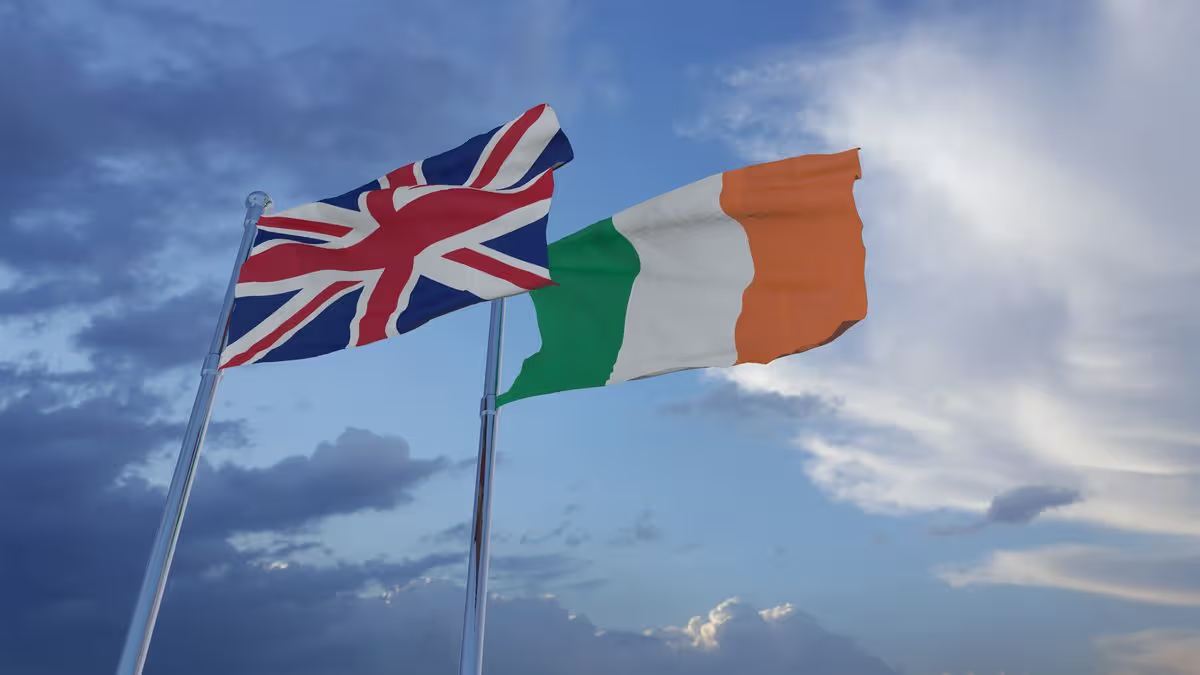
Almost 7,000 responses were received
Belfast Live readers would vote overwhelmingly to remain in the United Kingdom if a border poll were held tomorrow, according to our latest reader poll.
6,955 responses were recorded in our reader poll between 18th and 26th March.
Of those respondents, 57 per cent (3981) said that they would vote to remain in the United Kingdom if a border poll were held tomorrow. 40 per cent (2781) said that they would vote for a united Ireland, 2 per cent (161) were undecided, while less than half a per cent (32) would not vote.
What the results tell us and what they could hide
Analysing the results, Prof. Fidelma Ashe from Ulster University said: “The question of a border poll has become heavily focused on numbers, reflecting the Belfast/Good Friday Agreement’s provision that the Secretary of State should call a poll when it appears likely, in his judgement, that a majority would express a wish for a change in Northern Ireland’s constitutional status.
“That provision helps explain why every new survey is quickly read as evidence for or against how close Northern Ireland might be to such a moment. No doubt there will be some eyerolling at the appearance of yet another unity poll.
“Belfast Live’s recent readership survey is another snapshot in that ongoing debate. As with any self-selecting readership poll, it should be treated cautiously; the findings cannot be assumed to reflect the wider electorate. Even so, it offers a useful opportunity to think more carefully about how people respond when asked to choose between two constitutional options, and what that response can and cannot tell us about the dynamics of the unity debate.”
What the survey findings suggest
Prof. Ashe added: “First, the survey tells us something straightforward: among Belfast Live readers who responded, there is a sizeable gap between support for Irish unity and support for remaining in the United Kingdom.
“A second, perhaps more striking feature of the Belfast Live survey is that very few respondents described themselves as “undecided”. The survey suggests the undecided share is just over 2 per cent, which is exceptionally low for a constitutional question that is widely recognised as complex and contested.
“That unusually small ‘undecided’ category is a prompt to interpret the findings carefully because the size of the undecided group often tells us as much about question format and context as it does about deep certainty on ill-defined constitutional choices.
Is the undecided category shrinking?
“In larger surveys using probability-based random sampling on Irish unity, the undecided group is bigger,” Prof. Ashe said. “The ARINS North–South project with the Irish Times regularly finds that a higher percentage of respondents in Northern Ireland say they are unsure how they would vote in a border poll. In the most recent ARINS survey published in 2025 by the Irish Times, 14 per cent were undecided, with 34 per cent favouring unity and 48 per cent opposed.
“So why might a readership survey produce such a small, undecided category? Has this survey uncovered a shift towards more binary choices in the form of for and against, or could there be another explanation?
“One possibility is not that voters have suddenly become more certain, but that many people respond differently when faced with a for or against choice framed in immediate terms (for example, unity “tomorrow” versus staying in the UK). When questions are posed in this way, some respondents who hold mixed views, conditions or reservations may still select an option rather than choose “undecided”. This does not mean their choice is insincere; rather, it reflects the way people often resolve uncertainty by choosing the option that feels more secure in the moment.
“This matters because constitutional preferences are frequently conditional. A voter might favour the Union in principle but worry about the performance of devolved governance. Another might support unity in principle but remain unconvinced that it is feasible, affordable or that it would be a better choice in the immediate future. Others may feel pulled in competing directions, as identity, economic considerations, public services, stability and rights rarely align neatly.
“When those considerations are compressed into a single immediate choice, uncertainty does not always present itself as ‘undecided’. Where details about a future constitutional arrangement are unclear, many people may reasonably prioritise what feels institutionally familiar. In a context of uncertainty, that may be a rational response.”
Risk, reassurance and constitutional futures
Prof. Ashe continued: “Concerns about economic security and social provision are central to how many people engage with questions of constitutional change, particularly where the practical implications of change remain uncertain. Findings from research I have conducted with collaborators highlight how everyday social and economic issues shape constitutional attitudes.
“Using more intensive participatory research methods, this work shows that questions of healthcare, welfare security, employment, housing, childcare and community resources are inseparable from constitutional futures as they are lived and imagined.
“That research captures a cautious concern with material, social and security consequences. Where people lack clear, credible information about how social and economic protections would be maintained in a new constitutional arrangement, uncertainty is bound to constrain support for immediate change. Constitutional questions, in this sense, are rarely abstract: they are evaluated through lived experience, everyday stability and perceptions of risk.
“My research highlights the importance of process: without clarity on economic and social outcomes, apparent certainty often reflects caution rather than settled constitutional preference. Research associated with the ARINS project, including focus group and participatory work by Jennifer Todd and colleagues, supports this interpretation.
“That long-running research similarly shows that individuals who express uncertainty about a future unity referendum often do so because of limited information, lack of prior discussion and unresolved questions about economic and social governance. Rather than articulating fixed opposition or endorsement, participants frequently express conditional views and emphasise the need for deliberation and detail before being asked to make a definitive choice.
“Taken together, this research helps explain why uncertainty may not register as ‘undecided’ in a binary survey format. Faced with unanswered questions about the organisation of healthcare, pensions, welfare provision or employment protections, some voters may reasonably default to remaining in the UK. Additional research from the ARINS/Irish Times, including survey findings and associated focus group analysis by Jennifer Todd, Joanne McEvoy and John Doyle, suggests that undecided voters want much more discussion and information on the issue.”
What this means going forward
“If there is a single lesson here, it is that polls do not merely measure opinion. They also reflect how opinion is shaped by uncertainty, question format and what voters believe is realistically on offer,” Prof. Ashe concluded.
“That is not a judgment on the legitimacy of union support (or unity support). Belfast Live readers are perfectly capable of evaluating survey findings and assessing the validity of this recent survey themselves. It is, however, a reminder that in constitutional politics, headline “certainty” often sits alongside a deeper and more complex political context that can be obscured by headline numbers. Despite these survey results, there may be a wider landscape of conditionality and contingency that suggests the need for wider deliberation. More deliberation does not imply a particular outcome; it simply clarifies what different outcomes would entail.”
For all the latest news, visit the Belfast Live homepage here and sign up to our daily newsletter here.














































You must be logged in to post a comment Login