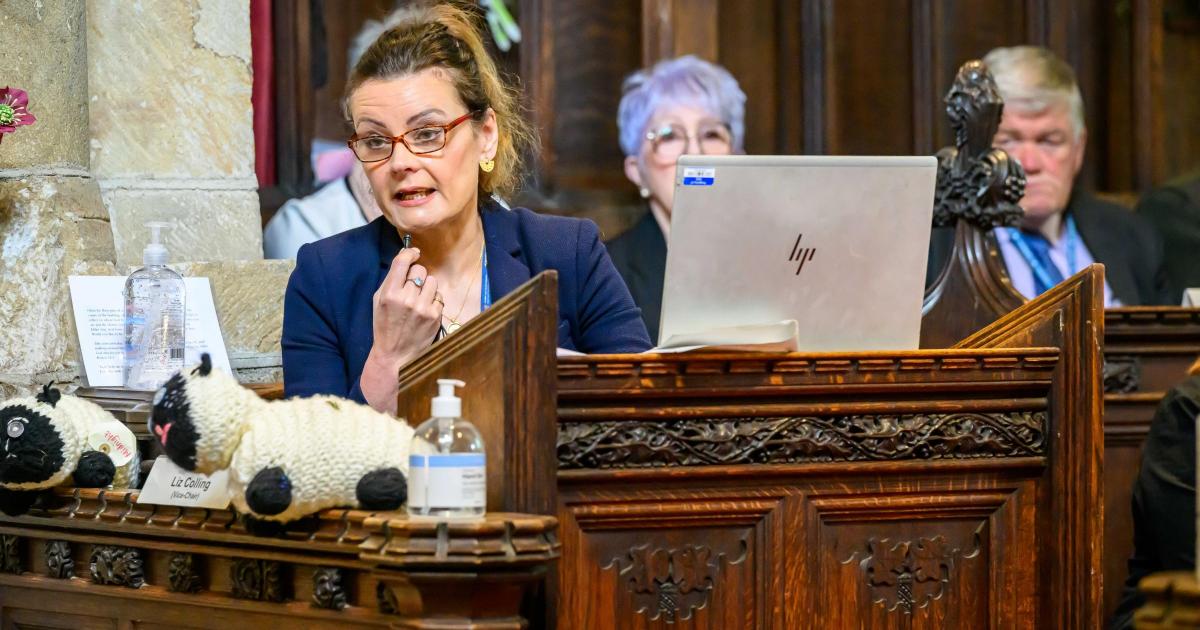
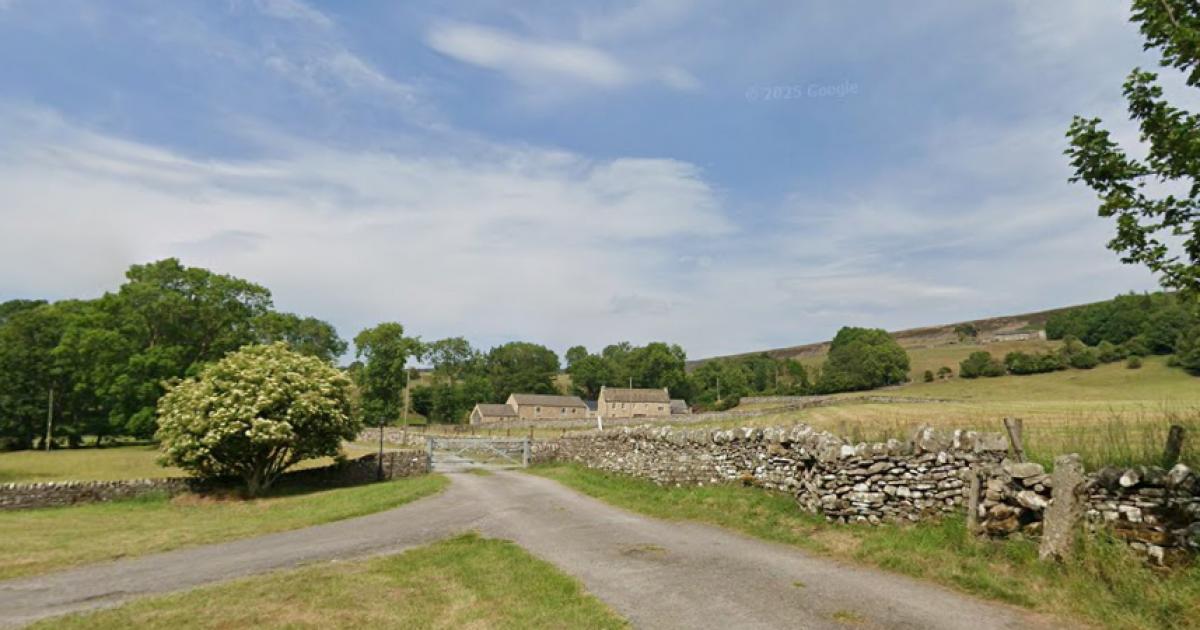
Facing criticism of their handling of the closure of Reeth Medical Centre, senior NHS officials told about 300 people who attended a public meeting at St Andrew’s Church, in Grinton, today (FRIDAY) that they followed the statutory process at all times over the issue.
The officers from NHS Humber and North Yorkshire ICB said distributing the centre’s 1,600 patients to neighbouring practices was the only option they were left with when the only bidder to take over the centre was found to be unsuitable.
The Wensleydale-based Central Dales Practice had stepped in to provide a two-day-a-week branch service in Reeth.
Advertisement
Practice staff were holding talks with the owners of the existing centre owners, Dr Mike Brookes and Marie Brookes, whose retirement has prompted the closure, the audience was told.
But the meeting of North Yorkshire Council’s scrutiny of health committee heard from patients who were still deeply concerned about the ICB’s involvement and the level of service patients could expect in the future.
Mother-of-two Hannah Waggett said: “Timely health interventions are at risk from the current proposal of just two days a week when appointments are available the full five days a week currently.
“If our children aren’t able to be seen in a timely manner, that is unacceptable.”
Advertisement
Patient Deborah Kerrigan asked the ICB what checks had been done to ensure the proposed changes would not put patients at risk and lead to a preventable loss of life.
She said members of the community felt “frightened, scared and still in the dark, adding: “Assigning somebody a GP at a surgery they can’t access because they have no car, there is no public transport, or the only road is both due to weather or roadworks — this really does happen here — has the same impact as not having a GP at all.”
Jill McMullon, chair of Hawes and High Abbotside Parish Council, questioned what the impact of the changes would be on existing Central Dales Practice patients and whether the plans being put in place were sustainable.
She said: “Rural areas deserve the same care as those living in towns and cities.
Advertisement
“The ICB has demonstrated a lack of care and a distinct disregard and lack of understanding for the area they cover.
“Their suggestion that over 1,200 patients could simply be transferred to Hawes was frankly ludicrous.”
In response to the criticism, after being asked why there had been no apology, Lisa Pope, the ICB’s deputy place director for North Yorkshire, said: “If people feel that there is something that we could have done differently within our responsibilities and as an ICB, then I absolutely apologise, if we have made people feel unsafe, unclear or unconsulted with.”
Asked how patients could continue to be kept safe, the senior officer said: “I think the answer is that you will be every bit as safe under the care of the Central Dales Practice as you have been under the care of Mike and Marie Brookes.”
Advertisement
But the ICB officials rejected criticism of the organisation’s communications, saying they had been unable to announce the closure during the process to find a new operator due to statutory requirements.
The meeting was told that the ICB attempted to find a new operator for the medical centre, but although there were a number of enquiries, only one bid was submitted which patients were told was not suitable.
Ms Pope stressed that the ICB had not chosen to close the medical centre, adding: “This is not an ICB decision, this is not a commissioning decision; it’s a decision that’s been made by the partners and the ICB is then duty bound to follow a distinct process that was set out in the statute of law and we’ve done that and we’ve done it at the times that we’ve been able to do that.”
The meeting heard concerns that no succession planning had been undertaken ahead of Dr Brookes’ retirement.
Advertisement
However, Dr Valerie Taylor, who has worked at the medical centre, told the meeting that Dr Brookes had made attempts over a number of years to find a GP to take over the business.
The ICB said they were unaware that the Reeth Medical Centre partners were going to hand back their contract until they gave notice in November last year.
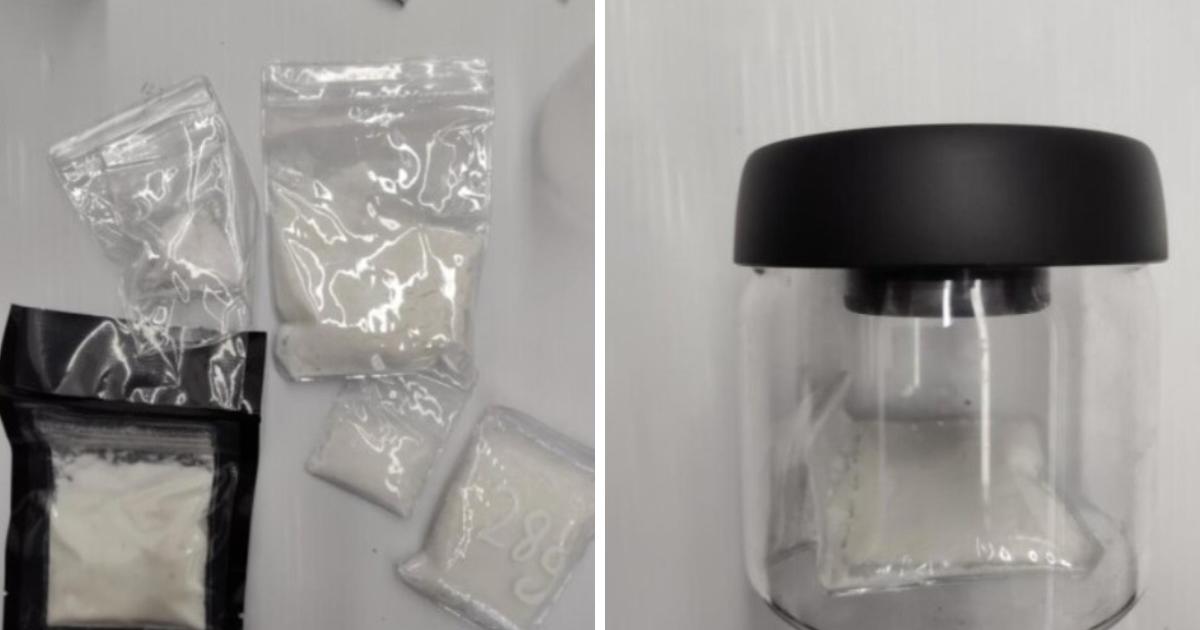
Officers carried out a dawn raid where they discovered a large quantity of suspected Class A drugs – including a 20 litre barrel of a substance believed to be in the manufacture of drugs.
Two men– both aged 29 – were arrested on suspicion of possession with intent to supply class A and B drugs, in addition on suspicion of being concerned in the supply of Class A and B drugs.
Advertisement
They remain in custody for questioning.
During searches of the property, officers uncovered a quantity of suspected class A drugs – including crystal meth, ketamine, and other related paraphernalia.
A 20 litre barrel of a substance believed to be used as part of the manufacturing process was also recovered, and will be tested before being appropriately disposed of.
The work comes as part of an ongoing operation, with the warrant conducted by the Violence, Reduction and Exploitation team.
Advertisement
Discovery after raid (Image: GMP)
Sergeant Adam Culpan said: “This morning’s work resulted in significant recoveries and has seen harmful substances taken out of circulation.
“Our proactive teams work diligently every single day to tackle drug-related criminality, in addition to the wider repercussions that it can cause – such as exploitation and addiction.
“If you have any information about criminality in your area, please don’t hesitate to get in touch with police, either directly or anonymously via Crimestoppers.”
Is the name as naughty as it seems, or is there a different way to pronounce it?
Where is Shittlehope?
Shittlehope sits between Stanhope and Frosterley in the upper Wear Valley, tucked into the North Pennines landscape of farmland, steep banks and old mining ground.
The name lives on in Shittlehope Burn, which cuts down to meet the River Wear, and in Shittlehope Shield, a small settlement close to the main road up the dale.
Advertisement
It is the sort of place you are more likely to walk or drive past than search for, until the sign flashes past and the spelling sticks in your mind.
Why the name confuses people
Written down, the first part of Shittlehope looks like a word many people avoid saying in polite company, which is why some visitors try to soften it to “Sheetlehope” or glide over the middle completely.
Online, there are threads where people argue about the “right” way to say it and joke about how broadcasters will cope.
Locally, Shittlehope – as in Shittlehope Burn and Shittlehope Shield in Weardale – is generally pronounced “SHIT-uhl-hohp”, with a clear short “i” and both parts sounded as written.
In faster local speech, it is often clipped even further to something closer to “SHIT-lup”, the second half tumbling away in a single syllable.
Both versions sit comfortably within the Weardale accent, where vowels are short and place names are often shortened in everyday use.
Advertisement
A call for local voices
Even in an age of mapping apps and street-level images, small places like Shittlehope rarely come with audio guides. That is why local knowledge still matters.
If you live in or around Stanhope, Frosterley or along Shittlehope Burn, how do you say it?
Do you lean towards “SHIT-uhl-hohp”, the clipped “SHIT-lup”, or something else entirely?
One type of outside light may make burglars “think twice before attempting to break into the property”
Worried homeowners who feel troubled by security and safety have been urged to install one type of light. And it may help prevent a break-in.
Advertisement
Touching on Home Security, one question on a police website asks: “Are external lights a good idea for security?” In its answer, the Ask the Police website, hosted by the Police National Legal Database, issued guidance and said “yes.”
It explained: “Yes they are, outside lights deter potential burglars from dark hidden areas. The best type of external light is one that stays on all the time. Any intruder that has made up their mind to break into a property will more than likely not be put off by lights that are triggered by movement.
“If the light is on all the time then it may make them think twice before attempting to break into the property.” In another question that asks, “how can I protect my home from burglary?”, the site recommends making sure you have taken all the necessary steps to ensure your home is not a target.
Advertisement
It says: “A secure home will reduce the chance of you getting burgled. Many domestic burglaries are committed by opportunists; criminals will look for homes that have little or no obvious security, have doors or windows left open or seem unoccupied.”
It recommends these “top tips” listed below “to help keep your home safe from thieves”.
Install an alarm system will help to deter burglars.
Ensure you have a robust, secure front door with British Standard-approved locks and hinges.
Install outside lighting, such as motion sensor lights so that intruders cannot approach without being seen.
Lock your doors and windows every time you leave the house, even when you are just out in the garden.
Consider installing CCTV, as this is good deterrent for thieves and if you are targeted, CCTV can provide valuable evidence.
When you go out, leave radios or lights in your house on a timer to make the property appear occupied.
Keep hedges and walls at the front of your house low (under one metre) so burglars have nowhere to hide.
Keep side and rear boundaries high and add trellis or prickly defensive planting to make it harder for burglars to climb over.
If you have a sliding patio door, check that it has an anti-lift device fitted so it can’t be lifted out of the frame.
Move bins or garden furniture that could be used to reach windows.
Ensure communal doors in flats/apartments are closed and secure, and report any faults to your landlord or maintenance company.
Never buzz anyone into the building that you do not know, or let them follow behind you.
Lock and secure any sheds and outbuildings.
Property mark and register valuable items.
Think about having your door reinforced with a security door bar.
Mark your property with a UV marker pen or Security DNA marking Kit – these can be bought online or in some stores.
Waterspouts were spotted spiralling off the Mediterranean coast as flash floods and severe storms battered a popular Brit holiday spot
Tannur Anders UK & World News Reporter
05:33, 09 May 2026Updated 05:34, 09 May 2026
Footage circulating on social media has captured the dramatic moment enormous waterspouts spiralled off the coastline of a popular tourist destination.
Southern Spain has been battered by flash floods as fierce storms swept through the region ahead of the summer holidays. Torrential downpours triggered widespread flooding on roads across parts of Murcia, with cars pictured floating in deep floodwater as the deluge hammered the area.
Advertisement
Several marine tornadoes emerged offshore, with witnesses reporting at least three waterspouts. The towering vortexes stretched from dark, brooding storm clouds down towards the Mediterranean, according to the Sun. A waterspout is a rotating column of air that forms over water, capable of producing destructive wind gusts. In extreme cases, winds can reach speeds of up to 250km/h.
Days earlier British holidaymakers in parts of Spain were issued a weather warning.
Spain’s state meteorological agency AEMET reinforced severe weather warnings across Campo de Cartagena, while authorities issued a yellow alert for thunderstorms, cautioning residents about the possibility of hail and powerful wind gusts, reports the Mirror.
Advertisement
An orange alert remained active for torrential rainfall, with forecasters predicting up to 40mm of rain falling within a single hour.
The conditions form part of a broader storm system sweeping across eastern and southern parts of the country, following weeks of warm weather. Meteorologists have cautioned of heavy downpours, electrical storms and rapidly shifting conditions throughout the region.
The severe weather arrives just weeks after storms struck Spain in March, claiming one life. In some areas, rainfall exceeded 250 litres per square metre, with rivers surging to perilous levels.
Earlier this year, Storm Leonardo unleashed more than 15 inches of rain within just 24 hours, forcing mass evacuations, school closures and widespread train cancellations.
Advertisement
The devastating storm also claimed a life in Portugal, displacing thousands of residents from their homes.
Police are appealing for witnesses and dashcam footage
A man and a woman have suffered “serious injuries” following a single-vehicle crash in a Cambridgeshire village. Officers and paramedics were called at 7.56pm yesterday (May 7) to Yelling High Street, near Papworth Everard, where a grey Vauxhall Corsa had left the road and hit a tree.
Advertisement
Cambridgeshire Police have confirmed that a woman in her 20s from St Neots and a man in his 30s from Cambridge were taken to Addenbrooke’s Hospital with serious injuries.
Police are now appealing for witnesses and dashcam footage following the crash. Anyone who saw what happened or has footage is urged to report it through the force website quoting Operation Nanstallon.
Seven-time champion Hendry still holds the distinction of being the youngest ever winner, though Wu now sits second on that list following his victory over Shaun Murphy on Monday. A total of 11 Chinese players featured in the main draw in Sheffield from a field of 32, with only England (13) providing more representatives.
He added: “They are taking the game to new levels. We need some young blood from these shores – obviously with Stan Moody, Liam Pullen did really well, Antoni Kowalski did really well at the World Championship.
Advertisement
“These three are going to have to step up if they’re going to keep up with the likes of Xintong and Wu Yize.”
English hopeful Moody, 19, made his World Championship first-round debut and established an early advantage against former champion Kyren Wilson before eventually succumbing 10-7.
Pullen was also making his main draw bow at 20 and claimed six frames from Chris Wakelin.
Kowalski became Poland’s first representative in the tournament at the age of 22 after navigating three qualifying rounds. His run also concluded in round one, with Mark Williams inflicting a 10-4 defeat.
New world champion Wu, also 22, had never progressed past the first round in Sheffield prior to this year. Yet after defeating former world champions Murphy and Mark Selby in this year’s tournament, he has no intention of leaving the city he has considered home since the age of 16.
“I don’t have any plans,” Wu told BBC Sport following his dramatic 18-17 victory in the final.
He added: “I think I will buy a house or an apartment in Sheffield for practice and the World Championship.”
One more seasoned European player who earned plaudits from Hendry was runner-up Murphy. The 43-year-old received glowing praise during his semi-final victory over reigning champion Zhao, which led him to joke about the pundit requiring an intervention.
Hendry said: “It was nigh on the perfect session. I don’t think Shaun will have ever played as good a session, it was a super-human performance and it needed that to take out Zhao Xintong, because he wasn’t playing badly.”
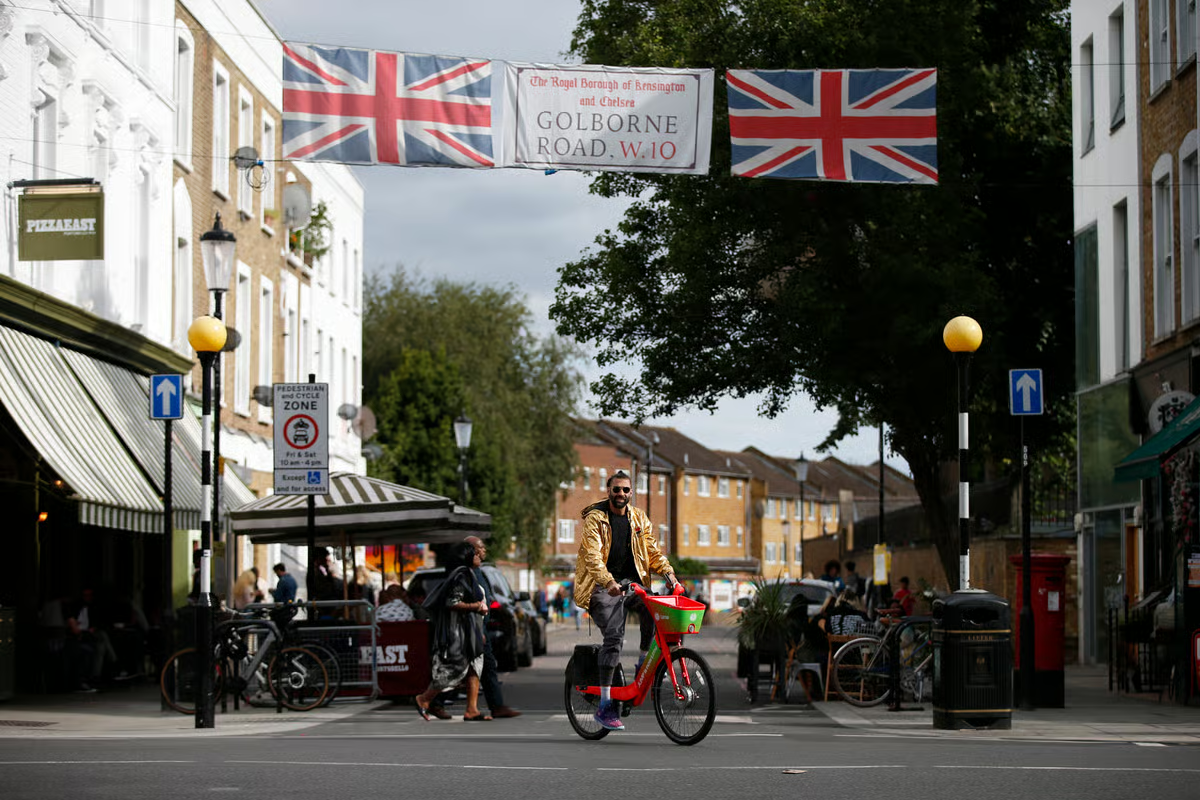
The Tories kept the same number of seats held in 2022, while Labour made notable inroads, increasing its representation from seven to 13 seats. The Liberal Democrats also saw a modest gain, securing three seats. However, the election proved less fruitful for other contenders with no wins for Reform or the Green Party.
The Liberal Democrats gained a seat but Advance UK and the Green Party each lost one, effectively returning the borough to the status quo of the three established parties.
Three independents also lost their seats.
Cllr Elizabeth Campbell, Leader of the Kensington and Chelsea Conservative Group, said: “Thank you to all the officers here – you’ve all been incredibly calm, incredibly professional and I can’t thank you enough.
Advertisement
“It’s time to go home, time to go to bed, time to wake up for a new dawn and to deliver what we promised on the doorstep.”
Cllr Elizabeth Campbell
RBKC
Kensington and Chelsea has been a Conservative majority council since it was created in 1965. Polling had suggested this was unlikely to change with the borough seen as one of the party’s most secure in the capital.
Final results for the borough came in after 8am on Friday after an overnight count. Some candidates had already left the Town Hall as the count had “no end in sight”, the LDRS understands.
Advertisement
Labour Leader Kasim Ali held his seat in Notting Dale, alongside fellow Labour Councillors Claire Simmons and Portia A Thaxter. He said he was proud of the 45 percent increase in Labour councillors on Kensington and Chelsea Council.
The Liberal Democrats took all three seats in the Earl’s Court Ward – gaining one seat from the Tories. Cllr Linda Wade was elected for the fifth consecutive term for the ward.
Here are the full results in Kensington and Chelsea
Kensington and Chelsea (Total number of seats: 50)
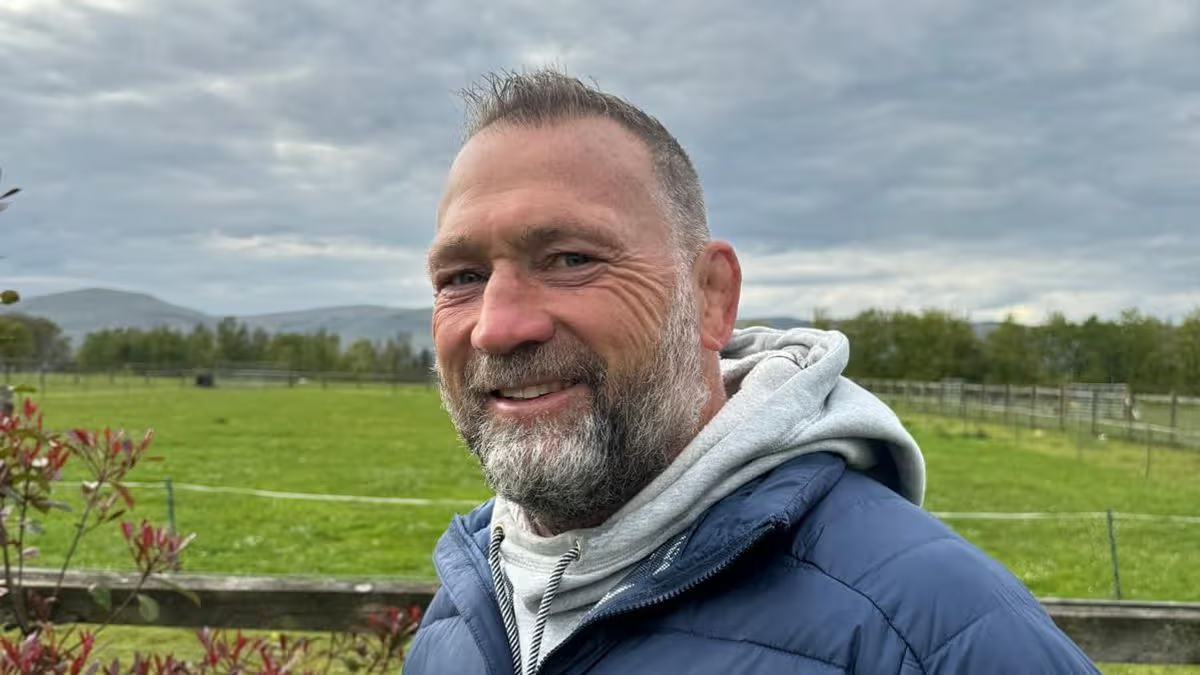
For the first time in some 35 years, Jonathan Humphreys has taken a break from rugby – and he is loving the experience.
He’s quick to stress that he considers himself hugely fortunate to have made a living out of the game for as long as he did.
But he also admits there were tough times along the way, particularly when he was Wales captain and then again more recently while coaching the national team.
With that latter role having ended last year, Humphreys is now away from it all, living up in Scotland on a smallholding near Stirling.
Advertisement
That’s where I caught up with the 57-year-old former hooker for an extended chat about a rugby career which frequently left him struggling to believe what was happening to him.
Born and brought up in North Cornelly, a village four miles from Porthcawl, he was something of a later developer, being 23 before he became a regular with Cardiff, for whom he was to make 240 appearances.
Boxing was a big focus during his teenage years, with his father Colin having competed at a high level in the sport.
“He was the youngest ever ABA champion. He was just 17 when he won it,” he says.
Advertisement
“Whoever won the ABAs at the time would go to the Rome OIympics in 1960, but my dad broke his thumb in the semi-final. He boxed the final and won, but they wouldn’t let him go to the Olympics even though he was fit. It was the Games where Muhammad Ali won his gold.”
Humphreys donned the gloves himself as a youngster.
“My dad used to take me down the boxing gym in Porthcawl a lot when I was 13, 14,” he recalls.
“It would just be me and him. He made me skip for three minutes and then I would be on the bag for another three. It was brutal.
Advertisement
“I kept on doing that for a good while, but I didn’t do it competitively. It was something I definitely wanted to do, but my mum stepped in because a lot of the shows were in the evenings and quite late, so she wouldn’t let me do it.”
When he reflects on his rugby journey, Humphreys picks out various people who played key roles.
Advertisement
The first of those were Cardiff and Wales hooker Alan Phillips and his brother Howard.
“Howard was my coach at Cornelly RFC Youth,” he says.
“I had never played for any representative team, not for the County or Wales Schoolboys or Wales Youth.
“If it wasn’t for him, I don’t think I would have gone anywhere.
Advertisement
“He went to speak to Alan and said ‘You want to come and see this boy’.
“Alan, who was coming towards the end of his playing career at the time, would then take me training. We would go over the sand dunes.
“Because of all the stuff I was doing with my dad, I was just ridiculously fit, but I wasn’t big enough. So Alan became like my personal trainer.
“I have got a huge amount to thank those two brothers for.”
Advertisement
It was through Alan Phillips’ influence that Humphreys made his Cardiff debut against Harlequins in September 1989, aged 20.
At the time, he was doing a Human Movement Studies degree at South Glamorgan Institute of Higher Education, where he played for the college alongside future Wales scrum-half Paul John, who he shared a house with.
He went on to sign for Cardiff, but opportunities were very limited during his early years at the Arms Park. So how did that situation change?
“There was one massive reason – Alec Evans,” he replies.
Advertisement
“I was going to join Pontypridd because Paul (John) was there, but then Cardiff appointed Alec.
“I was third or fourth choice hooker at the time, but the very first meeting I had with him, he said ‘If I promise you the first five games of next season, will you stay?’
“And he had never seen me play! It was a pretty ballsy call by him. So I stayed.”
Wales VIP hospitality tickets from £330
Advertisement
This article contains affiliate links, we will receive a commission on any sales we generate from it. Learn more
Seat Unique offers VIP hospitality tickets for Wales’ autumn internationals including New Zealand and Australia
Humphreys went on to become a regular starter under the Aussie coach. So what was it Evans saw in him?
“I think it was my attitude,” he says.
Advertisement
“Everything to me was a bonus. I never thought I was good enough to be there, but I just thought I will try my hardest, I will try my guts out.
“In those days in rugby, if you were fit and you were aggressive and you would just do anything, you could go a long way. You didn’t necessarily have to have a lot of skill.
“Alec was a very combative player himself, so he just loved people who had a bit of guts and would do anything.
“In those first games I started, there were plenty of people in his ear telling him what he was doing was wrong and that I shouldn’t be playing.
Advertisement
“But he kept on telling me I was the best hooker in Wales, because that’s the way he worked.”
Evans also saw Humphreys as the man to implement a radical change.
“When he came over, he wanted the hooker to throw in with two hands. There was nobody in the northern hemisphere doing it, but he had seen this guy in Japan do it.
“If he wanted me to, I would have kicked the ball in! So I was the one who took it up.
Advertisement
“I was going over the fields in Cornelly and throwing it and it was horrendous trying to do it, especially when everybody was saying ‘What the f*** are you doing?’
“I remember Alan Phillips came up to me and said ‘Look mate, you are never going to play for Wales as long as you are throwing the ball in two hands’.
“I said ‘Mate, I don’t care about that. I am playing every week!’
“I was definitely the first to do it in Europe. Now everybody does it.”
Advertisement
With the new approach adopted, an early highlight under Evans was the 1994 Swalec Cup final victory over Llanelli at a packed National Ground.
“It was the first time I had played at the stadium.
“I remember running out and it was just the most unbelievable feeling. I was thinking ‘What am I doing here?’
Advertisement
“It was just incredible because I never thought I had any chance of doing anything like that.
“It was a beautiful day and we went on to win. I remember I put Mikey Rayer in for a try down the short side. I drew a guy and passed the ball to him. I had never done that before in my life. I usually just put my head down!
“It was just the perfect day. It’s very close to my favourite rugby memory ever.”
The following year, Cardiff won the league, so Evans was an obvious choice to take over as Wales coach for the 1995 World Cup in South Africa following the departure of Alan Davies.
Advertisement
One of his first actions in the job was to call up his hooker.
“When I was named in the squad, it was the same old thing ‘What am I doing here?’” recalls Humphreys.
“It was unbelievably surreal. I only really started playing when Alec took over in 1993. So, we are talking two years.”
Things got even more surreal when Humphreys was selected to make his Test debut in the group match against mighty New Zealand in Johannesburg.
Advertisement
“I remember looking down the tunnel in Ellis Park and thinking ‘F****** hell, look at the size of that second row’. But it was Jonah Lomu!
“As I was running out, Sean Fitzpatrick said to me ‘You are not ready for this, little boy’. I felt like saying to him ‘I know, mate!’
“It was that same feeling again, ‘What the f*** are you doing here?’
“During the second half, Robert Jones passed the ball to me and Jamie Joseph forearm smashed me straight in the head. From that point on, I don’t remember anything.
Advertisement
“I was in the changing room afterwards asking boys next to me ‘How did I play? Was I any good?’
“I had no idea – and I played then three days later against Ireland and scored a try!”
With just two caps under his belt, Humphreys received the biggest bombshell of them all ahead of Wales returning to South Africa three months later for a game against the newly crowned world champion Springboks.
“I can still vividly remember getting the phone call from Alec.
Advertisement
“He goes ‘Do you want to be captain out in South Africa?’
“I think I said ‘F*** yeah!’
“So, in two years, I have gone from nothing to being captain of my country.”
Leading Wales out against the ‘Boks that day in Johannesburg remains a very special memory.
“It was a feeling of pride more than anything. My parents flew over for the game.
“Anybody who grew up with me in rugby would have gone ‘There is no chance he is going to do that, he will never captain Wales’, but here I was.
“It was all just so new. There I was tossing the coin with Francois Pienaar, who was a world icon at that point.
Advertisement
“Then I’m running out in front of the team at Ellis Park and it was a celebration of South Africa winning the World Cup, so it was packed.
“We were seen as lambs to the slaughter, but we didn’t do as badly as everyone thought we would.
“We were actually leading for a bit and we were pretty competitive for large periods. We showed a lot of guts.”
Humphreys continued as captain for victories at home to Fiji and Italy under new coach Kevin Bowring and then the 1996 Five Nations. Initially, there was something of a honeymoon period.
Advertisement
“I was so naive about it,” he admits.
“What happens with anything, the first period of time, everybody is positive. Everybody is saying good things about you, you are doing stuff for the papers.
“Nobody had ever asked me for an interview before, so it was all right, here we go.
“But what it doesn’t prepare you for is when it all turns.”
Advertisement
There was the high point of a victory over title-chasing France in March 1996, but that summer brought heavy defeats on tour in Australia and then things really got nasty during the 1997 Five Nations.
“We beat Scotland in the first game, but then went downhill badly after that.
“You had the disharmony in the Welsh camp with all the players from different clubs fighting against each other. There was a massive divide between Cardiff, Swansea and Neath. There was no team spirit as such. There was a huge split in the camp.
“Then, outside that, you had the clubs and the Union fighting against each other.
Advertisement
“It was just a perfect storm, especially for me.
“What should have been the best time in my life was literally the worst.
“I wasn’t prepared for the criticism. It felt like it came from everywhere. It did affect me and it affected my family. It was the toughest time in my rugby life.
“I remember the bus journey to one match and I was counting in my mind ‘How many games have I got until I retire?’
Advertisement
“I probably didn’t think I deserved to be there, in the team, let alone captain, and then I’ve got everyone telling me I shouldn’t be there.
“The tail end of the 1997 Five Nations was the worst bit. I was getting hate mail sent to the team hotel. I had to stop reading the papers at that point. Every letter the Western Mail would print would be about me. That’s what it felt like.”
Around that time, he was being pilloried for the number of penalties he was giving away, picking up the unflattering nickname of ‘Offside Humphreys’.
“I don’t know who started that. I have no idea,” he says.
Advertisement
“I look back at all that and I think it was probably that I would do anything to stop us getting pumped.
“Wales weren’t very good at the time. I would be offside because I thought to myself if they get the ball they are going to score. I did give away a lot of penalties. I was over committed, I suppose.
“If you wanted to decipher it, it probably came from a place of ‘If we get pumped here, I am going to get more s**t.’
“I remember in games, if we were losing, I was thinking ‘What the f*** are the press going to do to me now?’
Advertisement
“What sort of way is that to live?”
So when his first reign as skipper came to an end after the 1997 Five Nations, it was something of a blessing.
“When Kevin Bowring rang me to say he was going to put Gwyn Jones as captain, my reaction was immense relief,” he reveals.
“I didn’t want to do it anymore.
Advertisement
“I remember Gwyn coming round my house and he thought it would be an awkward conversation, but I welcomed him with open arms. It was ‘In you come, son!’”
Over the next couple of years, starts for Wales were to be few and far between, with Garin Jenkins, Barry Williams and Robin McBryde all vying for the hooking berth.
However, Humphreys did share in the memorable winning run in 1999, coming on as a replacement for Jenkins in the series-clinching win out in Argentina and the historic victory over South Africa in the first game at the new Millennium Stadium, while also figuring at the home World Cup that autumn.
“After that World Cup, I started playing the best rugby I had probably played for a long time,” he recalls.
Advertisement
“I remember Graham Henry ringing me up to say I would be starting the 2000 Six Nations opener against France. But, that same day, I dislocated my shoulder against Harlequins, so I never got back.”
With that, Humphreys’ international career appeared to be over, but then, in 2003, came another seismic shock.
Now with Bath and aged 33, he was called up to the Wales squad as injury cover by Steve Hansen ahead of the Six Nations game against England – but that was just the half of it.
“I was only expecting to be there for a day,” he recalls.
Advertisement
“I saw Steve and he said just to go into a couple of meetings and I would be done.
“So, I went into this team meeting and, with them playing England, one of the coaches said ‘What do we know about Jason Robinson?’.
“Because I was playing in that league and nobody was answering, I said he does this, this and this.
“Anyway, I came out of that meeting and said I will have something to eat and I will go.
Advertisement
“But then Steve comes on to me and says ‘Can I have a chat with you, mate?’
“So he takes me into a room and he goes ‘I want you to play on the weekend and I want you to be captain’.
“I looked at him and my exact words were ‘F*** off’.
“The press conference that afternoon when they announced me as captain was chaos.
Advertisement
“I went on my phone afterwards and it had gone nuts.
“It was all the boys from Bath going ‘Is this a joke?’”
But it was no joke, with Humphreys returning to the side as skipper.
Advertisement
“We could have beaten England and we should have beaten Ireland,” he recalls.
“My eldest son came to watch the games, so at least he saw me play in that stadium.
“I was honoured to captain Wales. I did it 19 times in all. But I think the only time I actually really enjoyed it was when I came back in 2003 because I was determined I was going to enjoy it for what it was.
“Then it came full circle where everybody was saying nice things about me.
Advertisement
“I had young children and I was conscious of ‘Am I going back into all this shit again?’
“But to have people say nice things about you at the end was a nice way to go. They said nice things at the start and nice things at the end!”
In all, Humphreys won 35 Wales caps and played more than 300 games for club and country before hanging up his boots in 2005, aged 36.
Then came the move into coaching, with the next two decades taking in spells with the Ospreys, Scotland, Glasgow and Wales.
Advertisement
“I could have stayed playing another year at Bath, but I just felt I was done. I didn’t like the nerves before games any more. That sort of stuff.
“So I never missed playing and coaching was just something completely different for me.
“You still get the buzz, but I never felt like I wanted to go back out there and throw myself around.
“I really enjoyed the early part of my coaching career because it was all so new to me and we were pretty successful at the Ospreys. The biggest shame was we never won Europe because we had a team that should have done so.
Advertisement
“My fondest memories as a coach are of the people I worked with, some incredible people, people I really enjoyed.”
Humphreys came in as Wales forward coach after the 2019 World Cup to work with new boss Wayne Pivac and shared in both the 2021 Six Nations title triumph and the historic victory over South Africa in Bloemfontein the following year.
After Pivac’s departure, he was retained by the returning Warren Gatland and looks back on the 2023 World Cup campaign with particular fondness.
But, following Gatland’s exit, Humphreys’ time with Wales came to an end after the 2025 Six Nations.
“I’m not bitter about leaving because if you lose 17 games in a row you’re lucky to stay in a job. So I have no issue that they wanted to go a different way.
“I loved my time with Wales and I was proud to win the Six Nations and beat the Springboks for the first time out in South Africa, but everything must come to an end at some point.
“I will always look back at my time in the job with an equal measure of pride and disappointment.”
Advertisement
Since the end of his six-year stint with Wales, father-of-three Humphreys has stepped away from the game.
“I have taken a big break because I haven’t had one for 35 years,” he says.
“I have taken a complete break which I have very much enjoyed. I have loved it. I haven’t missed rugby at all.
“With Wales, towards the end, you knew it was going to be a massive struggle to compete. All that comes with the stresses of it all.
Advertisement
“Until you have actually taken yourself away from it, you don’t know how much effect that has on you.
“It’s again like having the Welsh captaincy taken off me. It’s like a relief and I feel a lot better for it.
“I’m more relaxed and your emotions are not up and down on a weekly basis.”
So it is that we find Humphreys at ease with life up in the Scottish countryside with the crowing of a cockerill and the braying of a horse in the background as we chat.
Advertisement
“We are about 15 minutes from Stirling. We moved up when I did the Scotland job and the kids all settled up here. It’s great.
“I have got a smallholding, a few acres at the back of the house, and my wife has got horses.
“I have been able to spend more time with my younger son, who is 14. It’s been good.”
So, finally, as he looks back on it all, what are his thoughts?
Advertisement
“I was lucky to have rugby as my life for so long,” he says.
“It has given me everything. I was very fortunate to play when I did, where I could do something I would have done for free as my living.
“I have never had to work a day in my life and that’s true. It’s never felt like work. There are not many people who can do that.”





































You must be logged in to post a comment Login