The NHS has also warned people that they may need to dial 111 or 999 in some circumstances
Sophie Buchan Money and Lifestyle Writer
03:30, 11 Feb 2026
The NHS has warned anyone feeling unusually “tired” to see their GP. However, in some cases, you may need to dial 111 or 999, as a “fatal” situation can develop quickly.
On social media, the health service highlighted the signs of type 1 diabetes, which can appear at any age. It urged people to remember the four T’s.
Advertisement
Listing “Toilet, Thirsty, Tired and Thinner” as four common signs to look out for, it said that if any of these symptoms come on suddenly, or they are unusual for you, it is time to seek help.
In its post, it took to X, it warned: “Do you know the signs of type 1 diabetes? They can happen at any age, and if left undiagnosed, it can be fatal.”
Type 1 diabetes – explained
Content cannot be displayed without consent
Type 1 diabetes is a condition where the body cannot produce insulin, causing blood sugar levels to rise. People with type 1 diabetes need to take insulin daily and manage their blood glucose through regular monitoring, diet, and insulin adjustments. There is no cure, but it can be managed effectively.
Remember the 4 T’s
It advised people to remember four words – each starting with the letter T. These are:
Advertisement
Toilet – “going for a wee more often, especially at night”
Thirsty – “being constantly thirsty and drinking more than usual”
Tired – “being very tired and having less energy.”
Thinner – “losing weight without trying to or looking thinner than usual”
Dial 111
After sharing these common signs, the NHS warned: “Ask for an urgent GP appointment or call NHS 111 if you think you or your child has type 1 diabetes.”
According to the NHS website, other signs of type 1 diabetes include:
blurred vision
breath that smells sweet or fruity (like nail polish remover or pear drop sweets)
cuts and wounds are taking longer to heal
getting frequent infections or infections that do not get better, such as thrush or nappy rash
The NHS warns: “The symptoms develop quickly, over a few days or weeks.”
It may be time to call 999
The NHS warns you should call 999 if you or your child has been peeing more, feeling very thirsty and tired, and:
your symptoms are getting worse quickly
you have stomach pain, diarrhoea, or you’re feeling or being sick
you’re feeling sleepy or confused
you’re breathing faster and more deeply than usual
“These could be signs of diabetic ketoacidosis, which can be life-threatening if not treated quickly”, it cautions.
Diabetes UK has a free helpline that’s open from 9am to 6pm, Monday to Friday. You can call 0345 123 2399 or email helpline@diabetes.org.uk for support and advice.
The warning runs from 5pm on Saturday (April 4) until 7am on Easter Sunday (April 5).
It warns that Storm Dave will bring a spell of very strong winds – of 50-60mph in the York area – which may cause some damage and travel disruption.
The yellow warning says road and rail services are likely to be affected, with longer journey times and cancellations possible.
Power cuts may occur, with the potential to affect other services, such as mobile phone coverage, it adds.
Advertisement
Some damage to buildings, such as tiles blown from roofs, could happen, the warning also suggests, adding injuries and danger to life from flying debris are possible.
A yellow weather warning has been issued for York ahead of Storm Dave (Image: Met Office)
Met Office deputy chief forecaster, Tom Crabtree, said: “StormDave will form and rapidly deepen on Saturday as it approaches the UK from the west.
“By Saturday afternoon winds will strengthen significantly, with gusts of 60-70mph expected at times across parts of Scotland with the potential for gusts of 80-90mph in exposed coastal locations in Scotland.
“Gusts of 50-60mph are likely more widely in northern Britain.
“As well as strong winds, StormDave will also bring heavy snowfall over the hills in northern Scotland where up to 10-20cm of snow could accumulate.
Advertisement
“Along with the strong winds this will lead to blizzard conditions.
“Elsewhere there will be heavy spells of rain as the system moves through eastwards across the UK.”
A yellow wind alert has been announced for northern England, including several areas in Greater Manchester. The warning covers Bolton, Bury, Oldham and Trafford, as well as other parts of the region.
This alert is in place from 5pm on Saturday, April 4, until 7am on Sunday, April 5, due to the anticipated strong winds of up to 90mph in some parts of the UK.
#StormDave has been named and is forecast to bring damaging winds across northern parts of the UK, with some disruptive snow possible in northwest Scotland later on Saturday and into Easter Day #WeatherAwarepic.twitter.com/J0NZYD2SPC
This is different to the previous wind warning, which was previously in place from 6pm on Saturday, April 4 until 12pm on Easter Sunday.
According to Tom Crabtree, deputy chief forecaster at the Met Office, “Storm Dave will form and rapidly deepen on Saturday as it approaches the UK from the west.”
He added that parts of Scotland might experience gusts of 60-70mph, and some coastal areas could face winds as high as 80-90mph.
Gusts of 50-60mph are predicted to occur more commonly across northern Britain.
Advertisement
Northern Scotland may see heavy snowfall on the hills, accumulating up to 10-20cm of snow, alongside strong winds that could result in blizzard-like conditions.
Heavy rain is expected to spread across the UK as Storm Dave moves eastwards.
The Met Office warned that the strong winds pose a risk of causing injuries and danger to life from flying debris, which may also result in damage and travel disturbances across the affected areas.
While northern regions are anticipated to face more severe conditions, southern parts of the UK are not set to feel the impact of the storm.
Advertisement
Travel services, including road, rail, air, and ferry, are likely to be disrupted, with longer journey times and potential cancellations.
Certain roads and bridges might need to be closed, and power cuts could occur, possibly impacting other services such as mobile phone coverage.
Debris-related injuries and danger to life are forecasted, with large waves expected to pose a threat to sea fronts, coastal roads, and properties.
Precautionary advice encourages the public to ensure the safety of loose items around their homes and to prepare for any delays by checking travel conditions and schedules.
Advertisement
Residents near the coast are advised to be cautious of large waves and to be prepared for the quick updates in weather warnings.
The general public is continually advised to stay informed with the latest updates as Storm Dave was expected to move across Scotland on the night of Saturday into Sunday and off into the North Sea.
The storm is predicted to bring strong winds, primarily from the southwest direction.
The highest wind speeds are expected during Saturday evening, with a small chance of brief gusts of 70-80 mph, particularly in northern England and southern Scotland.
Advertisement
In addition to the strong winds, large waves could result in dangerous conditions around windward coasts.
People are advised to follow official advice to ensure safety.
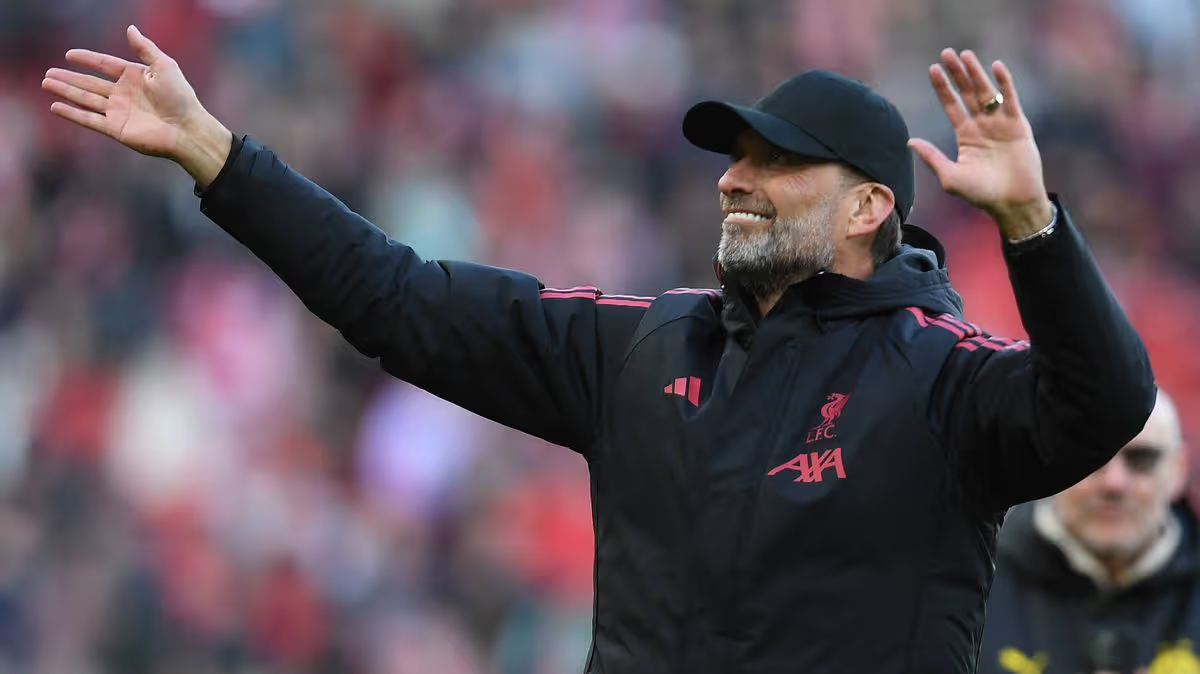
Kloppreceived a hero’s welcome as he oversaw an entertaining 2-2 draw at Anfield. Before and after the fixture, he participated in various community activities in support of the LFC Foundation. He continues to serve as an ambassador for the club’s charitable organisation, having taken up the role when he stepped down as Reds boss in 2024.
Following the event, Klopp shared photos on Instagram. Tagging in the LFC Foundation, he wrote: “Thank you to everyone who made my homecoming so special.”
Klopp has embraced several new positions since departing the Reds. He joined the Red Bull Group as Head of Global Football in an advisory capacity before being appointed as an expert by the German Football League (DFL).
Advertisement
He now faces a hectic summer after being signed up as a pundit for the World Cup by German television and streaming service Magenta TV. Klopp revealed the news late last year in a video that hinted at a return to management, only to confirm he would instead be working as an analyst at the tournament.
After strolling through a stadium, gazing wistfully at his surroundings, he told the camera: “Oh no, not as a manager. I am becoming a pundit for Magenta TV at the FIFA World Cup 2026.”
“But that’s all nonsense. They haven’t called even once, not once. My agent is there, you can ask him. They haven’t called him either.”
Content cannot be displayed without consent
Klopp has made it abundantly clear that should he return to the dugout, it wouldn’t be with another English club. His comments following the Dortmund legends fixture reinforced his enduring connection with the Reds.
He said: “Enjoyed every second. My role was definitely not to have a lot of words. I was here for the Foundation and to be part of a really special experience.
“For me, a very special experience after a while – being around, being that close, seeing all the Liverpool lads and then seeing the Dortmund lads as well, because that was like 80 per cent of my players. And you don’t meet very often and have them all together in one room. It’s really cool.”
Advertisement
Join our LFC WhatsApp community and get all the latest LFC news, views, transfer gossip and more, as it happens We also treat our community members to special offers, promotions, and adverts from us and our partners. If you don’t like our community, you can check out any time you like. If you’re curious, you can read our Privacy Notice.
Get 70% off Premier League kits and merch
This article contains affiliate links, we will receive a commission on any sales we generate from it. Learn more
Fanatics has slashed up to 70% off football kits and merch. Fans can find discounts on products from Premier League clubs including Man United, Man City, Liverpool, Everton, Arsenal, Spurs and more.
Everyone has their favourite pub, but has yours been named as one of the best?
Several Cambridgeshire pubs have been named as the best in the region. More than 250 pubs have been recognised in Tyrrells National Pub and Bar Awards 2026.
Advertisement
Of the pubs nominated, three Cambridgeshire favourites are among some of the best. These are: The Burleigh Arms in Cambridge, The Lion at Ickleton, and The Three Hills in Bartlow.
Tristan O’Hana, editor of Pub and Bar magazine said: “Our bigger and better format that debuted in 2025 was such a success, we can’t wait to roll it out again this year. The fact that the celebrations last from the long Easter weekend, when we celebrate this year’s County Nominees, right up until the awards night at the beginning of summer is no less than this wonderful industry deserves.
“We just want to do what we can to spread the word about these brilliant businesses.”
All of those nominated will be invited to a celebration in London, which takes place on June 10. The 94 county winners will be announced. Pubs that are highly commended will also be able to collect their certificates.
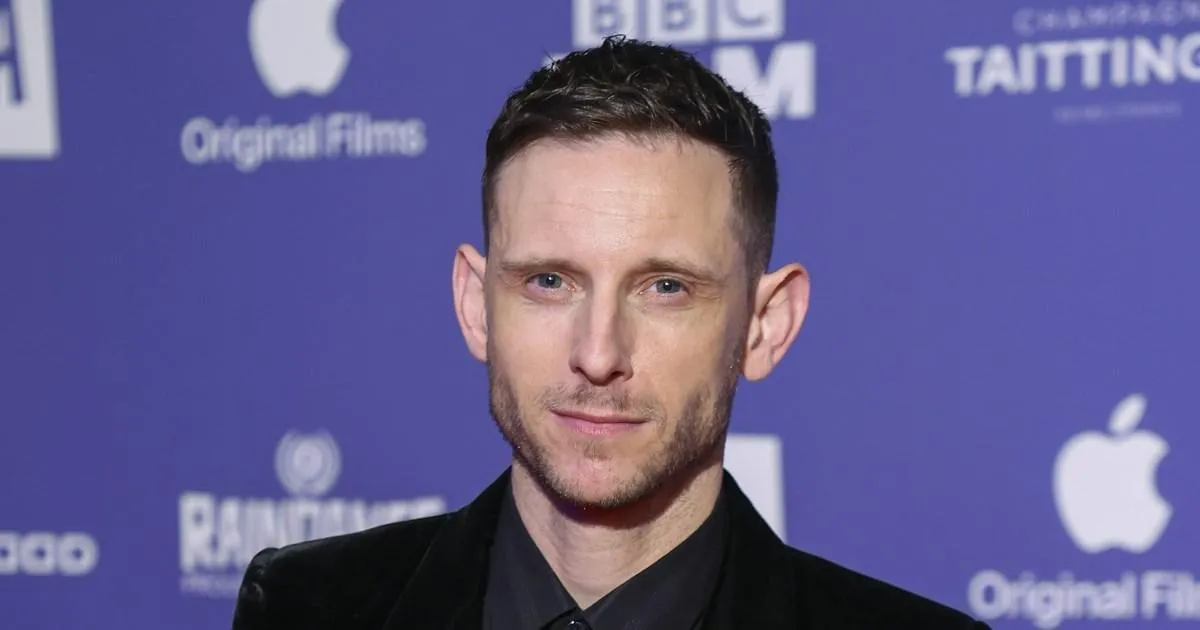
Who is the British actor Jamie Bell, star of the new Peaky Blinders series? (Picture: Mike Marsland/WireImage)
British actor Jamie Bell is about to burst back onto screens in the new Peaky Blinders sequel series – but what does his life look like behind-the-scenes?
The 40-year-old screenstar was announced as the all-new Duke Shelby (played by Barry Keoghan in the movie and Conrad Khan in the original series), as we return to Birmingham in the aftermath of World War Two.
Showrunner Steven Knight has teased that this iteration of Tommy Shelby’s eldest illegitimate son will be ‘older, wiser, more ambitious and more dangerous’ as the city starts trying to rebuild in the wake of devastation.
Jamie will be joined by Downton Abbey’s Jessica Brown Findlay, Stranger Things star Charlie Heaton and Day of the Jackal’s Lashana Lynch and newcomer Lucy Karczewski in as-yet undisclosed roles.
Advertisement
The award-winning star first rose to fame after landing a historic Bafta aged 14 for his role as Billy Elliot in the movie of the same name 26 years ago.
But after a lifetime spent in front of the camera, what does it look like off-set?
Jamie Bell is set to play Duke Shelby in the new Peaky Blinders sequel series (Picture: Ben Blackall/BBC/PA Wire)
Who is Jamie Bell married to?
Jamie Bell has been married to actress Kate Mara since 2017.
The Emmy-nominated actress has appeared in several high-profile TV shows and movies, including Netflix’s House of Card where she played Zoe Barnes, 24 as Shari Rothenberg and, most recently, Apple TV’s Imperfect Women.
The pair had known each other as far back as 2005, but remained acquaintances for a long time.
Advertisement
‘We were friends but not – we didn’t really know each other. And then we made the Fantastic Four movie together, which was a really interesting experience,’ she told the Where Everybody Knows Your Name podcast.
Jamie Bell and Kate Mara have been married since 2017 (Picture: Getty)
Both starred in the 2015 superhero action movie with Kate as Sue Storm and Jamie as Ben Grimm.
As Kate explained: ‘We got to know each other on it, and I thought, “Oh, he’s so great”. I just thought he was the best.’
Even then, she revealed, she initially attempted to set him up with other people until a year later when ‘we fell in love on the press tour of that movie ’cause it was trauma bonding.’
Does he have any children?
They soon realised ‘that was it’ and got married in 2017, before going on to have two children – a daughter, six, and son, three.
Advertisement
‘We just thought, “Oh, this is gonna be forever. Wonderful.” And here we are, a bunch of kids later and it’s the best,’ Kate said.
They’ve welcomed two children but keep them out of public life (Picture: Getty)
Romance blossomed after working on Fantastic Four together (Picture: 20th Century Fox/Marvel/Kobal/Shutterstock)
The family lived in Los Angeles at one time but now live just north of New York, with Jamie, used to the world of child actors, previously reflecting on their plans to keep their children away from the spotlight.
‘Not that anyone’s ever been particularly invasive with me – I go around with relative ease – but it’s just a poppa thing to think, “No, no, no”; that’s a different side of my life that no one sees,’ he told the Evening Standard.
He also shared admiration for his wife’s family (giants in the NFL world): ‘They’re an incredible family, so loving, connected and together. They’re functional.
‘It’s kind of an amazing surprise to know that stuff really exists. I come from a broken home… But to see parents who are together, who have raised four children, with no sign of splitting up, is a joy to watch.’
Advertisement
As well as his two children with Kate, he also has a son from his previous marriage.
Who has Jamie Bell previously been in a relationship with?
The Billy Elliot star was once married to actress Evan Rachel Wood, who met in 2005 when they played lovers in Green Day’s music video for Wake Me Up When September Ends.
Before Kate, Jamie was married to Evan Rachel Wood with whom he shares one son (Picture: Getty)
The pair were briefly together before breaking up, during which time Evan dated Marilyn Manson and got engaged. When their relationship ended, however, she once more started dating Jamie, and they tied the knot in 2012.
A year later, in 2013, they welcomed their son, but only 10 months after, in 2014, they announced their divorce – although both have reiterated they remain on good terms.
A statement read at the time read: ‘This is a mutual decision and the two remain close friends.
Advertisement
‘They both love and respect one another and will of course remain committed to co-parenting their son.”
Talking about co-parenting with the Evening Standard in 2017, Jamie explined they ‘understood very quickly the importance of maintaining a good relationship’.
Although he acknowledged, ‘It’s tricky enough when you’re actors who are together. The kid is just going to have to get used to going here, going there.’
What are some of his most well-known movies and TV shows?
He rose to fame after landing the Bafta for Billy Elliot at only 14 (Picture: Tiger Aspect Pics/Kobal/REX/Shutterstock)
He played Abraham in Turn: Washington’s Spies for three years (Picture: AMC)
In recent years, he notably starred in All of Us Strangers (Picture: AP)
After his breakout role as the eponymous Billy Elliot in 2000, the following year he landed his Bafta for best actor (and remains the youngest to win this category)
Since then, Jamie has starred in a steady stream of projects, including 2005’s King Kong, 2011’s Jane Eyre, the lead role in the animated Tintin movie and 2013’s Snowpiercer.
Advertisement
As mentioned, he met his now-wife Kate while filming the Fantastic Four remake and starred in TURN: Washington’s Spies from 2014 to 2017.
In recent years, he’s appeared in Paul Mescal and Andrew Scott’s haunted gay romance, All of Us Strangers, and has now landed top billing in the highly-anticipated sequel series.
Got a story?
If you’ve got a celebrity story, video or pictures get in touch with the Metro.co.uk entertainment team by emailing us celebtips@metro.co.uk, calling 020 3615 2145 or by visiting our Submit Stuff page – we’d love to hear from you.
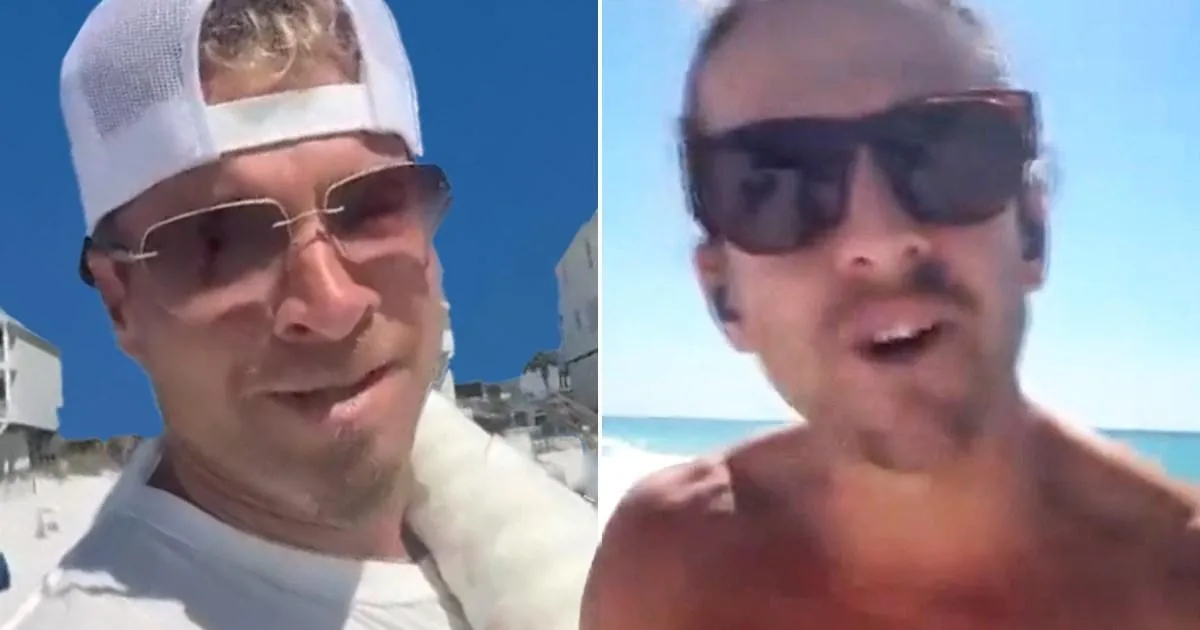
Backstreet Boys star Brian Littrell has sparked major backlash online after confronting an alleged trespasser on his private beach.
Advertisement
The 51-year-old singer – who rose to fame alongside Nick Carter, Howie Dorough, AJ McLean, and Kevin Richardson – got into a heated exchange with a sunbather outside of his multimillion-dollar mansion in Santa Rosa Beach, Florida.
Littrell stormed across the sand where beachgoer Kyle Gallagher was sitting, filming him from behind as he relaxed on his towel by the water.
Initially unaware of the Everybody hitmaker’s presence, Gallagher was scrolling on his phone and wearing headphones but jumped up startled when he realised he was being recorded.
What followed was an intense argument, during which many social media users believed Littrell used a homophobic slur, something he was forced to deny.
Advertisement
‘You cannot be putting s**t in my face, bro,’ Gallagher began, reaching out and attempting to shove the phone down, to which Littrell warned him: ‘Don’t test me.’
Backstreet Boys singer Brian Littrell got into a heated argument with a beachgoer outside his Florida mansion (Picture: Walton County Sheriff’s Office)
Gallagher quickly got to his feet, instructing Littrell to ‘get out of my f***ing face’, causing him to get defensive.
‘You can’t grab my phone, dog,’ Littrell told him, leading to Gallagher starting to film in retaliation.
‘I’m on the wet sand right now, bro,’ Gallagher retorted, saying Littrell ‘came in [his] face out of nowhere’ and saying to his camera: ‘Look at this gay s**t.’
Advertisement
As the row continued, Gallagher informed Littrell that he had ‘lived across the street for 20 years’, so he is ‘never going to be left alone’ out there.
‘I will,’ stated Littrell. ‘No, you will not,’ Gallagher laughed.
Littrell turned his camera around and said: ‘This is what I deal with. This is what I deal with. People like this.’
Kyle Gallagher was caught off guard by Littrell filming him (Picture: Walton County Sheriff’s Office)
‘You came and shoved your phone in my face, bro. You’re lucky I didn’t knock you the f**k out,’ Gallagher shouted, becoming more irate.
Littrell also asked the local, ‘You wanna be gay?’ and called him a ‘p***y’.
Advertisement
The quarrel carried on, with Gallagher reminding Littrell that the beach had ‘public access’ and that he was ‘done for’.
‘I can’t wait ’til this gets out,’ Littrell smiled to his phone.
Having been mocked by Gallagher, who said any case would ‘get thrown out’, Littrell had attempted to press criminal charges; deputies visited Gallagher’s home the next day, where he reiterated that he was caught off guard by the phone being so close to his face, saying he felt threatened and only reached out as a reflex.
Consequently, Walton County authorities decided to drop the matter, concluding that his so-called video evidence did not show enough criminal intent to warrant pressing charges. The case was closed.
Advertisement
The sunbather got out his own phone, with him and Littrell hurling insults at one another for several minutes (Picture: Walton County Sheriff’s Office)
This led to Littrell suing the county last month, alleging that they had not protected him against trespassers.
However, a judge also dismissed this, to which Littrell’s attorney, Peter Ticktin, said: ‘Littrell was assaulted by a hostile beach protester. A report was made to the feckless sheriff’s office.
‘The assault was awful enough, but the fact that the sheriff’s office is not enforcing the law makes our whole community one of greater danger.’
Meanwhile, the footage is now doing the rounds online, with Ticktin issuing a fresh statement to The Independent: ‘Mr Littrell and his family purchased what they saw as their dream home, only to discover an ongoing pattern of trespassing and harassment targeting private property owners along their and their neighbours’ stretch of beach.
‘These actions are not about public access; public beaches exist on both sides of the neighbourhood and remain open and uncrowded.
Advertisement
‘Instead, certain individuals appear intent on challenging the very concept of private property rights.’
Littrell rose to fame in the early 90s as part of the group with Howie Dorough, Kevin Richardson, Nick Carter, and AJ McLean (Picture: Nicholas Hunt/Getty Images for 103.5 KTU)
He also stressed that, despite claims of what people online heard, Littrell did not use a homophobic slur in the clip.
‘It is deeply troubling that these incidents have been allowed to escalate due to a lack of enforcement by the local sheriff’s office. Homeowners are entitled to safety and privacy on their own property, and Mr Littrell is no exception.’
Still, the video certainly hasn’t gained Littrell any new fans, with many criticising him for claiming to ‘own that part of the beach’.
@FFAFamily wrote on X that Littrell himself ‘is the problem’, adding: ‘He may own up by his house but definitely not by the water!’
Advertisement
@shermjanae called him a ‘whole Karen’, while @AncientArgonaut wrote: ‘So basically it’s a public beach and Brian felt the need to come down and harass the beach goer by shoving a phone in his face. For the crime of being near his house. He thinks it’s his beach. Prosecutor could see exactly what this was.’
@trishhyland said the incident was a ‘waste of police time’ after Littrell called 911, with @elina_vibes echoing: ‘Glad the prosecutors saw it for what it was—just a messy misunderstanding and not some criminal battery case.’
Since purchasing his Florida mansion in 2023, he’s been battling for ‘privacy’ on the public beach (Picture: Christopher Polk/Penske Media via Getty Images)
The quest for privacy has been an ongoing battle for Littrell and his family – wife Leighanne, 56, and their son, Baylee, 23 – with his family previously claiming the alleged trespassing has caused ’emotional distress’.
‘It’s scary to have to be in this small community with a lot of angry people, honestly, and then making us out to be these monsters that we’re not,’ Leighanne told Fox News. ‘We love this town, but now we don’t know where to eat because of who hates us.’
Their legal team has continued arguing that the beach is Littrell’s ‘backyard’, after he purchased the property in 2023 for $3.8million (£2.9m), records show.
Advertisement
As for the truth, Visit South Walton reports that public access to privately owned beaches is allowed up to 20 feet landward from the wet/dry sand line.
This area is known as the Transitory Zone, which the public is encouraged to enjoy at their leisure.
Sunbathing is also permitted in those areas from 9am to 4pm.
Got a story?
Advertisement
If you’ve got a celebrity story, video or pictures get in touch with the Metro.co.uk entertainment team by emailing us celebtips@metro.co.uk, calling 020 3615 2145 or by visiting our Submit Stuff page – we’d love to hear from you.
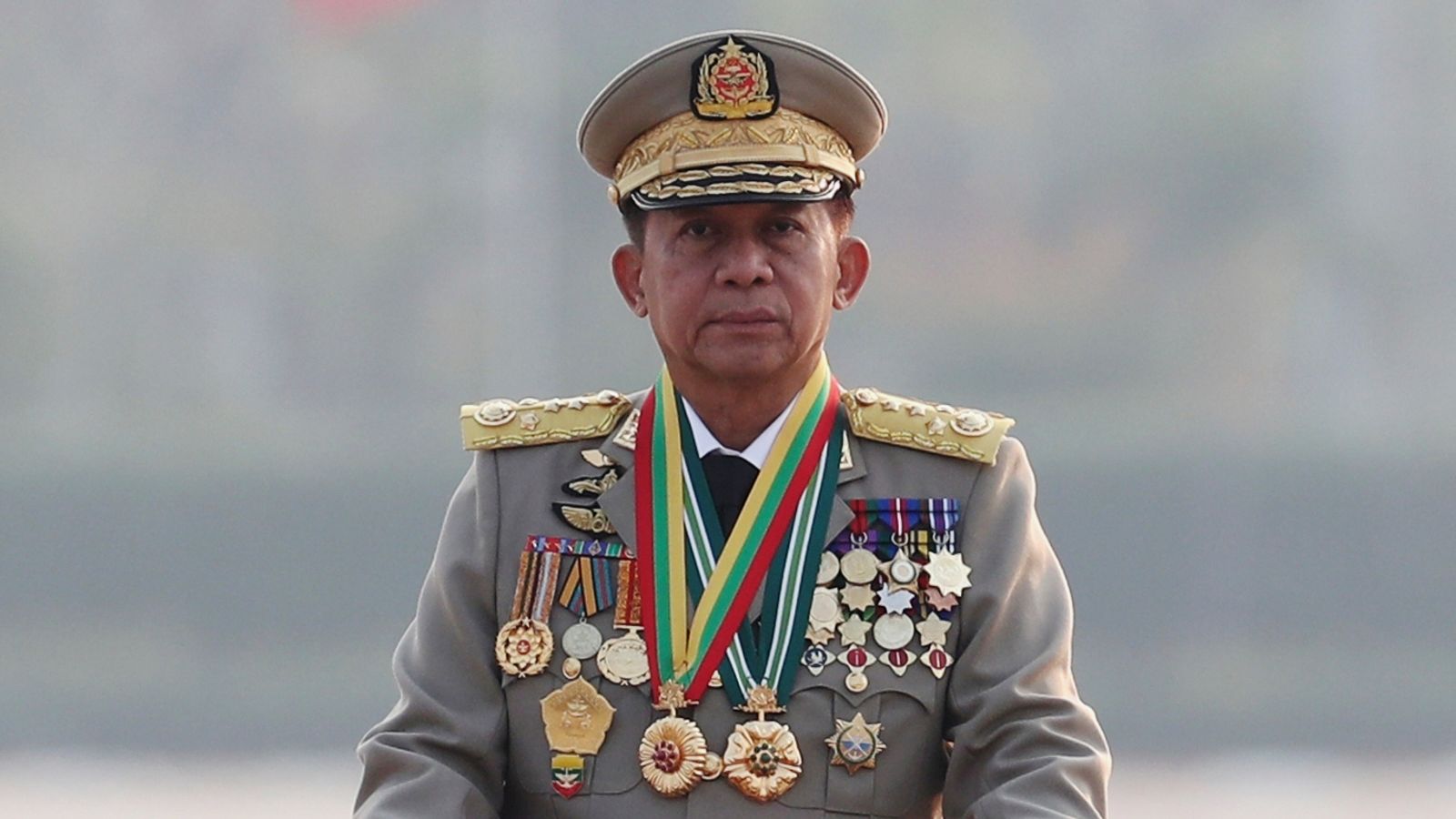
The head of Myanmar’s ruling military junta, who overthrew the previous government five years ago, has been elected president after winning a parliamentary vote.
Min Aung Hlaing, 69, who is a senior general, won 429 out of the 584 votes in Friday’s ballot, Aung Lin Dwe, speaker of both the upper and lower house, said.
The run-off, which was broadcast live, was held in the newly renovated parliament building in the capital, Naypyidaw, which was damaged in last year’s earthquake.
His victory was expected as the chamber is dominated by the pro-military Union Solidarity and Development Party (USDP) and members appointed by the armed forces.
Advertisement
It follows a landslide victory for the army-backed USDP in a general election held in December and January.
Image: General Min Aung Hlaing (L) handing a flag to newly appointed Commander-in-Chief General Ye Win Oo. Pic: Reuters
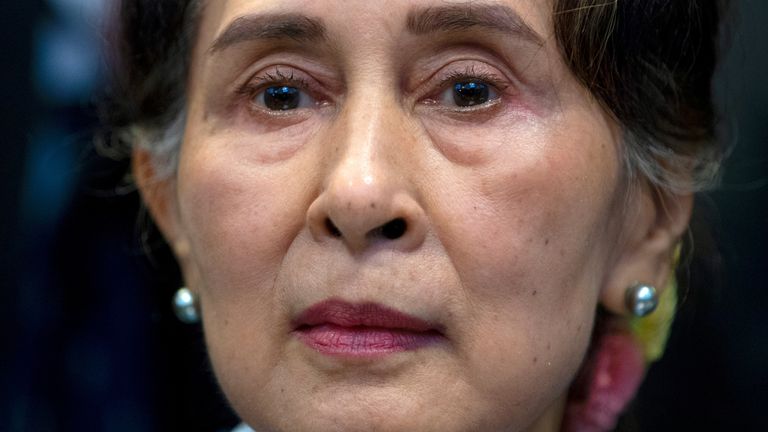
Image: Aung San Suu Kyi in 2019. File pic: AP
Critics and Western governments dismissed those polls as a sham to continue military rule behind a facade of democracy.
Min Aung Hlaing has led the nation since orchestrating a coup against the government of Aung San Suu Kyi in 2021, leading to a civil war.
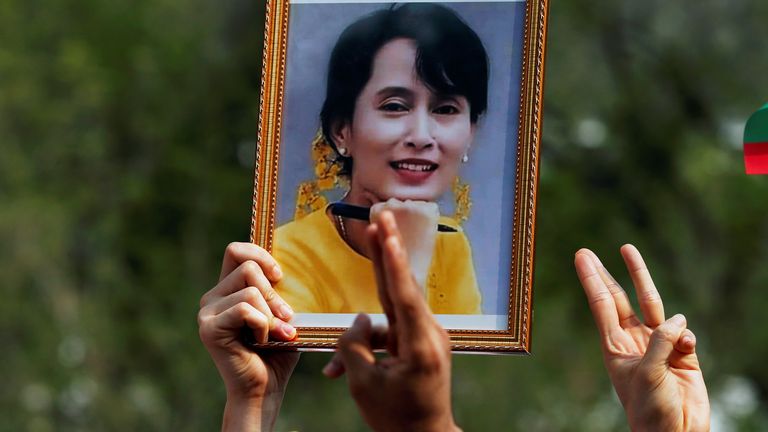
The Nobel Peace Prize winner was arrested, sparking widespread protests that turned into nationwide armed resistance against the junta.
Advertisement
Ms Suu Kyi, 80, is serving a 27-year prison term on charges widely viewed as politically motivated.
The general, who has led the armed forces since 2011, has long coveted the presidency, according to independent Myanmar analyst Aung Kyaw Soe, who said “it appears his dreams are now becoming a reality”.
Image: A protest against the military coup in 2021. File pic: Reuters
On Monday, Min Aung Hlaing stood down as commander-in-chief because the country’s constitution prohibits the president from simultaneously holding the top military position.
As he was nominated in parliament as a presidential candidate, he proposed Ye Win Oo, a former intelligence chief seen as a fierce loyalist, as his successor to lead the military.
Earlier this week, some anti-junta groups – including those containing remnants of Ms Suu Kyi’s party and longstanding ethnic minority armies – joined forces in a new combined front to take on the military.
The Steering Council for the Emergence of a Federal Democratic Union said on Monday that they wanted to “completely dismantle all forms of dictatorship” and “collectively initiate a new political landscape”.
Resistance groups could face intensified military pressure as well as increased scrutiny from neighbouring countries that may seek to bolster their relationship with Min Aung Hlaing’s new administration, analysts said.
The military handover and Min Aung Hlaing’s rise to the presidency are seen by analysts as a strategic pivot to consolidate his power as head of a nominally civilian government and earn international legitimacy, while protecting the interests of an armed forces that has run the country directly for five of the past six decades.
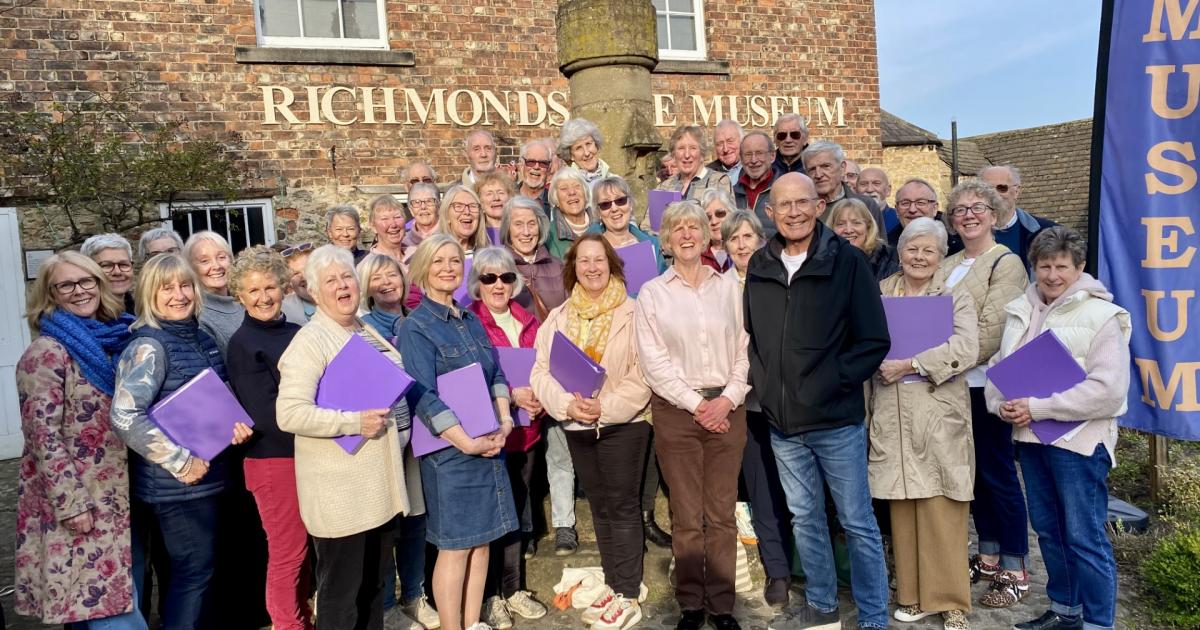
The Station Singers’ Spring concert will take place on Saturday, April 18, at 7pm at St Mary’s Church in Richmond, where they will perform a selection of popular pieces from well-known shows, stage productions, and films.
Kay Bromhead has taken over as musical director after serving as deputy conductor since 2016.
“The choir continues to thrive.
Advertisement
“Supporting local causes is very important to the Station Singers and we hope that you will join us for an evening of wonderful music.”
The concert will support Richmondshire Museum, which is raising funds for building improvements aimed at reducing long-term energy costs.
The choir hopes to raise funds through ticket sales, a raffle, and a bucket collection during the event.
Ms Bromhead brings a wealth of experience, having worked with Harrogate schools, Catterick WAGS, a male voice choir, and the Richmond Operatic Society.
Advertisement
The choir will be accompanied on the night by Brett Overin.
Tickets are available online for £11 at www.ticketsource.co.uk/the-station-singers or for £12 at the door.
Entry is free for under-18s who are accompanied by an adult, and refreshments will be available to buy.
The BBC sci-fi series first arrived on screens almost 63 years ago, spanning around 900 episodes, 41 seasons, 15 (main) Doctors, and a 2005 reboot.
With such a wealth of content, there have been several early stories from the Classic Who era (1963-1989) which have been lost to time and wiped from the records.
In fact, over 90 episodes from the 253 which aired in the first six years are unaccounted for.
Advertisement
However, last month it was revealed that, in the first major recovery in over a decade, two more long-lost episodes have been found.
Get personalised updates on Doctor Who
Wake up to find news on your TV shows in your inbox every morning with Metro’s TV Newsletter.
Sign up to our newsletter and then select your show in the link we’ll send you so we can get TV news tailored to you.
Advertisement
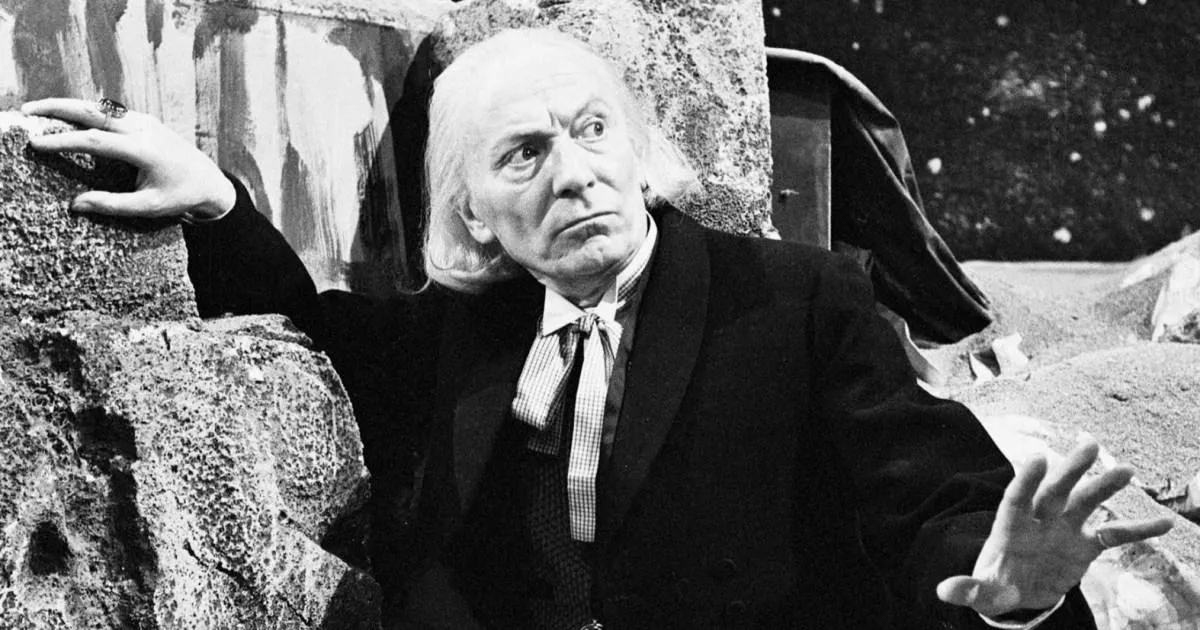
The two episodes in question – season three episode one, The Nightmare Begins, and episode three, Devil’s Planet – aired in November 1965, to launch William Hartnell’s third season with companion Steven Taylor (Peter Purves).
Nearly all of this William Hartnell adventure had been lost to time (Picture: BBC)
This story centred around the Doctor’s arch-nemesis – The Daleks (Picture: BBC)
A clip released earlier this week from one of the episodes, The Nightmare Begins, shows the Doctor attempting to get to a city in a jungle before being held at gunpoint.
The intervening second episode, Day of Armageddon, was also recovered in 2004 by a former BBC engineer.
All in all, the revived trio are part of a 12-part ‘dark and gritty’ Dalek storyline written by Terry Nation, with nine segments still wiped from history.
Advertisement
As for where these gold-dust episodes were found, they were sitting in a cardboard box filled with a ‘ramshackle’ collection of vintage films discovered by charitable trust Film is Fabulous! (FIF), according to the BBC.
The episodes were only ever aired in the UK in the 60s, making them a true rare find and exciting addition to the Whoniverse.
Purves, 87, was invited to the Phoenix Cinema in Leicester, where the joyous finds were revealed, leading him to declare: ‘My flabber has never been so gasted.’
Purves, now 87, was surprised by the findings
BBC Archives are working to restore the original 16mm telerecordings, ensuring fans can enjoy a little extra treat with their Easter Eggs this April,’ Director of BBC Archives, Noreen Adams, shared in a statement.
Explaining the recovery process, FIF trustee chair Professor Justin Smith, explained: ‘We travel all over the country to recover film collections from private hands.
Advertisement
‘A lot of the films had suffered water damage, and the cans had corroded. These are gems in what was an eclectic and ramshackle collection, a lot of which hadn’t been looked after as well as the Doctor Who had.
‘The collector did recognise what he had, but how he acquired them has been lost to time.’
There are still over 90 lost episodes (Picture: BBC)
Meanwhile, discussing his memories of the lost episodes, Purves added: ‘I’m not sure I even saw those programmes go out originally – I remember the stories, but having seen them, the pictures are unfamiliar to me.
‘I didn’t remember the first one when I was still almost comatose following the injury I received fighting in Troy in the wonderful Mythmakers – which of course is missing.’
The last time Doctor Who episodes were recovered was in 2013, through a Nigerian TV station housing nine missing instalments from two Patrick Troughton stories, The Enemy of the World and The Web of Fear.
Advertisement
The BBC has been maintaining the legacy of Classic Who on iPlayer in recent years, with the vast corpus available on iPlayer.
This is the biggest discovery in over a decade (Picture: BBC)
It has even launched a colourisation project with the iconic 1963 tale, The Daleks, being released with colour just a few years ago. This was followed by Patrick Troughton’s The War Games.
The original series of Doctor Who aired from 1963 to 1989, before being rebooted in 2005. The most recent season, starring Ncuti Gatwa as the 15th Doctor, aired last year.
During the finale of his second season, the character regenerated and appeared to be replaced by Billie Piper, who played Rose Tyler, the Doctor’s first companion when the series was rebooted over two decades ago.
The finale also saw Jodie Whittaker, the 13th Doctor, make a guest appearance while Gatwa’s Doctor appeared to be travelling through alternate universes.
Advertisement
The Nightmare Begins and Devil’s Planet are available to stream on BBC iPlayer now.
A version of this article was originally published on March 13, 2026.
Got a story?
If you’ve got a celebrity story, video or pictures get in touch with the Metro.co.uk entertainment team by emailing us celebtips@metro.co.uk, calling 020 3615 2145 or by visiting our Submit Stuff page – we’d love to hear from you.
Three teenagers have been arrested on suspicion of murder after a 14-year-old boy was shot dead in south-east London.
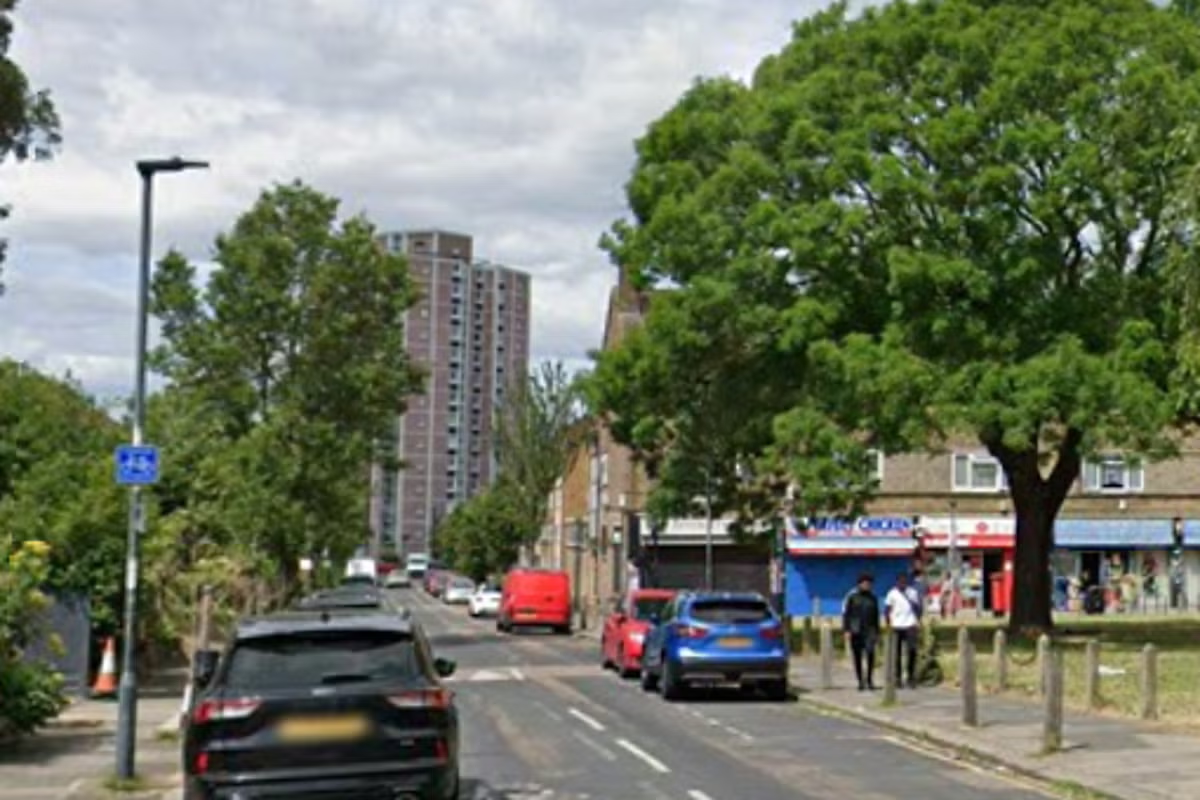
Officers received reports of a shooting on Lord Warwick Street, Woolwich, at about 3.40pm on Thursday, the Metropolitan Police said.
Two boys, aged 14 and 16, and an 18-year-old man have been arrested on suspicion of murder.
The force had said in an earlier press release that the victim was a man, but on Friday confirmed he was a 14-year-old boy.
Advertisement
Detective Chief Inspector Lucie Card said: “Our thoughts remain with the boy’s family and loved ones.
“We are aware of the concern that this incident will cause the local community.
“We have already made three arrests and our investigation continues at pace. An increased police presence remains in the area.
“I would appeal for anyone who was in the area at the time, who has CCTV or dashcam footage of the incident or has information that could help my officers to come forward.”















































You must be logged in to post a comment Login