1983 smash hit Chuckie Egg is being remade for mobile phones, and we’ve spoken to the bedroom programming teen protégé that originally made it.
It’s always sobering to realise that what counts as retro gaming is constantly changing. Although there’s no official definition, it was recently suggested that the Xbox 360 and PlayStation 3 are now definitely retro, being over 20 years old and two generations ago. Some might insist they still don’t count but there’s no arguing about the 8-bit era of the ZX Spectrum and Commodore 64, which is now well over 40 years ago.
Although there are some games from that period that are still active today (Donkey Kong launched a year before the Spectrum itself) most are not, especially anything that was developed in the UK – as a majority of Spectrum games were. 1983 was the start of the video game crash in the US but that didn’t affect Japan or Europe. At that point though the NES was still three years from release in Europe, so at that time the video games industry consisted almost solely of coin-op games and 8-bit home computers.
That year, the best-selling games on the Spectrum included text adventure The Hobbit, Jetpac from Ultimate Play the Game (later to be renamed Rare), seminal platformer Manic Miner and… Chuckie Egg by Nigel Alderton. Back in the days when a game being made by a single person was the norm, he developed the game as a teenager, in his bedroom, and saw it hog the number one spot for much of the year.
Advertisement
Nowadays you have to be of a certain age to even remember the name Chuckie Egg, especially as it only had one sequel – that was not made by Alderton and was a very different style of game, more similar to Manic Miner sequel Jet Set Willy. The original, though, unlike so many games from the period, is still very playable today.
It’s a single screen platformer where you have to collect eggs before a timer runs out. You’re pursued by chickens, with all of you attempting to pick up piles of seeds along the way – which if you get to them first will slow the timer. After the first eight levels the giant bird in the top left of the screen escapes and also pursues you, as the levels get harder and harder.
Expert, exclusive gaming analysis
Sign up to the GameCentral newsletter for a unique take on the week in gaming, alongside the latest reviews and more. Delivered to your inbox every Saturday morning.
Advertisement
It sounds simple, and it is, but what made it such a hit is the smoothness of the controls, which were much more akin to a coin-op than most computer games. Initially released on the Spectrum, BBC Micro, and Dragon 32/64, it was later ported to the Commodore 64, Acorn Electron, MSX, Amstrad CPC, and a variety of other now forgotten computer formats. It subsequently appeared on the 16-bit Amiga and Atari ST, as well as MS-DOS, but never on any console.
Like so many games of the era that means it’s largely been lost to time, increasingly forgotten by British fans and completely unknown to most American and Japanese gamers. However, Chuckie Egg has now been recreated for mobile and is available to pre-order now on iPhone and iPad, and Apple TV, for a one-time, ad-free fee of £2.99. It includes both a version of the original and a modernised edition that twists the camera angle to give it a 2.5D look.
The launch this week also gave us a chance to interview Nigel Alderton, as we discussed his memories of the 8-bit days, how he came to make the game, and what he thinks of the video games industry today.
Advertisement
GC: Even though Chuckie Egg ended up on so many different formats, I still think of it as a Spectrum game. I think probably because it was a few years before I got a computer, a Commodore 64, and the port still looked a lot like a Spectrum game.
NA: I think that was Mike Webb, the Commodore one. Mike Webb wrote about 11 different versions of it, because I wrote the original one and then other people did the conversions. But Mike ended up writing some ridiculous number, I think it might have been 11.
The Commodore had hardware sprites, and you could move a lot around the screen, taking up very little CPU, but if you wanted to scroll the whole screen on the Spectrum that was quite an exotic thing to do. So, people stayed away from those if you’re designing a game for the Spectrum; quite hard to do.
Advertisement
GC: As I understand it you were influenced by Donkey Kong and Space Panic, and I think Space Panic in particular can be regarded as the first ever platformer. So you’re talking the very early days of gaming and yet there was already an established scene with influential titles.
NA: I walked to school every day and there was a newsagent on the way, that had an arcade game. And so the first first one that I remember was Space Panic. And then at some point they had Scramble. They might have had Donkey Kong, but the very, very early arcade platform games. So if you look at Space Panic and Chucky Egg, side by side, the colours are embarrassingly similar. [laughs] I basically pinched them, but they work really well on the Spectrum, the high contrast purple and the green. But yeah, it was very early days, wasn’t it?
GC: So were you a keen gamer at that time? What were your first experiences of computing?
NA: We were lucky enough to have two or three computers at school. There was a teacher called Mr Bishop, who was very forward-looking, ’cause computers were just barely a thing at that time. And he managed to get the funds to get some Tandy TRS-80s. He commandeered a sort of broom cupboard and put these computers in there and I’d seen people wandering in out of the place with these glowing screens and wondered what the heck it was.
Advertisement
So I used to just hang around and try and get onto them to try and type BASIC. And then I peed my parents for a ZX81. But I was always more interested in the writing. I never really played computer games very much at all. Played loads of arcade games. I used to put all my pocket money into the arcades, there’s an arcade in Stockport, which unfortunately was directly on my bus route home from my Saturday job.
So I’d earn my £7 working on the Saturday, get off and change buses at Stockport with the arcade right there. And many times all my money that I earned that day went into those damn machines. [laughs] But I never really played Commodore games or Spectrum games; I never played those sorts of games very much. Just arcade games.
Nigel Alderton back in his school days
GC: I’ve been playing the game and it’s… I wouldn’t call it easy but it’s not as vindictively unfair as a lot of games from that period and it doesn’t involve rote learning. From what you’ve just said I can totally see the arcade influence, where it’s not easy but it is a lot more fluid and accessible than a lot of computer games of the times, things like Manic Miner – which I know you’re not a fan of.
NA: Yeah, I’m not a fan of puzzle games. I much more enjoy games where it’s more about the dexterity rather than figuring out a puzzle. So, I was just writing a game that I would like to play. I can’t remember if that was a conscious thing or a subconscious thing. And also, I didn’t like games that I played where if one pixel of your character touches one pixel of a deadly thing, an enemy character, then you die. So I didn’t like the feel of that. I thought it was too unforgiving. So that was a deliberate choice.
But I think I could have made it easier, is that when you come to a ladder, you’re running on platforms, when you first start playing, it takes people a while to figure out that you have to hold the ‘up’ button as you get to the ladder to be able to run up. Watching people struggling with, they go to the left of the ladder and then press ‘up’ and then to the right and press ‘up’. It’s frustrating, but once you’ve got that knack I think it was quite easy to get into.
Advertisement
GC: There’s a lot of games from that period where climbing that ladder would be a lot fiddlier than even that, but Chuckie Egg seems pretty smooth to me. Were you thinking of things like difficulty and accessibility when you were making it?
NA: Very much. I wanted to try and get progression, so that you would learn skills gradually. And so try and have a screen early on… the first screen, you don’t have to learn all the skills in one lump, and then you develop them over time. So on the first screen, you don’t really have to be able to jump off of a ladder and grab another ladder, for example. Or jump on the lift, you know? So I wanted to introduce things slowly.
And also, I wanted to be able to have as many new levels, where it was not the same as any previous level, without having to come up with new platform layouts every time. So hence, you do the first eight screens and that’s got the eight platform layouts, but then you go and do them again, and you get the bird coming out instead of the tall birds, and then you do ’em again, and you get the next eight and you do them again, and you get both, and so on.
So I was trying to have a progression, so it got got harder. There were other ideas that I never got to do because they were sort of breathing down my neck to say, ‘Come on! Get it finished, get it finished!’ [laughs] Because I would’ve gone on and just kept adding things to it, I think, if they hadn’t been getting me to do that. There were other things that could have been added to make it go on even further. But I think there’s something like, maybe 48 levels where it’s different each level and then after that it just repeats.
Advertisement
The original version has aged surprisingly well (Elite Systems)
GC: I don’t think a lot of developers in those days, were thinking along those lines, which would certainly explain why it was so popular.
NA: Yeah. I also wanted it to be four players [consecutively, not at the same time – GC]. That probably comes from the arcade, when you’re hanging around with a bunch of people or watching one player play. You get the group dynamic of taking the mickey or saying ‘Well done!’ or whatever. The more the merrier.
GC: So what would you have done to the game if you’d had more time?
NA: I think the next thing might have been two birds coming out at the same time, but with with different movements. So one would move with a different algorithm. And then I think another one was getting bits of the platform to disappear. So you get the same platform layout, but just with the odd brick taken out… ’cause that wouldn’t take up much memory to do that or having to design a complete new level.
GC: I guess maybe there was a story in the cassette inlay or something, but did you have any kind of plot explanation in mind while you were working on it? Because it’s pretty abstract but it’s not completely surreal or random like some other games from the time.
Advertisement
NA: I dunno. Because it’s all out scale, isn’t it? You know, the tall birds… I called them tall birds, but that was kind of an ostrich type thing. But then the bird that comes out of the cage is ridiculous size, isn’t it? Compared to that. There’s a sort of narrative, but it’s a bit messed up. But it is more to do with what I would… because I’m hopeless at graphics. I can do the programming, but I can’t make a pretty picture.
So it was just what was easy to draw. And the square hat came from the fact that I didn’t want pixel collision, I wanted it to be based on a softer collision detection, the collision had to be a roughly a square shape. So the hat kind of makes him visually more square.
GC: So it becomes the hit box?
NA: Yeah, so it’s a trade off between the limits of my coding ability and the limits of my graphics ability. [laughs] And then they [publisher A&F Software] called him Hen-House Harry. They came up with the name Chuckie Egg and tried to create a bit of a narrative, I think, but they were almost random characters that I was drawing.
Advertisement
Nigel tasted success early
GC: Who was the publisher? They were all northern companies back in that day, weren’t they? There were very few that were down south.
NA: Yeah, there was a lot up North and a few in Birmingham, and then there was a couple in Liverpool and then a few in London. But all the magazine publishers were down in London, but all the developers and the game creators were sort of spread all over the country.
GC: So you lived in Stockport but where was A&F based?
NA: A&F were in Denton, I think it was. But I got a Saturday job with them, through a friend of mine. And so I was just making cups of tea on a Saturday and serving in the shop and that kind of thing. And I showed them a game and they weren’t interested, but they said, ‘Oh, take it up to this guy up the road. That was in Hyde, so I went and I got given a cheque for something like £700, for this game that I’d written just before I wrote Chuckie Egg.
GC: That would’ve been a lot at the time, I imagine.
Advertisement
NA: It was a ridiculous amount! I went home with this cheque, thinking, ‘Well, this can’t be real. I won’t believe until I see it in my bank account. I showed it to my dad and that was the first time I’d actually heard him swear, like really swear. And he just couldn’t believe it. I was shocked somebody would pay me to do this thing that I just did for fun, you know? I wrote it because I enjoyed it. And then I wrote Chuck.
So anyway, I turned up to my Saturday job one day, and Chuckie Egg was only half finished, and I showed it to them and this crowd of people all started crowding around going, ‘Wow, look at this!’ So I was really chuffed that I had impressed them.
It was pixel movement and that wasn’t really a thing at that point, on the Spectrum. Nobody had really worked out how to do it. It was all character movement and there wasn’t really any pixel movement games published at that point.
GC: Can you briefly describe what the difference is?
Advertisement
NA: So, if your character, you are controlling, moves left and right, then character movement is it has to move in jumps of eight pixels on the Spectrum, left or right, or up or down. But pixel movement, you can just move one pixel at a time. Chuckie Egg moves two pixels at a time.
Nigel as he is today (Elite Systems)
GC: So were you doing all this just by yourself?
NA: I did the whole thing. I did the whole Spectrum thing, yeah.
GC: How did you learn to program? Was that at school?
NA: I managed to get a little bit of time on these Tandy TRS-80s, occasionally. ‘Cause there’s loads of kids, all sort of fighting to get on them. And there was only three of them, I think. And then there was a sort of pecking order, but I did manage to occasionally, if I stayed late enough after school or got in early enough, to get a go. And then I got to play with that on BASIC.
Advertisement
Then the main thing, where I learned the most and really started to learn how to code, was that I got a ZX81. I pestered my parents or… I think I used part my pocket money and then they chipped in a bit and I got the ZX81 and learned BASIC on that.
But then, also, I started to learn machine code on that, just the real beginnings of it. But actually got machine code to work on the ZX81. And the difference in the speed just blew my mind. When I first got a block to move left and right, on the screen, using keyboard controls… when I got the code running in machine code, I thought it’s not working because it just goes fully from the left of the screen all the way to the right of the screen, in one jump. But it wasn’t, it was just because it was so quick!
So it just blew my mind, the speed of it. And I thought, right, this is the answer. And then the Spectrum was announced and I was just drooling over magazines every week, looking at these beautiful colour pictures of the upcoming Spectrum, which was massively delayed and delayed and delayed. But yeah, I sent my cheque off and that was partly my pocket money and partly my parents. And it covered Christmas and birthday rolled into one, so I think it was over £100, which was a lot of money in those days.
So I sent my cheque off, or postal order or whatever, and then just waited and waited and waited. And I think it took three months to come, ’cause they were just so massively swamped by orders. And the day it came through I couldn’t believe it, like this magical thing. It was awesome!
Advertisement
GC: [laughs] What age were you when this was happening?
NA: I got the Spectrum when it first came out… would that have been ’82? So I was born in ’66. So what’s that? Maybe 15 or 16? I was 16 when I first started writing Chuckie Egg, I think, and then it came out when I was 17. So I was writing Chucky when I should have been studying for my mock A-levels.
GC: Well, the world benefitted from your choice. Well, I say the world, but I doubt anyone outside of Europe even knows the game. Did it ever get ported to anything that wasn’t a home computer?
Advertisement
NA: No, I don’t think so. It is being now, but back in the day. But it did go to Europe. It’s known in Portugal, apparently, and Spain. Which I’ve only just found out recently, because I got an email from a sort of retro computer enthusiast in Portugal.
GC: [laughs] Playing it again now it really should have been turned into an arcade game, but as big as the British development scene was at the time that sort of thing never happened.
NA: There was plenty of games for the Spectrum or the Commodore that could have gone the other way and gone to arcades. I think you’re right. But they all came the opposite way, didn’t they? You’d have conversions from the arcade games, but the arcade industry could have done the same thing and licensed home computer games and just pick the most popular and successful ones.
GC: So Chuckie Egg is a big success and you’ve got another massive cheque from the publisher. What happened after that? Did you work on Chuckie Egg 2?
Advertisement
NA: No, I didn’t. And I wasn’t a fan, actually. I didn’t like their design for it.
GC: I thought as much, because if you don’t like Manic Miner you’re not going to like Chuckie Egg 2.
NA: [laughs] Yeah, I don’t like that Manic Miner style of game, with the collision detection and it being puzzle-orientated. It’s just not my thing. I’ve nothing against, hat’s his name that wrote it?
GC: Matthew Smith, I think.
Advertisement
NA: That rings a bell, yeah. So then I finished school and I didn’t want to go to university, The parents were quite keen for me to do that but I didn’t really like school, so I didn’t really want to go to university. And I felt that I had a skill and somebody told me that, well, you’ve written Chuckie Egg. You could walk into any company, any games publisher, and just say, ‘Gimme a job!’ And they’d hire me. So I did. So I went and I applied to Ocean and they said, ‘Yeah, come and work for us. So I went to work for them for about 18 months, I think. A year and a half.
Nigel even made it into the papers
GC: What did you do there?
NA: I worked on Street Hawk with Mike Webb and Joffers [probably Jonathan M. Smith], what did we do? We did this game… you had like a car and it was a rollercoaster thing on the screen, and I can’t remember what the actual game was [Kong Strikes Back – GC]. I can’t remember what you were trying to do, but I think those were the only two. I don’t remember working on any others.
GC: So what happened after that 18 months? Did you go to another company or had you had enough of games by then?
NA: Well, I thought I’d go and be a freelance programmer. So I started touting around for freelance work. I think, mainly, so I had more freedom and you get more money as well. That’s how I met Steve Wilcox [who currently runs Elite Systems, publishers of this new version of Chuckie Egg – GC].
Advertisement
I can’t remember how I got in contact with him – maybe I phoned up or wrote or something, or did I reply to an advert? So he was looking for programmers to do Commando on the Spectrum and the Commodore, and one other. So I said I’ve written Chuck Egg and Street Hawk, so he hired me and a guy called Keith Burkhill to do Commando on the Spectrum. And that was on a very, very tight schedule, ’cause it had to be out for Christmas.
So I went and worked for them. And then I sort of got burnt out as a programmer and then went and worked for Steve full-time as an employee, just managing all the other programmers. Just coordinating them and making note of how far along they were, ’cause he was running so many projects at the same time and Steve was sort of overwhelmed. So I helped him to just basically schedule things. So I did that for a while, maybe a year or two, and then moved to Audiogenic down in London. And I was software development manager there and I was sort of slightly involved in that football game [Emlyn Hughes International Soccer – GC].
So I think I spent a couple of years there and then after that… I’d always viewed the games industry as a bit of a not proper job, if you know what I mean. And I thought PCs were grown-up computers and the Spectrum and the Commodore were games computers, there were sort of toys really. It’s a bit of snobbery there maybe.
So I thought, right, I’ll try and get a proper job now. And so I went to work for a company in the city. So I was back to programming again, but I was programming on a PC. So that was my entry into the PC world, which is where I spent the rest of my career, if you can call it that, my life. [laughs]
Advertisement
GC: What were you doing there? Nothing to do with games, by the sound of it?
NA: No. So, I started off doing PC support and computer installation and maintenance. So I moved to a company in south London and so they sold computers and installed ’em for people and installed ethernet networks, early ethernet networks. So, I was installing the computers, installing the networks, and we also did tech support as well. So we’d go around and fix computer problems. That was for all sorts of different companies and then I went to work for Engelhard in Surrey and spent seven years there. And they’re a precious metal manufacturer, and I was looking after all the PC equipment in that company.
GC: Steve said you were in property now?
Advertisement
NA: [laughs] I’m semi-retired but I moved house and it was a bit of a doer-upper, but then I decided that I didn’t like the location in the end. So I moved again, very quickly, and bought another doer-upper, so now I’m doing this one. So that keeps me busy.
GC: So while all this was going on the games industry was expanding and evolving in the background. Did you retain an interest in it, have you kept abreast of how things have changed?
NA: Not really, no. Because I’ve kind of grown out of going to arcades.
GC: Well, you don’t get a chance nowadays…
Advertisement
NA: [laughs] I don’t think any of my friends were particularly still into playing computer games and I was never really into playing computer games. It was a bit of a bubble really, wasn’t it? ‘Cause all these home computers came out, the VIC-20 and the Dragon and god knows what, and there was gazillions of them at one point, and then it seemed a bit of a bubble that burst maybe, I don’t know if that’s true, but it was mainly a console thing.
GC: Yeah, the whole home computer market faded away in the 16-bit era and much of the British games industry with it. It’s a shame because if Chuckie Egg had been Japanese or American you’d be on your 20th sequel by now!
NA: [laughs] I mean, the hardware moved on, didn’t it? And then you get these first person shoot ’em ups and also the idea of being able to write a game completely yourself… I mean, maybe not the graphics, but all the design, all the programming, and do it in a reasonable amount of time… one person could write a game. There’s no chance one person can do that now, or very rarely, isn’t it? Games are massive beasts now that you might need hundreds of people. Yeah, it’s very different.
Advertisement
GC: Well, that’s true for the bigger games but I don’t know how aware you are of the indie scene, where it’s not unheard of to have just a single person – or certainly a very small team – making a game on their own. Is that something you’d ever be interested in doing, as a hobby or something?
NA: So they do exist, do they? There’s the phone games I suppose, as well, isn’t there? I dunno whether Flappy Bird was just one guy?
GC: It was and he got so upset that people were addicted to the game that he stopped it, he withdrew it from sale.
NA: [laughs] I didn’t realise that!
Advertisement
GC: He was so overtaken with guilt that he was wasting people’s lives.
NA: Is that what it was?
GC: Well, that’s what he said. I think fans brought it back or something, but the original creator is not involved I don’t think.
NA: Wow. So it had a shelf life and now it’s gone.
Advertisement
GC: There’s dozens of indie games released every week but a good percentage are by very small or one-man teams.
NA: On what hardware?
GC: Some are only PC, but many of them make it to consoles if they’re successful. And some to mobile as well.
NA: Right. Yeah, it’s not a world I know anything about.
Advertisement
GC: And yet you created a classic video game all those years ago, which is still perfectly playable today. More so than most home computer games from that era.
NA: Thanks very much.
GC: It’s not a complicated game but it is very playable and there’s more variety than you’d expect.
NA: That was a conscious thing, that I wanted to get a complexity of play without a complexity of structures or things… concepts. So to try and get a lot of variety by doing combinations of the different ideas in there.
Advertisement
The 3D effect is a neat way to update the visuals (Elite Systems)
GC: I’ve always felt learning a new skill was very important, to action games at least. But it’s something that mainstream publishers have been fighting for years; they worry that it puts people off.
NA: There was a ton of kids coming up with ideas in the early days. There was so much variety as well. It was all different, the types of games and many, many genres of games.
GC: I think you’d be interested if you looked into the indie scene. Slay The Spire 2 is one of the biggest games on Steam at the moment and the first one… I think they got more people to help with the sequel but the first one was basically just two guys.
NA: I believe you get these 3D engines, and physics engines, and things now, so you’re not having to code every line. You’ve at least got some something to start with.
GC: You can get things like Unity, which are very cheap, so you can plug all that in, yeah.
Advertisement
NA: I mean, that’s the sort of thing that might get me to have a fiddle around with something and play around with something.
GC: [laughs] Give it a go, make a true Chuckie Egg 2.
NA: [laughs] Chuckie Egg 2026 or something. Chuckie Egg 2100.
GC: I suppose we should put in a quick plug for the new mobile versions. So there’s a recreation of the original and then a version with sort of isometric graphics?
Advertisement
NA: Sort of pseudo 3D, yeah. But the gameplay is very close, if not identical, to the Speccy version, the original version.
GC: Did you oversee this new version?
NA: It’s taken a while to come to fruition and I have had a play every now and again, but I’m not supervising it. It’s not me writing the code but I’ve put my twopenn’orth in occasionally.
GC: Purely by coincidence we’ve had a lot of retro stories recently, and there’s been a lot of interest.
Advertisement
NA: I had a plumber come round, a while ago.
GC: Mario, was it?
NA: [laughs] Some friends, for my birthday, had a T-shirt made with Chuckie Egg on the front of it and it was so well done that it’s framed, and so it happens to be leaning up against the wall and this guy came in and he said, ‘Oh, Chuckie Egg!’ And I said, ‘Yeah, I wrote it.’ And he couldn’t believe it. It’s amazing how many people of the right age group remember it and have a fond memory for it.
GC: You should be absolutely proud of what you made. For a Brit of the right age that was their Mario or Halo. You made something that will long outlive you.
Advertisement
NA: Yes, It’s amazing though, isn’t it? Yeah, yeah. Nice little feather in my cap.
GC: Alright, well thanks very much for your time.
NA: Cheers, cheers.
Maybe one day there’ll be a true Chuckie Egg 2 (Elite Systems)
There was good news for customers announced on Tuesday afternoon
Halifax has given a new update to customers and potential customers, but there’s a warning that the good news might not last.
Advertisement
It announced mortgage rate reductions of up to 0.25% on Tuesday, but brokers have said the cuts could be “short-lived” as SONIA swap rates, which are used to price fixed-rate mortgages, have risen sharply following renewed tensions in the Middle East. Halifax on Tuesday afternoon said it was making reductions of up to 0.25% on two, three and five-year fixed rate remortgage products and up to 0.24% on two and five-year fixed rate product transfer and further advance mortgages.
It also announced reductions of up to 0.05% on two, three and five-year Homemover and First Time Buyer fixed rates. However, the two-year SONIA swap was up 13.2bps on Tuesday, at 4.338%, while the five-year was up 13.6bps, at 4.313%.
In recent weeks, numerous lenders have announced chunky rate reductions, but Emma Jones, MD at Runcorn-based Whenthebanksaysno.co.uk, cautioned that this kind of jump in swap rates could see lenders reprice upwards in the days ahead.
She said: “Renewed tensions in the Middle East are sending swaps north again and mortgage rates could soon follow. If they carry on climbing, the rates that are here today could be gone tomorrow.”
Advertisement
Nouran Moustafa, practice principal and IFA at Roxton Wealth, described the increase in swap rates as “a real warning light for borrowers” and said “if Middle East tensions keep pushing oil, inflation expectations and swap rates higher, some of today’s cuts could disappear very quickly”.
She continued: “For borrowers, the message is simple: do not wait for a perfect rate that may never arrive. If your deal is ending in the next six months, review your options now, secure something and keep monitoring. A good adviser can switch you if a better rate appears before completion.”
Riz Malik, Independent Financial Adviser at Southend-on-Sea-based R3 Wealth, agreed: “With renewed instability in the Gulf, recent rate cuts may be short-lived.”
Advertisement
Rohit Kohli, director at Romsey-based The Mortgage Stop, described the current mortgage market as a rollercoaster and said some lenders are pulling rates with hardly any notice.
He warned on Tuesday: “Swap rates have moved up sharply today, and when funding costs rise, lenders that price heavily off swaps often respond quickly. We have already seen other lenders pull products at short notice today, including one with less than two hours’ warning.
“My advice to borrowers is simple: if the rate works for you today, do not delay. Get your documents ready, speak to a broker and secure the deal while it is available. You can always review later if pricing improves, but you cannot lock in a rate after it has been withdrawn.”
David Stirling, Independent Financial Adviser at Belfast-based Mint Wealth, urged people to “think carefully before playing the waiting game”.
He added: “Any escalation could send rates back up as quickly as they came down. For any existing Halifax borrowers, a swift internal product transfer may well be worth more than sitting tight for a remortgage deal that could yet prove elusive. These can potentially be revised should rates drop.”
Mirroring Moustafa, Ken James, director at London-based Contractor Mortgage Services, said the cuts were “good news on the surface, but the market underneath is flashing warning lights, because while Halifax is cutting, the cost of funding mortgages is rising fast”.
He continued: “If swaps stay elevated, these rates won’t stick around but for those who can benefit from these cuts, the message is clear: ACT and don’t dilly-dally.”
Would you try it? (Picture: Inbaal Honigman/Getty)
There are lots of big decisions that come with choosing to have a baby – things like which cot should you get? How many babygros will you need? And, can you really name your child Asparagus?
Often, people will talk about the decision to try and time having a baby born at a particular time of year – like a September baby so they’ll be the oldest in the school year, or a summer baby, to avoid the expense of Christmas.
But now, some parents-to-be aren’t just thinking about what age their child will be when they’re sitting their SATs, they’re also thinking about determining their star sign.
Some keep astrology in mind believing their baby will grow up with personality traits that are reflected in their Zodiac sign, or will be more compatible with other family members because their signs work together.
Advertisement
This is an idea that Inbaal Honigman, 52, a psychic from Holmfirth in Yorkshire, fully understands – because all four of her children’s star signs were planned.
Though she was hoping for a full house of Pisces children, the one Capricorn fits right in. For Inbaal, the priority was avoiding Aries.
‘I wasn’t raised in an environment that was open to spiritual ideas, and when I was 20, I accidentally stumbled onto Tarot and loved it,’ she tells Metro.
‘Practising Tarot readings and learning the spiritual world fascinated me, and one of the most attractive parts in learning Tarot was how the different elements, earth air fire and water, responded to one another. Star sign compatibility has fascinated me ever since.’
Advertisement
Inbaal and her family of Pisces and one Capricorn (Picture: Inbaal Honigman)
Long before children were on the radar for Inbaal, she knew that star signs were important when it came to meeting a future partner, and she filtered through online dating profile matches hoping to find someone who was a compatible sign.
‘In 2005 I set up a dating profile, and one of my criteria was that they had to be Pisces or Sagittarius. Not only are they my favourite signs, but I thought they’d be my most compatible signs,’ she explains.
‘I’m a Pisces and would have loved someone my own sign, and I have my moon in Sagittarius, so I thought a Sagittarian would be compatible with my more adventurous, fun loving side. I met my husband, Sean, this way – he’s a Pisces with Sagittarius rising and we were a wonderful match.’
Two years later, Inbaal and Sean began trying for a baby – and although the child’s zodiac sign wasn’t her number one criteria, Inbaal still hoped that she would have a child whose sign was compatible with her own.
‘I struggled to conceive, so I’d have been happy with any baby. But, in one of my many conversations with friends and colleagues, a fellow psychic suggested that I send my husband a Father’s Day card from our unconceived baby. That was June 21 that year, which coincided with the Summer Solstice, a traditional day of conception, and I thought, if we conceived right now, it would be a Pisces. I loved the idea so much – a happy family of three happy Pisceans!
Advertisement
‘We did conceive and her due date was in Pisces.’
With her baby overdue, Inbaal was offered an induction – and, although she wanted to try and hold on without intervention, she also knew how important it was to her to have her Piscean baby.
‘I was relieved.’ (Picture: Inbaal Honigman)
‘I was offered two induction dates, one would be in Pisces and the other in Aries. Even though I wanted to wait for her to arrive naturally, my desire for a Pisces baby made me pick the earlier date,’ she says.
‘I was absolutely elated to get my Pisces baby, I was relieved, as I know Pisces so well and what makes them tick. I felt that I could be an amazing mum to this baby, there’s nothing about Pisces I didn’t know, and I was thrilled.’
Although she admits her husband has no idea which sign is associated with which dates, when it came to planning for further children, Inbaal says he supported her desire to have children with Piscean or Saggitarian zodiac signs.
Advertisement
Inbaal’s husband has no idea about star signs, but supports her wishes (Picture: Inbaal Honigman)
But, even with careful planning, Inbaal’s pregnancies didn’t always result in the star signs for her babies that she’d hoped for. While her second child, born in 2012 was also a planned Pisces, her third pregnancy in 2015 hit complications and resulted in a Capricorn son – a sign that wasn’t on her wishlist.
‘Originally a twin pregnancy, the due date was in Capricorn season, which was never on my wishlist. If I’d delivered as a multiple, I’d have had a caesarean scheduled for Sagittarius, and I adored the idea of two Sagittarius babies together. Only one twin made it, and he’s a Capricorn, but he’s perfect. I’ve searched my soul for any signs of regret or sadness that he wasn’t Sagittarius, and there are none. He’s a gorgeous, smart and sassy child, and I wouldn’t change him for the world.’
Inbaal’s fourth child arrived in 2017 – another Pisces, born on the same day as their first child, who she jokes arrived ‘nice and Pisces, just the way I like them!’
While the reasoning behind this trend might be to get certain traits in your child that are synonymous with their star sign, Inbaal does admit that the plan isn’t foolproof – especially as only 5% of babies actually arrive on their due date – which could spell disaster if you’ve got your heart set on a flexible Gemini but end up with a stubborn Taurus.
‘Even if you get exactly what you asked for, you may not get what you want,’ she says.
Advertisement
‘I planned my Pisces babies specifically to avoid Aries babies. Some of my favourite people are Aries, but I didn’t think I’d be a great mum to a boisterous, overactive baby like an Aries.
‘I got my perfect Pisceans, but they do all have strong Aries placements in their charts, which means they’re all boisterous and overactive despite being Pisces.’
This article was originally published in June 2023.
Two million airline seats have been cut from May schedules worldwide as soaring jet fuel prices, driven by the US-Iran war and Middle East conflict, spark mass flight cancellations including over 100 from Heathrow
Tannur Anders UK & World News Reporter
06:28, 06 May 2026
More than 100 flights have vanished from Heathrow Airport’s May timetable as jet fuel costs continue to surge during the US-Iran conflict.
Heathrow’s schedules have axed 111 flights over concerns that prolonged jet fuel supply issues could trigger additional cancellations throughout the summer months. British carriers were informed over the weekend that they may be given greater leeway to merge flights on busy routes should the need arise.
Advertisement
Airlines have slashed two million seats from May’s schedules as they reshape their operations in response to rocketing jet fuel costs stemming from the Middle East crisis, according to the Guardian.
Fuel prices have skyrocketed since the US-Iran war began over two months ago, following joint American and Israeli strikes on multiple Iranian targets. Iran hit back by attacking locations throughout the Middle East and shutting down the vital Strait of Hormuz shipping channel, which handles 20% of the world’s oil trade.
Roughly 13,000 fewer flights will take off globally in May following recent cuts, based on figures from aviation data firm Cirium.
Part of the two million seat reduction has come through deploying smaller aircraft alongside outright cancellations.
The most significant reductions in flight numbers have occurred at Istanbul and Munich airports. Turkey’s national carrier and Germany’s Lufthansa have implemented massive cutbacks. Lufthansa has axed 20,000 short-haul services run by its CityLine division. Most short-haul airlines flying from the UK have secured strong hedging on jet fuel. This means they’re not bracing for instant cost hikes.
Low-cost operators EasyJet and Wizz Air have pledged to run their summer timetables in their entirety, despite strain on the unhedged element of their fuel expenses.
The sector reports no current supply problems, considering the typical six-week forward visibility, though international bodies have warned that Europe could face jet fuel shortages should the Middle East conflict continue disrupting supplies.
Advertisement
The UK government has indicated that extraordinary steps might be implemented ahead of time to prevent last-minute chaos for holidaymakers throughout the summer period. This includes merging timetables on routes where several flights to identical destinations operated on the same day.
Ministers added that where airlines haven’t shifted a substantial share of seats, flights could also be axed to avoid squandering fuel by operating near-empty aircraft.
Transport Secretary Heidi Alexander has stated there were no “immediate supply issues”, though the government was “preparing now to give families long-term certainty and avoid unnecessary disruption at the departure gate this summer”.
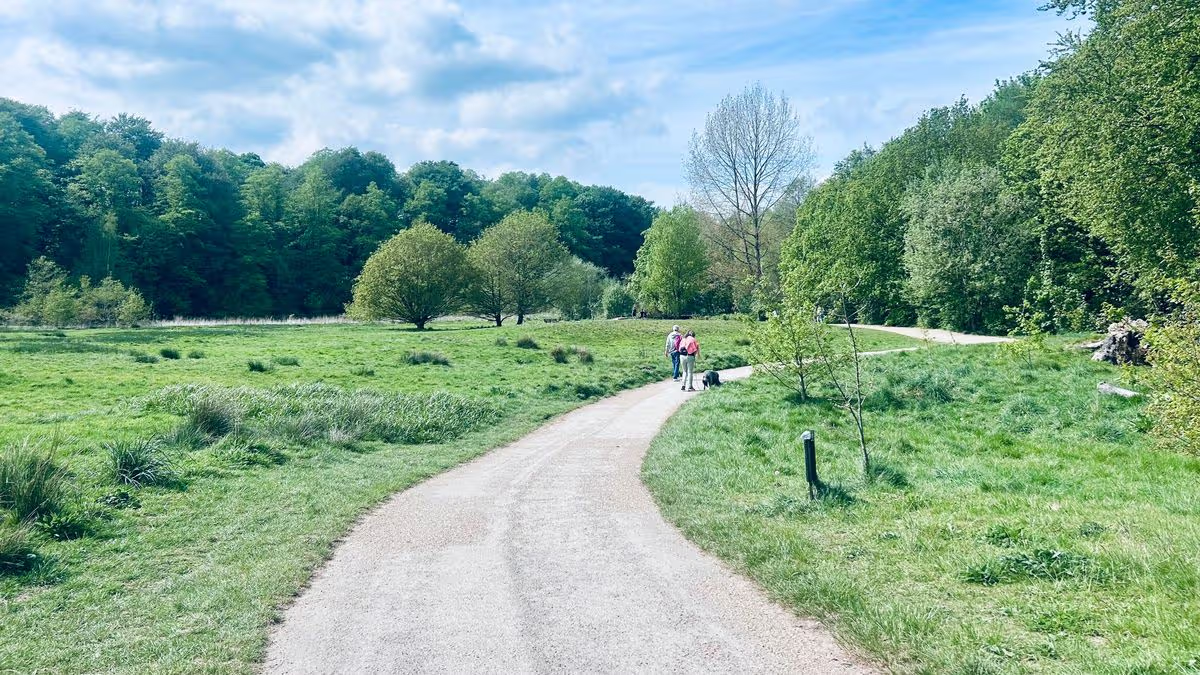
Set along the leafy banks of the River Bollin the park links the nearby town centre with the Cheshire countryside
As we edge closer to summer and with warmer weather and conditions hopefully on the horizon, spending time outside will become much more appealing. In early spring we’ve been treated to beautiful daffodils bursting through the ground, the trees coming into blossom and lush greenery covering our landscapes.
Advertisement
We can expect more of the same as the next May Bank Holiday approaches and it’s not too soon to start planning a day out, excursions and family activities. If we’re blessed by the weather gods, there’s a Cheshire spot just a few miles from the boundary with Stockport that’s ripe for exploring.
The Carrs in Wilmslow is a huge 71-acre park with a network of paths following the route of the River Bollin. It meanders all the way to Quarry Bank Mill and then to Styal Country Park, meaning there are plenty of walking options and places to explore.
Click here for the latest on Manchester’s food & drink scene, gigs and more in our CityLife newsletter
The word ‘Carrs’ comes from the Old Norse word ‘Kjarr’ meaning ‘meadow recovered from bog’ or ‘waterlogged woodland’ nodding to the original state and subsequent use of the area. It first started to take shape as a park in 1925 when Henry Boddington, of Boddingtons Brewery gave playing fields to the public. Then in 1935 Wilmslow Urban District Council bought the land adjacent and established The Carrs Park.
Advertisement
For families there’s a great deal of facilities and attractions at the park. This includes two children’s playgrounds – one modern and one wooden featuring a zip wire, obstacle features and swings and slides. There’s also a multi-use football area, outdoor gym equipment, courts, and skateboard ramp.
More widely, and for everyone to enjoy are the plentiful riverside and woodland walks, open grassland and number of spots to have a picnic. Within walking distance of Wilmslow, it’s an easy spot to access if you want to explore the Cheshire town during a visit too.
Just beyond the playground you’ll come across the route map which shows you various different paths to take but also the types of wildlife you might encounter should you plan to walk all the way to Styal Country Park.
Wildlife in the Carrs to be on the lookout for includes Grey Herons, Pipistrelle Bats, Kingfishers, and Brown Trout. Also within the Carrs, and of historical interest is the ruined St Olaf’s chapel, which was built in Victorian times by the Boddington family.
For those wanting to take a picnic in the park there are designated picnic areas with tables for use – and some of these are right by the river where there’s a chance to paddle in the shallower water.
Advertisement
Cheshire East Council has published some guidance about holding gatherings in the park and picnics – and if you’re holding an organised event for more than 20 people you will need to fill in a form via the council’s website.
For those wanting a good stroll, the park is a good starting point to Styal Country Park and the wider Dean Valley. Equally, you can just do a short riverside loop with points marked out to spot the aforementioned wildlife species.
After a walk and if you finish up at the end by the modern playground there’s a hut run by Tiger Coffee and Ice Cream which serves hot drinks, cakes, snacks and ice cream tubs.
Advertisement
There’s also the ice cream van selling classic Mr Whippy soft-mix ice cream with the classic Flake and raspberry sauce, as well as an assortment of other treats. You can also venture into Wilmslow where there’s a strong roster of cafes and coffee spots.
The Carrs Park, Wilmslow, Chancel Lane, Wilmslow, Cheshire, SK9 4AA. There are two car parks at either end, and the one at Parish Hall is limited to 60 spaces, but has toilets and baby changing facilities.
Bishopton PRU, which looks after 67 children between 11 and 16 at risk of exclusion, was failing to provide an acceptable standard of education during an Ofsted inspection in January.
Students at the Billingham school were found to experience “significant disruption to their learning” with a “narrow” curriculum leaving them “ill-prepared” for later life.
Leaders also raised concerns about “insufficient support” from the Atomix Educational Trust, which runs the site, amid serious issues with attendance.
Advertisement
Dr Sharon Dobson Waters, director of quality and curriculum at Atomix, said it welcomes the external support and said a number of improvements have been made over recent months.
‘Urgent improvement’
While relationships between staff and pupils were positive, inconsistencies in management meant some students did not feel safe because of their peers’ behaviour.
Some students were reluctant to come to school over fears of being bullied – and pupils do not get the support they need to boost attendance, despite staff working hard to try and help.
Bishopton PRU does not have an “effective or rigorous approach” to overseeing pupils’ whereabouts and being assured of their safety.
Advertisement
Some pupils and parents have little confidence in the site’s ability to keep them safe, and the trust has not acted on requests from school leaders to make sure that the site is secure.
Pupils do not achieve well, including the high proportion of pupils who have special educational needs (SEND) and/or disabilities.
Many pupils have gaps in their prior learning when they join the school and are not supported well enough to catch up, meaning these gaps are widened.
Systems to monitor and record what pupils know as they progress are weak.
Advertisement
While leaders express “high ambition” for the curriculum, current staffing arrangements do not support the full delivery of it.
Staff do not get the training they need to develop their subject knowledge and curriculum guidance for teachers is inconsistent.
Despite this, when serious concerns are raised about a pupil, leaders “take appropriate action to check on their welfare” and record a “clear picture of actions to safeguard pupils”.
‘Frequent absences’
Bishopton PRU has low rates of attendance, with strategies to improve this “not effective”.
Advertisement
In the 2024/25 year, the school had an overall absence percentage of 61.7 per cent – although this was up from 2023/24’s figure of 51.5 per cent.
Behaviour at the site has improved since the previous inspection, but inconsistencies in management remain.
Rates of suspensions increased during the autumn term this year because leaders enforced tighter rules – but the reintegration process after doesn’t offer pupils “sufficient support to change their behaviour”.
The Ofsted report also found the trust, formerly the Tees Valley Collaborative Trust, was not meeting its statutory responsibilities for educating or safeguarding SEND pupils.
Advertisement
Leaders do not ensure that learning is adapted well enough to support SEND pupils and there are significant weaknesses in the school’s approach with supporting them.
Staff do not get the training they require so that they know how to adapt support when necessary and the overside of SEND pupils who attend education off site is poor.
School and trust leaders were found to lack the strategic direction, capacity and oversight needed to secure rapid and necessary improvement.
Leaders have raised concerns about insufficient support from the trust, while trustees and governors appear to be unaware of the scale of support that the school needs.
Advertisement
Leaders assert that the school is improving but “overestimate” the success of their work to improve attendance.
However, the school has a “coherent” PSHE curriculum that is approached by staff with sensitivity and care. It also is developing an appropriate careers provision.
‘Continuing challenge’
Atomix Trust said pupils remain at the “very heart” of the school’s commitment to education, safeguarding, and care.
Dr Waters said the trust welcomes external support and will “continue to work openly and collaboratively”.
Advertisement
She said: “Bishopton is one of the largest pupil referral units in the region and it serves some of the most vulnerable children and families in our community, including many pupils who have experienced exclusion, trauma and disrupted education.
“Supporting these young people back into learning is complex work that takes time, partnership and sustained effort.
“The recent inspection recognised improvements in staffing, curriculum and behaviour, but also highlighted the continuing challenge of attendance and school refusal.
“These are not issues any school can solve in isolation. They require close working between schools, families and the local wider system that supports children.
Advertisement
“There have been many new updates at Bishopton to meet the new Ofsted inspection framework and we continue to work closely with the Local Authority.
“Over recent months Bishopton has introduced new leadership structures, curriculum changes and community-based outreach, to re-engage pupils who are struggling to attend.
“This work is still at an early stage, but the direction is clear: the focus is on keeping children safe, supporting families and helping pupils back into education.
“We encourage the community to support the school and its leadership through our open-door approach, and we want to reassure our pupils, families, staff and community that we will continue to take decisive, detailed action as part of our ongoing commitment to our number one priority – putting young people first.”
Divorce is a major life event that often brings significant personal and financial changes.
While many people focus on property, finances, and arrangements for children during divorce proceedings, updating a will is often overlooked.
Advertisement
Understanding what happens to your will after divorce is important to ensure your estate remains consistent with your wishes.
Is your will valid after a divorce?
Your will generally remains valid after divorce, but the law changes how certain parts of it are treated once the divorce is finalised.
When the family court issues the Final Order, the law treats your former spouse as though they have died for the purposes of your will.
Advertisement
This means:
· Any gifts left to your former spouse or civil partner will usually fail
· Any appointment of your former spouse as an executor or trustee may no longer apply
This can create problems if your will is not reviewed, especially if your former spouse played a major role in your estate planning.
Advertisement
What happens before the final order?
These changes do not happen when separation begins or when divorce proceedings start. They usually only take effect once the Final Order is granted.
Until then, your existing will still applies fully. This means that if something happens before the divorce is legally completed, your spouse or civil partner may still inherit under your will.
This is particularly important for estranged spouses where the relationship has ended, but the legal divorce is still ongoing.
Advertisement
Why you should update your will
Even though your will may remain valid after divorce, failing to update it can lead to unintended consequences.
For example:
· Children or family members may not inherit as intended
Advertisement
· Your chosen executor or trustee may no longer be appropriate
· Part of your estate could fall under the rules of intestacy. The rules of intestacy apply where there is no valid will, or where part of your estate is not fully addressed. These rules follow a strict legal order, which may not reflect your wishes.
How AFG Law can assist
At AFG Law, our experienced private client team provides clear advice on wills and estate planning following divorce and separation.
Advertisement
We can assist with:
· Helping you understand whether your current will remains suitable
· Advising on how divorce affects your estate planning
· Preparing a new will that reflects your updated wishes
Advertisement
· Replacing a former spouse as executor or trustee
· Supporting wider planning, including Powers of Attorney and tax planning
Divorce is the right time to review your will.
Updating it now can help avoid complications later and give you peace of mind for the future.
Not the picture-perfect version. The real version.
The one where life gets busy. Where conversations get shorter. Where you’re both trying to keep everything going, and connection slowly takes a back seat.
I’ve felt this myself. When you’re juggling work, family, and responsibilities, it’s easy to slip into routine. You’re talking, but not really connecting. You’re there, but your mind is somewhere else.
And over time, that creates distance. Not because you don’t care, but because you’re stretched.
Advertisement
Then comes the guilt. Feeling like you’re not showing up properly. Not giving enough. Not being present.
But here’s something I always come back to. Connection doesn’t need hours.
It needs intention. So instead of trying to fix everything, start small.
The State Shift (NLP Tool)
Advertisement
Before you walk into your home or into a moment with someone important, pause. Take a breath. Drop your shoulders. Think of one thing you genuinely appreciate about that person. Hold that feeling for a few seconds, then walk in with that energy.
That small shift changes everything.
Kirsty Redford (Image: Kirsty Redford)
Now add mindfulness. When you’re with someone, put your phone down and really listen. Notice their tone, their expressions, their presence. Stay in that moment fully, even if it’s just for a few minutes.
Also check in with yourself:
Advertisement
Have I been present today? Have I actually listened? Have I shown how I feel? And then check in with them, too.
Because sometimes all someone needs is to feel seen. Relationships don’t break from one big moment.
They drift from lots of small ones. So bring it back, one moment at a time.
See you next week!
Advertisement
Kirsty Redford is the founder of Firewalk Events, based in the North West. She specialises in mindset, empowerment and wellbeing experiences, helping individuals, charities and businesses build confidence, resilience and connection through powerful, interactive events.
Bear Wolf (Joshua Richards) is still trying to adjust to life back in the Emmerdale village after his stint on remand.
His time inside has taken its toll, particularly as he spent a chunk of his final days in there in solitary confinement.
A tough day in court also weakened the fragile former wrestler, after Simo’s appearance in the stand triggered Bear’s PTSD and saw him spiral at the worst possible time.
He’s now a free man once again, but despite being home and with his loved ones, he’s no less fragile.
Advertisement
He is, however, determined to get back to normal life and with Mandy (Lisa Riley) having lost the salon after her customers deserted her for her association with Bear and Paddy, the two team up to get back into the work force.
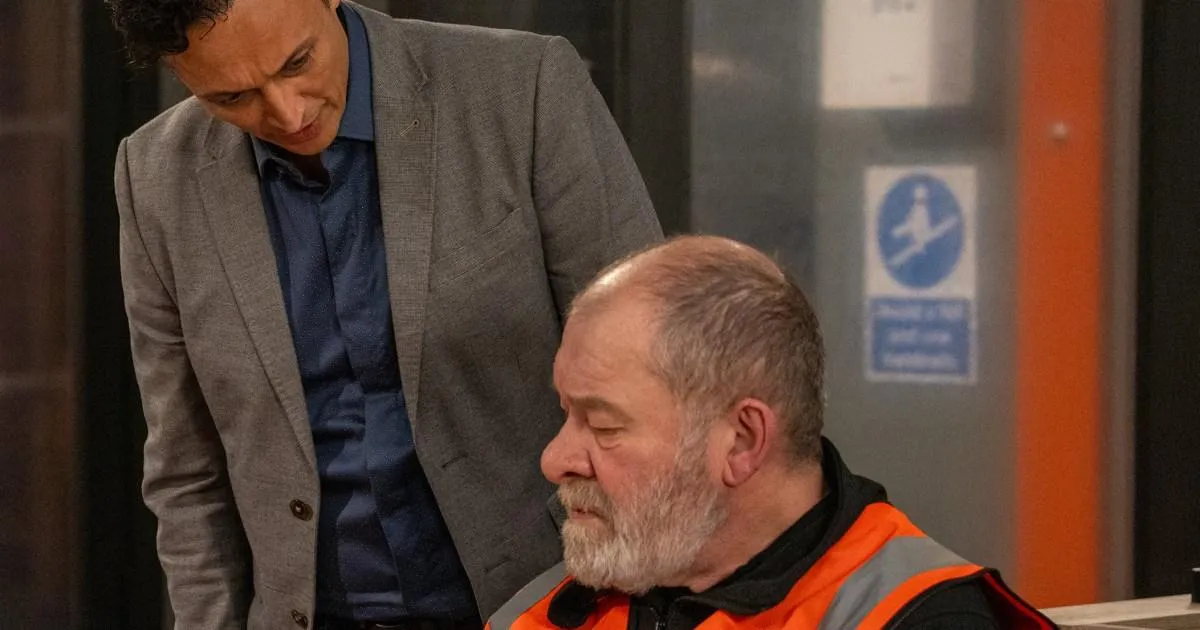
They both manage to secure themselves jobs at the depot, meaning both now have to deal with Jai Sharma (Chris Bisson) as a boss. Jai introduces a ‘Productivity Chart’ to keep an eye on his workers and it does the job of spurring them on. As it becomes a competition, Bear easily wins.
Having spent some time as a slave, he knows how to work hard.
Bear faced a tense ordeal in court (Picture: ITV)
Jai triggers Bear (Picture: ITV)
Just as Bear is getting settled, Jai has some strong words for him and Bear’s anxiety shoots through the roof at being disciplined – the exchange triggers a traumatic flashback for Bear and places him right back on that farm.
As the trauma swirls inside him, he snaps at both Mandy and Kerry (Laura Norton). Jai responds in kind, raising his voice, causing a broken Bear to flinch as if at the hands of Ray (Joe Absolom).
Advertisement
Bear is in a bad way and Mandy and Kerry explain to Jai he needs to back off and show Bear some compassion.
Don’t miss a Soaps scoop! Add us as a Preferred Source
As a loyal Metro Soaps reader, we want to make sure you never miss our articles when searching for stories. We have all the latest soaps news, spoilers, videos, and interviews, with a vibrant community of highly engaged readers.
Click the button below and tick Metro.co.uk to ensure you see stories from us first in Google Search.
Are you guilty of T-bagging? (Picture: Getty Images)
The platform flashes on the screen at Euston station, but you’ve no need to join the stampede to get on the train: you’ve reserved your seat.
But when you make it to your coach, someone is already sitting in the very spot you should be enjoying. Then, they refuse to move.
This unbecoming behaviour isn’t new, but now Metro has given it a name: ‘T-bagging’.
Get your mind out the gutter – it’s an abbreviated term for ‘ticket baggers’ – who are rife on cross country trains, and opt to sit in a reserved seat, sometimes even despite other seating options being available to them.
Advertisement
And we aren’t the only ones who have a problem with them either.
One train traveller, Lydia Wilson, took to TikTok to share her frustration with these inconsiderate passengers, in a video that hit nearly 400,000 views.
Best of Metro Deals
Get exclusive discounts with Metro Deals – save on getaways and spa days. Powered by Wowcher
Bannatyne Spa: Spa day for two with treatments, lunch & prosecco — save up to 57% off.
‘Just a public service announcement, if you’re sat in MY seat that I reserved on a train, I will ask you to move,’ she says. ‘Don’t look annoyed because funnily enough, you can also reserve a seat for free, or sit in an available one. I will not apologise if you are rude.’
Advertisement
Lydia adds: ‘As someone who gets the train regularly across the country, it is literally free (to reserve a seat), so move when I ask politely and don’t huff and puff – it literally says reserved and you chose to ignore that.’
Samuel Ryan, 30, who travels by train frequently from London to Manchester, thinks people who sit in someone’s reserved seat and refuse to move are completely ‘entitled’.
‘If they care so much about having a seat, maybe they should book it for themselves and stop playing the victim,’ he tells Metro.
‘It wouldn’t bother me if seats could or couldn’t be reserved in the first place, but as long as the system to book seats is in place, people should respect that.
Advertisement
Do you avoid sitting in a reserved seat on a train?
Yes, someone booked it, I’ll sit in an unreserved seat or stand
No, reservations don’t matter – people sit anywhere anyway
Sign up to The Getaway Expert, your exclusive seven-day guide to travelling with confidence from Metro’s travel editor, Alice Murphy.
Advertisement
‘When it’s incredibly busy, I would give my reserved seat up if someone truly needed it – if they’re elderly, pregnant or disabled.
‘Other than that, being prepared costs nothing.’
For 37-year-old Emily Pomroy-Smith, who lives with chronic pain and invisible disabilities, seat reservations are vital.
Advertisement
‘When I travel from Wiltshire to London the services can be incredibly busy, and I don’t just want a seat, I need one,’ the business owner tells Metro.
‘It would be incredibly stressful if someone refused to move, especially as I don’t want to have to publicly disclose my medical history in order to get a seat. That would be humiliating.’
In fact, Emily finds this behaviour ‘disrespectful and in some cases, harmful’.
‘I genuinely don’t see why someone should pay the same or sometimes considerably more if they’ve bought an advance ticket, just to have to stand,’ she adds. ‘Your poor planning should not be my problem, but on the other hand people should be able to get a seat if they need one regardless of advance reservations.’
Advertisement
Many others have posted similar videos on TikTok, branding t-bagging their ‘number one pet peeve’. But not everyone takes issue with this, implying train travel is first come, first serve.
‘Not gonna lie I judge real hard if someone asks me to move seats. there are clearly enough seats on the train, just find another one it’s not hard. really don’t get it,’ said @bigforeheadahh1.
‘If the seat behind is available what is the problem? I cannot believe people are that petty re a specific seat on a train, unless you need a table to work. Should stop all this specific seat nonsense,’ @sabci wrote.
‘Unless you get police here to move me, I’m not moving,’ said another. One TikToker even suggested seating should follow the ‘same rules as a bus’ – essentially making it a free-for-all, even for long journeys.
Advertisement
How can train travellers deal with ‘T-baggers’?
When it comes to how you should be handling the situation, multiple train providers suggested seeking out a member of staff who can ask that individual to move.
A spokesperson for Great Western Rail told Metro: ‘We recommend any customer who encounters the situation described to contact a member of staff who would then be able to speak to the other customer and ask them to move.’
But, they added they can’t forcibly remove a passenger, as this is something only the police can do. So, there could be a situation where you are sadly made to stand.
If you’re travelling with LNER, you could be entitled to compensation if someone takes your reserved seat. Under its Seat Guarantee Scheme, you can claim money back if a member of staff can’t find you an alternative place to sit.
Advertisement
If you’ve got a one-way ticket, you’ll get a 100% refund, while a return ticket means you’ll get a 50% refund for that half of the journey. Those travelling first class will also get compensation if the alternative seat they’re given is in standard class – you’ll be refunded the difference between the fare you paid and the standard pricing.
Of course, certain trains, like Greater Anglia, don’t have reserved seating at all, and haven’t for years, which renders the debate null and void on its trains.
Some passengers have chosen to take matters into their own hands, though, with some pretty bold solutions when someone pinches their chair.
‘I just go and sit in the 1st class carriage when this happens,’ wrote @stripycurtain. ‘If they won’t move the person in my seat, they ain’t moving me.’
Advertisement
One mother who fell victim to this had a brilliant response. ‘Booked a table seat for me and my kids when they were younger, specifically so we were near the toilet. We got on the train and there were people sat there so I sat my kids on their table,’ TikToker Maria John explained. ‘Never seen people move so fast.’
Another said: ‘I’ve had this before and put my bag on their table/on top of theirs and stand as close to them as physically possible and they get so uncomfortable they just give me my seat.’
This article was originally published in September 2025.
“Now I’m settled in Scotland, I don’t feel I have to run and hide from anyone. I live here openly and have no fears of attempts on my life.”
04:30, 06 May 2026
Advertisement
Johnny Adair was the former leader of the Ulster Defence Association’s (UDA) notorious C company who fled for his life to Ayrshire. The Record have taken a look at his life and ties to Scotland.
The 62-year-old, infamously dubbed ‘Mad Dog’, was the ruthless leader of the Ulster Defence Association’s notorious C Company before a savage loyalist feud forced him to flee for his life. Alongside his family and closest allies from Belfast’s Shankill Road, Adair eventually washed up in Troon, Ayrshire.
The youngest of seven, Adair clawed his way to the top of the UDA in the early 1990s. In 1993, he narrowly escaped death in an IRA assassination attempt that left nine people dead in a fish and chip shop.
Two years later, in September 1995, Adair was jailed for 16 years at the Maze Prison for directing terrorism. While on home leave in April 1999, he was grazed by a bullet to the head while attending a UB40 concert with his wife Gina in Belfast.
Released under the Good Friday Agreement later that year, Adair’s return to freedom sparked fresh bloodshed, becoming embroiled in a bloody feud with former comrades and other loyalist factions. This would result in Adair being expelled from the UDA in September 2002.
After being jailed again in January 2003, his loyalist network was blamed for the murders of UDA divisional leader John Gregg and member Robert Carson, who were gunned down after returning from a Rangers match in Glasgow. Fearing revenge, Adair’s family fled to Scotland and later Bolton.
When Adair walked free again in 2005, he joined them down south but after attacking his wife Gina following a night in the pub, he relocated to Troon just 10 months later.
In his autobiography Mad Dog, he claimed: “Now I’m settled in Scotland, I don’t feel I have to run and hide from anyone. I live here openly and have no fears of attempts on my life.”
In 2013, a plot to assassinate Adair and his right-hand man Sam McCrory was foiled by police. Three men were later jailed for the conspiracy to blast McCrory in the head with a sawn-off shotgun in a lane near his Ayr home – and then assassinate Adair.
Adair would continue to live on Ayrshire’s coast and would be a pall bearer at McCrory’s funeral in August 2022 in Ayr, who had lived in the town for around 25 years.
Advertisement
Adair’s son, Jonathan Adair Jr, died aged just 32, in September 2016, one day after being released from prison. Known as “Mad Pup”, he died from an accidental overdose of “heroin intoxication”.
Advertisement
A devastated Adair later said: “I want people to realise that this is what this drug does to you. My son was a fit, good looking, healthy big boy who went to the gym, but that horrible drug got its grip and that’s what it did to him. He no longer had any control over it and sadly that was the end of my son.
“So I am not ashamed to say what killed him. Why should I hide away the drug that killed my son, because me saying lets people know, if it kills Johnny Adair’s son it can kill me. If I was hiding that I would be a cheat, if one person listens to me it’s worth it.”
Get more Daily Record exclusives by signing up for free to Google’s preferred sources. Click HERE























































You must be logged in to post a comment Login