In his speech, which was light on new policy announcements, Farage said the country needed a government “that actually delivers on its promises” and “we’re the only people capable of doing it”.
He argued the Tories “had 14 years in power and failed absolutely miserably”, while Labour’s new Prime Minister Andy Burnham “says he needs 10 years”, a reference to the PM’s promise to set out a 10-year plan for the country later this year.
If Reform wins the next general election, Farage pledged to sack ministers who fail to deliver on their promises in their first 100 days in the job “and replace them with somebody else with the courage to do it”.
Setting out his plans to call a “national emergency” if Reform wins power, Farage said: “Parliament will sit, if necessary, for 24 hours a day, for six days a week until we pass the necessary legislation.”
Advertisement
He said he expected the House of Lords to “honour” Reform’s policy pledges but if they refused to do so threatened to appoint hundreds of new peers so the party had a majority in the upper chamber.
“And if that proves difficult, we will hold a referendum on the current composition of the House of Lords, and they would be swept away by a British public appalled by them,” he added.
Identifying the judiciary as another possible “obstacle”, Farage promised to remove the ability of judges to rely on conventions like the European Convention of Human Rights (ECHR),which critics blame for hindering some deportations.
“We don’t want the courts striking down, do we, the will of the people,” he said.
Advertisement
“Parliament makes the law, judges interpret the law. We will do whatever it takes, and perhaps have to consider how judicial appointments work in the future.”
Meanwhile, he said civil servants who “try to obstruct us” would be removed from their posts and replaced by people from the world of business.
“I’m tired of being told what can’t be done,” the Reform leader added.
“That is not what the public want. The public want action, the public want genuine change, the public do not want any more of the same. And our attitude is can do, and will do.”
Advertisement
Predicting that Burnham would call an early general election in spring 2027, Farage attempted to use his speech to convince the public Reform was ready to govern.
Stressing he now had a team of spokespeople with “frontline experience”, he said the party was planning to broaden its expertise.
“There are more big jobs to fill, and I’m looking and working on defence, health, and the other areas,” he added.
The deal sets out how a Reform government would intercept boats in the English Channel and return them to France using the Navy, with France “ordinarily” accepting those on board.
It was signed by the National Rally President Jordan Bardella, whose party is currently leading in opinion polls ahead of French presidential elections in April next year, after he gave a speech to the main conference hall.
Farage took to the stage after a long delay, which he told delegates was due to a “security alert”.
He took the opportunity to walk through the crowd and greet delegates during the delay.
Advertisement
His speech was also interrupted several times by protesters, including two women who held up a banner reading “Reform works for billionaires”.
They were booed by audience members who shouted “out”, as they were removed by security.
Farage laughed off the disruption, chanting “boring, boring, boring”.
Reform is no longer consistently topping national opinion polls, after more than a year of enjoying a comfortable lead.
Advertisement
Meanwhile, Labour’s ratings have risen since Burnham entered Downing Street, and Reform has lost some support to Restore Britain, the new right-wing party founded by former Reform MP Rupert Lowe.
Crikey, but the news is a trial these days, what with climate armageddon, wars, world leaders who are either crazy, or ill, or both, politicians on the take and many, many more dark and foreboding stories. Which is why it’s a bit of a relief that Taskmaster (Channel 4, Thurs, 9pm) has returned in all its ludicrous, clever, hilarious glory.
The early readings were encouraging, as an own-goal from Julia Zigiotti and a clever flick from Danielle van de Donk sent United home empty-handed, save for Simi Awujo’s last-gasp consolation.
Make no mistake, though. This was a match between two much-changed sides, both very much works in progress.
Is Alexia Putellas all she’s cracked up to be?
For London City, this has been the summer of Alexia Putellas. When she signed in July, the club became less Michele Kang’s, more hers.
Advertisement
One would not expect a player as decorated as the veteran Spaniard to allow such a billing to get the better of her, but this move to Bromley is arguably biggest challenge of her career. At Barcelona, she was effectively a one-club woman. This is a step into the unknown, new surroundings for the first time since 2012.
And in the far-from-imposing surrounds of Hayes Lane, watched by what the club claimed was a sell-out crowd largely drawn to watch her, Putellas was subdued.
Tentative start: Alexia Putellas was not at her brilliant best on her WSL debut
Getty
Advertisement
Starting in the No10, the Lionesses’ hesitance to play through the middle of the park limited her involvement. She managed 34 touches of the ball in the first half, but made few memorable contributions. It was far from a statement start.
Speaking pre-match, Eder Maestre had discussed her importance as a link between midfield and front line, a conduit from possession to chances.
It leaves Maestre with an urgent item right at the top of his to-do list, highlighted in bold.
Eva Olid tenure learns scale of task at hand
Advertisement
Eva Olid’s tenure as Man United manager is still in its nascency – Marc Skinner’s departure and her appointment came within five weeks of the season opener.
The early days, namely a winless pre-season campaign, were unconvincing. The transfer dealings, even more so. The dark clouds continued to hang low over day one of the season.
Olid’s first press conference was bullish. She promised to ‘make the impossible possible’, as she did at Hearts, but could not put a timeframe on delivering that promise.
Work to do: Eva Olid
Getty
Advertisement
Plainly, Friday came too soon. United were on the back foot for much of the opening exchanges as they struggled to contend with their hosts’ lively press.
Come half-time, they had not managed a shot and trailed thanks to the Zigiotti own-goal, the product of hopeless defending under pressure from Alanna Kennedy.
There was slight improvement in the second half, most notably at the introduction of the lively winger Monica Jusu Bah, but the issues were endemic. Their first attempt of the evening did not come till the 79th minute, and the chance was created by a wild swing-and-a-miss from Ella Toone.
Things will get no easier, with Chelsea and Arsenal the next two clubs on the fixture list. From day one, Olid has a point to prove. She can at least take comfort in Awujo’s equaliser with the last kick of the game.
Advertisement
Maestre facing same old problem as Kang watches on
Eder Maestre, the London City head coach plucked from Real Sociedad, formerly in the backroom at UD Tenerife, is far from the biggest man at London City, but he does have plenty of influence.
Speaking pre-match, Maestre deployed the usual grand promises of a manager in need of a statement. He called for high-possession, fast-paced football replete with plenty of chances.
With the club’s billionaire patron Michele Kang watching on from the director’s box, this was not the time to slip up.
Advertisement
All eyes were on Michele Kang ahead of kick-off
PA
There were big calls in Maestre’s selection. Mary Earps, said to have picked up an injury during an error-strewn pre-season, was left on the bench. In the starting lineup, three debutants.
The bottom line today is the Lionesses came out on top. But there seemed a hangover from last season. The very problems Maestre set out to solve continued to frustrate – high possession, plenty of chances, only one scrappy goal to show for it.
He will take comfort, though, in the knowledge that he has laid strong foundations. His high press effectively disarmed a talented United side, and his defence showed no signs of bowing through spells of high pressure, save for that unfortunate late lapse in concentration.
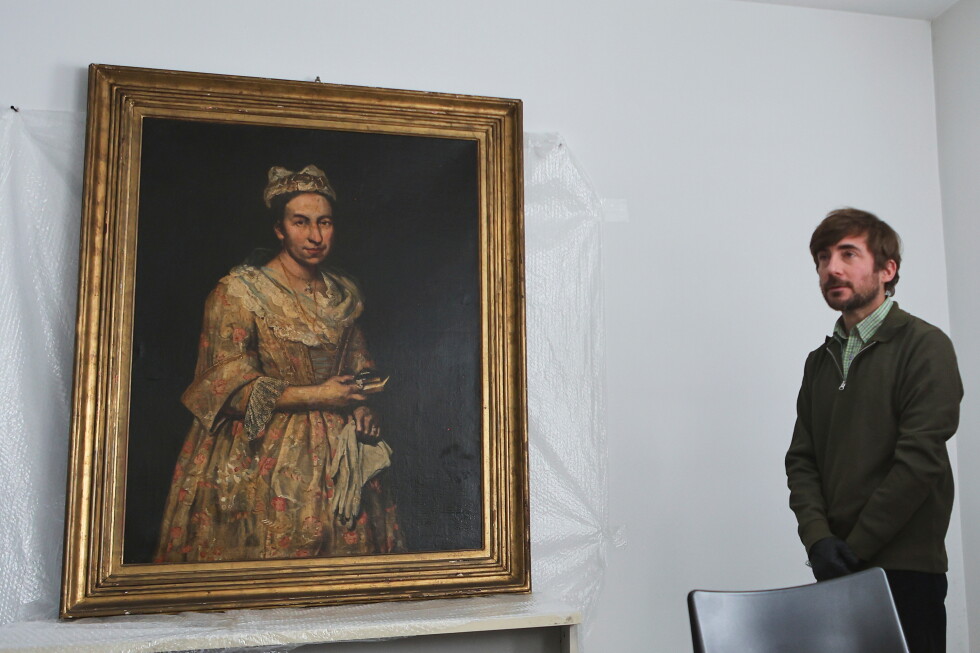
BUENOS AIRES, Argentina (AP) — A long-lost Italian portrait looted from a prominent Jewish art dealer during World War II was set to be returned to his heir after an Argentine court on Friday approved a deal under which the daughter of a fugitive Nazi official agreed to give up her claim rather than face trial.
The agreement paves the way for the long-sought return of “ Portrait of a Lady ” to Marei von Saher, the sole surviving heir of Dutch-Jewish art dealer Jacques Goudstikker, whose celebrated collection was sold under duress to Nazi officials after Adolf Hitler’s Germany invaded the Netherlands in 1940.
Patricia Kadgien, the daughter of the late high-ranking Nazi official Friedrich Kadgien, and her husband, Juan Carlos Cortegoso, were charged with aggravated cover-up last year after authorities said they hid the 18th-century painting despite knowing it was being sought by Argentine and international investigators.
Under the agreement, a copy of which was obtained by The Associated Press, the couple agreed to give up any claim to the work and consent to its return to von Saher in exchange for avoiding a criminal trial and spending two years under court supervision. During that time, they must make payments to a hospital in Argentina’s coastal city of Mar del Plata, where they live, and keep authorities informed of their whereabouts.
Advertisement
The deal ends a generations-long search for the missing portrait and a yearlong legal saga that began in August 2025. Dutch reporters investigating Friedrich Kadgien, a fugitive Nazi financial official who fled to Argentina after World War II, spotted “Portrait of a Lady” hanging above a green velvet couch in an online real estate listing for his daughter’s rustic home in Mar del Plata.
The listing disappeared within hours of the Rotterdam-based newspaper Algemeen Dagblad publishing its findings. Police raided the home several times but failed to find the painting. More than a week later, Kadgien’s lawyer turned it over to authorities.
For decades, the portrait had been identified as a work by the Italian Baroque painter Giuseppe Vittore Ghislandi. It appeared under that attribution in Goudstikker’s collection records and was exhibited as a Ghislandi in Amsterdam before the war. But a court-ordered examination by Argentina’s National Academy of Fine Arts reached a different conclusion, attributing the work to the Italian artist Giacomo Antonio Melchiorre Ceruti.
Experts authenticated the painting as part of Goudstikker’s collection and estimated its value at about 250,000 euros ($290,000).
Advertisement
Sign up for Morning Wire:
Our flagship newsletter breaks down the biggest headlines of the day.
Advertisement
Goudstikker was one of Europe’s leading art dealers before World War II, known for a collection that included works by Rembrandt and Vermeer. He died in a shipwreck while fleeing Amsterdam with his family as German forces swept into the Netherlands in May 1940.
An estimated 1,100 works from his collection were illegally sold to Hermann Göring, known as Hitler’s right-hand man, who amassed a vast art collection during the war. It remains unclear exactly how “Portrait of a Lady” came into the possession of Kadgien, Göring’s financial adviser, who handled foreign currency, precious metals and the sale of confiscated property for the Nazi regime.
Advertisement
Kadgien fled Europe after Germany’s defeat, first for Switzerland and later Argentina. He died in the South American country in 1978 without having been arrested or charged with war crimes.
Lawyers for von Saher, who now lives in Greenwich, Connecticut, and spent decades trying to recover her family’s looted art, said she has agreed to let the painting be exhibited in Argentina before being returned to her.
During last year’s raids on homes owned by Kadgien and her sister in Mar del Plata, Argentine police also seized two 19th-century paintings, along with other prints and engravings. Authorities are still investigating whether any of them may also have been looted during World War II.
___
Advertisement
Associated Press writer Isabel DeBre in Buenos Aires, Argentina, contributed to this report.
24 Hours in Police Custody fans have been left furious by Channel 4’s scheduling of the true crime series, with many taking to social media to demand the broadcaster never split episodes again
Devotees of 24 Hours in Police Custody have expressed their annoyance at Channel 4 following the broadcaster’s latest announcement regarding the popular true crime programme.
Advertisement
Loyal viewers have endured a wait spanning several months for fresh episodes to broadcast, being served numerous repeats instead. Nevertheless, last weekend, audiences were at last given new material with a two-episode special.
The opening instalment of 24 Hours in Police Custody: The Ambush was shown on Sunday, 30 August, documenting the investigation into a 17-year-old lad left in a coma following a severe attack. Officers were depicted piecing together the circumstances that preceded his catastrophic injuries, relying substantially on CCTV footage to assist them in constructing their case.
The concluding instalment, still to be broadcast, will pick up from where the opening episode finished. Yet, numerous viewers were left baffled about when they’d be able to watch the second part of the special, with many presuming it would be screened the following night.
Due to the extent of bewilderment among audiences, Channel 4 has subsequently released a playful scheduling update, clarifying that the concluding half would be transmitted on Sunday, September 6 at 9pm on Channel 4 alongside screenshots of puzzled fan messages, reports Glasgow Live.
The post read: “POV you’re the Social Media Manager reading the comments on the new 24 Hours in Police Custody.” However, rather than being satisfied, numerous fans seized upon the update to voice their frustration at the week-long gap – and to insist Channel 4 reconsider its strategy going forward.
One viewer fumed: “Please listen to the feedback and NEVER again make us wait a week for part two!”
“Why make us wait a week?” questioned another devotee of the programme. They continued: “Deeply unfair and frustrating. You can only tease us so far, social media manager take note.”
Advertisement
Meanwhile, a third enthusiast, posting on X, observed: “I absolutely LOVE #24HoursInPoliceCustody, but the programming really does test my patience. We get about 3 new cases every 117 years while #Channel4 get u excited putting out episodes, only to find they are repeats.
“Then they FINALLY give us a new one that’s apparently an absolute belter and part 2 isn’t tomorrow. IT’S NEXT SUNDAY? ! A WHOLE WEEK? ! It’s called 24 Hours in Police Custody, not 168 Hours Waiting for Part Two.”
The long-running documentary programme has built up a dedicated fanbase since its debut in 2014, offering a raw look at law enforcement throughout the UK and the work officers undertake to achieve criminal prosecutions.
24 Hours in Police Custody: The Ambush returns to Channel 4 on Sunday, September 6 at 9pm.
Although Clancy does not deny killing her three children, she pleaded not guilty to three counts of first-degree murder
The trial of Lindsay Clancy, a mother accused of strangling her three children before throwing herself from a second-floor window, has been declared a mistrial after jurors were unable to reach a unanimous verdict.
Advertisement
Thirty-six-year-old Clancy was charged over the deaths of her children, Cora, aged five, Dawson, three, and eight-month-old Callan, who were found dead at the family’s home in Duxbury, Massachusetts, in January 2023.
The former labour and delivery nurse, who was paralysed after her fall and appeared in court in a wheelchair throughout the trial, allegedly sent her husband, Patrick Clancy, on a series of errands before the children were killed. He later returned home to discover their bodies in the basement, The Mirror reports.
Jurors deliberated for more than 38 hours but repeatedly told the court they could not agree on a verdict. After a third deadlock warning, the judge formally declared a mistrial.
“At this point, I’m going to declare that the jury is deadlocked, and I’m going to declare a mistrial,” Judge William Sullivan told the jury, before discharging them.
Advertisement
The sticking point of the trial focused on the mother’s mental state at the time of the killings. Clancy’s defence team argued that the former nurse was suffering from postpartum psychosis, making her not criminally responsible for her children’s deaths. Prosecutors dispute this point, alleging that she had deliberately killed the three youngsters.
Although Clancy does not deny killing her three children, she pleaded not guilty to three counts of first-degree murder. The indecisive jury heard evidence from more than 80 witnesses during the trial, observing roughly 300 exhibits. Clancy’s attorneys, while defending her, had never rejected her role in the killings, instead putting forth a defence of insanity; they argued that Clancy had hallucinations and delusions after giving birth to her youngest child.
Treatment for mental health issues, and Clancy’s decision to check herself into a psychiatric hospital just days before the deaths, were highlighted by the defence.
Advertisement
Countering this, prosecutors contended Clancy made a calculated decision to kill her children intentionally, alleging that she sent her husband out on errands so that he would not be home and she could carry out the killings.
Patrick, who has since remarried, told the court about Lindsay’s declining mental health following the birth of their youngest son, with the “big spiral” starting around a month before the killings.
“She started to lose a lot of weight, and she became very depressed, and she was having a really hard time,” he said. It was also revealed that Clancy had previously sought help from doctors and had been taking various medications.
Patrick added that he could recall her admitting to having suicidal thoughts. The jury had previously told Judge William Sullivan it was struggling to reach a unanimous decision before returning without a verdict for a third time.
Advertisement
Judge Sullivan said: “I’m going to declare a mistrial at this point,” before Clancy’s defence asked for the declaration to be temporarily stayed while it sought emergency relief from a higher court.
Ensure our latest stories always appear at the top of your Google Search by making us a Preferred Source. Click here to activate or add us as your Preferred Source in your Google search settings.
Just over a decade ago, at the height of Russia’s bombing campagn in Syria in 2015, an old friend who had spent much of his career teaching in the Middle East sent me two photographs of the city of Homs, which had taken a particularly heavy bombardment at the hands of Vladimir Putin’s warplanes.
One of the pictures, which had been taken some years previously, was of a cafe on the centre of this city of 1.3 million. It was packed with smiling, well-dressed young men and women and hinted at a vibrant cafe culture in Syria’s third-largest city. The other was an aerial photograph downloaded from contemporaneous news reports which my friend confirmed was the street on which that cafe had sat. It was now nothing but rubble.
This week our Insights team has published this moving account by three peace and conflict researchers who have travelled through some of Syria’s shattered cities, to observe at first hand how people have been trying to rebuild their lives since the fall of the Assad regime in December 2024. They spoke with many people returning to these cities having fled the violence. They observed food stalls, cafes, repair shops and other small and medium enterprises that had sprung up amid the rubble as people began to rebuild their lives, homes and livelihoods.
The researchers, from the UK’s Durham University and the Bonn International Centre for Conflict Studies, attended the wedding of a friend and recount hearing the joyous zalghouta – the traditional high-pitched ululation so characteristic of celebrations across the Arab world.
Advertisement
As they write here: “hope and hardship coexist. So do recovery and destruction”. Or as someone told them when they visited Damascus: “We sit on the ashes, and everything remains extremely fragile.”
Something else that remains extremely fragile is the ceasefire in Iran – if indeed it still exists in any meaningful sense. Both sides have carried out strikes this week. The US has hit what it referred to as military targets, including rocket-propelled mine launchers in the Strait of Hormuz (although it also reportedly hit a wedding party, killing several civilians and wounding many others). Iran struck at US military assets in the Gulf.
Tehran is now threatening to launch cyberattacks against energy and water facilities in the US.
Advertisement
Donald Trump, has said he has no plans to talk with Iran, claiming that the US has almost total control of the Strait of Hormuz and that the Iranian economy is close to collapse. He reiterated his call from the beginning of the conflict for the Iranian people to rise against the Islamic Republic.
While there’s no sense that the regime is in any real jeopardy at present, the war has prompted some important power shifts in Iran. Andreas Krieg, a Middle East specialist at King’s College London, explains who’s who in the struggle to control Iran and what that might mean for the future of negotiations with the US.
One of the policy approaches taken by Keir Starmer as prime minister which his successor Andy Burnham is clearly keen to continue is the UK’s stance as a key ally of Ukraine. Burnham’s first, and so far only, overseas visit since moving into Downing Street has been to Ukraine, where he told President Volodymyr Zelensky that “Britain is 100% behind you”.
Advertisement
Predictably, this drew a harsh response from the Kremlin, several of whose leading lights issued threats that the deeper the UK’s involvement in the war “the higher price it will pay”.
Historian Peter Whitewood of York St John University believes the messaging coming out of Putin’s proxies recently echo a familiar theme. Russia has repeatedly accused the UK of being something of a ringleader in ganging up on Russia.
Whitewood points to a series of episodes in the 1920s, when Britain threw its weight behind Poland in its struggle to remain independent from the Soviets. Then, the Kremlin’s line was – as it is now – that Britain was “always striving to push others instead of itself into military actions against us”. As one Soviet diplomat observed, the Kremlin was inclined to see “the malevolent hand of the British government everywhere”.
Given this was Stalin’s personal belief, there wasn’t much mileage in suggesting it was misguided and it wasn’t until the rise of Nazi Germany that Britain was knocked off its podium as the Soviet Union’s main bogeyman.
Thousands of people are still missing after the devastating floods that swept through Nepal last week, while the death toll from the disaster continues to mount. One settlement particularly hard hit was the village of Khalte, close to the Trishuli River in northern Nepal.
Khalte was located on flat, sandy and gravel-heavy soil right next to the river. Heaven Crawley, Author provided (no reuse)
This village of around 5,750 people included 257 families who had been displaced in the disaster of 2015, when Nepal was rocked by a 7.8-magnitude earthquake. Heaven Crawley, a researcher from Coventry University, spent time working with families there in September 2019 as part of a research project looking at how renewable energy could improve people’s lives.
As she writes here, the local people were well aware of how precarious their village was as it was critically vulnerable to flooding from the Trishuli, which repeatedly flowed into Khalte, particularly during monsoon season. The urgency of finding somewhere safer was further brought home in 2025, when a glacial lake outburst sent floodwaters flowing into Nepal from Tibet.
Advertisement
Now Khalte no longer exists. It was completely swept away in the flooding of August 26. Scores of people are missing. Crawley believes that this terrible tragedy must be taken seriously as a lesson about the urgency of heeding these climate warnings.
Shadow fleets are the outlaws of the ocean. They are used by countries such as Russia, Iran and North Korea to evade sanctions and are among the reasons why some of the world’s conflicts seem so intractable.
In the latest episode of The Conversation Weekly, Justin Hastings, a professor of international relations at the University of Sydney, describes the tactics that North Korea uses to disguise the identities of its shadow ships – and why it has got away with it for so long.
Advertisement
There’s a superb multimedia piece to go with it, with vivid graphics illustrating the way in which shadow fleets go about hiding their identities.
Nicola Peltz makes her Venice Film Festival debut – but is an hour late because of her iconic diva co-star Faye Dunaway – ahead of being awarded her ‘rising star’ gong
Nicola Peltz Beckham made her film festival debut tonight – attending an event at the 83rd Venice Film Festival.
Introduced simply as ‘Nicola Beckham‘ the actress smiled and giggled with delight when making an entrance – an hour late – behind the renowned diva Faye Dunaway.
Sources indicate that the delay was because Ms Dunaway was not ready to appear.
Ms Dunaway stars in Peltz Beckham’s upcoming film, Prima, about a ballerina, and both women are to be given a Kineo award tomorrow.
Advertisement
Nicola will be named a ‘Rising Star’ and Dunaway is to accept a lifetime achievement award.
The actress, wearing white trousers and a camisole, said: ‘Thank you so much for having me here, this is such an honour. I’m so happy to be sitting here next to the one and only Faye Dunaway, the icon!’
Ms Dunaway, who was walking with the aid of a cane, responded: ‘I am very happy to be here with this lady who I can see is going to have a very big career.
Advertisement
Nicola Peltz Beckham made her film festival debut tonight – attending an event at the 83rd Venice Film Festival
Introduced simply as ‘Nicola Beckham’ the actress smiled and giggled with delight when making an entrance – an hour late – behind the renowned diva Faye Dunaway
‘I think she’s so talented and we are going to see so much of her.’
Moments later, the pair left the stage, at the Italian pavilion in the Excelsior hotel, followed by a small barking dog. It wasn’t clear if the dog belongs to either, or neither, of them.
Advertisement
Nicola started in acting in Deck The Halls with Danny DeVito, in 2006, and posted a throwback snap on her Instagram earlier this week.
She was also in The Last Airbender and Transformers: The Age Of Extinction.
More recently she has been writing and producing films through her label, Bunny Films, which is named after her late grandmother and bankrolled partly by her billionaire father, Nelson.
Her last movie was Lola, which did not gain wide distribution and took under $1,000 at the box office.
Advertisement
She has been married since April 2022 to Brooklyn Beckham, the son of David and Victoria, and is at the centre of a family feud which has seen her husband cut off his family in search of ‘peace’, having explained on Instagram in January that they had tried to split him up from his wife.
The Kineo Awards, celebrating their 25th anniversary, note that ‘in recent years, the American actress, screenwriter and producer has attracted growing international attention through increasingly multifaceted roles, both in front of and behind the camera’.
The actress, wearing white trousers and a camisole, said: ‘Thank you so much for having me here, this is such an honour’
Ms Dunaway stars in Peltz Beckham’s upcoming film, Prima, about a ballerina, and both women are to be given a Kineo award tomorrow
Advertisement
Nicola appeared in high spirits at the event
Nicola and Brooklyn were glued to one another’s side after jetting into the Italian city on Thursday evening
Nicola has been working on her indie drama Prima since January but the film does not yet have an official release date
Nicola is seen in Transformers: Age Of Extinction in 2014
Advertisement
The ceremony, set to take place at Venice’s Casa Cinema Giovani was conceived by Kinéo Cultural Association president Rosetta Sannelli and launched in 2002.
It takes place during the Venice Film Festival, which welcomes A-listers annually, but has no direct ties to the international gathering.
Nicola has been working on her indie drama Prima since January but the film does not yet have an official release date.
The movie also stars Dunaway, Jack Huston, Mira Sorvino and Betty Gabriel. Luca and Alessandro Morelli, known professionally as the Morelli Brothers, directed the film as their feature debut.
Advertisement
Nicola stars as Margo, a dedicated prima ballerina facing life-altering decisions as modern changes disrupt her ballet company.
The actress and her family attended a private Los Angeles screening in May for the movie, hosted by East West Bank CEO Dominic Ng. Afterwards she thanked supporters and said their backing of independent film meant ‘more than I can express’.
Nicola and Brooklyn were glued to one another’s side after jetting into the Italian city on Thursday evening.
The couple sipped on glasses of red wine and enjoyed a PDA, with Brooklyn nuzzling into Nicola’s neck during a romantic moment on their night out.
Advertisement
The actress wore low-slung jeans, a black vest top and designer sunglasses, while Brooklyn wore a crisp white T-shirt and khaki shorts.
A man captured images of the cars going up in flames
Two cars went up in flames in a Cambridgeshire town. Firefighters were called to a car fire in Onyx Court, Wisbech just before 3.30pm on Thursday (September 3).
Advertisement
Daniel Green captured pictures of the cars when they went up in flames. A fire spokesperson said: “At 3.29pm on Thursday a crew from Wisbech was called to a fire on Onyx Court in Wisbech.
“Firefighters arrived to find a fire involving two cars well alight. Wearing breathing apparatus they extinguished the fire using hose reels and returned to their station by 4.50pm.”
The cause of the fire was determined to be accidental.
Queen Camilla enjoyed a very special Gruffalo performance by the book’s author Julia Donaldson during a visit to Liverpool today.
Camilla, 79, couldn’t stop smiling as she joined school children and families in Speke Hall for an interactive storytelling session led by Julia and Gruffalo’s co-creator Axel Scheffler.
King Charles‘s wife looked radiant in a black-and-white printed dress that she paired with a cream trench coat as she wrapped up a busy week of engagements.
During today’s visit, she also met with local partners and organisations working with the National Literacy Trust to improve access to early years support in Liverpool.
Advertisement
Dame Julia, the author of The Gruffalo stories, said: ‘It was fun to meet the families and act out The Gruffalo with them, and I hope that they’ll feel encouraged to read more stories and perhaps even to act them out themselves.
‘It was also a good opportunity to get together with some of the people from the National Literacy Trust’s Liverpool hub and find out more about all that the charity is doing to promote books and reading during the Year of Reading and beyond.
Earlier in the day, the Queen congratulated a community which brought a library back ‘from the ashes’ after it was torched during riots.
On Friday, Camilla visited the Spellow Community Hub and Library in Walton, Liverpool, which was set alight when violent disorder broke out on County Road in the wake of the stabbings at a dance class in Southport, Merseyside, in summer 2024.
Advertisement
Camilla, 79, couldn’t stop smiling as she joined families in Speke Hall for an interactive storytelling session led by Julia and Gruffalo’s co-creator Axel Scheffler. She is seen here with Jonathan Douglas, the chief executive of the National Literary Trust
Queen Camilla, Patron of the National Literacy Trust (NLT), Axel Scheffler, Julia Donaldson posing with the Gruffalo and children in the woodlands as part of a visit to Speke Hall, Liverpool.
The Queen donated a box of books when the library was restocked before its reopening and brought more books with her when she visited.
Advertisement
After unveiling a plaque, she said: ‘You can never have too many books. I’ve brought some more and it’s so wonderful to see this place rise from the ashes.
‘Congratulations to all of you who made it happen,’ she continued. ‘It was such a terrible story, and it’s had a happy ending.’
Sean McEvoy, a library and information assistant who was joined by the Queen as he read a story to schoolchildren, said: ‘There are so many positives that came from what happened.
‘We’ve moved past the point where we talk about it and how it made us feel, and now we look at the community’s reaction and focus a lot more on the positives out of it.
Advertisement
‘It has been amazing since the library reopened. It’s been great to have the Queen visit today. It’s good for the community and good for the library and they deserve it.’
Mr McEvoy read Giraffes Can’t Dance by Giles Andreae to the children as Camilla sat next to him.
He said: ‘It’s not something I expected to do on a normal day in work! The children were fantastic.’
Julia Donaldson performinh for local schoolchildren in the woodlands of Speke Hall in Liverpool
Advertisement
The Queen (far right) watching Julia and Axel’s interactive storytelling session today
King Charles’s wife looked radiant in a black-and-white printed dress that she paired with a cream trench coat as she wrapped up a busy week of engagements
Before Camilla unveiled the plaque, children’s author Frank Cottrell-Boyce read a poem about the library.
He told the Queen he had done a workshop with children to come up with a new name for the facility ahead of its reopening, but they wanted it to remain as Spellow.
Advertisement
Speaking after the visit, he said: ‘What makes Spellow especially important is that, after the riots, people came together to restore something their community could not afford to lose. It’s a powerful story of resilience and hope.
‘The joy of sharing a book together is one of the greatest gifts we can give a child. Reading helps children dream bigger, build confidence and feel connected.
‘It was a privilege to share with Her Majesty The Queen how communities are working together to put books and stories at the heart of children’s lives.’
Mayor of the Liverpool City Region Steve Rotheram, who was among the dignitaries at the library, said: ‘Spellow Hub has gone from being a symbol of the devastation to a powerful example of what this community really stands for. I’m delighted to welcome Her Majesty to our region, and for her to see first-hand the remarkable journey this area has been on.’
Advertisement
Camilla helped pupils from St Francis De Sales Catholic Junior School and Arnot St Mary Primary School as they took part in colouring and wordsearch tasks in the library, before joining children who were having chess lessons.
She picked up a queen chess piece for a child who dropped it and heard the class had been learning about which directions a queen can move in.
She then spoke to first responders from the police and fire service about their involvement in dealing with the disorder and was shown pictures of the damage to the library after the blaze.
She also met Alex McCormick, who set up an online fundraiser with the aim of raising £500 to go towards repairing and restocking the library and raised £250,000.
Advertisement
Ms McCormick said: ‘It has been incredible to see Spellow Community Library and Hub thrive and grow, and prove what we’ve always known – that it’s a vital part of this community.
‘It has been a privilege to be a part of this wonderful journey.’
HARRISBURG, Pa. (AP) — The snowballing opposition to data centers in communities across the United States has transformed the midterm election landscape, thrown a wrench into the plans of the world’s richest companies and brought perhaps the industry’s biggest booster, President Donald Trump, to its defense.
It’s a dramatic shift from two years ago, when few people had even heard of a data center.
But the late 2022 debut of OpenAI’s ChatGPT ignited worldwide demand for chatbots and other generative AI products that typically require large amounts of computing power to train and operate. Now, Oracle, Meta, Google, Amazon and Microsoft expect to plunge more than $700 billion into data centers in the U.S. this year alone.
Here are some takeaways from the shifting politics of data centers.
Advertisement
Sprawling into rural America
Tech giants and developers need huge tracts of land to accommodate mammoth computing warehouses, so they’ve been exploring deeper into rural America.
The push has united conservative ranching and farming communities with left-leaning environmental advocacy groups, who share a combined concern about drought-stricken waterways, pollution in food-growing areas and shrinking farmland.
In New Mexico, where Oracle and OpenAI are building Project Jupiter, a $165 billion data center complex planned near the Mexican border, concerns over dwindling water supplies are mounting.
There, the Center for Biological Diversity, an environmental advocacy group, challenged the state’s approval of well drilling permits to supply millions of gallons of water to Project Jupiter. The center said the state approved a permit last year after ignoring public-notification procedures in state law.
Advertisement
Samantha Barncastle Salopek, a water rights lawyer who comes from a pecan-farming family, said farmers and ranchers are worried about their water rights in a state hammered by drought. She is running as a Republican for a seat on the Doña Ana County commission.
He said last week that if he were a mayor or a governor with a chance to land a big data center, “I would absolutely want it, because the jobs are enormous and the money paid, the taxes paid, are just enormous.”
Advertisement
Sign up for the Ground Game Newsletter:
Your guide to the biggest stories in politics, policy and U.S. elections.
Advertisement
Trump also acknowledged, however, that data centers need “a little public relations help.”
The Republican president is a leading champion for the industry, seeing it as critical to winning the artificial intelligence race against China.
In some states, governors have halted their state’s sales tax exemption for new data center projects. Other states are trying to force data centers to pay for their own electricity supply, limit their water use, disclose more about their operations and win community support before they get a state permit or tax exemption.
In Texas, Republican Gov. Greg Abbott ordered regulators to take steps to ensure Texans were not paying higher electricity bills because of data centers, and promised to push a legislative agenda next year to impose tougher regulations on data centers, including taking away the state’s billion-dollar-plus-per-year tax break.
New York Gov. Kathy Hochul, a Democrat, ordered a one-year ban on large data centers.
Advertisement
Worries that AI’s energy demands will scuttle climate goals
Michigan, Oregon and Minnesota have enacted laws in the last 18 months designed to protect their preexisting requirements that electric utilities use only emissions-free energy sources by 2040. Similar legislation is in play at the end of California’s legislative session this month.
In other states, including Georgia, Colorado and North Carolina, environmental advocates and corporations with clean energy goals are working regulatory levers to push monopoly utilities that historically control the energy supply and grid access.
Data centers still have a friend in labor unions
Members of building trades unions are employed on a huge number of massive data center projects, as union locals scramble to recruit new apprentices and expand training centers to feed the explosive demand.
Advertisement
National union leaders say their ranks are growing faster than they have ever seen. Meanwhile, tech giants are putting millions toward training programs.
Unions aren’t just working on the projects. They are also advocating for data centers in Congress, statehouses and communities. In packed town council meetings where a project is under consideration, union members often show up to answer complaints about data centers in ways that executives at tech giants and the development firms rarely do.































































You must be logged in to post a comment Login